Department of Economics and Marketing
Discussion Paper No.1
Concept Testing:
A Key to Successful
Product Development
Sally Ann Fraser
July 1994
Department of Economics and Marketing
PO Box 84
Lincoln University
CANTERBURY
Abstract
Contents
LIST OF TABLES (i)
LIST OF FIGURES (i)
1. INTRODUCTION 1
1.1 The New Product Process 1
1.2 Impact on Success 2
1.3 What's the Reality? 3
2. CONCEPT TESTING 4
2.1 Definition and Objectives 4
2.2 Research Procedures 5
2.3 Limitations of Concept Testing 9
3. TAIT ELECTRONICS - A CASE HISTORY 10
3.1 Background 10
3.2 Idea Generation/Screening 11
3.3 The Concept 11
3.4 Concept Testing Objectives 11
3.5 Research Method 11
3.6 Results and Implications 12
3.7 Success or Failure? 16
4. CONCLUSIONS 16
REFERENCES 17
APPENDIX 1 THE CONCEPT
List of Tables
1. % New Product Projects Undertaking Each Activity
in the New Product Process 3
2. Purchase Interest 12
3. Mean Price Responses 14
List of Figures
1. INTRODUCTION
New Zealand's economy is reportedly in a growth phase. The National Government has set a goal of 5% growth in GDP per annum (NZ National Party, 1993), in order to attain a sufficient standard of living for all New Zealanders. One of the keys to that growth, they say, is to continually "create new products and services for which the world will pay a premium."
Porter (Crocombe, Enright and Porter, 1991) tells us that while we have "been innovative in some areas (especially agricultural production), few New Zealand firms employ proprietary technology and even fewer have been innovative marketers. Innovation, in its widest sense, is at the heart of competitive advantage." However he does acknowledge that New Zealanders as a whole are an innovative people. Examples of NZ innovations include the Hamilton jet, Linc software, electric fencing, kiwifruit, and even bungy jumping. What we need to do, says Porter, is unleash this potential throughout the economy. Our ability to get better at the innovation process - to drive new products from idea to market faster and with fewer mistakes - will be a critical factor in achieving the required economic growth.
1.1
The New Product Process
New product development systems vary greatly from one company to another. Some may have quite formal and detailed procedures while others follow sketchy, intuitive, and largely informal systems.
Those companies that do follow more formalised procedures are probably using a derivative of the most widely accepted product development model. This particular model was created by Booz, Allen, and Hamilton in 1968 and modified in 1982 after a study of 700 companies in the United States (Booz, et al. 1982). The model consists of seven steps:
1.exploration (idea generation);
2.screening (elimination of obviously unsuitable ideas); 3.concept testing (exposure of the idea to potential customers); 4.business analysis (profit potential);
6.test marketing (sales to a limited part of the market to assess the product itself as well as the rest of the marketing mix); and
7.commercialisation (full scale distribution).
The BAH model appears in many marketing texts (Kotler (1984), Hisrich & Peters (1991), Crawford (1991), Urban & Hauser (1993), McColl-Kennedy et al. (1994), Stanton et al. (1991)).
1.2
Impact on Success
But does following the seven steps of the New Product Process (NPP) actually increase the chances of success for new products? The evidence suggests overwhelmingly that it does. Cooper and Kleinschmidt (1990), Booz, Allen, and Hamilton (1982), and de Brentani (1986), have all published studies on the correlates of success for new products. All but one of the studies identified that an organisation's use of the New Product Process is a key factor in determining success.
Cooper and Kleinschmidt (1993) investigated factors responsible for success from 103 new product projects in one industry (the chemical industry). The products included both `winners' and `losers' and came from countries all over the world. They concluded that six factors were critical to success:
1.a quality NPP is pivotal - one that builds in key activities by design and ensures they are executed in a proficient manner;
2.early project and product definition is vital;
3.a strong team leader with an accountable multidisciplinary team is a key factor; 4.irrespective of the source of the new product idea, it should be further refined with
customer input;
5.launch elements (customer service, technical support, sales force quality, and product availability) are important ingredients for success. (By contrast, advertising and promotion elements made little difference to success for these industrial products);
1.3 What's
the
Reality?
Firstly, success rates are not good. Booz, Allen, and Hamilton (1982) reported that of the 700 consumer and industrial firms studied, on average only one out of seven new product ideas generated succeeded. "Success" is defined as meeting the company's original profit objectives, and "new product" is defined as new to the company (as opposed to new to the market). Figures for Australia suggest only 40% of all new products launched, succeed (Schwartz, 1987).
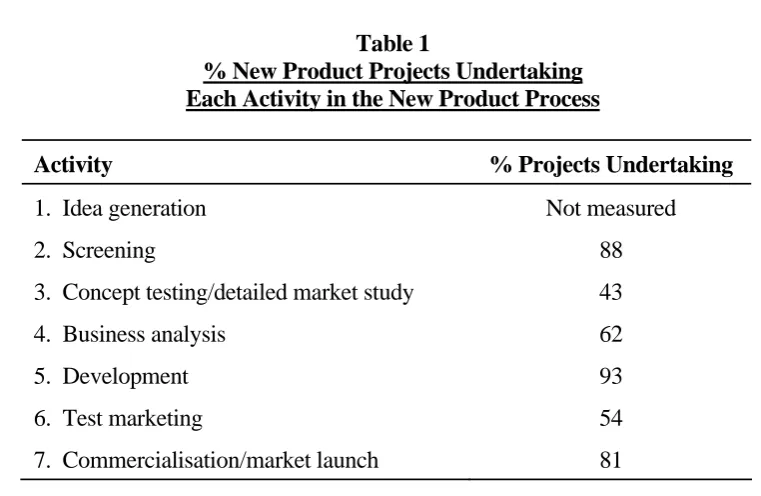
Secondly, managerial practice does not follow the prescribed theory. Cooper and Kleinschmidt (1993) found that the proportion of projects that included all of the NPP activities was alarmingly low (Table 1). Feldman and Page (1984) revealed similar findings in their study of the electronics industry in the United States.
Table 1
% New Product Projects Undertaking Each Activity in the New Product Process
Activity % Projects Undertaking
1. Idea generation Not measured
2. Screening 88
3. Concept testing/detailed market study 43
4. Business analysis 62
5. Development 93
6. Test marketing 54
7. Commercialisation/market launch 81
Source: Cooper & Kleinschmidt (1993)
2. CONCEPT
TESTING
Concept testing is arguably the most important step in the New Product Process. Given that idea generation, development, and commercialisation are virtually mandatory, this leaves four steps that firms can choose to either omit or include.
Concept testing offers the advantages of actually providing much of the information required for the screening step as well as the business analysis step. It also contributes to at least three of the six critical success factors outlined by Cooper and Kleinschmidt (1993). These are; a quality NPP, early product definition, and refinement of the idea using customer input.
In addition, in the Tait Electronics case outlined below, it also provided the following additional benefits:
1.early company-wide support (inter divisional arguments over `important' features, price, and specifications were noticeably reduced after results of the concept test were known);
2.a development focus (Engineering were able to focus on those features and specifications that were rated most highly);
3.a receptive market (the distribution network as well as certain market segments were `primed' before launch, that is, awareness was increased as a result of the concept test, enabling the introduction phase to be significantly shortened).
In terms of cost, concept testing is relatively inexpensive compared to the costs of development, tooling, inventory, and launch. Furthermore, compared to the costs of developing and launching a potential "failure" the cost of concept testing is again relatively small.
2.1 Definition
and
Objectives
language. The literature tends to categorise these various concept forms into two groups - "core idea" concepts and "positioning" concepts (Page & Rosenbaum, 1992).
The principal objectives of concept testing include:
1.identification of poor concepts so they can be dropped; 2.estimation of the size of the potential market;
3.identification of the various market segments and their characteristics; 4.identification of potential improvements to the concept;
5.identification of appropriate positioning strategies (with respect to price, promotion, and distribution);
6.identification of potential cannibalization of existing products.
The fourth objective, that of identifying improvements to the concept, is one of the most important. In fact many of the articles referenced refer to concept testing as "concept development", because the enhancement aspect is just as valuable as the evaluation aspect.
Both Kelley (1993) and de Bono (1993) refer to the iterative nature of concept/product development. Ideally concept tests would be conducted at every stage of the NPP. Not only would each improved concept get re-evaluated, but the concept would also be exposed to the dynamics of the market as it evolves over time. This is particularly relevant for development cycles that span years rather than months. The reality of time and cost constraints however, often overrides this ideal.
2.2 Research
Procedures
The most widely published techniques for concept testing are outlined below.
The
Concept
on whether the core idea only is being tested or the core idea together with its positioning strategy. If the positioning strategy is included, the concept will be presented complete with advertising, packaging, branding, etc.
For some concept tests the concept is broken down into a list of attributes. For example, Page and Rosenbaum (1992) presented their Sunbeam steam iron with the following list:
1.press a button on top of iron for a fine mist of water for spot dampening tough wrinkles;
2.iron is extremely light-weight for ease of handling and comfort; 3.can use tap water;
4.iron holds 8 ounces of water for over 30 minutes of normal steam ironing.
Sample
selection
This often depends on who is actually involved in the purchase decision, and in some cases, particularly for industrial products, up to three levels of the distribution channel may be sampled. Some researchers select a judgement (non probability) sample and limit their concept tests to groups such as lead users (Tauber, 1975), or heavy users. However the most common type of sample appears to be a quota sample, where general guidelines make it more representative of the target group being studied, but because the sample is limited to a preset number of interviews due to cost restrictions, it is not a true probability sample.
Methodology
Personal interviews appear to be the most common way of surveying respondents (Crawford, 1991). However both mail and telephone surveys have been used (Crawford, 1991). Personal interviews are usually conducted individually but occasionally researchers use focus group situations.
Most concept tests involve evaluation of a single concept. However some tests provide a paired comparison with either a control concept, the respondent's currently preferred brand, or the market leader (Moore, 1982).
Questionnaire
The data gathered from a concept test typically fall into four categories (Dolan, 1993): 1.intended purchase measures
2.product diagnostics
3.attribute diagnostics
4.respondent profiling variables
Intended purchase measurement is usually based on the following five-point scale:
1.Definitely would buy
2.Probably would buy
3.Might or might not buy
4. Probably would not buy
5.Definitely would not buy
Other purchase measures used include volume and frequency. Occasionally a constant sum approach is used instead of the five-point scale. For this method, a number of points are distributed among a set of concepts to assess the relative attractiveness of each concept.
Product diagnostics obtain feedback on the concept's uniqueness, credibility, ability to solve the user's problem, and value for money.
The respondent profiling data help to identify the demographic and socioeconomic characteristics of the target market, as well as possible market segments. Data on attitudes and current purchasing habits also help to predict future behaviour.
Analysis
Depending on the objectives of the researcher, a number of different analytical techniques can be used. If the objective is to identify relevant market segments, a cluster analysis can be carried out to group respondents according to their desired product attributes. To assess the size of the potential market, cross tabulations can be done with the "definitely would buy" group against variables such as "frequency of purchase".
If the researcher wants to establish which attributes were the most important in the overall assessment of the concept, multiple regression analysis can be used. Lesser used techniques include multiple discriminant analysis to identify the characteristics of various market segments, and multidimensional scaling to identify optimum positioning strategies.
2.3
Limitations of Concept Testing
There are a number of limitations. Not all concept tests predict success accurately. There are even concepts that have been dropped due to test results that would, in hindsight, probably have been successes.
Difficulty in identifying what's being measured
There are a number of variables involved in a concept test: the product idea itself, the form of presentation, the positioning strategy and the execution of the entire concept (language, graphics, etc.). Some authors argue that a concept test should be limited to the product idea itself (Stanton, et al. 1991), while others argue that this is not realistic and the concept in its entirety should be tested (Page & Rosenbaum, 1992). Some say that two tests need to be conducted, firstly the idea and secondly the idea together with its positioning elements.
Concept
changes
There are often changes to the concept, and its positioning between the concept test and introduction. It is therefore difficult to know if the changes affected the final outcome for the product or not (Moore, 1982).
Environment
changes
There are also often changes in the marketplace (new competitors, preferences, etc.) as well as in the legal or regulatory environment. These changes may also cause the introduction results to differ from the test result (Moore, 1982).
Adoption
vs
trial
Trial rates cannot be translated into adoption rates because adoption depends on satisfaction with the actual product, and a concept test cannot measure this (Tauber, 1972).
Executional
difficulties are common
items) may incur problems if receiving a free sample is conditional upon giving a favourable response at the "intention to purchase" question (Lewis, 1984).
Highly
innovative
or sensory products
Products with a prime benefit that involves one of our senses (smell, touch, taste) are obviously very difficult to concept test (Crawford, 1991). In addition, products that are true innovations, involving technology that is difficult to visualise are also hard to test (e.g. Disc cameras, Xerox machines, Hair Mousse, ATMs) (Crawford, 1991).
3.TAIT ELECTRONICS - A CASE HISTORY
3.1 Background
Tait Electronics is a mobile ratio manufacturer. With an annual turnover of approximately NZ$80 million and a staff of around 500, it ranks in the top 150 companies in New Zealand. The company was formed in Christchurch in 1968 by Angus Tait, and now has six sales-based subsidiaries worldwide (USA, Australia, Germany, UK, Singapore, NZ).
In 1989 the company was largely reliant on its T500 mobile radio, whose sales had risen to account for around 60 per cent of the company's total unit sales. The product had been launched in 1985 and it was widely recognised that there was a limit to its competitive life.
However, the company's recent product development efforts had experienced a number of problems. A handheld mobile radio project was cancelled well after it had entered the Engineering development phase. An upmarket mobile radio had ended up with a far higher unit cost than planned for, and another mobile radio had been launched and almost immediately withdrawn because of technical difficulties.
3.2 Idea
Generation/Screening
The idea generation stage began in July 1989 with a brainstorming exercise in the factory building. Staff from every department were invited to attend one of the three sessions that were held. Overseas subsidiaries submitted their ideas in writing.
The Engineering department nominated one of their senior engineers to attend all of the sessions. This person later led the entire development project.
3.3 The
Concept
A final concept was originally decided upon in March 1990 (seven months later) and as the time taken indicates, the path was by no means smooth, or conclusive. After a number of alternative names were considered the concept was finally called the T2000. It was decided to test the concept in Tait Electronic's three largest markets - New Zealand, Australia, and the United Kingdom. It was also decided that due to the size of the project and the need for confidentiality, a professional marketing research firm should be employed. Colmar Brunton was the successful contender.
3.4
Concept Testing Objectives
The objectives for the concept research were to determine:
1.level of interest in buying the product;
2.positive and negative perceptions of the product; 3.features likely to be used;
4.pricing perceptions; and
5.behavioural information (channels used, frequency of use, etc.).
3.5 Research
Method
supplied through Tait Electronics dealers, who endeavoured to keep the sample representative of the mobile radio market by balancing industry representation as well as brand usage.
The concept was presented to respondents in printed form with photographs and diagrams (Appendix 1). The concept folder was also accompanied by a `mock-up' model. The model was a sophisticated one (more than one respondent attempted to turn it on). No positioning material was included. The concept was a `core idea' type only.
Due to the complexity of mobile radio technology and the difficulty in translating technical features into user benefits, the concept itself became quite detailed and took considerable time and effort to prepare. However the research results indicated that this effort was worthwhile, with 88 percent of respondents stating that they did not find the concept information difficult to understand.
Interviewing was carried out by specialist business interviewers on a face-to-face basis using a standardised questionnaire (Appendix 2).
3.6
Results and Implications
The main results, as determined by the objectives, were very encouraging. They confirmed that the T2000 concept had great potential, and as discussed previously, helped to cement the project in place.
Purchase
Interest
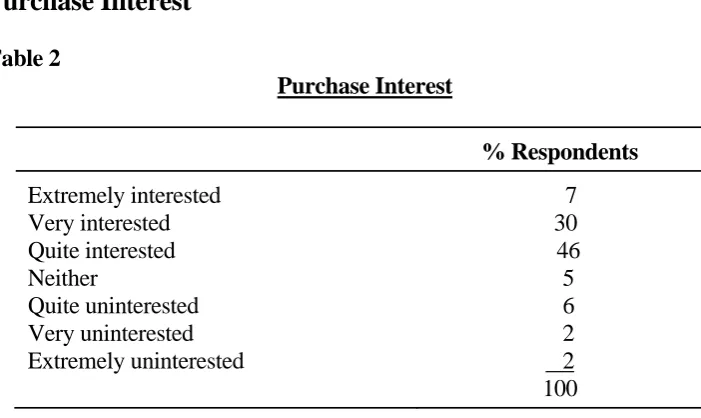
Table 2
Purchase Interest
% Respondents
Extremely interested Very interested Quite interested Neither
Quite uninterested Very uninterested Extremely uninterested
The level of purchase interest was high, with 83 percent of respondents saying they were either quite, very, or extremely interested in the concept (above the 80 percent rule-of-thumb figure indicated by many authors as the minimum required to proceed with development). It is also high with respect to Colmar Brunton's other concept research `norms', although they did not have other mobile radio category figures to compare these results with.
Positive and Negative Perceptions
There were two main freely mentioned advantages of the radio. These were the handsfree feature (37 percent of respondents) and its compact size (27 percent of respondents). When asked about negative perceptions or disadvantages, 61 percent of respondents did not mention any. The few dislikes that were mentioned were concerned with appearance, the number of features, and the perceived cost.
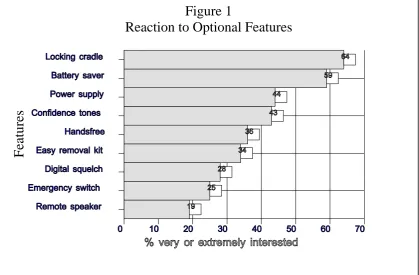
Features Likely to be Used
These questions helped the Engineering department to sort out which features should be included as standard, and which should be available as optional extras. They also helped the Engineering department to allocate their limited resources to those features considered to be highly desirable, leaving less desirable ones to be developed at a later date.
Figure 1
Reaction to Optional Features
Features
Pricing Perceptions
Five related questions were used to ascertain respondents' perceptions of price. The first question was posed at the beginning of the interview and asked respondents their level of interest in purchase, assuming the radio's price was competitive with others that were available. The second question was also posed towards the beginning of the interview, after respondents had discussed their likes and dislikes. It asked respondents how much they would expect to pay for a radio like this. After this response the next question was, how much were they prepared to pay for a radio like this.
Table 3
Mean Price Responses
As Table 3 illustrates, on average New Zealand and Australian respondents were not prepared to pay quite as much as the price they expected this radio would be. The British were actually prepared to pay slightly more than their expected price.
The last two questions on price were posed at the end of the interview. Here two prices were introduced, the first higher than the second, and purchase interest was ascertained again (NZ$850 and NZ$700 respectively). These questions proved that the company's perception of the radio's retail value was actually lower than the market's. For both suggested prices the level of purchase interest increased. Respondents who were extremely interested at an "assumed competitive price" went from 7 percent to 18 percent at the higher price and up to 30 percent at the lower price.
These results also suggest that due to the information absorbed through the interview (around 30 minutes) respondents' perceptions of the radio's value went up. This is indicated by the price New Zealand respondents, for example, were prepared to pay at the beginning of the interview ($772) and the price at which 37 percent of them were either very or extremely interested in, at the end of the interview ($850).
Behavioural
Information
These results were largely centred around purchase volumes, purchase frequencies, brands held, and frequencies used. Although not as useful as the likes and dislikes information, it was still valuable for planning the types and quantities of different mobile radio variants.
undertaken. Another explanation could be that given a choice, mobile radio users prefer radios with excess channel capacity ("just in case").
3.7 Success
or
Failure?
Eighteen months after launch the T2000 mobile radio is reportedly going from strength to strength (Angus Tait, pers. comm.). In terms of meeting the company's own objectives, it is valuable to compare projected sales volumes and margins in 1990 with those achieved today. The actual sales for the T2000 have exceeded projected volumes by an impressive 65 percent. Unit margins do not compare quite as well, being 20 percent lower than anticipated. This is probably a result of the increased competitiveness of the market place since 1990. However, the increase in unit volumes has meant that total profit is still close to the levels projected.
4. CONCLUSIONS
Concept testing is a key to successful product development, as both the literature and the Tait Electronics case history show. Provided that it is conducted with full knowledge of its limitations and using a method that is appropriate to the research objectives, concept testing can provide New Zealand firms with the ability to get new product ideas to market faster and with fewer mistakes. At present there appears to be no published information on the types and extent of concept testing carried out by New Zealand firms. In fact, there appears to be very little published on product development processes in general in New Zealand.
References
Booz, Allen and Hamilton. New products management for the 1980s. Booz, Allen and Hamilton Inc., New York, 1982.
Cooper, R.G. and Kleinschmidt, E.J. New products: the key factors in success. American Marketing Association, Chicago, 1990.
Cooper, R.G. and Kleinschmidt, E.J. New product success in the chemical industry. Industrial Marketing Management 22, pp 85-99, 1993.
Crawford, C.M. New products management. Irwin, Boston, 1991.
Crocombe, Enright and Porter. Upgrading New Zealand's Competitive Advantage, Oxford University Press, Auckland, 1991.
de Bono, E. Serious creativity. Fontana, London, 1993.
de Brentani, U. Do firms need a custom designed new product screening model? Journal of Product Innovation Management 3, pp 108-119, 1986.
Dolan, R.J. Managing the new product development process. Addison-Wesley, Massachusetts, 1993.
Feldman, L.P. and Page, A.L. Principles vs practice in new product planning. Journal of product innovation management 1, pp 43-55, 1984.
Haley, R.I. and Gatty, R. The trouble with concept testing. Journal Marketing Research 8 pp 230-232, 1971.
Hisrich, R.D. and Peters, M.P. Marketing decisions for new and mature products. Macmillan Publishing Company, New York, 1991.
Kelley, D. Creative challenges of product development: lessons form the front lines. Paper presented at the AMA Business to Business Conference, 1993.
Kotler, P. Marketing management. Prentice Hall International, New Jersey, 1984.
Lewis, I.M. Do concept scores measure the message or the method? Journal of Advertising Research 24 (1984), pp 54-56.
McColl-Kennedy, J.R.; Kiel, G.F.; Lusch, R.F. and Lusch, V.N. Marketing concepts and strategies. Thomas Nelson, Melbourne, 1994.
Schwartz, D. (1987) Concept testing. AMACOM, New York, 1987.
Shoebridge, N. "Shoebridge". Business Review Weekly, 8 Sept, pp 99, 1989.
Stanton, Miller and Layton. Fundamentals of marketing. McGraw-Hill, Australia, 1991.
Tauber, E.M. What is measured by concept testing? Journal of Advertising Research 12 pp 35-37, 1972.
Tauber, E.M. Predictive validity in consumer research. Journal of Advertising Research 15, pp 59-64, 1975.
Urban, G.L. and von Hippel, E. Lead user analyses for the development of new industrial products. Management Science 34, No 5, pp 569-582, 1988.
Urban, G.L. and Hauser, J.R. Design and marketing of new products. Prentice Hall, New Jersey, 1993.
Wilson, G. Sometimes it's a sin to use a concept test model. Marketing News 9, pp 20, 1984.
Appendix
One
TR MOBILE 2
General Description
This trunking mobile radio transceiver is very durable, constructed with diecast aluminium chassis and covers, yet lightweight and compact. It can be installed as a single unit or remotely mounted with just the control panel on the
dashboard. The control-~anel has all the controls, a liquid
crystal display (LCD) and an alphanumeric keypad on it. The
product conforms to the U.K. Department of Trade and Industry
trunking specifications MPTl327 and MPTl343 in Band III. It is
available in five versions covering the common commercial bands from 66MHz VHF to 520MHz UHF.
Standard Features
1. PC Programmable - Changes can be made quickly and easily
using a personal computer, via the microphone socket.
2. Power - 25 watts transmit output, programmable by PC. You
can select the particular power capability you require.
3. Wide Band Switching - five versions of the radio cover the
following fequency bands:
1. VHF 66-88MHz
2. VHF l36-l74MHz
3. Band III l75-225MHz
4. UHF 400-470MHz
5. UHF 450~520MHz
The very wide band coverage allows a greater choice of systems or networks, because extra versions of radios are not required and neither is retuning, when moving to
another system within your band. For instance, only one
version of the radio is required to cover Sub bands I, II and III within Band III.
4. Rugged Cradle - The radio slides into a strong metal
cradle capable of withstanding extreme shock and vibration.
5. Reverse Polarity Protection - Protects the radio from
accidental damage in cases where the vehicle battery is incorrectly connected.
6. Audible Confidence Tones - This feature provides positive
- 2
8. One Touch Dialling - The provision of a despatcher call
button (DESP) means only one keystroke is required to call the despatcher or base. One touch dialling of other
parties is also possible.
9. Call Logging - up_to 20 incoming calls can be logged by
the radio. Thus if you are busy in traffic or out of your vehicle, you may scroll through these later and call back
if you wish.
10. Last Number Redial - You may redial the last number you called, simply by pressing the microphone button (pressel).
11. Call Timeout Warning - The radio display automatically
counts down the call time from the commencement of a
call. Audible warning pips will occur 8 seconds before
the call time-out.
12. User Definable Setup - Using the setup button (SET), you
ca~ scroll through a menu of user modifiable parameters (e.g. preset call numbers, tone levels, automatic logging of calls etc.)
13. Programmable ·Soft Keys· - Two buttons (Fl, F2) can be
programmed to provide a number of functions (e.g. replacing a commonly used sequence of keystrokes).
14. Automatic Number Identification - For incoming calls, the
callers number (or name if alphanumeric labels are used) will automatically be shown on the radio's display - thus you will always know the identity of your caller.
15. Alphanumeric Addressing - With the alphanumeric display
and keypad available, up to 20 often called numbers can be
programmed as names rather than number strings. Thus
incoming calls can be displayed "BILL", "CAR-52", "HOME" etc. Similarly, calls can be made by simply dialling B-I-L-L-# for instance. Usually only the first, or the first and second letters need to be dialled. This not only reduces the number of keystrokes, it also eliminates the need to have a written list of names and their
3
Qptional Features
1. Battery Saver - This radio can detect whether the vehicle
ignition switch is off, and if so, can partly shut down after a given period of time. In the event of the radio being inadvertently left on this saves the battery from draining.
2. Car Stereo Suppression - This option automatically
silences car stereos, cellphones, or other audio equipment, when the radio is receiving or sending a message.
3. Locking Cradle - There is an optional locking cradle.
4. Easy Removal Kit - There is also an optional kit, that
allows the radio to be fitted or removed without having to unplug any connections.
5. Data Facility - An optional RS232 port and internal modem
are available for the connection of displays or printers.
6. Handsfree - This option allows you to speak without having
to pick-up or hold a microphone. Either a voice activated or switch activated transmission is available.
7. Emergency Switch - This option allows you to send an
emergency message, even when the radio is switched off. A remote switch is connected to the radio, together with a
hidden microphone. While the emergency message is being
sent the transmit indicator on the front panel will not illuminate.
8. Despatcher Mode - The radio is programmable as a
despatcher radio with special call queuing functions. A
4
-Description of Buttons and Indicators
*
Push on/vol - Push to turn radio on. Push again to turnradio off. Turning knob clockwise increases received audio volume from radio loudspeaker.
Despatcher (DESP).button - Provides a one touch call to the despatcher.
*
Status (STAT) button - Your status (e.g. 2 or 'at lunch')may be displayed by pushing the STAT button after keying in the appropriate number .
. Function (FI/F2) buttons - Progranunable "soft keys" which can be used to replace a sequence of often used keystrokes.
Up/down buttons - Used to scroll through logged calls,. set up parameters and the like.
Clear (CLR) button - Used to clear down calls or clear entries from the keypad/display.
*
Setup (SET) button - Used to enter setup mode where youmay alter some of the radio's features (e.g. volume of confidence tones, automatic logging of calls etc.)
Alphanumeric keypad - Used for all forms of dialling e.g. single digit preset calls through to full length dialled numbers. The "#" button is used to initiate the call once a number is dialled.
*
Eight character display - The eight character display isused to show channel names, status messages and alphanumeric labels.
*
System (SYS) available indicator - This indicator appearswhen your radio is in range of your system or network.
WAIT indicator - The WAIT indicator appears when a call is being setup.
*
GO indicator - The GO indicator appears when your call hasbeen set up. You may then begin talking.
1 I I I I I r I I I I I I I I I I I I I
l
1
1
o
o
TOP view
(in cradle)
Top view Remote Panel
o
o
r T I I I I I I , I I I I I I l,---~I I I I I Ir
---~1~5~6---:
Front view Remote Panel
--
ABC OEF0)
i
1
~. ~
2
~
~3~
""D
C
(J) I
Mic::;phone 01
sc:ket Z\ '-...'
<
0
r
Oespat::h button
0
States button
Om
(J)U
Fun::tions
I:~
18.2 :x.Jttons
11
.0 _.C _.
-...
r··"',
0.1 :"":::J i cat or ~ 0
lights . . . . AIIIIIIIo, ....,
)::l '<
r
en.-+
'.-:p/down -1
j
CDC>
...
-:::~ttons
.... '7
0. _.C)
L ...
en0 D
Clear do~~ button
-
CD'<
( ) (f)
I
-<
Set-ur; button
:::tJ
(f)8
8~8~8
:r.>
8
8~8~8~
-"'0 ":J CD ;;2...
:3 CD ...., -0 -r8
8~8~8~
CD
'<
Appendix Two
P/N:0720
REF:Jl.QST
INTERVIEWER'S NAME:
CODE AREA
Auckland ....••...••..••..•
01Wellington ...•....•...•
02Sydney . «I • • 0 • 0 • • • • e o " • • 0 • o .
03-~OBILE
RADIOS
QUESTIONNAIRE
DAY AND DATE:
CODE RADIO TYPE
FH 1 ••• «I • 0& • 0 • • 01 0 • • to • 0 • , , «I " • CI 1
FH2 O'. ~ ., ., 0 " • • " • • e o . <> <:I 01 • • • 0 • • 2
TR 1 • e ., e 0 e o • • QI Co " II) 0 • • 0 • • 0 • • • • 3
Melbourne ....••..••..•...•
04Lond on 0 • • 0 • 0 «I III 0 • • e «I • " • • • • e 05
TR2 •• e o • • • • • 0 to " II . . . 01 .. • • ..:....4 _ _ --'P-"'-3
CODE COUNTRY
Edinburgh ....••..•...•..••
06New Zea
1and ...
1Other (SPECIFY) _ _ _
_
Australia ••••...
2Pl
United Ki ngdom ...
~3 _ _ --'P-.:.4CODE RESPONDENT TYPE
User Only ....•...•.
1User/Decision Maker ...
2User and Decision Maker
(2
people) ...
3P2
INTRODUCTION
This ;s a survey about mobile radios. I'm going to show you a description of a new
mobile radio. (HAND RESPONDENT APPROPRIATE CONCEPT.) Please read it carefully.
ALLOW RESPONDENT TIME TO READ CONCEPT IN FULL. RECORD ANY COMMENTS.
lA.
IF FMl OR TRI USER
--->
Q2, OTHERWISE (IF FM2 OR TR2 USER) SAY:
How I would like to ask you some questions about your reactions to this radio.
IF FM2 USER ASK:
P5M
There are two types of installation shown in the folder. The remote control panel
and the remote control microphone with the separate display. (REFER RESPONDENT TO
PHOTOGRAPHS.) There is a third option available that is not shown in the folder,
where the radio is mounted as a complete unit under the dashboard.
IF TR2 USER ASK:
Just from what you have seen. which one type of installation would you prefer?
CODE ONE ONLY. READ IF NECESSARY.
Remote control panel...
1(FH2 ONLY) Remote control microphone with separate
d; s play """" ... ". '" ... III • • • 2
Complete underdash (not shown) ...
3(DON'T READ) Not sur e .
0 • • • • • • • • • • • • • • • • • • • • • • 0 • 0 • • • • • • 4 P 6B.
For what reasons do you prefer this installation type?
D O 'For what other reasons
do you prefer this installation? PROBE TO NO/CLARIFICATION.
P7M
2A.
CARD A
IF FM2 OR TR2 USER SAY:
For the whole of this interview, please assume that this radio is available with
the installation type you prefer.
ALL RESPONDENTS:
Now, just imagine that your organisation was about to buy new mobile radios for
all
your vehicles. Please assume that the price of this radio is competitive
with others that are available.
From this card, please tell me how interested or uninterested your organisation
would
bein buying a mobile radio like this. CODE ONE ONLY.
B.
For what reasons do you say that? ... For what other reasons? PROBE TO
NO/CLARIFICATION.
C.
REFER RESPONDENT BACK TO CONCEPT. ALLOW TIME FOR RESPONDENT TO FLICK THROUGH
CONCEPT AGAIN, THEN ASK:
P9H
What are the main things you like about this mobile radio? .•. What else do you
like about it? PROBE TO NO/CLARIFICATION.
D.
What are the main things you dislike about this mobile radio?
you di sl ; ke about it? PROBE TO NO/CLARIFICATION.
PlOM
3A.
Now imagine that this radio was fitted with all the standard features you have
seen, but none of the optional features. About how much would your organisation
expect to pay to purchase a mobile radio like this with the standard features?
WRITE IN:
IF NECESSARY SAY:
By purchase we mean buying the radio rather than leasing
itor using hire
purchase.
IF DON'T KNOW ASK ANNUAL LEASE PRICE OR PROBE BEST ESTIHATE OF PURCHASE PRICE.
CODE PRICE TYPE:
Buy pri ce ... 0 • ,. 0 I(> • , . • • • e , • • Cl • • • • • • • • • • • .. • • 1
Annual lease price ••.•...•... 2
Hire purchase ••••..••... 3
Other (SPECIFY) _---,-_ _ _ _ _ _ _
_
B.
And about how much would your organisation be prepared to pay to
~a mobile
radio like this?
WRITE IN:
IF DON'T KNOW ASK ANNUAL LEASE PRICE OR PROBE BEST ESTIMATE OF PURCHASE PRICE.
CODE PRICE TYPE:
Buy pri ce ..•..••.•...
Annual lease price ••... 2
Hire purchase •.•••... 3
Other (SPECIFY)
C.
Does your organisation usually ...
READ AND CODE ONE ONLY
buy its mobile radios ••.•...• 1
1 ease them ...•.•••... 2
put them on hire purchase ... '. . .. 3
or obtain them in some other way (SPECIFY)
4A.
CARD B
REFER RESPONDENTS TO SCALE DIAGRAM AT END OF CONCEPT.
P12
P13
P14
PIS
P16
Looking at the size of this radio now. From this card please tell me how
B.
For what reasons do you say that? PROBE CLARIFICATION.
P18M
5.
What frequency band does your organisation mostly use? REFER RESPONDENT TO BAND
WIDTH IN FOLDER
IFNECESSARY.
READ AND CODE EACH MENTIONED.
Would it be •••
VHF - 66 - 88 MHz ••••••••••..•... 01
VHF - 136 - 174 MHz ..•••... 02
UHF - 400 - 470 MHz .•..•••...•. 03
UHF - 450 - 520 MHz .••••••...•... 04
or Band Three (Band III) - 175 - 225 MHz
05
Other (SPECIFY) _ _ _ _ _ _ _ _
_
Don't know (TICK BOX)
iii • • • iii • iii • • iii iii • • • iii • • • ~~-'-P=19'_'_!M6.
REFER RESPONDENT BACK TO STANDARD FEATURES IN FOLDER.
Now some questions about the standard features of this radio.
CARD C
LooKing at the reverse polarity protection. From this card please tell me whether
or not your organisation would find the reverse polarity protection useful. CODE
ONE ONLY.
A. Very useful iii iii iii iii iii • • • • iii iii iii • • • II III • iii iii iii iii iii iii. iii 1B. Quite useful ••.••.•.•...•.• 2
C. Not that useful .•.••... 3
D. Not at all useful ..•..•...• 4
Don I t know iii iii • • iii • • • • • iii iii • iii iii iii • iii • iii • • • • iii iii iii P20
7A.
IF TRIOR TR2 USER ---) Q8
tOTHERWISE (FHl OR FM2 USER) ASK:
Just thinking about the channel capacity, about how many channels would your
organisation require?
WRITE IN NUMBER: _ _ _ _ _ _ _ _ _ _ _ _ _ _ _ _ _ _ _ _ _ _
--!...!P2~1c.
STIll CARD 0
looking at the scanning feature, how likely or unlikely would your organisation
be to use scanning? CODE ONE ONLY.
A. Would definitely use it •...
1B.
Would probably use it •... 2
C. Probably wouldn't use
it ... 3D. Definitely wouldn't use it ...
4Don't know COl ~ COl " • 0 • • e • " .. " • " 0 " COl 0 • 0 • 0 0 • • •
I
P 2 3D.
CARD C AGAIN
Looking at the timeout facility, please tell
mewhether or not your organisation
would find the timeout facility useful? CODE ONE ONLY.
A. Very useful ...••••••...
1B.
Quite useful •....••.•...••. 2
C. Not that useful •...••...•
3D.
Not at all useful ..•....•...
4
Don't know ...•...
I
P 2 4SA.
CARD B AGAIN
IF TR2 OR FH2 USER ---)
Q9,OTHERWISE (IF TRIOR FHl USER) ASK:
Looking at the internal speaker now. How acceptable or unacceptable is the
internal speaker facility to your organisation? CODE ONE ONLY.
A. Perfectly acceptable
• • • • • 0 • • • • • • • • • • • 1Q9
<---B.
Quite acceptable
.
...
2
C. Not really acceptable
·
...
3QSB
<---D. Not at all acceptable
·
...
4Don't know (TICK BOX)
·
...
"....
B.
For what reasons do you say that? PROBE CLARIFICATION.
9.
CARD 0 AGAIN
IF TRIOR FMl USER ---) QIO, OTHERWISE (IF TR2 OR FH2 USER) ASK:
I
Looking at the alphanumeric addressing now. How likely or unlikely would your
P25
10.
CARD
BAGAIN
IF FMl OR FM2 USER ---) Q13. IF TR2 USER ---) 012. OTHERWISE (TRI USER) ASK:
Looking at the four call capacity now. From this card. how acceptable or
unacceptable would it be to have just four call buttons plus the despatcher cal'
button? CODE ONE ONLY.
A. Perfectly acceptable ...
1Q12
(---B.
Quite acceptable •..•...•..• 2
C.
Not really acceptable .•...• 3
Qll
(---D.
Not at all acceptable ..•••...•••
4
Don I t Know ... OoOo 0 • " . . . 0 . . . 0 ~ • • P28 11.
How many call buttons would your organisation require?
WRITE IN NUMBER (PROBE BEST ESTIMATE):
P29
12A. CARD C AGAIN
IF TRI USER ---) Q13, OTHERWISE (TR2 USER) ASK:
What about the user definable setup. Please tell me whether or not your drivers
would find the user definable setup useful? CODE ONE ONLY.
A. Very useful ....•••.•...•...• 1
B. Quite useful ..••••••..•...•• 2
C. Not that useful •..••... 3
D. Not at all useful .•... 4
Don' t know ...••...
I
P30B.
CARD D AGAIN
And the programmable soft keys. How likely or unlikely would your drivers be to
use the two programmable function keys? CODE ONE ONLY.
A. Would definitely use it ...• 1
B. Would probably use it •... 2
C. Probably wouldn't use it ...•...•. 3
D. Definitely wouldn't use it ...•.••. 4
Don't know ...
I
P3113.
Now I would like to ask you some questions about the optional features of this
radio. REFER RESPONDENTS TO OPTIONAL FEATURES IN THE CONCEPT.
CARD A AGAIN
The battery saver is available for no extra cost. From this card, how interested
or uninterested would your organisation be in the battery saver? CODE ONE ONLY.
A. Extremely interested ... 1
14A. STill CARD A
If the car stereo suppression option cost NZ$65/A$90/UK£35 extra, how interested
or uninterested would your organisation be in this feature? CODE ONE ONLY COL
A.
B.
STIll CARD A
If
the car stereo suppression cost HZ$35/A$45/£17 extra, how interested or
uninterested would your organisation be in this feature? CODE ONE ONLY COL
B.
P33
P34
ICOl
A ICOl B
A.
Extremely interested •••.••...•.. _--=1'--_--=-1 __
B.
Very interested •••••.•••••.•...
2
2
C. Quite interested ••••.••.•••...
3
3
D. Neither interested nor uninterested
4
4
E. Quite uninterested •....•...
5
5
F.
Very uninterested ••...
6 6s.
Extremely uninterested •...
77
Don't k.now IS • • 1/1 • • 0 • 0 IS • IS • a • • • IS IS IS 1/1 • • 0 • •
15A. STIll CARD
AThe locking cradle is available at no extra cost. How interested or uninterested
would your organisation be in the locking cradle? CODE ONE ONLY.
A.
Extremely interested ...
1B.
Very interested .•••...•...
2
C. Quite interested •...
3D.
Neither interested nor uninterested ..
4
E. Quite uninterested •...•.
5F.
Very uninterested •...
6
G.
Extremely uninterested ... 7
Don't know...
I
P35
B.
The optional easy removal kit, costs about NZ$40/A$50/ UK£20 extra. How
interested or uninterested would your organisation be in the easy removal kit?
CODE ONE ONLY.
A.
Extremely interested •...••..•••...••. 1
B.
Very interested ••.••••
r • • • • • • • • • • • • • •2
C. Quite interested ••.••...•..•••••...•. 3
D.
Neither interested nor uninterested •.
4
E. Quite uninterested ••...•.•.•...
5 F.Very un; nterested ••.•...•....
616A. STIll CARD A
looKing at the data facility option.
Ifthis cost NZ$135/A$170/UKC70 extra, how
interested or uninterested would your organisation be in the data facility
option? CODE ONE ONLY COL
A.
B.
If the data facility option cost NZ$65/A$85/£35 extra, how interested or
uninterested would your organisation be in it? CODE ONE ONLY COL
B.
17.
STIll CARD A
A. Extremely interested ••••••••...•...•
B. Very interested •••••••••••••••.•••.•
c.
Quite interested .•••...•••.•...•....
D. Neither interested nor uninterested
E. Quite uninterested ••.•.••••••..•....
F. Very uninterested .•••••.•••.•...•..•
G. Extremely uninterested ••••••....•.••
Don I t know 0 13 a. G " • eo e _ 0 . . . " • G • • • • " " • • •P37
P38
leOl
A
ICOl B
I
1 1
2 2
3 3
4 4
5 5
6 6
7 7
And the emergency switch option. The emergency switch will cost about
NZ$65/A$87/UK£35 extra. How interested or uninterested would your organisation
be in the emergency switch option? CODE ONE ONLY.
A. Extremely interested ... 1
B. Very interested ...•... 2
C. Quite interested ..•.••... 3
D. Neither interested nor uninterested .. 4
E. Quite uninterested •••...•...•... 5
F. Very uninterested .••••...•... 6
G. Extremely uninterested ....••...••• 7
Don't know .•..•.••.•...•...
I I
P39
18.
STIll CARD A
And the hands free option. This feature will cost about NZ$65/A$90/UKr35 extra.
How interested or uninterested would your organisation be in the hands free
option? CODE ONE ONLY.
19A.
STILL CARD A
IF TRIOR TR2 USER ---) 022. OTHERWISE: (IF FHl OR FH2 USER) ASK:
looking at the audible confidence tones. This is available at no extra cost. Her.
interested or uninterested would your organisation be in the audible confidence
tones option? CODE ONE ONLY.
A.
Extremely interested
. f -• • O g . . . " 1B.
Very interested
. . . 0 0 c;> •2
C.
Quite interested
• ... 0· ... 0 .•. ··.·93
D. Neither interested nor uninterested
..
4E.
Quite uninterested
• • • • • G . o • • • e • • • • • 8 . 5F.
Very uninterested
..o .... O . . . UIil • • • 6G.
Extremely uninterested
.
...
'"...
7Don't know
. 0 • • • • • • • • 0 • • 0 • • • 0 • • • • • 0 . . . .I
I
P41B.
STILL CARD A
looking at the despatcher/base radio option with the matching desk top power
supply. The power supply will cost about NZ$240jA$310jUK£125 extra. How
interested or uninterested would your organisation be in the power supply? CODE
ONE ONLY.
A.
Extremely interested
.
...
1B.
Very interested
.
...
2C.
Quite interested
.
...
3D.
Neither interested nor uninterested
..
4E.
Quite uninterested
...
5F.
Very uninterested
.
...
" .. 6G.
Extremely uninterested
. ...
,,,,....
7Don't know
...
I
I
P4220A. STILL CARD A
Now the optional signalling features. One of these is digital coded squelch. This
wi 11 cost about NZ$30/A$30/UK£l4 extra. How; nterested or un; nterested waul d your
organisation be in this optional signalling feature? CODE ONE ONLY.
A.
Extremely interested ... 1
B. Very interested •...•... 2
C.
D.
E.
Quite fnterested ...•... 3
Neither interested nor uninterested .• 4
Quite uninterested ... 5
F. Very uninterested ...••... 6
G.
Extremely uninterested ...•... 7
B.
STIll CARD A
Another optional signalling feature is five tone selective calling and automatic
number identification (ANI). If this feature cost NZ$150/A$190/UK£aO extra, how
interested or uninterested would your organisation be in it? CODE ONE ONLY COL A.
C.
STILL CARD A
If the selective calling and ANI cost NZ$lOO/A$130/£S5 extra, how interested or
uninterested would your organisation be in it? CODE ONE ONLY COL B.
P44
P45COL A COL B
A.
Extremely interested
. . 6 8 0 • • • 0 . 0 . . . . 0 0 1 1B.
Very interested
• • • 0 6 0 • • 0 0 0 0 0 0 0 0 0 0 0 0 l i 0 • •2
2
C. Quite interested
• • • • • 0 0 • • • • • • • • • • • " ' .3
3
D. Neither interested nor uninterested
4 4E.
Quite uninterested
• • 0 • • • • • • • • • • • • 0 " .5
5
F. Very uninterested
.CI ••••••••••• o o . o • • 6 6G. Extremely uninterested
e . o . o a o o • • o o o o 7 7Don't know
• • • • • • • • • • • • • • ct • • o • • • • • • • •21.
STIll CARD A
IF FHl USER
--->
Q22, OTHERWISE (IF FH2 USER) ASK:
Another optional signalling feature is DTHF dialling which ;s available for no
extra cost. How interested or uninterested would your organisation be in DTMF
dialling? CODE ONE ONLY.
A. Extremely interested •...•...•. 1
B. Very interested .•..•...••.•...••. 2
C. Quite interested •••••...•... 3
D. Neither interested nor uninterested .. 4
E.
Quite uninterested •...•.••• 5
F. Very uninterested ...•...•.••. 6
G. Extremely uninterested ...••... 7
Don't Know •••..•..•••. III III • III • • • fI • • • • • • •
I
P4622.
STILL CARD A
IF FH2 OR TR2 USER ---) Q23, OTHERWISE (IF TRIOR FHl USER) ASK:
Now 1 ookingat the remote speaker option. Thi s will cost about NZ$40/A$50/UK£20
extra. How interested or uninterested would your organisation be in the remote
speaker option? CODE ONE ONLY.
23. Now some questions about the controls on this radio. REFER RESPONDENT TO DESCRIPTION OF BUTTONS AND INDICATORS.
A. Do you feel that the lettering on each button clearly tells you the function of each button?
Q24
<---
Yes ... INot Sure ...••...•... 2
23B
<---No ...•.•... 3 P48
B.
Which buttons are not clearly labelled? WRITE IN:P49M
24A. CARD G
From this card, how easy or difficult do you feel this mobile radio would be to use? CODE ONE ONLY.
A. Very difficult ... I
B. Quite difficult ... 2 C. Not very difficult ... 3
D. Not at all difficult •... 4
Don't know... P50
B.
For what reasons do you say that? PROBE CLARIFICATION.P51H
C. CARD B AGAIN
From this card, please tell me how acceptable or unacceptable the appearance of this radio is overall?
A.
Perfectly acceptable...
IB. Quite acceptable
...
2C. Not really acceptable ... 3
25.
Thinking about this radio overall now, what suggestions do' you have for
improvements that could be made to it? ... What other suggestions
forimprovement
do you have? PROBE ONCE ONLY.
P53M
26A. CARD A AGAIN
PRICING GUIDE
1:NZ
AUS
UK
FMl - $850
$1,100 £400
FM2 - $950
$1,200 £450
TRI - $950
$1,200 £450
TR2 - $1.100
$1,400 £525
If this mobile radio. with all the standard features, cost (READ APPROPRIATE
PRICE FROM ABOVE AND WRITE
IN)
,
please tell me how interested or
uninterested your organisation would be in buying it? CODE ONE ONLY IN COL A.
B.
STI LLCARD A
PRICING GUIDE
2:NZ
AUS
UK
FMl - $700
$900
£350
FM2 - $800
$1,000
£400
TRI - $800
$1,000
£400
TR2 - $900
$1,200
£475
And if this radio cost (READ PRICE FROM ABOVE AND WRITE IN)
, how
interested or uninterested would your organisation be in buying it? CODE ONE ONLY
COL B.
P54
P55COL A COL B
A. Extremely interested...
1
1
B. Very interested •••...••••..••..•.•.•.••..•
2
2
C. Quite interested •••...•••.•••..•...
3
3
D. Neither interested nor uninterested ...•...
4
4
28.
CARD E
REMOVE CONCEPT AND ASK: lastly, a few questions about your organisation. Using
this card, please tell me when your organisation last bought a mobile radio. CODE
ONE ONLY.
A.
In the last 12 months •..••... 1
B. 1 to 2 years ago ..•..•... 2
Ce 3 to 5 years ago ...•... G • • • • • • • • 3
D. 6 years ago or longer ••••••••••...•... 4
Don't Know (TICK BOX) ••••••••••...•...
PS7
29.
How many mobile radios does your organisation have at the moment?
WRITE IN:
PS8
30.
CARD F - BRAND CARD
Which of these brands and models of radio does your organisation have the most
of? CODE EACH MENTIONED.
AWA/Exicom RTB5 ...
01Don't know model ...
02I COM
V200 ....•... , ... ,... 03
Don't know model ...•....•...•
04K~nwood
705/805 ....••...••..•...•
05710/810 . Go 0 • 0' III • 0 III It • II 0 It 0 0 .. 0 III 0 e G o . It " G 06
Don't know model.... . . . • • • . . . • • • •• 07
Key KM225 .. ". III 0 • • • lit • II • III 0 Q • • 0 • • • 0 • • • • O'. 08
Don't know model ...•..•...••.• 09
Marantz
GX2000 O ' O ' . O ' . O ' • • • II' • • II> III • " It III III " CI • • • • • 0 0 10Don't know model ..•...•...•
11Marconi
RC630 0 . . . 0 lit • • a 0 41 0 " • It 0 It 0 lit " oil • • • • 12Don't know model ..•...•
13Maxon SHX ... ". II 0 0 /I • • Go Co ., • " " 0 • • " • • " • • 0 It 14
Don't know model ...••...
15Motorola
Hicr
0 •.. O'. e lit Go • • • • 0 • • • 0 .. • • • • " • • 0 • • 0 16 Rad ius .. 0 • • • • • • • " • • 0 • • • • III " • • • • • • • • 17Syntrx ...•...
18Don't know model ... 19
Phil;
ps FM91/92 .... O' • • • 0 • • • III • • • • 0 • • 4' • • • • • 0 20FHII00/1200 .•.•.•...•.•. 21
HX295 .••... O' • • • • • • 0 .. 0 • • • • • • • " e o • • " 22 PRH80 O'. II ., " . . . . " • II • II . . . " . . . It. 23
Don't know model...
24Plessey
HTR9000 .•...••....••...•
25Don't know model ..•...•
26Pye . " .... " • It . . . ., ., 0 . . . . , . 27
Tait T162, T182, T196, T198, T199 ... 28
T500 ... " .... " ... It • • • • • o. 29 T700 •.. " ... "... 30