Developing A Sustainable AoL Framework
Using Supply Chain Principles
Constance A. Lightner, Fayetteville State University, USA Carin A. Lightner-Laws, Bonnie Speed Logistics, USA
ABSTRACT
Many accreditation agencies have adopted Assurance of Learning (AoL)-based paradigms for assessing educational institutions. Colleges/universities transitioning to an Assurance of Learning (AoL) system encounter common challenges while implementing new standards. In this research, the authors develop a stakeholder driven AoL framework which addresses common transitional issues while maintaining the Southern Association of Colleges and Schools (SACS) and Association to Advance Collegiate Schools of Business (AACSB) accreditation standards. The model incorporates supply chain practices by best in class (BIC) companies to optimize overall assessment efforts. The model decreases the number of redundant processes, improves collaboration throughout the university, and promotes a more comprehensive curriculum. After the model implementation, the authors examine mission statements and tenure, promotion and reappointment documents to gain insight about how to sustain accreditation.
Keywords: Assurance of Learning; Assessment Outcomes; SACS; AACSB
INTRODUCTION
ecades of research acknowledge the disparities that exist between the information that an instructor teaches and the actual knowledge that students gain (Lubinescu, 2001; Pringle, 2007; Weldy, 2008). Many regional and specialized accreditation agencies, such as SACS and AACSB, have adopted new AoL standards to address this apparent teaching-learning gap. Currently, only twenty-five percent of business schools are accredited by AACSB (AllBusinessSchools, 2012). As schools seek to acquire or maintain their accreditation status, they are tasked with ascertaining efficient ways of implementing a student learning-based system. This research provides a blueprint for universities to follow that will significantly enhance their ability to meet SACS and AACSB standards.
LITERATURE REVIEW: SACS AND AACSB
Van Vught (Van Vught, 1994) defines accreditation as “the most fully developed institutionalization of the idea of accountability in higher education.” In 1988, the US Department of Education required all federally approved accreditation agencies to include assessments in their post-secondary accreditation standards (Apostolou, 1999). Publically funded institutions were faced with increased scrutiny and pressure in the 1990’s to improve their accountability practices and student retention rates (BHEF, 2004; Lubinescu, 2001). In response, accreditation agencies began to revise their standards to focus on outcome-based, AoL requirements.
AACSB is an accreditation agency which evaluates business schools. During their evaluation process, peers interpret the quality of a program within the context of self-defined goals and activities. In 2002, AACSB drafted new standards requiring institutions to provide evidence of student learning (i.e., AoL) and increase faculty involvement in the accreditation/assessment process. Programs were given a three-year window to implement the new AACSB standards (Martell, 2007; AACSB International, 2003). AACSB released an interpretation of AoL standards in 2007 (AACSB, 2007) which provided an assessment framework for defining program goals and designing assessment measures that substantiate student learning. One distinguishing feature of AACSB is the emphasis on including stakeholders in the overall AoL system design process.
In contrast to ACCSB, SACS is a regional accreditation agency that provides recognition to institutions that meet minimum standards of quality. In 2007, SACS also adopted standards requiring institutions to demonstrate student learning. AoL-based standards were more detailed in the 2008 SACS Standards Edition (SACS, 2007; SACS, 2008). By 2010, most accreditation agencies that fall under the Council for Higher Education Accreditation (CHEA) had adopted AoL-based standards (Lubinescu, 2001).
Although regional and program specific accreditation agencies have varying requirements and processes, there are a multitude of analogous themes that exist among these agencies. AACSB and SACS have convergent focuses in three main areas: 1) Institutions must develop and adopt a mission statement which drives the direction and activities for all units; 2) Programs (or majors) must develop learning goals which support the unit mission (Weldy, 2008; Garceau, 2011), and adopt assessment measures to assess each goal; and 3) A continuous improvement process must be identified to routinely review assessment data and make program changes based upon the results (referred to as “closing the loop”). In addition, institutions are required to respond to any criticism or recommendations given and develop a plan that addresses these issues (Lubinescu, 2001).
INITIAL AoL IMPLEMENTATION VS. MEDIAN IN CLASS FIRMS
Many universities are enmeshed in a cycle where AoL goals are added post hoc to their current curriculum. The authors contend that institutions implementing learning outcome assessments in this manner are still in the infancy stage of the AoL system development. With this approach, the current curriculum and university structure is driving the AoL process. Departments often operate in a silo, where information sharing, joint planning, and collaboration between academic units is not emphasized. The results of the infancy stage AoL model provide a myopic view of learning outcome goals that are largely designed to meet accreditation agency standards and are not necessarily aimed at improving student learning. AoL should create an environment where continuous improvement drives the learning process and provides a foundation for academic units to support. An efficient AoL system should lead institutions to review (and often revise) their mission statement, curriculum, and course objectives, based upon stakeholder input (Gardiner, 2010; Martell, 2007; Weldy, 2008).
Challenges with the Research Institution’s Initial AoL-Based System
The research institution (RI) is accredited by SACS and the School of Business and Economics (SBE) at the RI is accredited by AACSB. SBE was first accredited by AACSB in 2006 and was scheduled for reaffirmation in 2012. The RI was scheduled for SACS reaccreditation in 2011. Both reaccreditation processes require the implementation of AoL-based systems, whereas prior accreditation success was achieved through an input-based (i.e., examining competencies being taught in the classroom) assessment process. Transitioning from teaching to learning-based assessments was not a seamless process. The authors encountered challenges which included the lack of adequate funding to support faculty training and assessment activities (Martell, 2007), faculty resistance to learning and adopting a new process (Pringle, 2007), and convincing faculty and administration that learning shortfalls should (and would) be viewed as curricular design issues as opposed to teaching deficiencies (Kelley, 2010).
During the initial transitioning phases, the current academic structure was adapted to fit the new AoL requirements. Since the university and various program specific accreditation agencies were all transitioning to AoL-based systems, the university wanted to merge objectives and unify departmental efforts. The initial administrative structure was created to incorporate AoL throughout the RI. A Vice Chancellor for Assessment was appointed to oversee all university assessment operations. Each college/school appointed an assessment coordinator to synchronize all college/school assessment activities. Coordinators met with a committee of faculty members to determine the learning outcomes that each department would assess and the classes where assessments would be administered. This assessment structure was adopted and implemented for approximately two academic years.
1. Lack of Consistency (And Cohesion) Between Colleges/Schools - Each department developed their own assessment goals and processes. Very little communication occurred between departments, which led to frequent duplication of resources (i.e., budget, rubric development, etc.).
2. No Formal Accountability for “Closing the Loop” - No official process existed for providing seamless administrative oversight of all assessment activities. As a result, there was a lack of consequences for failing to follow up and use assessment results to improve future student learning activities.
3. Lack of Global Solutions to Common Problems - Learning goals, assessment measures, and improvement plans were developed and implemented by individual faculty members. Chairs, deans, and upper level administrators were not included in the review process. Thus, global solutions to common problems occurring across departments were not appropriately recognized and addressed.
4. Individual Assessment Initiatives were not Fully Supported - When a faculty member suggested an improvement plan which required significant changes, resources, or funding, it was difficult to get support from administrators because they were not involved in the planning process.
Since the RI sought to attain AACSB and SACS reaffirmation, a more efficient AoL process needed to be developed, which addressed the aforementioned issues.
Median in Class Firms
Supply chain management (SCM) literature about best in class organizations has revealed remarkable commonalities between the challenges of universities in the infancy stage of AoL system implementation and median in class (MIC) organizations. MIC organizations have not reached the highest current performance level in an industry (i.e., not best in class). To better understand these similarities, the Google scholar search engine was used to find documents about benchmarking, best and median in class supply chain practices. Excluding citations and patents, 4,050 such documents were found. In order to attain the most recent benchmarking studies, the authors restricted their review to manuscripts published between 2010 and 2012. There were 994 documents that met these criteria, 31 of which were inaccessible. The remaining 963 documents were read and common practices of MIC and BIC organizations were extracted.
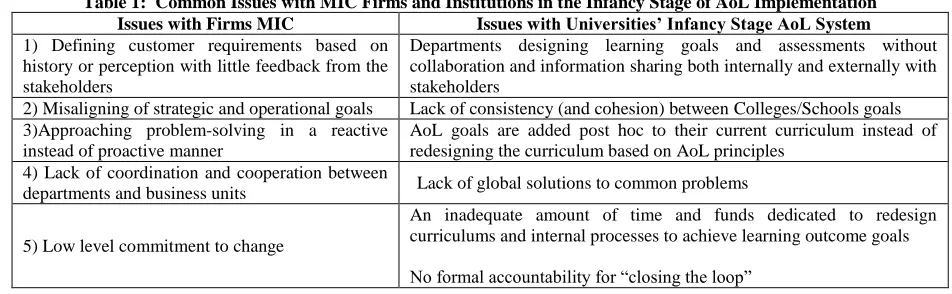
Table 1 lists common issues with MIC firms. This table also highlights the similarities between firms that are MIC and institutions that are in the infancy stage of AoL implementation. For instance, both firms and institutions that meet this criterion are typically not demand or stakeholder driven (first issue listed in Table 1); instead they are using history, perception and individual expertise to shape most operational and strategic decisions while underutilizing stakeholder input/feedback. Companies have acknowledged that many of the practices listed in Table 1 have led to redundant processes, operational inefficiencies, higher costs, and overall sub-optimal results (Stewart, 1995; Mittelstaedt, 1992; Fawcett et al., 2008). In an attempt to mitigate these unfavorable outcomes, companies have employed techniques, such as best practice benchmarking. Best practice benchmarking is a commonly used strategy that continuously compares (and seeks to improve) processes, products and services to competitors and renowned industry leaders (Patton, 2001; Mittelstaedt, 1992).
Table 1: Common Issues with MIC Firms and Institutions in the Infancy Stage of AoL Implementation Issues with Firms MIC Issues with Universities’ Infancy Stage AoL System 1) Defining customer requirements based on
history or perception with little feedback from the stakeholders
Departments designing learning goals and assessments without collaboration and information sharing both internally and externally with stakeholders
2) Misaligning of strategic and operational goals Lack of consistency (and cohesion) between Colleges/Schools goals 3)Approaching problem-solving in a reactive
instead of proactive manner
AoL goals are added post hoc to their current curriculum instead of redesigning the curriculum based on AoL principles
4) Lack of coordination and cooperation between
departments and business units Lack of global solutions to common problems
5) Low level commitment to change
An inadequate amount of time and funds dedicated to redesign curriculums and internal processes to achieve learning outcome goals
USING BIC BENCHMARKING TO IMPROVE AoL SYSEM PROCESSES
According to the Supply Chain Council, “Leading organizations are viewing and improving their competitiveness by taking a supply-chain perspective rather than an organizational perspective” (Stephens, 1998). Since 1996, the Supply Chain Council has published numerous studies comparing BIC and MIC companies. These studies reveal that BIC companies consistently outperform MIC companies with regard to various cost, time, adaptability, and service metrics. The council concluded that “organizations that are focusing on supply chain performance from an integrated perspective experience improvements in virtually every phase of their supply chain” (Stephens, 1998). The studies published by the Supply Chain Council affirms the importance of institutions taking an integrative supply chain perspective and understanding BIC practices to improve organizational performance.
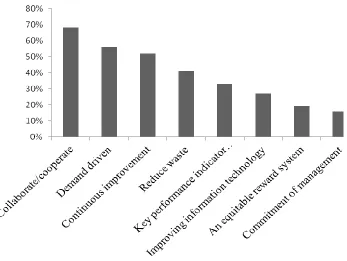
The similarities between MIC firms and institutions in the infancy stage of AoL implementation serve as the impetus for this framework. Since BIC practices have been used to improve the performance of MIC companies, academic institutions should consider using best practice benchmarking research to design efficient AoL systems. An analysis of substandard, common and best practices can reveal characteristics that lead to companies gaining a competitive advantage and sizeable market share. Many MIC companies modify their business model to reflect some of the best practices of industry leaders and improve many of their inefficiencies. The top practices common to BIC organizations (as found in the 963 documents examined) are listed in Figure 1.
Figure 1: Top BIC Practices Listed in Documents between 2010 and 2012
As shown in Figure 1, sixty-seven percent of the articles cited collaboration and cooperation throughout the firm and with other supply chain partners as an important characteristic of BIC companies. Subsequently, being customer demand-driven and desiring continuous improvement had the second and third highest percentages, respectively.
supply chain. The authors are viewing academic institutions as supply chain members who are developing skilled laborers for stakeholders (i.e., residents, graduate institutions and potential employers). It is easier to apply the concept of being demand-driven to a university if stakeholders are viewed as customers and universities as channel members. Ultimately, in a supply chain, each organization is challenged with meeting the needs of its customers in the most efficient way possible. In academia, the onus is on universities to understand how to meet stakeholder needs and expectations.
BIC strategies used by industry leaders to improve operational and supply chain inefficiencies at the RI have been incorporated. In the next section, a learning outcome-based framework using supply chain practices from BIC organizations was developed. This model is then applied to strategic and assessment planning for the Department of Management at the research institution, a constituent member of a 17 institution statewide university system (SUS). The authors posit that the optimal AoL-based academic environment would be stakeholder (demand)-driven, with mutually shared information and collaborative efforts toward reaching joint learning goals.
THE ASSESSMENT MODEL AT THE RESEARCH INSTITUTION
Phase One: Gathering Stakeholder Information
As the initial AoL process was implemented, the SUS commissioned a statewide initiative to proactively anticipate and identify the needs of residents within the state. The project began with a year-long research study which included in depth dialogues with community residents, faculty, businesses, nonprofit organizations, and government leaders. The results of this research study were summarized in a report which outlined the following seven major findings, or areas, where the 17 constituent schools could be more responsive to the needs and challenges of the state (UNCTC, 2007): 1) Enhancing global competitiveness, 2) Increasing access to higher education, 3) Improving public education, 4) Spurring economic transformation in the community, 5) Improving health and wellness, 6) Addressing environmental challenges, and 7) Engaging in university outreach programs.
The 17 constituent institutions were then charged with developing institutional mission statements, programs, and curriculums which address the needs of the residents. Deficiencies in the existing AoL process and the SUS charge presented an opportunity for the research institution to enhance student-learning outcomes by incorporating stakeholder information.
Phase Two: Defining University Objectives Using Stakeholder Input
The research institution revised their mission statement and developed a strategic plan in response to SUS findings. The university’s strategic plan included the following six priorities: 1) Improving retention and graduation rates, 2) Stimulating economic transformation, 3) Developing intellectual and cultural centers, 4) Creating leaders and global citizens, 5) Fostering collaborations and partnerships, and 6) Promoting fiscal resourcefulness and sustainability. After developing the university’s strategic plan, administrators asked all academic units to review and update their mission statements, strategic plans, and learning goals to ensure consistency with university objectives. Colleges/schools were provided a list of guidelines (and recommendations) for implementing their directives.
University guidelines and recommendations included the following:
1. Colleges/schools were required to create an Operational Plan and Assessment Record (OPAR). The OPAR serves as the unit’s guide for strategic planning and AoL processes.
2. All academic units were mandated to include a goal focused on improving retention and graduation rates in their strategic plans. AoL planning and learning goals were to be incorporated into the unit’s retention strategies; increased levels of student learning should lead to higher retention rates. Units were encouraged to include learning goals related to enhancing writing skills, critical thinking and global exposure.
3. All academic units were required to maintain their OPAR and all assessment-related activities in Taskstream, a web-based software used to manage assessment processes.
4. Unit OPARs were updated biannually to include all strategic planning and assessment activities.
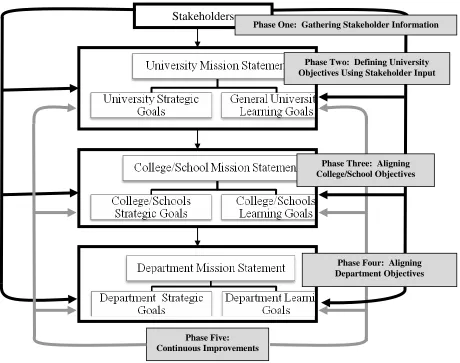
The research institution adopted Taskstream software to manage strategic planning and assessment activities. Taskstream simplifies administrative monitoring of university operations and easily generates reports detailing learning goal assessments. These reports help administrators determine whether academic units fail to update assessment records and identify gaps in cohesive learning objectives from the university, college/school and departmental levels. Moreover, patterns of similar failing assessment outcomes across departments can be highlighted and prompt administrators to consider more global improvement planning options, such as providing core subject tutoring labs, prerequisite changes, or curriculum modifications. The strategic planning and assessment model, shown in Figure 2, lays the foundation for meeting critical SACS and AACSB accreditation standards. AoL competencies (largely determined by stakeholders) drive the development of mission statements, learning outcomes and strategic goals (Garceau, 2011).
Figure 2: Strategic Planning and Assessment Model
Phase Three: Aligning Colleges/Schools Objectives
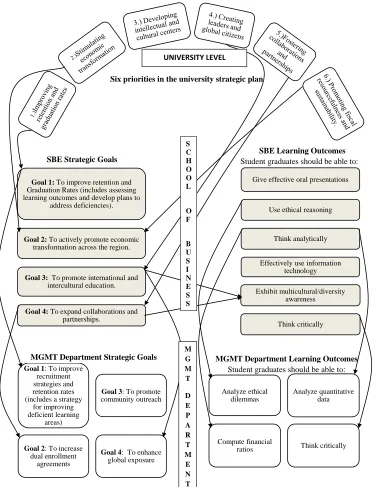
The School of Business and Economics convened an advisory board (consisting of graduates, business leaders, and potential employers) to solicit business stakeholder feedback. A school-wide assessment coordinator was also appointed to manage all assessment activities. Strategic goals and learning outcomes were developed based on the five university guidelines (listed in the previous section), the SUS findings and advisory board feedback. An SBE-wide assessment plan was established to outline general competencies that graduates should acquire through their business programs. Departments were provided guidelines for OPAR. SBE goals and learning outcomes are displayed in Figure 3. This table shows that university priorities 1-2 and 4-6 were incorporated in the SBE strategic goals. Additionally, stakeholder information was used to develop the SBE learning outcomes.
Stakeholders
Phase One: Gathering Stakeholder Information
Phase Four: Aligning Department Objectives
Phase Five: Continuous Improvements
Phase Two: Defining University Objectives Using Stakeholder Input
Figure 3: Strategic Goals and Learning Outcomes
Phase Four: Aligning Department Objectives
The fourth phase is the most challenging and taxing to effectively implement. This phase requires the department mission statements, goals, and learning outcomes be aligned with college/school objectives. The department should incorporate content-specific goals based on feedback from content area stakeholders. The most significant challenge is to get faculty to buy into the idea that developing learning goals and assessment strategies goes well beyond vague and perfunctory expressions of what concepts students should be learning in various classes. The objective is to encourage faculty members to work together within the department and school to develop stakeholder-driven learning outcomes. Tangentially, the process that is generally neglected (and sometimes ignored)
Six priorities in the university strategic plan
SBE Learning Outcomes
Student graduates should be able to:
Goal 1:To improve retention and
Graduation Rates (includes assessing learning outcomes and develop plans to
address deficiencies).
Goal 2:To actively promote economic transformation across the region.
Goal 3:To promote international and intercultural education.
Goal 4:To expand collaborations and partnerships.
Give effective oral presentations
Use ethical reasoning
Think analytically
Effectively use information technology
Exhibit multicultural/diversity awareness
Think critically
Goal 1: To improve recruitment strategies and retention rates (includes a strategy
for improving deficient learning
areas)
Goal 3: To promote community outreach
Goal 2: To increase dual enrollment
agreements
Goal 4: To enhance global exposure Analyze ethical dilemmas Analyze quantitative data Compute financial
ratios Think critically
SBE Strategic Goals
MGMT Department Strategic Goals MGMT Department Learning Outcomes
Student graduates should be able to:
necessitates faculty to examine course content and the general curriculum to ensure that core learning goals are reinforced throughout the semester and in other major courses; professors may need to collaborate and consider redesigning the course. By no means are the authors attempting to limit or stifle academic freedom. However, it is essential that both inputs (curriculum design) and outputs (assessment results) are examined in an attempt to improve student learning. Although this may be a cumbersome process, focusing on both inputs and outputs as a means of assessing operational performance levels is consistent with the BIC practices referenced in Figure 1.
Management department faculty reviewed all SUS findings, advisory committee feedback, and SBE strategic goals and learning outcomes. Following numerous discussions about how student learning would be assessed, faculty collectively adopted strategic and learning objectives. In some instances, the learning goals prompted faculty to redesign portions of their curriculum so that the objectives were consistently reinforced. Figure 3 shows that SBE strategic goals 1 (Improve Retention and Graduation Rates) and 3 (Promote International and Intercultural Education) were directly integrated into the Management departmental goals. SBE strategic goal 4 (Expand Collaborations and Partnerships) was exhibited through the department’s goal to increase dual enrollment agreements with community colleges. Figure 3 also highlights how Management department learning outcomes were directly linked to SBE learning objectives. Additional SBE learning outcomes that were not adopted in the Management department were included in other SBE department learning outcome plans.
Department strategic and learning outcomes were collectively mapped to SBE objectives to ensure consistency and collective competency coverage. Essentially, strategic goals were aligned from the SUS level down to the departmental units. Coordinated learning goals were adopted throughout each college/school. All university guidelines were followed regarding revising unit mission statements, updating (and aligning) strategic plans, organizing assessment initiatives, and maintaining Taskstream (OPAR, learning goals, assessment instruments, assessment data, and improvement plans). SBE administrators met to modify annual faculty evaluation rubrics to incorporate higher service ratings for faculty who actively participated in critical assessment activities. Critical assessment activities include creating assessment rubrics, administering instruments and analyzing data, and/or developing coordinated improvement plans. Salary increases for SBE faculty are heavily influenced by annual evaluation ratings.
Phase Five: Continuous Improvements
SBE requires departments to set target goals regarding student achievement for each learning outcome. Departments are mandated to review assessment results each year and develop plans to augment learning strategies when achievement goals are not attained. All deficient learning outcome areas must be reassessed the following year to determine the effectiveness of the improvement plans; after a year, if the plans do not improve student learning results, alternative solutions ought to be explored. Learning goals are continuously reassessed each year until the goals are consistently realized. All improvement plans, target goals, and assessment results are managed and maintained in Taskstream. Additionally, departments are required to include a strategy under their retention rates goal which addresses improving deficient learning outcome areas. The assessment data are continuously reviewed by the Dean and upper level administrators.
AoL MODEL DISCUSSION
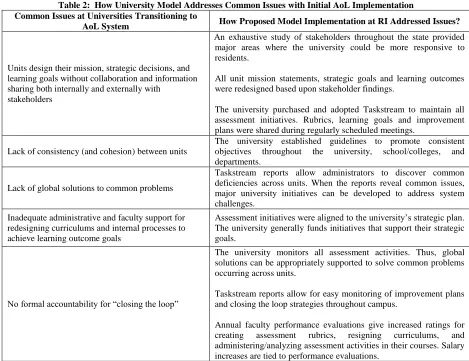
Table 2: How University Model Addresses Common Issues with Initial AoL Implementation Common Issues at Universities Transitioning to
AoL System How Proposed Model Implementation at RI Addressed Issues?
Units design their mission, strategic decisions, and learning goals without collaboration and information sharing both internally and externally with
stakeholders
An exhaustive study of stakeholders throughout the state provided major areas where the university could be more responsive to residents.
All unit mission statements, strategic goals and learning outcomes were redesigned based upon stakeholder findings.
The university purchased and adopted Taskstream to maintain all assessment initiatives. Rubrics, learning goals and improvement plans were shared during regularly scheduled meetings.
Lack of consistency (and cohesion) between units
The university established guidelines to promote consistent objectives throughout the university, school/colleges, and departments.
Lack of global solutions to common problems
Taskstream reports allow administrators to discover common deficiencies across units. When the reports reveal common issues, major university initiatives can be developed to address system challenges.
Inadequate administrative and faculty support for redesigning curriculums and internal processes to achieve learning outcome goals
Assessment initiatives were aligned to the university’s strategic plan. The university generally funds initiatives that support their strategic goals.
No formal accountability for “closing the loop”
The university monitors all assessment activities. Thus, global solutions can be appropriately supported to solve common problems occurring across units.
Taskstream reports allow for easy monitoring of improvement plans and closing the loop strategies throughout campus.
Annual faculty performance evaluations give increased ratings for creating assessment rubrics, resigning curriculums, and administering/analyzing assessment activities in their courses. Salary increases are tied to performance evaluations.
Sustaining Accreditation after Model Implementation
Although the research institution successfully switched over to student learning-based standards that are driven by stakeholders, the ongoing challenge is to maintain these accreditation standards. The authors’ sustainability efforts led them to explore trends that occur after universities attain accreditation and implement the proposed framework. Mission statements were examined, as well as tenure, promotion and reappointment (TPR) guidelines, to ascertain whether there are significant differences between these documents at AACSB vs. non-AACSB schools. Mission statements were probed because most accreditation agencies require both institutional and departmental mission statements to reflect the long-term vision for the university and demonstrate compliance with agency policies. TPR guidelines impact the actions and behavior of faculty who are responsible for ensuring that accreditation standards are maintained. In general, both mission statements and TPR guidelines play instrumental roles in shaping strategic and operational decisions that ultimately impact accreditation. The authors surmise that more AACSB accredited schools will have language reflecting top BIC practices in mission statements and TRP guidelines vs. non-AACSB schools because these congruencies would help universities maintain their AACSB status, and they sought to explore the following Hypotheses:
Hypothesis 1: A greater proportion of university mission statements from AACSB accredited business schools in the US contain language about top BIC practices as compared with non-AACSB schools.
Hypothesis 2: A greater proportion of business school mission statements from AACSB institutions in the US contain language about top BIC practices as compared with non-AACSB schools.
A web-based search was conducted for colleges/universities that awarded bachelors, masters and/or doctoral degrees in the US. An internet search was used in lieu of surveys or interviews because documents online exhibit a degree of visibility, accessibility and transparency that AACSB accredited institutions should strive for. Excluding for profit institutions, 1,808 schools met this criteria. The initial sample of interest consisted of 1,776 schools in the US which had accessible mission statements posted online. The second sample was comprised of 1,015 business schools that posted their mission statements on the school website. The mission statements for both the universities and business schools were perused for language reflecting some of the top BIC practices outlined in Figure 1.
Only five of eight BIC practices from Figure 1 were directly applicable to academia. These five BIC practices include collaborating, being stakeholder-driven, improving information technologies, commitment of management, and having an appropriate reward system. The BIC practice about having an appropriate reward system should be put into the proper context for a university setting. Faculty are ultimately rewarded through attaining tenure, promotion, or reappointment. Since universities desire to maintain accreditation and many regional/program specific agencies emphasize student learning initiatives, language related to learning should be a pervasive theme throughout the university; more specifically, referencing student learning initiatives in mission statements and TPR guidelines would encourage and stimulate faculty to improve AoL standards.
The number of university and school of business mission statements containing language related to collaborating, being stakeholder-driven, improving information technologies, commitment of management or having an appropriate reward system was recorded in Tables 3 and 4. The majority of the proportions associated with university and school of business mission statements in Table 4 offer support for Hypotheses 1 and 2. For each of the practices, there are a greater proportion of university mission statements from AACSB schools that have language associated with top BIC practices. There are also statistical differences between AACSB and non-AACSB schools regarding the proportion of university mission statements that include language about collaboration (p-value < 0.0001), being stakeholder-driven (p-value = 0.0048), or dedication to student learning (p-value < 0.0001). In four of five practices, there is a greater proportion of business school mission statements from AACSB institutions that contain verbiage about BIC practices; tangentially, statistical tests reveal significant differences between the proportion of business school mission statements from AACSB vs. non-AACSB schools that use language which promotes collaboration value = 0.0278), stakeholder involvement value < 0.0001), and student learning (p-value < 0.0001). Language regarding information technologies and administrator commitment was similar among AACSB and non-AACSB schools for both types of mission statements.
Table 3: Number of Universities, Business Schools and TPR Guidelines Posted Online
Universities in US
Universities with Accessible Missions
Business Schools in US
Business Schools with Accessible
Missions
Schools with TPR Guidelines Available
Online
AACSB 596 487 496 471 203
Non AACSB 1212 1289 551 544 316
Table 4: BIC Practices in Universities and Schools of Business Mission Statements BIC Practice Example of Language in Mission Statements AACSB School with Accessible Business School Mission (n = 471)
Non AACSB School with
Accessible Business Mission
(n = 544)
Test
Statistic p-value
AACSB School with
Accessible University Mission (n = 487)
Non AACSB School with Accessible University Mission (n = 1289)
Test
Statistic p-value
Is collaboration between departments, the community and/or external companies encouraged? collaboration, working together, partnership 296 (62.8%) 201
(37.0%) 8.2308 < 0.0001
315 (64.7%)
760
(59.0%) 2.2006 0.0278
Does the mission statement express a concerted effort to include or satisfy the demands of stakeholder? stakeholder, graduate schools, industry involvement, community 272 (57.7%) 266
(48.9%) 2.8181 0.0048
186 (38.2%)
293
(22.7%) 6.5501 < 0.0001
Is there a commitment to improving information technologies? information technology, computer information systems, connectivity 160 (34.0%) 167
(30.7%) 1.1124 0.2660
102 (20.9%)
221
(17.1%) 1.8518 0.0640
Is there explicit language which mentions the support of administrators, deans, chancellor, board of trustees etc. to the mission?
commitment of administrators, board of trustees
12 (2.5%)
11
(2.0%) 0.5613 0.5746
15 (3.1%)
54
(4.2%) -1.0792 ~1.0
Does there appear to be an appropriate reward system that encourages proper behavior (ie stresses student learning)?
commitment to learning, student achievement, student centered 258 (54.8%) 232
(42.6%) 3.8568 < 0.0001
301 (61.8%)
614
The authors wanted to examine TPR guidelines for schools of business to shed light on how faculty are evaluated and their subsequent reward system. An internet search for TPR documents was done for all 1,808 colleges/universities in the US that award bachelor, master and/or doctoral degrees. There were 519 schools which posted their TPR guidelines online. Table 5 displays the number and proportion of TPR documents that had verbiage about research, teaching, service, student learning and grantsmanship. There is a statistical difference (p-value = 0.0022) between the proportion of TPR documents that contain statements about student learning in AACSB vs. non-AACSB accredited institutions. Thus, the results offer support for Hypothesis 3 and indicate that AACSB schools make more of an effort to show that their rewards system is consistent with the business schools’ desire to maintain student learning standards and sustain AACSB accreditation.
Table 5: Contents of TPR Documents Available Online
TPR Documents Available Online Test Statistic p-value AACSB (n = 203) Non AACSB (n = 316) - -
Research 203 (100%) 316 (100%) - -
Teaching 203 (100%) 316 (100%) - -
Service 203 (100%) 316 (100%) - -
Student Learning 83 (40.9%) 91 (28.8%) 2.8470 0.0022
Grantsmanship 74 (36.5%) 54 (17.1%) - -
In this section, the authors wanted to examine whether there were apparent differences in the language of university mission statements, school of business mission statements and TPR guidelines in AACSB vs. non-AACSB institutions. As colleges/universities work to sustain their accreditation status, disparities in the mission statements could give insight into the type of language that should be included in these documents. Tables 3-5 offer support for Hypotheses 1, 2 and 3. Verbiage about collaborating, stakeholders and student learning were more common in AACSB documents. In general, many of the top BIC practices are consistent with AACSB standards. Thus, using language that parallels top BIC practices in mission statements and TPR guidelines would be beneficial for institutions desiring to maintain their accreditation status.
CONCLUSION AND FUTURE WORKS
As more business schools seek to attain AACSB accreditation, institutions will need guidance in transitioning to a stakeholder-driven AoL system. In practice, transitioning to an AoL-based assessment environment requires a challenging balance of collaboration, joint planning, using information technologies and strategizing throughout an academic institution. Ultimately, the proposed framework is a compilation of the best practices adopted by the research institution and an intense review of supply chain management literature about best in class companies. This research serves as a guide to institutions transitioning to an AoL system; the model merges strategic planning and assessment processes in order to meet both SACS and AACSB re-accreditation standards.
Faculty collectively devised all assessment and strategic goals in the proposed framework for their respective departments. Common practice is to have an assessment committee develop department objectives and present them to faculty. By replacing this process with faculty derived measures, faculty cooperation and willingness to implement the new system was improved. Moreover, through incorporating assessment activities into annual evaluations, faculty participation increased. Additionally, the adoption of Taskstream software to manage all university assessment initiatives provided seamless management oversight of all activities. This oversight allows for quick identification of units failing to complete required tasks and/or “close the loop.”
AUTHOR INFORMATION
Dr. Constance Lightner has been an Associate Professor in the Department of Management at Fayetteville State University since January 2000. She attained her PhD in Operations Research from North Carolina State University. Her research interests include Fuzzy logic, genetic algorithms and route scheduling optimization. E-mail: [email protected]
Dr. Carin Lightner-Laws is a consultant at Bonnie Speed Logistics. She attained her PhD in Operations Research from North Carolina State University in 2008. Her research interests include tabu search algorithms, simulating annealing and transportation route optimization. E-mail: [email protected] (Corresponding author)
REFERENCES
1. AACSB International. (2003). Eligibility procedures and standards for business accreditation. St. Louis, MO.
2. AACSB (2006). Eligibility procedures and accreditation standards for business accreditation. Retrieved July 13, 2011, from http://www.aacsb.edu/accreditation/business/STANDARDS. pdf
3. AACSB. (2007). AASCB assurance of learning standards: An interpretation. Retrieved July 13, 2011 from http://www.aacsb.edu/accreditation/Papers/ AOLPaper-final-11- 20-07 .pdf
4. AllBusinessSchools (2012). Business school accreditation. Retrieved March 12, 2012 from http://www.allbusinessschools.com/business-careers/business-school-101/accreditation
5. Ammons, J. L., & Mills, S. K. (2005). Course-embedded assessments for evaluating cross-functional integration and improving the teaching learning process. Issues in Accounting Education, 20(1), 1-19. 6. Apostolou, B. A. (1999). Outcomes assessment. Issues in Accounting Education, 14(1), 117-197. 7. Buckman, K. (2007). What counts as assessment in the 21 century? Thought and Action: NEA Higher
Education Journal, 23, 29-37.
8. Business-Higher Education Forum (2004). Public Accountability for Student Learning in Higher Education. Retrieved June 2011 from http://www.bhef.com/publications/documents/public_accountability_04.pdf (American Council of Education).
9. Christopher, M. (1992). Logistics and supply chain management. London: Pitman Publishing.
10. Coyle, J., Langley, C., Gibson, B., Novack, R., & Bardi, E. (2008). Supply chain management: A logistics perspective. Ohio: South-Western Cengage Learning.
11. Economist Intelligence Unit (2009). A demand driven supply chain: A holistic approach. Retrieved from http://viewswire.eiu.com/report_dl.asp?mode=fi&fi=1304214915.PDF&rf=0
12. Fawcett, S. (2008). Benefits, barriers, and bridges to effective supply chain management. Supply Chain Management: An International Journal, 13(1), 35-48.
13. Garceau, L., & Tarnoff, K.A. (2011). Seeking initial or maintenance of accreditation: What a peer review team really looks for when it comes to AoL. AACSB Assessment Conference, Atlanta, GA. March 14-16, 2011.
14. Gardiner, L. R., Corbitt, G., & Adams, S. J. (2010). Program assessment: Getting practical how to model. Journal of Education of Business, 85, 139-144.
15. Kelley, C., Tong, P., & Choi, B.J. (2010). A review of assessment of student learning programs at AACSB schools: A dean’s perspective. Journal of Education of Business, 85, 299-306.
16. Lightner, C. (2011). Integrating AoL into the strategic planning process. AACSB Assessment Conference, Atlanta, GA. March 14-16, 2011.
17. Lubinescu, E.S., Ratcliff, J.L., & Gaffney, M.A. (2007). Two continuums collide: Accreditation and assessment. New Directions for Higher Education, 113, 5-21.
18. Martell, K. (2007). Assessing student learning: Are business schools making the grade. Journal of Education of Business, 82, 189-195.
19. Mentzer, J., DeWitt, W., Keebler, J., Min, S., Smith, C., & Zacharia, Z. (2001). Defining supply chain management. Journal of Business Logistics,22(2), 1-25.
20. Mittelstaedt, R. (1992). Benchmarking: How to learn from best-in-class practices. Global Business and Organizational Excellence, 11(3), 301-315.
22. Patton, M. (2001). Learned evaluation, knowledge management, best practices, and high quality. American Journal of Evaluation,22, 329-336.
23. Pringle, C., & Michel, M. (2007). Assessment practices in AACSB accredited business schools. Journal of Education of Business, 82,202-211.
24. SACS (2007). Principles of accreditation: Foundation for quality enhancement. 2007 Interim Edition. Retrieved June 2011 from http://www.sacscoc.org/pdf/2007%20Interim%20Principles%20complete.pdf 25. SACS (2008). Principles of accreditation: Foundation for quality enhancement.2008 Edition. Retrieved
June 2011 from http://www.sacscoc.org/pdf/2008PrinciplesofAccreditation.pdf
26. Shaftel, J., & Shaftel, T. L. (2007). Educational assessment and the AACSB 2007. Issues in Accounting Education, 22, 215-232.
27. Stephens, Scott (1998), Supply chain council and supply chain operations reference. (SCOR) model overview. Retrieved January 2012 from
http://www.myvsp.cn/technology/Ma%20eBooks4/supplier%20chain%20operation%20reference_overvie w/supplier%20chain%20operation%20reference_overview.pdf
28. Stewart, G. (1995). Supply chain performance benchmarking study reveals keys to supply chain excellence. Logistics Information Management,8(2), 38-44.
29. Tompkins, J. (2000). Speech presented at the warehouse of the future conference (Atlanta, GA).
30. UNC Tomorrow Commission (2007). UNC tomorrow commission final report. Retrieved June 2011 from http://www.northcarolina.edu/nctomorrow/reports/commission/Final_Report.pdf
31. Van Vught, F. A. (1994). Intrinsic and extrinsic aspects of quality assessment in higher education. In Westerheijden, D.F., Breenan, J., and Massen, P. A. M. (eds.), Changing contexts of quality assessment. Utrecht: Lemma.
32. Weldy, T. G., Spake, D. E., & Sneath, J. Z. (2008). Challenges and best practices: Meeting AACSB and SACS requirements. Proceedings of the 4th Annual Academic Business World International Conference, 119-128.