934
Enhancement Of Employees Performance Via
Professional Training And Development: A Study
On Oil And Gas Companies Operating In Yemen.
Gehad Mohammed Ahmed Naji, Ahmad Shahrul Nizam Isha, Mohammed Alzoraiki, Osama Sharafuddin, and AL-Baraa Abdulrahman AL-Mekhlafi
Abstract: Human resources (HR) in any organization around the world need to cope with the changes in business techniques. Employee training is considered the main factor to increase organizational performance. Training is considered as the best method to identify and help employees do their required works effectively, correctly, conscientiously and safely. The research work study focused on the training and improvement of employee performance at oil and gas companies operated in YemenThe aim of this study is to investigate the effect of training on employees’ performance. The quantitative technique was conducted surveys by questionnaires that were utilized as instruments to assemble information to i nvestigate the relationship between training and employee performance. A survey has been conducted in oil and gas companies operated in Yemen, yielding responses from 150 out of 200 employees. Then, the data was studied and analyzed using Smart PLS 3.0 to test the hypothesis that comprised the two factors of training and employee performance. Bootstrapping was performed to investigate the standard error of the estimate and t-values. The results of this research work study showed that training has an obvious and positive effect on employee performance in Yemen’s oil and gas companies. And their performance influenced by the training. The relationship between training and employee performance affirmed that it is beneficial to implement a successful training program at oil and gas companies in Yemen. HR management are required to find a suitable and relevant training program for all individual employee in the organization. However, the study would help Yemeni companies to develop and improve the HR workforce, which in turn will enhance the effectiveness and the success of the companies. Moreover, this research study would provide the management of Yemen oil and gas companies with supportive guidelines and recommendations.
Keywords: Training, employee performance, oil and gas. Yemen
—————————— ——————————
1.
INTRODUCTION
Organizations around the world strive to succeed and compete those in the same industry. Therefore, Any organization is required to handle and control human resources effectively [1]. It needs to update and follow up all new technologies and innovations to train their staff respectively. Consequently, department managers have to pay more attention and choose a relevant training program for their staff that in return will benefit the employees and increase and enhance their performance. [2]. In addition, both social and economic sections have a great impact on the success of any organization [3]. Oil and gas companies need to develop their staff, so, they can face the challenges, improve employee performance and manage to put in place local trained employees to replace expatriates [4]. Thus, in the current economy, employee performance is an important factor for organizations to increase a competitive advantage in the business world [5]. The oil and gas companies in Yemen like everywhere in the world consists of three sectors, the national oil company that represents the government such as Petromasila and SAFER. The second type of companies are the giant service companies such as Schlumberger, Weatherford and Halliburton. Finally the operating companies such as Total, OMV and Canadian Nexen [6]. For instance, Schlumberger that has a branch in Yemen is a world-driving provider of specialized solutions, coordinated project administration and data to clients working in the oil and gas industry around the world .With more than 100,000 individuals across 140 nationalities and working in excess of 85 nations, Schlumberger offers the industry's broadest scope of items and services through investigation and production [7]. Likewise, SAFER Exploration & Production Operations Company, is considered a pioneer national oil and gas company in Yemen leading both upstream and midstream operations. SAFER provides and produce more than 40,000
bbl of oil per day and 2.4 Billion SCF of natural gas per day. SAFER recruited more than 1300 Yemeni and 100 international and professional expatriate. Thus, the main purpose of this research work study is to focus on the impact of training and analyse the performance of employees at the any origination. In Yemen, there are few research and studies relevant to concentrate on this subject, as well as there is a remarkable lack of empirical studies on Yemeni organizations in terms of training of employees that may help to enhance the performance rate among Yemeni employees at oil and gas companies.
2.
REVIEW
OF
LITERATURE
AND
DEVELOPING THEORY
2.1 Training Concept
by inspiring them and changing them into well arrange and very much mannered, that at least influences the execution of association. Laing [11] characterize training as a marker to upgrade predominant aptitudes, learning, capacities and viewpoint of the representatives that outcomes in viable execution of the labourer’s. Nonetheless, he includes one thing progressively that it (training) expands the generation of the association. Training is a functioning way to empower individual to make utilization of his capacity and his potential ability. Mzimela, et al. [12] stated that, providing the training, development, and education for employees at the right time provides significant rewards for the organization in increasing their productivity, knowledge, loyalty, and contribution. In order to serve the employees to do their work as wanted, the organizations should provide pieces of training to improve staff capabilities. When employees realize their organizations’ interest in their capabilities by offering training programs, they will do their best to achieve organizational goals and display better performance in their work [13]. Additionally, previous studies also provide evidence that HR activities in increase training [14-17] . In this direction, employee performance improves. Consequently, training and development help organizations to continue competitively on the market [18]. In this view, organizations should create a professional environment that stimulates employees' knowledge of their organization, as well as their competitiveness [19].
2.2 Employee Performance
Paul [20] identified that, the performance of employees typically taken a glance at as far as outcomes. However, it can likewise be taken a gander at as far as behaviour. Communicated that representative execution is assessed against the execution rules set by the organization. There are different appraisals that can be pondered while evaluating execution, for example using of benefit, ampleness, profitability, quality and productivity measures [21, 22] as fast illuminated starting now and into the foreseeable future [23]. Proficiency and viability - productivity is the capacity to deliver the coveted outcomes by utilizing as insignificant assets as could be allowed while adequacy is the capacity of workers to meet the coveted goals or target. It is a proportion of how the individual, organization and industry changes over information assets into products and ventures [24]. The proportion of how much yield is delivered per unit of assets employed.
2.3 Relationship between training and employee performance
An examination by Al-Nuseirat and Biygautane [25] analysed the connection between training practices / adequacy and organizational execution in Dubai's open division demonstrated that the training has a positive effect on organizational execution in the government of Dubai. Similarly, Alsamawi, et al. [26] conducted the study about 108 of workers to look at the connection among training and its effect on representative execution in the organizations at oil and gas corporations in Yemen [26] . Consequence of study demonstrated that training prompts an enhanced the performance of employee's. Nizam, et al. [27] studied the training effected and advancement, on the job training, the conveyance of the training configuration style of hierarchical execution among 100 workers of various associations in Islamabad, capital of Pakistan. The study found that,
development and training, on the career training, the delivery of design training style has huge impact on hierarchical execution and all these have unequivocally affected the organization performance. Actually, authoritative development and improvement is influenced by various components. However, the present research among the improvement of associations, training of employee assumes an essential career in increasing performance and also expanding efficiency. This is thus prompts putting associations in better positions to confront rivalry and remain in the best. This, along these lines infers a presence of a critical distinction between the associations that prepare their workers and associations that don't. Existing literature presents proof of a presence of evident impacts of training and development on employee performance. A few study have proceeded by taking a glance at execution regarding worker performance specifically [28] however others have outstretched to a general viewpoint of organization performance. Regarding empirical studies of employee training and employee performance, several scholars have found a positive role of employee training in employee performance [13]. According to Asfaw, et al. [29] conducted a research in Ethiopia to investigate the relationship between employee training and development and found a significant and positive relationship between two variables. Another study conducted in Pakistan and found a significant influence of employee training and development on employee performance [30]. Consequently, on the basis of the above discussion, the present study hypothesis that employee training leads to higher employee performance.
H1: There is a positive relationship between employee training and performance of employees at Oil and Gas Company in Yemen
3.
RESEARCH METHODOLOGY
The data was collected from the employees of oil and gas companies of Yemen, therefore, the unit of analysis of the study were individuals. The sector of the study was the oil and gas industry, data collected from their employees related to training, and employee performance. The nature of the study is cross-sectional, which means that only one time data is collected from the employees. The employees of the oil and gas companies of Yemen are the population of the current study, and the sample selected from a large population that represents the overall population.
3.1 Research Design
936
goal to create models or discover trends in the information. This methodology can dissect various needy and autonomous factors with the end goal to discover and measure connections between them.
3.2 Population and Sample Research
Sekaran and Bougie [33] stated that, the population as: "the whole gathering of occasions, individuals, or anything of premium which the special wishes to examine (in view of test insights)". Hence, for this research, the population comprised of representatives in various oil and gas companies situated in Yemen. There is a need to determine the sample size. For the most part, the testing procedure includes three stages, which are perceiving the populace, recognizing the span of the example and test determination [33]. Then, the whole populace of the examination must be spoken to by a subset of 200 employees. For this example, measure is somewhere in the range of 30 also, 500, it agrees with Roscoe's general rule and is from this time forward respected sensible for research [34].
3.3 Procedure
The questionnaire was developed based on the literature of related subjects. The questionnaire was randomly distributed to the respondents, and they were informed of the main
objectives of this study in order to gain their full interest and cooperation and to ensure the questionnaire was completed accurately. The questionnaire comprised of three areas. Area one got some information about the demographic variables. Area two got some information about the preparation level and segment there are 10 items. The last segment of the survey, Area three, is the worker's execution level and comprises 10 items The survey of this study comprised of an arrangement of close-ended inquiries in the second area and third segment an arrangement of 5-point.
3.4 Data Collections
The veritable data gathering began and the flow of the questionnaires was done through email to the specific respondents. They were given around two weeks to complete the questionnaires. The researcher has distributed 200 forms. A total of 150 questionnaires were revert through the google frameworks. Then, Statistical package of social science (SPSS) tests was conducted and the results were analysed. The descriptive statistical analysis findings consist of the frequency investigation and using the mean of the information. Moreover, and Smartpls3 has been used to test the hypothesis.
Table 1: Gender
4.
RESULTS AND FINDINGS
4.1 The descriptive analysis
Descriptive numerical methods were used to describe the graphical profiles for respondents who work at the oil and gas companies operated in Yemen.As shown in table 1, the majority of people who responded were male (95.3%) while only (4.9%) were females. As the result of the age showed in
table 2 that the responses obtain between the age of (40-49) is 46 % and the response between the ages of (30-39) is 35.3%, which additionally respondent between the age of (20-29) comprised of 12.7 and the age of (50 or more) comprised of 6.0% which implies that most of the relies acquired are between 40 - 49 years’ age.
Table 2: Age
Similarity in table 3 shown that (59.3%) were having a Bachelor degree, (23.3%) having master’s degree and obtained a Diploma degree, (9.3%) were doctorate degree
holders, (6.7%) were and (1.3%) were high school holders. Accordingly, the majority of participants have a bachelor degree.
Regarding to working experience table 4 illustrated that 20.7% of the participants have one to four years of experience, from ten to fifteen years of experience there are
42 %, and from five to nine years of experience are 24.7%, finally for participants who have more than fifteen years of experience is 12.7%.
Table 4: working Experience
4.2 Model of the measurements
To analyze the properties for the measurement scale, a conformity factor diagnosis was used to examine and confirm
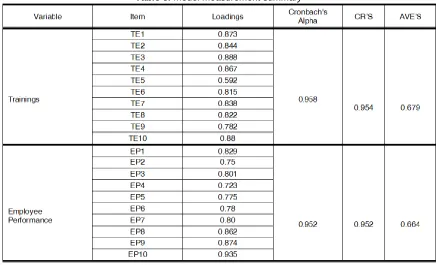
the convergent validity, reliability and discriminant validity as illustrate in below table 5.
Table 5: Model measurement summary
4.2.1. Validation of Convergent
The measurement scales mean the how reliable is the variables that constantly calculate and measure the same construct. The reliability test and average variance extracted (AVE) use the Cronbach’s Alpha as measurement factor as in table 5. All the reliabilities and Cronbach’s Alpha factors have to be more than 0.7 and for the AVE’s should exceed 0.5 as shown in the above tables. As shown in the result the Alphas coefficient variables are a > 0.70. The Cronbach’s for the training variable is 0.958. While the coefficient alphas factor for employee performance is 0.952.
4.2.2 Validation of the Discriminant
To evaluate and assess the items measure distinct concept we use the discriminant validity. In such analysis, comparison of square root of AVE with correlation between constructs. The Square root of the AVE have to be more that the links between the construct in order to consider it as valid. As illustrated below in table 6 that all AVE square roots exceed and more than the correlation factor values. According to table 5 and table 6, it is obvious that all measurement model results were satisfactory.
938
4.3. Model structure
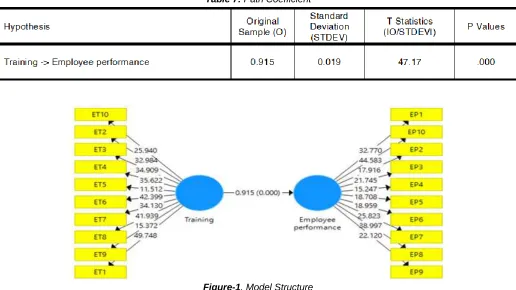
The model structure is conducted and applied to test the hypothesis and evaluate the causal relationships between the constructs. Particularly, while checking the R2 and the path coefficient, It can be decided if the relationship between constructs are well-established and the hypothesis is strongly supported or not. As shown in table 7 the path coefficient and
figure number 1 the model structure that show the results that come up from the PLS output. For the hypothesis results which demonstrated a positive and significant relationship between training and employee performance (T = 47.17, P = 0.000 < .05); accordingly, the hypothesis is supported. Therefore, providing more training programs will result in higher performance among all staff.
Table 7: Path Coefficient
Figure-1. Model Structure
5.
DISCUSSION AND CONCLUSIONS
This research work study examined the impact of conducting training courses on staff performance. The findings revealed that training influence the performance of the employees. In general, the current study supported previous studies [14-17]. Thus, the outcomes and results assured importance of training to enhance the performance of the staff at any company. Costen, et al. [35] showed that employees who are fully aware of the availability of training programs would rather to stay on their institutions. Likewise, Renaud, et al. [36] assured that trainings would have a positive influence on employees retention. According to all sated studies, organizations that support their staff to conduct trainings are more likely to have a stable staff and can keep them for a longer time. Moreover, this result is in accordance with past investigations of Al-Mzary, et al. [37] who discovered that there is a connection between impact training and employees’ job performance at Malaysian small and medium enterprise. [1] mentioned that, the training has a clear effect on the employee's performance. In addition, the connection between training and employee performance in Yemen, particularly in oil and gas segment has been overlooked. According to Ashton and Tourism [38] that affirmed the training develop a job satisfactory among staff that reflect the service quality of for their performance. Such result revealed that the training programs significantly reduce the stress and increase the
employee performance by graphical and statistical results. Which means that providing valuable and professional training to existing employees will positively improve the performance of the staff while doing their daily work within their current organizations. These facts and findings support the previous studies that affirmed the role of training on employees performance [39]. All in all, the significance of training programs in all types of organizations have been highlighted in previous literature. Furthermore, it is essential to analyse any problem regarding training seriously and try to come up with effective solutions. The inspiration behind such investigation is to examine the effect of training on worker performance through the Yemen oil organization. Additionally, few objectives are producing to encourage an unmistakable accomplishment of the motivations behind the study. However, these incorporate what are the training programs that exist in the Yemen oil organization, what techniques are utilized, what are the training targets and do these strategies meet the training goals, lastly inspect the impacts of training on workers' performance.
6.
FURTHER RESEARCHES SUGGESTIONS
This outcome provides some possible areas for future research. It will be useful to identify the relationships and the strength of the relationships of these factors on effective training and the quantitative effects on the various learning processes that contribute towards the effectiveness of training programs. It is also recommended that future research be carried out to study on business management programs in public organizations and performance and effectiveness. These recommendations serve to strengthen the training program; it cannot be left to chance; it needs integrated efforts of all, only then the development of human capital can be realized.
7.
ACKNOWLEDGMENTS
Universiti Teknologi PETRONAS is acknowledged
8.
REFERENCES
[1] A. Nassazi, "Effects Of Training On Employee Performance.: Evidence from Uganda," 2013.
[2] J. Rissanen, "Globalizing human resource management successfully: case Hunkemöller International BV," 2019. [3] N. Chams, J. J. R. García-Blandón, Conservation, and
Recycling, "On the importance of sustainable human resource management for the adoption of sustainable development goals," vol. 141, pp. 109-122, 2019.
[4] I. S. Anthony, I. V. O. Modo, O. I. J. J. o. H. R. Anthony, and S. Studies, "Oil and Gas Contracting Firms Compliance to Nigerian Local Content on Industrial Growth Using a Study of Saipem Contracting Nigeria Limited," vol. 7, no. 1, pp. 1-12, 2019.
[5] H. Khan, J. D. J. J. o. O. Wisner, and S. C. Management, "Supply chain integration, learning, and agility: Effects on performance," vol. 12, no. 1, p. 14, 2019.
[6] P. Dresch and D. Paul, A history of modern Yemen. Cambridge University Press, 2000.
[7] Y. Lung, J.-J. Chanaron, T. Fujimoto, and D. Raff, Coping with variety: flexible productive systems for product variety in the auto industry. Routledge, 2018. [8] A. M. Al-Mughairi, "The evaluation of training and
development of employees: the case of A national oil and gas industry," Brunel University London, 2018. [9] M. Van Wart, Leadership in public organizations: An
introduction. Taylor & Francis, 2017.
[10] A. Akugri, "Examining the impact of training and development on employees performance_a case study some selected national health insurance scheme offices within the Kumasi Metropolis," University of Education, Winneba, 2017.
[11] I. F. Laing, "The impact of training and development on worker performance and productivity in public sector organizations: A case study of Ghana Ports and Harbours Authority," 2009.
[12] T. Mzimela, C. J. A. J. o. H. Chikandiwa, Tourism, and Leisure, "Employee training and development practices in the tourism and leisure sector in KwaZulu-Natal, South Africa," vol. 6, no. 4, pp. 1-17, 2017.
[13] A. Elnaga, A. J. E. j. o. B. Imran, and Management, "The effect of training on employee performance," vol. 5, no. 4, pp. 137-147, 2013.
[14] J. P. J. D. Wilson and L. i. Organizations, "International human resource development: Learning, education and training for individuals and organisations," 2014.
[15] S. Shafiq, S. M. J. I. J. o. E. Hamza, Learning, and Training, "The effect of training and development on employee performance in private company, Malaysia," vol. 2, no. 2, pp. 7-12, 2017.
[16] M. E. Motlokoa, L. P. Sekantsi, and R. P. J. I. J. o. H. R. S. Monyoloc, "The Impact of Training on Employees’ Performance: The Case of Banking Sector in Lesotho," vol. 8, no. 2, 2018.
[17] A. Ditta, "Assessment of Human Resource Management Practice in Ethiopian Broadcasting Corporation," Addis Ababa University, 2019.
[18] J. Ford, K. Kraiger, S. Merritt, S. Kozlowski, E. J. L. Salas, training,, and d. i. organizations, "The multidimensionality of learning outcomes revisited," pp. 135-165, 2010.
[19] M. A. Huselid and B. E. Becker, "Bridging micro and macro domains: Workforce differentiation and strategic human resource management," ed: Sage Publications Sage CA: Los Angeles, CA, 2011.
[20] S. Paul, "An Analysis of Generation tendency in the work place: Effect of different generation on work behavior," 2019.
[21] B. W. Mwangi and R. J. I. J. o. C. A. Njuguna, "Performance Appraisal Strategies on Performance of Teachers in Public Secondary Schools in Kiambu County, Kenya," vol. 3, no. II, pp. 218-230, 2019.
[22] Y. Pambreni, A. Khatibi, S. Azam, and J. J. M. S. L. Tham, "The influence of total quality management toward organization performance," vol. 9, no. 9, pp. 1397-1406, 2019.
[23] D. F. Haas, Interaction in the Thai bureaucracy: structure, culture, and social exchange. Routledge, 2019. [24] D. Nuscheler, A. Engelen, and S. A. J. J. o. B. V. Zahra, "The role of top management teams in transforming technology-based new ventures' product introductions into growth," vol. 34, no. 1, pp. 122-140, 2019.
940
[26] M. A. Alsamawi, M. R. Darun, S. K. Panigrahi, and A. A.-A. H. J. s. Al-Refaei, "Investigating the Effect of Corporate Social Responsibility and Affective Commitment on Corporate Performance in Oil and Gas Corporations in Yemen," vol. 17, no. 1, pp. 41-56, 2019. [27] K. Nizam, F. M. J. i. j. o. m. s. Shah, and research,
"Impact of employee motivation on organizational performance in oil and gas sector of Pakistan," vol. 3, no. 12, pp. 7-15, 2015.
[28] J. Purcell, Understanding the people and performance link: Unlocking the black box. CIPD Publishing, 2003. [29] A. M. Asfaw, M. D. Argaw, L. J. J. o. H. R. Bayissa, and
S. Studies, "The impact of training and development on employee performance and effectiveness: A case study of District Five Administration Office, Bole Sub-City, Addis Ababa, Ethiopia," vol. 3, no. 04, p. 188, 2015. [30] N. Tahir, I. K. Yousafzai, S. Jan, M. J. I. J. o. A. R. i. B.
Hashim, and S. Sciences, "The Impact of Training and Development on Employees Performance and Productivity A case study of United Bank Limited Peshawar City, KPK, Pakistan," vol. 4, no. 4, p. 86, 2014.
[31] A. J. A. h. f. s. s. f. r. E. Gottlieb, b. s. o. r. design, and methods, "Ethnographic Methods: Ethnography: Theory and Methods'," 2006.
[32] J. W. Creswell and J. D. Creswell, Research design: Qualitative, quantitative, and mixed methods approaches. Sage publications, 2017.
[33] U. Sekaran and R. Bougie, Research methods for business: A skill building approach. John Wiley & Sons, 2016.
[34] U. Sekaran and R. Bougie, "Research for Business–A Skill Building Approach," ed: John-Wiley and Sons, New York, NY, 2010.
[35] W. M. Costen, J. J. J. o. H. R. i. H. Salazar, and Tourism, "The impact of training and development on employee job satisfaction, loyalty, and intent to stay in the lodging industry," vol. 10, no. 3, pp. 273-284, 2011.
[36] S. Renaud, L. Morin, J.-Y. Saulquin, and J. J. I. J. o. M. Abraham, "What are the best HRM practices for retaining experts? A longitudinal study in the Canadian information technology sector," 2015.
[37] M. M. M. Mzary, A. D. rifai, M. O. E. J. J. o. E. Al-Momany, and Practice, "Training and Its Impact on the Performance of Employees at Jordanian Universities from the Perspective of Employees: The Case of Yarmouk University," vol. 6, no. 32, pp. 128-140, 2015. [38] A. S. J. J. o. H. R. i. H. Ashton and Tourism, "How
human resources management best practice influence employee satisfaction and job retention in the Thai hotel industry," vol. 17, no. 2, pp. 175-199, 2018.