————————————————————
1. BACKGROUND
Deep Learning is an important function in artificial intelligence that work similar to that of our brain in processing data and it creates pattern, which are helpful in decision making. Deep learning is a part of machine learning in Artificial Intelligence, which has the capability of learning any unsupervised data that even the data may be in unlabeled, or in unstructured form. In this digital era, the applications are aligned with deep learning functionalities, which has brought a sudden increase of data in all forms like images, videos etc and from every part of the world. The data, which is emerging out in this digital environment, is generally and purely known as Big Data. There are many sources of data generation like social media, internet search engines, e-commerce applications, online cinemas and many more. This huge volume of data with various other characteristics like veracity, viscosity and velocity etc is now freely and easily available. The Big Data can be shared through various file sharing applications, which is used in financial services - from businesses to consumers. However, 80% of the data, which normally is in the unstructured form, is so huge in nature.
The unstructured data usually could take a long duration for us to analyse it and mine relevant information which will be used for the analysis of the system. The corporate identify the incredible potential that can result from wasting this valuable information and are increasingly adapt to modern intelligence systems. In order to process the huge volume of data and extract the unique patterns the most common Artificial Intelligence techniques used for processing the data is machine learning algorithms. Machine Learning provides many categories of algorithms like prediction, regression, clustering etc that generate a high-precision analysis report and patterns with historical data or newly generated data. If medical company wants to detect the disease or occurrence of a specific disease pattern or potential for fraud in its system like forgery of insurance documents, originality of drugs etc it could employ machine learning algorithms and tools for this purpose. The computational algorithm employed into the data analytics system will process all the kind of data in that particular domain and it extracts patterns from the historical data and detects any anomalies in the system. Deep learning domain is a subset of machine learning and follows a hierarchical level of artificial neural networks to do the process of pattern identification. The artificial neural networks imitates the functionality of the human brain and it contains millions neuron nodes connected to each other like a web. There is a fundamental difference in the way that how the traditional algorithms process the data and the Machine learning algorithms process the data. A nonlinear approach of data processing is employed in Machine Learning and deep learning based application development. The deep learning techniques uses a nonlinear approach which takes many attributes for processing in parallel. In the case of anomaly/fraud detection in a network based applications it takes many parameters as input which includes time of occurrence of the event, geographical location information, identification of the device like IP address and Hardware address, type of events and many other feature that is likely to point to the illegal activity. The initial layer i.e the input layer of the neural network processes takes the raw input data contains various attributes of variety of data. The input layer passes it on to the next level hidden layers and finally it will be sent to a output layer. Deep learning networks not only takes the text data in the tabular column format and produces an high
Identification Of Weeds From Crops Using
Convolutional Neural Network
Dr.P.Natesan, Dr.E.Gothai, Dr.R.Thamilselvan and Dr.R.R.Rajalaxmi
Abstract: Deep learning is the nucleus in machine learning discipline which uses knowledge representation of learning. Learning can be supervised, semi-supervised or unsupervised. Many Deep learning architectures are available which includes deep belief networks, deep neural networks and recurrent neural networks of which it has been applied to most of the fields. The commonly used applications of deep learning are vision related, audio, video, language processing, social media, medical, game and many more programs where they have produced a promising accurate results comparable to and in few cases superior to human experts. Smart agriculture is an area that can benefit from the latest advances in expert systems. One of the objective is to remove the weeds by reducing the use of herbicides used, the risk of pollution of crop and water. The image of crop field is given as input training examples. By using the extracted feature, the images with weeds are detected and classified. A deep learning model is developed using convolution neural network to detect weeds with a good accuracy so that the model could be used to detect the weeds in the cucumber crop field in a shorter time.
Keywords: Classification, Weed Identification, Convolutional Neural Network, Deep Learning
————————————————————
_____________________
Correspondence Author
*Dr. P. Natesan, Department of Computer Science and Engineering,
Kongu Engineering College, Perunduai,India Email:
Dr. E. Gothai, Department of Computer Science and Engineering,
Kongu Engineering College, Perunduai,India Email:
Dr.R.Thamilselvan, Department of Information Technology, Kongu
Engineering College, Perunduai,India Email:
Dr.R.R.Rajalaxmi, Department of Computer Science and
843
accuracy output, it also takes the images, audios, videos and time series data and promises a high accuracy output. The social media Facebook Research division head and Father of network Architecture YannLeCun uses a new architecture which is good at object recognition in image dataset called the Convolutional Neural Network (CNN). The convolutional technique is showing a great success in image processing like multilayer perceptron feed forward neural networks. Also this technique is capable of scaling with data and model size and the model could be well trained with back propagation algorithm. This fundamental idea and the requirement leads to the significance of deep learning as the development of CNNs with large number of layers, which has promised to produce a high accurate detection and classification rate on image and video content. Deep learning methods have several well-defined computational models, which consist of multiple computational layers to learn representations of input data with multiple abstraction levels. Deep learning is a well known classification and prediction technique which is used for constructing and training neural network models that are considered highly promising best models for image promising. Deep learning techniques have the word deep in the sense that its input data should be passed and processed through a series of nonlinear transformations before it comes out of the output layer. For extracting the features from the images, deep learning networks employ an automated technique. The trained data follows the well defined training procedure and it identifies the new and required pattern from the image given as input to network. Image recognition is another interesting area of application. The images are represented as a 2D array of pixels. Each pixel with RGB channels or gray scale is feed directly into a convolutional neural network which is trained end-to-end. A CNN consists of alternating layers of convolutions called convolutional layers, and also it contains pooling and sub sampling layers. The result of this is a deep abstract representation of images at the output layer thus CNNs or convents is thus it a powerful tool for classifying the contents of images. Therefore the deep network leads to the success of:
1. Google photos: Powered by a large scale CNN in the cloud running on powerful Google servers with tensor processing units (TPU) and developed using TensorFlow, a now popular machine learning (ML) library. Google photos scans and tags the backed up photos in the cloud automatically so that they are easily accessible and searchable.
2. Microsoft How-Old: Though not very accurate at determining a persons age from photos, even humans find it difficult to do so.
3. Clarifai: Another interesting cloud-based image recognition service.
4. Natural language understanding (NLU) is about extracting from spoken words. In this case this sub-system needs to extract meaning from a conversation just as a real human would. This is such a very hard problem that it is termed AI-hard or AI-complete because solving it is like ushering in real AI or what is termed strong-AI.
5. Natural language generation (NLG): The natural language understanding is about finding meaning but NLG is about generating language so that the system can respond in a respectable and understandable in a correct manner to another intelligent agent usually a human in a human-computer
interface. The system needs to somehow crawl through it’s knowledge representations effectively and efficiently and be able to formulate a way to respond back. The actual robot voice can then be generated by other generative models, and DeepMind demonstrated WaveNet for such tasks.
There also are many more areas of application for Deep learning such as:
Face detection: In cameras for snapping photos when someone smiles.
Face recognition: Such as on Facebook automatic face tagging feature
Now a days, agriculture is a very important field where everybody has to pay attention to help the farmers. Population go on increasing in recent years and therefore the farm products requirements keep on increasing. Therefore farm yield plays an important role. New methods are emerging now a days to keep the yield high by considering the impact that is caused due to environment factors. One of the important step in increasing the yield is to treat the weed as it directly associated with the crop yield. So here we consider the weed identification in the farm field using deep learning technique. In deep learning we use convolutional neural network to identify the weed.
II. CONVOLUTIONAL NEURAL NETWORK
part. The neurons in a layer is connected only to a subset of the given input image which helps to optimize the number of hyper parameters in the architecture and supports in improving the computation efficiency of the model. The farmers of our country must be exposed to different kinds of weeds and they should be given the knowledge of the weeds status in their field. This could help them to decrease the usage of excess quantity of herbicides in the field of agriculture, so that they can spray it minimally which in turn bring down the herbicide consumption. The collection of the present top factor which are important for choosing the appropriate herbicides and quantity lists are determination of kinds of weed species and expansion stage in the agriculture field. For example in the country Denmark, taking into consideration most of the crops, there is a 15–35% decrease in the use of herbicide. However, the sociological study in the recent years has shown that farmers of Danish are unwilling to carry out field survey and that detection of weeds is a main obstacle. The development of an automatic system for an effective and accurate weed control is the grouping of computer vision and its allied fields. The proposed model is capable to group the weed varieties based on its commonality and it also able to sense the quantity of leaves with satisfactory level of precision. In order to develop a robust and precision system for identifying the kinds of weed species and together with leaves of the plants, the captured images need to wrap the natural variation in terms of ecological circumstances and plant growth progress stages. These circumstances include sun light settings, nature of soil types and plant condition. A central problem in automatic leaf recognition and counting is that weed leaves commonly lie on top each other. Most of the fully automated systems developed for measuring the leaves count using computer vision techniques are limited to binary category images. In such cases, initially the binary images are segmented from the given background and then it must be processed. After the segmentation process is completed, the next process of counting the leaves could be done. Since the weeds in the field and crops have been overlap with each other, it is very difficult to process the images of crops and the weeds individually. Giuffrida et al. proposed a novel idea called as log polar space technique which is employed for counting the crop leaves. In this technique, the representations of the images were transferred to log-polar space from an RGB space. From this new log-polar representation, the various features of the images are extracted. The features extracted from the images are given as input to the vector regression technique to find the number of crops and weed leaves. The drawback of the above method was requirement of segmented images during the training of the model as well as in the testing of the model for its efficiency. Due to this constraint, it faces few challenges in the automatic system implementation. Recently, there are various deep learning architectures found in the literature for images and video content analysis. One the architecture, the convolutional neural networks (CNNs), a popular and widely applied in many applications had shown a promising performance in computer vision. It is also capable in extracting prominent features which are used in classifying images. The CNN architecture has also been mostly applied for solving problems in the agricultural domain. It is used to classify plant species, detection of weeds, classifying pest images and different types of plant disease detection, prediction and diagnosis. Ren and Zemel and Romera-Paredes and Torr proposed how a recursive neural networks was used in the field
of agriculture. For example, in the case of leaf-segmentation, the recursive neural network acted as a tool on the dataset CVPPP LSC and this approach produces a promising results. In addition, these approaches demand more number of images for training the model.
III. LITERATURE REVIEW
The study on CNN has expanded thoroughly and rapidly in recent times in the field of agriculture and many researchers have many terms to describe the combining models involving different algorithms. Ciro Potena, Daniele Nardi, and Alberto Pretto designed a robotics system for automating certain agriculture activities that employ an unmanned ground vehicle (UGV) provided with a high resolution camera of multi spectral capability. This would help to carry out crop/weed detection and classification tasks in the agriculture field without human intervention. Their design explores a channel that consists of two different architectures of convolutional neural networks (CNNs) connected to the input RGB plus Near Infra-Red (NIR) images. A lightweight version of CNN is used to achieve a fast, scalable, robust, pixel-wise, binary image segmentation, in order to extract the pixels that shows projections of 2D/3D points which belong to green vegetation category. A deeper CNN architecture could be employed to classify the extracted pixels between the two prominent crop and weed classes. A further added important contribution of this work is a new kind of dataset summarization algorithm. The purpose of this algorithm is to select the most informative subsets from a large dataset that better describe the original one automatically. This would enable us to speed up the manual labeling process of the images collection in the dataset. Nima Teimouri, Mads Dyrmann, Per Rydahl Nielsen, Solvejg Kopp Mathiassen,Gayle J. Somerville,and Rasmus Nyholm Jørgensen presented paper on weed identification using CNN. They outlined a new method which estimates the weed species and growth stages of these in some images automatically. According to various environmental conditions, image of weeds that are grown in the same type of crops are collected. The parameters that are considered may be the types of soils, dark light, medium light and resolution are considered. A set of images are taken for training out of which it separates into nine classes. Then the next sets of images are taken to evaluate the performance of the proposed network. Everything is differentiated with that of the parameters considered. Maximum accuracy of 78% is obtained for the Polygonum species and 46 % for blackgrass. Obtained about 70% accuracy for finding the number of leaves. The new method which is proposed has a good high ability to estimate the weed species.
IV. FEATURE EXTRACTION
845
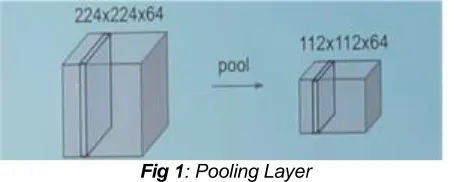
which in turn reduces the parameters and calculations in the network. The pooling layers are inserted one after the convolutional layers in the network. It is one form of translation. It works without any dependencies till the depth of the input and it resizes it. It uses 2x2 filters with a stride of 2 without considering 75% of the activations. It does not have any change in the depth.
Fig 1: Pooling Layer
Rectified Linear Units (ReLU) layer is the most commonly used activation function, which is used to increase the nonlinear properties. It does not affect the receptive field. This activation function is used for the outputs of the CNN. The fully connected layer is used to do the reasoning function in the neural network by using matrix multiplication. It uses bias offset. The last layer is the loss layer which specifies the difference that occurs during the predicted and true labels. For different tasks there are different types of loss functions available. Softmax is the commonly used loss function for predicting a class.
The training process involved in the CNN during weed detection is as follows:
Step1: First, initialize all the filters with random values, parameters and the weights also with it.
Step 2: Second, in this step, the output probabilities for each class is being find out. The output is also be random values due to random weights.
Step 3: Calculate the total error.
Step 4: calculate the gradients of the error by using backpropagation. Then update the gradient descent to update the filters to minimize the error. Here we will not change any parameters and its values which are fixed earlier till the training process is complete. The updation takes only in the weights and the filter matrix.
Step 5: Step 2, step 3 and step 4 are repeated for all the images in the training dataset. Finally, all the hyper parameters of CNN will be optimized.
After the segmentation of images, the feature extraction from each segment of the image was performed. We have extracted this by using collection of extractors such as image shapes, color distribution, texture and the different image orientation extractors. There are about 218 features are composed in the chosen collection of extractors. The brief description of each feature extractor is in the below sub-sections.
Gray-Level Co-occurrence Matrix (GLCM)
The extractor Gray-Level Co-occurrence Matrix (GLCM) is applied to collect and store pixel information about the texture
of the given image. A multidimensional array of frequencies
is used to store the extracted pixel information with two
adjoining pixels separated by a distance d in the image in which one point is with gray level x and the other point is with a gray tone y. These frequencies describe the angular relationship and distance between neighboring pixels that exists in the representation.
Local Binary Patterns (LBP)
One of the widely used and best texture feature extractor in many image based analytics applications is Local Binary Patterns (LBP). This method has many features like invariance to changes in darkness of pixel of the image, computational efficiency etc. The strategy adopted for identifying the texture is to examine to a central point the difference of its color in relation to its neighbors. This process is repeated for all pixels in the chosen image being identified as center point.
Distribution of colors in RGB, HSV and CIELab spaces
The various attributes that we used for each color space of the channels RGB, HSV and CIELab are minimum, maximum, mean and standard deviation. The python language framework Caffe (Jia et al., 2014) was used for ConvNets training. Caffe is a free and open source framework for Machine Learning and Deep Learning applications implemented in the language C++ and CUDA. The main focuses are image recognition and image classification which is being commonly used directly or as a fundamental for design and implementations of Convolutional Neural Networks. The topology of the proposed Neural Network used was the CaffeNet network, which is a imitation of the already implemented topology in AlexNet architecture (Krizhevsky et al., 2012). There are about eight layers in the CNN architecture. Next to the input layer there are about five convolutional layers which includes various sizes of filters and striding components. The last three layers are based on the concept of fully connected ie each neuron in one layer is connected to all other neurons in the next layer. The output from the fully connected last layer of CNN feeds a 1000-way sofmax function for mapping its input to a output. This function generates a probabilistic distribution over the 1000 categorizes used in the collection. The original images utilized for the training purpose is supplemented by crops from its original images and their corresponding horizontal reflections, to enlarge the training set. For the training of the CNN model, the collected dataset given as input to the network model. The system learned from the input dataset, the final values of the weight parameters and other network parameters are obtained after the completion of the training. Based on the validation sets and with the use of snapshots, the accuracy of the proposed model is measured. The trained model is saved in a format compatible to the Caffe supported format and the saved model contains the values for the various hyper parameters of the trained model. The trained model is evaluated with the set of test images and the values of the hyper parameters are taken from the saved model. Based on the evaluations on the given test dataset, the performance of the proposed model is calculated. Considering the performance and robustness of the CNN model, there is no alteration in the original construction of the CaffeNet network architecture is required.
The dataset contains various features extracted from the given image dataset to calculate whether an image include any indication of weed or not. The features that were extracted represent the individual anatomical part. The method that were utilized for image analysis and feature construction of 64 color features and 45 texture attributes are based on grey level co-occurrence of matrix.
Fig 2: Image dataset
The dataset for our experiment is taken from online repository Mendeley dataset. The collection of images in the dataset was captured from one hectare of soybean plantation in the country Brazil. All the images are captured by utilizing quadcopter platform with an orientation of vertical take-off and with landing capability. It was sent over the soyabean field on a weekly basis for two hours between eight to ten in the morning timings. Sony EXMOR 1/2.3 was the drone used for capturing of images. It is equipped with an RGB camera with 4000 × 3000 pixel detector. The weight of the UAV is about 1280g with payload. The flight’s average operational time was 20 min. There are various parameters used for evaluating the performance of the classification and prediction models. Accuracy is one of the metrics for evaluating the performance of classification models. Accuracy has the following definition:
5.1
For binary classification problems, the accuracy of the model can also be calculated in terms of positive samples and negative samples as follows:
( )
( ) 5.2
where TP = True Positives, FP = False Positives, TN = True Negatives, FN = False Negatives.
Table 1: Confusion Matrix
Predicted Class
Actual Class
P N
P True Positive(TP) False Negative(FN)
N True Positive(FP) True Negative(TN)
The accuracy obtained through the model is 62% (0.62). The accuracy can be improved further through optimization of various hyper parameters of CNN classification model.
Fig 3: Preparing Dataset
847
Fig 5: Grayscale Image
Fig 6:Testing
VI. CONCLUSION
Feature extraction concept utilized for reducing the amount of computing and storage resources required to describe and process a large set of data. In the proposed work, CNN classification model is used to extract the important features and the extracted significant features are used for effective training of the model. The proposed model gives an accuracy of 62%.In the near future, steps may be taken to improve the accuracy and to evaluate the model with other parameters. The research methodology proposed in this article would be extended further to other crops and weeds with high dense field contains different categories of crops.
REFERENCES
[1] Ahmed, F., Al-Mamun, H.A., Bari, A.S.M.H., Hossain, E., Kwan, P., 2012. Classification of crops and weeds from digital images: A support vector machine approach. Crop Protect. 40, 98–104
[2] Hung, C., Xu, Z., Sukkarieh, S., 2014. Feature learning based approach for weed classification using high resolution aerial images from a digital camera mounted on a uav. Remote Sens. 6 (12), 12037–12054
[3] Siddiqi, M.H., Lee, S., Kwan, A.M., 2014. Weed image classification using wavelet transform, stepwise linear discriminant analysis, and support vector machines for an automatic spray control system. J. Inform. Sci. Eng. 30 [4] Saha, D., Hanson, A., Shin, S.Y., 2016. Development of
enhanced weed detection system with adaptive thresholding and support vector machine. Proceedings of the International Conference on Research in Adaptive and Convergent Systems, pp. 85–88
[5] Ishak, A.J., Hussain, A., Mustafa, M.M., 2009. Weed image classification using gabor wavelet and gradient field distribution. Comput. Electron. Agric. 66 (1), 53–61
AUTHORS PROFILE
Dr.P.Natesan completed Ph.D in the area Network Security. He has 19 years of teaching experience. He published 6 research papers in International journals and presented 9 papers in the conferences. He is working as an Associate Professor in the department of Department of Computer Science Engineering, Kongu Engineering College, Tamil Nadu. His areas of interest include Cloud computing, Network Security and Deep Learning.
Dr.E.Gothai completed Ph.D in the area of Big Data Analytics. . She has 19 years of teaching experience. She published 9 research papers in International journals and presented 16 papers in the conferences. She is working as an Associate Professor in the department of Department of Computer Science Engineering, Kongu Engineering College, Tamil Nadu. Her areas of interest include Data mining, Big Data Analytics and Deep Learning.
Dr. R.Thamilselvan completed Ph.D from Anna University in the area of Grid Computing. He has 19 years of teaching experience. He published 14 research papers in International journals and presented 17 papers in the conferences. He is working as an Assistant Professor in the department of Information Technology, Kongu Engineering College affiliated to Anna University, Chennai,Tamilnadu. His areas of interest include Cloud computing, Grid Computing and Nature Inspired Computing.