The Effect Of Temperature On The Performance
Of PV Array Operating Under Concentration
Eng. Sameh. M.El –Sayed, Dr. Wagdy R. Anis, Dr. Ismail M.Hafez
Abstract: The sun is the world’s sole source of energy. In fact, all of the energy being used on the earth today is driven from solar energy. Because of
the increase in world energy demand and the threat of global warming; there is a pressing need for the development of reliable, cost-effective sources of renewable energy. Renewable energy sources include indirect solar energy such as hydro, wind and direct solar energy conversion through thermal receivers or photovoltaic. This paper discusses the parameters that affects on the cell temperature under concentration. Comparison between fixed modules and solar cells operating under concentration to get the optimum solution. By increasing the concentration factor one minimizes the area of the cell .System uses special cell (Fresnel lens and multilayer cells).This cell has large efficiency and bear high temperature. The economic studies are necessary to calculate the cost of 1kwh for each case.
Index Terms: Photovoltaic (PV) system, Concentration photovoltaic (CPV) system, Special cell(soitec module), Economics ————————————————————
1
I
NTRODUCTIONHowever, most of the energy that is used today is in the form of fossil fuels, which also originated from the Sun but has been stored in the earth for millions of years. If the current trends of global energy use and demand continue, the supply of fossil fuels are predicted to be exhausted within 50-100 years from now[1]. Burning fossil fuels releases stored carbon into the environment. This disturbs the global carbon cycle and leads to an increase in atmospheric CO2 levels [2]. Photovoltaic (PV) cells are semiconductor devices that can convert sunlight into electricity. Photons below a threshold wavelength have enough energy to break an Electron-hole bond in the semiconductor crystal, which in turn can drive a current in a circuit. The solar radiation consists of photons at a range of wavelengths and corresponding energies. Photons with wavelengths above the threshold are converted into heat in the PV cells. This waste heat must be dissipated efficiently in order to avoid excessively high cell temperatures, which have an adverse effect on the electrical performance of the cells. The cells are the most expensive part of a photovoltaic system. A simple way of reducing system costs is therefore to replace some of the photovoltaic area with less expensive optics such as mirrors or lenses. The optical devices focus the sunlight onto a small area of cells. Because fewer cells are needed, one can afford to use higher efficiency cells. Under high concentration there is also a considerably higher heat load that needs to be dissipated [3]. When photovoltaic cells are used under concentrated illumination, they experience a high heat load because the photons not converted to electricity are dissipated in the cells as heat. Thus, an essential
requirement for a successful photovoltaic concentrator is a cooling system which can efficiently remove the dissipated heat while keeping the cells at the desired temperature. Concentrating sunlight onto photovoltaic cells, thus replacing expensive photovoltaic area with less expensive concentrating mirrors or lenses, is seen as one method to lower the cost of solar electricity. Because of the smaller area, more costly, but higher efficiency PV cells (special cells) may be used. However, only a small portion of the incoming sunlight onto the cell is converted into electrical energy (a typical efficiency value for concentrator cells is 25% [4]). The remainder of the incoming energy will be converted into thermal energy in the cell and cause the junction temperature to rise unless the heat is efficiently dissipated to the environment. The photovoltaic cell efficiency decreases with increasing temperature [5-6]. Cells will also exhibit long-term degradation if the temperature exceeds certain limit [7, 8]. The cell manufacturer will generally specify a given temperature degradation coefficient and a maximum operating temperature for the cell. The cell efficiency is known to decrease due to non-uniform temperatures across the cell [9, 10]. In a photovoltaic module, a number of cells are electrically connected in series, and several of these series connections can be connected in parallel. Series connections increase the output voltage, while the parallel connection increases the current. The aim of this paper is to study the effect of temperature on performance of PV system operating under concentration to get solutions to minimize the cost of 1kwh.
1.1 Concentrator geometries
It is sensible to distinguish between concentrators according to their method for concentrating (mirrors or lenses), because the requirements for cell, we can use parabolic mirrors or Fresnel lenses to achieve the concentration. Cooling techniques differ considerably among the various types of concentrator geometries. If lenses are used, the cells are normally placed under the light source; the sunlight is usually focused onto each cell individually [11].
1.2 Why we use concentration?
In the past (20 years ago) the cost of solar cells was very high (1wp ~ 5$) which forced us to get a solution to reduce the system cost.
________________________
Eng. Sameh. M.El -Sayed, Research Assistant Ain,Department of Shams University, Cairo, Egypt Communication, Cairo, Egypt
Dr. Wagdy R. Anis, Professor Department of Electronics and Communication Engineering, Faculty of Engineering Ain Shams University, Cairo, Egypt
Fig1. Comparison between mirrors and Fresnel lens under concentration. [12]
One of the proposed solutions is to use concentrators. The system is composed of low cost mirrors (or lenses) plus a small number of high cost PV cells. Thus the overall system is redused significantly by decreasing the number of expensive cells that will give me the same output power of concentration, for example we can use concentrators with concentration factor (Cth=10) and concentrate the irradiation on a single cell which was cheaper than usage ten cells so it was effective to increase the concentration factor instead of increase number of cells but the disadvantages of concentration techniques is the two axis tracking. Now due to decreasing the cost of solar cells (1wp ~ 0.5$) , the economical usage of concentration systems with tracking system need to be restudied which we spot in this paper added to that the disadvantages of this technique is using tracking systems that increases the cost of the PV systems and is more complex which need periodic maintenance .
2 Electrical output power under concentration
For concentration CPV with tracking the relation between electrical output power (Pel) under concentration and the instantaneous irradiation (Geff) track:Cth=A1/A2 concentration factor (1) A1: Area of mirrors or lenses (large area)
A2: Area of cell
70% directed radiation (can be concentrated)
30% diffused radiation (scattered can't be concentrated) (Geff) track= ((0.7* Cth) +0.3)*(GT) tracking (KW/m2) (2) ηctrackeff=(ηco*(1- Βc*(Ta+(( αc* (Geff)track*1000)/Ul')-Tco
))/(1-(Βc*ηco*(Geff)track)*1000/ Ul'))) (dimentionless) (3)
Ahs= Cth.*Ac.*Ff (m 2
) (4)
Pel=1000* Ahs * ηctrackeff*(Geff) track) (watt) (5) Ul‛= Ul/Fp (watt/m2) (6) Ul: heat loss coefficient of solar cell to the ambient
Ul =2*(2.8+ (3*w)) w: wind speed (m/sec) (7) Pel : electrical output power under concentration with tracking (Geff) track: The instantaneous irradiation under concentration with tracking.
Ahs: area of heat sink. Ff: fins factor. (Dimensionless) Fp: packing factor (ratio between areas of cell to the area of
module) Ta: ambient temperature (C) Tco: temperature of the cell at room temperature (C)
Βc: coefficient of efficiency drop per degree centigrade =0.005 for silicon. (C-1) αc: solar cell absorption coefficient for incident radiation (dimensionless)
ηctrackeff : efficiency of the solar cell that work under concentration with tracking (dimensionless)
ηco: efficiency of the solar cell at room temperature (25°c). (Dimensionless)
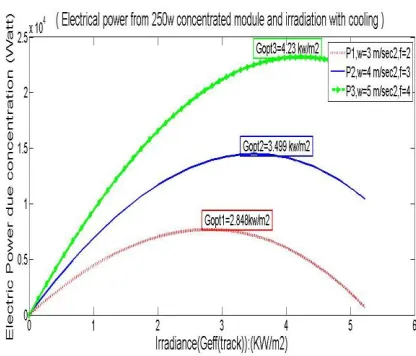
Fig2. Power- concentration relationship with cooling
AS (Geff) track increases Isc increase then Pel increases and Tc increases that decrease cell efficiency (ηc), so concentration increases Geff but simultaneously, Tc increases and cell efficiency's reduced. As result Pel increases till certain Tc is reached and ηc drops. Thus there is an optimum G at which Pel is reached its maximum. [13]
3 Effect of temperature on the performance of
PV systems using concentration:
3.1 Effect of fins factor of heat sink on cell temperature by vary wind speed
Fig. 3 show the relation between Ff (fins factor) and Tc(cell temp.) for different values of w(wind speed).As seen, one
can observe that as fins factor and wind speed increase then cell temperature decreases.
Equations:
ηc=30% , Ul=2*(2.8+(3*w)) empirical formula
3.2 Effect of wind speed and cell temperature by vary concentration power
Fig.4 show the relation between w (wind speed) and Tc (cell temp.) for different values of GT (concentration power).
As seen, one can observe that as wind speed and concentration power decrease then cell temperature
decreases.
Equations:
Fp=0.7 , Ul‛= ( Ul/Fp) (8) Ul=2*(2.8+ (3*w)) empirical formula
Tc= (Ta+ ((( αc* Fp)/ Ul')*GT*1000)) (9)
3.3 Effect of packing factor on cell temperature by vary wind speed
Fig.5 show the relation between Fp (packing factor) and Tc(cell temperature) for different values of w(wind speed). As seen, one can observe that as packing factor decrease and wind speed increase then cell temperature decreases.
Equations:
Ul'=( Ul/Fp) , Ul=2*(2.8+(3*w)), Tc=(Ta+((( αc* Fp)/ Ul')*GT*1000))
3.4 Effect of concentration power on cell temperature by vary packing factor
Fig.6 show the relation between GT (concentration power) and Tc(cell temperature) for different values of Fp (packing factor). As seen, one can observe that as packing factor decrease and wind speed increase then cell temperature
decreases.
Equations:
Ul'= ( Ul/Fp) (9) Ul=2*(2.8+ (3*w)) empirical formula
Tc= (Ta+((( αc* Fp)/ Ul')*GT*1000))
4 To compare the system using concentration
with standard fixed system, a detailed
simulation program for both fixed system and
system) under concentration(special cell
(soitec module)) is developed.
4.1 Design without Tracking (fixed panels system)
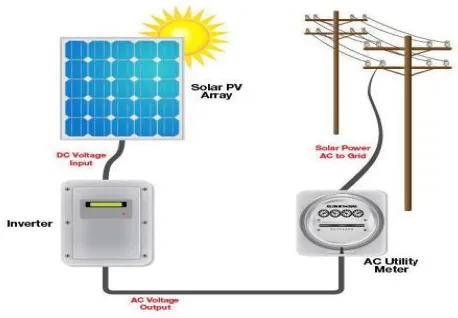
Fig.7 Block diagram of on grid fixed panels system at β=30
Fig.(8) shows the monthly average daily energy produced by 1kw peak array throughout a complete year. Those values are put in table (1) and they are plotted in fig. (8).The tilt angle β of the array is taken equal to latitude angle φ=30°.
Month Jan Feb Mar Apr May Jun Energy KWh/day 2.86 7 4.47
3 5.085 5.29 48 5.55 48 5.859 1
Month Jul Aug Sep Oct Nov Dec Energy KWh/day 5.95 35 6.03 52 5.660 0 5.20 19 3.40 32 2.686 5
Fig.8 Monthly daily average energy during a year produced by 1 KWp in Cairo (30°N) with fixed system at β=30.
4.1.1 Comparison between calculated and measured results for monthly daily average energy during a year produced by 40KWp in Cairo (30°N) with fixed system at β=30°.
Fig.9 Show total generated energy during a year from Nasr city building.
Table.2 Comparison between calculated and measured results for monthly daily average energy during a year produced by 40KWp in Cairo (30°N) with fixed system at
β=30°.
Months 1 2 3 4 5 6
Calculated results(kwh /month) 103. 212 161.0 28 182. 916 190.6 128 199.9 728 210.9 276 Measured results(kwh /month) 112. 40 130.3 3 177. 50 219.0 6 207.3 0 213.7 7 months
7 8 9 10 11 12
Calculated results(kwh /month) 214. 326 217.2 672 203. 76 187.2 684 122.5 152 96.71 4 Measured results(kwh /month) 210. 625 209.7 9 185. 09 147.7 8 125.5
6 111.5
Total calculated generated energy results = 63.576 MWh/year
Total measured generated energy values=62.438 MWh/year
Error=1.8%
4.2 Special cell (Soitec module)
Multi-junction solar cells
Soitec CPV technology uses optimized III-V-based multi-junction solar cells in which different sub-cells are stacked on top of one another. Each sub-cell is designed to convert a certain range of the solar spectrum: short wave radiation, medium wave radiation and infrared. Soitec’s concentrator photovoltaic (CPV) modules use Fresnel lenses to concentrate sunlight 500 times and focus it onto small, highly efficient multi-junction solar cells. With this technology, Soitec achieves a module efficiency of 31,8%. This is almost twice as high as the efficiency of conventional silicon photovoltaic modules. The materials used in the cell include GaInP, GaAs and Ge. Such cell construction maximizes the utilization of solar spectrum energy so that cell efficiency is maximized .The increase of cell efficiency will decrease the area required to generate same energy. In comparison to conventional solar cells, multi-junction solar cells are more efficient but also more expensive to manufacture. By using concentrating optics to focus the sunlight on these multi-junction solar cells, it is possible to minimize the amount of semiconductor material needed down to a small fraction, using cells of only a few square millimeters. This principle enables the manufacturing of CPV modules efficient and inexpensive.[14]. Soitec’s technology is a concentrator photovoltaic (CPV) technology, whereby sunlight is focused onto highly efficient solar cells using Fresnel lenses. CPV offers efficiencies twice those of standard silicon photovoltaic technologies. [15].
Materials in multilayer cell are arranged so that materials with larges energy gab is put in the top of multilayer cell and that with minimum energy gab is put in the bottom.
4.2.1 Design of PV system under concentration using soitec module
To evaluate the CPV system under concentration with tracking by using special cell (multilayer cell).
Fig. (10) Block diagram of PV system under concentration using soitec module.
Control unit: for protection the tracking system as breking it in the case of very high wind speed.
Inverter: convert dc signal to ac signal.
4.2.2 Soitic module discreption:
Concentration ratio (Cth) =500 Array size=Pp=2450wp
Max. power voltage(vmp)=645v Max. power current( Imp)=3.8A Isc=4.2A
Voc=740v
The efficiency of this special cell (ηc) =31.8%. [16]
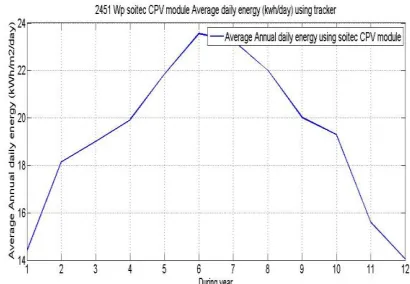
Fig.(11) shows the monthly average daily energy produced by 2451w peak array throughout a complete year. Those values are put in table (3) and they are plotted in fig.(9).The
concentration factor=500 and the efficiency of this special cell=31.8%.
Table.3 Monthly daily average energy using soitec cpv module.
Month Jan Feb Mar Apr May Jun
Energy
KWh/day 14.4 18.14 19.01 19.9 21.85 23.55 Month Jul Aug Sep Oct Nov Dec
Energy
KWh/day 23.2 22 20.02 19.2 15.58 14.03
Fig.11 A verage annual daily energy during a year by 2451wp soitec cpv module
5 Cost estimation
Compare between initial cost, cost (EGP) per KWh and interest rate for fixed module and CPV using soitec module When it is implemented in Egypt and sold to the Egyptian government.
5.1 Economical study
5.1.1 for fixed module:
Using data of 200wp module For silicon:
Cell area=15*15cm2 Isc(1cm2)=37mA
Isc(15*15cm2)= 37mA *15*15=8.3 A Operating voltage (one cell) =0.5 v Pel(one cell)=8.3*0.5=4 (w/cm2) For module of 48 series cells: Pel=4*48=200w
200wp cost =120$
One cell cost=120/48=2.5$
Cost/1cm2=2.5$/225=0.011$ (for silicon)
PV modules=0.65$/wp as 120$/200 wp =0.6$ wp
5.1.2 For soitec module:
Module area=8.77m2
Cells area=Module area/concentration ratio=8.77m2/500=8.77*10000/500=175.4cm2 Operating voltage of one cell=0.4v
The no. of cells=vmp/operating voltage=645/0.4=1612cells Area per one cell=175.4/1612=0.11cm2
Special cell cost=15 times silicon cell=15*0.011=0.165$/cm2
Module cells cost=175.4*0.165=28.941$
Area of each fresnel lense =area per cell*concentration factor=0.11*500=55cm2
Cost of one lens=0.5$
Pel(one module)= Imp* vmp=3.8*6451wp=2.5kwp (10)
5.2 Economical analysis for 1MWp
Table.4 Economical analysis for 1MWp
Economical
analysis Fixed si module
PV modules 0.65$/wp 3$/wp Inverter 250000$ for
system
250000$ for system Mounting 0.18$/wp 1.1$/wp
Dc cables
0.03$/wp so 30000$ for
system
30000$ for system
Ac cables 30000$ for
system 30000$ for system Earthling
and lightning
5000$ for system 5000$ for system
Step up transformer
s
30000$ for
system 30000$ for system weather
station
5000 $ for
system 5000 $ for system
land preparation
0.3$/wp so 300000$ for
system
150000$ for system as land
preparation is halved accessories and installation cost 25000$ for
system 25000$ for system
Tracking system
--- =1.2$/wp
Total initial fixed cost
1505000$*8=12. 04*10^6 l.E
5825000$*8=46.6* 10^6 l.E
For fixed module 1MWp:
Average daily energy=4.8395*10^3kwh/day
Annual average daily energy=4.8395*10^3*365day*0.9(dc to ac) =1.589*10^6 kwh/year
For soitec module 1MWp:
Average daily energy=7.5*10^3kwh/day
Annual average daily energy=7.5*10^3*365day*0.9(dc to ac)=2.52*10^6 kwh/year
5.3 Compare between cost (EGP) per KWh and interest rate for fixed module and cpv using soitec module when it is implemented in Egypt and sold to the Egyptian government
Geometric series equation:
P=Eo*Co*(1((1+g)/ (1+i)) ^N)/ (i-g)) (11) P: initial cost
i: interest rate
Co : selling price=0.136$/kwh g:degredation factor= -2% Eo: energy generated first year N:payback period=25years
Table.5 Compare between cost (EGP) per KWh and interest rate for fixed module and CPV using soitec module
when it is implemented in Egypt and sold to the Egyptian government Economical analysis for 1MWp Fixed si module Soitic multilayer module under concentration
interest rate( i) given that Co= 0.136$/kwh
11.86% 1.35%
selling price(Co) 1.02L.E 2.51L.E
For Egyptian market the available bank interest rate is about 11% , thus if IRR is less than 11% ,the investment is rejected, On the other hand if IRR exceed 11% ,the investment is accepted. Accordingly, the investment in case of fixed array is accepted while that of PV system under concentration and using tracking is rejected due to low IRR. The results show that the cost per KWh for fixed system is 1.02 LE while it is 2.5 LE for system using concentrators. Thus the fixed system’s KWh cost is about 40% that of system using concentrator. Hence fixed system is recommended.
6
CONCLUSIONS
Detailed study of both fixed PV system and system operating under concentration showed that economically wise, the fixed system is superior. This means that the cost per kwh delivered to grid utility is less in case of fixed system. Although the PV system with concentration reduces the cell area required, the necessity of two axes tracking beside the concentrator raised the cost per kwh produced.
7
R
EFERENCES[1] World Energy Council: Survey of Energy Resources 2001 (cited March 2005). [Available online from http://www.worldenergy.org]
[2] Intergovernmental Panel on Climate Change (IPCC): Climate Change 2001 (cited March 2005). [Available online from http://www.ipcc.ch]
[3] Website of EN.ERGO - Club per la riconversione del sistema energetico e per la promozione delle fonti di energia rinnovabili (cited March 2005)
[Available online from
http://www.energoclub.it/a%20solarebis.htm]
[4] Sinton, R.A., Kwark, Y., Gruenbaum, P. and Swanson, R.M. Silicon point ―contact concentrator solar cells‖‚. 18th IEEE Photovoltaic Specialists Conference, pp. 61-65, (1985).
[5] Sala, G., ― Cooling of solar cells, in Cells and optics for photovoltaic‖‚ concentration, ed. Luque, A. Adam Hilger, Bristol, pp. 239-267 Chp. 8 , (1989).
[6] Dalal, V.L. and Moore, ―Design considerations for high-intensity solar cells ‖‚ A.R. Journal of Applied Physics 48 (3), 1244-1251. (1977).
[7] SunPower (2002) Application notes for HED312 Silicon Concentrator Solar Cell.
[8] Horne, W.E. ―Solar energy system.‖‚ Patent no. US5269851. (1993).
Specialists Conference, San Diego, pp. 431-436, C.E. (1980) .
[10] Mathur, R.K., Mehrotra, D.R., Mittal, S. and Dhariwal, ―Thermal nonuniformities in concentrator solar cells. Solar Cells‖‚11, 175-188 ,S.R. (1984).
[11] ANJA RØYNE , ―COOLING DEVICES FOR DENSELY PACKED,HIGH CONCENTRATION PV ARRAYS ‖, A thesis submitted to the University of Sydney for the degree of MASTER OF SCIENCE, march 2005.
[12] Mohamed Anwer Rady, ―Solar Thermal Concentrating Technologies‖: state of the art and new developments, NONEMBRE16, 2013.
[13] Anis, Wagdy R., Robert P. Mertens, and R. Van Overstraeten. "Analysis of a photovoltaic powered reverse osmosis water desalination system." Solar cells15, no. 1 ,1985 .
[14] Soitec’s high-performance CPV technology, On
May 2015,
http://www.soitec.com/en/technologies/concentrix/c omponents/
[15] Every aspect of the CPV technology has been optimized to offer a competitive commercial
solution, On May 2015,
http://www.soitec.com/en/technologies/concentrix/