Licensed under Creative Common Page 646 http://ijecm.co.uk/
EFFECT OF AGENCY BANKING FEATURES ON THE FINANCIAL
PERFORMANCE OF COMMERCIAL BANKS IN KENYA: A CASE OF
EQUITY BANK, KISII, NYAMIRA AND KEROKA BRANCHES - KENYA
Jasper Ondara Nyota
Department of Social Sciences, Jomo Kenyatta University of Agriculture and Technology, Kenya [email protected]
Willy Muturi
Department of Social Sciences, Jomo Kenyatta University of Agriculture and Technology, Kenya [email protected]
Abstract
This study sought to establish the effect of agency banking model on the financial performance of
commercial banks in Kenya with special reference to equity bank, Kisii, Nyamira and Keroka
branches, Kenya. The research objectives were: to establish the effect of accessibility of banking
services in performance of Equity bank, to establish effect of total transaction cost in the financial
performance of Equity bank, and to establish effect of market share on the performance of Equity
Bank. This study was guided by agency theory, financial intermediation theory and bank led
theory. The study adopted a descriptive case study design with a target population of 88 Equity
bank staff and agents. The study used census method. Data was collected using questionnaires
and analyzed using descriptive and inferential statistics. The study found that financial
performance has strong correlation with agency banking factors that include: accessibility cost of
offering financial services and market share. Agency banking significantly accounts for the
variance in financial performance of Equity bank. Financial performance increases with the
introduction of agency banking which increases access for financial services, reduce cost of
offering the service and increased markets share. The study concluded that agency banking
improves financial performance by increasing access for financial services, lowering the cost of
provision of financial services and enlarging market share.
Licensed under Creative Common Page 647
INTRODUCTION
Agency offers a variety of banking comprises of activities such as bank account opening, depositing cash, withdrawing, money transfer among other activities. Through this model banks have expanded their financial services to rural areas without a financial capacity for a formal branch. This is true of remote areas with a high number of people who do not access banking services (Mulupi, 2011). This has prompted stakeholders such as policy makers and regulators to give the model attention even though banking regulations still stifles its growth. Where regulations allow, the agency model and other branchless initiatives have shown tremendous growth (Neil & Leishman, 2010). Account ownership within Africa greatly varies. In average, 23% of adults have an account in a mainstream bank. In the sub-Saharan Africa on average 24% of the adults, have accounts in formal banks. However, this varies from 11% in central Africa to about 51% in southern Africa.
It is noted that both in the Democratic Republic of Congo and Central African Republic, about 95% of the adults do not have any know how neither do they have bank accounts in a formal bank. North America is said to have at least 20% of adults having created bank accounts with financial institutions, 30% and 10% has been recorded from Morocco and Egypt respectively. The Financial Sector Deepening Kenyan report (2010) reported that 19% of adults in Kenya have access to formal financial institutions whereas about 38% of the adults do not have access to even the rudimentary form of financial service or product. This increases the percentage to 80% (The Kenya Bureau of Statistic Report, 2011).
A number of challenges have been highlighted to be affecting access to financial service and products in Africa and they include; - uneconomically banking incomes, dispersed population, distance lack of financial products and service knowledge and ignorance on issues relating to banking. To reach this untapped banking market one has to appreciate these factors. For financial institutions to position themselves successfully, they must seek to address the special needs of the unbanked. One of such approaches is agency banking (Muasya & Kerongo, 2015).
Licensed under Creative Common Page 648 have embraced this model to extend financial services including Pakistan, Philippines, Kenya, South Africa, Uganda, Nigeria and India (CGAP, 2011). The agency banking model has grown the numbers of the rural unbanked people. The model now serves many millions of the population initially unbanked (Mwende, Bichang’a & Mosoti, 2015).
Kenya launched agency banking in 2011 and two years later in 2013 commercial banks had contracted 18082 active agents generating 48.4 million transactions worth $3 billion according to a 2014 central bank report. Agency banking was institutionalized in 2013 with a hope a similar region exponential growth. Similarly in Nigeria the central bank released guidelines for agency banking in February 2013 (Iveri payment technologies, 2014). Kenyan financial institutions have turned to agency banking to compensate for the poor retail infrastructure, minimize set up and running costs. That has worked well in providing much low income population their first experience to a range bank services. Banks have also used the model as an alternative to decongest crowded branches and allowing customers access their account information with ease (Muasya & Kerongo, 2015).
The Kenyan business environment is very dynamic and it has been reported to be having very stiff competition among the financial players and the banking industry as a whole leading to no exception. Development of mobile banking and competition has led to increased competition with increased innovativeness. Mwangi (2013), argued that evaluation of the role of agency baking in the performance of commercial banks contributed to increased performance in the agency banking largely. The Equity bank embraced the model in 2011. The approach has recorded tremendous success. An initial number of 875 agents in the start of 2011 short up 3991 agents by March 2013. This shows the huge contribution to cash transactions (Equity Bank report, 2013). In its financial results covering nine months to September 2011, the bank recorded a 39% increase of the pre-tax profit (Anyanzwa, 2012)
Statement of the Problem
Licensed under Creative Common Page 649 According to Barasa & Mugambi (2013), it was reported that agency banking has increasingly being significant in developing countries. However, the extent to which agency banking can be used to deepen the financial sector which remains unidentified. The significant benefits of the agency banking is a model used on maintain the customer and agents that have not yet been studied. However, despite the efforts done on agency banking the commercial banks still remains to be achieving a lot of competitiveness hence Improving the financial performance, it has been noted that there is limited studies done locally on the contributions of agency banking on commercial banks. Aosa (1992) argued that it is not recommended to import the entire of results of a study conducted without taking into consideration the account and the contextual differences and hence calling for the needs to conduct a local study for purposes of making clear understanding on the financial performance of commercial banks. It is through this reason that the exists a knowledge gap on the effect of agency banking on performance of commercial banks leading to the development of a study on the effects of agency banking in the financial performance of commercial banks.
Research Objectives
The main objective of the study was to establish the effects of agency banking features on financial performance of commercial banks in Kenya case of Equity Bank of Kenya, Kisii County. Specific research objectives are:
i. To establish the effect of accessibility of banking services in performance of Equity bank. ii. To establish effects of total transaction cost in the financial performance of Equity bank iii. To determine the influence of market share on the performance of Equity Bank
LITERATURE REVIEW
Theoretical Literature Review
Agency Theory
Licensed under Creative Common Page 650 to customers, they offer to customers the bank’s financial services at the convenience of the customer, lower the cost of customer in accessing bank services and even promotes a saving culture. As clients accrue benefits, on the other hand banks improve their financial performance due to increased market share, more banking by customers and lower operations costs.
Bank Led Theory
The bank led theory is composed of three parties; the bank who distribute financial services and products to the customer through a retail agent. The series of associated activities begins with the bank. The banks come up with final financial products and services to be offered to customers. The products and services are made available or provided to customers through retail agents with whom they are directly involved with customer on behalf of the bank (Lyman, Ivatury & Staschen, 2006). Essentially, banks open and hold accounts for customers. The retail agents comes in to verify customers identity, process applications, conduct one on one transactions like group forming, collecting loans and small deposits on behalf of the bank, they handle low value payments and sell insurance related products (Chowdhury, 2010). Through this arrangement customers access a variety of financial and non-financial services on offer (Owens, 2006).
The bank installs electronic technology like mobile phones and point of sale gadgets for the retail outlet. These facilitate exchange between bank and customer at the agent point (Lyman, 2006). This bank led model is applauded due to its close interactive ways that is between banks and far way located customers. It has enabled the low income remote clients to get both financial and non-financial products and services from retail agents. Risks relating to this structure are: the security system and lack of qualified trained agents (Kumar, et al. 2006; State Bank of Pakistan, 2011). However, these are the same challenges conventional branch based banking faces.
Licensed under Creative Common Page 651
Bank-Focused Theory
The bank-focused theory is based on situations whereby traditional financial institutions used traditional low cost delivery procedures to deliver financial products and services to their respective customers. For instance, employees vary on the usage of automated teller machines (ATMs) to access internet banking or cell phone banking to enable limited access to available financial institutions’ clients. This theoretical model tends to be additive in the normal situation leading to reserving of conventional branch based banking. Many banks have tried to apply favorable outcome which involve branding and control to financial institutions interested, it may not lack challenges. Customers are keen on the kind of quality services offered and how secure their transaction activities are in financial institutions, (Kapoor, 2010).
Empirical Literature Review
In the past in Africa, poor people experienced many challenges in their attempt to have access to financial products and services. This was a result of the banks proximity which was far apart in their localities leading to individuals being forced to walk for long distances in search of financial institution to provide banking services and products. This could only mean that those in informal settlements would only have to spend a bigger part of their day travelling to banking facilities and their bear with long queues to access financial products and services. The whole process would prove to be time consuming and costly since transportation cost would also be taken into consideration. Despite that the banking industry has been facing gradual development with the introduction of agent baking, which is an innovative delivery approach which is determined to have accessibility to financial services and products which are far much closer to the local citizens, (Making Finance Work, 2013).
Licensed under Creative Common Page 652 According to CBK (2013), the agency banking structural measures which was launched in 2010 has continued to contribute to increased access to banking services.
The application of agency banking is expected to propel financial institutions to offer banking services are more cost effectively and customer friendly. The objective of this initiative is that it is expected to enhance and yield financial access for those people who are currently not reached by financial inclusion (CBK, 2011). Han & Melecky (2013) found out that in times of financial stress a variety and broader access to use bank deposits can greatly reduce deposit withdrawals or cause growth slowdown. As integration in global financial flows is growing there is still a large population share that still lack accessibility to bank deposits thus making it hard to establish trust in banks. Additionally the use of bank deposits, bank stability, accessibility and a substitute for occurrence of banking stress or dangers are most notable explanations variable in regression. Even when accounting for the possible leverage effects of outliers the results are usually the same, (Han, et al., 2013).
There is a practical correlation along bank deposits and banking service expansion. Since it’s costly to build banking halls in every town, banks opted to increase their service provision through agents. These agents not only influence deposits but agency banking is also influenced by the level of deposits in a certain area. It is expected that banks expand their facilities and service provision by considering factors such as competition, deposit potential, regional income and existence to infrastructure. Thus deposits can also be a factor to consider when in need of an agency banking expansion strategy. By creating greater access to financial services, agency banking has in turn increased the level of deposits for banks. Providing the ‘un-banked’ access to safer and cheaper financial services has led to banks recording more deposits than ever before. Equity bank attributes two thirds of the income from agency banking as a result of deposits and the remainder on withdrawals (Bankelele, 2015).
Cheyech, Kitilit, Bowen & Amata (2016) did a study on The Role of Agency Banking In enhancing Financial Accessibility in Kenya: A Case Study of Langata Constituency. The study finalized that agency banking is a great role player in the convergence of variety banking and non-banking players to provide financial services to all end consumers of financial services. In addition, it increases the number of access points that provide financial services. The level of utilization of agency banking was high. It was revealed that an agency unit served above 200 clients a month. It is therefore clear that the agencies serve quite a good number of clients with most of the agencies serving more than 100 clients a month.
Licensed under Creative Common Page 653 at the end brings out the statement that the strongest predictor of financial inclusion is greater geographical and regional penetration brought about by agent banking. This is because the services are brought proximitically nearer to the people and thus saves a lot of time which in turn could be used to making long queue in banking institutions or ATMs. The strongest evidence to this effect is the fact that customers were ready to forego the extra charges at a retail agent banking outlets to have their banking requirements sorted. It is the conclusion of the researcher that as far as financial inclusion is involved retail agent banking model is a success.
A percentage of an industry or market's total sales or percentage that is occupied by a particular company over a specified time period is the market share. Many firms seek to raise their sales relative to competitors in the market thus associating market share with profitability. Calculation of Market share is achieved by noting the company's sales over the period of operation and dividing it by the cumulative total sales of the industry over the same period. This system of measurement is used to give a more general view of the size of a company as at according to its market and its competitors. An increase in market share allows a company to reach a greater scale in its operations and increase profitability. Companies and industries are always focusing to increasing their share of the market, in addition to efforts of growing the percentage of the total market by enhancing to larger demographics, reducing prices and marketing through advertising.
Entrepreneurs often look at market share trends that either increases or decreases carefully since they could inform on relative competitiveness of the company's products or services in the market population. As the overall size of the market of a product or service increase, a company holding constant its market share is likely to growing revenues at the equal rate as the total market share. A company that is expanding its market share will also be increasing its revenues rapidly as compared to its competitors. Additionally, under the presumption that firms will acquire a larger market share and increase their profitability due to their greater efficiency thus the market share is considered as a profitability determinant. A larger market share also means there will be more power to the bank in controlling the prices and rates of services it offers to the customers. Heggested & Mongo (1976) discovered that the more the market share, the greater it for a bank’s control over its prices and the services it offers to customers. Heggested (1977) and Mullineaux (1978), however, noticed that market share had an unfavourable relationship with profitability.
Licensed under Creative Common Page 654 outstanding effect on profit. Smirlock (1985) not only was he convinced that market share had an effect on profitability but also that development in the market created more chances for a bank and thus earning more profits. His discovery indicated that growth had a remarkably positive relationship with profits. Larger banks have a larger share of their income in terms of non-interest income (Huizinga, 2012). The market share will give the bank size. This comprises of net asset deposits, capital, number of loan accounts and number of deposits.
Essentially, the financial institutions should shift their attention away from the singular obsession with perfection of recent years, and refocus their gaze to revenue growth and increase, market share, and put back in the center of focus the very stream of that revenue: the customer. The consumers marketplace is continuing to segment into smaller subsections of requirement and behaviors, which is influencing the way banks and other financial institutions advertise their products and services Drawing new customer segments and region as a potential source of additional revenue streams would mostly reduce, but ensure secure income regions with retired people and public institutions employees (e.g. teachers) as potential arranged groups for cheaper and low volume loan products (cash loan, credit card) that increase the revenues streams of the financial institution (Ruttoh, 2013).
Muriungi (2012), reports that through associations with different businesses throughout the country, financial institutions will take their services nearer to the areas populated with potentially low and reduced number of transactions. This in will after all lead to an improved and increase number customer base and thus the market share would increase its coverage with low cost solution, increased levels of revenue from improved indirect efficiency by reducing long queus in existing branches. According to the Central Bank yearly Supervision report of (2006), job opportunities in the banking segments increased by 23 percent. The report recognizes the quality because of the increase of the institutions branch network and increased the volume of business transactions. Agency banking has driven an increase in financial service which penetrated to local and rural areas that have led to increase in market share for financial institutions using agency banking.
Licensed under Creative Common Page 655 2013). This in turn will ensure an increased client base and therefore the market share, widened coverage with low cost expenses, resulting in realization of revenue through improved indirect productivity by minimizing congestion and reducing queues in existing branches. Customers will in turn benefit from agency services since the cost of travelling distances has been reduced considerably with the service being at close proximity.
METHODOLOGY
Research Design
This study was the descriptive case study design. This research design facilitates gathering of data at a particular point time with an idea of describing the nature of the available conditions, recognizing the standards based on the conditions compared and determined through relationship between specific event, (Cooper & Schindler, 2003; Orodho, 2005). Descriptive research design gives the study more external validity more generalizable results to a big population. The descriptive research method was appropriate because of the fact that it facilitates analysis and relation of variables.
Target Population
According to Mugenda and Mugenda (1999), population refers to the entire group of individuals, units, events or objects which share common observable features which the study intends to generalize its results. Ngechu (2004) noted that target population comprises of well-defined set of individuals, services, elements, event being investigated. This particular study targeted all the 88 Equity Bank Employees in Kisii, Nyamira and Keroka Branches.
Sample Design
Gay (1992) argued that sampling involves the process of selecting some individuals for a given study in a way that the selected individuals represent the entire group from which the sample is selected. With a target population of 88, the study used a census
Data Collection and Instrumentation
Licensed under Creative Common Page 656
Validity and Reliability of Research Instruments
Before administration, the questionnaires were pretested to facilitate clarity and validity of the research instrument. Validity refers to the level to which the research instrument measures the right questions in terms of accuracy (Mugenda & Mugenda, 2003). To measure the validity of the research instrument, the researcher pre-tested the questionnaires on ten respondents who were finally excluded from the study to test research instruments. This ensured face validity.
Reliability of an instrument is the extent to which the research instruments offer regular results or data after repetitive attempts (Mugenda & Mugenda, 2003). To ensure reliability, the researcher used Cronbach’s alpha which was found to be 0.8. The instrument was therefore found to be reliable.
Data Analysis
The data collected was cleaned, coded, tabulated, translated into specific categories, record them appropriately and computing them using appropriate statistical techniques. Reliability and validity were tested using Cronbach’s alpha.
In this study, descriptive and inferential statistical techniques were used. Descriptive statistics included the mean, standard deviation and correlation analysis. Inferential statistics included regression analysis. To establish the influence of agency banking on customer satisfaction in equity bank in Kisii County the study adopted the use of multivariate regression analysis was done on the data collected.
The model took the following structure;
Y= β0+β1X1+β2X2+β3X3+ε
Where;
Y= Financial performance β0 = Constant
X1 = Accessibility of Bank Services
X2 = Transaction Cost
X3= Market Share
βn= coefficients to be determined while,
Licensed under Creative Common Page 657
RESULTS AND DISCUSSION
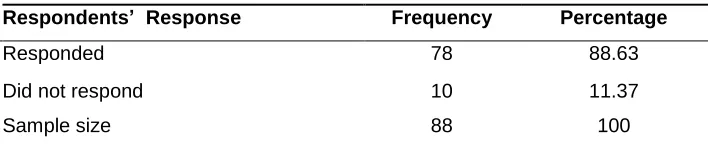
The information about the response rate is shown in Table 1 below.
Table 1: Response Rate
Respondents’ Response Frequency Percentage
Responded 78 88.63
Did not respond 10 11.37
Sample size 88 100
The response rate refers to percentage of the sample that returns the questionnaires completed (Bryman and Bell, 2007). The study targeted 88 respondents; 33 bank staff and 57 agents of Equity bank in Kisii County. From the study, 78 of the targeted respondents filled the questionnaires making a response rate of 88.63%. Mugenda & Mugenda (2003) observed that a 50% response rate is adequate, 60% good and above, while 70% is rated very well.
Table 2: Correlation
Pearson Correlation
Financial
Performance Accessibility Cost Market share
Financial Performance 1.000
Accessibility .745 1.000
Cost .823 .889 1.000
Market share .761 .932 .943 1.000
**. Correlation is significant at the 0.01 level (2-tailed).
Table 2 shows that financial performance has a 0.745 correlation with access to financial services, 0.823 correlations with cost of providing the service, and 0.761 correlations with market share. The correlations are strong for all the independent variables meaning an increase in access to banking services, reduction on the cost of providing financial services and increase in market share translated to increased financial performance of Equity bank.
Table 3: Model Summary
Model R R Square Adjusted R Square Std. Error of the Estimate
1 .551a .304 .294 .909
Licensed under Creative Common Page 658 The Adjusted R2 is the coefficient of determination that tells us the variation in the dependent variable due to changes in the independent variable. The value of adjusted R2 was 30.4% indicating the variability of financial performance caused by its relationship to agency banking in Equity bank. R is the correlation coefficient that shows the relationship between the study variables. From the findings, there was a positive relationship between the study variables as shown by R= 0.551 which is agency banking and financial performance.
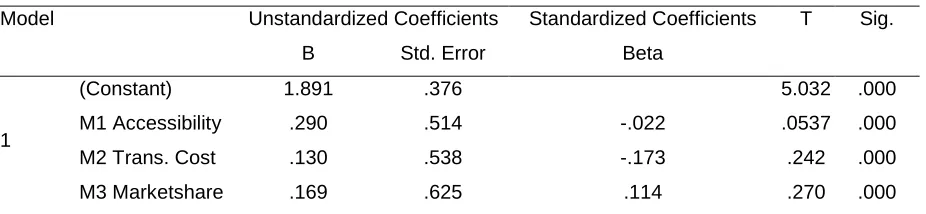
Table 4: Regression Model
Model Unstandardized Coefficients Standardized Coefficients T Sig.
B Std. Error Beta
1
(Constant) 1.891 .376 5.032 .000
M1 Accessibility .290 .514 -.022 .0537 .000
M2 Trans. Cost .130 .538 -.173 .242 .000
M3 Marketshare .169 .625 .114 .270 .000
a. Dependent Variable: B8: Financial Performance
From the table 4, the regression model of the relationship between agency banking and financial performance was Y= 1.891+0.290X1+0.130X2+0.169X3.
The Y-intercept was 1.891 meaning that if accessibility, cost of offering the service and market share were not influenced financial performance will be affected by 1.891. Accessibility of financial services through agency banking accounts for 0.290 of financial performance, while cost of providing the service accounts 0.130 of financial performance, market share accounts for 0.169 of financial performance. The t-vales of the variable – accessibility, cost and market share – are less than 2. This implies that whereas the agency model affects financial performance of Equity bank, the effect in not significant.
SUMMARY OF THE FINDINGS
Licensed under Creative Common Page 659 Through Banking agency model has, banks have lowered the high initial cost of setting up uneconomical branch in remote areas. Further, fixed cost, operational costs and transactional cost have also been reduced. As a result, the savings experienced is passed to customers. Moreover, agency banking accommodates well the huge volumes of transaction with low values that cannot warrant opening of a brick and mortar branch. Low cost of provision of financial services attracts more customers hence more profits.
More access of financial services couples with low cost of providing the services encourage more people to have accounts with Equity bank and are further, encourage to transact on them. In the process low income earners san save and offer the bank money to lend and they can also borrow to earn the bank interest. More customer give the banks its size and the power to control prices and services it offers to customers. A large and growing market share enables a bank to grow its revenues faster.
CONCLUSIONS
From the study findings, it can be concluded that:
Increasing access of financial services to customers entices them to use them, by opening and running accounts. This is true more too remote low-income earners who are financially excluded. More, access, more use leads to better financial performance of the bank Agency bank has enabled equity bank not to incur the high initial cost of setting up of a brick and mortar branch, further, the operational and transactional cost are also greatly reduced. This lowers the cost of providing the service and when the same is passed to the customers in terms of low cost of getting financial services, more transactions are realized translating to more profits.
Licensed under Creative Common Page 660 However, the above conclusions should be evaluated from the point of view of the following limitations:
(i) That the study used a case study of only one bank and its two branches in Nyamira and Keroka. This implies that other equally important financial institutions such as Saccos were excluded from the study.
(ii) The study was only limited to three agency banking constructs. Other agency banking constructs were therefore not factored.
The above limitations therefore limit the generalization of findings of the study.
RECOMMENDATIONS
Based on the findings, this study makes the following recommendations:
The study recommends that; commercial banks should be encouraged to embrace agency banking through adoption of improved technology. This will increase volume of transactions and bank size which will lead to financial performance. Security enhances accessibility and operation of agents’ banks; the government of Kenya should thus improve security to enhance operation of the agents’ bank. This will enable commercial banks in Kenya increase the number of agents. This can be done by reducing the requirements of becoming a bank agent. Commercial banks in Kenya should improve customers’ perception by making more advertisements and increase promotion activities of agent’s banking. By doing this the number of transactions made by customers will increase. This in turn helps the customers to save more and hence the amount the bank can loan increases. This helps to improve the financial performance of commercial banks. The government should support the program of operation of agency banking. This can be done by reducing the high compliance costs, bureaucracy in registration and high cost of taxation. This will increase the number of transaction by the banks hence profitability.
REFERENCES
Adiera, A., Instituting effective linkages between formal and informal financial sector in Africa: A proposal. Savings and Development, 1 (1995):5.
Afande, F., & Mbugua S. (2015). Role of Agent Banking Services in Promotion of Financial Inclusion in Nyeri Town, Kenya. Research Journal of Finance and Accounting, 148- 173. Retrieved from www.iiste.org/Journals/index.php/RJFA/article/download/19956/20484.
Allen, C.R., Fontaine, J.J., Pope, K.L., & Garmestani, A.S. (2011). Adaptive management for a turbulent future. Journal of Environmental Management 92, 1339-1345.
Alliance for Financial Inclusion – AFI (2012). Agent Banking in Latin America. Discussion paper, March 2012. Anyanzwa, J. (2012), Branchless banking runs into headwinds, Standard Digital.
Licensed under Creative Common Page 661 Sector. Paper Presented During DFID and HM Treasury Financial Inclusion Conference, London
Atieno,R. (2001). Formal and informal institutions’ lending policies and access to credit by small scale enterprises in Kenya. An Empirical Assessment AERC Research Paper 111.
Bankelele. (2015, November 16). Equity Bank 3.0: Agency Banking & Equitel. Retrieved from Bankelele: http://bankelele.co.ke/2015/11/equity-bank-3-0-agency-bankingequitel.html
Barasa D. A., & Mugambi, F. M. (2013). The Role of Agency Banking in Enhancing Financial Sector Deepening in Emerging Markets: Lessons from the Kenyan Experience. European Journal of Business and Management. Vol.5 (21) pp26-34
Bean, C., (2009), "The Great Moderation, The Great Panic And The Great Contraction", Transcript Of The Schumpeter Lecture At The Annual Congress Of The European Economic Association, Barcelona, 25 August. Beck T., Demirgüç-Kunt, A., & Levine, R. (2007), Finance, inequality and the poor. Journal of Economic Growth. Bloodgood, J.M., & Michael, A.C. (2010). Adoption-innovation theory and knowledge use in organizations. Management Decision, Vol. 48, Issue: 8, pp.1159-1180
Bold, C., (2011). Branchless Banking In South Africa. Consultative Group to Assist the Poor (CGAP). June 28, 2011 BNR (2014), Annual report July 2013-June 2014 – Kigali
Central Bank of Kenya (CBK). (2010). Guideline On Agent Banking. Nairobi, Government of Kenya Printers, CBK/PG/15
Central Bank of Kenya (2010). Agent Banking Knowledge Exchange. Nairobi, Kenya. Retrieved from http://www.afilobal.org/sites/
Central Bank of Kenya (2010). Guideline on Agent Banking - CBK/PG/15, Nairobi Central banks of Kenya’s annual supervision repot (2011).
Central bank of Kenya’s annual supervision report (2012).
Central Bank of Kenya (2012), Regulating Transformational Branchless Banking: Mobile Phones and Other Technology to Increase Access to Finance. Annual Report CBK/PG/48, Nairobi. CGAP. 2008. Focus Note No. 43 Washington DC.
CBK - Banking Supervision Department (2013). Banking Development Report, September 2013.
CBK, (2013). Developments in the Kenyan banking sector for the quarters ended 31st Mar, 30th and 30th Sep 2013 CheyechKitilit, Bowen & Amata (2016). The Role of Agency Banking In Improving Financial Access in Kenya: Case Study of Langata Constituency. Journal of Developing Country Studies, Vol.1, Issue 1 No.1, pp 61-73.
CGAP, (2011). Agent management toolkit: Building a Viable Network of Branchless Banking Agents.
Equity bank, (2013). Financial results half year 2013[Accessed from; http://equitybankgroup com/ index.php/investor-relations/financial-results[Accessed 3rd Oct 2013]
Gardeva, A., and Rhyne, E. (2011), Opportunities and Obstacles to Financial Inclusion Survey Report, Center for Financial Inclusion.
Gardner M.J, Mills D.L & Cooperman E.S (2000). Managing Financial Institutions an assets liability approach (4th ed.) Malaysia, Asia. John Wiley & Sons.
G20 Financial Inclusion Experts Group (2010), Innovative Financial Inclusion
Han, R., &Melecky, M. (2013). Financial Inclusion for Financial Stability. The World Bank. Retrieved from https://openknowledge.worldbank.org/bitstream/handle/10986/16010/WPS6577.pdf?sequence=1&isAllowed=y Ivatury, G., & Lyman, T. (2006). Use of Agents in Branchless Banking for the Poor:
Rewards, Risks, and Regulation. Washington D.C: CGAP Focus Note No. 38, October
Ivatury, G., Lyman, T. R. &Staschen, S. (2006). Use of Agents in Branchless Banking for the Poor: Rewards, Risks, and Regulation. Consultative Group to Assist the Poor.
Kabira (2013). The effect of agency banking on financial performance of commercial banks in Kenya.
Licensed under Creative Common Page 662 King’ang’ai, P. M., Kigabo, T., Jomo, E. K., &Kibachia, J. (2016). Effect of Agency Banking on the Financial Performance of Commercial Banks in Rwanda. A Study of Four Commercial Banks in Rwanda. European Journal of Business and Social Sciences, 5(1), 181-201.
Kinyanjui, K. (2011), Money markets, agency banking runs into hurdlers. Business Daily Monday, June 11, 2011. Kipng'etich, L. W. (2014). Agency Banking and Financial Inclusion in Kisumu, Kenya. Nairobi: University of Nairobi. Retrieved from http://erepository.uonbi.ac.ke/xmlui/bitstream/handle/11295/63226/Langat_Agency% 20banking%20and%20financial%20inclusion%20in%20Kisumu,%20Kenya..pdf?seq uence=3&isAllowed=y
Kitaka, P., (2001) A survey of the Use of Financial performance Indicators by Microfinance Institutions in Kenya, Unpublished MBA Research Project, University of Nairobi. 36
Kombe, S. K., & Wafula, M. K. (2015). Effects of Internet Banking on the Financial Performance of Commercial Banks in Kenya a Case of Kenya Commercial Bank. International Journal of Scientific and Research Publications. Retrieved from http://www.ijsrp.org/research-paper-05
Kumar, A. Nair, A. Parsons, and Urdapilleta E. (2006). Expanding Bank Outreach Through Retail Partnerships: Correspondent Banking in Brazil.
Ledgerwood, J., Earne, J., & Nelson, C. (Eds.). (2013). The New microfinance Handbook.
Financial Market System Perspective. Washington D. C.: The World Bank. Retrieved from https://openknowledge.worldbank.org/bitstream/handle/10986/12272/9780821389270 .pdf?sequence=6&isAllowed=y Lehman, J. (2010), Operational Challenges of Agent Banking Systems, Bill & Melinda Gates Foundation.
Lozano, D. M., &Mandrile, M. (2010). A New Agent Model for Branchless Banking in Colombia. International Development Law Organization. Retrieved from https://www.files.ethz.ch/isn/139395/BranchlessBankingColombia.pdf Mas, I. (2011). Why Are Banks so Scarce in Developing Countries? A Regulatory and Infrastructure. A Journal of Politics and Society, 23, 135-145. Retrieved from http://poseidon01.ssrn.com/delivery.php
Microcredit Summit E-News.(2004). United Nations general assembly launches program for the 2005 International year of microcredit. Retrieved from http://www.microcreditsummit.org/ enews/200401_intlyr.html
Mutua, R.W. (2013). Effects of mobile banking on the financial performance of commercial banks inKenya.MBA Project, University of Nairobi, Kenya.
Mwando, S. (2013).Contribution of agency banking on financial performance of commercial banks in Kenya. Journal of Economics and Sustainable Development, 4(20), 26-35.
Mwangi, R.W. (2013). An evaluation of the role of agency banking in the performance of commercial banks in Kenya. Unpublished MBA project, Kenyatta University
Mwende, Bichanga & Mosoti (2015). Investigation on Importance of Agency Banking in Provision of Banking Services in Kenya:(A Case of Equity Bank) in Kitui Central District, Kitui County, Kenya. International Journal of Scientific and Research Publications, Volume 5, Issue 10, October 2015. ISSN 2250-3153
Muasya, I. M., & Kerongo, F. (2015). The Effects of Agency Banking on Access to Financial Services: A Survey of Commercial Banks in Kilindini District. International Journal of Management Research and Business Strategy, 3(4), 103-118. Retrieved from http://www.ijmrbs.com/ijmrbsadmin/upload/IJMRBS_559a8c0da8f09.pdf
Mugenda, O., & Mugenda, A. G. (2003). Research methods: Quantitative and qualitative approaches. Nairobi, Kenya: ACTS Press
Nganga, S. I. &Mwachofi, M. M. (2013). Technology Adoption and the Banking Agency in Rural Kenya. Journal of Sociological Research. Vol. 4(1).
Podpiera, J. (2008). Emerging banking market experience. Journal of Financial Stability, 4(2), 135-148.
Oxford Policy Management (2011). Evaluation of Agency banking Models in Different Countries. Oxford: Oxford Policy Management Ld.
Rosen, T.V. (2013). Branchless banking in Kenya: Does mobile banking and agent banking have the potential to lift the welfare of low‐income individuals? Lund University.
World Bank, (2006).Making Finance Work for Africa, Washington DC.