ORIGINAL ARTICLE
IJPHY
ABSTRACT
Background: Hamstring injury is a common problem in many sports, especially those involving acceleration and max-imal sprints. Hamstring strains are both common and painful. During sprinting the hip flexor and knee extensor torques are frequently produced and is opposed by the hamstring muscles, hence there are numerous studies done on the muscle strength training to prevent the hamstring strain injury as it is statistically stated as the highest rate involved injury in the contact sport. This study has been focused to evaluate the effectiveness of concentric and eccentric exer-cises in improving hamstring muscle strength and power among futsal players.
Method: Thirty recreational futsal players were recruited for the study and were randomly divided into two groups. Each group received either hamstring curl exercise (concentric) or Nordic hamstring exercise (eccentric) twice a week for 4 weeks. The manual muscle test (MMT) and 40-yard dash test was used to evaluate the muscle strength and power respectively by comparing the pretest and posttest values for both groups.
Results: Wilcoxon signed rank test showed that there is no statistically significant difference between pre and post test values of MMT (Concentric (right side, z=.317; left side, z=.157), Eccentric (right side, z=.157; left side, z=.317)) in both groups. Based on paired 't' test there is a significant difference between the pre and post test on improving muscle power [Concentric group, P=.020; Eccentric Group, P=.000]. Mann–Whitney U test and unpaired 't' test showed that there is no significant difference between both groups of MMT (z=.775) and 40-yard dash test (P=.707) respectively.
Conclusion: The concentric strength training and eccentric strength training have a similar effect in improving ham-string muscle power in futsal players.
Keywords: Eccentric strength training, Concentric strength training, Hamstring injury, Futsal.
Received 27th September 2016, revised 15th November 2016, accepted 01st December 2016
www.ijphy.org
10.15621/ijphy/2016/v3i6/124728
CORRESPONDING AUTHOR
Int J Physiother. Vol 3(6), 674-679, December (2016) ISSN: 2348 - 8336
COMPARISON OF CONCENTRIC AND ECCENTRIC HAMSTRING
STRENGTH TRAINING IN IMPROVING MUSCLE STRENGTH AND
POWER AMONG FUTSAL PLAYERS – A RANDOMIZED CONTROLLED
TRIAL
*1Arunkumar Nedunchezhiyan ²Lorrian Shin Chee Lim
¹Syed Abudaheer Kajamohideen ¹Ilayaraja AlagiaThiruvevenkadam ¹Karthikeyan Rajendran
³Anithabhavani Nedunchezhiyan
*1Arunkumar Nedunchezhiyan
Senior Lecturer,
Department of Physiotherapy, Faculty of Therapeutic Sciences, Asia Metropolitan University, Selangor, Malaysia.
¹Senior Lecturer, Department of Physiotherapy, Faculty of Therapeutic Sciences, Asia Metropolitan University, Selangor, Malaysia.
²Alumna, Department of Physiotherapy, Asia Met-ropolitan University, Selangor, Malaysia.
³Cheif Physiotherapist, NG Hospitals, Singanallur, Coimbatore, Tamilnadu, India.
INTRODUCTION
Futsal is one of the popular sport which played by pro-fessional leagues in most of the countries in these recent years. As it is a small sided game, the players encounter the challenging situations where they have to run fast and tackle the opponent players.
During sprinting the hip flexor and knee extensor torques are produced and is opposed by the hamstring muscles, hence there are numerous studies done on the muscle strength training to prevent the hamstring strain injury as it is statistically stated as the highest rate involved injury in the sprinting swing–stance transition [1].
In futsal games, it requires a sequence of different physical activities or skills. Running is the predominant activity in the sport and it needs an explosive type of the efforts or power, such as sprinting generated by the hamstring for the contribution to a successful futsal game. In the sprinting cycle, the hamstrings first will undergo a stretch-short-ening cycle. However hamstrings also take part in the ex-plosive type of action, such as sprinting where the muscle power facilitates in achieving maximum speed or acceler-ation which is important for a successful performance [2]. Muscle strength is the crucial foundation in developing the muscle power. Muscle power is one of the import-ant aspects of the muscle performance that related to the strength and speed. It can be enhanced by increasing the input that a muscle needs to work over a specific time[3]. Isotonic resistance training is superior to isokinetic resis-tance training in terms of increasing muscle strength and power [4]. Several studies show that concentric and eccen-tric exercises are used independently or in combination in improving the muscle strength in hamstring, but there are fewer studies have been done in improving hamstring muscle power.
In sprint gait cycle, during the forward and double swing phases the activity of the hamstrings increase as they ec-centrically subdue the terminal stages of hip flexion and knee extension. The hamstrings concentrically contract to extend the hip and flex the knee during the stance phase of running and sprinting [5]. Hamstring posses a signifi-cant role in running activities which are predominant in futsal games. The hamstring tends to injure, especially the terminal swing phase where the hamstring contracts ec-centrically[6].
In futsal game, running is the predominant activity in the sport and it needs an explosive type of the efforts or power, such as sprinting generated by the hamstring for the con-tribution to a successful futsal game.
Since the strength training can improve the muscle pow-er [7], four week protocol for concentric and eccentric strength training is used, so that the futsal players can have shorter period training in order to enhance their perfor-mance in the games. There are still less number of studies have been done on comparing the two hamstring strength training in improving the muscle power. Hence this study focused on to determine the effectiveness of concentric
and eccentric hamstring strength training in improving muscle strength and power among futsal players.
METHODS AND RANDOMIZATION
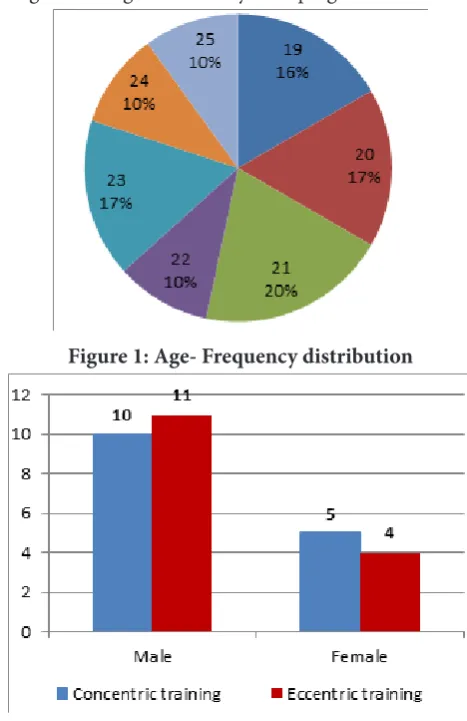
The study was a randomized control trial to compare the hamstring strength and power in recreational futsal players followed by two different strength trainings. The study was approved by University Human Ethical Committee (HEC, Asia Metropolitan University, Malaysia); The study was conducted at the Asia Metropolitan University, Malaysia. The research design was two group pretest-posttest exper-imental study design. The sampling technique used in this study was purposive sampling with random allocation of 15 participants, respectively in each concentric strength-ening group and eccentric strengthstrength-ening group. System-atic assignment was used for randomization. The subjects who fulfilled the selection criteria were recruited for the study. The inclusion criteria for the study were as follows: Adultsage between 18 and 30 (Figure 1), both genders (Figure 2) , no previous and/or present illness/condition limiting participation. Exclusion criteria were as follows: participating in any other clinical trials and /or lower limb strength training and history of doping.
Figure 1: Age- Frequency distribution
Figure 2: Gender- Frequency distribution Outcome measures and Interventions:
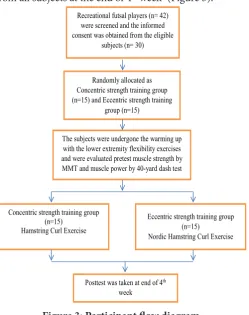
strength and power. The concentric and eccentric ham-string strength trainings were started after pretest and were performed for 4 weeks of 8 training sessions. Training ses-sions were given in 2 sesses-sions in a week. Posttest was taken from all subjects at the end of 4th week9 (Figure 3).
The subjects were undergone the warming up with the lower extremity flexibility exercises and were evaluated pretest muscle strength by MMT and muscle power by 40-yard dash test
Randomly allocated as Concentric strength training group (n=15) and Eccentric strength training
group (n=15)
Eccentric strength training group (n=15)
Nordic Hamstring Curl Exercise Concentric strength training group
(n=15) Hamstring Curl Exercise
Posttest was taken at end of 4th week
Recreational futsal players (n= 42) were screened and the informed consent was obtained from the eligible
subjects (n= 30)
Figure 3: Participant flow diagram.
Informed consent was obtained from all the eligible sub-jects. Prior to the strength trainings, the subjects from both groups were evaluated with pretest session using MMTand 40-yard distance on the flat surface. The players performed warm up with the stretches for quadriceps, hamstrings and calf muscles before each session. Each stretch was held for 15 seconds with 3 repetitions to above mentioned muscles. After the warm-up exercises hamstring muscle strength was assessed by standard MMT procedure [8]; then, sub-jects were asked tobe ready in a starting position with the appropriate foot postion behind the starting line without any physical movements and subjects ran up to 40-yard when the signal was given out. The stopwatch was started when the players started to run and stopped when they had reached the finishing line. The procedures were repeated for the second time. Two trial results were documented and the best result was taken.
Hamstring Curl Exercise:
The subjects were asked to lie in prone on the quadriceps table. A small towel roll was placed under the femur just proximal to the patella to avoid compression of the patella between the treatment table and the femur. Before starting out with the exercise protocol, the 10 RM for both legs of the subjects were identified. In prone lying with the resis-tance of 10 RM against the ankle in quadriceps table, the subjects flexed the knee to only 90° as fast as possible in their comfortable pace [9,10]. The 10 RM of the subjects was rechecked every week. After the 10 RM was tested, the
percentage of the exercise load was adjusted according to the training protocol (Table 1).
Nordic Hamstring Exercise:
The subject was in kneeling position on exercise mat and attempted to resist a forward-falling motion using the hamstring to maximize loading in the eccentric phase. The subjects kept their hips fixed in a slightly flexed position throughout the range of motion, and to break the forward fall for as long as possible using their hamstrings, and to keep the tension in their hamstrings even they have to “let go” [7,11]. They had to use arms and hands to buffer the fall, let the chest touched the surface and immediately got back to the starting position by forcefully pushing with their hands to minimize loading in the concentric phase (Table 1).
Concentric strength training - Hamstring curl
Ses-sions No of sets repetitions No of (% of 10 RM)Load
WEEK 1 1 1 15 60 2 1 15
WEEK 2 1 2 12 ‘70 2 2 12
WEEK 3 1 3 10 80 2 3 10
WEEK 4 1 3 8 90
2 3 8
Eccentric strength training - Nordic Hamstring Curl
Ses-sions No of sets repetitions No of (% of 10 RM)Load
WEEK 1 1 1 20
The subjects were asked to move forward their trunk as slow as
pos-sible 2 1 20
WEEK 2 1 2 20 2 2 20
WEEK 3 1 3 20 2 3 20
WEEK 4 1 3 20 2 3 20
Table 1: Training protocols Results and Statistical Analysis
RESULTS
Table 2 and 3 show that paired and independent samples inferential statistics of 40-yard dash test for concentric and eccentric strengthening groups.
Table 2 shows that the calculated ‘t’ value is 2.612, which slightly greater than table value 2.145 and the p value of p<0.05 (0.020). Hence this exhibits that there is less
signif-icant improvement in concentric strength training group. For eccentric strength training group, table reveals that the calculated ‘t’ value is 10.862 larger than table value 2.145 and a p value of p<0.05 (0.00). Hence, it confirms that high significant improvement in the eccentric strength training group.
Mean N Std. De-viation t df Sig.
(2-tailed) CONCENTRIC
GROUP
PRE-TEST 6.2533 15 .76749
2.612 14 .020*
POST-TEST 6.1173 15 .76502
ECCENTRIC
GROUP PRE-TEST 6.5620 15 .57230 10.862 14 .000*
POST-TEST 6.2133 15 .61127
Table 2: Paired Samples test for 40-yard dash test
t-test for Equality of Means
N t df (2-tailed)Sig. Mean Dif-ference DifferenceStd. Error
95% Confidence Inter-val of the Difference
Lower Upper
POST TEST
Equal variances
assumed 30 -.380* 28 .707* -.09600 .25284 -.61391 .42191 Equal variances
not assumed -.380* 26.700 .707* -.09600 .25284 -.61505 .42305
Table 3: Independent Samples Test for 40-yard dash test
Table 3 conveys that there is no significant difference be-tween concentric and eccentric groups with p<0.05 (0.707), respectively calculated ‘t’ value is 0.380 smaller than table value 2.048. So the alternative hypothesis is rejected. However, the analysis statistically shows there is a signif-icant difference between pretest and posttest score of the 40 yard dash test for the concentric and eccentric strength training respectively.
Pre and post test manual muscle test comparison for con-centric and eccon-centric strength training was done by Wil-coxon signed rank test. There was no significant statistical difference between pre and post test of both groups Con-centric group (right), Z>. 317; ConCon-centric group (left), Z>. 157, Eccentric group (right), Z>. 157, Eccentric group (left), Z>. 317)(Table 4).
Asymp. Sig. (2-tailed) 95% CI
RIGHT LEFT CONCENTRIC
GROUP Z>.05(.317)* Z>.05(.157)* ECCENTRIC
GROUP Z>.05(.157)* Z>.05(.317)*
Table 4: Within group compassion for MMT
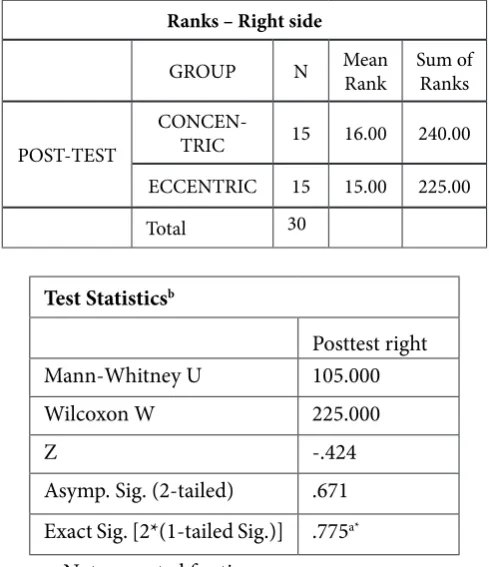
There was no significant statistical difference between concentric and eccentric strengthening group on manual muscle test in improving hamstring muscle strength with Z >.05 (.775) for the right side and with Z >.05 (.775) for left side (Table 5, 6).
Ranks – Right side
GROUP N Mean Rank Sum of Ranks
POST-TEST
CONCEN-TRIC 15 16.00 240.00
ECCENTRIC 15 15.00 225.00
Total 30
Test Statisticsb
Posttest right
Mann-Whitney U 105.000
Wilcoxon W 225.000
Z -.424
Asymp. Sig. (2-tailed) .671 Exact Sig. [2*(1-tailed Sig.)] .775a* a. Not corrected for ties.
b. Grouping Variable: GROUP
Ranks- Left side
GROUP N Mean Rank Sum of Ranks
POST-TEST
CONCENTRIC 15 16.00 240.00
ECCENTRIC 15 15.00 225.00
Total 30
Test Statisticsb
Posttest left
Mann-Whitney U 105.000
Wilcoxon W 225.000
Z -.424
Asymp. Sig. (2-tailed) .671 Exact Sig. [2*(1-tailed Sig.)] .775a* a. Not corrected for ties.
b. Grouping Variable: GROUP
Table 6: Group comparison for MMT- Left Side
DISCUSSION
There is a potential positive result in both concentric and eccentric strength training groups showed that there is a significant difference between the pretest and posttest on 40-yard dash test for the muscle power. Aagaard P et al (2010) and Kisner C et al (2015) found that this could be due to muscle hyper trophy followed by eccentric ecercis-es [7] and improving neuromuscular control and muscle endurance followed by concentric exercises [9]; but there is no change in muscle strength between pre and posttest in both groups. This can be explained by Newton R et al (1994), when the type II fibers are selectively recruited when there is a dynamic and explosive movements. The muscle has the ability to produce high force output as the velocity of contraction increases [14].
The more the cross sectional area occupied, the greater the number of fast myosin cross-bridge that can produce force during contraction. Thus, when the type II motor unit pool is recruited to produce explosive movement, these can be produced with correspondingly greater force and hence enhancing the power output. Hence the results of the pres-ent study suggest that, there is the significant improvempres-ent in posttest of the 40-yard dash test for concentric strength training among the futsal players.
The sport which integrates with running and jumping ac-tivities, it is important to improve muscle strength while minimizing the increases in muscle mass. This can be fur-ther explained with as the muscle size increases, strength increases at a slower rate than the muscle mass, Kendall F et al, (2010) [8].
For the Nordic hamstring exercise, previous study had sug-gested that as the athletes lowered themselves towards the ground where the hamstring contracted eccentrically and this had placed a great magnitude of stress on the limb. Clark R et al (2005) found that the Nordic hamstring
exer-cise enhanced the explosive power performance in athletes [15]. Hence, the overload on the hamstring may enhance the neuromuscular adaptation in the limb. It can be seen in the results of the present study that there is a significant difference in pretest and posttest of 40 yard dash test in eccentric strength training.
With regard to the previos study Mjolsnes R et al (2004), it was foud that there was a improvement in maximal ec-centric hamstring strength in Nordic hamstring exercise group compared to traditional hamstring curl exercise group [16]. The main reson for this may be that the dif-ferent outcome measures and the duration were used in the study. Thererfore, further randomized trials, number of participants would be increased and various protocols can be compared to improve muscle power and strength in futsal players .
CONCLUSION
This current randomized control trial concludes that the concentric (hamstring curl) and eccentric (Nordic ham-string) strength training is similarly effective in improving hamstring muscle power in futsal players.
Acknowledgement
The authors acknowledge the volunteers.The authors are also grateful to authors / editors / publishers of all those articles, journals and books from where the literature for this article has been reviewed and discussed. No part of the study has received financial support from any sources.
Conflicts of interest
The author declares no conflicts of interest. REFERENCES
[1] Ivan Z. Anatomy, Physiology and biomechanics of hamstrings injury in football and effective strength and flexibility exercises for its prevention. Journal of Human Sport and Exercise. 2012; 7(1): 208-S217.
[2] Sun Y, Wei S, Zhong Y, Fu W, Li L, Liu Y. How joint torques affect hamstring injury risk in sprinting swing–stance transition. Medicine & Science in Sports & Exercise. 2015; 47(2):373-380.
[3] Cometti G, Maffiuletti N, Pousson M, Chatard J, Maf-fulli N. Isokinetic strength and anaerobic power of elite, subelite and amateur French soccer players. In-ternational Journal of Sports Medicine. 2001;22(1):45-51.
[4] Kovaleski J, Heitman R, Trundle T. Isotonic preload versus isokinetic knee extension resistance train-ing. Medicine & Science in Sports & Exercise. 1994; 26:895-899.
[5] Schache A, Dorn T, Pandy M. Lower-limb muscle function in human running. advances in mechanisms. Robotics and Design Education and Research. 2013; 14:323-327.
[7] Aagaard P. The use of eccentric strength training to enhance maximal muscle strength, explosive force (RDF) and muscular power - consequences for ath-letic performance. The Open Sports Sciences Journal. 2010;3(1):52-55.
[8] Kendall F, McCreary E, Provance P. Muscles Testing and Function with Posture and Pain. 5th ed. Lippincott Williams & Wilkins; 2010.
[9] Kisner C, Colby L. Exercise Foundation and Tech-niques. 5th ed. iGroup Press Co., Ltd; 2015.
[10] Brotzman S, Wilk K. Clinical orthopaedic
rehabilita-tion. 2nd ed. St. Louis: Mosby; 2003.
[11] Hertling D, Kessler R. Mangement of Common
Mus-culoskeletal Disorders. 4th ed. Lippincott Williams & Wilkins; 2006.
[12] Lehmkuhl L. Nonparametric Statistics: Methods for
analyzing data not meeting assumptions required for the application of parametric tests. Journal of Pros-thetics and Orthotics. 1996;8(3):105-113.
[13] Pauole K, Madole K, Garhammer J, Lacourse M,
Rozenek R. Reliability and validity of the t-test as a measure of agility, leg power, and leg speed in col-lege-aged men and women. Journal of Strength and Conditioning Research. 2000;14(4):443-450.
[14] Newton R, Kraemer W. Developing Explosive
Muscu-lar Power: Implications for a Mixed Methods Train-ing Strategy. Strength and ConditionTrain-ing Journal. 1994;16(5):20.
[15] Clark R, Bryant A, Culgan J, Hartley B. The effects
of eccentric hamstring strength training on dynamic jumping performance and isokinetic strength param-eters: a pilot study on the implications for the preven-tion of hamstring injuries. Physical Therapy in Sport. 2005; 6(2):67-73.
[16] Mjolsnes R, Arnason A, Osthagen T,
Raas-tad T, Bahr R. 10-week randomized trial com-paring eccentric vs. concentric hamstring strength training in well-trained soccer players. Scandinavian Journal of Medicine and Science in Sports, 2004; 14 (2):311-317.
Citation
Nedunchezhiyan, Chee Lim, L., A., Kajamohideen, S. A., Thiruvevenkadam, I. A., Rajendran, K., & Nedunchezhi-yan, A. (2016). COMPARISON OF CONCENTRIC AND ECCENTRIC HAMSTRING STRENGTH TRAINING IN IMPROVING MUSCLE STRENGTH AND POWER AMONG FUTSAL PLAYERS – A RANDOMIZED