ORIGINAL ARTICLE
IJPHY
ABSTRACT
Background: Current available standardized clinical balance assessment tools are used for screening. BESTest helps us identify the specific system that might be responsible for balance dysfunction with aging.
Methods: An observational single point cross-sectional study. Healthy subjects (N=120) Young age group (20-40 yrs), Middle age group (41-60 yrs), Old age group (61-80yrs). Quota sampling. Total BESTest score and a Total score of each of 6 components of BESTest were compared across the three age groups.
Results: Non- parametric Kruskall Wallis test. Post hoc test study of Total BEST Score H=48.88 (p value <0.0001) showed a significant difference in young adult as compared to Middle aged adult (p value <0.001) and older adults (p value <0.001). Similar post hoc test study with a P value < 0.0001 were observed in biomechanical constraint H=32.10, Stability limits or Verticality H=25.11 and Anticipatory control score H=19.83. Post study of reactive postural response H=41.17 and Sensory Orientation H=28.14 (p value <0.0001) showed a significant difference in Older adults as com-pared with Young Adults and Middle age adults. Post Study of Stability in Gait H=51.00 (p value=0.0001) showed significant difference across the three age group.
Conclusion: Total BEST score and three balance components start getting impaired by middle age. Reactive postural responses and sensory orientation diminish in older adults. Stability in gait shows a steady decline with aging. Our study concludes that middle age is critical aging and changes start appearing by middle age. Future studies are needed to observe the effect of an exercise program designed to target specific component of BESTest.
Keywords:Aging, Postural control, Balance Assessment, BESTest, Young Age, Middle Age and Old Age.
Received 09th April 2017, revised 31st May 2017, accepted 05th June 2017
www.ijphy.org
10.15621/ijphy/2017/v4i3/149072
CORRESPONDING AUTHOR
Int J Physiother. Vol 4(3), 191-195, June (2017) ISSN: 2348 - 8336
EFFECT OF AGING ON COMPONENTS OF BALANCE
EVALUATION SYSTEM TEST (BEST
est
)
*1
Varsha Soni
²Hutoxi Writer
*1Varsha Soni
Neurophysiotherapist,
Pacific Medical College and Hospital, Udaipur. Alumni-PT School and Center, TNMC, Mumbai.
Email: [email protected] ²Professor and Head of Department,
Physiotherapy Department at Topiwala Na-tional Medical College and Nair B.Y.L. Chari-table Hospital, MUHS, Mumbai.
INTRODUCTION
Aging is a fundamental process that affects all of our sys-tems and tissues. The rate and magnitude of change in each system may differ person to person, but total body decline is an inevitable part of life for everyone. It was found by Porter Mm and et al. in 1995 that approximately half of the decline with age has a genetic basis. The remainder of age-related change is the consequence of lifestyle, primar-ily physical inactivity that can account for the other half of the decline with age [1]. India is the second largest country in the world, with 72 million elderly persons above 60 years of age as of 2001. According to projections, the elderly in the age group 60 and above is expected to increase from 71 million in 2001 to 179 million in 2031 [2].Postural con-trol involves many sensory and motor systems, and studies have been done to show age-related declines in visual, ves-tibular, and sensory motor functions [3-11].For many el-derly subjects, the aging process is inevitably accompanied by a restriction of the ability of independent movement and loss of balance [3]. Functional limitations associated with aging often lead to a vicious downward cycle with in-creasing levels of disability leading to greater recondition-ing that further decreases functional ability. These declines lead to secondary conditions and, often, to additional new diseases. Current standardized clinical balance assessment tools are directed at screening for balance problems and predicting fall risk, particularly in elderly people. These tools identify which patients may benefit from balance re-training, but they do not help therapists decide how to treat the underlying balance problems .BEST is developed on a clinical test of balance control based on Bernstein’s concept that postural control results from a set of interacting sys-tems. BEST evaluates balance in 6 components.Since much of the decline with aging is lifestyle related, physiotherapists have ample opportunity to intervene along the way Physi-cal therapists can be particularly instrumental in reducing the disabling effects by promoting restorative and accom-modative changes that stop or reverse the vicious down-ward functional cycle, allowing the individual to achieve optimal aging [12]. Age 50 marks a point in middle age at which the benefits of regular physical activity can be most relevant in avoiding, minimizing, and reversing many of the physical, psychological, and social hazards which often accompany advancing age. Heidelberg guidelines suggest preventative and rehabilitative effects of regular physical activity are optimized when physical activity patterns are adopted early in life, rather than when initiated in old age [13]. These beneficial effects apply to most individuals re-gardless of health status and disease state. The objective of this study to see how each of the six components is affected in the three age groups as age advances. So that earliest and most affected component of BESTest can be targeted in fu-ture for early aging to promote healthy aging.
METHODS
Study was conducted in tertiary healthcare centre (Topi-wala National Medical College, BYL Nair Charitable Hos-pital, and Mumbai) with community-based sample. The study was started in 2013 and completed by 2015.
Institu-tional Ethics Committee Review Board of B.Y.L Nair Char-itable Hospital, Mumbai. (Registration No.: ECR/22/Inst/ Maha/2013/RR-16) approval was obtained before com-mencing the study
timed get up and go- similar task with backward counting. The protocol is in accordance with the ethical standards of the institutional review board. Mean of the Total Best score, Component 1, component 2, component 3, Component 4, Component 5, and Component 6 are measured in each age group. Post evaluation data were collected and statistically analyzed. No data was missing in the study. Mean, median and standard deviation were calculated.
RESULT
Data was collected and statistically analyzed using the GraphPad Prism 6 and GraphPadI nstat. The data was test-ed for normality using the kolmogorov’s- smirnov test. The data was not passing the normality. Hencenon- parametric Kruskall Wallis test was used for comparison of Total best score and component score across the three age groups. Means of each component within the group was plotted using frequency distribution in each age group. The level of significance was set as 5%. Distributions of age in 3 age groups were[mean(SD: min to max)]. In young age group mean age was 29.95 (5.47: 21 to 39). In middle age group mean age was 49.77 (5.87: 41 to 60). In old age group mean age was 67.45 (4.95: 61 to 80). Among the young age group, lowest mean was for component 4 (89.43) and high-est mean for component 5 (97.75). Among the middle age group, the lowest mean was for component 4 (85.75) and highest mean for component 5 (92.85). Among the middle age group, the lowest mean was for component 4 (85.75) and highest mean for component 5 (92.85). Among the old age group lowest mean was for component 4 is (76.63) and highest mean was for component 1(85.10).
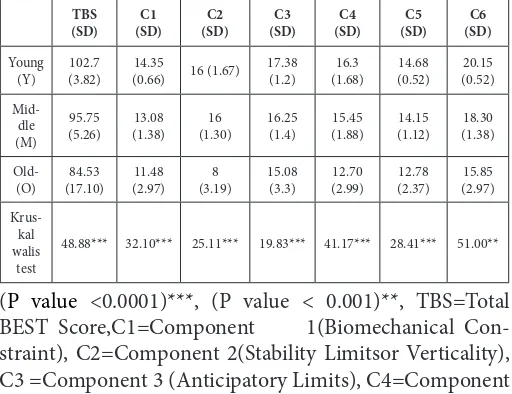
Figure no. (1) Gives a graphical presentation of Compari-son of Total BEST scores among the three age groups. Age group was plotted on the Xaxis, and BESTest scores plot-ted on the Y axis. Mean of three age group are 102.7(SD+- 3.82), 95.75(SD+-5.26), 84.53(SD+-17.10). There was a significant difference among three age groups. In the post hoc study results showed a significant difference in young as compared middle and old. There was no significant dif-ference between middle and old. Table no. (1) Shows com-parison of Total BEST score and components in three age groups (Young, Middle and old age). Table shows mean, standard deviation, comparison by kruskal Wallis test of Total BESTest score and six components among the young, middle and old age group. It shows Kruskall Wallis value along with the level of significance. Table no. (2) Shows Post hoc study between different age group in total score and each component.
By table (1) and (2) it is observed that old age group had a significant difference in total BESTest Score, biomechanical constraint, Stability limits or Verticality and Anticipatory control score compared to middle and young age groups. There was no significant difference between middle and old age group Reactive postural responses and sensory ori-entation score were found to significantly decrease in Old age group compared to young and middle age group. There was no significant difference between young and middle age groups. Stability in gait score showed a significant dif-ference in three age groups. The level of significance was
more when young was compared with Middle and Old. Also, Sensory Orientation Score found to be a least affect-ed component in each age group, and Reactive Postural Responses was found to be a most affected component in each age group.
DISCUSSION
Component 4 Reactive postural responses was the most affected component in all the three groups. In middle and old age group, there is a steady decline in mean suggesting postural reactive strategy starts affecting early. similarly, Liaw MY, Chen CL et al. in 2009 while studying static and dynamic balance concluded that elderly uses hip strategy to maintain postural balance in standing [14].
Comparison of total BEST score shows that the Young group had significantly good balance than Middle and Old group. The Old group did not show difference scores sig-nificantly compared to Middle age group. In our study, it suggests balance starts declining by middle age. Kang hee cho in 2012 found that non-faller elderly has good balance; hence in our study , it could be seen that there was no sig-nificant difference between middle and old age group [15]. Middle age is an ideal age to start exercise to prevent fall associated with poor balance in old age. Indian popula-tion has a sedentary lifestyle with less interest in compet-itive sports. This could lead to poor strength and reaction time even in middle age. Similar results were seen with biomechanical constraint, Stability limits or Verticality, and Anticipatory control score. Exercise program for this component needs to be trained from middle age group. Reactive postural responses and sensory orientation score were found to be significantly reduced in Old age group compared to young and middle age group. Tsai YC in 2014 found that older adults have similar patterns of joint move-ment and COM excursion as the young adults during the balance reactive-recovery. However, the elderly group has larger proximal joint rotation inducing larger COM sway to envelop and it leads to loss of compensatory strategy of posture recovery [16]. Weinstin in 1991 found that elderly appear to use a hip strategy more than an ankle strategy, in contrast to younger adults [17]. Also, Fay Horak in 1997 showed that elderly increased body stiffness and prolonged onset latency leads to poor compensatory postural strategy [18]. Wollacot M and et al. in 1986 found that resolution of sensory conflicts becomes challenging in the old age group with a decline in the integrity of many postural regulating systems, including musculoskeletal and sensory systems, as well as neural processing and conduction of information [19]. Because of involvement of multiple system and loss of compensatory strategy with aging, there is a significant de-crease in reactive postural strategy and sensory orientation score in old age group.
in step width, walk end sway, turn sway, and decrease in step length and speed of walk when compared to young adults. Moreover, there was significant prolongation in la-tencies of all responses elicited by both the gastrocnemius muscle (SLR, MLR) and tibialis anterior muscle (LLR) in the posture evoked aresponse of elderly individuals. Also, Jennifer Byrne et.al [21] in 2002 noted that with aging there occurs a change in intralimb coordination with asymmet-rical weighting in lower limb during walking. Elderly sub-jects have reduced stability limits, delayed reaction time and decreased rate of torque generation. This section also includes the Timed “Get Up and Go” Test without and with a secondary cognitive task to challenge the patient’s atten-tion. Lack of sensory inputs, inefficient reactive strategies make gait much more cognitively controlled resulting in increased attentional demands on gait. As found by Dubost et. at in 2006 [22]authors that the rhythmic stepping mech-anism of walking in healthy older adults requires some at-tention. Hence when an additional cognitive task is added, there is a further decrease in walking speed. So, there is a steady decline in scores of stability in gait. As using force platforms and accelerometers is expensive and not always feasible in our Indian set up, a simple, inexpensive tool like BESTest may be used to assess different component of
pos-tural stability.
Limitations
1) The study was conducted at one area, and the results cannot be generalized to the general population. 2) The study had a Small sample size. 3) The activity level was not compared in across three age groups. Future Suggestions: 1) A large multicentre study should be conducted so that the results can generalized to the general population. 2) An interventional study can be undertaken to see the effect of a balanced program planned as per the components of bal-ance affected in this study.
CONCLUSION
Total BEST score, Biomechanical constraint, stability lit and anticipatory control components start getting im-paired by middle age. Reactive postural responses and sensory orientation diminish in older adults. Stability in gait shows a steady decline with aging. Our study con-cludes that middle age is critical aging and changes start appearing by middle age. Future studies are needed to ob-serve the effect of an exercise program designed to target specific component of BESTest.
Tables and Graph
Figure 1: Comparison of Total BEST scores among the three age groups chart.
A g e g r o u p
BE
ST
est
Y M O
0 5 0 1 0 0 1 5 0
Table 1: Comparison of Total BEST score and compo-nents in three age groups (Young, Middle and old age).
TBS
(SD) (SD)C1 (SD)C2 (SD)C3 (SD)C4 (SD)C5 (SD)C6 Young
(Y) (3.82)102.7 (0.66)14.35 16 (1.67) 17.38(1.2) (1.68)16.3 (0.52)14.68 (0.52)20.15
Mid-dle (M)
95.75
(5.26) (1.38)13.08 (1.30)16 16.25(1.4) (1.88)15.45 (1.12)14.15 (1.38)18.30
Old-(O) (17.10)84.53 (2.97)11.48 (3.19)8 15.08(3.3) (2.99)12.70 (2.37)12.78 (2.97)15.85
Krus-kal walis
test
48.88*** 32.10*** 25.11*** 19.83*** 41.17*** 28.41*** 51.00**
(P value <0.0001)***, (P value < 0.001)**, TBS=Total BEST Score,C1=Component 1(Biomechanical Con-straint), C2=Component 2(Stability Limitsor Verticality), C3 =Component 3 (Anticipatory Limits), C4=Component 4 (Reactive postural strategy), C5=Component 5(Sensory Orientation), C6= Component 6(Stability in Gait).
Table 2: Post hoc study (Post Kruskal Wallis) of the total BESTest score and different components among three age
groups (P value showing level of significance between groups).
Post Hoc Study Middle Vs old age group Young Vs Middle age group Young Vs old age group
Total BEStest
Score >0.05 < 0.001 < 0.001 Component 1 >0.05 < 0.001 < 0.001
Component 2 >0.05 < 0.01 < 0.001 Component 3 >0.05 < 0.01 < 0.001 Component 4 < 0.001 >0.05 < 0.001 Component 5 < 0.01 >0.05 < 0.001 Component 6 0.0362 < 0.001 < 0.001 Abbreviations: BESTest = Balance Evaluation System Test
Acknowledgment
I would like to thank Kedar Mate, Shilpa Gaikwad, Nar-endra Soni and Chandresh Soni for critically reading the manuscript and helpful discussion.
REFERENCES
[1] Porter Mm, Vandervoortaa et al. Aging of human muscle: structure,function and adaptability. Scand J Med Sci Sports. 1995 Jun;5(3):129-42.
[2] Rajan SI, Sarma PS, et al. Demography of Indian aging, 2001-2051. J Aging Soc Policy. 2003;15(2-3):11-30.
[3] Woollacott M. Age-related changes in posture and movement. J Gerontol. 1993 Sep;48 Spec No:56-60.
[4] Stephen Lord, Russell Clark, et al. Postural Stability and Associated Physiological Factors in a Population of Aged Persons. J Gerontol.1991; 46 (3): M69-M76.
[5] Scott W Shaffer and Anne L Harrison. Aging of the Somatosensory System: A Translational perspective. PhysTher. 2007 Feb;87(2):193-207.
Citation
Soni, V., & Writer, H. (2017). EFFECT OF AGING ON COMPONENTS OF BALANCE EVALUATION SYSTEM TEST (BESTest). International Journal of Physiotherapy, 4(3), 191-195.
[7] Ann P. Woodhull-McNeal.Changes in posture and bal-ance with age. Aging (Milano). 1992 Sep;4(3):219-25.
[8] Wolfson L, Whipple R et. al. The effects of age, disease, and gender on the balance of healthy elderly. In: Falls, Balance and Gait Disorders in the Elderly. Christen Y (eds), Elsevier, Paris, 1992, pp 129-135.
[9] Enriettoja, Jacobson km, and Balohrw. Aging effects on auditory and vestibular responses: a longitudinal study. Am J Otolaryngol. 1999 Nov-Dec;20(6):371-8.
[10] George E Stelmach, G. E. andSirica. A. Aging and proprioception. Age.1986;9(4):99-103.
[11] Manchester D, Woollacott M, Zederbauer-Hylton N, Marin O. Visual-vestibular and somatosenso-ry contributions to balance control in the older adult. J Gerontol. 1989 Jul;44(4):M118-27.
[12] Guccione.The Physiology of Age Related and Life-style Related Decline. Geriatric Physical Therapy, 3rd
Edition;2011.
[13] The Heidelberg Guidelines for Promoting Physi-cal Activity among Older Persons.4th International Congress meeting on Healthy Ageing, Activity and Sports, August 1996 in Heidelberg, Germany, and finalized at WHO/AHE.
[14] Liaw MY, Chen CL, et al. Comparison of the static
and dynamic balance performance in young, mid-dle-aged, and elderly healthy people. Chang Gung Med J. 2009 May-Jun;32(3):297-304.
[15] Kang Hee Cho, M.D., Soo Kyung Bok, M.D., Young-Jae Kim, M.D., SeonLyul Hwang, M.D. Effect of Lower Limb Strength on Falls and Balance of the
El-derly. Ann Rehabil Med. 2012 Jun; 36(3): 386–393.
[16] Tsai YC, Hsieh LF, Yang S. Age-related changes in posture response under a continuous and unexpect-ed perturbation. Journal of Biomechanics. 2014 Jan 22;47(2):482-90.
[17] Winstein CJ. Knowledge of the results and motor learning implications for physical therapy. PhysTher. 1991 Feb;71(2):140-9.
[18] Fay B Horak, Sharon M Henry and Anne Shum-way-Cook. Postural Perturbations: New Insights for Treatment of Balance Disorders. PhysTher. 1997 May;77(5):517-33.
[19] Wollaacott M. H., Shumway cook, et. al. Aging and posture control: Changes in sensory organisation and muscular coordination. Int J Aging Hum Dev. 1986;23(2):97-114.
[20] Osama Baradah, Mahmoud Allam et. al. Bal-ance in elderly. Egypt J. Neurol. Psychiat. Neuro-surg.2004;41(1):95-114.
[21] Byrne, Jennifer E.; Stergiou N, et. al. Comparison of gait patterns between young and elderly women: an examination of coordination. Percept Mot Skills. 2002 Feb;94(1):265-80.
[22] Dubost V, Kressig RW, et al. Relationships