INVESTIGATION OF THE IMPACT OF PRE-SCHOOL EDUCATION ON THE ATTITUDES OF THE PARENTS
Fatma Nesrin Dabakoğlu
Bingöl University, Vocational School of Healthy, 12000, Bingöl/Turkey
Abstract
The aim of this study is to investigate parental attitudes of third grade students who attended and did not attend pre-school education. The sample of the study consists of 360 third grade students from 13 separate public secondary schools in Ankara. In order to determine parental attitudes of students, it was measured by parental attitudes scale which was developed by Suna Polat. The other measure used in the study is personal information which was developed by the researcher for this research. Results indicated that there was a significant difference between parental attitudes of third grade students who attend pre-school education and those who did not in the favor of students who attended preschool education. Finally, the result showed that there was a negative significant relationship between both mothers’ and fathers’ attitudes of students who attended preschool education.
Key words: importance of preschool education, parental attitudes
1. INTRDUCTION
Early childhood is one of the significant periods of a member who is in interaction with social environment after birth (Black et al., 1995). In this period, materially and morally support is given to the child, in particular, by family, close social relationships and education experiences, providing the integrity of supports in terms of social, cultural and psychological to guide the members to grow up literately and sensibly (Karavalis et al., 2003). On the basis of this, preschool education experiences which support the development of members from many aspects beginning from early childhood associated with domestic acquirements have significant impressions on members’ lives (Avci, 1995). School is the most important social environment for the child after domesticity (Calhoun, 2001). Preschool education which is the first step of school life provides child development being with all cognitive, social and physical aspects (Aral et al., 2000). In the period of preschool education, development is very fast and comprises a critical period, and there is an interaction among all aspects of the development (Deckard, 2001). Negativity or neglecting regarding any aspect of the development in this period, may affect the child development and his/her life negatively (Confield et al., 1994). Sufficiencies and insufficiencies and emotional problems of child that involve preschool period should be determined and taken due precautions (Krhansstoever, 2001). Therefore, in preschool period, which is described as early childhood and includes 0-6 ages, approach to child and education will affect the personality development, training experiences and self perceptional style directly (Rotenberg et al., 2003).
In this study has been planned to find out whether there is a significant difference between members who attend preschool education and those who do not, regarding parents’ attitudes.
2. MATERIALS AND METHODS
This research has been designed, as a descriptive research, to state for the purpose of importance of preschool education in the development of students’ parents’ attitudes (Kaptan, 1998). The population of research consists of the third grade students who attended primary education public schools of the National Education Ministry in Çankaya district of Ankara between 2002 and 2003 academic years.
Table. 1 the Attitudes of Mother-Father depending on Parents’ age Factor
Age of Mother
30 and under 55 18.0 119 31.5 174 25.5
31-40 208 66.2 222 58.7 430 63.0
41 and over 42 13.8 37 9.8 79 11.6
Total 305 100 378 100 683 100
Age of Father
30 and under 8 2.6 25 6.7 33 4.9
31-40 118 61.4 238 64.0 426 62.8
41 and over 110 35.9 109 29.3 219 32.3
Total 306 100 372 100 678 100
According to parents’ attitude scale score, there is a significant difference between the attitudes of mothers and their age factors regarding students’ attending prescchool education. the difference for students attending preschool education is significant (f (2.302)= 2.762, p<.01), on the other hand, those not attending preschool education is significant as well (f (2.375)= 1.059, p<.01. If the scale score is analysed by depending on the age of mother, it has been pointed out that the attitudes of mothers whose children attend preschool education have higher democratization tendency than mothers whose children do not attend any preschool education.
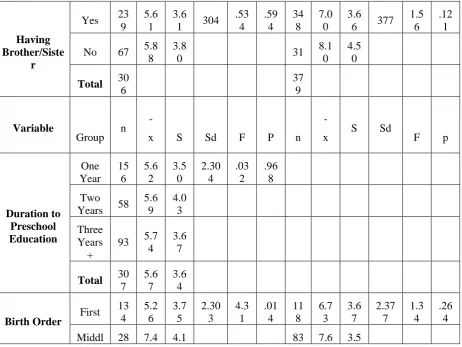
Table. 2 According to Parental Attitude Scale Score In Case of Attending Preschool Education, In Terms of Dependent Variables on Having Brother/Sister
Having Brother/Siste
r
Yes 23 9
5.6 1
3.6
1 304 .53
4 .59
4 34
8 7.0
0 3.6
6 377 1.5
6 .12
1
No 67 5.8 8
3.8
0 31
8.1 0
4.5 0
Total 30 6
37 9
Variable
Group n -
x S Sd F P n
-
x S Sd F p
Duration to Preschool Education
One Year
15 6
5.6 2
3.5 0
2.30 4
.03 2
.96 8
Two Years 58
5.6 9
4.0 3 Three
Years +
93 5.7 4
3.6 7
Total 30 7
5.6 7
3.6 4
Birth Order First 13
4 5.2
6 3.7
5
2.30 3
4.3 1
.01 4
11 8
6.7 3
3.6 7
2.37 7
1.3 4
.26 4
Middl 28 7.4 4.1 83 7.6 3.5
There is a significant difference between the students whose parents’ attitude scale mean score in accordance with the situtitaiton of attending preschool education. t (690)=5.168, p<.01) mothers’ attitudes of students who attend prescchool education are more democratic in compared to students’ mothers’ attidues who do not attend.There is a significant difference with respect of gender factor between Parents’ attitude scale mean score according to the situation of attending preschool education. The difference for those attending preschool education is (t (304)=,3.034, p<.01); and for those not attending preschool education is (t (377)=4.051, p<.01).There is not a significant difference for Parents’ attitude scale mean score for the factor of having a sibling in terms of attending preschool education. From the point of mothers’ attitudes, the difference for students who attend preschool education is (t (304)= .534; p<.05); for students not attending preschool education, mothers’ attitude have been assesed as (t (377)= 1.556; P>.05).
According to parents’ attitude scale scores of students, there is not a significant diffecence regarding continuation to attend preschool education (t (2.304)=.032 p>.05). Considering parents’ attitude scale scores of students, there is a significant difference between the factor of birth order and mothers’ attitudes in terms of attending preschool education. while the difference has been pointed out for students who continue preschool education is (t (2.303)= 4.307, p<.05); for students not attending is (t (2.377)= 1.336, p<.05).The result of Mother attitude scale of students has been stated on Table 3 by being based on analysis of variance results. In case that the results of analyses are significant, Secheffe’s multiple range test has been done and its results have been interpreted.
Table. 3 According to the Attitudes of Mothers In Case of Attending Preschool Education, Anova Results In Terms of Dependent Variables on Parents
Variable Group
Attending Preschool
Education Not Attending Preschool Education n -
x S Sd f p n
-
x S Sd f P
Age of Mother
30 and
under 55 6.3
3 3.9
3
2.30 2
2.7 6
.06 5
11 9
7.3 9
3.8 4
2.37 5
1.0 6
.34 8
31-40 20 8
5.7 3
3.6 8
22 2
7.0 3
3.7 0 41 and
over 42 4.5
9 2.8
8 37
6.4 0
3.2 9
Total 30 5
5.6 8
3.6 5
37 8
7.0 8
3.7 1
Age of Father
30 and under 8
6.5 0
2.2 0
2.30 3
.98 3
.37 5 25
8.2 4
3.9 3
2.36 9
1.7 5
.17 6
31-40 11 8
5.8 3
3.8 9
23 8
7.0 2
3.7 1
41 and 11 5.2 3.2 10 6.7 3.4
e 6 5 0 0
Last 14 4
5.6 9
3.3 7
17 9
7.1 4
3.8 9
Total 30 6
5.6 7
3.6 5
38 0
7.1 1
3.7 4
over 0 9 4 9 2 7
Total 30 6 5.6 5 3.6 4 37 2 7.0 1 3.6 6 Mother education Level
Illiterate - - - 40 8.3
0 4.0 5 5.28 8 2.2 7 .04 8
Literate 15 6.4 7 3.1 4 4.26 7 3.2 8 .01 2 47
7.1 5
3.5 5
Primary School 30
6.1 7
3.3
2 94
7.3 9
3.9 2 Secondary
School 25 5.4
0 2.6
9 45
6.3 5
3.8 8
High
School 99 6.4
2 4.4
7 53
6.0 6
3.5 4
University 10 3
4.6 6
3.2
2 15
5.9 3
4.3 0
Total 27 2 5.6 4 3.7 6 29 4 7.0 0 3.8 7 Father Education Level
Illiterate - - - -
Literate 14 7.2 1 4.0 0 4.27 1 1.5 9 .17 8 49
8.0 2 3.4 5 4.29 5 2.2 9 .06 0 Primary School 15
6.0 0
3.2
9 84
7.4 0
3.5 2 Secondary
School 24 6.5
4 3.3
0 50
6.4 0
3.6 5
High
School 91 5.8
9 3.7
0 82
7.1 9
4.2 6
University 13 2
5.1 9
3.7
9 35
5.8 0
4.1 5
Total 27 6 5.6 8 3.7 2 30 0 7.0 9 3.8 5 Mother Occupatio n Not working 14 1 6.3 7 4.0 3 2.28 0 7.4 6 .00 1 30 4 7.0 2 3.7 2 2.35 9 1.5 5 .21 4
Employee 5 - - - 31 8.2
6 4.0 9 Civil Cervant 11 8 4.6 6 3.0
9 6 - -
Self-Employme
nt
24 5.6 2
2.5
7 27
7.1 1
3.4 4
Total 28 3 5.6 0 3.6 4 36 2 7.1 3 3.7 4 Father Occupatio Not
working 7 - -
2.27 8
2.9 7
.05 3 34
n
Employee 42 6.0 2
3.9 0
12 4
7.5 5
3.8 6
Civil Cervant
13 4
5.0 9
3.3
3 55
6.3 3
3.3 5
Self-Employmen
t
105 6.18 3.82 141 6.67 3.70
Total 281 5.64 3.63 354 7.13 3.73
When parents’ attitude scale score is analysed, there is a significant difference between the attitudes of mothers and their age factors in terms of students’ attending prescchool education. While the difference for students attending preschool education is significant (f (2.302)= 2.762, p<.01), and for those not attending preschool education is significant (f (2.375)= 1.059, p<.01. If the scale score is analysed based on the age of mother, it has been pointed out that the attitudes of mothers whose children attend preschool education have higher democratization tendency than mothers whose children do not attend any preschool education. If parents’ attitude scale score is analyzed, there is a significant difference between the attitudes of fathers and their ages factor about students’ attending preschool education. The difference for students attending preschool education is significant (f (2.369)= 1.746, p<.05), and for those not attending preschool education is sigificant (f (2.375)= 1.059, p<.01). If the scale score is considered dependent on the age of father, it has been pointed out that the attitudes of mothers whose children attend preschool education have higher democratization tendency than mothers whose children do not attend any preschool education. According to scale average score, as fathers’ ages rise the attitudes of mothers have been more democratic.
To comment on mother’s attitude scale score regarding attending preschool education, there is a significant difference between the attitudes of mothers and education factor. Whilst, the correlation for the students attending preschool education is (f (4.267)= 3.285, p<.01), for not attending preschool education is (f (5.288)= 2.267, p<.01). In the event of investigating mother’s attitude scale score about attending preschool education, there is a significant difference between mother’s attitudes and father ducation factor. The relation for the students who join preschool education is significant (f (4.271)= 1.589, p<.01), for not attending preschool education is significcant as well (f (4.295)= 2.289, p<.01). If mother’s attitude scale score is analysed, there is a significant difference between mother’s occupation and attitudes regarding students’ attending prescchool education. The difference for those attending preschool education is significant (f (2.280)= 7.465, p<.01), and similarly for those not attending preschool education is significant (f (2.280)= 7.465, p<.01). According to parents’ attitude scale score, answers for democratic attitudes has not been given points, and each answer that represents authoritarian attitude has gained 1 score. Based on this, there is an inverse proportion between democratic attitudes and high scores or direct proportion and low or negative scores. For that reason, the attitudes of mothers who are civil servants have shown more democratization tendency (through x=4.74) than other mothers.
When parents’ attitude scale score is analysed, it would be recognized that there is a significant difference between the attitudes of mothers in terms of father occupation among the third grade students attending preschool education who participated in the research. The difference for those attending preschool education is significant (f (2.278)= 2.973, P<.01), and as for students who do not attend preschool education is significant (f (3.350)= 4.551, P<.01). In mother attitude scale score, if it is considered that the low score represents democratic attitude, it is pointed out that the mothers’ attitudes of students whose fathers are civil servant, have more democratization tendency than others. Moreover, being self-employment father affects the attitudes of mother positively.
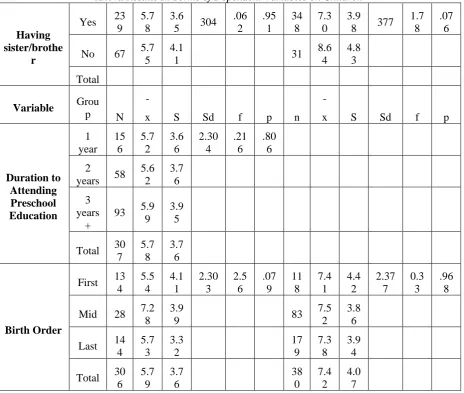
Table. 4 According to the Attitudes of Fathers In Case of Attending Preschool Education, T-Test and Anova Results In Terms of Dependent Variables on Children
Having sister/brothe
r
Yes 23 9
5.7 8
3.6
5 304 .06
2 .95
1 34
8 7.3
0 3.9
8 377 1.7
8 .07
6
No 67 5.7 5
4.1
1 31
8.6 4
4.8 3
Total
Variable Grou
p N
-
x S Sd f p n
-
x S Sd f p
Duration to Attending Preschool Education
1 year
15 6
5.7 2
3.6 6
2.30 4
.21 6
.80 6
2
years 58 5.6
2 3.7
6 3
years +
93 5.9 9
3.9 5
Total 30 7
5.7 8
3.7 6
Birth Order
First 13 4
5.5 4
4.1 1
2.30 3
2.5 6
.07 9
11 8
7.4 1
4.4 2
2.37 7
0.3 3
.96 8
Mid 28 7.2 8
3.9
9 83
7.5 2
3.8 6
Last 14 4
5.7 3
3.3 2
17 9
7.3 8
3.9 4
Total 30 6
5.7 9
3.7 6
38 0
7.4 2
4.0 7
According to the results of father attitude scale score, there is a significant difference between the attitudes of father and attending preschool education. The fathers’ attitudes of students who attend preschool education are more democratic than the students’ fathers who do not attend preschool education (t (690)= 5.538, P<.01). When mother’s attitude scale score is analysed, there is a significant difference between the attitudes of fathers and their ages factor. The difference for attending preschool education is significant (t (304)= 2.543, p<.05), and as for those not attending preschool education is significant (t (377)= 3.137, p<.05).
Parental attitude scale score demonstrates that there is not a significant difference between the attitudes of father and having a sibling factors. That difference for attending preschool eudcation is insignificant (t (683)= 634, P>.05); and for those not attending preschool eduation is insignificant (t (377)= 1.777, P>.05).Parental attitude scale score expresses that there is not a significant difference between the attitudes of father and the duration of preschool education factör in terms of attending preschool education (t (2.304)=0.216, p>.05). However, it has been considered that the parents whose children attending preschool education are more sensible, and they are aware of the importantce of early childhood education and preschool school education period. Therefore, it could be thought that the parents whose children attend preschool education exhibit more democratic attitudes.
The variance analyses results of father attitude scale score by depending on some variables have been demonstrated on Table 5. Furthermore, Scheffe’s multiple range test was used and interpreted in order
to determine siginificant differences between groups in case that the results of analyses were significant.
Table. 5 According to the Attitudes of Fathers In Case of Attending Preschool Education, Anova Results In Terms of Dependent Variables on Parental
Variable Group
Attending Preschool
Education Not Attending Preschool Education
n -
x S Sd f p n
-
x S Sd f P
Age of Mother
30 and
under 55 6.5 8 3.9 2 2.30 2 2.2 7 .10 5 11 9 7.2 4 3.6 9 2.37 5 .29 4 .74 5
31-40 20 8 5.7 0 3.7 9 22 2 7.5 6 4,2 3 41 and
over 42 4.9
8 3.2
3 37
7.1 9
4.6 3
Total 30 5 5.7 6 3.7 6 37 8 7.4 2 4.1 0 Age of Father 30 and under 8
7.5 0 2.3 3 2.30 3 2.9 2 .05 6 25
8.2 8 3.8 6 2.36 9 .75 3 .47 2
31-40 11 8 6.0 7 4.2 0 23 8 7.2 4 4.0 4 41 and over 11 0 5.1 6 2.8 8 10 9 7.2 7 4.1 3
Total 30 6 5.7 8 3.7 7 37 2 7.3 2 4.0 5 Mother education Level
Illiterate - - - 40 8.1
2 4.1 6 5.28 8 1.3 1 .25 9
Literate 15 7.0 7 3.2 6 4.26 7 3.3 8 .01 0 47
7.4 5
4.1 4 Primary
School 30 6.4
3 3.7
6 94
7.6 5
3.9 9
Secondary School 25
6.4 0
3.3
8 45
6.8 9
3.6 6
High
School 99 5.9
6 3.5
9 53
6.7 2
4.4 0
University 10 3
4.6 9
3.4
3 15
5.6 0
4.0 3
Total 27 2 5.6 3 3.5 7 29 4 7.2 9 4.0 8 Father Education Level
Illiterate - - - -
Literate 14 8.2 8 6.0 2 4.27 1 4.7 1 .00 1 49
Primary School 15
7.4 0
3.9
4 84
7.9 0
4.0 8
Secondary School 24
7.0 4
3.7
0 50
6.8 6
3.6 7
High
School 91 5.8
8 3.2
3 82
7.0 6
4.2 0
University 13 2
5.0 1
3.4
8 35
6.0 3
3.9 7
Total 27 6
5.7 7
3.7 0
30 0
7.3 9
4.1 1
Mother Occupatio
n
Not working
14 1
6.3 7
4.0 1
2.28 0
7.1 8
.00 1
30 4
7.2 3
4.0 8
2.35 9
2.7 5
0.6 5
Employee 5 - - - 31 8.5
5 3.9
1
Civil Cervant
11 8
4.7 0
3.2
9 6 - - - - -
Self-Employme
nt
24 6.5 0
3.6
1 27
8.6 7
4.3 6
Total 28 3
5.6 9
3.7 8
36 2
7.4 5
4.1 1
Father Occupatio
n
Not
working 7 - -
2.27 8
3.3 8
.03 5 34
8.7 9
3.6 9
3.35 0
4.1 9
.00 6
Employee 42 5.6 7
3.2 4
12 4
7.9 2
3.9 9
Civil Cervant
13 4
5.0 8
3.2
5 55
6.1 4
3.9 6
Self-Employmen t
105 6.27 3.88 141 7.10 4.03
Total 281 5.61 3.53 354 7.40 4.03
Parental attitude scale score shows that there is not a significant difference between the attitudes of father and Mother age factor (f (2.680)= 1.761, P>.05). On the other hand, there is a significant difference between the attitudes of father and father age factor (f (2.675) = 3.532, P<.05).
When parental attitude scale score is investigated, there is a significant difference between the attitudes of father and mother educational status factor in terms of attending preschool education. While the difference for attending preschool education is significant (f (4.267)= 3.381, P<.01); as for those not attending preschool education is (f (5.268)= 1.312, P<.01).
There is a significant difference between the attitudes of father and father educational status factor for attending preschool education as parental attitude scale score has demonstrated. The difference for those attending preschool education is significant (f (4.271)= 4.706, P<.05), and for those not attending is significant (f (4.295)= 2.695, P<.05). According to the scale score, the lower the educational status of the father, the less democratic the attitudes of the father.
When parental attitude scale score is investigated, there is a significant difference between mother occupation status factor and the attitudes of father in terms of attending preschool education. The difference for attending preschool education is significant (f (2.280) = 7.177, P<.05); and for those not attending preschool education is significant too (f (2.359) = 2.754, P<.01).
If it is considered giving point to authoritarian attitude in the father attitude scale score, it might be seen that the fathers’ attitudes of students whose mothers are civil servant are more democratic than other fathers’ attitudes of students whose mothers are in different occupation groups. Moreover, the father attitudes of students whose mothers are housewives have demonstrated democratization tendency as well.
In this case, it could be understood that while parents’ attitudes of third grade students whose mothers are civil servants are more democratic, as for parents’ attitudes of students whose mothers are employees tend to be authoritarian. According to these results, it might be seen the reason why there is a difference between the attitudes of parents when it is considered that civil servants’ educational status and life conditions are higher than employees owing to having state guarantee and social rights and regular salary.
When father attitude scale score is analyzed, there is a significant difference between the attitudes of father and father occupation status factor in terms of attending preschool education. The difference for attending preschool education is significant (f (2.278) = 3.381, P<.05); for those not attending preschool education is significant (f (3.350) = 4.192, P<.01). If it is regarded that low score represents more democratic attitude on the father attitude scale scoring, the fathers of students whose fathers are civil servants are more democratic than those fathers who have other occupations.
3. CONCLUSION
In this study, it has been investigated that there is a significant difference between attending preschool education and not attending preschool education of students’ mother attitude scale scores regarding attending preschool education (p<0.01). It has been seen that the mothers of students who attend preschool education have more democratic tendency than mothers of students not attending preschool education.
According to father attitude scale score, it has been pointed out that there is a significant difference between the attitudes of father and attending preschool education (P<0.01). Therefore, the fathers of students who attend preschool education have more democratic tendency than fathers of students not attending preschool education.
4. SUGGESTIONS
Preschool education has gained a great importance in Turkey which is a developing country. School which constitutes the second most important social environment of child subsequent to family environment starts with preschool education in early childhood that is acquired first and main education experiences (Stright et al. 2003). Preschool education which generates the first step of education process, in preschool education periods, will prepare the child for life and future’s education life by supporting all developments and proficiency areas of students (Doyle, 2000). Preschool education institutes which facilitate main knowledge, experiences, skills for student and by impressing to discover about knowledge, personally performing notions, objects and cases, learning through experience actively aim to grow up curious members (Purkey et al., 1996). For an active school environment, it is inevitable to be in cooperation with family. The institutions of preschool education have been necessitated and compulsory due to constituting basis of child-family-school by integrating with family (Omeroglu, 1992). Therefore,
- It could be organized that the collective endeavors of private and public institutions regarding the importance of preschool education institutions which are carried out from two sources might be
conducted seminars, panel discussions, prepared programs through mass media in order to inform society, parents and children
- If Nursery classes which are within the structure of primary and high schools are care and supported capably, it can be extended by constituting within the structure of every primary school. - Ministry of National Education and Chairmanship of Social Services Department with the
participation of experts about early childhood education can plan projects including compulsory education by considering that preschool education is the main right of every child to attend.
- It can be obligated that by law parents attending to the courses, which are organized for parents who wish to, have child. Thus, it would be important to redound to parents who play an important role about the development of child education about attitude and behavior which would affect child’s development positively.
- In order to develop family and school cooperation, education seminars which are promoted by the experts who will educate parents work in cooperation with agency and institutes by organizing mother-father-teacher programs might be set up.
- Different type of research about other effects of preschool education on children and parents in addition to this study has investigated the effects of preschool education on parents’ attitudes.
REFERENCES
ARAL, Neriman & Munevver & C AN YAŞAR. (2000). Preschool Education and Nursery Class Programs. Istanbul. YA-PA Publishing
Avci, Neslihan. (1995). the Investigation between the Relation’s of Characteristics of Nursery Class Teachers and Exhibiting the Behaviors Which Supports Social Development of Child. The PhD Dissertation of Child Health and Education. University of Hacettepe, Graduate School of Health Sciences. Ankara.
BLACK, B. & A. LOGAN. (1995). Links between Communication Patterns in Mother-Child, Father-Child and Father-Child-Peer actions and Father-Children’s Social Status. Father-Child Development, 66, 255-27 I.
CALHOUN, George & Ranuka SETHI. (2001). the Self-Esteem Pf Pupils from India, the United States, the Philippines. The Journal of Psychology,121 (2),199-202.
CHANG, Lei & Catherine McBride CHANG & Sunita M. Stewart & Ernest AU. (2003). Life Satisfaction, Self-Concept, and Family Relations in Chinese Adolescents and Children. International Journal of Behavioral Development, 27 (2),182-189.
CONFIELD, j. & H.C. WELLS. (1994). 100 Ways to Enhance Self-Concept in the Classroom. Boston Allyn and Baccon. 2-4.
CATAKLI, Melike & Necla ONER. (1986). the Scale of Sense of Self in Children: A Study and Reliability of Piers Harris’s Scale. Educational Sciences Journal, 12, 85-100.
DECKARD, Kirby Deater. (2000). Parenting and Child Behavioral Adjustment in Early Childhood: A Quantitative Genetic Approach to Studying Family Process. Child Development, 71(2), 468-484 DOYLE, Anna Beth & Dorothy MARKIEWICZ & Mara BRENDGEN. (2000). Child Attachment Security and Self-Concept: Associations with Mother and Father Attachment Style and Marital Quality. Merill Palmer Quarterly, 49 (3), 39-514