E-LEARNING AND THE TOP 200 UNIVERSITIES ACCORDING TO THE ACADEMIC RANKING OF UNIVERSITIES WORD
Juraj Fabus, Viktoria Simkova
Department of Communications, Faculty of Operation and Economics of Transport and Communications, University of Zilina, 010 26 Zilina, Slovak Republic
Abstract
Paper provides an introduction to evaluation ladders for measuring quality of education at universities. It presents current state of this problematic in the world. We are presenting shares of using particular e-learning systems at the 200 best universities in the world. Through survey we are finding out frequency of using each tool. For identification the best 200 universities in the world was used evaluation system of quality of universities – ARWU - because it belongs to reputable evaluation system quality and its methodology provides comparison of all universities.
Key words: ARWU, e-learning, LMS, universities ranking ladder, LMS tools
1. INTRODUCTION
The paper deals with education at universities by using information and communication technologies. The aim of this paper is to analyse used e-learning systems at top rated universities and assess the trend in this area.
There were used several methods of evaluation during processing. When analyzing the use of e-learning system we relied on the information provided at the university websites. In the analysis of using the e-learning systems and its parts and perception of e-learning system, we used a questionnaire survey, which was distributed between students of the selected best universities.
2. UNIVERSITIES RANKING LADDER AND E-LEARNING SYSTEMS
The globalization has brought an opportunity to study not only at universities and colleges in the same country, but also abroad. As a result, school selection has risen and therefore competition in the university environment has grown. It was one of the causes, why quality evaluation systems on universities have been created. Another reason results from the need of informing consumers about the academic quality of the universities. (Alagehg 2010)
First time was university ranking ladder on national level created by company U.S. NEWS & WORLD REPORT, which is multiplatform publisher of news, analysis, research and ranking ladders in the USA. (Usher & Savino 2006)
At the present, there exist several evaluation systems for universities and their order is different. It is because every publisher uses different methodology in their compilation. Universities are getting points for various activities or on the basis of primary survey, which is observing how the university is seen by society.
In Slovakia, the evaluation of quality of universities and colleges engaged in Academic Ranking and Rating Agency (ARRA) and the Accreditation Commission. Both organizations assess the quality of education, but their activities and missions vary. The Accreditation Commission is an advisor organ of the Slovak Republic government and on basis of their results are universities awarded by accreditation. But objective of ARRA, which is independent citizen association, is to provide the information to general public and especially provide insights to applicants for study at university, which will help them to decide which university to attend.
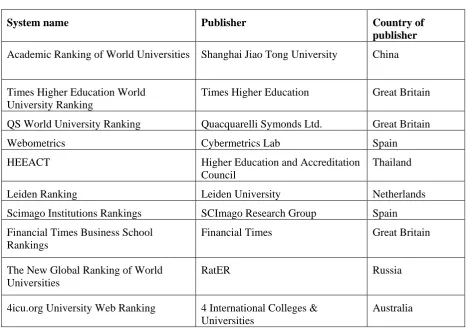
The global evaluation systems have developed from national evaluation systems. In table 1 are presented worldwide evaluation systems with country of publisher.
System name Publisher Country of publisher
Academic Ranking of World Universities Shanghai Jiao Tong University China
Times Higher Education World University Ranking
Times Higher Education Great Britain
QS World University Ranking Quacquarelli Symonds Ltd. Great Britain
Webometrics Cybermetrics Lab Spain
HEEACT Higher Education and Accreditation
Council
Thailand
Leiden Ranking Leiden University Netherlands
Scimago Institutions Rankings SCImago Research Group Spain
Financial Times Business School Rankings
Financial Times Great Britain
The New Global Ranking of World Universities
RatER Russia
4icu.org University Web Ranking 4 International Colleges & Universities
Australia
Table 1 The global evaluation systems (Source: University Ranking By Academic Performance: A Scientometrics Study For Ranking World Universities. Available on the internet:
http://www.ii.metu.edu.tr/sites/default/files/1284868_oguzhan_alasehir_thesis.pdf)
Academic Ranking of World Universities (ARWU)
ARWU is leader in university evaluation. First assessment report was published in 2003, compiled by the Centre for World-Class Universities. Since then, assessment report is annually updated. ARWU evaluate more than 1000 institutions and evaluation of the first 500 places is published. We decided to use ARWU ranking ladder as the basis for our research. (Kružlik & Trajtel 2011)
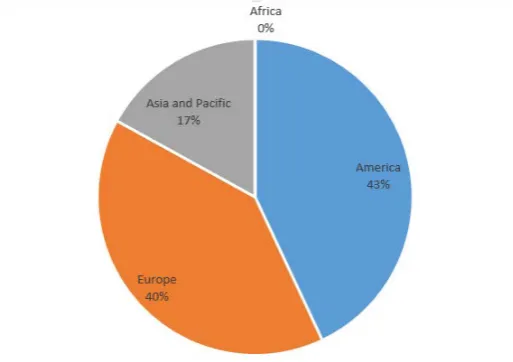
The ARWU evaluation system compiles annually ranking ladder of the best universities in the world and publishes them on its website. In this subsection we analyse the presentations of countries in this ranking ladder. On the Figure 1 is graphically shown percentage of each continent and in the table 2 is it shown in numbers.
Representation of continents in the ARWU ranking ladder, TOP 200
Continent Number of universities
America 86
Europe 80
Asia and Pacific 34
Africa 0
Table 2 Number of universities in the ARWU evaluation by continents (Source: Academic Ranking of World Universities 2014.
Available on the internet: <http://www.shanghairanking.com/ARWU2014.html>.)
Figure 1 Representation of continents in the ARWU ranking ladder in percentage, TOP 200, 2014 (Source: Academic Ranking of World Universities 2014
Available on the internet: <http://www.shanghairanking.com/ARWU2014.html>.)
E-learning systems
We can distinguish several kinds of e-learning systems based on presentation of the learning materials form. LMS systems can be divided to:
Open Source solution: open source system is turnkey system, which is free to share. Market representatives of Open source e-learning systems are:
• Moodle – http://moodle.org • Ilias – http://ilias.de
• Olat – http://olat.org
• Sakai – http://sakaiproject.org • dotLRN – http://dotlrn.org • Atutor – http://atutor.ca • Claroline – http://claroline.net • Dacebo – http://dacebo.org • eFront – http://efrontlearning.net
Commercial LMS solution: software developed in purpose for gaining profit and based on license principle. Well-known commercial LMS systems are:
• Blackboard – http://blackboard.com • Desire2Learn – http://desire2learn.com • iTutor – http://e-learn.cz
• Oracle iLearning - https://ilearning.oracle.com
• SharePointLMS – http://sharepointlms.com • Sumtotal – http://sumtotalsystems.com • Meridian KS – http://meridianksi.com • Pathlore – http://pathlore.com
In Europe union colleges and universities are using more Open Source LMS. In French it is Clarolin and in Germany Iljas. Information can be distorted, because within European Union doesn’t exist study focused on usage of the LMS systems. (Červeňan 2010)
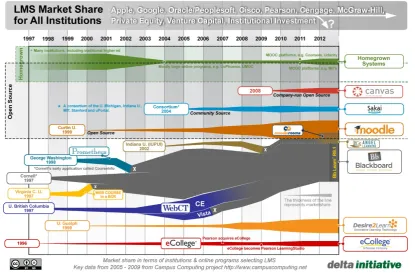
Figure 2 shows the evolution of the e-learning system usage from 1997 to 2012 and shows the change in reducing commercial LMS usage and increasing usage of Open Source systems.
Figure 2 Evolution of e-learning systems usage Source: The state of the learning management system at the University of Chicago and beyond. 2012
Available on the internet: < https://itservices.uchicago.edu/connect/article/state-learning-management-system-university-chicago-and-beyond
3. ANALYSIS OF THE REPRESENTATION OF OPEN SOURCE AND COMMERCIAL LMS In this chapter we present the frequency of use of e-learning systems at the best universities in the world. This analysis was performed using the information which the selected universities publish at their websites about the use of e-learning system.
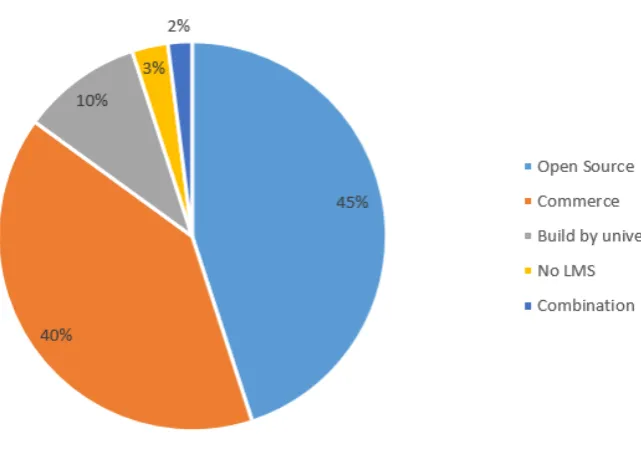
Figure 3 shows the percentage of each type of LMS systems. The most commonly used solution with a share of 45% is the Open Source solutions among which belong mainly Moodle, Sakai etc. Commercial systems presents 40% from among the 200 best universities of the world and the most common representative is BlackBoard. 10% have LMS systems developed by the university and the last part represent universities, which do not use any of LMS systems and it is only 3% and 2% of the total number of universities are using a combination of one commercial and one open source system, so there are used at least 2 LMS systems simultaneously.
Figure 3 Type of used LMS system (Source: Author)
Analysis of the e-learning system usage
Individual e-learning systems have different structure and provide different range of services. The most commonly used LMS systems are Blackboard, Moodle, Sakai, Ilias. Our own research proves that. Individual solutions are provided in various versions. In Figure 4 is shown the percentage of each system usage.
If the university used more systems we counted only one e-learning system in the evaluation, which was used most often by university.
Others include e-learning systems, we had presented them to a group “others”, because they occur only in few universities: Cabvas, CFIVE, Dokeos, Drupal, Fronter, Haiku, LAMS, OLAT, Terminal Four.
Figure 4 Percentage of VLE systems usage (Source: Author)
The research results show that the most common system is Blackboard, and thus confirm the secondary research published by The Campus Computing Project, because most countries in the TOP 200 comes from the USA.
4 QUESTIONNAIRE SURVEY
In this chapter we present the results of the questionnaire survey. We chose for data collection a quantitative survey and as collection method we chose questioning. Questioning was conducted electronically via the web portal www.typeform.com, which provides an interactive questionnaire survey. Students were contacted through social networks, contacts were found on the official website or groups of universities.
It was contacted 3000 potential respondents through reports and by advertising on the created Facebook page "survey about Academic Learning Management System", we reached the potential contribution of 9144 respondents. 99 respondents participated in the questionnaire survey finally and thus we were able to meet a sufficient sample.
The questionnaire contained several questions, we chose the most important results.
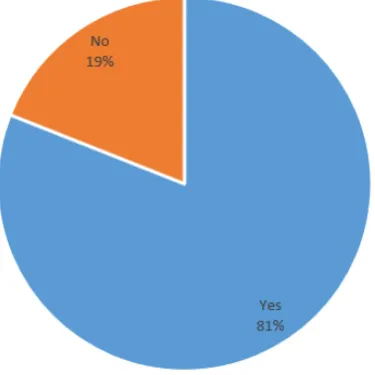
We wanted to find out what digital audio / video content universities provide and students use subsequently for educational purposes. The results of the questions are shown in figure 5.
Figure 5 Use of digital content in audio or video format (Source: Author)
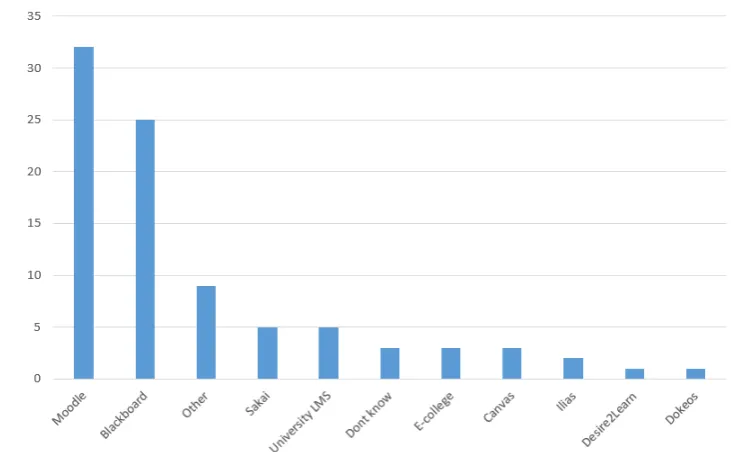
Frequency of use of e-learning systems from the perspective of students is shown in figure 6. For “Other” respondents indicated Ping Pong (Swedish company), Olat, Toledo, Minerva, and Ceiba.
Figure 6 Using LMS systems from the student’s point of view (Source: Author)
The results are partially different from our analysis in chapter 3, but still are not fundamentally different, because in this analysis we have identified Blackboard as the greatest representative and Moodle followed with a 7% decline. The situation is different in the questionnaire, 36% of respondents said they use Moodle and 28% of respondents said they use Blackboard. In any case, the three most widely used e-learning system remain unchanged: Blackboard, Moodle and Sakai.
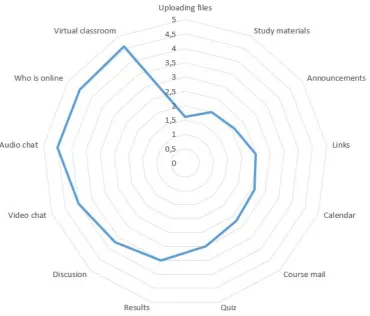
On figure 7 is evaluation of the use of tools in the LMS. The interval was set from 1 to 5, meaning: one - the most frequently used tool and 5 - the tool is not used.
A more detailed description of the various instruments is available on request.
Figure 7 Frequency of use of selected tools in the LMS (Source: Author)
The most used instruments within LMS are: Uploading files, publication of study materials, announcements, publication of links, a favorite tool is also Calendar and Course mail. On the contrary, the least used tools are virtual classroom, "who is online" application and voice recording.
One question was determined to find ways how students learned to work with a selected e-learning system, the results of this question are shown graphically in figure 8, the respondents could tick more than one option.
Figure 8 Method of how the respondents learned to work with LMS (Source: Author)
The majority said that they have learned to work with the system alone, this represents 59 respondents. The second most common way students learn how to work with e-learning system is through the help of faculty and also often helpful are online tutorials or help desk.
5. CLOSURE/SUMMARY
The analyses show that the e-learning system usage is already a common part of the education and the top rated universities prefer commercial e-learning systems and are willing to pay fees for the provision of the licenses. We assume that the reason of the higher frequency of commercial e-learning system usage is in meeting all the needs for proper security. Trend of preference is changing and we can assume that share of Open Source software will continue to grow versus commercial e-learning system.
This article will help universities in the selection of e-learning system, and will also help in the issue of which instruments within the e-learning system should universities use to the fullest possible use of the e-learning system potential, as it analyzed e-learning systems at the best universities, which have high quality of education and long experience in the field of education.
ACKNOWLEDGEMENT
The present work is supported by Ministry of Education, Science, Research and Sport of the Slovak republic and grant KEGA - 005SPU-4/2014, VEGA 1/0733/15 and VEGA 1/0748/14.
REFERENCES
ALAĠEHG, O. University ranking by academic performance: a scientometrics study for ranking world universities: diplom thesis. Ankara (Turkey): the Middle East Technical University, 2010. 157 s.
ČERVEŇAN, E. E-learningové CMS a formáty v nich používané, Brno : Masaryková univerzita, 2010. 38 s.
DOROBAT, I., Models for Measuring E-learning Success in Universities: A Literature Review. Informatica Economica vyd. 18. č. 3/2014. The Bucharest University of Economic Studies.
KRUŽLIK, P. – TRAJTEL, E. Ranking univerzít v kontexte hodnotenia publikačnej činnosti vo svete. In Bibliografický zborník z 12. slovenskej bibliografickej konferencie. Martin: Slovenská národná knižnica, 2011. ISBN 978-80-89301-92-8. s. 85-94.
MACFADYEN, L. P., DAWSON, S. (2012). Numbers Are Not Enough, Why e-Learning Analytics Failed to Inform an Institutional Strategic Plan. Educational Technology & Society, 15 (3), 149–163
SARNOVSKÝ, J. Kybernetický svet. 3. vyd. Košice : elfa, 2006. 199 s. ISBN 80-8086-048-3.
Universities, 2011: If Students Are Digital Natives, Why Don’t They Like E-Learning? Toronto: Higher Education Strategy Associates.
USHER, A.-SAVINO, M. World of Difference: A global survey of university league tables. Toronto: Education Policy Institute, 2006. 63 s.
Zákon č. 131/2002 z 21. februára o vysokých školách.