A New Extremely Flexible Version of The Exponentiated Weibull
Model: Theorem and Applications to Reliability and Medical Data Sets
Mohamed Aboraya
Department of Applied Statistics and Insurance, Damietta University, Egypt.
Abstract
In this work, a new lifetime model is introduced and studied. The major justification for the practicality of the new model is based on the wider use of the exponentiated Weibull and Weibull models. We are also motivated to introduce the new lifetime model since it exhibits decreasing, upside down-increasing, constant, increasing-constant and J shaped hazard rates also the density of the new distribution exhibits various important shapes. The new model can be viewed as a mixture of the exponentiated Weibull distribution. It can also be considered as a suitable model for fitting the symmetric, left skewed, right skewed and unimodal data. The importance and flexibility of the new model is illustrated by four read data applications.
Keywords: Burr-Hatke Differential Equation; Exponentiated Weibull; Maximum Likelihood Estimation; Generating Function; Moments.
1. Genesis of the new model
A random variable (R.V.) 𝑇 is said to have the Exponentiated Weibull (EW) distribution (see Mudholkar and Srivastava (1993), Mudholkar et al., (2015) and Nadarajah et al., (2013)) if its probability density function (P.D.F.), cumulative distribution function (C.D.F.) and the reliability function (R.F.) are given by
𝑔𝐸𝑊(𝑡 ; 𝛼 , 𝛽) = 𝛼𝛽𝑡𝛽−1[1 − 𝑒𝑥𝑝(−𝑡𝛽)]𝛼−1𝑒𝑥𝑝(−𝑡𝛽),
𝐺𝐸𝑊(𝑡 ; 𝛼 , 𝛽) = [1 − 𝑒𝑥𝑝(−𝑡𝛽)]𝛼, and
𝑅𝐸𝑊(𝑡) = 𝐺𝐸𝑊(𝑡 ; 𝛼 , 𝛽) = 1 − 𝐺𝐸𝑊(𝑡 ; 𝛼 , 𝛽) = {1 − [1 − 𝑒𝑥𝑝(−𝑡𝛽)]𝛼},
respectively, for 𝑡 > 0 , 𝛼 > 0 and 𝛽 > 0 . When 𝛼 = 1 we get the standard one parameter W model (see Weibull (1951)). In statistical literature, the Burr-Hatke differential equation (B.H.D.E.) can be written as
𝑑𝐹/𝑑𝑡 = 𝑔(𝑡, 𝐹)𝐹(1 − 𝐹) with 𝐹0 = 𝐹(𝑡0)|[𝑡0∈ℜ], (1)
where 𝐹(𝑡) = 𝐹 is the C.D.F. of a continuous R.V. 𝑇 and 𝑔(𝑡, 𝐹) is an arbitrary positive function (𝑔(+)) for any 𝑡0 ∈ ℜ . Using (1), Maniu and Voda (2008) introduced and studied the BH distribution with C.D.F. and P.D.F. given by
𝐹(𝑡 ; 𝜃) = 1 −(𝑡 + 1)−1
𝑒𝑥𝑝(𝑡𝜃) |[𝑡>0,𝜃>0],
and
𝑓(𝑡 ; 𝜃) =(𝑡 + 1)−2[𝜃(𝑡 + 1) + 1]
respectively. By replacing 𝑡 by {− 𝑙𝑜𝑔[𝐺𝐸𝑊(𝑥)]}, Yousof et al., (2018) introduced a new flexible family of distributions called the BH-G family of distributions. Based on Yousof et al., (2018), the C.D.F. of the BHEW distribution can be defined as
𝐹𝜃,𝛼,𝛽(𝑥) = 1 − {1 − [1 − 𝑒𝑥𝑝(−𝑥
𝛽)]𝛼}𝜃 ⏞
𝐴
1 − 𝑙𝑜𝑔{1 − [1 − 𝑒𝑥𝑝(−𝑥𝛽)]𝛼} ⏟
𝐵
. (2)
Equation (2) can be also obtained using idea of Alzaatreh et al., (2013). The P.D.F. corresponding to (2) is given by
𝑓𝜃,𝛼,𝛽(𝑥) = 𝑓(𝑥 ; 𝜃 , 𝛼, 𝛽) = 𝛼𝛽𝑥𝛽−1𝑒𝑥𝑝(−𝑥𝛽) [1 − 𝑒𝑥𝑝(−𝑥𝛽)]𝛼−1
× {1 − [1 − 𝑒𝑥𝑝(−𝑥
𝛽)]𝛼}𝜃−1
(1 − 𝑙𝑜𝑔{1 − [1 − 𝑒𝑥𝑝(−𝑥𝛽)]𝛼})2 × [𝜃(1 − 𝑙𝑜𝑔{1 − [1 − 𝑒𝑥𝑝(−𝑥𝛽)]𝛼}) + 1].
(3)
The R.F. and hazard rate function (H.R.F.) of new model are given by
𝑅𝜃,𝛼,𝛽(𝑥) =
{1 − [1 − 𝑒𝑥𝑝(−𝑥𝛽)]𝛼}𝜃 1 − 𝑙𝑜𝑔{1 − [1 − 𝑒𝑥𝑝(−𝑥𝛽)]𝛼},
and
ℎ𝜃,𝛼,𝛽(𝑥) = 𝛼𝛽𝑥
𝛽−1𝑒𝑥𝑝(−𝑥𝛽) [1 − 𝑒𝑥𝑝(−𝑥𝛽)]𝛼−1
{1 − [1 − 𝑒𝑥𝑝(−𝑥𝛽)]𝛼}[1 − 𝑙𝑜𝑔{1 − [1 − 𝑒𝑥𝑝(−𝑥𝛽)]𝛼}] × [𝜃(1 − 𝑙𝑜𝑔{1 − [1 − 𝑒𝑥𝑝(−𝑥𝛽)]𝛼}) + 1].
Some useful extension of the W and EW models are developed by Yousof et al., (2015), Aryal et al. (2017), Yousof et al., (2017), Brito et al., (2017), Hamedani et al., (2017), Aboraya (2018), Almamy et al., (2018), Cordeiro et al., (2018), Korkmaz et al., (2019), among others.
2. Justification
The major justification for the practicality of the new model is based on the wider use of the exponentiated Weibull and Weibull models. We are also motivated to introduce the new lifetime model since it exhibits decreasing, unimodal and constant hazard rates (see Figure 2) also the P.D.F. of the new distribution exhibits various important shapes such as decreasing, unimodal, right skewed and left skewed (see Figure 1). The new model can be viewed as a mixture of the EW distribution. It can also be considered as a suitable model for fitting the symmetric, left skewed, right skewed, and unimodal data (see application section).
modified-Weibull, modified beta-Weibull, transmuted additive-Weibull, exponentiated transmuted generalized Rayleigh models. The new model is much better than the Weibull-Weibull, Odd Weibull-Weibull, gamma exponentiated-exponential models in modeling survival times of Guinea pigs. Finally, the proposed model is much better than the exponentiated-Weibull, transmuted-Weibull, Odd Log Logistic-Weibull models in modeling glass fibers data. Figure 1 shows that the P.D.F. BHEW distribution exhibits various important shapes such as decreasing, unimodal, right skewed and left skewed, from Figure 2 we conclude that the H.R.F. of the BHEW distribution exhibits decreasing, unimodal and constant hazard rates (Figure 1 and 2 are given in Appendix).
3. Properties
3.1 Asymptotic
Proposition Let 𝑎 = 𝑖𝑛𝑓{ 𝑥|𝐺𝐸𝑊(𝑥) > 0} . The asymptotics of the C.D.F., P.D.F. and H.R.F. as 𝑥 → 𝑎 are:
𝐹𝜃,𝛼,𝛽(𝑥) ∼ [1 − 𝑒𝑥𝑝(−𝑥𝛽)]
𝛼 |[𝑥→𝑎],
𝑓𝜃,𝛼,𝛽(𝑥) ∼ 𝛼𝛽𝑥𝛽−1𝑒𝑥𝑝(−𝑥𝛽) [1 − 𝑒𝑥𝑝(−𝑥𝛽)]
𝛼−1 |[𝑥→𝑎], and
ℎ𝜃,𝛼,𝛽(𝑥) ∼ 𝛼𝛽𝑥𝛽−1𝑒𝑥𝑝(−𝑥𝛽) [1 − 𝑒𝑥𝑝(−𝑥𝛽)]−1|
[𝑥→𝑎].
Proposition The asymptotic of C.D.F., P.D.F. and H.R.F. as x →∞ are:
1 − 𝐹𝜃,𝛼,𝛽(𝑥) ∼ 𝜃{1 − [1 − 𝑒𝑥𝑝(−𝑥𝛽)]𝛼}𝜃| [𝑥→∞],
𝑓𝜃,𝛼,𝛽(𝑥) ∼ 𝜃2𝛼𝛽𝑥𝛽−1𝑒𝑥𝑝(−𝑥𝛽) {1 − [1 − 𝑒𝑥𝑝(−𝑥𝛽)]
𝛼 }𝜃−1[1 − 𝑒𝑥𝑝(−𝑥𝛽)]𝛼−1|[𝑥→∞],
and
ℎ𝜃,𝛼,𝛽(𝑥) ∼ 𝜃𝛼𝛽𝑥𝛽−1𝑒𝑥𝑝(−𝑥𝛽) {1 − [1 − 𝑒𝑥𝑝(−𝑥𝛽)]𝛼}−1[1 − 𝑒𝑥𝑝(−𝑥𝛽)]𝛼−1|
[𝑥→∞].
3.2 Useful expansions
Consider the following expansions
(−𝑧 + 1)𝑡 = ∑ ∞
𝑑=0
(−1)𝑑(𝑡
𝑑) 𝑧𝑡|[|𝑧| <1],
(4)
And
𝑙𝑜𝑔( − 𝑧 + 1) = − ∑
∞
𝑤=0
[𝑧𝑤+1/(𝑤 + 1)] | [|𝑧| <1].
(5)
Applying (4) for in Eq. (2) we get
{−[1 − 𝑒𝑥𝑝(−𝑥𝛽)]𝛼+ 1}𝜃 = ∑
∞
𝑑=0
𝑎𝑑{[1 − 𝑒𝑥𝑝(−𝑥𝛽)] 𝛼
}𝑑,
𝑎𝑑 = (−1)𝑑(𝜃 𝑑). Applying (5) for the term 𝐵 , still in Eq. (2), we obtain
1 − 𝑙𝑜𝑔{−[1 − 𝑒𝑥𝑝(−𝑥𝛽)]𝛼+ 1} = 1 + ∑
∞
𝑖=0
{[1 − 𝑒𝑥𝑝(−𝑥𝛽)]𝛼}𝑖+1 (𝑖 + 1)
= ∑
∞
𝑑=0
𝑏𝑑{[1 − 𝑒𝑥𝑝(−𝑥𝛽)] 𝛼
}𝑑,
where 𝑏0 = 1 and for 𝑑 ≥ 1 , 𝑏𝑑 = −1
𝑑. Then, Eq. (2) can be writen as
𝐹𝜃,𝛼,𝛽(𝑥) = 1 − ∑
𝑑=0 ∞ 𝑎𝑑 ∑ 𝑑=0 ∞ 𝑏𝑑
{[− 𝑒𝑥𝑝(−𝑥𝛽)]𝛼+ 1}𝑑 {[− 𝑒𝑥𝑝(−𝑥𝛽)]𝛼+ 1}𝑑
= 1 − ∑
∞
𝑑=0
𝑐𝑑{[1 − 𝑒𝑥𝑝(−𝑥𝛽)] 𝛼
}𝑑,
where
𝑐0 = 𝑎𝑜 𝑏0 and, for 𝑑 ≥ 1, we have
𝑐𝑑 = (𝑎𝑑− 1 𝑏0∑
𝑑
𝑟=1
𝑏𝑟𝑐𝑑−𝑟) /𝑏0.
At the end, the C.D.F. (2) can be written as
𝐹𝜃,𝛼,𝛽(𝑥) = ∑
∞
𝑑=0
𝑉𝑑+1 𝛱(𝑑+1)𝛼(𝑥), (6)
where 𝑑0 = 1 − 𝑐𝑑, for 𝑑 ≥ 1 we have 𝑑0 = −𝑐𝑑 and [− 𝑒𝑥𝑝(−𝑥𝛽) + 1](𝑑+1)𝛼 = 𝛱(𝑑+1)𝛼(𝑥)
is the C.D.F. of the Exp-G family with power parameter (𝑑 + 1)𝛼 . By differentiating (6), we obtain the same mixture representation
𝑓𝜃,𝛼,𝛽(𝑥) = ∑
∞
𝑑=0
𝑉𝑑+1𝜋(𝑑+1)𝛼(𝑥 ; 𝜉), (7)
where
𝜋(𝑑+1)𝛼(𝑥) = [(𝑑 + 1)𝛼]𝛼𝛽𝑥𝛽−1𝑒𝑥𝑝(−𝑥𝛽) [1 − 𝑒𝑥𝑝(−𝑥𝛽)](𝑑+1)𝛼−1[1
− 𝑒𝑥𝑝(−𝑥𝛽)]𝛼−1
3.2 Moments and generating function
The 𝑟𝑡ℎ ordinary moment of 𝑋 is given by
𝜇𝑟′ = 𝐸𝑋𝑟 = ∫ ∞
−∞
𝑥𝑟𝑓
𝜃,𝛼,𝛽(𝑥)𝑑𝑥.
Then, we obtain
𝜇𝑟′ = 𝛤(1 + 𝑟𝛽−1) ∑
∞
𝑑,𝑚=0
𝜉𝑑,𝑚((𝑑+1)𝛼,𝑟)|[𝑟>−𝛽],
(8)
where
𝑉𝑑+1𝜉𝑚
((𝑑+1)𝛼,𝑟)
= 𝜉𝑑,𝑚((𝑑+1)𝛼,𝑟), and
𝜉𝜏(𝜂,𝑞) = 𝜂(−1)𝜏(𝜏 + 1)−(𝑞+𝛽)/𝛽(𝜂 − 1
𝜏 ) Setting 𝑟 = 1,2,3 and 4 we get
𝐸𝑋 = 𝛤(1 + 1/𝛽) ∑
∞
𝑑,𝑚=0
𝜉𝑑,𝑚((𝑑+1)𝛼,1)|[1>−𝛽],
𝐸𝑋2 = 𝛤(1 + 2/𝛽) ∑
∞
𝑑,𝑚=0
𝜉𝑑,𝑚((𝑑+1)𝛼,2)|[2>−𝛽],
𝐸𝑋3 = 𝛤(1 + 3/𝛽) ∑
∞
𝑑,𝑚=0
𝜉𝑑,𝑚((𝑑+1)𝛼,3)|[3>−𝛽],
and
𝐸𝑋4 = 𝛤(1 + 4/𝛽) ∑ ∞
𝑑,𝑚=0
𝜉𝑑,𝑚((𝑑+1)𝛼,4)|[4>−𝛽].
3.4 Effect of on the mean, variance, skewness and kurtosis
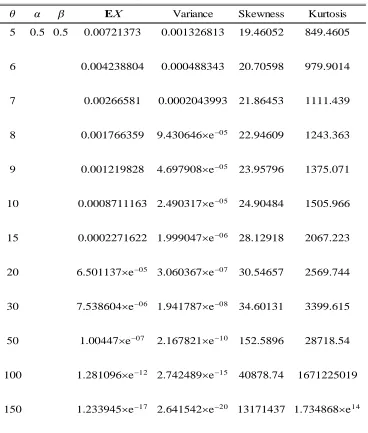
From Table 1 we note that: 1- 𝐸𝑋 decreases as 𝜃 increases.
2- The variance decreases as 𝜃 increases.
Table 1: Mean, variance, skewness and kurtosis.
EX Variance Skewness Kurtosis
5 0.5 0.5 0.00721373 0.001326813 19.46052 849.4605
6 0.004238804 0.000488343 20.70598 979.9014
7 0.00266581 0.0002043993 21.86453 1111.439
8 0.001766359 9.430646e05 22.94609 1243.363
9 0.001219828 4.697908e05 23.95796 1375.071
10 0.0008711163 2.490317e05 24.90484 1505.966
15 0.0002271622 1.999047e06 28.12918 2067.223
20 6.501137e05 3.060367e07 30.54657 2569.744
30 7.538604e06 1.941787e08 34.60131 3399.615
50 1.00447e07 2.167821e10 152.5896 28718.54
100 1.281096e12 2.742489e15 40878.74 1671225019
150 1.233945e17 2.641542e20 13171437 1.734868e14
The moment generating function M.G.F.can be derived via Eq. (7) as
𝑚𝑟(𝑦) = 𝛤(1 + 𝑟𝛽−1) ∑ ∞
𝑑,𝑟,𝑚=0
𝜉𝑑,𝑟,𝑚((𝑑+1)𝛼,𝑟)|[𝑟>−𝛽],
where
[𝑡𝑟/𝑟!]𝑉
𝑑+1 𝜉𝑚
((𝑑+1)𝛼,𝑟)
= 𝜉𝑑,𝑟,𝑚((𝑑+1)𝛼,𝑟). The 𝑟𝑡ℎ incomplete moment of 𝑋 is defined by
𝜏𝑟(𝑦) = ∫ 𝑦
−∞
𝑥𝑟𝑓(𝑥)𝑑𝑥.
We can write from (7)
𝜏𝑟(𝑦) = 𝛾(1 + 𝑟𝛽−1, (𝑡−1)𝛽) ∑ ∞
𝑑,𝑚=0
By setting 𝑟 = 1,2,3 and 4 we get
𝜏1(𝑦) = 𝛾(1 + 𝛽−1, (𝑡−1)𝛽) ∑ ∞
𝑑,𝑚=0
𝜉𝑑,𝑚((𝑑+1)𝛼,1)|[1>−𝛽],
𝜏2(𝑦) = 𝛾(1 + 𝛽−2, (𝑡−1)𝛽) ∑ ∞
𝑑,𝑚=0
𝜉𝑑,𝑚((𝑑+1)𝛼,2)|[1>−𝛽],
𝜏3(𝑦) = 𝛾(1 + 𝛽−3, (𝑡−1)𝛽) ∑ ∞
𝑑,𝑚=0
𝜉𝑑,𝑚((𝑑+1)𝛼,3)|[3>−𝛽],
and
𝜏4(𝑦) = 𝛾(1 + 𝛽−4, (𝑡−1)𝛽) ∑ ∞
𝑑,𝑚=0
𝜉𝑑,𝑚((𝑑+1)𝛼,4)|[4>−𝛽].
3.5 Moments of residual life
The 𝑛𝑡ℎ moment of the residual life, say
𝐸(𝑋 − 𝑡)𝑛 = 𝑧𝑛(𝑡)|[𝑋>𝑡,𝑛=1,2,… ],
uniquely determines 𝐹(𝑥) . The 𝑛 th moment of the residual life of 𝑋 is given by
𝑧𝑛(𝑡) = 𝑅𝜃,𝛼,𝛽−1 (𝑡) ∫ ∞
𝑡
(𝑥 − 𝑡)𝑛𝑑𝐹𝜃,𝛼,𝛽(𝑥).
Therefore,
𝑧𝑛(𝑡) =𝛾(1 + 𝑛𝛽
−1, (𝑡−1)𝛽)
𝑅(𝑡) ∑
∞
𝑑,𝑚=0
𝜅𝑑,𝑚((𝑑+1)𝛼,𝑛)|[𝑛>−𝛽],
where
𝑞𝑑+1𝜉𝑚((𝑑+1)𝛼,𝑛) = 𝜅𝑑,𝑚((𝑑+1)𝛼,𝑛), and
𝑉𝑑+1∑ 𝑛
𝑟=0
(−𝑡)𝑛−𝑟(𝑛
𝑟) = 𝑞𝑑+1
3.6 Moments of the reversed residual life
The 𝑛𝑡ℎ moment of the reversed residual life, say 𝐸(𝑡 − 𝑋)𝑛 = 𝑍
𝑛(𝑡)|[𝑋≤𝑡,𝑡>0,𝑛=1,2,… ], we obtain
𝑍𝑛(𝑡) = 𝐹𝜃,𝛼,𝛽−1 (𝑡) ∫ 𝑡
0
(𝑡 − 𝑥)𝑛𝑑𝐹𝜃,𝛼,𝛽(𝑥).
Then, the 𝑛𝑡ℎ moment of the reversed residual life of 𝑋 becomes
𝑍𝑛(𝑡) =𝛾(1 + 𝑛𝛽
−1, (𝑡−1)𝛽)
𝐹(𝑡) ∑
∞
𝑑,𝑚=0
𝛿𝑑,𝑚((𝑑+1)𝛼,𝑛)|[𝑛>−𝛽],
where
𝑉𝑑+1∑ 𝑛
𝑟=0
(−1)𝑟(𝑛
𝑟) 𝑡𝑛−𝑟 = 𝑙𝑑+1.
3.7 Order statistics
Suppose 𝑋1 : 𝑛, 𝑋2 : 𝑛, … , 𝑋𝑛 : 𝑛, is a random sample (R.S.) from the BHEW model. Let 𝑋𝑖 : 𝑛 denote the 𝑖𝑡ℎ order statistic. The P.D.F. of 𝑋
𝑖 : 𝑛 is
𝑓𝑖 : 𝑛(𝑥) = 𝐵−1(𝑖, 𝑛 − 𝑖 + 1) ∑
𝑛−𝑖
𝑗=0
(−1)𝑗(𝑛 − 𝑖
𝑗 ) 𝑓𝜃,𝛼,𝛽(𝑥)𝐹𝜃,𝛼,𝛽(𝑥)𝑗+𝑖−1.
(9)
Following the result 0.314 of Gradshteyn and Ryzhik (2000) for a power series raised to 𝑛 is a positive integer we have
∑ ∞ 𝑖=0 𝑐𝑛,𝑖𝑢𝑖 = (∑ ∞ 𝑖=0 𝑎𝑖𝑢𝑖) 𝑛
|[𝑛≥1],
where 𝑐𝑛,𝑖 (for 𝑖 = 1,2, … ) are the coefficients determined from the recurrence Eq. (with 𝑐𝑛,0= 𝑎0𝑛 )
(𝑖𝑎0)−1 ∑ 𝑖
𝑚=1
𝑎𝑚𝑐𝑛,𝑖−𝑚[𝑚(𝑛 + 1) − 𝑖] = 𝑐𝑛,𝑖.
The P.D.F. of the 𝑖𝑡ℎ order statistic of any BHEWmodel can be expressed as
𝑓𝑖 : 𝑛(𝜃,𝛼,𝛽)(𝑥) = ∑
∞
ℎ,𝑑=0
𝑏ℎ,𝑑𝜋ℎ+𝑑+1(𝑥), (10)
where
𝑏ℎ,𝑑 = 𝑛! (ℎ + 1)(𝑖 − 1)! (ℎ + 𝑑 + 1)−1𝑑
ℎ+1∑
𝑛−𝑖
𝑗=0
(−1)𝑗𝑣𝑗+𝑖−1,𝑑
(𝑛 − 𝑖 − 𝑗)! 𝑗!
and the quantities 𝑣𝑗+𝑖−1,𝑑 can be determined with and recursively for
𝑓𝑗+𝑖−1,𝑑 = (𝑑𝑑0)−1 ∑
𝑑
𝑚=1
𝑑𝑚 𝑣𝑗+𝑖−1,𝑑−𝑚[ 𝑚(𝑗 + 𝑖) − 𝑑] .
4. For the BHEW model
5. 𝐸𝑋𝑖 : 𝑛𝑞 = 𝛤(1 + 𝑞𝛽−1) ∑∞ℎ,𝑑,𝑚=0 𝜉ℎ,𝑑,𝑚(ℎ+𝑑+1,𝑞)|[𝑞>−𝛽], 6. where
7. 𝑏ℎ,𝑑𝜉𝑚(ℎ+𝑑+1,𝑞) = 𝜉ℎ,𝑑,𝑚(ℎ+𝑑+1,𝑞).
8. Estimation
ℓ= ℓ(𝚿) = 𝑛 𝑙𝑜𝑔 𝛼 + 𝑛 𝑙𝑜𝑔 𝛽 + (𝛽 − 1) ∑ 𝑛 𝑖=1 𝑙𝑜𝑔𝑥𝑖− ∑ 𝑛 𝑖=1 𝑥𝑖𝛽 − ∑ 𝑛 𝑖=1
𝑥𝑖𝛽+ (𝛼 − 1) ∑ 𝑛 𝑖=1 𝑙𝑜𝑔𝑧𝑖+ ∑ 𝑛 𝑖=1 𝑙𝑜𝑔𝑞𝑖 + ∑ 𝑛 𝑖=1 𝑙𝑜𝑔𝑠𝑖 , where
𝑞𝑖 = (1 − 𝑧𝑖𝛼)𝜃−1/[1 − 𝑙𝑜𝑔(1 − 𝑧 𝑖𝛼)]2,
𝑠𝑖 = {𝜃[1 − 𝑙𝑜𝑔(1 − 𝑧𝑖𝛼)] + 1} and
𝑧𝑖 = [1 − 𝑒𝑥𝑝(−𝑥𝑖𝛽)].
The components of the score vector is available if needed.
9. Applications
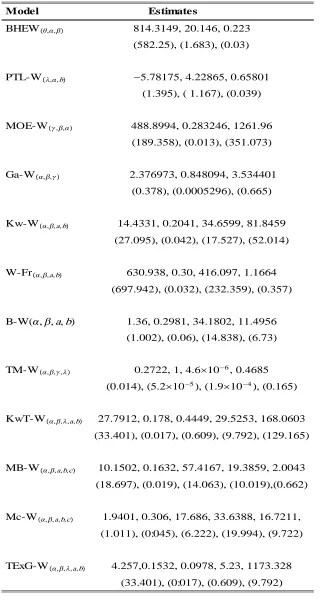
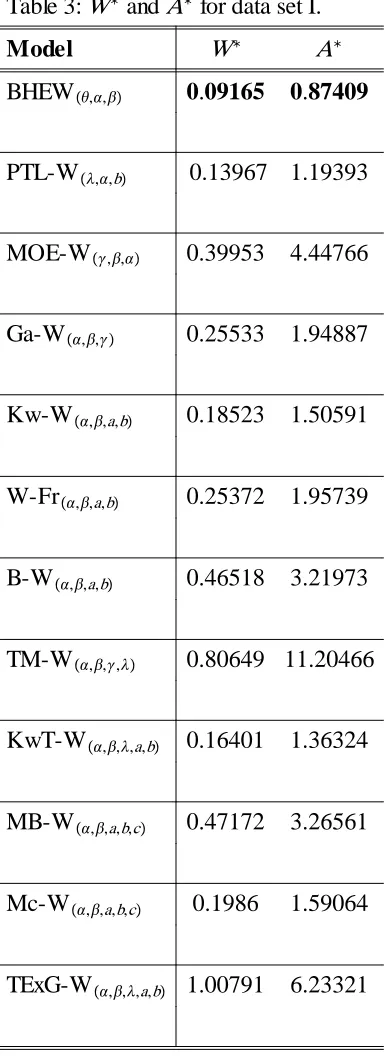
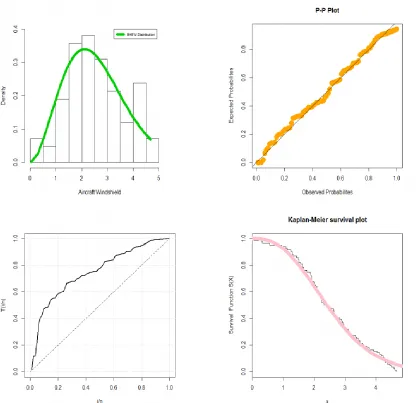
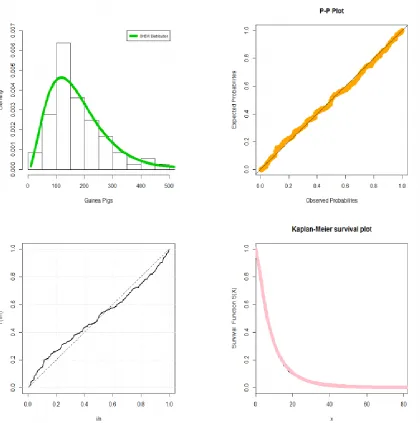
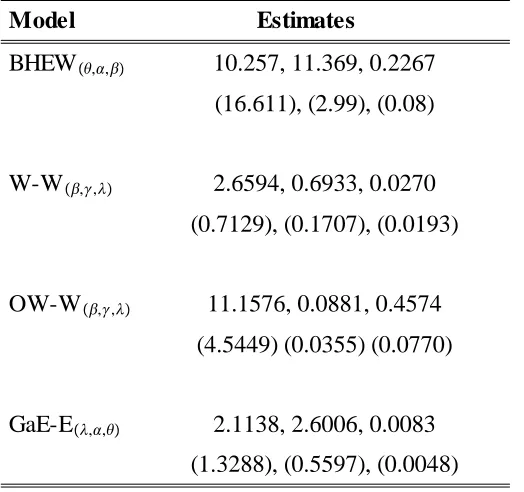
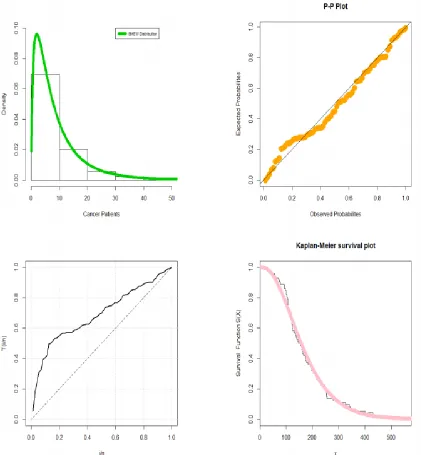
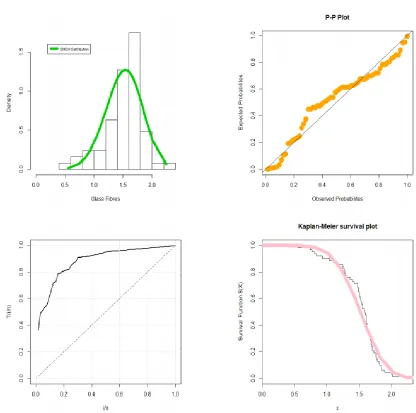
In this Section, we provide four applications to show empirically its potentiality. We consider the Cramér-Von Mises W* and the Anderson-Darling 𝐴∗ statistics. The computations are carried out using the R software. The M.L.E. and the corresponding standard errors (S.E.) (in parentheses) of the new model parameters are given in Tables 2, 4, 6, and 8. The numerical values of the W* and A* are listed in Tables 3, 5, 7, and 9. The estimated P.D.F., P-P plot, TTT plot and Kaplan-Meier survival plot of the four data sets of the proposed model are displayed in Figures 3, 4,5 and 6. These four data sets were used for fitting the Odd Lindley EW by Aboraya (2018).
Application 1
new distribution yields the lowest values of these statistics and hence provides the best fit to the two data sets.
Table 2: M.L.E.s (S.E. in parentheses) for data set I.
Model Estimates
BHEW,, 814.3149, 20.146, 0.223 (582.25), (1.683), (0.03)
PTL-W,,b 5.78175, 4.22865, 0.65801 (1.395), ( 1.167), (0.039)
MOE-W,, 488.8994, 0.283246, 1261.96 (189.358), (0.013), (351.073)
Ga-W,, 2.376973, 0.848094, 3.534401 (0.378), (0.0005296), (0.665)
Kw-W,,a,b 14.4331, 0.2041, 34.6599, 81.8459 (27.095), (0.042), (17.527), (52.014)
W-Fr,,a,b 630.938, 0.30, 416.097, 1.1664 (697.942), (0.032), (232.359), (0.357)
B-W(,,a,b) 1.36, 0.2981, 34.1802, 11.4956 (1.002), (0.06), (14.838), (6.73)
TM-W,,, 0.2722, 1, 4.6106, 0.4685 (0.014), (5.2105), (1.9104), (0.165)
KwT-W,,,a,b 27.7912, 0.178, 0.4449, 29.5253, 168.0603 (33.401), (0.017), (0.609), (9.792), (129.165)
MB-W,,a,b,c 10.1502, 0.1632, 57.4167, 19.3859, 2.0043 (18.697), (0.019), (14.063), (10.019),(0.662)
Mc-W,,a,b,c 1.9401, 0.306, 17.686, 33.6388, 16.7211, (1.011), (0:045), (6.222), (19.994), (9.722)
Table 3:WandAfor data set I.
Model W A
BHEW,, 0.09165 0.87409
PTL-W,,b 0.13967 1.19393
MOE-W,, 0.39953 4.44766
Ga-W,, 0.25533 1.94887
Kw-W,,a,b 0.18523 1.50591
W-Fr,,a,b 0.25372 1.95739
B-W,,a,b 0.46518 3.21973
TM-W,,, 0.80649 11.20466
KwT-W,,,a,b 0.16401 1.36324
MB-W,,a,b,c 0.47172 3.26561
Mc-W,,a,b,c 0.1986 1.59064
Figure 3: Estimated P.D.F., P-P plot, TTT plot and Kaplan-Meier survival plot for data set I.
Application 2
with corresponding densities (for x > 0 ) (for more details about these P.D.F.s see Aboraya (2018)).
Table 4: M.L.E.s (S.E. in parentheses) for data set II.
Model Estimates
BHEW,, 61.746, 45.807, 0.170
(157.0984), (7.291, (0.0544)
W, 9.5593, 1.0477
(0.853), (0.068)
TM-W,,, 0.1208, 0.8955, 0.0002, 0.2513
(0.024), (0.626), (0.011), (0.407)
MB-W,,a,b,c 0.1502, 0.1632, 57.4167, 19.3859, 2.0043
(22.437), (0.044), (37.317), (13.49), (0.789)
TA-W,,,, 0.1139, 0.9722, 3.0936105, 1.0065, -0.163
(0.032), (0.125), (6.106103), (0.035), (0.28)
ETG-R,,, 7.3762, 0.0473, 0.0494, 0.118
(5.389),(3.965103), (0.036), (0.26)
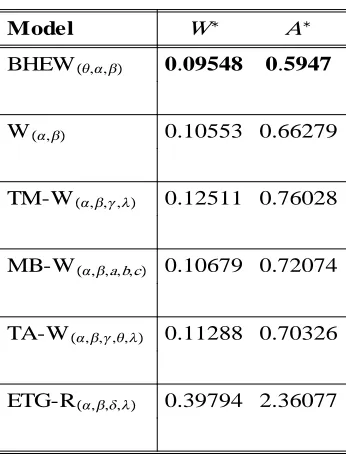
Table 5:WandAfor data set II.
Model W A
BHEW,, 0.09548 0.5947
W, 0.10553 0.66279
TM-W,,, 0.12511 0.76028
MB-W,,a,b,c 0.10679 0.72074
TA-W,,,, 0.11288 0.70326
Figure 4: Estimated P.D.F., P-P plot, TTT plot and Kaplan-Meier survival plot for data set II.
Application 3
The second real data set corresponds to the survival times (in days) of 72 guinea pigs infected with virulent tubercle bacilli reported by Bjerkedal (1960). The data are: 72,74, 77, 10, 33, 44, 56, 59, 92, 93, 96, 107, 107, 108, 108, 100, 100, 102, 105, 108, 116, 120, 121, 122, 109, 112, 113, 115, 122, 124, 130, 146, 153, 159, 160, 134, 136, 139, 144, 163, 163, 168, 176, 183, 195, 196, 215, 216, 222, 230, 197, 202, 213, 231, 240, 245, 293, 327, 342, 251, 253, 254, 255, 278, 347, 361, 402, 171, 172,432, 458, 555.
Table 6: M.L.E.s (S.E. in parentheses) for data set III.
Model Estimates
BHEW,, 10.257, 11.369, 0.2267
(16.611), (2.99), (0.08)
W-W,, 2.6594, 0.6933, 0.0270
(0.7129), (0.1707), (0.0193)
OW-W,, 11.1576, 0.0881, 0.4574
(4.5449) (0.0355) (0.0770)
GaE-E,, 2.1138, 2.6006, 0.0083
(1.3288), (0.5597), (0.0048)
Table 7:WandAfor data set III.
Model W A
BHEW,, 0.0418 0.2792
W-W,, 0.1427 0.7811
OW-W,, 0.4494 2.4764
Figure 5: Estimated P.D.F., P-P plot, TTT plot and Kaplan-Meier survival plot for data set III.
Application 4: Glass fibers data
Table 8: M.L.E.s (S.E. in parentheses) for data set IV.
Model Estimates
BHEW,, 908.64, 21.127, 0.5
(577.313), (1.610), (0.057)
EWa,, 0.671, 7.285,1.718
(0.249), (1.707), (0.086)
T-Wa,, 0.5010, 5.1498, 0.6458
(0.2741), (0.6657), (0.0235)
OLL-W,, 0.9439, 6.0256, 0.6159
(0.2689), (1.3478), (0.0164)
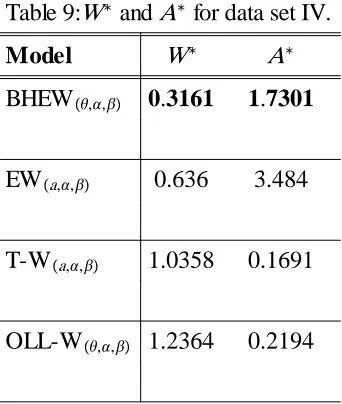
Table 9:W andA for data set IV.
Model W A
BHEW,, 0.3161 1.7301
EWa,, 0.636 3.484
T-Wa,, 1.0358 0.1691
Figure 6: Estimated P.D.F., P-P plot, TTT plot and Kaplan-Meier survival plot for data set IV.
Based on Tables 3, 5, 7 and 9, the BHEW lifetime model provides adequate fits as compared to other Weibull models with small values for W* and A* . The BHEW lifetime model is better than the PTL-W, MOE-W, W-Fr, B-W, TM-W, KwT-W, Ga-W, Kw-W, MB-W, Mc-W and TExG-W models in modeling the failure times data, also the new model is much better than the TL-E, W, TM-W, MB-W, TA-W and ETG-R models in modeling cancer patients data, and much better than the OW-W and GaE-E models in modeling survival times of Guinea pigs. Finally, the proposed model is much better than the EW, T-W and OLL-W models in modeling glass fibers data. Also, Plots of estimated P.D.F., P-P, TTT and Kaplan-Meier survival given in Figures 3-6 supports these results.
10.Concluding remarks
models. We are also motivated to introduce the BHEW lifetime model since it exhibits increasing, decreasing and bathtub hazard rates. The BHEW model can be viewed as a mixture of the EW density. It can also be considered as a suitable model for fitting the left skewed, right skewed, symmetric, and unimodal data. We prove empirically the great importance and wide flexibility of the BHEW model in modeling four types of lifetime data, the new model provides adequate fits as compared to other Weibull models with small values for W* and A* so the new model is much better than other competitive model in modeling four data sets. The proposed lifetime model is much better than the Poisson Topp Leone-Weibull, Marshall Olkin extended-Weibull, Gamma-Weibull, Kumaraswamy-Weibull, Weibull-Fréchet, B-W, Beta-Weibull, Kumaraswamy transmuted-Weibull, transmuted modified-Weibull, transmuted exponentiated generalized Weibull, modified beta-Weibull and McDonald-Weibull models in modeling the failure times data. In modeling cancer patient's data, the new model is much better than the transmuted linear exponential, Weibull, Transmuted modified-Weibull, modified beta-Weibull, transmuted additive-Weibull and exponentiated transmuted generalized Rayleigh models. The BHEW model is much better than the Weibull-Weibull, Odd Weibull-Weibull and gamma exponentiated-exponential models in modeling survival times of Guinea pigs. Finally, the BHEW model is better than transmuted-Weibull, the exponentiated-Weibull and Odd Log Logistic-Weibull models in modeling glass fibers data.
References
1. Aboraya, M. (2018). A new flexible lifetime model with statistical properties and applications, Pak.j.stat.oper.res, forthcoming.
2. Almamy, J. A., Ibrahim, M., Eliwa, M. S., Al-mualim, S. and Yousof, H. M. (2018). The two-parameter odd Lindley Weibull lifetime model with properties and applications International Journal of Statistics and Probability, 7(4), 1927-7040.
3. Aryal, G. R., Ortega, E. M., Hamedani, G. G. and Yousof, H. M. (2017). The Topp Leone Generated Weibull distribution: regression model, characterizations and applications, International Journal of Statistics and Probability, 6, 126-141. 4. Alzaatreh, A., Lee, C. Famoye, F. (2013). A new method for generating
families of continuous distributions, Metron, 71, 63-79.
5. Bjerkedal, T. (1960). Acquisition of resistance in guinea pigs infected with different doses of virulent tubercle bacilli. American Journal of Hygiene, 72, 130-148.
6. Bourguignon, M., Silva, R.B. Cordeiro, G.M. (2014). The Weibull--G family of probability distributions, Journal of Data Science, 12, 53-68.
7. Brito, E., Cordeiro, G. M., Yousof, H. M., Alizadeh, M. and Silva , G. O. (2017). Topp-Leone Odd Log-Logistic Family of Distributions, Journal of Statistical Computation and Simulation, 87(15), 3040–3058.
Journal of Statistical Computation and Simulation, 88(3), 432-456.
9. Gradshteyn, I. S. and Ryzhik, I. M. (2000). Table of Integrals, Series and Products (sixth edition). San Diego: Academic Press.
10. Hamedani G. G. Yousof, H. M., Rasekhi, M., Alizadeh, M., Najibi, S. M. (2017). Type I general exponential class of distributions. Pak. J. Stat. Oper. Res., XIV (1), 39-55.
11. Korkmaz, M. C., Altun, E., Yousof, H. M. and Hamedani G. G. (2019). The Odd Power Lindley Generator of Probability Distributions: Properties, Characterizations and Regression Modeling, International Journal of Statistics and Probability, 8(2). 70-89.
12. Lee, C., Famoye, F. Olumolade, O. (2007). Beta-Weibull distribution: some properties and applications to censored data. Journal of Modern Applied Statistical Methods, 6, 17.
13. Maniu, A. I. and Voda, V. G. (2008). Generalized Burr-Hatke Equation as Generator of a Homogaphic Failure rate, Journal of applied quantitative methods, 3, 215-222.
14. Mudholkar, G. S. & Srivastava, D. K. (1993). Exponentiated Weibull family for analyzing bathtub failure-rate data. IEEE Transactions on Reliability, 42, 299-302.
15. Mudholkar, G. S., Srivastava, D. K. & Freimer, M. (1995). The exponentiated Weibull family: A reanalysis of the bus-motor-failure data. Technometrics, 37, 436-445.
16. Nadarajah, S., Cordeiro, G. M. Ortega, E. M. M. (2013). The exponentiated Weibull distribution: A survey, Statistical Papers, 54, 839-877.
17. Weibull, W. (1951). Statistical distributions function of wide applicability. J. Appl. Mech.-Trans, 18(3), 293-297.
18. Yousof, H. M., Afify, A. Z., Alizadeh, M., Butt, N. S., Hamedani, G. G. and Ali, M. M. (2015). The transmuted exponentiated generalized-G family of distributions, Pak. J. Stat. Oper. Res., 11 (4), 441-464.
19. Yousof, H. M., Afify, A. Z., Alizadeh, M., Butt, N. S., Hamedani, G. G. and Ali, M. M. (2015). The transmuted exponentiated generalized-G family of distributions, Pak. J. Stat. Oper. Res., 11 (4), 441-464.
20. Yousof, H. M., Afify, A. Z., Cordeiro, G. M., Alzaatreh, A., and Ahsanullah, M. (2017). A new four-parameter Weibull model for lifetime data. Journal of Statistical Theory and Applications, 16(4), 448 – 466.
Appendix
Figure 1: Plots of the BHEW P.D.F.