Page 296
PERCEPTIONS OF THE GEOMORPHOLOGY OF GEOGRAPHY TEACHER CANDIDATES
Caner Aladağ
Necmettin Erbakan University, Faculty of Education, Geography Dept. 42 090 Meram, Konya, Turkey
Abstract
Aim: The purpose of the study, which is the main theme of geography teacher candidates to determine the cognitive level of geomorphology.
Methods: The data of the study, Geography Teacher Grade 4 students were obtained by independent word association test applied to. The obtained data are classified by investigators according to semantic relationships.
Findings: The categories examined, the frequency and percentage, environmental awareness, organizations concerned with the environment, combating climate change and environmental issues to be considered waste has come to the fore.
Result and Discussion: Clear statements about the geomorphology of Geography Teaching students observed that the difficulty in letter. Difficulty in expressing even though, they knew the subject and are experiencing a lot of confusion.
Key words: geomorphology, perception, candidate teacher, geography
1. INTRODUCTION
To understand how students get the information and configure it in their minds is an important issue not just for educators but for geography education researchers. Constructivist learning theory argues the idea that information is configured by individuals through associating it with his/her preliminary information and experiences. In this context, the perceptions of students about Geomorphology and the issue how they configure it is important.
Today geography is divided into many subfields. These fields have diversified due to the technological improvements and increasing knowledge. And this is important for organizing the information and taking more advantage in interested branch by going deeper. Thus, the other scientific fields have emerged from the geography, which was a whole scientific-discipline at the beginning, with the diversity and increase in the information about earth (Üçışık & Demirci, 2002). One of the scientific fields of Geography is Physical Geography and it contains many subfields in terms of its concerning subjects.
Physical geography is a composite discipline of several interconnected scientific subfields, each of which has standing in its own right. While some disagreement exists on the relative importance of, and even the number of, recognized subfields, most practitioners would agree that four–biogeography, climatology, hydrology, and geomorphology (with foci on the biosphere, atmosphere, hydrosphere, and lithosphere (taken conceptually) –subsume the bulk of the research in physical geography (Malanson et. al. 2014). Geomorphology which is in the scope of Physical Geography is a science explaining how and with which factors the earth formed (Atalay, 1992). Geomorphology is a science dealing with the landforms and their occurrence. It examines with caring the internal and external factors and main tectonic movements (Benner, 2003). Geomorphology is the study of the form of the earth. Geomorphology is one of the most comprehensive and complicated fields of geography and it has many subjects such as; structural, karst, fluvial, arid and semi-arid areas, volcano and klimageomorphology.
Page 297
them, exploring the geographic expansion and groups with its reasons on lands and under the seas (Erinç, 1996). Geomorpology is a science describing the landforms that was created by internal and external factors, processes and examining the formation, development and geographical distribution (Güney, 1993). The word geomorphology, which means literally to write about (Greek logos) the shape or form (morphe) of the earth. First appeared in 1858 in the German literature (Georgy & Gouide 2011). Geomorplogy is a highly complex science that involves elements of geography and geology, and concerns the study of, and explanations for, landforms at various temporal and spatial scales. This review focuses on those aspects of geomorphology that highlight its global importance. Each landform is the consequence of a complex interaction between bedrock, changing climate, biological activity, geomorphic processes and time. The role of geomorphologist is to unravel this complexity from the relief, where the remnants of past deposites and landforms constitute a palimpsest from which most information has disappeared (Garcia-Ruiz, 2015). Allusion to concepts in geomorphology is a paradox – frequently mentioned but seldom explicitly analysed. This is surprising in view of the frequent use of the word ‘concept’ in many papers and also in view of the way in which concepts, which have been so fundamental in philosophy, are vital to the development of any discipline. Geomorphology has now developed to such an exciting and productive stage that it is appropriate to focus more explicitly upon the underlying concepts (Gregory, & Lewin, 2015). The last decade has seen a revolution in the geomorphological techniques and approaches applied to understand tectonics at a range of spatial and temporal scales. In some instances, the results have been remarkably elegant; in other cases, the lack of consensus has highlighted the complexity of the problem, and raised more questions than have been answered (Brocklehurst, 2010). Modern geomorphology was founded in the nineteenth century as an exercise of historical interpretation of landscapes. After the mid-twentieth century it dominantly became a quest to understand the processes by which landscapes are modified (Church, 2010). In the past periods, there have been considerable debates about the scope and topic areas of geomorphology. Taking the scope and subjects of the Geomorphology into account, different definitions have been tried to be created.
One of the approaches reflecting this different view is Structural Geomorphology which focuses on the relationship between structure and relief and in the formation of the landforms; it holds the role of evaluation factors in the concept of structure in the foreground. A second approach is the Analytical and Dynamic Geomorphology which holds the role of external forces and processes in the foreground. Then the subject of Applied Geomorphology has also become a current issue (Erinç, 1996). As a result, when analysed in the context of all these approaches; geomorphology, with its concerning subjects, is a multidisciplinary science ranging from climatology to geophysics.
2. OBJECTIVE OF THE RESEARCH
In this research, the level of information and misconceptions that geography students have about the concept of “geomorphology” were tried to be determined using free word association test. When choosing the subject of Geomorphology, the diversity of its concerning subjects was taken into account. One of the objectives of the study is to determine how to differentiate the Geomorphology that is a comprehensive science discipline from other Physical Geography subjects
3. METHOD
Page 298
3.1. Working group. Working group consists of 4th and 5th grade students in the Geography Teaching
Department of Ahmet Keleşoğlu Faculty of Education, in Necmettin Erbakan University in 2015-2016 academic year. While choosing the sample group, 4th and 5th grade students were preferred because
fewer students have been taken to the High School Social Studies Education departments in the last years. In fact, the lesson of ‘Geomorphology’ is given to the 1st and 2nd grade students but survey
wasn’t applied the students in these classes due to their number. Although a quota is given to the departments of High School Teaching approximately for 20 students, there are 15 – 20 students in each class because of the students who don’t register to the school or don’t attend the classes after register. 63 students attended the test and their sex and age ranges weren’t taken into account.
3.2. Data Collection Instrument. Word Association Test (WAT) was used as data collection instrument in this study. According to Wettler and Rapp (1996): In a typical word association test, subjects are asked to respond to a stimulus word with the first word that comes to their mind. These associative responses have been explained by the principle of learning by contiguity: “objects once experienced together tend to become associated in the imagination, so that when any one of them is thought of, the others are likely to be thought of also, in the same order of sequence or coexistence as before” transmitting, (Spiteri, 2005). The word association test is a common method within psychology which has been used to reveal the private world of an individual. In its simplest form a series of disconnected words (stimulus words) are projected orally or in writing to the respondents who must respond with the first word which comes to mind (response words). These associations reveal the respondents’ verbal memories, thought processes, emotional states, and personalities (Nielsen & Ingwersen, 1999). There are different variations of word association tests but the underlying principle remains the same: stimulus words are presented to the subject (either verbally or in written form) who is asked to respond with the first word or words that come to mind. The resulting word association is thought to mirror the way the words are stored and linked in the mental lexicon (Peppard, 2007). In a word association test, a list of words is presented to subjects, who is asked to respond with the first word that comes into their mind, and this gives information on the way knowledge structures in the human mind (Nekah, et al. 2013). Free word association test requires responses that are not restricted to any specific category or class of words. In tests of discrete word association, each participant is asked to produce only a single associate to each word, while in tests of continuous association, the stimulus word or the list of stimulus words is presented to the respondents only once and they are asked to give as many associations as they can in a pre-specified period of time (Kostova & Radoynovska, 2010). For solving a number of practical problems word association technique proved to be very valuable. Word association technique applies different types of questionnaires: a table with two columns (first column – list of stimulus words, second column – associated words), sentence completion (a list of sentences to be finished with more than one example for each sentence, list of stimulus words with spaces to fill in the associated words at a given time under a given situation (Kostova & Radoynovska, 2008).
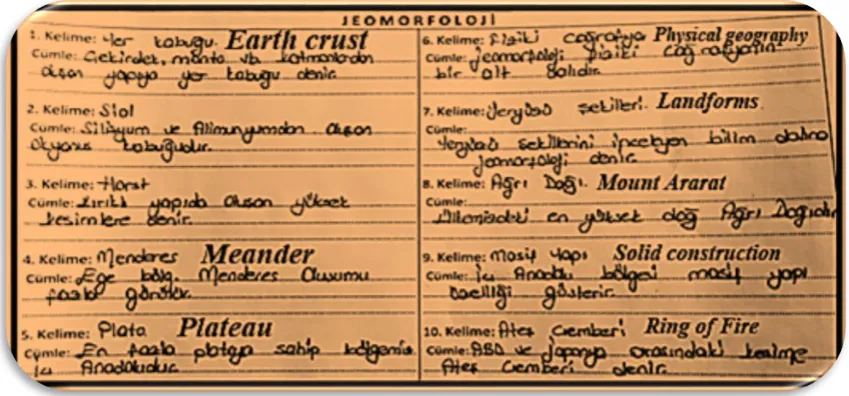
The concept of “geomorphology” was selected with the aim of creating WAT. Additionally, it was consulted to two lecturers in geography department while selecting this concept. Students were informed about WAT and given 60 seconds to write 10 statements about the concept of “geomorphology”.
Page 299
cognitive structures of students about the key concept of “geomorphology” and detection of possible misconceptions.
3.3 Data Analysis. Content analysis method was used while analyzing the data obtained from word association test. The main objective in content analysis is to reach the concepts and relationships explaining the data collected. With this aim, it is required to conceptualize the collected data firstly and then arrange it according to concepts emerged.
Content analysis is to interpret the similar data by integrating under certain themes and concepts and editing so that readers can understand (Yıldırım & Şimşek, 2011). In WAT analysis, all the response words given for the key concept by students are detected one by one. Similar response words are combined and categorized according to their titles. A frequency table is prepared by calculating how many times different words are repeated in each category (Atasoy, 2004). At the test result phase, although 630 statements were expected to be written by 63 students, 529 statements were observed to be written. It was seen that some students had difficulty in writing 10 statements and a few of them wrote unrelated statements. The results of the word association test were sorted from the highest to lowest according to their frequencies of correct connections regardless of their wrong words. With the light of this information, data obtained from the test were analyzed by using the number of the most frequently repetition and the technique of semantic relation. All the answers given for the key concepts were examined deeply with the aim of evaluating the test results.
Figure 1. An example of a key grip express written word.
4. FINDINGS AND INTERPRETATION
Page 300
Table 1. A category of statements describing the relationship between of geomorphology and topography.
Statements Frequency
Landforms 131
Structure types 27
Karst topography 25
Arid and semi-arid topography 15
Volcano topography 16
Fluvial topography 9
Glacial topography 7
Tor topography 3
Total expression and category 525 233 %44,3
Page 301
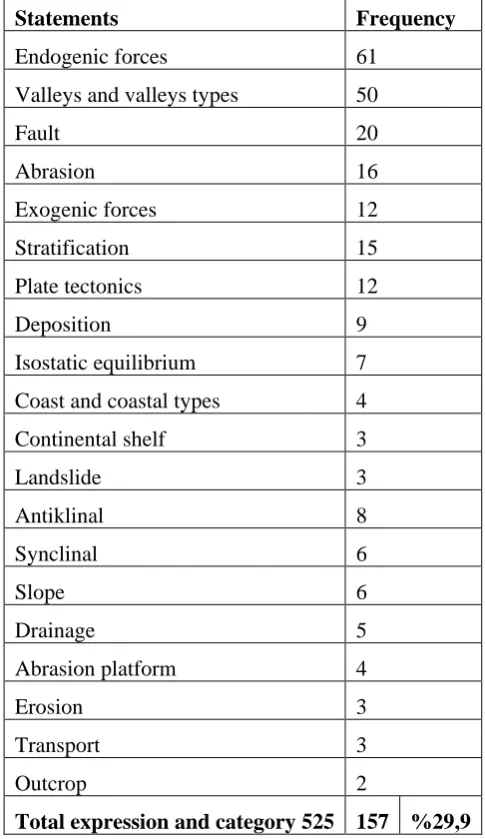
Table 2. A category of statements related to forming of topography forms in geomorphology.
Statements Frequency
Endogenic forces 61
Valleys and valleys types 50
Fault 20
Abrasion 16
Exogenic forces 12
Stratification 15
Plate tectonics 12
Deposition 9
Isostatic equilibrium 7 Coast and coastal types 4
Continental shelf 3
Landslide 3
Antiklinal 8
Synclinal 6
Slope 6
Drainage 5
Abrasion platform 4
Erosion 3
Transport 3
Outcrop 2
Total expression and category 525 157 %29,9
In this category, geomorphologic forms, the materials and factors that create these forms are given. Among the ideas that students state in this category, the frequency of internal forces which have an important place in the forming of the landforms is very high. As known, internal forces provide the initial formation of the landforms. The activities of the external forces start after this stage. And when some statements are taken into account such as fault, isostasy, plate tectonics, synclinal and anticlinal, the rate of the internal forces is quite high. Students’ using a statement like isostatic balance shows that they don’t have information about details. The concept of isostasy already shows the balance. Statements written most after internal forces belong to external forces. Students here both wrote internal-external forces statements and mentioned about internal-external forces. They stated some of the external forces such as; landslide, drainage and accumulation.
Page 302
Table 3. A category of statements that have a little direct-connection to geomorphology
Statements Frequency
Geomorphology 35
Rocks 32
The layers of places 17
Geological time table 12
Geomorphologist 11
Pangea 6
Continent 4
Geographer 4
Age determination 3
Mineral 2
Fossil 2
Spring water 2
Total expression and category 525 130 %24,7
When this category is evaluated semantically, statements except for the geomorpholog are not directly related to the concept given. Students included the statements such as geographer and geomorpholog which connote a discipline. These fields, of course, connote the concept of geomorphology. But it is not suitable to put them into other categories. The statements written except for these two statements, connote the subjects of geology more than geomorphology. It is also not possible to detach the statements in this table from the geomorphology completely. In fact, the areas of geomorphology and geology are not detached from each other at all. So rocks, minerals and fossils’ etc. being written shouldn’t be found odd. This can be evaluated as a misconception. But, it should not be considered as expressions completely away from the concept of geomorphology.
Apart from three categories mentioned, there are also some expressions written by students which repeated only once and wasn’t subjected to classification. Expressions out of categories are; current, altitude, pyroclastic material, ocean and random rains. Some of the statements mentioned such as altitude and pyroclastic materials connote the forming of landforms; however, statements such as ocean and random rains include the misconceptions about geomorphology.
5. RESULT AND DISCUSSIONS
Page 303
geomorphology. Those in this category are the statements that might be indirectly associated with geomorphology.
Page 304
When taken together with the results of the research and the studies mentioned above, it is possible to conclude that geomorphology is a comprehensive branch of science. Teaching geomorphology better and concept richness are properties mentioned in almost all studies. And biomorphology is a concept by Stallins that never mentioned in the study and not mentioned about it much in our country. This statement wasn’t also found in sources about geomorphology. In the printed resources of geomorphology, the width of the scope of the geomorphology is always emphasized but this statement is not written in anywhere. Acceptance of biogeomorphology may contribute to the concept of geomorphology.
The findings of the study indicate that geography teacher-candidates have a general knowledge about the science of the geomorphology. Considering that geomorphology is a science which has a very wide scope, it was pleasing that students did not write statements that away from subject. When looking at the debates about the scope of the geomorphology from past till now, this result shows that there are not many misconceptions.
When it comes to the proposals that can be suggested in this context, it would be appropriate to mention the following points.
There is a benefit in teaching the wide scope of geomorphology.
The interests of the geomorphology are required to be taught to students better. Especially it is necessary to teach the connections and differences between the geomorphology and geology.
Learning geomorphology thoroughly brings a broad perspective when addressing the many issues for geographers and therefore it is necessary to make it comprehend that it has a great importance.
REFERENCES
Atalay, İ 1992, Genel Fiziki Coğrafya, Ege Üniversitesi basımevi, İzmir. Atasoy, B 2004, Fen Öğrenimi ve Öğretimi, 2. Baskı, Asil Yayınevi, Ankara.
Bahar, M & Özatlı, S 2003, Kelime İletişim Testi Yöntemi İle Lise 1. Sınıf Öğrencilerinin Canlıların Temel Bileşenleri Konusundaki Bilişsel Yapılarının Araştırılması, Balıkesir Üniversitesi Fen Bilimleri Enstitüsü Dergisi, 5 (1), 75- 85.
Bahar, M, Johnstone, AH & Sutcliffe, RG 1999, Investigation of Students’Cognitive Structure in Elementary Genetics Through Word Association Tests, Journal of Biological Education, 33, 134-141. Bahar, M, Nartgün, Z, Durmuş, S & Bıçak, B 2006, Geleneksel ve Alternatif Ölçme Değerlendirme Öğretmen El Kitabı, Pegem Yayıncılık. Ankara.
Bremer, H 2003, Geomorphology, Geography (Vols. 1-2), Ed: Maria Sala, eISBN: 978-1-905839-60-5, 978-1-905839-61-2, EOLSS, Publications, Catalogue. pdf.
Brierley, G 2009, Communicating Geomorphology, Journal of Geography in Higher Education, Vol. 33, No. 1, 3–17, DOI: 10.1080/03098260802576899.
Brocklehurst, SH 2010, Tectonics And Geomorphology, Progress in Physical Geography, 34(3), 357-383.
Church, M 2010, The Trajectory Of Geomorphology, Progress in Physical Geography, 34(3) 265–286, ppg.sagepub.com, DOI: 10.1177/0309133310363992
Creswell, JW 2013, Nitel Araştırma Yöntemleri, Transmitting Ed: Mesut Bütün ve Selçuk Beşir Demir, Siyasal Kitapevi, Ankara.
Erinç, S 1996, Jeomorfoloji-I, Öz Eğitim Yayınları, ISBN: 975-8004-12-2, İstanbul.
Page 305
Garcia-Ruiz, JM 2015, Why Geomorphology İs A Global Science, Cuadernos de İnvestigacon Geografica, 41(1), 87-105 Issn: 0211-6820, DOI:10.18172/cig.2652
Gregory, KJ & Gouide, A 2011, Introduction to the Discipline of Geomorphology, SAGE publication Ltd, ISBN: 978-1-4129-2905-9, London
Gregory, KJ & Lewin, J 2015, Making Concepts More Explicit For Geomorphology, Progress in Physical Geography, 39(6), 711-727.
Güldalı, N 1978, Jeomorfoloji ve Ekonomi Uygulamalı Jeomorfolojinin Sorunları, A.W. Siderenko, (Transmitting: Nuri Güldalı), Yeryuvarı ve İnsan Dergisi, sayı: Şubat 3/1, 28-31.
Güney, E 1995, Jeomorfoloji Sözlüğü, Eko yayınları: 04, Ankara.
Huggett, R.J 2007, Fundamentals of Geomorphology, Second Edition, Routledge Fundamentals Of Physıcal Geography Series, Ed: Gerrard, J. ISBN 0-203-94711-8 Master e-book ISBN, <http://www.cec.uchile.cl/~fegallar/Fundamentals_of_Geomorphology.pdf>
İslamoğlu, AH 2009, Sosyal Bilimlerde Araştırma Yöntemleri, Beta Basım Yayın Dağıtım A.Ş., Y. N: 180, 2009, İstanbul.
Kostova, Z & Radoynovska, B 2008, Word Association Test for Studying Conceptual Structures of Teachers and Students, Bulgarian Journal of Science and Education Policy (BJSEP), Volume 2, Number 2, 209-231.
Kostova, Z & Radoynovska, B 2010, Motıvatıng Students’ Learnıng Usıng Word Assocıatıon Test And Concept Maps, Bulgarian Journal of Science and Education Policy (BJSEP), Volume 4, Number 1.
Malanson, GP, Scuderi, L, Moser, KA, Willmott, CJ, Resler, LM, Warner, TA & Mearns, LO 2014, The Composite Nature Of Physical Geography Moving From Linkages To İntegration, Progress in Physical Geography, 38(1), 3-18.
Martínez, P, Ritland, BB, Peters, EE & Baek, J 2011, Learning to Observe in a Geomorphological Context, Science Activities: Classroom Projects and Curriculum Ideas, 48:1, 13-22, DOI: 10.1080/00368121.2010.493903.
Nekah, SMA, Akhlaghi, E & Ebrahimi, S 2013, An Assessment Of Lexıcal Sense Relatıons Based On Word Assocıatıon Test, European Scientific Journal, April edition vol.9, No.11 ISSN: 1857 – 7881.
Nielsen, ML & Ingwersen, P 1999, The Word Association Methodology - A Gateway To Work-Task Based Retrieval, Final Mira Conference, 17-27, <http://www.bcs.org/upload/pdf/ewic_mi99-paper6.pdf.>
Orme, AR 2002, Shifting Paradigms In Geomorphology: The Fate Of Research Ideas In An Educational Context, Geomorphology, 47, 325–342, www.elsevier.com/locate/geomorph.
Paker, T 2015, Nitel Araştırma: Yöntem, Teknik, Analiz Ve Yaklaşımları, Anı Yayıncılık, Ankara.
Peppard, J 2007, Exploring The Relationship Between Word-Association And Learners’ Lexical Development, <http://www.birmingham.ac.uk/documents/college-artslaw/cels/essays/.pdf.>
Sack, D 2002, The Educational Value Of The History Of Geomorphology, Geomorphology 47, 313 -323.
Spiteri, LF 2005, Word Association Testing and Thesaurus Construction: A Pilot Study, Cataloging & Classification Quarterly, 40:1, 55-78, DOI: 10.1300/J104v40n01_05.
Stallins, JA 2006, Geomorphology And Ecology: Unifying Themes For Complex Systems In Biogeomorphology, Geomorphology, 77, 207–216, www.elsevier.com/locate/geomorph.
Page 306
Wolf, J, Stanton, M & Gellott, L 2010, Critical Thinking in Physical Geography: Linking Concepts of Content and Applicability, Journal of Geography, Volume 109, Issue 2, ISSN: 0022-1341.