Page 48
CURRICULUM, LEARNING DESIGN AND DIGITAL RESOURCES FOR STEM EDUCATION
Daniel Churchill
Faculty of Education, The University of Hong Kong, Hong Kong SAR China
Abstract
The STEM (Science, Technology, Engineering and Mathematics) is widely recognized as crucial to societal development in the context of increasing economic, scientific, and technological globalization. STEM education emphasizes that STEM curricula and teaching must (a) incorporate concepts and methods from across the STEM disciplines, (b) be inquiry-, problem-, and activity-based, and (c) incorporate digital literacies. The paper reflects on STEM practices and development in Hong Kong and explicates frameworks for Curriculum and Learning Design and technologies with potential for adoption in school education, such as 3D printing, design kits, CNC machining, robotics, and coding tools. However, it is argued that, the focus on STEM education alone might be limited option for education today. It might be better to consider it as STEM± education, or even as an idea of transdisciplinary education, more broadly. In this paper, the author explore STEM as a form of Transdisciplinary Activity, without limiting it to the four core disciplines. This is processed through a theoretical lens known as the Activity Theory, in order to articulate a learning design framework.
Keywords: STEM, Transdiciplinary Education, Activity Theory, RASE Learning Design
1. INTRODUCTION AND BACKGROUND TO STEM
STEM (Science-Technology-Engineering-Mathematics) is widely recognized as crucial to societal development in the context of increasing economic, scientific and technological globalization (see Li, 2014). The U.S. Government’s recognition in 2009 of dependence of national competitiveness on a sufficient number of citizens well-prepared in STEM resulted in a number of initiatives (e.g., The White House, 2016a, 2016b; U.S. Department of Education, 2016). Since 2012, STEM has also been adopted as an educational priority area in other countries/territories, including the U.K., Canada, Australia and HK (e.g., The Australian Government, 2016; Harrison, Mann, & Nolan, 2013).
Hong Kong’s (’HK’) overall strategic plan to diversify traditional industries and further develop the STEM fields requires more, and better-prepared, STEM teachers and resources. The plan also includes objectives to include traditionally under-represented groups, such as minority groups, achieve gender equity and engage students in understanding the importance of STEM education to resolving some of the world’s pressing challenges. These objectives are in line with the trends in and initiatives taken by other leading developed economies. In a response to these, the authorities and schools alike are working on formulating educational policies, curricula and practices aimed at the more effective integration of the STEM disciplines. STEM-related reforms emphasize that teaching must (a) focus on cross-disciplinary concepts and methods, (b) be inquiry-, problem- and activity-based, and (c) incorporate 21st century skills (e.g., digital literacy). A key strategy is to deploy the scientific method and engineering design in a distinct teaching and learning approach (Reeve, 2013).
Page 49
resources and learning designs, leaving them to make their own interpretations based on their own ideas and assumptions (i.e., private theories). Partnering with governmental organizations and NGOs is seen as crucial to establishing a territory-wide ecosystem that supports the objectives of HK’s STEM education strategy. A Croucher Foundation-funded project investigating the STEM ecosystem in HK identified teachers’ STEM readiness as a key parameter limiting the effective integration of STEM disciplines (see Lee & Foster, 2017). Teachers are on the front-line of strategy implementation, and understanding their thinking is thus critical to the development of effective policy, training and support mechanisms.
However, other than broad policy documents and a few examples of learning designs from the EDB, HK teachers and schools have been provided with no STEM-specific curriculum, resources or learning design strategy, leaving them to make their own interpretations based on their own knowledge and private theories about what STEM might be (see Churchill, 2005; Bell, 2016). The development of STEM strategies as well as pre-service training and in-service teacher development requires, in addition to an in-depth understanding of these teachers’ thinking, clearly articulated programme and a learning design strategy. Also, strategic understanding of roles current and emerging technologies play in STEM is essential.
Education research suggests that teachers struggle to connect the STEM disciplines in their instructional planning (see Abell & Lederman, 2007; Kelley & Knowles, 2016). That of middle school teachers, in particular, is reported to suffer from their limited cross-disciplinary knowledge (e.g., Brophy et al., 2008; Estapa & Tank, 2017). In Hong Kong, Lee and Foster (2017) report that primary and lower secondary teachers’ limited knowledge of the STEM disciplines presents an obstacle to effective transdisciplinary STEM education. A further challenge for primary and junior schools in particular, noted by Pitt (2009) is the lack of any common understanding of “what it [STEM] is, how it can be taught in schools, whether it needs to be taught as a discrete subject or whether it should be an approach to teaching the component subjects, what progression in STEM education is, and how STEM learning can be assessed” (p. 41).
This paper addresses some of these concerns and proposes certain ideas for curriculum, learning design and technology adoption. The proposed framework should be useful to help to resolve some of the impediments to STEM integration, provide support for public education in HK and, in particular, contribute to the Enhanced Professional Development Strategy for Promoting STEM in HK schools specified by the EDB (see Hong Kong Curriculum Development Council, 2015). These might have more global application, and lead to further research exploring effective transdisciplinary methods in education.
2. STEM AS A TRANSDISCIPLINARITY ACTIVITY IN EDUCATION
Page 50
integration: disciplinary, multidisciplinary, interdisciplinary and transdisciplinary, with transdisciplinary integration the most effective and desirable for STEM education success (see English, 2016; Vasquez et al., 2013). In disciplinary integration, disciplinary concepts are taught separately from other disciplines; in multidisciplinary integration, concepts and skills are taught separately in each discipline but housed within a common theme; in interdisciplinary integration, closely linked concepts and skills from two or more disciplines are introduced to deepen understanding and skills; and, finally, in transdisciplinary integration, knowledge and skills from two or more disciplines are applied to real-world problems and projects with the aim of shaping the total learning experience.
Some propose that STEM education needs to integrate elements of arts and crafts to support student creativity (see Root-Bernstein, 2015). This thinking leads to a term STEAM, STEM+Philosphy (e.g., in India) and even STEM+Religion (e.g., in Malaysia). This is certainly a valid argument as arts, creativity, entrepreneurship, digital literacies, etc., are critical to innovation. I am aligned to think that the STEM alone is a limiting rather than enabling concept for modernization of education, and that it is more effectively to think beyond these four core disciplines, allow teachers from across all disciplines to come forward and develop innovative and relevant education experiences. In my discussion and work on a project articulation with Professor Lyn Goodwin from the University of Hong Kong, Lyn suggested that we might need to think of a more creative option, such as of the STEM+, that would allow potential of other disciplines to enhance what we can achieve with the STEM education alone. What might be misinterpreted as contrary rather than complementary to this, emerging from my discussion with Professor John Williams from the Curtin University (in Australia) during our meeting at the International Mobile Learning Festival 2018 in Singapore. John suggested that we might we might need to consider educational activities where some, but not all, of the core disciplines might be integrated (e.g., STM, TEM, or ST). In such context, the idea of STEM± Education emerged as the most flexible option. Also, I am arguing that the idea of Transdisciplinary Education might appears broad enough to encapsulate possibility for any discipline, practice and human potential to come forward and be integrated in an innovative education that in long run contributes to solution of broad range of world-pressing problems. Therefore, in line with English (2016), I believe that transdisciplinary integration is the most desirable form of disciplinary integration in education. Hence, the critical term in this context is transdisciplinary activity where traditionally separated disciplines are integrated in an educational process of solving of ill-defined and important problems that humanity faces (e.g., global warming, poverty, pollution, world conflicts, water shortage, health, education and others that cannot be solved by a single discipline and where technology play a critical enabler). Transdisciplinarity raises STEM to the level of STEM±, allowing other important disciplines, practices and human potential to be integrated, such as for example, Arts, Law, Social Science and Health, and other cores, such as, Science to be put aside, such as in Digital Humanities and electronic Arts. Thus, I believe, education needs transdisciplinary method, rather than fixed focus on the limited integration, such as in the STEM. Hence, the broader focus of our inquiry, practice and policy must be on transdisciplinarity, or at minimum, on STEM±.
3. TRANSDICIPLINARITY AND LEARNING FROM THE PERSPECTIVE OF THE ACTIVITY THEORY
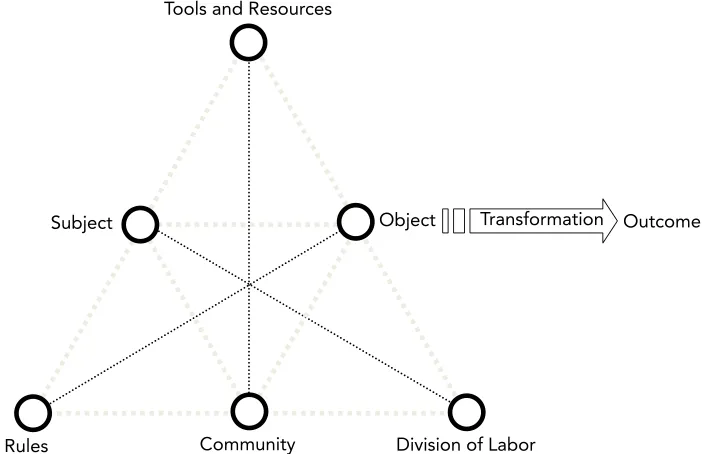
In this paper, I attempt to explore Transdisciplinary Activity through a theoretical lens known as Activity Theory (Engeström, 1987), in order to understand its core elements that can be articulated in a learning design and curriculum frameworks. Engeström articulated a general representational framework of a human activity (see Figure 1). An activity can be as small as making a cup of tea, or as large as national education. According to this framework, a subject in an activity transforms an object into an outcome.
Page 51
a power drill, a trowel, a brick jointer, a plumb and a chalk line. For another, and more relevant example, school education is one large and complex activity system with community composed of teachers, principals and deputies, administrative staff, councillors, heads of departments, laboratory technicians, etc., all together working on transforming object of their activity (learners) into an outcome (school graduate creating impact in their societies). All these members of community execute different actions essential in completing this transformation (e.g., someone teaches mathematics, someone social science, while someone takes care of learner administration). Within this community there is a division of labour (for example, principal and teachers do different things and have different powers) and there are rules (e.g., curriculum and assessment requirements). Often, contradictions arise in an activity between different nodes (e.g., subject and rules, or community and division of labour), and these contradictions cause changes in the activity itself. Contradiction might emerge with other activates that in some way relate or affect the current activity (e.g., a tool making activity). Thus, human activities, in general, are usually under continuous change.
In an activity, a subject and an object are in a symbiotic relationship where “... the subject is transforming the object, while the properties of the object penetrate into the subject and transform him or her” (Kuutti, 1997, p.32). In other words, a subject learns from an experience by receiving feedback from the environment he is acting upon. This process is mediated by tools (or supporting artefacts and resources) whose properties and use might also penetrate into and transform the subject. Often, a subject in an activity collaborates, and is not an “…unaided individual divorced from a social group and from supporting artefacts” (Nardi, 1997, p.67). When an activity involves collaboration amongst multiple individuals, there is always a division of labour. In addition, an activity is carried according to certain rules, standards, requirements and framing parameters. Tools, community, division of labour and rules, are both enabling and constraining, meaning that these all mediate goal-directed actions that can be executed within an activity. Figure 1 shows a representational framework of an activity system.
Figure 1: A representational framework of an activity (modified from Engeström, 1987)
Page 52
through their individual re-production by means of special actions upon learning objects” (p. 12). Literature is suggesting that an outcome of a learner’s activity should be development of ‘theoretical thinking’ (Chaiklin, 1999; Davydov, 1999; Hedegaard & Lompscher, 1999). Theoretical thinking is important for learners because “development of creative abilities, initiatives, self-understanding, and, finally, the development of their personality depend on it” (Davydov, 1999, p.132). Development of theoretical thinking is achieved through an activities “related to the conceptual foundations of the subject matter being taught, which in turn are related to the societal traditions within which this knowledge was originally developed” (Chaiklin, 1999, p.189). For Davydov (1999), to design an activity which supports development of theoretical thinking “one needs to use such material that the children could perform the respective transformations and make object-related or mental experiments with the material” (p.128). Furthermore, Davydov (1999), suggests that, often, learning does not occur because “textbooks and methodical recommendations for the instruction of particular school subjects do not meet the requirement of the very learning material and the intended way of how to introduce the subject into the teaching/learning process” (p. 130). Hence, as Chaiklin (1999) suggests, in order to realize development of theoretical thinking, “the key is to have a significantly good analysis of the subject matter, such that one can create a framework of learning task within which variations in pupil motives and motivation can find expression” (p.188). A motive for a subject (a learner) in a learning activity is assumed to be achievement of learning outcomes specified by a curriculum, or perhaps, to achieve a high grade at exams (an outcome). However, in practice how many learners are motivated to learn if not driven by intrinsic motivation? This represents one of the key challenges for educators – how to intrinsically motivate learners, and how to sustain that motivation and engagement throughout learning process. What might be a solution to this problem? How to design activities that are engaging and sustain intrinsic motivation of learners? How STEM± and Transdisciplinary fits with all of these?
This discussion brings me to these questions. Firstly, is Transdisciplinary activity in education a Learning Activity? I argue that it is not, thus it emerges as a separate kind of activity in education. Secondly, “Is there such a thing as transdisciplinary curriculum?” I argue that certainly there is a need for a programme to orient educators how to develop transdisciplinary skills, however, it is not a traditional, content driven curriculum found in the classical disciplinary subjects. Thirdly, “What should be outcomes of a Transdisciplinary activity in education? The answer to this third question is more complex and based on a number of different perspectives:
From a teacher’s perspective, transdisciplinary offers opportunity to traditionally isolated conceptual knowledge of core concepts (or theoretical thinking) from the disciplines, to be brought forward, applied and revised, leading to greater educational impact. These core concepts (ir representations of these) are mediating tools in a transdisciplinary activity.
From a government’s perspective, establishments aims to have better prepared individuals (e.g., scientists, engineers and technologists) to serve and solve economical needs, and ensure sustainability and growth of the society (economical, but also political and social perhaps). Transdisciplinarity offers an opportunity for students to study carriers that the establishments might need, e.g., more engineers are needed to fill in shortages in the projected diversification of traditional industry for purpose of creating more comparative economy for tomorrow.
From a humanitarian perspective, transdisciplinarity will lead to greater opportunity for traditional underprivileged and under-represented groups, e.g., engagement of minorities in governmental decision-making or closure of gender in professions traditionally dominated by males.
Page 53
These perspectives, although often conflicting, I believe, are not mutually exclusive, but each one of them has something to offer to us to more closely articulate purpose and outcomes of transdisciplinary education. From Activity Theoretical perspective, no activity stands isolated and dynamic, but it can be constantly under its own developmental trajectory due to contradiction emerging between and within different nodes, and interacting with other horizontally (e.g., another transdisciplinary activity) and vertically distributed activities (e.g., tool making activity).
4. RASE LEARNING DESIGN FRAMEWORK FOR TRANSDISCIPLINARY EDUCATION In many human activities other than a learning activity, learning emerges as a special component of this experience (i.e., learning is incidental). For Engeström (1987), learning might occur in the context of at least three kinds of activities other than a learning activity: work, science and art (and engineering, I add). Learning outcomes, per se, are not a motive behind these activities -- rather, a motive may be, for example, to answer an interesting inquiry (science), design a computer graphics (art), or make money for living (work). Engeström (1987) illustrates this by using an example where a child is allowed to go outside and play once he completed his homework. In this case, a motive for an activity and learning is a play, not learning. I add to these, transdisciplinary activity is an activity where practices and concepts from across disciplines are deployed as mediating tools in the process of solving important problems that humanity faces. By ‘important problems that humanity faces’ it is meant that learners work on a problem that they can relate to, despite how small contribution their solution to a problem can make, but importantly, this leads to a large solution that STEM± can achieve at the end. Overall, what Activity Theory tells us about learning design, for it to be effective, is that it must incorporate activity (including a motive), resources (including tools and material to be manipulated), and outcomes that can be evaluated. When I talk about a learning design, I mean a plan developed by a teacher to serve as a tool in his/her teaching activity on one side, and on the other, from learners’ perspective, a framework for an activity where learners are engaged and motivated to participate. As it is a challenge for teachers to create learning activities where learners are motivated to learn, a strategy I call here ‘masking’ is proposed as a solution (Churchill, 2017). It means that we can design activities that on surface are not learning activities, but are designed with an intention to result in changes in learners. Such activities make possible for learners to learn with tools they use while transforming objects (materials) into an outcome (artefact), as well, from development of an outcome. Often, in such learning design, learners as subjects of an activity, create learning artefacts (outcome of an activity) in formats such as (see Jonassen & Rohrer-Murphy, 1999):
Physical artefacts -- e.g., a robot or a cardboard model,
Soft artefacts -- e.g., a computer-based model or a multimedia presentation, and
Cognitive artefacts -- e.g., a conceptual solution to a problem, or a theoretical thinking derived form an experience.
Page 54
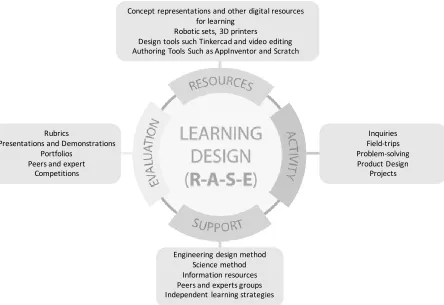
for completing inquires, problems and projects). Evaluation is emphasized as strategy for reviewing completed activities (including self, peer and a facilitator evaluation of learning artefacts such as models, presentations and digital essays). Finally, Support is seen as a strategy for developing students’ independent learning and metacognitive strategies. The RASE framework is represented in the Figure 2.
Figure 2: The RASE Learning Design (adapted from Churchill, 2017)
5. DIGITAL CONCEPT REPRESENTATIONS AS A TOOLS IN TRANSDISCIPLINARY ACTIVITY
Careful analysis of this representation will provide a reader with sufficient understanding of these core components, including technology roles. As the last part in this paper, I will explore use of special form of digital resources for learning, concept representations, in context of transdisciplinary activity in education. Although technology plays an irreplaceable role as constructionist tool in a transdisciplinary activity, role of pre-designed digital representation must also be emphasized.
The central argument in my thesis is that the transdisciplinary activity is not where disciplinary declarative knowledge, procedures and concepts are learnt. Transadisciplinary activity is where conceptual foundations and practices from disciplines are brought together to mediate the activity. Disciplinary concept knowledge is under continuous polygenetic and ontogenetic development (see Vygotsky, 1962), and intersection of these two trajectories of development represent current ideal state of individual’s disciplinary knowledge. Discussion of these trajectories is beyond the scope of this paper and it requires another in-depth discussion. However, here I want to simplify my argument by writing that it is the concept knowledge that plays critical role into how theoretical thinking from disciplines are brought and integrated in a transdisciplinary activity. Where these concepts were not developed fully as cognitive resources to that point of intersection in teaching in core disciplines (their polygenetic development is at the level where it does not intersect with the ontogenetic development of the disciplinary concepts), these might be supplied externally to students in transdicsciplinary activity by
Concept representations and other digital resources for learning
Robotic sets, 3D printers
Design tools such Tinkercad and video editing Authoring Tools Such as AppInventor and Scratch
Inquiries Field-trips Problem-solving Product Design
Projects Rubrics
Presentations and Demonstrations Portfolios
Peers and expert Competitions
Page 55
devices through a special form of mediating tools I call “concept representations” (see Churchill, 2017). Transdisciplinary education is about students revising their knowledge and discovering meanings, importance and purposes in their knowledge in context of solving important problems. These problems, from a learning design perspective, need to be based upon and focusing on important problems that the world is facing, such as, global warming, water shortage, poverty, access to healthcare and education, new sources of energy, conflicts, equality, migration, etc.
The importance of concept learning in STEM-related education is emphasized in the literature, which also presents evidence to show that incomplete concept knowledge and misconceptions seriously impede learning (e.g., Mayer, 2002a; Smith III, diSessa, & Roschelle, 1994; Vosniadou, 1994, 2008). Singer, Nielsen, and Schweingruber (2012) note the large number of studies on concept knowledge related to STEM, with approximately 115 such studies in the context of physics education (e.g., McDermott & Redish, 1999), 120 in chemistry (e.g., Barke, Hazari, & Yitbarek, 20092 ), 16 in engineering (e.g., Svinicki, 2011), 17 in biology (e.g., Dirks, 2011), and 79 in geoscience and astronomy (e.g., Cheek, 2010; Bailey & Slater, 2005). A concept is broadly understood as a form of knowledge that enables a student to comprehend new information, learn, communicate, and understand language, and engage in specific disciplinary thinking, decision-making, problem-solving, generalizing, reflecting, inference-making, and forming and reconstructing personal theories. There are various interpretations of concepts in the literature, such as concepts as network nodes in a knowledge schema, as patterns of synaptic connections, as systems for classifying objects into categories, and as psychological tools or acts of thought (e.g., Berger, 2004a, 2004b; diSessa, Gillespie, & Esterly, 2004; Engeström,1987; Ivarsson, Schoultz, & Säljö, 2002; Jonassen, 2006; Merrill, Tennyson & Posey, 1992; Vygotsky, 1978).
The provision of particular conceptual tools or representations has been found to exert positive effects on concept learning. Representations have been described as effective tools for concept learning, and their educational use as model-centred learning and instruction (e.g., Churchill, 2017; Dawson, 2004; Gibbons, 2008; Ivarsson & Säljö, 2005; Mayer, 1989; Norman, 1983; Seel, 2003; Singer, Nielsen, & Schweingruber, 2012). The affordances of today’s representational technology enable the design of concept representations in interactive, visual, and multimedia formats (Churchill, 2017; De Jong & Van Joolingen, 1998; Fraser, 1999; Johnson & Lesh, 2003; Someren et al., 1998). Technology-based concept representations are posited to support learning by activating such cognitive processes as mind modelling and the linking of internal representations (e.g., Churchill & Hedberg, 2008; Mayer, 2002b; Seel, 2003).
For this paper, a concept representation is a visual and interactive digital media artifact for education that is designed to represent a specific concept (or set of related concepts or theoretical thinking) and its properties, parameters, and relationships (Churchill, 2017). If the representation is optimally designed, a learner can manipulate those properties, parameters, and associated relationships using interactive components (e.g., sliders, buttons, hotspot areas, text input boxes) and observe changes and information displayed across a variety of modes (e.g., numerical, textual, auditory, and visual) in order to explore their own theoretical thinking in context of transdisciplinary tasks.
Page 56
theoretical perspective of Vygotsky (1986) and those who subscribe to it (e.g., Berger, 2004a, 2004b; Blunden, 2011; Scott, 1997; Sierpinska, 1993; Wellings, 2003). For Berger (2004a), “Vygotsky’s theory around the genesis of concepts is a theory around the genesis of intellectual operations such as generalization of objects and situations, identification of features of objects, their comparison and discrimination (that is, their abstraction), and the synthesis of thoughts” (p. 3). Therefore, a concept is an act of thought or theoretical thinking. According to the Vygotskian perspective, concepts develop through pre-conceptual stages, including syncretic heaps (characterized by subjective grouping of unrelated objects by chance), complexes (grouping of objects in the mind, not only by subjective impression but by bonds that actually exist, in forming associations, collections, chains, and pseudo-concepts), and, finally, socially and culturally accepted scientific concepts (Berger, 2004a, 2004b; Blunden, 2011). For Vygotsky (1986), “a concept is not an isolated, ossified, and changeless formation, but an active part of the intellectual process, constantly engaged in service of communication, understanding and problem solving,” and the process of concept appropriation “is not a quantitative overgrowth of the lower associative activity, but a qualitatively” new activity mediated by signs (e.g., language, symbols, and internal images) (p. 109).
Engaging students to use technology to develop and apply concept knowledge has been explored in the context of cognitive tools (Lajoie & Derry, 2000), mindtools (Chu, Hwang, & Tsai, 2010; Jonassen & Reeves 1996; Jonassen, 1996; Jonassen, & Carr, 2000), and technologies of mind (Pae, 1985; Salomon, Perkins, & Globerson, 1991). However, much less has been explored in context of design concept representation for augmenting transdisciplinary education activities. In my line of work, I am asking a question if it is possible to design representations of concept knowledge in the way that these can be utilized as augmentation tools in context of transdisciplinary education activities. To have an answer to such question, and in addition to clear understanding of a learning design for transdisciplinary education, we need to understand both: affordances of concept representations, and how concept representations augment trandsiciplinary activities. This is a large area of inquiry that needs to draw upon knowledge of experts from a number of areas, however, at this stage, I have been working to understand identifying, designing and using digital resources which represent conceptual, as different to procedural and declarative, knowledge. Numerous examples of such concepts are featured in my book title “Digital Resources for Learning” (see Churchill, 2017).
6. CONCLUSION
The central ideas presented in this paper is that education need to consider broader approach than what emerges within the current focus on STEM. The idea of STEM± is explicated as a step forward, but further argument presented here is that we might think further consider tansdisciplinarity as the core idea in education. Trandsciplinary activity can be understood through the conceptual lens of the Activity Theory and associated work that explicates development of theoretical thinking as a core purpose of education. Transdiciplinary takes theoretical thinking to a higher level, elevating it to a tools for solving world-pressing problems that the humanity faces. Based on the Activity Theory, this paper proposes the RASE as a suitable framework for learning design of Transdiciplinary activates. Furthermore, the paper argues that concept representations, as a specific kind of digital media for learning, can serve a purpose of externally supplied concepts as mediating tools in Transdisciplinary activities.
REFERENCES
Abell, S., & Lederman, N. (2007). Handbook on research in science education. Thousand Oaks, CA: Sage.
Bailey, J.M., & Slater, T.F. (2005). A contemporary review of K-16 astronomy education research. In O. Engvold (Ed.), Highlights of astronomy (vol. 13, pp. 1029-1031). San Francisco, CA: Astronomical Society of the Pacific.
Page 57
Bell, D. (2016). The reality of STEM education, design and technology teachers’ perception: A phenomenographic study. International Journal of Technology Design Education, 26, 61-79.
Ben-Ari, M. (2001). Constructivism in computer science education. Journal of Computers in Mathematics and Science Teaching, 20(1), 45-73.
Berger, M. (2004a). Heaps, complexes and concepts. For the Learning of Mathematics, 24(2), 2-6.
Berger, M. (2004b). Heaps, complexes and concepts. For the Learning of Mathematics, 24(3), 11-17.
Blunden, A. (2011). Concepts in Vygotsky’s Cultural Psychology. Retrieved from http://home.mira.net/~andy/works/concepts-laboratory.htm
Brophy, S., Klein, S., Portsmore, M., & Rodgers, C. (2008). Advancing engineering education in P-12 classrooms. Journal of Engineering Education, 97(3), 369-387.
Brown, J. S., Collins, A., & Duguid, P. (1989). Situated cognition and the culture of learning. Educational Research, 18(1), 32-42.
Chaiklin, S. (1999). Developmental teaching in upper-secondary school. Introduction. In M. Hedegaard & J. Lompscher (Eds), Learning activity and development (pp. 187-210). Aarhus, Denmark: Aarhus University Press.
Cheek, K.A. (2010) A summary and analysis of twenty-seven years of geoscience conceptions research. Journal of Geoscience Education, 58(3), 122-134.
Chi, M.T.H. (2008). Three types of conceptual change: Belief revision, mental model transformation, and categorical shift. In S. Vosniadou (Ed.), International handbook of research on conceptual change (pp. 61-82). New York: Routledge.
Chu, H. C., Hwang, G. J., & Tsai, C. C. (2010). A knowledge engineering approach to developing mindtools for context-aware ubiquitous learning. Computers & Education, 54(1), 289-297.
Churchill, D., & Hedberg, J. (2008). Learning object design considerations for small-screen handheld devices. Computers & Education, 50(3), 881-893.
Churchill, D. (2005). Teachers’ private theories and their design of technology-based learning. British Journal of Educational Technology, 37(4), 559-576.
Churchill, D. (2017). Digital resources for learning. Singapore: Springer
Davydov, V.V. (1999). What is real learning activity? In M. Hedegaard & J. Lompscher (Eds.), Learning activity and development (pp.123-128). Aarhus, Denmark: Aarhus University Press.
Dawson, M.R. (2004). Minds and machines: Connectionism and psychological modeling. Oxford: Blackwell Publishing.
De Jong, T., & Van Joolingen, W.R. (1998). Scientific discovery learning with computer simulations of conceptual domains. Review of Educational Research, 68(2), 179-201.
Dirks, C. (2011). The current status and future direction of biology education research. Paper presented at the Second Committee Meeting on the Status, Contributions, and Future Directions of
Discipline-Based Education Research. Retrieved from http://www7.
nationalacademies.org/bose/DBER_Dirks_October_Paper.pdf.
diSessa, A.A. (2008). A bird’s-eye view of the “pieces” vs. “coherence” controversy (from the “pieces” side of the fence). In S. Vosniadou (Ed.), International handbook of research on conceptual change (pp. 35-60). New York: Routledge.
diSessa, A.A., Gillespie, N., & Esterly, J. (2004). Coherence vs. fragmentation in the development of the concept of force. Cognitive Science, 28, 843-900.
Page 58
English, l. D. (2016). STEM education K-12: Perspectives on integration. International Journal of STEM Education, 3(3), 1-8.
Estapa, A.T, & Tank, K.M. (2017). Supporting integrated STEM in the elementary classroom: A professional development approach centered on an engineering design challenge. International Journal of STEM Education, 4(6), 1-16.
Lee, S.P., & Foster, D. (2017). The out-of-school STEM ecosystem in Hong Kong. Hong Kong: Croucher Foundation.
Fraser, A. (1999). Web visualization for teachers. Retrieved from http://fraser.cc/WebVis/.
Gibbons, A. (2008). Model-centered instruction, the design and the designer. In D. Ifenthaler, P. Piarnay-Dummer, & J.M. Spector (Eds.), Understanding models for learning and instruction, (pp. 161-173). New York: Springer.
Glynn, S.M., Yeany, R.H., & Britton, K.B. (Eds.) (1991). The psychology of learning science. Hillsdale, NJ: Lawrence Erlbaum.
Grabinger, R.S., & Dunlap, J.C. (1997). Rich environments for active learning: A definition. Research in Learning and Teaching, 3(2), 5-34.
Harrison, M., Mann, L., & Nolan, D. (2013). Enhancing STEM education in secondary schools. London: Royal Academy of Engineering.
Hedegaard, M., & Lompscher, J. (Eds.). (1999). Learning activity and development. Aarhus, Denmark: Aarhus University Press.
Hong Kong Curriculum Development Council. (2015). Promotion of STEM education: Unleashing potential in innovation. Retrieved from http://www.edb.gov.hk/attachment/en/curriculum-development/renewal/Brief%20on%20STEM%20(Overview)_eng_20151105.pdf
Ivarsson, J., Schoultz, J., & Säljö, R. (2002). Map reading versus mind reading. In M. Limon & L. Mason (Eds.), Reconsidering concept change: Issues in theory and practice (pp. 77-99). Dordrecht: Kluwer Academic Publishers.
Johnson, T., & Lesh, R. (2003). A models and modeling perspective on technology-based representational media. In R. Lesh & H. Doerr (Eds.), Beyond constructivisim: A models and modeling perspective on mathematics problem solving, learning and teaching (pp. 3-34). Mahwah, NJ: Lawrence Erlbaum.
Jonassen, D.H., & Reeves, T.C. (1996). Learning with technology: Using computers as cognitive tools. In D.H. Jonassen (Ed.), Handbook of research for educational communication and technology (pp. 693-719). New York: Simon & Schuster Macmillan.
Jonassen, H. D. & Rohrer-Murphy, L. (1999). Activity theory as a framework for designing constructivist learning environment. Educational Technology Research and Development, 47(1), pp. 61-99.
Jonassen, D.H. (1996). Computers in the classroom: Mindtools for critical thinking. Englewood Cliffs, NJ: Merrill.
Jonassen, D.H. (1999). Designing constructivist learning environments. In C.M. Reigeluth (Ed.), Instructional design theories and models: A new paradigm of instructional theory (pp. 217-239). Mahwah, NJ: Lawrence Erlbaum.
Jonassen, D.H., & Carr, C. (2000). Mindtools: Affording multiple knowledge representations in learning. In S.P. Lajoie (Ed.), Computers as cognitive tools (pp. 165-196). Mahwah, NJ: Lawrence Erlbaum.
Page 59
Jonassen, D.H. (2006). Modeling with technology: Mindtools for concept change. Upper Saddle River, NJ: Pearson Education.
Kelly, T.R., & Knowles, J.G. (2016). A conceptual framework for integrated STEM education. Journal of STEM Education, 3(11), 1-11.
Kolodner, J.L., Camp, P.J., Crismond, D., Fasse, B.B., Gray, J.T., Holbrook, J., Ryan, M., & Puntambekar, S. (2003). Problem-based learning meets case-based reasoning in the middle-school science classroom: Putting a learning-by-design curriculum into practice. Journal of the Learning Sciences, 12(4), 495-548.
Kozulin, A. (1990). Vygotsky’s psychology: A biography of ideas. Cambridge, MA: Harvard University Press.
Kutti, K. (1997). Activity theory as a potential framework for human-computer interaction research. In B. A. Nardi (Eds.), Context and consciousness: activity theory and human-computer interaction. (pp. 17-44). Cambridge, MA: The MIT Press.
Li, Y. (2014). International journal of STEM education—A platform to promote STEM education and research worldwide. International Journal of STEM Education, 1(1), 1-2.
Mayer, R.E. (1989). Models for understanding. Review of Educational Research, 59(1), 43-64.
Mayer, R.E. (2002a). Understanding concept change: A commentary. In M. Limon & L. Mason (Eds.), Reconsidering concept change: Issues in theory and practice (pp. 101-111). Dordrecht: Kluwer Academic Publishers.
Mayer, R.E. (2002b). Multimedia learning. Psychology of Learning and Motivation, 41, 85-139.
McCloskey, M. (1983). Naive theories of motion. In D. Gentner & A.L. Stevens (Eds.), Mental models (pp. 299-323). Hillsdale, NJ: Lawrence Erlbaum.
McDermott, L.C., & Redish, E.F. (1999). Resource letter: PER-1: Physics education research. American Journal of Physics, 67(9), 755-767.
Merrill, D.M., Tennyson, R.D., & Posey, L.O. (1992). Teaching concepts: An instructional design guide. Englewood Cliffs, NJ: Educational Technology Publications.
Nardi, B. A. (1997). Activity theory and human-computer interaction. In B. A. Nardi (Eds.), Context and consciousness: activity theory and human-computer interaction. (pp. 7-16). Cambridge, MA: The MIT Press.
Norman, D.A. (1983). Some observation on mental models. In D. Gentner & A.L. Stevens (Eds.), Mental models (pp. 7-14). Hillsdale, NJ: Lawrence Erlbaum.
Pae, R.D. (1985). Beyond amplification: Using the computer to reorganize mental functioning. Educational Psychologists, 20, 167-182.
Pitt, J. (2009). Blurring the boundaries – STEM education and education for sustainable development. Design and Technology Education: An International Journal, 14(1), 37-48.
Reeve, M.E. (2013). Implementing science, technology, mathematics, and engineering (STEM) education in Thailand and in ASEAN. Bangkok: The Institute for the Promotion of Teaching Science and Technology (IPST).
Salomon, G., Perkins, D.N., & Globerson, T. (1991). Partners in cognition: Extending human intelligence with intelligent technologies. Educational Researcher, 20(3), 2-9.
Savery, J.R., & Duffy, T.M. (1995). Problem based learning: An instructional model and its constructivist framework. Educational Technology, 35(5), 31-38.
Page 60
Seel, N.M. (2003). Model-centered learning and instruction. Technology, Instruction, Cognition and Learning, 1(1), 59-85.
Sierpinska, A. (1993). The development of concepts according to Vygotsky. Focus on Learning Problems in Mathematics, 15(2), 87-107.
Singer, R.S., Nielsen, R.N., & Schweingruber, A.H. (2012). Discipline-based education research: Understanding and improving learning in undergraduate science and engineering. Washington, DC: The National Academies Press.
Sleeman, D., Putnam, R.T., Baxter, J.A., & Kuspa, L. (1989). A summary of misconceptions of high school Basic programmers. In E. Soloway & J.C. Spohrer (Eds.), Studying the novice programmer (pp. 301-314). Hillsdale, NJ: Lawrence Erlbaum.
Smith III, J.P., diSessa, A.A., & Roschelle, J. (1994). Misconceptions reconceived: A constructivist analysis of knowledge in transition. The Journal of the Learning Sciences, 3(2), 115-163.
Someren, A.V., Boshuizen, P.A., Jong, T.D., & Reimann, P. (Eds.). (1998). Introduction. Oxford: Elsevier Science.
Svinicki, M. (2011). Synthesis of the research on teaching and learning in engineering since the implementation of ABET engineering criteria 2000. Paper presented at the Second Committee Meeting on the Status, Contributions, and Future Directions of Discipline- Based Education Research. Retrieved from http://www7.nationalacademies.org/bose/DBER_ Svinicki_October_Paper.pdf.
The Australian Government. (2016). Embracing the digital age. Retrieved from http://www.innovation.gov.au/page/embracing-digital-age
The White House. (2016a). STEM for all. Retrieved from https://www.whitehouse.gov/blog/2016/02/11/stem-all
The White House. (2016b). Commuter science for all. https://www.whitehouse.gov/blog/2016/01/30/computer-science-all
Turns, J., Atman, C., Adams, R., & Barker, T. (2005). Research on engineering student knowing: Trends and opportunities. Journal of Engineering Education, 94(1), 27-41.
U.S. Department of Education. (2016). Science, technology, engineering and math: Education for global leadership. Retrieved from http://www.ed.gov/stem
Ivarsson, J., Schoultz, J., & Säljö, R. (2002). Map reading versus mind reading. In M. Limon & L. Mason (Eds.), Reconsidering concept change: Issues in theory and practice (pp. 77-99). Dordrecht: Kluwer Academic Publishers.
Vasquez, J.A., Sneider, C., & Comer, M. (2013). STEM lesson essentials, grades 3-8: Integrating science, technology, engineering, and mathematics. New York: Heinemann Portsmouth.
Vosniadou, S. (1994). Capturing and modeling the process of concept change. Learning and Instruction, 4(1), 45-69.
Vosniadou, S. (Ed.). (2008). International handbook of research on conceptual change. New York: Routledge.
Vosniadou, S., De Corte, E., & Mandl, H. (1995). Technology-based learning environments. Heidelberg: Springer-Verlag.
Vygotsky, L. (1986) Thought and language, Kozulin, A. (ed. and trans.), Cambridge, MA: MIT Press.
Vygotsky, S. L. (1962). Thoughts and language. Cambridge, MA: The MIT Press.
Page 61