Available online on 15.09.2018 at http://jddtonline.info
Journal of Drug Delivery and Therapeutics
Open Access to Pharmaceutical and Medical Research© 2011-18, publisher and licensee JDDT, This is an Open Access article which permits unrestricted non-commercial use, provided the original work is properly cited
Open
Access
Research Article
RP-HPLC METHOD DEVELOPMENT AND VALIDATION FOR
SIMULTANEOUS ESTIMATION OF ASPIRIN AND OMEPRAZOLE
IN BULK AND DOSAGE FORM
Sarode Tukaram K
1*, Jadhav Prerana B
2*
1Department of Quality Assurance Technique, SND College of Pharmacy, Babhulgaon, Yeola, Nashik- 423401, Maharashtra, India
2
Jadhav Prerana Bhaskar,Dept. of Pharmaceutical Chemistry,SND College of Pharmcy,Yeola, Nashik-423401,Maharashtra, India
ABSTRACT
RP-HPLC method was developed for the determination of Omeprazole (OME) & Aspirin (ASP) in bulk and dosage form. Mobile phase use for the separation of OME & ASP is methanol and 0.05%OPA in water (pH=3.5) with ratio of 60:40. The Colum used as C18 (Cosmosil) 4.6×150mm and flow rate 0.7mL/min. UV detector is used and the detection wavelength is 231nm. Retention time of
OME and ASP are 4.61 & 8.03 min, respectively. This method was validated as per ICH guidelines. Linearity was observed at 10-50µg/mL of OME and 20-100µg/mL of ASP. The % RSD is found to be less than 2%.The resolution between OME and ASP is 11.55 and the tailing factors of both are less than 2.0.Therotical plates for OME and ASP are 5060, and 9367, respectively. Total run time is 15min. The developed RP-HPLC method was accurate, precise, selective and rapid for simultaneous estimation of Omeprazole and Aspirin in the pharmaceutical dosage form.”
Keyword: Omeprazole, Aspirin, RP-HPLC validation.
Article Info:
Received 23 June, 2018; Review Completed 10 Aug 2018; Accepted 24 Aug 2018; Available online 15 Sep 2018Cite this article as:
Sarode TK, Jadhav PB, RP-HPLC method development and validation for simultaneous estimation of aspirin
and omeprazole in bulk and dosage form, Journal of Drug Delivery and Therapeutics. 2018; 8(5):322-328 DOI: http://dx.doi.org/10.22270/jddt.v8i5.1825
*Address for Correspondence:
Sarode Tukaram K, Department of Quality Assurance Technique, SND College of Pharmacy, Babhulgaon, Yeola, Nashik- 423401, Maharashtra, India
INTRODUCTION
YOSPRALA is a combination of aspirin, an anti-platelet agent, and omeprazole, a proton pump inhibitor (PPI), indicated for patients who require aspirin for secondary prevention of cardiovascular and cerebrovascular events and who are at risk of developing aspirin associated gastric ulcers.
Reducing the combined risk of death and nonfatal stroke in patients who have had ischemic stroke or transient ischemia of the brain due to fibrin platelet emboli,
• Reducing the combined risk of death and nonfatal MI in patients with a previous MI or unstable angina pectoris,
• Reducing the combined risk of MI and sudden death in patients with chronic stable angina pectoris,
• Use in patients who have undergone revascularization procedures (Coronary Artery Bypass Graft [CABG] or
Percutaneous Transluminal Coronary Angioplasty
[PTCA]) when there is a pre-existing condition for which aspirin is already indicated.
The omeprazole component of YOSPRALA is indicated for decreasing the risk of developing aspirin associated gastric ulcers in patients at risk for developing aspirin-associated gastric ulcers due to age (≥ 55) or documented history of gastric ulcers.
methods for simultaneous estimation of omeprazole and aspirin in bulk drugs and combined pharmaceutical formulation and validation of newly developed analytical method.
Omeprazole is use proton pump inhibitor (Antacid),
chemically
(4-methoxy-3,5-dimethylpyridyl,5-methoxybbenzimidazol.Litreature survey of omeprazole has been estimated by UV, HPLC, HPTLC, RP-HPLC.
Figure 1: Omeprazole
Aspirin is use as antithrombotic, antianginal, antipyretic
and anti-inflammatory agent chemically
(2-Acetoxybenzoic acid) aspirin is a use to lower risk to
heart attack, artery disease 1, 2, 3, 4
Figure 2: Aspirin
MATERIALS AND METHODS
Instrument and equipment
1. RP-HPLC –Yonglin acme 9000
2. Sonicator- Vensor
3. UV Spectroscopy- Shimatzu 2080
Materials
1. Aspirin-Aspirin (AR grade) gifted sample from Sci-tech laboratory Musalgaon, MIDC, Sinner, Nashik .
2. Omeprazole-(AR grade) gifted sample from sci-tech laboratory Musalgaon MIDC, Sinner, Nashik.
3. Methanol-HPLC grade methanol purchase from
Merck ltd, Mumbai.
4. Ortho phosparic acid water- 0.1mL OPA in 200mL
water.(0.05%)
Methods
Identification of Aspirin & Omeprazole 4
Melting point was determined using digital melting point apparatus with one end open capillary method. The reference melting point of aspirin and omeprazole is
136oC and 156oC respectively.
Determination of wavelength maxima 5, 6
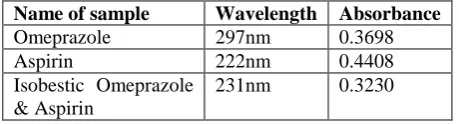
Both the standard solution was scanned between 400nm to 200nm.The overlain spectrum of both drugs was recorded. From the overlain spectrum, 297nm (λmax of omeprazole) and 222 nm (λmax of Aspirin) were selected for estimation of drugs and the isobestic point was found to be at 231 nm and it is shown in fig 3
-UV of Aspirin -UV of Omeprazole
Figure 3: Isobestic point of Omeprazole & Aspirin
Name of sample Wavelength Absorbance
Omeprazole 297nm 0.3698
Aspirin 222nm 0.4408
Isobestic Omeprazole & Aspirin
Selection of chromatographic mode
Proper selection of the method depend upon the nature of the sample (ionic, ionisable and neutral, its molecular weight and solubility. Both the drugs are freely soluble in organic. Hence, reversed phase HPLC was selected for the initial separations because of its simplicity and suitability.
Selection of Mobile phase
Omeprazole and Aspirin are freely soluble in HPLC
grade of methanol. Not freely soluble in
orthophosphoric acid and used uitrasonication. Both drugs are soluble in methanol and orthophosphoric acid.
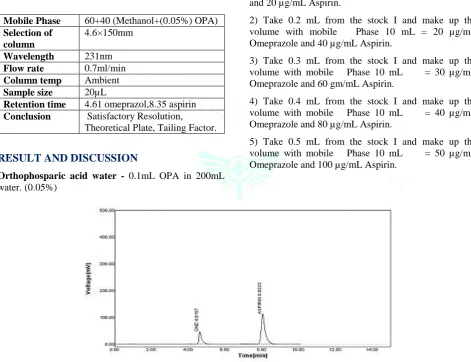
Mobile Phase 60+40 (Methanol+(0.05%) OPA)
Selection of column
4.6×150mm
Wavelength 231nm
Flow rate 0.7ml/min
Column temp Ambient
Sample size 20µL
Retention time 4.61 omeprazol,8.35 aspirin
Conclusion Satisfactory Resolution,
Theoretical Plate, Tailing Factor.
RESULT AND DISCUSSION
Orthophosparic acid water - 0.1mL OPA in 200mL
water. (0.05%)
Preparation of stock solution
Accurately weighed of Omeprazole 10mg and 20mg Aspirin was taken in 10mL volumetric flask and dissolved in 10 mL methanol. To get standard stock solution.1000 µg/mL Omeprazole and 2000 µg/mL Aspirin. STOCK -I
Preparation of mobile phase
Pipette out 60 ml of concentrated methanol and 40 ml of 0.05% OPA make up the volume up to 100ml and Sonicate 5 min.
1) Take 0.1mL from the stock I and make up the volume with mobile Phase 10 mL = 10 µg/mL Omeprazole and 20 µg/mL Aspirin.
2) Take 0.2 mL from the stock I and make up the volume with mobile Phase 10 mL = 20 µg/mL Omeprazole and 40 µg/mL Aspirin.
3) Take 0.3 mL from the stock I and make up the volume with mobile Phase 10 mL = 30 µg/mL Omeprazole and 60 gm/mL Aspirin.
4) Take 0.4 mL from the stock I and make up the volume with mobile Phase 10 mL = 40 µg/mL Omeprazole and 80 µg/mL Aspirin.
5) Take 0.5 mL from the stock I and make up the volume with mobile Phase 10 mL = 50 µg/mL Omeprazole and 100 µg/mL Aspirin.
Figure 4: Chromatogram of Ome & Asp
Table 1: Final chromatographic conditions
Peak Name
Retentio n time
Area Plate
count
T F
Ome 4.6167 507.77 5060.1 1.1297
Asp 8.0333 1753.2 9367.1 1.3266
Tab solution Preparation:
Brand Name: Yosprala
Weigh and finely powder 20 tablets. Accurately weigh and transfer a quantity of powder sample equivalent to 10mg of Omeprazole and 20mg of Aspirin into a 10 ml clean dry volumetric flask, add 10ml methanol and
sonicate to dissolve it completely and make volume up to the mark with the diluents(1000 µg/mL Ome and 2000 µg/mL. From these solutions 0.1ml was pipette out and transferred into 10ml volumetric flask and makeup the volume up to the mark with methanol & Orthophosphoric acid (10 µg/mL Omeprazole and 20 µg/mL Aspirin) and measured the absorbance at 231nm. The % purity of the drug was calculated by comparing the absorbance of test solution with standard.
Tab Assay 7,8
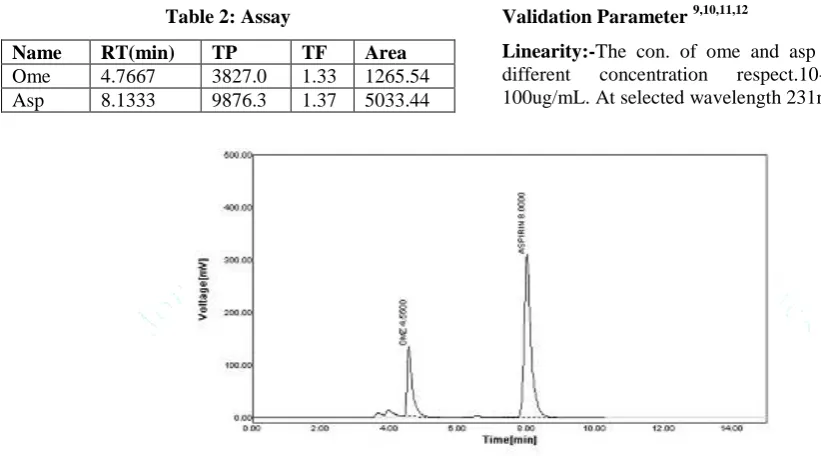
Figure 5: Chromatogram for Assay
Table 2: Assay
Name RT(min) TP TF Area
Ome 4.7667 3827.0 1.33 1265.54
Asp 8.1333 9876.3 1.37 5033.44
Validation Parameter 9,10,11,12
Linearity:-The con. of ome and asp solution take in
different concentration respect.10-50ug/mL,
20-100ug/mL. At selected wavelength 231nm.
Figure 6: Linearity 50 µg/mL Ome & 100 µg/mL
Peak Name
Retention time
Area Plate
count
T F
Ome 4.6000 1230.7 5503.1 1.1472
Asp 8.0167 5042.1 9537.0 1.1699
Accuracy: The accuracy of an analytical method is the closeness of test results obtained by that method to the
true value. The three triplicates of stock solution of Omeprazole and Aspirin equivalent to 10ppm, 20ppm, 30ppm and 20ppm, 40ppm, 60ppm respectively were preparing by using standard solution. From stock solution aliquots of Ome and Aspirin 0.1 ml, 0.2ml, 0.3ml were taken and diluted to 10ml mobile phase with diluted such that the final concentration of Ome-10, 20,
30 µg/mL and Aspirin-20, 40, 60 µg/mL.
Table 3: Accuracy of Omeprazole
Conc. (μg/ml)
Standard Deviation %RSD
Area
Mean SD
%RSD
10 288.91 2.63 0.91
20 525.86 7.71 1.47
30 778.18 3.34 0.43
Table 4: Accuracy of Aspirin
Conc. (μg/ml)
Standard Deviation %RSD
Area
Mean SD
RSD
20 706.42 5.03 0.71
40 1741.04 7.25 0.99
60 2863.04 3.78 0.13
Precision:-The precision intraday and inter day
Precision system result showed good reproducibility. Intraday precision study was carried out by preparing drug solution from stock solution, aliquots of Omeprazole and Aspirin 0.2, 0.3, 0.4 ml were taken an diluted to 10 ml with diluents such that the final concentration of Ome-20, 30, 40 µgm/mL and Asp-40, 60, 80 µg/mL and analyzed. The same procedure was followed for second day also to determine inter-day precision.
Table 5: Intra-day precision
Conc µg/mL
Area Mean
SD %Amt
Found % RSD OME
20 530.32 6.74 100.42 1.27
30 748.75 6.60 97.98 0.88
40 996.01 5.40 99.84 0.54
ASP
40 1765.1 10.9 99.87 0.58
60 2880.9 6.19 100.95 0.22
80 3913.4 1.44 98.58 0.21
Figure 8: Precision-20ug/ml and 40ug/ml Intra-day
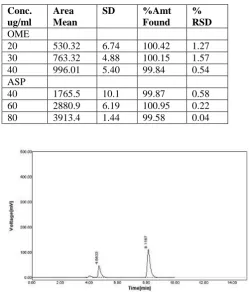
Table 6: Inter day precision
Conc. ug/ml
Area Mean
SD %Amt
Found % RSD OME
20 530.32 6.74 100.42 1.27
30 763.32 4.88 100.15 1.57
40 996.01 5.40 99.84 0.54
ASP
40 1765.5 10.1 99.87 0.58
60 2880.9 6.19 100.95 0.22
80 3913.4 1.44 99.58 0.04
Figure 9: Precision-20ug/mL and 40ug/ml interday
% Recovery 13,14
The recovery of an analytical method is determined by applying the method to analyzed samples to which known amounts of analyte have been added. The Recovery is calculated from the test results as the
percentage of analyte recovered by the assay. Three
replicate injections, each of three different test concentrations in the range of 80%, 100% and 120% of labeled claim of tablet under study yielded the result within 98 to 102% of true concentration of each drug. The results indicated that the method is accurate.
Table 7: Statistical Validation of Recovery Studies Ome and Asp
Level of Recovery
(%)
Drug Mean %
Recovery
Standard Deviation
% RSD
80% Ome 98.20 1.70 1.73
Asp 99.10 0.75 0.64
100% Ome 101.16 1.78 0.44
Asp 100.75 1.51 0.27
120% Ome 101.58 1.07 0.37
Figure 10: Recovery 120 %
Robustness 16 ,17
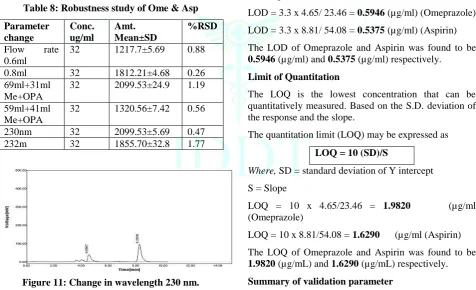
The robustness of an analytical method is a measure of its capacity to remain unaffected by small but deliberate variations in method parameters and provides an indication of its reliability during normal usage. To verify the robustness of the method, the analysis was done under variables flow rate, mobile phase ratio and wavelength.
System suitability parameter
The system was evaluated by analyzing repeatability, retention time, tailing factor and theoretical plats of the column.
Table 8: Robustness study of Ome & Asp
Parameter change
Conc. ug/ml
Amt. Mean±SD
%RSD
Flow rate
0.6ml
32 1217.7±5.69 0.88
0.8ml 32 1812.21±4.68 0.26
69ml+31ml Me+OPA
32 2099.53±24.9 1.19
59ml+41ml Me+OPA
32 1320.56±7.42 0.56
230nm 32 2099.53±5.69 0.47
232m 32 1855.70±32.8 1.77
Figure 11: Change in wavelength 230 nm.
Figure 12: Change in wavelength 232 nm.
Limit of Detection (LOD)
The LOD is the lowest limit that can be detected. Based on the S.D. of the response and the slope. The limit of detection (LOD) may be expressed as:
LOD = 3.3 (SD)/S
Where, SD= Standard deviation of the Y intercept
S = Slope
LOD = 3.3 x 4.65/ 23.46 = 0.5946 (µg/ml) (Omeprazole)
LOD = 3.3 x 8.81/ 54.08 = 0.5375 (µg/ml) (Aspirin)
The LOD of Omeprazole and Aspirin was found to be 0.5946 (µg/ml) and 0.5375 (µg/ml) respectively.
Limit of Quantitation
The LOQ is the lowest concentration that can be quantitatively measured. Based on the S.D. deviation of the response and the slope.
The quantitation limit (LOQ) may be expressed as
LOQ = 10 (SD)/S
Where, SD = standard deviation of Y intercept
S = Slope
LOQ = 10 x 4.65/23.46 = 1.9820 (µg/ml
(Omeprazole)
LOQ = 10 x 8.81/54.08 = 1.6290 (µg/ml (Aspirin)
The LOQ of Omeprazole and Aspirin was found to be 1.9820 (µg/mL) and 1.6290 (µg/mL) respectively.
Summary of validation parameter
Parameter (Unit) Ome Asp Accep. Criteria
Linearity range (µg/ ml) 10-50 20-100 ---
Correlation Coefficient 0.9995 0.9987 0.999
% Recovery 98.20-101.58% 99.10- 99.23% 98%- 102%
Precision %RSD
Intraday 1.27% 0.58 %
% RSD NMT 2
Inter day 1.27% 0.58 %
Robustness Robust Robust Robust
LOD 0.5946 μg /ml 0.5375 μg /ml NMT 2
CONCLUSION
RP-HPLC method has been developed for the simultaneous estimation of Omeprazole and Aspirin. These methods have good resolution both the drugs good and short analysis time. Literature survey revealed that several methods have been reported for determination of Omeprazole and Aspirin individually or in combination with other drugs in pharmaceutical
dosage forms. The developed method was validated. It was found to be simple, precise, accurate and robust. The proposed method can be used for routine analysis of omeprazole and Aspirin in combined dosage form.
ACKNOWLEDGMENT
Authors are thankful to sci-tech pharma, sinner, india. Provide gift sample of Omeprazole and Aspirin.
REFERENCES
1. Kalshetti MS, Kasabe S, Chauhan N, Dhanshri S, Kale B,
International Journal of Research in Pharmacy and Pharmaceutical Sciences, Development and validation of RP-HPLC method for simultaneous estimation of aspirin and omeprazole in dosage, 2017; 2(4):45-51.
2. www.yosprala.com.
3. www.drugbank.com/Aspirin.
4. Indian Pharmacopoeia, Government of India, Ministry of
Health and Family Welfare, Published by the controller of publication, Delhi 1, 1996, 469.
5. Kranthi KK, Supriya D, Divya D, Rani D, Neelima Munni G,
International journal of pharmaceutical Investigations and Research Analytical method development and validation for the estimation of aspirin and omeprazole using RP-HPLC method, ICJPIR, 2017; 4(1).
6. Saravanan V., Revathi R., Meera N. Method development and
validation for the simultaneous estimation of lycopene and ubidecarenone by RP-HPLC in combined pharmaceutical
dosage form. Journal of Drug Delivery and
Therapeutics, 2016; 6(5):46-51.
https://doi.org/10.22270/jddt.v6i5.1295
7. Practical HPLC methods developments ACS short course
attendees’ onl. Available
from:www.bioanalytical.com/NWL/pdfs/acs.pd f. Accessed on 2006 Jan.
8. Notes for guidance on guidance on validation of analytical
procedures: Methodology (CPMP/ICH/281/95).
9. Ravisankar P, Rajyalakshmi G, Devadasu C, Devala Rao G,
Instant tips for right and effective approach to solve HPLC trouble shooting, Journal of chemical and pharmaceutical sciences. 2014; 7(3):259-274.
10. Javali B, Sravanthi B, Rao BM, Gopi K, Vamsi K, Rao AK,
Prasanthi T, Global journal of Pharmacy & pharmaceutical Science, Development and Validation of UV Spectrophotom-
etric Method for Simultaneous Estimation of Omeprazole and Domperidone in Capsule Dosage forms. 2017; 1(2):1-4
11. Gousuddin M, Sengupta P, Tripathi V, Das A, Malaysian
Journal of Analytical Sciences, Malaysian Journal of Analytical Sciences, 2016; 20(2):247-257.
12. Singh D, Yadav H, Hinge M, Patel A, J Pharm Sci
Bioscientific Res. Development and Validation of Analytical Methods for Simultaneous Estimation of Rosuvastatin, Clopidogrel and Aspirin in Pharmaceutical Dosage Form. 2016; 20(2):247-257.
13. Foram J. Chodvadiya, Thula K, Maheshwari D, International
Journal of Recent Scientific Research, Simultaneous Estimation of Aspirin and Lansoprazol by RP–HPLC method, 2016; 6(4):3385-3390.
14. Kayesh P, ARahman, Sultan M, et al. Development and
Validation of a RP-HPLC Method for the Quantification of Omeprazole in Pharmaceutical Dosage Form. J. Sci. Res. 2013; 5(2):335-3425.
15. Bhowmick M., Bhowmick P., Sengodan T., Thangavel S.
Development and validation of bioanalytical RP HPLC method for the estimation of metoprolol tartrate in rabbit plasma after transdermal and oral administration: application in pharmacokinetic studies. Journal of Drug Delivery and
Therapeutics, 2015; 5(4):43-53.
https://doi.org/10.22270/jddt.v5i4.1118
16. Kumar S, Jamadar L, Bhat K, Musmade P. A Ssantharaju,
Udupa N, Analytical method development and validation for Aspirin, J. International Journal of ChemTech Research, 2010; 2(1):389-399.
17. Khristi A, Mardia R, Suhagia B, UV Spectrophotometric