INTRODUCTION
The occurrence of soil-limited factors (expensive chemical soil disinfection methods, low yields and possible plant residues) has increased the interest in soilless culture and the demand for a suitable technology adapted to this type of production, which expanded enormously during the 1980s (De Rijck and Schrevens, 1998). Recent environmental regulations against groundwater pollution and the requirement to minimize water and fertilizer consumption have led to the recycling of nutrient solutions resulting in considerable fertilizer saving (Savvas and Lenz, 2000). Soilless cultivation is intensively used in protected agriculture especially for crops during months when field production is
Biosciences, Biotechnology Research Asia Vol. 5(2), 593-600 (2008)
Feasibility decrease use of fertilizer on greenhouse
cucumber production in soilless culture
O. NOURI ROUDSARI¹, GH. PEYVAST², A. ALIMOSAVI³,
P. RAMEZANI KHARAZI
4and J.A. OLFATI
5¹Department of Ecological Agriculture, Environmental Sciences Research Institute, Shahid Behesthi University, (G.C.), Daneshjoo Blvd., Velenjak, Tehran (Iran). 2,5Department of Horticultural, Faculty of Agriculture, Guilan University, Rasht (Iran).
³Horticultural Sciences, Tarbiat Modares University, Rasht (Iran).
4Guilan University, Faculty of Science, Chemistry Department, Rasht, Tehran (Iran). (Received: August 06, 2008; Accepted: September 18, 2008)
ABSTRACT
In order to evaluate the effect of different substrates on growth, yield and quality of greenhouse cucumber cv. ‘Rubah-R’, two greenhouse experiments were conducted at the Agricultural Faculty of Guilan University in Rasht, Iran (37°16’N), during 2006 and 2007. Four growing media were used in 2006 including peat, perlite, rice-hull and a mixed substrate (perlite and rice-hull 50:50 v/v) and four other substrates such as peat + carbonized rice hull (50:50, v/v), peat + wood chips (50:50, v/v), peat + bark (50:50, v/v), and perlite 100%. Results of 2006 showed that substrates had a significant effect on the plant growth, total fruit yield, marketable fruits, fruit weight and number of fruits per m2.
Furthermore, no significant differences were found between substrates in term of fruit quality parameters such as fruit length, fruit diameter and total soluble solids. Results of 2007 experiment showed that tested substrate (peat + carbonized rice hull (50:50, v/v) (T1), peat + wood chips (50:50, v/v) (T2), peat + bark (50:50, v/v) (T3), and perlite 100%) could affect the most cucumber quality components, but plant elements analysis showed a negative correlation between the different substrates especially between calcium and magnesium. It is also a positive correlation between the roots and cucumber fruits in term of nutrient uptake.The analysis showed also a positive correlation between the calcium amount in root and fruit, but no differences were found between leaves and fruits.
Key words: cucumber, nutrient uptake, bag culture, quality, nitrate.
not possible, to improve control over the growing environment and to avoid uncertainties in the water and nutrient status of the soil. It also overcomes the problem of salinity and has provided a solution for decreasing fer tility of natural soils, the accumulation of pests and diseases and water-use efficiency can be at least doubled compared with soil-grown plants. Soilless cultivation has the capacity for increased yield (improvement in crop production could be more than 10-fold) and replaces major amounts of field production as well as improving efficiency and quality of the products (Verdonck et al., 1983).
rockwool fiber on human health, the disposal problems after use and the susceptibility of crops to root diseases (Hardgrave and Harriman, 1995; Yu and Komada, 1999). These concerns have initiated a search for local materials which are readily available, affordable and suitable for use as growing media (Ortega et al., 1996) with specific physico-chemical proper ties. By-products (humic substances) forms the forestry industry (bark sawdust) are used as growing media (Nakano, 1994). Methods such as composting, aging, washing, mixing or fertilization have also been used to reduce or eliminate toxicity problems associated with organic or inorganic substances and unsuitable C: N ratios (Nichols, 1981; Yates and Rogers, 1981). It is common practice to mix inorganic substances (vermiculite, perlite, pumice, sand) with organic substrates to provide desired characteristics, such as increased porosity and water holding capacity for the later (Hardgrave and Harriman, 1995).
Thanks to the wide-range climatic conditions open field cultivation of vegetables in Iran is possible in many provinces and in all seasons. However in recent years there has been a growing tendency to make use of greenhouses. The total area of greenhouses in 1998 in Iran was 70 ha of glasshouses and 515.5 ha of plastic tunnel houses, rising to 1600 ha in 2001, 2420 ha in 2003 and 5700 ha in 2005. Of these 70% were used for vegetables and 30% for ornamental plants. The main varieties of vegetables grown are cucumbers (70%), and tomatoes (20%), followed by paprika (5%) (Ministry of Agriculture, 2005). The cucumber (Cucumis sativa L.) is one of the major vegetable crops in Iran which occupies more than 70% of the total production area in greenhouses. High yield and high quality by field production need extreme care of soil fertility and soil handling, specially using organic manure and a deep soil preparation. Soilless culture on the other hand needs an accurate control of water and nutrient regimes. Therefore, the soilless culture using different media, i.e. rockwool, peat, perlite, r ice hull etc., has been intensively progressed in the past (Andreas, 1992; Benoit and Ceustermans, 1987; Goehler, 1994; Schroeder, 1992; Vogel, 1994).
Growing on artificial substrates started in the 1960s with organic substrates, mainly peat, and
nowadays a number of other materials such as rockwool, pumice stone, expanded clay and perlite (Schie, 1999). The use of different organic and inorganic substrates allow the plant the best nutrient uptake and sufficient growth and development due the optimize water and oxygen holding (Verdonck et al., 1982). On the other hand different substrates have several materials which could affect directly and indirectly on plant growth and plant development. Therefore, selection of the best substrate among various materials is one of the major tasters for the plant’s productivity.
This study was conducted to investigate the effect of different substrates on growth, nitrate amount and inorganic nutrients uptake as a quality indices of cucumber.
MATERIAL AND METHODS
In order to determine, the effect of different substrates on the yield and quality of cucumber in a bag culture, an investigation with cucumber cultivar ‘Rubah-R‘ was conducted in a glass greenhouse in 2006 and 2007 in the Agricultural Faculty of Guilan University, Rasht, Iran (37° 16’ N). 2006 were used four substrates, peat (T1), perlite (2-3 mm) (T2), rice hull (T3) and a mixture of perlite and rice hull (50:50, v/v) (T4), in a completely randomized experimental design with four replications. Same investigation was carried out 2007 with some different substrate such as peat + carbonized rice hull (50:50, v/v) (T1), peat + wood chips (50:50, v/v) (T2), peat + bark (50:50, v/v) (T3), and perlite 100%.
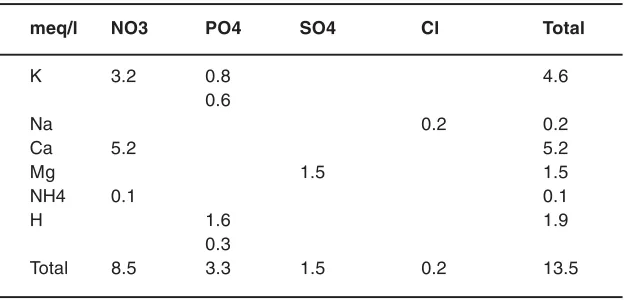
unit were sampled three times (at the start of setting, full harvest, and end of harvest). Fruit numbers and fruit weight were determined. The fresh weight and dry matter, after drying in a thermo-ventilated oven at 70 °C, were measured for the fruit, leaves and stem (including the parts removed during pruning). Nutrient solutions were used to fertigate plants were shown in Table 1 and 2 (Olfati et al., 2008). Nutrient solution was prepared with tap water and was delivered to plants by a drip irrigation system. It was distributed using a drip irrigation system, with pressure compensated by 2 L h-1 drippers, two per plant. The nutrient solution was refilled when the consumption had exceeded 30-50% of the initial volume (250 L). The volume of drainage (run-off) solution varied from 25-30% of the irrigated solution volume. Leachate was collected, but not recirculated. The quantity and uniformity, as well as the pH and the EC of the nutrient solution provided and drained, were measured every three or four days in order to optimize the fertigation process. Temperature inside the greenhouse was controlled using automatic activation of the aerial heating fan with a TCL split type air condition-indoor unit system to maintain temperature between 27 and 18oC (day and night). No pesticide and insecticide were used during this trial.
A completely randomized experimental design was used with four replications and eight plants per exper imental unit. Following characteristics were recorded: total yield, fruits number and weight, length and width of plant and fruits, soluble solid content, nitrate, total nitrogen, phosphorous, potash, calcium and magnesium in
fruits, leaves and roots . The resultant data were subjected to analysis of variance using SAS statistical program. Means were separated by Duncan‘s Multple Range Test.
RESULTS AND DISCUSSION First experiment (2006)
The results showed that different substrates affected significantly (P<1%) the total and marketable yield, number of fruits, and plant height in the first trial (Table 3). Peat substrate brought the best results throughout the harvest period. The optimized vegetative growth of the plant in peat could have enhanced the plant length with several side shoots which resulted early harvest and more fruits (Table 3). This is probably due to the high cation exchange capacity (CEC) in peat substrate as a result of the favorable water and nutrient uptakes and of the superior growth and development of cucumber plants. Same results with peat substrate have been reported by (Gul, 1996), (Lee et al., 1999a) and (Verdonck 1991) comparing different growing substrates.
The results showed that different substrates influenced significantly the total and marketable yield, and number of fruits, but did not affect non-marketable fruits (Table 4). Peat substrate brought the highest fruit fresh weight with 9.78 kg. m-2 followed by perlite and perlite+rice hull with an amount of 8.57 and 8.13 kg. m-2, respectively. Rice hull substrate had the lowest amount of cucumber fruits with 5.95 kg. m-2. Results showed that substrates have a significant effect on cucumber
Table 1: Macronutrient used for nutrient solution preparation
meq/l NO3 PO4 SO4 Cl Total
K 3.2 0.8 4.6
0.6
Na 0.2 0.2
Ca 5.2 5.2
Mg 1.5 1.5
NH4 0.1 0.1
H 1.6 1.9
0.3
Total 8.5 3.3 1.5 0.2 13.5
marketable yield (P<1%), the peat substrate had with 9.0 kg. m-2 more marketable fruits than other treatments. Perlite and perlite+rice hull had next highest yield with an amount of 7.88 and 7.52 kg. m-2 respectively. Rice hull substrate showed the lowest marketable yield with 5.43 kg. m-2. Suitable water uptake through the plant from peat and perlite substrates had increased the marketable and the total yield. Climatic conditions in the autumn period are characterized by lower temperatures, fewer hours of sunlight and lower levels of solar radiation with respect to the typical yearly cycle
(spring-Table 2: Macronutrient used for nutrient solution preparation
Element mg/l irrigation sollution (NH4)6Mo7O24/4H2O 0.1
H3BO3 1.5
MnSO4/4H2O 2
CuSO4/5H2O 0.25
ZnSO4/7H2O 1
Sequesteren Fe 136 10
Table 3: Effect of substrate on growth of cucumber (Cucumis sativus L. ‘Rubah-R‘) Substrates Plant height(m) Plant fresh weight (kg) Stem diameter(cm)
Peat 3.78 a 0.53a 0.98a
Perlite 3.63a 0.45b 1.01a
Rice-hull 3.30b 0.40c 0.96a
Mixture (R-h+P*) 3.59a 0.43bc 0.97a
*R-h+P: Rice-hull with Perlite (50:50, v/v).
Table 4: Effect of substrate on yield and yield component of cucumber (Cucumis sativus L.)
Substrates Total Marketable Non- marketable Yield/Plant Number Fruit yield yield yield (kg.m-2) (kg. m-2) of fruits weight
(kg.m-2) (kg.m-2) per m-2 (g.m-2)
Peat 9.78 a 9.00 a 0.77 a 3.26 a 102.4 a 95.33 a
Perlite 8.57 b 7.88 b 0.69 a 2.86 b 91.89 b 93.26 a
Rice-hull 5.95 c 5.43 c 0.52 a 2.25 c 69.06 c 84.68 b
Mixture (R-h+P*) 8.13 b 7.52 b 0.61 a 2.71 b 88.92 b 91.25 a
*R-h+P: Rice-hull with Perlite (50:50, v/v)
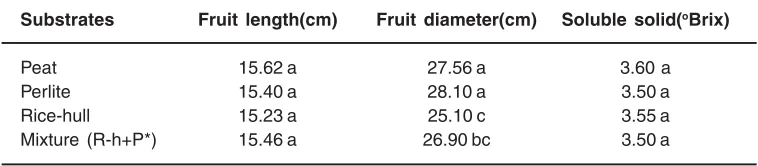
Table 5: Effect of substrate culture on fruit length, diameter and soluble solid content of cucumber (Cucumis sativus L. ‘Rubah-R‘)
Substrates Fruit length(cm) Fruit diameter(cm) Soluble solid(oBrix)
Peat 15.62a 27.56a 3.60 a
Perlite 15.40a 28.10a 3.50a
Rice-hull 15.23a 25.10c 3.55a
Mixture (R-h+P*) 15.46a 26.90bc 3.50a
summer period). A similar result was found by (Bohme, 1995) and (Thippayarugs et al., 2001) in cucumber and lettuce.
Different substrates have not affected significantly the non-marketable yield in cucumber. (Shaw et al. 2004) maintained that soilless media can not affect the non-marketable yield in cucumber. A similar investigation by (Bohme 1995) results that by water decreasing unlike by substrates with insufficient CEC like rice hull can not increase the
non-mar ketable yield, contrar y to total and marketable yield. These results agreed with our investigation. A significant effect on the fruit number and fruit weight was found also by different substrates so that the peat substrate with 102.4 fruits per m-2 and 95.3 g. per plant could be placed on the highest level in comparison to other substrates. No significant effect was found as affected by soluble solid in cucumber due the different substrates (Table 5).
Table 6: Physical and chemical characteristics of different substrates
Substrates WHC* (cm3/g DW) CEC**(mµ/ 100 g. DM) EC(ms/cm2) PH OM***(%)
Peat 445.9 a 105.6 a 0.70 a 5.6 c 90.5 a
Perlite 289.6 b 2.85 d 0.09 b 6.8 a 2.0 d
Rice hull 160.2 d 19.37 b 0.05 b 6.4 b 80.0 b
Rice hull+Perlite 238.4 c 8.79 c 0.06 b 6.6 b 43.5 c
* Water holding capacity, ** Cation Exchange Capacity, *** Organic Matter
Table 7: Effect of substrate on yield and yield component of cucumber (Cucumis sativus L.) Substrates Yield(g/pl) Plant height.(m) Fruit No. Fruit dry Leaf dry Root dry
mater(%) mater(%) mater(%)
C.R.H1.+ P2 2344a 1.54a 30.6a 8.08a 9.14a 7.85b
W.Ch3.+ P 2341a 1.52a 30.6a 6.71a 9.97a 8.03b
Bark+ P 2829a 1.59a 31.5a 6.57a 10.97a 10.97a
Perlite 2203a 1.43a 27.7a 7.43a 9.25a 11.49a
1= Carbonized Rice hull, 2= Peat, 3= Wood chips. C.R.H. with Peat (50:50, v/v), W.Ch. with Peat (50:50, v/v).
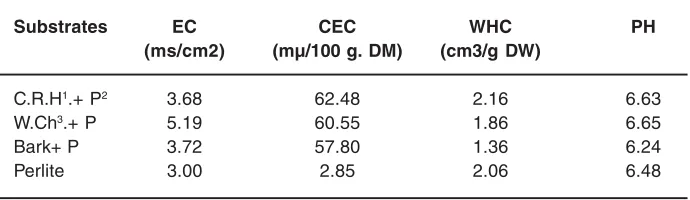
Table 8: Physical and chemical characteristics of different substrates
Substrates EC CEC WHC PH
(ms/cm2) (mµ/100 g. DM) (cm3/g DW)
C.R.H1.+ P2 3.68 62.48 2.16 6.63
W.Ch3.+ P 5.19 60.55 1.86 6.65
Bark+ P 3.72 57.80 1.36 6.24
Perlite 3.00 2.85 2.06 6.48
1= Carbonized Rice hull, 2= Peat, 3= Wood chips.
Obviously the CEC and water holding capacity are the most important characteristics of peat substrate (Table 6), so the best growth rate and yield can be obtained from this substrate whereas the low CEC and WHC characteristics of rice hull substrate lead to lowest growth rate and yield amount. Mixing of rice hull and perlite will optimize the physical characteristic of substrate and will increase the growth rate. While importing of peate substrate is costly and a reachable source of rice hull is available in Iran simply, a mixture of these two substrates is suggest and is suitable for hydroponics culture.
Second experiment (2007)
The results showed that in the second experiment different substrates could not affect the growth and yield components such as plant height, fruit numbers, fruit dry matter, and leaves dry matter (except root dry matter) (Table 7).
Highest plants, fruit numbers and leaves dry matter were observed in treatment bark and
peat with an amount of 1.54 m, 31.5 fruits per plant, and 10.97 g/100 g leaf dry matter respectively. The highest yield also belongs to this treatment with an amount of 2829 g/plant. Perlite showed the lowest plant height, and fruit number. No statistical differences were found by bark + peat and perlite treatments.
In term of fruit quality gave the second experiment interesting results, so that with an exception of total soluble solid (TSS) and phosphorus in the fruits all components such as nitrate, total nitrogen, potash, calcium and magnesium could affect by different substrates (Table 9-12). Highest and lowest TSS belong to the treatments C.R.H.+ P and W.Ch.+ P with an amount of 3.9 and 2.7 (oBrix) respectively (Table 9). 50% Bark and 50% peat treatment showed the lowest nitrate content in the plant with an amount of 16.13, 16.3 and 3.73 mg/100g in fruit, leaves and root respectively. A significant difference occurred by other three treatments.
Table 9: Effect of substrates on TSS and nitrate content of cucumber (Cucumis sativus L. ‘Rubah-R‘)
Substrates TSS(oBrix) Fruit Nitrat Leaf Nitrat() Root Nitrat
(mg/100g) (mg/100g)
C.R.H1.+ P2 3.9a 36.4a 45.07b 25.73a
W.Ch3.+ P 2.7a 22.53ab 32.53c 3.20b
Bark+ P 3.6a 16.13b 16.13c 3.73b
Perlite 3.7a 22.27ab 63.73a 24.40a
1= Carbonized Rice hull, 2= Peat, 3= Wood chips.
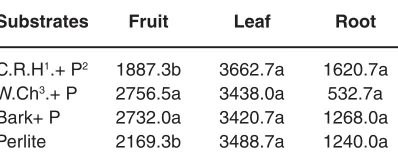
Table 10: Effect of substrate on nitrogen content of cucumber (Cucumis sativus L.
‘Rubah-R‘). (mg/100g DM)
Substrates Fruit Leaf Root
C.R.H1.+ P2 1887.3b 3662.7a 1620.7a W.Ch3.+ P 2756.5a 3438.0a 532.7a Bark+ P 2732.0a 3420.7a 1268.0a Perlite 2169.3b 3488.7a 1240.0a
1= Carbonized Rice hull, 2= Peat, 3= Wood chips.
Table 11: Effect of substrate on potash content of cucumber (Cucumis sativus L. ‘Rubah-R‘).
(mg/100g DM)
Substrates Fruit Leaf Root
C.R.H1.+ P2 3620.0b 2026.7a 1100.0a W.Ch3.+ P 3313.3a 2093.3a 880.0b Bark+ P 3920.0ab 1740.0a 800.0b Perlite 4693.3a 1726.7a 1060.0a
Although the total nitrogen was in cucumber’s leaf and root without any significant differences, but the two treatments (50% Bark and 50% peat and 50% wood chips and 50% peat) gave approximately the same amount of nitrogen in the fruit which was statistically difference at 1% level (Table 10).
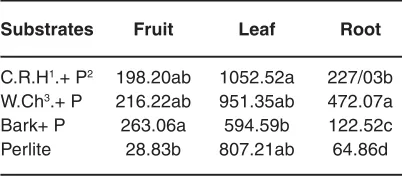
Different substrates had affected significantly the potash and calcium contends by cucumber’s fruit and root (Table 11 and 12), whereas no differences was found by phosphorus in all parts of plant (Table 13). A significant effect was showed in magnesium content by all substrates (Table 14). Correlation coefficients showed a significantly correlation between the nitrate amount in fruits, leaves and roots of cucumber, Whit other words a nitrification can take place in the whole plant even by fruits. The positive correlation between the leaves and fruits can citied this theory. In fact, nitrate amount which is not been reduced, can remove to the fruits so that an overdose of nitrogen fertilizer can distribute the cucumber quality.
Plant cation analysis showed a negative correlation between the different substrates especially between calcium and magnesium, which depend to cations competition. It is positive correlation between the roots and fruits in term of nutrient uptake so that nitrate can remove to the fruits. The analysis showed also a positive correlation between the calcium amount in root and fruit, but no differences were found between leaves and fruits. A positive correlation occurred also between nitrate and potash amount because by the protein synthesis potash can play as a reductive element. Because of most fruit set in the stem nodes, a significantly correlation was found between plant height and fruit numbers.
CONCLUSION
This two years experiment indicated that many unused agricultural waste material such as rice hull, pine bark, wood chips and so on can be reused in many soilless culture as a potential media for substitution by expensive peat and synthetic material which are imported in Iran for greenhouse vegetable production.
ACKNOWLEDGEMENTS
This study is supported by the funding from the Shahid Beheshti University (C.G.) of Iran. Authors are thankful Shahid Beheshti University for financial support of this research project.
Table 12: Effect of substrate on calcium content of cucumber (Cucumis sativus L.
‘Rubah-R‘). (mg/100g DM)
Substrates Fruit Leaf Root
C.R.H1.+ P2 378.7b 220.0a 24d W.Ch3.+ P 448.7b 222.0a 36c
Bark+ P 708.0a 220.7a 230a
Perlite 635.7b 220.0a 216b
1= Carbonized Rice hull, 2= Peat, 3= Wood chips
Table 13: Effect of substrate on phosphorus content of cucumber (Cucumis sativus L.
‘Rubah-R‘). (mg/100g DM)
Substrates Fruit Leaf Root
C.R.H1.+ P2 292.96a 284.41a 292.96a W.Ch3.+ P 208.13a 308.46a 208.13a Bark+ P 248.76a 320.90a 248.76a Perlite 235.49a 281.92a 235.49a
1= Carbonized Rice hull, 2= Peat, 3= Wood chips.
Table 14: Effect of substrate on magnesium content of cucumber (Cucumis sativus L.
‘Rubah-R‘). (mg/100g DM)
Substrates Fruit Leaf Root
C.R.H1.+ P2 198.20ab 1052.52a 227/03b W.Ch3.+ P 216.22ab 951.35ab 472.07a Bark+ P 263.06a 594.59b 122.52c Perlite 28.83b 807.21ab 64.86d
1= Carbonized Rice hull, 2= Peat, 3= Wood chips
1. Andreas, C., Ganzjährig tomaten erdelos auf steinwolle. Gartenbaumagazin 1(9): 48-50 (1992).
2. Benoit, F. and N. Ceustermans., Some qualitative aspects of tomatoes grown on NFT. Soilless Culture 3(2): 3-7 (1987. 3. Bohme, M., Evaluation of organic, synthetic,
and mineral substrates for hydroponically grown cucumber. Acta Hort. 401: 209-218 (1995).
4. De Rijck, G. and E. Schrevens., Distribution of nutrient and water in rockwool slabs. Sci. Hort. 72: 277-285 (1998).
5. Goehler, F., Moderne grosse NFT-Anlage. Deutscher Gartenbau 48(2): 90-93 (1994). 6. Gul, A., Investigation on the effect of media
and bag volum on cucumbers. Proc. of Coll. on Protected Cultivation, 6-9 Oct. Agadir, Morocco (1996).
7. Hardgrave, M. and M. Harr iman., Development of organic substrates for hydroponics cucumber production. Acta Hort. 401: 219-224 (1995).
8. Lee, B., J. Cho, S., Park, J. Ahnand and S. Chung., Effects of substrates on the growth and fruit quality of hydroponically grown tomatoes (Lycoperisicon esculentum Mill. cv. Kantinka). Acta Hort. 483: 147-154 (1999a). 9. Ministry of Agriculture. Office of Agric.
Statistics, Tehran, Iran (2005).
10. Nichols, D.A., The effect of Pinus radiate bark toxicity on the early growth of plants in containers. Sci. Hort. 15: 291-298 (1981. 11. Nakano, K., Coir: A new growth medium
substitute for rockwool. Prot. Horticult. 6: 22-26 (1994).
12. Olfati, J.A., M. Babalar. A.K. Kashi., Effect of different concentration of Ammonium and molybdenum in nutrient solution on yield and quality of cucumber. Pajouhesg and Sazandegi. In press (2008).
13. Ortega, M.C., M.T. Monero., J. Ordovas, and M.T. Aguado., Behaviour of different horticultural species in phytotoxicity bioassay of bark substrate. Sci. Hort. 66: 125-132 (1996). 14. Peyvast, Gh.and M. Charavi., Effect of four
kinds of pruning on greenhouse cucumber. Journal of Agricultural Sciences, 4: 111-119 (2005).
15. Savvas, D. and F. Lenz., Effects of NaCl or nutrient-induced salinity on growth, yield and composition of eggplants grown in rockwool. Sci. Hort. 84: 37-47 (2000).
16. Shaw, N.L., D.J. Cantliffe, J. Funes and C. Shine., Successful cucumber production in the greenhouse using pine bark as an alternative soilless media. Hort Tech. 14(2): 289-294 (2004).
17. Schie, W.V., Standardization of substrates. Acta Hort. 481: 71-78 (1999).
18. Schroeder, F.G., Beiträge zur Entwicklung und Pflanzenbaulichen Bewer tung des erdelosen Kulturverfahrens. Plant Plane Hydroponic. Disser tation Humbold Universität Berlin (1992).
19. Thippayarugs, S., K. Suzuki, Y. Katsuta and A. Yoshida., Vegetable production using energy saving hydroponic systems in Khon Kaen. JIRCAS working Repor t. No. 30 (2001).
20. Verdonck, O., D. De Vleeschauwer and M. De Boodt. The influence of the substrates to plant growth. Acta Hort. 126: 251-258 (1982. 21. Verdonck, O., R. Penninck, and M. De Boodt., The physical properties of horticultural substrates. Acta Hort. 150: 155-160 (1983). 22. Verdonck, O., Horticultural substrates. 21st Int. Course on Vegetable Production, IAC, Wageningen, The Netherlands (1991). 23. Vogel, G., Erdelose Freilandtomaten auch
mit Wachstums und Ertragsvorsprung. Gartenbaumagazin 3(4): 43-45 (1994). 24. Yates, N.L. and M.N. Rogers., Effects of time,
temperature and nitrogen source on the composting of hardwood bark for use as plant growing medium. J. Am. Soc. Hor. Sci. 106: 589-593 (1981).
25 Yu, J.Q. and H. Komada., Hinoki (Chamaecyparis obtuse) bark, a substrate with anti-pathogen properties that suppress some root diseases of tomato. Sci. Hort. 81: 13-24 (1999).