Available online on 15.12.2018 at http://jddtonline.info
Journal of Drug Delivery and Therapeutics
Open Access to Pharmaceutical and Medical Research© 2011-18, publisher and licensee JDDT, This is an Open Access article which permits unrestricted non-commercial use, provided the original work is properly cited
Open
Access
Research Article
Formulation development and evaluation of medroxyprogesterone acetate
injectable suspension
Dr. M. Sunitha Reddy*, B. Samatha Department of pharmaceutics, Centre of pharmaceutical sciences, IST, JNTU, Hyderabad, India
ABSTRACT
The aim of the present work is to develop sustained release parenteral drug delivery system of contraceptive drug i., e medroxyprogesterone acetate. The formulation was prepared by sterile combining of API and excipient powders by rapid stirring method. Different excipients used in the formulation are PEG 3350, Poloxamer -188, Polysorbate-80, Benzyl alcohol and Sodium chloride. The prepared parenteral suspension was evaluated for all official parameters like sedimentation volume, measurement of zeta potential, pH, viscosity, osmolality, dissolution, assay, particle size determination, and stability studies. The dissolution profile was found to be more when compared with the innovator formulation. Stability studies were also conducted at 25ºC / 60% RH and 40ºC / 75% RH conditions up to 3M.All the parameters evaluated are within the specified limits.
Keywords: Medroxy progesterone acetate, PEG 3350, Poloxamer-188, injectable suspension.
Article Info: Received 31 Oct 2018; Review Completed 10 Dec 2018; Accepted 13 Dec 2018; Available online 15 Dec 2018
Cite this article as:
Sunitha Reddy M, Samatha B, Formulation development and evaluation of medroxyprogesterone acetate injectable suspension, Journal of Drug Delivery and Therapeutics. 2018; 8(6-s):298-303
DOI:http://dx.doi.org/10.22270/jddt.v8i6-s.2146
*Address for Correspondence:
Dr. M. Sunitha Reddy, M. pharm, Ph.D., Assistant Professor, BOS chairperson, Centre of pharmaceutical sciences, IST, JNTUH, Hyderabad, India
INTRODUCTION The parenteral route is the most preeminent and common
form of drug delivery system. This system generally avoids the drug related problems which were associated with the oral route are acid degradation, hepatic metabolism (first pass effect), enzymatic action in the intestine, unpredictable pharmacokinetic parameters (solubility, absorption, distribution etc..,). Site specific drug delivery can also be achieved by this route1.
To overcome the loopholes various approaches like microemulsions2, liposomes, solid dispersion techniques, cubosomes and complexation with cyclodextrins are adopted. Though there reasonable success has been achieved employing these techniques but still some of the draw backs were there such as poor stability, low drug loading capacity, increased toxicity, complex manufacturing method3.
Depot systems
A depotis an injection, either administered intramuscularly or subcutaneously which usually deposits the drug at the site of injection as a mass, from which it gets absorbed and distributed to the tissue which surrounds it. This system usually releases the active compound in a consistent manner over a long period. The main advantage of long-acting depot injection includes decreased dosing frequency which in turns
increases the patient compliance; more consistent serum concentration can be gained4.
Parenteral suspensions are thermodynamically unstable heterogeneous systems in which the insoluble drug particles are dispersed or suspended in the dispersion medium (such as aqueous or non-aqueous vehicles). Particle size should be less than 5 μm5. Medroxy progesterone structurally resembles progesterone and it is widely used as contraceptive or hormone replacement therapy6. The overall aim of the present work was to formulate the parenteral depot suspension and illustrate the particle size, pH, in- vitro drug release profile and stability parameters with that of innovator product.
MATERIALS AND METHODS
Preformulation studies7
Preformulation is the study that yields necessary information related to physicochemical properties of drug candidate in order to develop safe, effective and stable dosage form. This study includes
Physical characterization of API Solubility of API
Drug-excipient compatibility study
Preparation of aqueous suspension
Aqueous suspension of medroxy progesterone acetate was prepared by rapid stirring method. Accurately weighed quantity of PEG-3350, poloxamer 188, Polysorbate 80, benzyl alcohol and sodium chloride was dissolved in Milli-Q water by continuous stirring. The API was added during stirring condition, at least for 45 minutes8. The formulation design for medroxy progesterone acetate suspension is represented (Table No. 1).
Table 1: Formulation design of Medroxy progesterone acetate injectable suspension S.No Name of the ingredients
(mg/mL) F1 F2 F3 F4 F5 F6 F7 F8 F9
1. Medroxy progesterone
Acetate 150 150 150 150 150 150 150 150 150
2. Polyethylene glycol 3350 27.1 26.9 28.5 - - - 28.1 27.7 26.9
3. Poloxomer 188 - - - 1.0 1.50 2.0 0.80 1.20 2.0
4. Polysorbate 80 2.41 2.41 2.41 2.41 2.41 2.41 2.41 2.41 2.41
5. Sodium chloride 8.68 8.68 8.68 8.68 8.68 8.68 8.68 8.68 8.68
6. Benzyl alcohol 4.45 7.10 8.88 5.6 6.90 9.16 7.5 6.80 8.88
7. Sodium hydroxide (0.1N) q.s q.s q.s q.s q.s q.s q.s q.s q.s
8. Hydrochloric acid (0.1N) q.s q.s q.s q.s q.s q.s q.s q.s q.s
9. Water for injection q.s q.s q.s q.s q.s q.s q.s q.s q.s
In-vitro Dissolution studies
In-vitro dissolution test was carried out by using USP type-IV apparatus (Flow through cell)9. 900 mL of pH 7.4 phosphate buffer and 0.50 % SLS was used as dissolution medium. Basket was rotated at 50 rpm and temperature was maintained at 37 ± 0.5ºC. Sampling was done at regular intervals and they are analysed by HPLC.
Physical characterization of suspension
Particle size and zeta potential
pH
Osmolality Viscosity
RESULTS AND DISCUSSION
Table 2: Physical characterization of API
X-Ray diffraction study
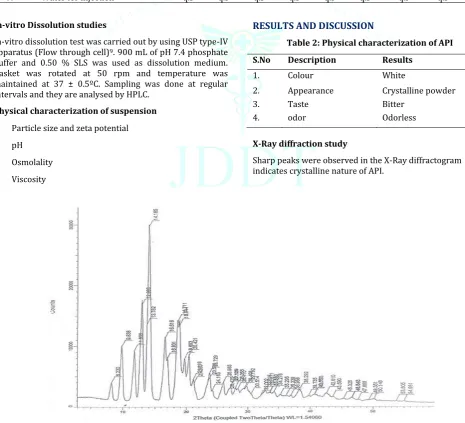
Sharp peaks were observed in the X-Ray diffractogram indicates crystalline nature of API.
Figure 1: XRD of Medroxy progesterone acetate
S.No Description Results
1. Colour White
2. Appearance Crystalline powder
3. Taste Bitter
Table 3: Solubility of API in different media
Solvent system Solubility (mg/mL)
Purified water 0.0033
0.1 N Hcl 0.0003
pH 4.5 acetate buffer 0.0004
pH 6.8 phosphate buffer 0.0002
pH 7.4 phosphate buffer 0.0014
Water + 0.5 % SLS 0.355
0.1 N Hcl + 0.5 % SLS 0.352
pH 4.5 acetate buffer + 0.5 % SLS 0.383 pH 6.8 phosphate buffer + 0.5 % SLS 0.329 pH 7.4 phosphate buffer + 0.5 % SLS 0.449
Drug-Excipient compatibility studies by FTIR
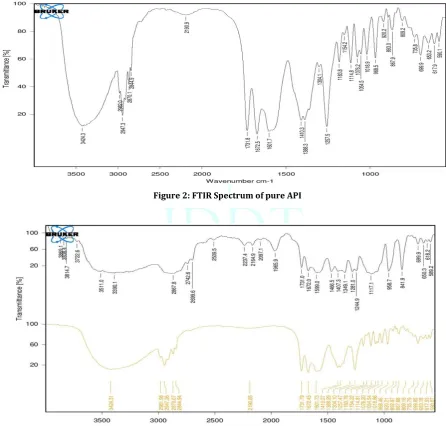
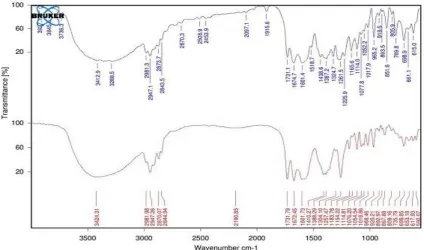
FTIR method was adopted to study the compatibility with drug and excipients. Medroxy progesterone acetate shows characteristics absorption bands at 3424.31cm-1 for O-H,
2947.26cm-1 for C-H stretching, 1731.79cm-1 for C=O stretching and 1410.27cm-1C=C bending. There were no extra peaks observed in the spectrum when API in combination with excipient. A figure 1, 2 & 3 represents the compatibility between drug and the excipients mixture.
Figure 2: FTIR Spectrum of pure API
Figure 4: FTIR Spectrum of medroxy progesterone acetate with Poloxamer-188
Assay
The assay percentage of innovator and optimized formulation was 100.2±0.5 and 99.8±0.69 respectively. Assay was within the limit and matches with the innovator.
Dissolution studies
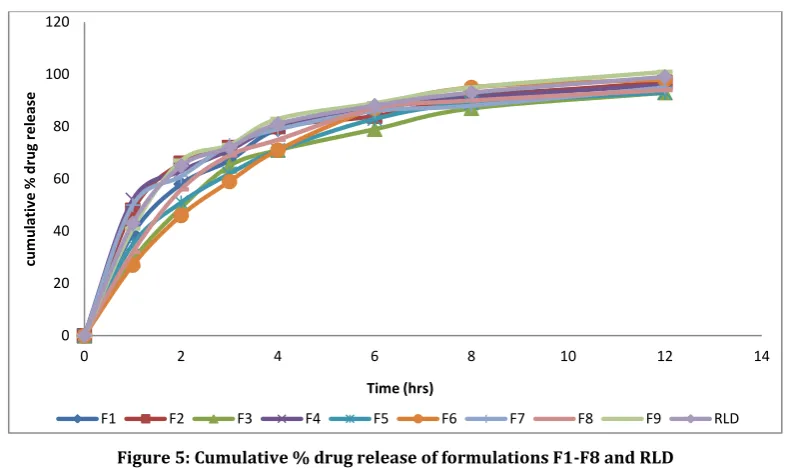
The drug release profiles are obtained for the innovator and different formulations F1, F2, F3, F4, F5, F6, F7, F8, and F9. Cumulative % drug release of Optimized formulation F9 0, 41±0.79, 67±1.52, 73±0.99, 83±0.75, 89±1.13, 95±0.98, 101±0.69 respectively. The innovator shows the drug release 0, 43±0.91, 65±0.97, 72±0.45, 81±0.79, 88±0.98, 93±1, 99±1.36 respectively. Among all formulations, F9 trial shows
the increased drug release pattern than innovator.
Table 4: Drug content
Test Assay (96%-103% USP)
RLD 100.2±0.51
F1 98.5±1.02
F2 100.9±0.98
F3 98.7±0.59
F4 101.5±0.12
F5 97.9±0.85
F6 95.9±1.05
F7 97.8±0.39
F8 98.1±0.78
F9 99.8±0.69
Mean±standard deviation (n=3)
Table 5: Cumulative Percentage drug release of profiles
Trials Time (hrs)
0 1 2 3 4 6 8 12
F1 0 39±0.5 58±0.63 67±0.20 79±1.29 87±0.91 92±1.23 96±1.49
F2 0 48±0.21 66±0.82 72±0.85 80±2.15 84±0.67 91±0.87 97±1.54
F3 0 29±0.82 49±0.71 65±1.09 71±1.1 79±0.98 87±1.25 93±1.49
F4 0 52±1.14 63±1.49 71±2.1 80±0.79 87±1 91±1.53 96±1.65
F5 0 35±0.75 51±1.13 62±0.98 71±0.83 83±0.8 89±0.86 93±0.79
F6 0 27±1.05 46±0.99 59±1.45 71±0.29 87±1.23 95±2.7 98±1.13
F7 0 50±0.91 61±0.84 73±1.25 79±0.87 86±1.4 88±1.11 95±2.1
F8 0 32±0.85 56±1 69±1.05 75±1.15 87±1.21 90±1.98 94±0.94
F9 0 41±0.79 67±1.52 73±0.99 83±0.75 89±1.13 95±0.98 101±0.69
RLD 0 43±0.91 65±0.97 72±0.45 81±0.79 88±0.98 93±1 99±1.36
Figure 5: Cumulative % drug release of formulations F1-F8 and RLD Table 6: Physical characterization
Trials Size (nm) Zeta potential
(mV) (3.0 -7.0) pH (mOsmol/kg) Osmolality (350-410)
Viscosity (cps) (6.0-9.0)
F1 1243±11.47 -33.7±0.49 5.67 375 6.15
F2 1190±32.7 -21.9±3.14 6.12 367 6.19
F3 1210±21.18 -28.5±2.89 6.67 364 6.23
F4 1240±19.8 -19.8±4.1 6.49 376 6.12
F5 1160±45.1 -31.8±0.56 5.97 361 6.51
F6 1290±12.5 -29.7±2.47 6.21 374 6.37
F7 1310±5.14 -34.2±0.31 6.60 361 6.64
F8 1180±19.2 -25.9±2.73 6.01 359 6.29
F9 1105±17.94 -38.1±0.21 6.80 381 6.95
RLD 1132±7.8 -35.4±0.64 6.78 379 6.92
Mean±standard deviation(n=3)
Table 7: Sedimentation study analysis Time
(hrs) F=Vs/Vi F9 F=Vs/Vi RLD
1 1.00 1.00
2 1.00 1.00
4 0.99 0.98
8 0.99 0.95
24 0.97 0.91
48 0.94 0.89
72 0.90 0.89
96 0.90 0.89
120 0.90 0.89
Note: Vs - Volume of sediment in mL, Vi – Initial volume & F – Sedimentation volume
Table 8: 3M stability data of optimized formulation F9
Formulation F9 F9 RLD RLD
Stability
conditions 25ºC / 60% RH 40ºC / 75% RH 25ºC / 60% RH 40ºC / 75% RH
Drug content 100.1±0.6 98.8±1.23 99.8±0.69 98.4±1.07
pH 6.79 6.76 6.77 6.74
Osmolality 381 379 378 376
Viscosity 6.94 6.89 6.91 6.88
Dissolution 101.17±0.58 100.8±0.6 98.87±1.63 98.28±1.94
Particle size (nm) 1112±10.58 1125±7.2 1145±5.89 1175±4.17
Report:
There were no marked changes observed in the 3M stability of optimized formulation F9 and innovator at 25ºC / 60% RH
and 40ºC / 75% RH conditions. It indicates that optimized formulation F9 shows good stability like that of innovator. 0
20 40 60 80 100 120
0 2 4 6 8 10 12 14
cum
ul
at
iv
e
%
dr
ug
r
e
le
ase
Time (hrs)
CONCLUSION The goal of the investigation was to develop a sustained
release parenteral drug delivery system of contraceptive drug i., e medroxy progesterone acetate which was administered intramuscularly. Drug excipient compatibility was performed and the spectrums show compatibility. The formulation was optimized and evaluated for the parameters of parenteral preparations. The dissolution profile of optimized was more when compared with the innovator formulation.3M stability data at 25ºC / 60% RH and 40ºC / 75% RH conditions generated and it shows good stability. Hence, this product was developed to get increased compliance with decreasing the dosing frequency. A stable pharmaceutically equivalent product was developed.
ACKNOWLEDGEMENT
I am very thankful for the guidance of Dr. M. Sunitha Reddy, Asst. Prof., CPS, IST, JNTU-Hyderabad, Muhammad Fazal UI Haq and K. Anie Vijetha.
REFERENCES
1. Patel RM, Parenteral suspension: an overview, International Journal of current Pharmaceutical Research, 2010; 2(3):5-13 2. Aungst B. J, Intestinal permeation enhancers, Journal of
Pharmaceutical Sciences, 2000; 89(4):428-442.
3. Lawrence M. J, Microemulsion-based media as novel drug delivery systems, Advanced Drug Delivery Reviews, 2000; 45(1): 89-121.
4. Patel CA, Keraliya R, A review: Parenteral depot drug delivery system, Journal of Drug Delivery Research, 2014; 3(1):1-10. 5. Parrott E L, Pharmaceutical technology: fundamental
pharmaceutics, Burgness Publishing Company; 1970.
6. Cundy T, Farqubar CM, Cornish J, Reid IR, Short-term effects of high dose oral medroxy progesterone acetate on bone density in premenopausal women, Journal of Clinical Endocrinology and Metabolism, 1995; 81(3):1014-1017.
7. Chaurasia G, A review on pharmaceutical preformulation studies in formulation and development of new drug molecules, International Journal of Pharmaceutical Sciences and Research, 2016; 7(6):2313-2320.
8. Alam. A, Alka Ahuja, Sanjula Baboota, S. K. Gidwani, J. Ali, Formulation and evaluation of pharmaceutically equivalent parenteral depot suspension of methyl prednisolone acetate, Indian Journal of Pharmaceutical Sciences, 2009; 71(1):30-34. 9. William P. Forrest, Kevin G. Reuter, Vivek Shah, Irina
Kazakevich, Michael Heslinga, Siddhi Dudhat, Sanjaykumar Patel, Claudia Neri, Yun Mao, USP Apparatus 4: A Valuable In Vitro Tool to Enable Formulation Development of Long-Acting Parenteral (LAP) Nanosuspension Formulations of Poorly Water-Soluble Compounds, AAPS PharmSciTech, 2017; 19(1):413-424.