Geschke Center
Doctoral Dissertations Theses, Dissertations, Capstones and Projects
5-2018
Improvisation and Leadership Development:
Understanding Improvisational Theater Arts as
Leadership Skills
Jack Skalican
University of San Francisco, [email protected]
Follow this and additional works at:https://repository.usfca.edu/diss
Part of theBusiness Administration, Management, and Operations Commons
This Dissertation is brought to you for free and open access by the Theses, Dissertations, Capstones and Projects at USF Scholarship: a digital repository @ Gleeson Library | Geschke Center. It has been accepted for inclusion in Doctoral Dissertations by an authorized administrator of USF
Recommended Citation
Skalican, Jack, "Improvisation and Leadership Development: Understanding Improvisational Theater Arts as Leadership Skills" (2018).Doctoral Dissertations. 435.
The University of San Francisco
IMPROVISATION AND LEADERSHIP DEVELOPMENT:
UNDERSTANDING IMPROVISATIONAL THEATER ARTS AS LEADERSHIP SKILLS
A Dissertation Presented to
The Faculty of the School of Education Department of Leadership Studies Organization and Leadership Program
In Partial Fulfillment
of the Requirements for the Degree Doctor of Education
by
Jack Skalican San Francisco
ABSTRACT
Leadership development is immersed in a philosophical struggle. Past efforts at
developing leaders have missed a set of skills important to the role of today’s leaders.
Since Frederick Taylor invented the practice of scientific management, the study of
management and leadership has largely focused on traits, practices, and behaviors that
conform to this model such as planning, analysis, control, and monitoring. Missing in this
focus, however, are less transactional leadership skills like intuition, improvisation, and
creativity. As a result, organizations have begun drawing on improvisational theater skills
as one answer to fill this leadership development gap.
This case study focuses on a single cohort group attending an introductory level
of training at an improvisational theater. Based on observations and interviews, the
relevance of the content is analyzed and compared to selected leadership theories and the
pedagogy is evaluated for underlying philosophies and critical curriculum design
components. By observing the student experience with this learning, the applicability of
improv theater arts to personal and professional lives outside of the theater context is also
explored.
Further research should focus on the efficacy of improvisational theater skills in a
professional setting and on additional comparisons between the skills taught in an improv
This dissertation, written under the direction of the candidate’s dissertation committee
and approved by the members of the committee, has been presented to and accepted by
the Faculty of the School of Education in partial fulfillment of the requirements for the
degree of Doctor of Education. The content and research methodologies presented in this
work represent the work of the candidate alone.
Jack Skalican May 8, 2018 Candidate
Dissertation Committee
Genevieve Negron-Gonzales, Ph.D. May 8, 2018 Chairperson
Jane E.Bleasdale, Ph.D. May 8, 2018
DEDICATION
This dissertation and the work behind it is dedicated to my brother, Mark C.
Skalican, who died just before its completion. He was already proud of my
accomplishment, and my hope is that some of the content may help someone or inspire
them to help someone else. He lived his life in that spirit, and I offer this work to the
ACKNOWLEDGEMENTS
While my name appears on the cover of this work, there are so many people who
contributed. First, I want to thank the owners of the theater who allowed me to conduct
the research. Their faith and trust in me, and their deep commitment to their theater
community, nurtured the learning for this research. I am deeply grateful for their support.
The University of San Francisco community obviously shouldered a large part of
this effort. Words cannot express the gratitude and love I hold for my fellow students and
the professors. Specifically, Dr. Patricia Mitchell and Dr. Doreen Jones were inspirational
guides and mentors in my growth as a scholar. My fellow student, Drew Roberts, was a
partner throughout the journey and a reminder that a gentle approach to life serves as its
own model of leadership. Dr. Danfeng Koon opened my eyes to the demands of social
justice and reminded me how much I love to read.
I also extend deep thanks to my dissertation committee, Dr. Jane Bleasdale and
Dr. Desiree Zerquera for their insights and positive support. My committee chairperson,
Dr. Genevieve Negron-Gonzalez, who also served as my academic advisor throughout
my educational journey, did far more than guide me through the dissertation process. As
an advisor, she reassured me that all would be well at exactly the times that I needed it.
As a teacher, she re-opened my love for writing and I cannot thank her enough for her
enthusiasm, intelligence, and passion to change the world.
Very special thanks are in order to my partner and spouse, Svetlana. She
sacrificed time with me and endured my lack of focus for the long duration of this
journey. Even more precious to me, she inspired me to enroll in the program in the first
For everyone else who contributed to my life and tolerated my shortcomings
along this educational journey, thank you. I will carry your investment in me in my heart
TABLE OF CONTENTS
ABSTRACT ... ii
SIGNATURE PAGE ... iii
DEDICATION ... iv
ACKNOWLEDGEMENTS ... v
LIST OF TABLES ... ix
LIST OF FIGURES... ix
CHAPTER I: THE RESEARCH PROBLEM ... 1
Statement of the Problem ... 1
Background and Need for Study ... 3
Purpose of the Study ... 7
Theoretical Framework ... 7
McGregor and Theory Y ... 9
Authentic Leadership ... 10
Adaptive Leadership ... 11
Skills-based Leadership Development ... 12
Improvisation and Leadership Development... 13
Research Questions ... 14
Delimitations and Limitations of The Study ... 15
Delimitations ... 15
Limitations ... 15
Significance of the Study ... 16
Definition of Terms ... 17
CHAPTER II: REVIEW OF THE LITERATURE ... 18
Restatement of the Problem... 18
Demands of 21st Century Leadership ... 20
Foundations of Leadership Development Content... 21
Theory X and Theory Y ... 21
Leadership, Creativity, and Innovation ... 26
Leadership Development Pedagogy in Transition ... 32
History and Elements of Improvisational Theater ... 35
Improvisational Leadership ... 37
CHAPTER III: METHODOLOGY ... 41
Restatement of the Purpose of the Study... 41
Research Design ... 42
Population ... 43
Data Collection ... 45
Validity... 46
Reliability ... 48
Data Analysis... 48
CHAPTER IV: FINDINGS ... 50
Philosophy and Methodology ... 54
Student Profiles... 125
My Personal Improv Experience ... 127
Summary ... 128
CHAPTER V: CONCLUSIONS, IMPLICATIONS, AND RECOMMENDATIONS ... 130
Restatement of Purpose ... 130
Conclusions and Implications ... 130
Implications for the Practice of Leadership Development ... 142
Limitations of Improvisation ... 152
Additional Research Needed ... 154
Closing Remarks ... 155
REFERENCES ... 158
Appendix A ... 164
LIST OF TABLES
Table 1: Leadership Theory Components for Coding Data... 49
Table 2: Curriculum Differences ... 57
Table 3: Themes of each Weekly Class ... 63
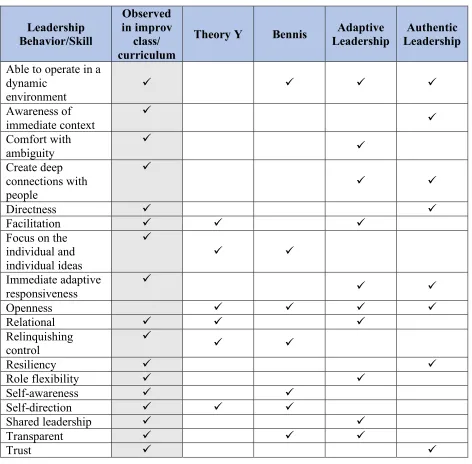
Table 4: Leadership Theory Components Compared to Class Observations ... 105
Table 5: Student Profiles ... 126
LIST OF FIGURES Figure 1. Foundations of improvisational leadership. ... 8
Figure 2. Overview of literature review. ... 19
Figure 3. Theater seating area. ... 66
Figure 4. Theater stage. ... 67
Figure 5. Classroom 3... 68
Figure 6. Leadership theory components most prominent in introductory improv curriculum. ... 133
Figure 7. Creativity process model. ... 135
CHAPTER I: THE RESEARCH PROBLEM
Statement of the Problem
Leadership development is immersed in a philosophical struggle. Past efforts at
developing leaders have missed a set of skills important to the role of today’s leaders (Bennis,
1989; Csikszentmihalyi, 2003; Friedman, 2016; Hamel, 2007; Hemlin, Allwood, Martin, &
Mumford, 2013). Since Frederick Taylor invented the practice of scientific management
(Drucker, 2008), the study of management and leadership has largely focused on traits, practices,
and behaviors that conform to this model such as planning, analysis, control, and monitoring.
Missing in this focus, however, are less transactional leadership skills like intuition,
improvisation, and creativity (Csikszentmihalyi, 2003). Among other approaches, organizations
have begun drawing on improvisational theater skills as one answer to fill this leadership
development gap (Barker, 2016; Checkley, 2015; Robson, Pitt, & Berthon, 2015; Yorton, 2015).
There has been little research, though, on the details and efficacy of this content and its
instructional methodology.
The industrial age generated a management philosophy that focused on efficiency,
productivity, compliance, obedience, and planning (McGregor, 1960; Drucker, 1973; Wren,
2011), which effectively met the demands of the industrial age. The underlying philosophy and
belief that places the manager in the role of controller and work designer is still the predominant
view over a century later (Brennan, 2011; Locke, 1982; Wren, 2011). An example is the growth
of project management in almost all organizations. This discipline calls for lists of tasks,
management is to eliminate chance and spontaneous events and to enforce a rigid plan that
generates predictable results (Wren, 2011).
Scientific management ignores some aspects of leading and managing people and
projects. Unexpected events happen, disruptive innovations show up suddenly, and results come
in that don’t match what was expected. Political figures emerge who change the regulatory
landscape. The economy expands suddenly. Unexpected competitors emerge. Leadership in
these conditions may require agility, spontaneity, and the ability to improvise. Responding to
unexpected events and rapid changes may require something different than planning and analysis
(Friedman, 2016; Palmer & Dunford, 2002; Sandelands, 2010).
Other leadership theories indicate that influence, relationships, and the ability to shape
but not try to control employees and events will be more effective (Palmer & Dunford, 2002).
Play, imagination, and creativity may be essential elements for leaders to develop to meet current
and future leadership demands (Sandelands, 2010). This complexity calls for a broader range of
leadership development approaches (Mumford, Zaccaro, Harding, Jacobs, & Fleishman, 2000)
and there is emerging interest in alternative leadership skills that are better matched to a
twenty-first century context (Bennis, 1989/2015).
Organizations are responding to this in part by seeking training in improvisational skills
and creativity for their leaders (Oelke, 2013). An example of a theater offering such corporate
training is that being offered by The Second City, a well-known improvisational theater, who
now service clients that include the energy industry and financial sector. The Second City is
considered among the top improv theaters, known for producing highly successful comedians
development courses are labelled under familiar leadership development categories like change
management, performance feedback, and team building (Second City, 2017).
Contemporary leaders (those in formal leadership roles and those exerting individual
leadership without a formal leader title) need skills missing in traditional leadership development
programs. One solution is to embrace artistic models as a way of expanding leadership
competencies in those areas, and one specific area – improvisational theater – offers skills
well-aligned with 21st century leadership needs. A clearer understanding of what is being taught in
improvisational workshops, how it is being taught, how learners are applying this content and
with what effect, the effectiveness of these skills when used outside of the theater context, and
what motivates learners to pursue this content area can help connect improv theater to the
leadership development arena.
More broadly, improvisational skills and mindsets can help counter-balance the strong
forces of scientific management embedded in leadership and leadership development. Like the
wizard in the Wizard of Oz, the curtain has been pulled back and leaders can no longer pretend
to be able to turn levers and dials and control every outcome.
Background and Need for Study
Research on effective leadership practices has covered many areas beyond scientific
management including authentic leadership (Cooper, Scandura, & Schriesheim, 2005),
transformational leadership (Avolio, Gardner, Walumba, Luthans, & May, 2004), and situational
leadership (Hersey & Blanchard, 1993). In addition, some of the work done by Mihály
Csíkszentmihályi (1996) on flow theory indicated the importance of more humanistic
management approaches.
stage for comparison and debate. Theory X focused on the manager’s control of what occurs in
the workplace and an inherent assumption that without extrinsic motivation, people will not work
to their fullest capacity. Theory Y, in contrast, considered various intrinsic human needs and
motivations and called on leaders to inspire and inform rather than control and manipulate. This
approach focused on creating conditions where people can accomplish their own goals and
required leaders to pay attention to the needs of individuals. Theory Y leaders focused more on
facilitation than directing (McGregor, 1960).
Warren Bennis (1989) offered additional alternatives to scientific management, with a
focus on the ambiguous and dynamic aspects of leadership. He advocated for self-leadership and
for a more flexible, people-focused approach for leaders. He used a similar construct as
McGregor, distinguishing between managing and leading.
The ongoing focus on the strategies of scientific management have ignored artistic- and
people-focused aspects of leadership. Connecting with people, listening intently, and responding
authentically even when facing the unplanned and unexpected are leadership skills that could be
enhanced by non-traditional leadership development approaches such as those found in
improvisational theater, also known as improv theater or improv (Buble, 2015; Flach, 2014;
Gardner, 2013; Geerlof & Beckhoven, 2016; Hmieleski & Corbett, 2008; Locke, 1982;
MacDonald, 2013; Newton, 2004; Rankin, Dahlbäck, & Lundberg, 2013; Robson, Pitt, &
Berthon, 2015; Tawadros, 2015; Vera & Crossan, 2005). Improv theaters offer workshops aimed
at working professionals, promising to teach skills that will help them in their working roles. The
skills found in improv theater focus on quick thinking and other, more nuanced skills such as
accepting offers, listening intently, and embracing the unexpected (Love, 2014; Zaunbrecher,
These skills support theory Y leadership approaches, authentic leadership, situational
leadership, adaptive leadership, and other humanistic leadership models. Existing research into
improvisation and leadership have identified some aspects of improvisational jazz as relevant to
leadership, including shared leadership and the leader as a primary support for employees
(Newton, 2004). Links have also been discovered between team performance and team
improvisation skills (Vera & Crossan, 2005).
What is yet to be fully explored are the specific improvisation skills used in improv
theater that apply to organizational leadership roles. This study sought to discover the specific
skills from improv that transcend performance theater and enhance individual leadership
performance. Using a case study methodology that included observations and interviews with a
selected improv workshop, the skills being taught and how they were being taught was
identified. Interviews with students helped clarify which of those skills they found most useful
and how they were applying what they learned.
The analysis of the results sought to identify which of the skills sets from improv theater
may appropriately be taught through existing leadership development training mechanisms in
organizations (e.g. instructor-led training, online learning, mentorships, coaching) or in
leadership and management higher education programs. Improv skills may be an element in
enhancing leadership development efforts in ways more relevant to twenty-first century
leadership and these skills could help with team interactions, problem-solving, innovation and
creativity, conflict resolution, and team participation (Yorton, 2003).
This study was needed to find the relevant learnings from improv theater that applied to
leadership and leadership development. A case study of a specific workshop provided a higher
which aspects are applicable to effective leadership and leadership development. Current
leadership development methodology consists largely of traditional workshop curriculum:
lectures, role plays, activities, and some experiential learning. As most of these efforts occur
within a corporate environment, learning pedagogy typically takes a more conservative
approach, focusing on learning skills, practicing them within the learning space, and trusting that
learners will apply the learning on the job. Additionally, online learning is increasingly popular
for leadership development. This learning methodology can potentially reach a saturation point
with learners, however, and there remains an assumption that learners will apply the learning on
the job. One alternative approach that has emerged is known as 70:20:10, indicating that 70% of
learning takes place on the job through challenging assignments, 20% through mentoring and
relationships, and 10% through formal learning methodologies (Center for Creative Leadership,
2017). Improv theater pedagogy could provide insights on further innovations in leadership
development methodology.
It is important to note a few aspects of improvisational theater in the United States that
impact who participates in workshops and performances. The typical business model for theaters
is to offer workshops that are priced at hundreds of dollars, with multiple workshops required
before a participant is ready for live performances. Those performances are usually unpaid, or
paid a small portion of ticket sales, and theater locations are often located in urban settings
requiring transportation resources. Therefore, performers tend to be reflective of cultural and
economic privilege. Additionally, there is a lack of gender and ethnic/racial diversity in many
improv groups that in some locations results in minority populations forming their own separate
teams of performers. While it is not the purpose of this study to explore this aspect of improv
skills could enable a wider dissemination of these skills to those for whom this content is
currently inaccessible.
Purpose of the Study
The purpose of this case study was to determine the relevance to leadership and
leadership development of the core skills involved in improvisational theater, by identifying
what is taught in introductory improvisational theater workshops, examining the teaching
methodology used in those workshops, understanding how those who are exposed to learning
these skills use them outside of the theater, and to gain insights as to why people choose to sign
up for an improvisational theater workshop.
An improv workshop was identified for study and all sessions of the class observed.
Participants and instructors in the improv workshops were interviewed to understand which skills
they learned, and how these skills were being used outside of the theater context. The principal
objective of this study was to fill a gap in understanding improvisational skills and how these
have applications for leadership development efforts. Understanding the motivation of
participants will help inform leadership development work by illuminating the attraction point
for participants; this is critical understanding especially with leaders and organizations who are
not focusing on non-traditional leadership philosophies and may even be actively resisting them.
By identifying the motivation for people to voluntarily enroll in improv workshops, leadership
development professionals can design programs that appeal to similar motivations within their
audience.
Theoretical Framework
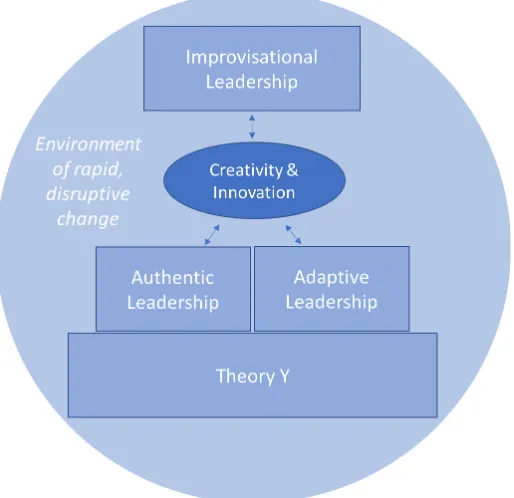
This study was built upon four foundational pillars (see Figure 1). As mentioned earlier,
those exerting leadership in any aspect of their life, using the term “contemporary leaders” to
capture this concept.
Douglas McGregor’s work on theory Y leadership provided a balancing perspective
against more controlling and authoritarian leadership styles by redirecting the focus of leadership
to collaboration, authenticity, open communication, and support (McGregor, 1960). The work of
Avolio, Gardner, Walumbwa, et al. (2004) described the essential qualities of authentic
leadership and investigates the role of leadership development to enhance these qualities in
leaders. Adaptive leadership provided the second piece of the framework, describing the change
in external environment that is creating a demand for a different style of leadership and models
for appropriate behaviors that leaders can follow to increase their level of adaptability and
increase the personal engagement of those around them (DeRue, 2011; Kahn, 1990). The fourth
pillar consisted of the use of improvisational theater-based leadership development and the
The broader question centered around the dichotomy between scientific management and
more humanistic leadership approaches. While there are many leadership theories in addition to
those already mentioned, the predominant approach to management focuses on planning,
controlling, and analyzing, currently enhanced with high technology tools. Yet, shifting
conditions within organization and society indicate that something different may be needed that
will generate higher levels of creativity and innovation and increased employee engagement.
Improvisational skills can be an important part of this new approach to leadership.
Improvisation is essentially relational, a common aspect of leadership that supports engagement
and creativity. Therefore, development in improv skills can create a shift in leadership practices
consistent with the humanistic leadership theories of McGregor, Bennis, Kohn, Avolio, DeRue
and others.
McGregor and Theory Y
McGregor offered an alternative theory to scientific management. He labeled command
and control leadership behaviors as theory X leadership. His alternative, theory Y, was based on
a different understanding of human nature and thus identified different leadership traits and
approaches as more effective. (McGregor, 1960).
Theory Y leaders believe that people are intrinsically motivated and engage in work for
satisfaction and a sense of accomplishment. This theory described the need for direct and open
communication between leader and follower with high value placed on the quality of the
relationship. Individualized approaches and ideas are encouraged over consistency and
uniformity (McGregor, 1960). This study identified how skills taught in improv theater support
McGregor (1960) also concluded that “leadership is a relationship” (p182), citing the
number of factors that influence effective leadership and the required role of the follower for
leadership to exist. Improvisational learning, with its foundation on relationships and openness
(Spolin, 1983), connects with theory Y concepts such as openness, individual expression, and
relationship quality.
Authentic Leadership
Avolio et al. (2004) provided a framework linking authentic leadership to followers’
behaviors and performance. This framework also helped define key aspects of authentic
leadership and connected those aspects with personal identification and social identification.
These in turn positively impact hope, trust, and positive emotions in followers which are
positively related to employee attitudes towards commitment, job satisfaction, meaningfulness,
and engagement. These mediate the relationship between authentic leadership and the job
performance of followers.
The key traits of authentic leadership identified by Avolio et al. (2004) that related to this
study were awareness of context, resiliency, trust, positive emotions, directness, openness,
transparency, a willingness to acknowledge personal limitations, the ability to model adaptive
responses, and optimism. “[Authentic leaders] are more interested in empowering the people
they lead to make a difference and are as guided by the qualities of the heart, passion, and
compassion as they are by qualities of the mind” (Avolio, et al., 2004, p. 806).
The behaviors and skills that a leader would need to develop to be an authentic leader are
not included in this model, however, and Avolio pointed out the need for additional research in
connecting this model to other models and for identifying the elements of leadership
behaviors that are taught in an improvisational theater program and to identified which of those
skills these participants found valuable and which they put into practice. These skills and
behaviors were then compared to the theoretical components of authentic leadership.
Adaptive Leadership
This theory posited that people engage in work roles much like an actor takes on a theater
role, and people can approach that role with different levels of engagement (Kahn, 1990). His
research was based on the premise that multiple organizational factors influence an individual’s
chosen stance on their role and that variability occurs within an individual; the level of
engagement is not static (Kahn, pp. 694-695).
These organizational factors may be influenced by leaders adopting improvisational
practices. Kahn (1990), in talking about the value of people bringing more of themselves into
their work roles, says, “People become physically involved in tasks, whether alone or with
others, cognitively vigilant, and empathically connected to others in the service of the work they
are doing in ways that display what they think and feel, their creativity, their beliefs and values”
(p.700).
DeRue explored role variability from a leadership perspective in designing a theory of
adaptive leadership. His theory is based on the concept that leadership is dependent and defined
by followership which is subsequently influenced by the emergent pattern of
leadership-followership. Key aspects of this theory are that leadership roles are fluid, not static; that they
emerge from interactions between leaders and followers; that they are not dependent on
authority, power, or title; and they are fundamentally a social construct (DeRue, 2011).
Improvisational workshops include learning content supportive of these concepts. These
participate (Spolin, 1999). Improv performances are dependent upon group dynamics, and
perceived leadership roles shift during performances and practices. This study provided data that
can help illuminate the connection between improvisational learning content, individual
engagement, and the group dynamics of leadership.
Skills-based Leadership Development
Skills-based leadership development is based on the philosophy that leadership skills can
be learned and developed and are not part of a package of traits inherent within the individual
(Mumford et al., 2000). Social skills can be critical for contemporary leaders, especially the
ability to view situations from multiple perspectives and to immediately apply past experiences
to novel situations (Mumford et al., 2000).
A different view of leadership was presented with relational leadership theory. According
to this school of thought, individual leader skills are not the key focus for leadership or
leadership development. Instead, leadership emerges as a social construct. The dynamic between
individuals on a team, which often includes a titular leader, is what creates leadership, not the
individual skills and actions of a single person (Uhl-bien, 2006). Viewed from this perspective,
leadership development would focus on the interaction between team members rather than on the
individual leader.
Improvisational theater integrates both points of view. Improv training provides a set of
concrete skills, learned experientially, that creates individual success in performances. At the
same time, that skill set, and the way success is defined, is based on group dynamics, fluid
leadership, and effective interpersonal interactions. Additionally, the learning methodology
Improvisation and Leadership Development
Vera and Crossan described the relevance of improvisational theater skills to leadership
while acknowledging its limitations. Citing the need for flexibility, responsiveness, and quick
action, they identified core improvisational skills that are transferrable from the theater setting to
the organizational setting. These included a focus on the process of improvisation rather than its
end product; expertise and practice in their craft to draw upon when needed; spontaneous action
and decision-making in response to immediate stimuli; the impromptu creation of ideas; the
ability to let go of results in the moment; embracing the uncertain and letting go of results;
embracing failure as a natural part of the process; maintaining a focus on agreement; and
working as a group with a focus on taking care of others (Vera & Crossan, 2004, 2005). They
defined improvisation as “the spontaneous and creative process of attempting to achieve an
objective in a new way” (Vera & Crossan, 2004, p. 733). Their study provided evidence of six
common components of successful improvisation that apply to theater and organizations:
expertise; teamwork quality; experimental culture that does not punish mistakes; access to
real-time information; strong communication; and training is used to build competency and increase
use of improvisational behaviors (Vera & Crossan, 2005, pp. 206-219).
Their work points to the need for additional research that focuses on identifying exactly
what improvisation includes and how it applies to organizations (Vera & Crossan, 2004, p. 728),
the accessibility of theater-based improvisational skills over, for example, jazz improvisation
(Vera & Crossan, 2004, p. 728), and how leaders in organizations can learn this skill and how it
can be effective for them (Vera & Crossan, 2005). They also acknowledged the difficulties of
introducing improvisational skills into a culture where planning and control predominate
Crossan, 2004, p. 735), and they maintained that improvisation in organizations will operate
much like in theater: sometimes it will result in positive outcomes and sometimes it will hurt
organizational outcomes (Vera & Crossan, 2004, p. 744).
Improvisational skills are closely aligned with theory Y leadership, authentic leadership,
and adaptive leadership. These leadership theories call for skills and behaviors that would be
enhanced with improvisational skills, which can then enhance personal creativity and
organizational innovation and may play a key role in effective leadership in a volatile external
environment. This study furthered an understanding of how these skills are applied outside of the
theater context.
Research Questions
As mentioned earlier, there is an over-arching question centered around the dichotomy
between scientific management and more humanistic leadership approaches. Using theory Y
beliefs, authentic leadership, and adaptive leadership as vehicles for applying improvisational
theater skills and pedagogy, this study was designed to explore the connection between improv
skills and these leadership theories.
While there are many leadership theories in addition to those already mentioned, the
predominant approach to management focuses on planning, controlling, and analyzing, currently
enhanced with high technology tools. Yet, shifting conditions within organization and society
indicate that something different may be needed that will generate higher levels of creativity and
innovation and increased employee engagement. The research study will address a primary
question and the sub-questions listed below:
1. Why are participants interested in learning improvisational skills?
3. How are improvisational skills being taught in these workshops?
4. How are the improvisational skills that are learned in the workshops being
used by learners outside of the theater context?
5. How are the skills that are being used helpful and effective for participants?
Delimitations and Limitations of The Study
Delimitations
The study relied on a single improvisational theater workshop and the instructor(s) and
participants assigned to it and therefore has limits to its generalizability. Data obtained from
interviews is dependent upon self-reporting, with its inherent limitations. While there is a body
of literature behind improvisational theater skills, the level of awareness of this literature may
vary among those who instruct improv workshops and the workshop and theater selected may
use concepts, skills, and pedagogy different than other theaters, and therefore be unique. There
may also be unexpected variability in curriculum based on geography or other factors.
This was not a longitudinal study. The focus was on a specific period of early learning in
improvisational skills and the immediate or short-term application by learners. Inferential
analysis was used based on the collected data only. No process of random sampling was engaged
in selecting the population for this study, therefore no statistical analysis was possible.
Quantitative and numerical analysis of the data was avoided in order to retain focus on the case
study and the qualitative data.
Limitations
Because the researcher has performed in improvisational theater and taught leadership
development in a corporate setting over a length of time, and was the sole data collection
participating theater, and the observations and analyses of the data. Also, participants joined an
improvisational class voluntarily and they may have been predisposed to reporting positive
outcomes and finding those programs valuable. Finally, the students and instructors may have
behaved differently because of the presence of an observer.
Significance of the Study
This research was conducted to expand knowledge of effective leadership development
approaches, specifically by learning more about the learning content of improvisational theater.
Leadership development is widely used in many organizations, especially within large
corporations. Many of the approaches and practices delivered in that context lack evidence-based
support (Ketter, 2009).
Concurrent with that, scientific management, first popularized by Frederick Taylor in the
early twentieth century, changed the way organizations managed and elevated planning, control
systems, and efficiency and became the primary focus areas for managers (Giannantonio &
Hurley-Hanson, 2011). Yet, in an era of rapid change, managers are finding control to be elusive.
As a result, fresh and innovative leadership development approaches are being explored and
made popular. One of those is content from improvisational theater (Robson et al., 2015; Vera &
Crossan, 2005).
This study was intended to provide data around the specific skills and approaches that are
being taught within improv workshops and to better understand how they are being used in
non-theater settings. In so doing, more effective leadership behaviors can be identified which leaders
may find valuable in volatile and changing workplaces. This may provide an important
counterbalance to the currently popular concepts of analytics and planning. This study was not
This study showed how the skills and practices learned in improv workshops are applied
by students within and outside of the theater context, with the theory that participants apply the
skills in contexts outside of the theater, in ways that could be applied to a leadership role. The
study also showed how the pedagogy employed by improv instructors can inform the field of
leadership development. Finally, the study showed why students are attracted to improv classes
and how they are applying what they learn outside the theater setting.
Definition of Terms
The following terms are commonly used in the improv community and in the leadership
development professional community. The definitions provided here guide an understanding of
the study:
Contemporary leader – For the purposes of this study, leader contemporary will encompass any
individual who is in a formal organizational leadership role (with people directly
reporting to them), and any individual who in the course of their work and personal life,
exerts leadership.
Employee engagement – The sense of connection and passion an employee feels toward their
work (Gallup, 2017); the degree to which an employee feels psychologically present and
feels they are using their full selves (Kahn, 1990).
Group Mind – The sense of connection groups of improv performers feel toward each other.
Often combined with the phrase “follow the follower” to indicate that the goal of improv
is to follow the direction of the collective mind rather than the direction of an individual
leader.
Improvisation/improv – A theater form where performances are unscripted and based on
performers. It is noted for spontaneity, creativity, group cohesion, and group approval of
new ideas and patterns (Spolin, 1983).
Improv theater – A performing arts theater that primarily presents improvisational shows. They
may also offer other types of shows and public workshops.
Leadership development – Any of a variety of training programs and learning efforts that are
designed to improve or change the performance and behaviors of leaders or potential
leaders. These programs typically take the form of training classes, online learning,
modules, written or video content, and related exercises and activities but development
can also occur from experiences, special assignments, mentors, and reflections (Bennis,
1989; Drucker, 2008).
Space/object work – Refers to the imaginary motions that improv performers make to create
objects and places on the stage. For example, when using a telephone, good space/object
work would be to hold your hands exactly as you would if there were an actual phone in
your hand. This can also refer to filling out a scene; for example, taking a sip of an
imaginary drink and placing it on an imaginary bar counter will create a bar on the stage
for the audience.
CHAPTER II: REVIEW OF THE LITERATURE
Restatement of the Problem
The demands on leadership are changing and require higher degrees of creativity and
adaptability from leaders. Organizations and leaders are seeking new approaches for leadership
development efforts and one of those is improvisational theater content. Little study has been
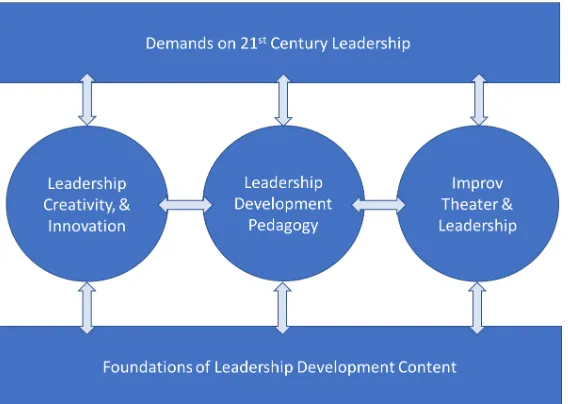
To explore the relevance of improvisational skills in the context of leadership and
leadership development in the 21st century, five topics were examined: the demands of
twenty-first century leadership, the foundations of current leadership development content, creativity
and leadership, the history and elements of improvisational theater, and improvisational
leadership (see Figure 2).
Figure 2. Overview of literature review.
There is a foundation of leadership development content that permeates current
leadership development efforts, some of which is more aligned with theory Y, and much of
which still focuses on a skills-based approach to traditional management functions such as
planning, analyzing, and controlling. Exploring alternative approaches to leadership and
leadership development uncovers content and instructional methodology that may be more
relevant to a 21st century context, specifically in the areas of creativity and employee
engagement. This review will examine the demands on leaders in the 21st century, explore
alternative leadership approaches, and outline the application of improvisational skills to
Demands of 21st Century Leadership
A common element of leadership theories and leadership development research focuses
on current or anticipated changes in the environment within which leaders operate (Bennis, 1989;
Buble, 2015; Drucker, 2008; Friedman, 2016). The theme since the latter half of the twentieth
century has been that significant changes are occurring, driven by technological innovation,
shifting expectations of customers and employees, and a transformation to a global market.
Within this dynamic environment, traditional management approaches that primarily
focus on controlling and planning may be outdated (Buble, 2015). An annual report from the
Gallup Organization provides data on the impacts of outdated ineffective leadership approaches.
The high number of disengaged employees – over 60% over an extended number of years – may
illustrate that different approaches to leadership and leadership development are needed (Gallup,
2017). Employee perspective is influenced by leadership style and approach, and expectations of
employees and leaders are changing, requiring a more adaptive style from leaders (DeRue, 2011;
Kahn, 1990).
This high-change environment has been described as volatile, uncertain, complex, and
ambiguous (VUCA) (Casey, Jr., 2017; Friedman, 2016). The current change environment seems
to be forcing a shift for leaders from a controlling role to an influencing and shaping role (Palmer
& Dunford, 2002). The argument is made that in an environment of rapid and dramatic change,
shaping behaviors are more effective in motivating and inspiring people through change.
Beliefs about effective leadership behaviors and skills are shifting. The focus of management in
the future may include a strong focus on mission and vision, the ability to deal with chaos and
ambiguity, wide empowerment, self-management, and dense networks (Buble, 2015). These
Foundations of Leadership Development Content
Theory X and Theory Y
Douglas McGregor (1960) laid the foundation for contemporary leadership development
with his seminal work, The Human Side of Enterprise. Based on the belief that people can be
self-motivated, McGregor saw the manager’s role to include creating a work environment that
allowed people to find meaning and purpose. He recognized that all managerial actions and
decisions are based on some theory, usually shown by the assumptions made by the manager
(McGregor, 1960). By changing these assumptions, different leadership approaches would
follow. By his theory, these approaches would be based on a belief that people can learn and
grow and so leadership development would focus on that learning and growth.
McGregor also argued that authority alone was not enough to motivate performance and
could impede performance. Yet, he still based his theory on this managerial belief: “Progress in
any profession is associated with the ability to predict and control, and this is true also of
industrial management…Successful management depends – not alone, but significantly – upon
the ability to predict and control human behavior” (McGregor, 1960, p. 4). His belief in theory Y
was still wrapped around an assumption that managerial intent and action is necessary to get
organizational results, and that the objective is still to control behavior. The influence of
scientific management has been pervasive and difficult to move past. Still, his thinking altered
what the assumptions and actions could be for leaders and laid the groundwork for later work
around people-focused leadership.
McGregor based his thinking on his perception that organizations were undergoing
significant change and would require leaders to adopt practices that responded to those changes
innovation” (McGregor, 1960, p. 57). By shifting the conversation to a different set of
assumptions about human behavior and motivation, McGregor opened the social aspects of work
and the role of individual engagement in accomplishing larger organizational goals.
This was a significant shift in thinking, since much of the earlier part of the twentieth
century had focused leadership study on individual traits and managerial approaches based on
Taylor’s theory of scientific management. Frederick Taylor studied industrial operations and
work. He determined that breaking a task into its smallest possible components and then
establishing the best way to complete that task was the key to effective management. His theory
assumes that individuals will not complete work in the most efficient way on their own, and that
most workers will not be motivated without strict methods, procedures, and standards backed up
by compliance efforts (Taylor, 1919).
McGregor labelled this leadership philosophy “theory X” and his counter-philosophy
“theory Y”. Follow up research reveals support for Theory Y leadership beliefs, with results that
showed a positive relationship between a theory Y management style and subordinates’
organizational citizenship behaviors, commitment to the organization, and satisfaction with their
leader (Gurbuz, Sahin, & Koksal, 2014).
Theory Y assumptions point to leadership behaviors that are more relationship-focused,
and more accepting of responsibility for creating a workplace that encourages the full expression
of the individual talents of each person, aligned around organizational objectives to which people
willingly commit. Leadership development in this context would focus on developing the
Management Theory
One of the most influential management writers in the 20th century was Peter Drucker.
His core belief was that an effective manager carries the responsibility to achieve the
organization’s goals. As a result, the achievement of those goals is the only valid measure of
success for a leader. Further, he held that to be successful, contemporary organizations require
managers (Drucker, 2008).
Aligned with the thinking of Frederick Taylor, Drucker’s belief was that organizational
structure had to be task-focused and focused on the needs of the organization – its results. He
popularized management by objectives, where organizational objectives determine the
responsibility and sole focus of managers and is the only criteria for success of leaders and
individuals within the organization. He also argued that managers should have a role in creating
the organization’s objectives so that these objectives become the foundation of self-control and
provide a means for managers to hold themselves accountable.
Drucker did acknowledge that there was greater complexity involved in leadership,
however. While he insisted on a performance focus for organizations and managers, he also said,
“The better a person is, the more mistakes she will make – for the more new things she will try”
(p.281), seeming to at least hint at the value of a performance failure as a vehicle for learning for
the leader. He also believed that management decisions must be focused on values and on
opportunities, not problems.
In Drucker’s view, “…the intellectual’s world, unless counterbalanced by the manager,
becomes one in which everybody ‘does his own thing’ but nobody achieves anything. The
manager’s world, unless counterbalanced by the intellectual, becomes the stultifying bureaucracy
fulfillment and mission” (p. 517). His view of leadership included the notion that leaders inspire
followers to higher performance, stretching them beyond their normal limits (p. 288).
Where Drucker falls in the theory X, theory Y continuum is well illustrated with a
comparison to classical heroic literature. In Heroic Drucker (2015), Joullie and Spillane compare
Drucker’s management theories with the Iliad. They contend that Drucker’s manager is a heroic
character in the classic tradition. This model of hero is different from the western interpretation
of a hero as someone who individually overcomes challenges and rises to success. The classical
definition of hero is someone who dutifully fulfills the role that fate has created for them.
Applied to the manager role as described by Drucker, this then is a leader who conforms to
expectations and fulfills the obligation to accomplish the organization’s goals. Much like the
classical hero who must fight the gods and save the day, Drucker’s manager must conform to
traditional expectations, exercise self-discipline, focus on pre-planned goals, and meet quarterly
expectations (Joullie & Spillane, 2015). This version of hero is measured by results, is celebrated
for individual accomplishments, and favors action over process. Relationships, collaboration, and
positive work environments will be addressed to the degree that they are perceived as adding to
bottom line metrics.
Leadership Theory
Warren Bennis expanded leadership thinking by building upon principles found in
McGregor’s theory Y. His leadership theory is based on qualitative research he conducted and
his personal leadership experience. According to his thinking, leaders should focus on knowing
themselves and who they are – learning about self as a way of learning about leadership (Bennis,
From this perspective, leaders should value independence of thought, and individualized
leadership styles and leadership development should be customized to the individual. Vision and
character are as important as drive and competence. “The first step toward change is to refuse to
be deployed by others, and to choose to deploy yourself” (Bennis, 1989, p. 37). He identifies
four steps to developing as a leader: becoming self-expressive; listening to the inner voice;
learning from the right mentors; and giving oneself over to a guiding vision (Bennis, 1989, p.
34).
Bennis also listed curiosity and daring as key leadership characteristics, encouraging
leaders to embraces mistakes. This lies opposite to the relentless pursuit of organizational
objectives advocated by Drucker. Benning dared leaders to explore the inner self. His “four
lessons of self-knowledge are:
One: You are your own best teacher.
Two: Accept responsibility. Blame no one.
Three: You can learn anything you want to learn.
Four: True understanding comes from reflecting on your experience” (Bennis,
1989, p.56).
Bennis’ leader focuses on possibilities, not problems and limitations. As he quotes
William James: “Genius…means little more than the faculty of perceiving in an unhabitual way”
(as cited by Bennis, 1989, p. 69). Bennis describes a more balanced leader who embraces both
the analytic and creative/intuitive side of the brain, combining the administrative and the
imaginative (Bennis, 1989, p. 103).
In this model of leadership, leaders embrace “the blessed impulse” (Bennis, 1989, p.
acts comes out of a certain kind of controlled free association” (p.145). Bennis sees a different
possibility for learning: “I think of it as learning from surprise” (p. 146).
Proponents of scientific management argue a different view. The social outcomes of
efficiently run organizations and production processes, they argue, benefit everyone, including
workers. The resultant prosperity provides communities and nations material benefits and social
stability (Zuffo, 2011). Given the advancement of technology and data analysis capability since
Taylor first documented his research, scientific management may be more relevant than ever for
leaders and managers (Brennan, 2011).
However, in a rapidly changing environment, a different set of skills may be necessary.
To encourage creativity and innovation within organizations, Bennis’ beliefs about leadership
may be more important. Adaptive leadership, especially as described by DeRue, may more
closely match the reality of this volatile environment and needs of the current generation. More
static and role-based management approaches were based on organizational models where
hierarchy, authority, and power were emphasized. Today’s organizations are more open to
flexible approaches and people within those organizations may be less accepting of
authority-based leadership (DeRue, 2011).
Leadership, Creativity, and Innovation
The narrative around creativity and innovation flows along a linear path that starts with a
description of the change-intense environment within which organizations are operating today.
This in turn requires organizations to change which then creates a demand for creativity and
innovation to meet the unexpected challenges and opportunities (Andriopoulos, C. 2001;
to learn how the creative process works in individuals and organizations, how leadership impacts
this process, and how organizations move creative ideas into practical innovations.
In Business Cycles, Shumpeter laid the groundwork for the importance of creativity in
organizations with this guidance: “…the decisive driving force for an economy undergoing the
alternating stages of prosperity, recession, depression and recovery is innovation” (cited in
Goodman & Dingli, 2013). The current manifestation of this dynamic centers around the change
in the economic relationship between organizations and their customers, described as a change
from a seller’s market, where products are priced based on an internal analysis by the producer,
to a buyer’s market where pricing is determined by what the customer is willing to pay
(Goodman & Dingli, 2013). This buyer’s market now determines which products and services
are in demand and how they are delivered (e.g. ride share services).
This dynamic is further expanded by extreme improvements in efficiency, innovation,
and production processes that have occurred over the past several decades. Consumer choice is
high, and improvements and innovations are executed quickly. There is intense pressure on
organizations and their leaders to produce change and innovation to meet changing customer
demand and take advantage of advancing technology. Thus, the demand for creativity increases:
“Creativity can help managers generate ideas and interventions that are manifestly different from
those of the past (mainly seller’s markets) but relevant to the challenges provided by buyer’s
markets” (Goodman & Dingli, p. 27).
Creativity has become a key competitive differentiator, with ideas now viewed as capital
within organizations (Dean & Kretschmer, 2007; Goodman & Dingli, 2013). Organizations
increasingly demand a level of creative output to support a necessary level of innovation and this
Specific leadership traits, behaviors, and approaches have been linked with creativity and
innovation. These include more humanistic approaches rather than authoritarian or controlling
approaches (Andriopoulos, 2001), ideas formalized by McGregor (1960). Leaders can support
creativity and innovation by developing a supportive environment (Andriopoulos, 2001). Mihaly
Csikszentmihaly (1996) said it this way “It is easier to enhance creativity by changing conditions
in the environment than by trying to make people think more creatively” (p. 1). He addresses the
concept of entropy, where living organisms tend to conserve energy as a survival mechanism.
The role of creativity is to overcome the entropy of the status quo, and if the opportunities for
curiosity and creativity are too narrow for individuals and teams, with too many obstacles and
constraints, creativity will suffer (p. 11).
Team norms can impact creativity with individuals and teams. People will hold back, or
self-edit ideas based on a perception of how well the idea will be received, and perceptions of
safety and approval influence individual creativity within teams (Goodman & Dingli, 2013).
“Good managers do not attempt to manage creativity, they manage for creativity, by providing a
working environment and culture that allows creativity to flourish” (Goodman & Dingli, p. 129).
Establishing an environment of trust, safety, and dignity is an essential element of that work
environment (Amabile, 1997; Goodman & Dingli, 2013; Spitzeck, 2011).
There are other components of an environment supportive of creativity and innovation.
There is a role for leaders to enhance intrinsic motivation for creativity (Andriopoulos, 2001). A
positive work environment is a key element for group and individual creativity. Extrinsic
rewards, and the withholding of them, reduce organizational creativity. The two exceptions to
this are reward and recognition for creative ideas and feedback useful for making the creative
Amabile (1997) also observed that the more interested people are in the work, the higher
the levels of creativity, an example of intrinsic motivation supporting creativity. At the same
time, her study showed a decline in creativity and productivity during organizational change (in
her research case, pending layoffs). It also revealed leadership behaviors that reduced the impact
on productivity and creativity during change: when employees “…feel their manager is
trustworthy, communicated honestly with them, and listened to their concerns” (p. 51). She also
presented her Component Theory of Organizational Creativity and Innovation (p. 43). This
model provides that organizational innovation results from individual creativity which is
impacted by the work environment. Hemlin et al. (2013) conclude, “…it also appears that
creative people will simply stop thinking when the environment is perceived not to be conducive
to creative work” (Oldham & Cummings, 1990, cited by Hemlin et al., p. 12). Specific
leadership behaviors that may contribute to this non-supportive environment include failing to
show support, providing poor communication, micromanagement, and giving non-constructive
feedback (Hemlin et al., 2013).
Diversity of perspective and thought tends to enhance creativity in work groups and this
diversity can be enhanced with the introduction of trading zones (Hemlin et al., 2013). These are
organizational structures, events, and locations that bring different individuals in the organization
together. The leader’s role is to facilitate these trading zones so that interesting connections are
made that can generate unusual and creative ideas.
Additional supportive organizational and leadership practices include introducing
multiple stimuli, encouraging the freedom to experiment, keeping a long-term perspective,
allowing autonomy, and building ideas collaboratively. Exposure to regular and frequent creative
and innovation (Andriopoulos, C., 2001; Hemlin et al., 2013). Flexibility, a humorous work
environment, and the ability to customize service responses based on individual context are also
creativity enhancers. The ability to create these ad hoc solutions generates greater engagement
and creativity with employees (Slåtten, Svensson, & Sværi, 2011). Modeling creative behavior
themselves provides another avenue of influence for leaders (Hemlin et al., 2013).
The foundational aspects of improv theater link directly to the leadership practices
described above. Improv performers focus keenly on the context of the immediate moment and
create their response based on that context and verbal and physical offers from other performers.
Engaging in a fluid relationship where leadership can be held by any team member, improv
performers learn to model consistent behaviors such as accepting offers made by others, paying
attention to the immediate moment, and moving scenes into unexpected contexts. These same
behaviors applied in an organizational (non-theater) setting would provide an encouraging
environment for creativity.
Writers on the topic also call for more analytical processes to support creativity and
innovation (Goodman & Dingli, 2013; Hemlin et al., 2013). There is a strong focus on creative
problem solving (CPS) and the techniques involved in this are part of standard process
improvement methodology. Convergent and divergent thinking, consensus-building, and
decision-making are practiced in many organizations in service to more efficient processes that
produce higher quality results in less time with less expense. These approaches are also viewed
as supportive of creativity and innovation, a way for a leader to focus a team on generating new
ideas and helping ensure the implementation of those ideas.
A four-phase model of the innovative process is also offered, consisting of the initial
generation of ideas, which seems to be a fully creative act. The other three phases quickly move
into the innovation realm, an evaluation and implementation process (Goodman & Dingli, 2013).
Opposite this analytic approach, play may be useful for encouraging a supportive
environment for creativity. The voluntary interaction of groups of people at play, typified by
high levels of engagement, point to a vehicle for more effective teamwork and more individual
creativity (Sandelands, 2010). Another less linear model is offered by distinguishing types of
creativity and innovation under the labels of idea scouts and idea connectors. Scouts are those
inside the organization who scan the internet and other external sources for creative ideas and
innovative practices. Idea connectors are skilled at networking and connect external ideas with
internal resources and internal resources with each other. Both serve the interests of creativity
and innovation (Goodman & Dingli, 2013). Similarly, they present an innovation model used in
the software design industry, the cathedral and the bazaar. The cathedral represents an internal,
more structured and controlled development process, where innovation is made in protected
privacy. The bazaar describes the world of open sourcing, a more chaotic and less controlled
approach, with higher levels of diverse thinking and greater unpredictability.
The concept of creative leadership provides an over-arching model for leaders challenged
with cultivating a creative environment. Built upon previous models of leadership – transactional
leadership, transformational leadership, and transcendent leadership – creative leadership
requires deep relationships, self-awareness, autonomy, and adaptiveness (Hemlin et al. 2013). As
they defined it, creative leadership is “…[t]he ability to deliberately engage one’s imagination to
define and guide a group towards a novel goal – a direction that is new for the group. As a
consequence of bringing about this creative change, creative leaders have a profoundly positive
Insights About Creative People
While much of the research reviewed here focuses on organizational creativity, there are
important insights to be gained from understanding creative individuals. acknowledging the
importance of their role. Some of the commonalities of creative individuals include curiosity,
wonder and an interest in how things work (Csikszentmihalyi, 1996). He described a fluid
attention as an integral part of the creative person and adds that complexity seems to be a
commonality, with creative individuals displaying paradoxical traits that in others are either/or.
They can experience sadness and pain about their work and find joy in it at the same time.
Building from his flow theory, he applied this to creativity by arguing that humans are
programmed for creativity. His argument centered around the idea that since external conditions
change, those who can constantly embrace novelty will be better equipped to handle changing
conditions. This can be directly applied to organizations.
Additional traits of highly creative people are “complexity, self-confidence, aesthetic
sensitivity, values originality and independence, and rejection of the narrow and the mediocre”
(Hemlin et al., 2013, p. 9).
Leadership Development Pedagogy in Transition
One response to the volatile environment is to develop leaders towards more
transformational leadership behaviors (Nicolaides & McCallum, 2013). They called for a
different approach to leadership development, described as the triple loop learning model, which
includes “unpredictable and uncontrolled learning” (p. 253). Triple loop learning asks learners to
be fully present and recognize their vulnerability in not knowing what will come next (p. 254).
Aligned with that, authentic leadership can be viewed as another potentially effective
on topics such as open- mindedness, empathy, care, and mutuality, leaders create an authentic
leadership style, which can be drawn upon under changing conditions and provide a sense of
team stability (Berkovich, 2014).
Flow theory also supports more innovative work environments. When employees are
challenged around clear goals, provided enough support and feedback, and connected with work
that feels meaningful and for which employees are skilled, they will immerse in flow which can
result in higher levels of productivity and innovation (Csikszentmihalyi,1996).
Theater-based Leadership Development
Theater-based Leadership Development (TBLD) has emerged as a potential approach to
developing leaders, effective both in content and delivery methodology (Tawadros, 2015).
Consistent with Bennis, he has found that leadership development is largely a self-discovery
process. In addition, in a time of rapid change, the ability to respond in the moment and act
immediately are key leadership competencies. TBLD and other arts-based learning provide the
content and delivery that resonates with contemporary leaders (Tawadros, 2015).
The advantages of using TBLD methodology, according to Tawadros, include:
Experiential learning that strengthens the connection between learning and
real-world leadership challenges; learning mimics the real real-world and the fluid nature
of the leadership role.
Interactive learning that encourages learning from discussion and interaction with
peers that allows emotional learning.
Learning that provides an opportunity to explore self in relation to others
TBLD provides an example of double-loop learning; participants learn the skill while receiving