CSUSB ScholarWorks
CSUSB ScholarWorks
Electronic Theses, Projects, and Dissertations Office of Graduate Studies
12-2018
Exploring Flag Matroids and Duality
Exploring Flag Matroids and Duality
Zachary Garcia
Follow this and additional works at: https://scholarworks.lib.csusb.edu/etd
Part of the Other Mathematics Commons
Recommended Citation Recommended Citation
Garcia, Zachary, "Exploring Flag Matroids and Duality" (2018). Electronic Theses, Projects, and Dissertations. 777.
https://scholarworks.lib.csusb.edu/etd/777
A Thesis Presented to the
Faculty of
California State University, San Bernardino
In Partial Fulfillment of the Requirements for the Degree
Master of Arts in Mathematics
by
A Thesis Presented to the
Faculty of
California State University, San Bernardino
by
Zachary David Garcia December 2018
Approved by:
Dr. Jeremy Aikin, Committee Chair Dr. Yuichiro Kakihara, Committee Member
Dr. Lynn Scow, Committee Member
Abstract
Acknowledgements
Thank you to the Math Department at California State University of San Bernardino. Their devotion to their students and their mathematical growth is nothing short of in-spiring.
Thank you specifically to Dr. Yuichiro Kakihara and Dr. Lynn Scow for both their excellent instruction and for dedicating their time and effort to the development of this study. Thank you, as well, to Dr. Corey Dunn and Dr. Chetan Prakash for their guidance and mentorship throughout my graduate career.
Thank you to my family: my mother who instilled in me a love for mathematics from an early age, my father who taught me to take pride in my work, and my brothers who remind me the power of humility and a sense of humor for oneself.
Thank you to Dr. James Oxley of Louisiana State University, whose tremendous work in the field of Matroid Theory laid the foundations for this and countless other forays into this area of mathematics.
Finally, an enormous thank you to my academic advisor, Dr. Jeremy Aikin. Without his guidance, instruction, patience, and dedication to this research, this study would not have come to be. This paper is a testament to his investment in his students, and his passion for Matroid Theory is infectious.
Table of Contents
Abstract iii
Acknowledgements iv
List of Tables vii
List of Figures viii
1 Introduction 1
2 What is a Matroid? 2
2.1 Defining a Matroid: Basis Axioms . . . 2
2.2 Visualizing a Matroid . . . 5
2.2.1 From Matrix to Geometry . . . 5
2.2.2 Identifying Bases of Matroids in Graphs . . . 9
2.2.3 Examples Given Sets of Bases . . . 12
2.3 Duality . . . 14
2.4 Some Matroid Constructions . . . 18
3 Gale Orderings 24 4 Maximality and Increasing Exchange Properties 27 4.1 The Maximality Property . . . 27
4.2 The Increasing Exchange Property . . . 29
5 Flags and Flag Matroids 31 6 Duals of Flag Matroids 36 6.1 Definition . . . 36
6.2 A Theorem of Flag Matroid Duality . . . 38
7 Flag Matroid Duals on n≤4 40 7.1 Flag Matroids on 1 Element . . . 41
7.3 Flag Matroids on 3 Elements . . . 43 7.4 Flag Matroids on 4 Elements . . . 49
8 Conclusion 57
List of Tables
7.1 Duality of the flag matroid on one element. . . 41
7.2 Duality of flag matroids on two elements. . . 43
7.3 Duality of flag matroids on three elements. . . 48
7.4 Dual rank 1 and rank 3 matroids on four elements. . . 54
7.5 Self-dual rank 2 matroids on four elements. . . 55
List of Figures
2.1 MatroidM as vectors in R3. . . 6
2.2 Hyperplane and vectors ofM. . . 6
2.3 The geometry of matroidM. . . 7
2.4 MatroidLas vectors in R2. . . 8
2.5 Hyperplane and vectors of the matroidL. . . 8
2.6 The geometry of the matroidL. . . 9
2.7 The graph of matroidK. . . 10
2.8 The bipartite graph of matroidJ. . . 11
2.9 Geometry of matriodN. . . 12
2.10 Geometry of matriod P. . . 13
2.11 Geometry of above “matroid”. . . 14
2.12 Geometry of matroidA. . . 15
2.13 Geometry of matroidA∗. . . 16
2.14 Geometry of matroidD. . . 16
2.15 Geometry of matroidD∗. . . 17
2.16 Geometry of matroid M. . . 18
2.17 Geometry of matroid M/2. . . 19
2.18 Geometry of matriod N. . . 19
2.19 Geometry of matriod N2. . . 20
2.20 Geometry of matriod N1. . . 20
2.21 Geometry of matriod M. . . 22
2.22 Geometry of matriod L. . . 22
2.23 Geometry of matriod HLM(L). . . 23
3.1 Geometry of matriodP. . . 26
5.1 The Geometry of constituent matroidM3. . . 32
5.2 The Geometry of constituent matroidM2. . . 32
5.3 Geometry of constituent matroidM1. . . 33
6.1 Diagram of bases as subsets of one another. . . 37
7.1 Rank 0 matroid on 1 element. . . 41
7.3 Rank 0 matroid on 2 elements. . . 42
7.4 Rank 1 matroids on 2 elements. . . 42
7.5 Rank 2 matroid on 2 elements. . . 43
7.6 Rank 0 matroid on 3 elements. . . 44
7.7 Rank 1 matroid structures on 3 elements. . . 44
7.8 Rank 2 matroid structures on 3 elements. . . 45
7.9 Rank 3 matroid structure on 3 elements. . . 45
7.10 Rank 0 matroid structure on 4 elements. . . 49
7.11 Rank 1 matroid structure on 4 elements. . . 50
7.12 Rank 2 matroid structure on 4 elements. . . 51
7.13 Rank 3 matroid structures on 4 elements. . . 52
Chapter 1
Introduction
Matroid Theory is a relatively new field of mathematical study, first introduced in 1935 by Hassler Whitney. He developed the concept of a matroid and a few of its defining characteristics initially in an attempt to “capture abstractly the essence of de-pendence” [Oxl03]. The resultant field has provided links between group theory, graph theory, linear algebra, abstract algebra, combinatorics, and finite geometry. His work in matroids won Whitney the 1983 Wolf Prize, and in the subsequent years the field has garnered a substantial following [Gor12].
In this study, we begin with an introduction to matroids. We do so by describing and depicting matroids in a variety of ways and through a number of examples. With a foundation laid, focus moves to the idea of matroid duality - a crucial concept in the study of matroids. From this, we then introduce less central concepts including quotients, concordancy, Gale orderings, maximality and the increasing exchange property.
Having fleshed out the essential qualities of a matroid, attention shifts to flag matroids. Misnomers in and of themselves, flag matroids are not matroids, but rather collections of sets constructed using matroids, and subject to some similar properties. We define flags and flag matroids, and ultimately suggest a definition for the dual of a flag matroid. Once this definition is established, we prove that the dual of a flag matroid, as defined herein, its itself a flag matroid.
Chapter 2
What is a Matroid?
A matroid captures an abstraction of the notion of independence and, as such, can be defined and represented in a variety of fashions. In this chapter, we will introduce a number of these, focusing predominantly on those prominent in later portions of this study: the basis axioms by which a matroid may be defined, and matroids’ geometric representations.
2.1
Defining a Matroid: Basis Axioms
A matroid consists of a finite setEtogether with a collectionBof “basis” subsets adhering to a series of basis axioms. We define a matroid as follows:
Given a finite setE, called the ground set, letB be a collection of subsets ofE
satisfying the following three axioms: (B1) B 6= Ø
(B2) IfB1,B2∈ B, then|B1|=|B2|
(B3) IfB1,B2 ∈ B and x∈(B1−B2), then there is an element y ∈(B2−B1) so that
(B1−x∪y)∈ B and (B2−y∪x)∈ B. (The Strong Basis Exchange Property).
Then B is called the collection of bases of amatroid on the ground setE.
M =
1 2 3 4 5 1 1 0 0 0 0 1 1 1 0 0 0 0 1 1
This matrix is one representation of a matroid we will, for now, callM. We will refer to the columns of this (and subsequently any) matrix as the elements of a matroid. Herein, they will be labelled as elements 1,2,3,4, and 5 progressing from left to right, resulting in the set E={1,2,3,4,5}.
A subset of a matroid that can be repersented by a matrix is considered abasis
in the matroid if the corresponding columns of the corresponding matrix are maximally linearly independent. That is, the addition of any other column of the matrix would result in a linearly dependent set. They thus form a basis set in the matroid.
Subsets that are linearly independent but not maximally linearly independent are referred to as independent sets in the matroid. Thus a set is independent if it is a subset of some basis.
By this definition, we see that the subsets,{1,2,4},{1,2,5},{1,3,4},{1,3,5}, {1,4,5},{2,3,4},{2,3,5},{2,4,5} are all basis subsets as there is no linear combination of the elements in each that would result in the zero vector, and no other element may be added to any of the subsets without resulting in some linear combination yielding the zero vector. (Note: In future listing of collections of subsets, we omit the numerous braces and commas in the interest of brevity, instead writing individual subsets as if they were a single term, and the full collection within a single set of braces. The collections of basis sets seen above would be written {124,125,134,135,145,234,235,245}.) At this point, the order of the elements in each subset does not matter. For example, {124} and
{241} denote the same basis subset. This, however, will not be the case once attention turns to flags.
Sets of elements that are not contatined entirely in some basis aredependent in the matroid. In the exampleM having ground setE as described above, the collection of dependent subsets of the matroid would be{123,345,1234,1235,1245,1345,2345,12345}
We denote the collection of bases of a matroid as B. Again, let us turn to the example above. Note that here, every independent subset with three elements is also a basis, as every subset with four elements is dependent, thus the addition of another element to any independent subset described would result in a dependent set. The bases of our example matroid may be written: B={124,125,134,135,145,234,235,245}. Notice that these bases are all of the same size.
We define the rank of an arbitrary subset X of E as the cardinality of the maximal independent subset ofX. From (B2) of the definition of a matroid, all bases of a matroid are of equal cardinality. Thus we define the rank of a matroid as the rank of any of its bases. In our example, for any B∈ B,|B|= 3, therefore our matroid has rank 3.
There is one more term worth defining regarding the elements of a matroid. While it is not the focus of this study, its establishment may aide in the understanding of and communication regarding matroids. A subset is acircuit if it is minimally dependent. That is, the elimination of any element from the set results in an independent set.
Once more, consider the example above. {1245} and {1345} are circuits as eliminating any single element from either results in an independent subset. However,
{1234},{1235}, and {2345}are not circuits as the elimination of 4 and 5 in the first two respectively result in {123}, while the elimination of 2 in the final yields {345}, both of which are still dependent sets. Moreover, subsets {123} and {345} are circuits, as they are both dependent subsets of three elements, but all two element subsets in this example are linearly independent.
Recall the basis axioms established at the beginning of this chapter: (B1) B 6= Ø
(B2) IfB1,B2∈ B, then|B1|=|B2|
(B3) IfB1,B2 ∈ B and x∈(B1−B2), then there is an element y ∈(B2−B1) so that
(B1−x∪y)∈ B and (B2−y∪x)∈ B.
2.2
Visualizing a Matroid
Any matroid that may be represented by a matrix is called a representable matroid. However, not all matroids are representable, and it becomes important that we establish a means of depicting matroids in a more general sense. Thus we establish the idea of a matroid geometry – the most general context by which we may view a matroid. We will now explore how a matrix and its vectors may result in the geometric representation of a matroid. Following this, we will present how some matroids may be presented as graphs and some as bipartite graphs, and how these too may result in matroid geometries. We conclude this introductory chapter by exploring how to determine if a collection of subsets of elements is a matroid without first visualizing it in one of these contexts.
2.2.1 From Matrix to Geometry
In this section we will develop the geometry of matroid from an initial matrix. Recall the representable matroid introduced at the beginning of this chapter.
M =
1 2 3 4 5 1 1 0 0 0 0 1 1 1 0 0 0 0 1 1
y−axis
x−axis
z−axis
3
1 2
5 4
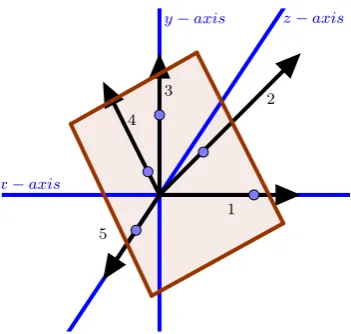
Figure 2.1: MatroidM as vectors inR3.
Having drawn the matroid in vector form, we place a hyperplane in general position observing where it intersects with a scalar multiple of each vector. Place points at these intersections.
y−axis
x−axis
z−axis
3
1 2
5 4
Figure 2.2: Hyperplane and vectors ofM.
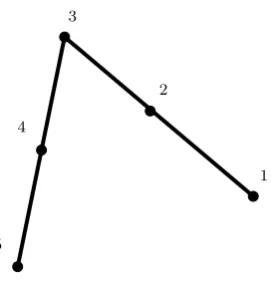
the elements of the matroid in the geometry. With these points in place, we make note of collinear points, remove the vectors, and observe the points on the hyperplane. In the case of our example, this is now in R2. The result is the geometric representation of
matroid M.
3
5
1 4
2
Figure 2.3: The geometry of matroid M.
Note that the three element circuits, like{123}, are collinear, and the four ele-ment circuits and dependent sets, like {1245}, are coplanar. Meanwhile, the bases, such as{135}, are not collinear.
To further illustrate this process, we consider another example. Let L be the matroid represented by the following matrix:
Example 2.1.
L=
1 2 3 4 5 1 2 1 0 0 0 0 1 1 0
y−axis
x−axis
4
1 2
3
5
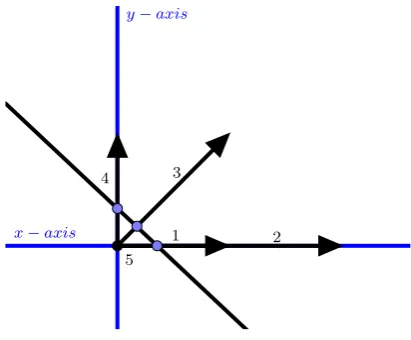
Figure 2.4: Matroid Las vectors in R2.
Note that Vectors 1 and 2 lie atop one another and form a linearly dependent set of size two. Meanwhile, Vector 5 has a magnitude of zero. We once again place a hyperplane in general position and observe the intersections.
y−axis
x−axis
4
1 2
3
5
Figure 2.5: Hyperplane and vectors of the matroid L.
4 1
2
3 5
Figure 2.6: The geometry of the matroid L.
The vectors of 1 and 2 are multiples of one another and share direction. There-fore they extend to intersect with the hyperplane at the same point. As a result, the two elements lie in the same position in the geometry, forming a two element dependent set, stemming from the linearly dependent set of size two they formed in the matrix. Element 5 forms a linearly dependent set of size one in the initial matrix, effectively forming a single element dependent set in the matroid. As such, it does not intersect with a hyper-plane in general position, and is depicted in the geometry within a cloud to denote it as a dependent singleton.
To summarize, given the matrix of a representable matroid, we may find its geometry by first designating the columns of the matrix as elements. We then graph the vectors in Rn wherenis the number of non-zero rows of the matrix. Once the vectors are
graphed, we place a hyperplane in general position and place points where some scalar multiple of each vector intersects the hyperplane. We label each of these points the same as the vector upon which they lie, before subsequently removing the vectors, hyperplane, and axes, and making note of which points are colinear, coplanar, etc.
2.2.2 Identifying Bases of Matroids in Graphs
Matrices and geometries are not the only means by which a matroid may be presented. Sometimes a matroid will take the form of a graph as seen in matroid K
2
8
7
1 5
3
4
6
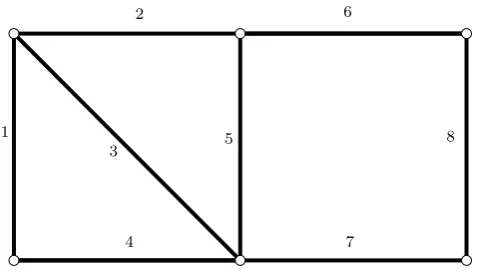
Figure 2.7: The graph of matroid K.
Although visually similar, graphs of matroids differ from geometries of matroids in a key regard: the elements of the matroid are depicted by the edges of the graph, not the points as in a geometry. As such, the vertices of a graph are herein depicted as open circles to help distinguish the two.
The subsets of the matroid are therefore depicted by collections of edges in the graph. Apath from vertexuto vertexv in a graphGis a sequence of alternating vertices and edges v1 = u, e1, v2, e2, v3, e3, ..., vk−1, ek−1, vk = v such that, for i = 1,2, ..., k−1,
edge ei is incident with vertices vi and vi+1 and all edges and vertices in the sequence
are distinct. For example, the collection of edges {1268} in the graph K form a path by which one may “move” from the lower-leftmost vertex to the lower-rightmost. A collection of edges is said to beconnected if there exists a path between any two vertices in the collection. Finally, a path where v1=vk, for example{1254}, is called a cycle.
Meanwhile, a connected graph that does not contain any cycles is referred to as a tree, and the collections of edges in these trees form the independent sets of elements of the matroid depicted by the graph. More importantly, a tree that includes all vertices of a graph is called a spanning tree, and the collection of edges forming the spanning tree form a basis in the matroid. In matroid K these bases are:
B={12367,12368,12378,12467,12468,12478,12567,12568,12578,12678,13567,13568,
The rank of matroid K can therefore be determined to be five. A geometry depicting it would require four dimensions. Herein we see the utility of matroid graphs. If a matroid is graphic and of rank greater than four, the graph of the matroid provides a means of visualizing it in a simpler fashion than the geometry, which is limited by dimension.
Sometimes, a matroid may also be modelled by a bipartite graph. Such matroids are called transversal matroids. However, in visualizing a matroid in this manner, we introduce another means of conceptualizing the matroid. In a transversal matroid, the corresponding bipartite graph has as its two vertex sets (E, R) where E is the ground set of the matroid, and |R| is the rank of the matroid. Consider the bipartite graph of matroid J below, where E={1,2,3,4,5}and R:{x, y, z}:
1
2
3
4
5
y x
z
Figure 2.8: The bipartite graph of matroidJ.
In a bipartite graph, a collection of edges wherein no two edges share a vertex is called a matching. Each of a transversal matroid is a subset of E corresponding to a matching in the bipartite graph. In matroidJ:
B={124,125,134,135,234,235,245,345}.
The vertices on the right do not depict elements of the matroid but determine the rank of the matroid. In matroid J above, the 3 vertices on the right indicate the matroid is of rank 3.
for one of the two to share vertex {y} with {1}. A similar argument may be made for the subset {145}.
Given these bases and dependent sets, one may notice matroidJ is structurally identical (isomorphic) to matroid M, although the elements have been relabelled.
2.2.3 Examples Given Sets of Bases
Not all matroids are representable, graphic, or transversal. However, one need not be given a matrix, graph, bipartite graph, or any other visual in order to determine if a collection of subsets of elements of E is indeed a matroid. Under the Basis Axioms previously established, one only needs to know the maximally independent subsets of the ground set, and check them against the axioms.
Consider the following matroidN. LetE={1,2,3,4,5,6,7}, andB={125,126,
135,136,245,246,345,346}. A check of the basis axioms confirms that this is indeed a matroid. However, should we want to represent it in another fashion, we might construct the geometry of the matroid. In attempting to draw the geometry of a matroid without first being given its matrix, graph, or bipartite graph, one does the following:
Each single independent element is represented by a point. Any two elements that are independent span a line, while a dependent pair share a point. A three element independent set spans a plane, whereas the elements of a three element dependent set are collinear. It follows that if four elements are independent they are not coplanar. [Gor12] By these criteria, and given the bases of N, we may construct the following geometry:
5
6 4
1
3 7
2
Likewise, given a geometry, one may determine the associated bases and use them to determine if the geometry represents a matroid. Consider the following geometry of a rank three matroid P. As the matroid is rank three (and thereby 2-dimensional), we know the bases must be any collection of three elements that span the plane.
1
3
5 2
4 6
Figure 2.10: Geometry of matriodP.
Such collections of elements form the basis subsets and soB={124,125,126,134,
135,136,146,156,234,235,236,245,246,256,345,356,456}. Basis axioms (B1) and (B2) are easily observed to be true, and an exhaustive comparison of each pair of bases would ultimately confirm (B3).
However, one must not confuse any collection of subsets declared as bases a ma-troid. Consider the following “matroid”Q: B={1235,1236,1245,1246,1345,1346,1356,
1
7 3
5
6
2 4
Figure 2.11: Geometry of above “matroid”.
This collection of maximally independent sets fails to satisfy axiom (B3). Con-sider “basis” subsets B1 = {1246} and B2 = {1567}. Recall from the definition of a
matroid, (B3), if B1,B2 ∈ B and x∈(B1−B2), then there is an elementy∈(B2−B1)
so that (B1−x∪y)∈ B and (B2−y∪x)∈ B. Letxbe the single element 4 inB1. There
does not exist any element y inB2 such that (B1−x∪y) ∈ B. If we replace element 4
in B1 with element 5 fromB2, the set{1256} forms a coplanar collection and therefore,
a dependent set. Meanwhile, if we replace the element 4 in B1 with 7 from B2, the set
{1267}contains the collinear subset{127}which is dependent. Neither of these resultant sets is a basis, and thus axiom (B3) is not satisfied. This geometry, which is not in fact a matroid, is referred to as the Escher Matroid.
2.3
Duality
Having established some of the ways in which matroids arise and can be viewed, we shift to one of the most useful of a matroid’s aspects: duality. Notions of duality are prevelent in a number of fields of mathematics, but within the scope of matroid theory, duality is defined as follows:
LetM be a matroid on a collection of elements E, with bases
as its set of bases: B∗ = {E −B : B ∈ B}. This definition leads us to the following theorem.
Theorem 2.2. The dual of a matroid is also a matroid.
Proof. LetM be a matroid with basesB={B1, B2, ..., Bn}. Consider the set of all basis
complements B∗ ={E−B:B ∈ B}.
(B1) M is matroid, thereforeB 6=∅. AsB⊂Eexists, for allB ∈ B, the setE−B exists, therefore B∗ 6=∅.
(B2) We defined the rank r of a matroid to be the number of elements found within each of its bases. Thus for every basis Bi ∈ B, we know |Bi| = r. It follows that the
complement of every basis has size|E| − |Bi|. Each basis complement is of the same size
and thus condition (B2) is fulfilled.
(B3) LetB1∗=E−B1 andB2∗=E−B2 whereB1, B2 ∈ Bsuch that there exists element
x ∈ B2 but x /∈ B1. (Should no such element exist, B1 and B2 are the same basis.)
Therefore, x ∈B∗1 butx /∈B2∗. By the basis exchange axiom, there exists y ∈B1−B2
such that (B1−y)∪x and (B2−x)∪y are also bases of M. If we take the complement
of these new bases, the results are E−((B1−y)∪x) and E−((B2−x)∪y), or rather
(B1∗−x)∪y and (B∗2)−y∪x ∈ B∗.
Consider the following examples exhibiting the process of constructing the dual of a matroid.
Example 2.3. Consider a rank 2 matroid A on the set E = {1,2,3,4} with bases
B={13,14,23,24,34}. The geometry of this matoid is seen below.
4 3
1
2
We find the bases of the dualA∗ofAby taking the complement of each basis of
A. Therefore the bases ofA∗ areB∗ ={E− {13}, E− {14}, E− {23}, E− {24}, E− {34}}. This results in B∗ ={24,23,14,13,12}. Thus A∗ has the following geometry:
1 2
3
4
Figure 2.13: Geometry of matroidA∗.
A quick check of the basis axioms against this new set of bases confirms thatA∗
is a matroid as well. Moreover, the geometries of the original matroid and its dual are structurally the same, but their elements (namely the two-element dependent set) have been labelled differently. This result is not always the case, as we will see in the next example.
Example 2.4. Let D be a rank 3 matroid on five elements E = {1,2,3,4,5} with the following set of bases: B ={124,125,134,135,234,235}. This matroid has the following geometry.
1 2 3
4 5
Again, a check of the basis axioms confirms that this is a matroid. We calculate the bases of the dual D∗ of D by once again taking the complement of each basis of D. The result is the collection of subsets B∗ ={35,34,25,24,15,14}. This collection passes the basis axioms as well, and therefore D∗ is also a matroid.
1
3 2
5 4
Figure 2.15: Geometry of matroidD∗.
Note that the resultant matroid D∗ is no longer of rank 3, but now of rank 2. This difference in rank can be explained by the following lemma.
Lemma 2.5. Given a matroidM of rankr on nelements, the rank of the dual matroid
M∗ isn−r.
The proof of this lemma comes about as a result of the proof of Theorem 2.4. For clarity, we prove it here separately.
Proof. LetM be a matroid of rankr onnelements, whose dual is also a matroidM∗. By definition, the rank of a matroid is equal to the size of its bases. That is, |B|=r:B ∈ B. The bases of the dual of a matroid, M∗, are defined as the complements of the bases of
M. That is B∗ ={E−B :B ∈ B}. Every element in any basis B must also exist in E. Therefore |E| − |B|=n−r, and so |B∗|=n−r
We have proven that the dual of a matroid is itself a matroid, and that the rank of this new matroid is equal to difference of the cardinality of the ground setE and rank of the original matroid.
MatroidsM1andM2areisomorphicif there exists a bijective functionφ:M1 →
basis in B(M2).We have seen in Example 2.5, an instance in which the dual of a matroid
is isomorphic to the original matroid. In later sections we will refer to matroids who are isomorphic to their dual as being self-dual. Matroids that are isomorphic and whose elements are labelled the same within the geometry are considered identically self-dual.
In the final lines of this section we introduce another minor, though important, quality of matroid duality.
Lemma 2.6. The dual of the dual of a matroid is the original matroid. That is, if
M∗ =N, thenN∗ =M.
Proof. LetM be a matroid and the dual ofM be the matroidN. The bases of the dual matroid N are found by taking the complement of those of M. Thus the dual of N,
N∗, would require taking the complement of its bases, or rather the complement of the complement of those of M, which results in the bases ofM.
2.4
Some Matroid Constructions
In this final section of our introductory chapter on matroids, we explore a few matroid constructions and the results of these constructions. Often, one may wish to construct new matroids from existing ones by methods other than duality. While there are a number of ways to do so, herein we examine three means by which a matroid may be constructed from another: contraction, truncation, and Higgs lift.
Given a matroid M on ground set E, and let ebe an element of E that is not a loop. The matroid constructed by the contraction of e ∈ E,written (M/e), has as its bases B(M/e), the set of all rank r −1 subsets B−e, for each B ∈ B(M). In the contraction of e, the elementeis removed from the ground set.
Example 2.7. LetMbe a rank 2 matroid onE ={1,2,3,4}with basesB={13,14,23,24}.
2 4
1 3
We contractM about element 2. As a result, the bases ofM/2 are the bases of
M that contained 2, that is{23}and {24}with 2 now deleted, BM/2 ={34}.
3
4 1
Figure 2.17: Geometry of matroid M/2.
Contraction will become an important procedure during the final chapters of this work, as it is essential to proving our suggested notion of flag matroid duality.
Given a matroidM of rankr, thetruncation ofM to rank k, wherek < r, is a matroid with all independent sets of size kinM as its bases.
Example 2.8. Consider the matroid N from Section 2.3, of rank 3, on the ground set
E = {1,2,3,4,5,6,7}, with bases B = {125,126,135,136,245,246,345,346}, and with the following geometry.
5
6 4
1
3 7
2
Should we hope to truncate this matroid to rank 2, we must identify the in-dependent sets of cardinality 2 in matroid N. These sets form the bases of a rank 2 matroid, N2: B2 ={12,13,14,15,16,24,25,26,34,35,36,45,46,56}. The element 7 does
not appear in any independent set in N and therfore remains a dependent singleton in this truncation. Similarly, elements 2 and 3 form a two element dependent set inN and are therefore not a basis in N2. The collection of these rank 2 bases satisfy the basis
axioms, and thus N2 is a matroid with geometry:
1 2 6
3
4 5
7
Figure 2.19: Geometry of matriod N2.
By the same truncation process, we may construct a matroid of rank 1, N1.
We identify the single element independent sets in N, and declare them the bases ofN1.
B1 ={1,2,3,4,5,6}which form a matroid, albeit an uninteresting one.
1 2
3 4 5
6
7
Before we present a third method of matroid construction, we introduce termi-nology that describes the relationship between matroids and their truncations, which will be essential in defining the Higgs lift.
Given a matroid M of rank r and a matroid N of rank s where s < r, N is
quotient toM if every basis ofN is contained within a basis ofM and every basis of M
contains a basis of N. When one matroid is quotient to another we say that the two are
concordant.
Due to the manner in which they were constructed, it is evident that matroids produced by truncation are quotient to their original matroid. By definition, trunca-tion constructs matroids of smaller rank than that of the original matroid. Our third construction, the Higgs lift constructs new matroids given concordant matroids.
Given matroidsLof ranklandM of rankm, onnelements, whereLis quotient toM, theHiggs lift ofLtowardsM, writtenHLM(L) is the matroid of rankl+ 1 whose
Example 2.9. Consider matroidM of rank 4 on ground set E={1,2,3,4,5,6,7}with bases BM ={1346,1347,1356,1357,1367,1456,1457,1467,2346,2347,2356,2357,2367,
2456,2457,2467,3467,3567,4567}.
5
3 6
1 2
4
7
Figure 2.21: Geometry of matriod M.
Consider as well, matroid L, quotient to M, of rank 2 on the same elements, with bases BL={13,14,15,16,17,23,24,25,26,27,34,35,36,37,45,46,47,56,57,67}.
7 1
2
3 4 5 6
Figure 2.22: Geometry of matriodL.
As the rank of matroidLis 2, we can construct the Higgs lift matroidHLM(L)
by identifying the independent sets of size 3 in M that are also of rank 2 in Land then by using these sets as the bases for our new matroid. Doing so results in the set of bases
BHLm(L) ={134,135,136,137,145,146,147,156,157,167,234,235,236,237,245,246,247,
1
3
5
2 4
6 7
Figure 2.23: Geometry of matriod HLM(L).
Chapter 3
Gale Orderings
It is at this point, having established the fundamental aspects of a matroid, we can begin to examine relationships between the elements of a matroid and those of the symmetric group. We begin by establishing the concept of a Gale Ordering.
Consider the symmetric group on n elements,Symn, where n is finite. We are
able to induce an ordering (denoted≤w) on these elements, effectively establishing which
elements are greater than which. For example:
1<w2<w 3<w ... <wn−1<wn
We refer to this particular example as the identity ordering. However, we can consider any rearrangement of the nelements. For example:
4<w9<w 2<w 1<w n <w ...
When establishing a Gale ordering on a collection ofnelements, we will use the symbol <w as no two elements can be weighted the same. However, when comparing the weights of subsets against one another, we will use the symbol ≤w as some
indi-vidual elements within a subset may be compared against themselves in another subset, necessitating a need to represent potential equality.
As this is a concept we will make frequent use of, there is an established short-hand for Gale orderings written in two rows. The upper row depicts the identity ordering, while the lower rearranges the n elements, assigning each the weight of the element di-rectly above it in the identity. For example, let n = 4 and consider the ordering <w
1234
4213
This corresponds to the ordering,
4<w 2<w1<w3
(Note: Despite the visual similarity to a matrix, and by extension the matrix represen-tation of a matroid, the array represenrepresen-tation of a Gale ordering is not a matrix.)
This concept can be be extrapolated to apply to subsets of [n], where [n] =
{1,2,3,4, ..., n}, and ultimately to the bases of a matroid. Let Pn,k be the collection of
all k-element subsets of [n]. By inducing the ordering≤w on [n], subsets withinP n,k are
subject to the same ordering. If the ordered elements in one set A are greater than the corresponding ordered elements of another set B, theA is said to be greater thanB.
Example 3.1. Let A = {134}, B = {123} ∈ P4,3 and induce the ordering described
above:
1234
4213
Under this ordering we rewrite A andB asA= (314) and B = (312). The subsets have not changed, but we have rewritten them in descending order of weight under the given ordering ≤w. As,
2≤w 4, 1≤w1, and 3≤w 3
We can compare the full subsets, claiming A≤w B.
Example 3.2. To further illustrate the application of a Gale ordering, let us apply one within the contexts of a matroid. Recall matroid P from Section 2.2. LetP be a matroid of rank 3 onE ={1,2,3,4,5,6}with basesB={124,125,126,134,135,136,146,156,234,
1
3
5 2
4 6
Figure 3.1: Geometry of matriodP.
Consider the following two Gale orderings ≤w
1 and ≤w2
≤w
1 =
123456
526341
≤w
2=
123456
134265
If we induce the first Gale ordering≤w
1on the matroid, we may rewrite the bases
as follows: B={142,125,162,143,135,136,146,165,432,325,362,425,462,625,435,365,
465}. Notice that the basis{143}is greater than any other basis under this Gale ordering. In subsequent sections, we will refer to this as the maximal basis under≤w
1.
If we instead induce the second Gale ordering ≤w
2 on the matroid, we may
rewrite the bases as B={241,521,621,431,531,631,641,561,243,523,623,524,624,562,
542,563,564}. Once again, a maximal basis arises, however, under this ordering this basis is {562}.
Chapter 4
Maximality and
Increasing Exchange Properties
In this chapter we introduce two new means by which a matroid may be defined using Gale orderings.
4.1
The Maximality Property
A collection of subsets B of n is said to satisfy the Maximality Property if for everyw∈Symn, the collectionBcontains a unique member A that is maximal inBwith
respect to≤w; that is,B ≤w Afor allB ∈ B. We call A thew-maximal or Gale-maximal
basis in B. [Bor03]
Theorem 4.1. LetB ⊆Pn,k. ThenBis a matroid if and only ifBsatisfies the Maximality
Property.
In order to prove this theorem we must first show that a collectionB ⊆Pn,kthat
satisfies the Maximality Property also satisfies the basis axioms that define a matroid. We must then show that the bases of a matroid satisfy the Maximality Property.
Proof. Let a collection of subsetsBofPn,k satisfy the Maximality Property. For (B1), by
the Maximality Property, for every Gale ordering≤w onnelements there exists a unique
member A ∈ Bthat is maximal in B with respect to ≤w. If such an element exists in B
For (B2), by definition, B ⊆ Pn,k where Pn,k is the collection of all subsets of
cardinality k ofnelements. EveryB ∈ B has cardinality k, and thus|B1|=|B2|for any
B1, B2∈ B. Therefore, (B2) is satisfied.
For (B3), letAand B be members ofB ⊆Pn,k. LetA−B ={x1, x2, ..., xk}be
the collection of all elements in A but not in B. Likewise, let B−A={y1, y2, ..., yl}be
all elements in B but not inA. Consider the Gale ordering ≤w shown below:
(elements not in A or B) <w x1 <wy1 <w y2<w ... <wyl <w x2 <w... <w xk.
By the Maximality Property, there must exist a maximal subset for any ordering induced on the n elements. A quick observation of our ordering above shows that neitherA nor
B is the maximal subset for this ordering, as x1 is less than all elements in B−A, while
all other elements of A−B are greater than those ofB−A. LetC∈ B be the maximal subset with respect to this ordering. We know that, A ≤w C, but A also contains the
k−1 greatest elements under this Gale ordering. Therefore, C must also contain these elements. In order to exist in Pn,k, set C must contain a “kth” element. In order to
ensure this element is greater than x1, it must come from {y1, y2, ..., yl} = B −A, lets
say yc. Thus the maximal element under this Gale ordering C =A− {x1} ∪ {yc}. This
is, in effect, an application of the Basis Exchange Property, and can be performed using any two subsets A, B∈ B ⊆Pn,k. Thus (B3) is satisfied.
Now letM be a matroid onnelements and therefore satisfy the Basis Exchange Property. Assume that a Gale ordering ≤w on these n elements does not result in a
unique maximal basis. Instead, let bases A and B be unique bases in B such that they are simultaneously maximal on the ordering. Let x ∈A be the minimal element among all elements in A but not inB, with respect to ≤w.
From the Basis Exchange Property, there exists an element y ∈ B such that
A− {x} ∪ {y}and B− {y} ∪ {x}are also bases ofM. One of the following must be true:
x <w y or y <w x. If x <w y, then A <w A− {x} ∪ {y} which contradicts the initial claim that A is a maximal basis under ≤w. Ify <w x, then B <w B− {y} ∪ {x} which
contradicts the initial claim that B is a maximal basis under≤w. Therefore, a matroid
cannot have more than one maximal basis on any given Gale ordering.
single subset A∈ B such thatA is weighted greater/heavier/etc. than any other basis of the matroid.
4.2
The Increasing Exchange Property
LetB ⊆Pn,k, let A1,A2 be distinct members of B, and let ≤w be an arbitrary
permutation. Then B is said to satisfy the Increasing Exchange Property if there is a transposition t= (a, b), with a <w b, such that for eitherA1 orA2, sayAi, containinga,
but not containing b,tAi =Ai−a∪b also belongs toB. [Bor03]
More simply, through a transposition, a non-maximal basis may increase in weight on a given Gale ordering. This implies that, given a matroid with bases B and a Gale ordering, if a basis B∈ B is not already maximal, there exists a series of transposi-tions by which it may become the Gale-maximal basis.
This property is an application of axiom (B3) under a Gale ordering. With this in mind, we aim to show that if a collection of subsets satisfies the Increasing Exchange Property, then those subsets form the bases of a matroid.
Theorem 4.2. Let B ⊆Pn,k. B satisfies the Increasing Exchange Property if and only
ifB satisfies the Maximality Property.
Proof. LetB ⊂Pn,k be a subset that satisfies the Maximality Property. As proven in the
last section, the subsets of B are therefore the bases of some matroid M on n elements and therefore satisfy the Basis Exchange Property. LetB1, B2 ∈ B, whereB1 andB2 are
distinct bases of M. By (B3) there must exists elements x∈B1−B2 and y ∈B2−B1
such that B1−x∪ {y}and B2−y∪ {x} ∈ B. Induce an arbitrary Gale ordering ≤w on
the nelements. By definition of such an ordering, eithery <w x orx <w y. Lettbe the transposition t= (x, y). By (B3) we know thattB1,tB2 ∈ B. Ify <wx, then under this
transposition B1 increases in weight, replacing one of its elements,x, with a heavier one,
y, thusB1 <w tB1. Similarly, if x <w y,B2 <w tB2
Now let B ⊂ Pn,k satsify the Increasing Exchange Property. Assume B does
not satisfy the Maximality Property. Therefore there exists some Gale ordering ≤w such
that two distinct subsets in B, say B1, B2, are both maximal under the given ordering.
Let x ∈ B1−B2 and y ∈ B2−B1, and let transposition t = (x, y). By the Increasing
subsets must increase in weight under the transposition. Thus, either B1 or B2 is not
maximal under the Gale ordering, and we have a contradiction.
The Increasing Exchange Property on a collection of subsets B ⊂ Pn,k implies
Chapter 5
Flags and Flag Matroids
We define aflag F to be a collection of finite sets
B1 ⊂B2 ⊂B3 ⊂...⊂Bk
where the cardinality of each set is denoted 1,2,3, ..., k respectively (i.e. |Bk|=k). For example, given the sets {1}, {14}, {124}, and {1234}, the collection {1 ⊂
14 ⊂ 124⊂1234} is a flag. In the interest of brevity, we write this flag {1423} placing elements in the order they were included as we increased in set size. Note, that whereas the order of the elements in a basis did not matter (i.e. if B1 ={123},B2 ={132}then
B1 =B2,) the same cannot be said for flags. F1 ={123} ={1 ⊂ 12 ⊂ 123} is not the
same asF2 ={132}={1⊂13⊂123}.
We now define what constitutes a flag matroid. A collection of Fk1,k2,...,km
n of flags of rank k1, k2, ..., km is a flag matroid on n
elements if the the following are true:
(F1) Each constituentMi of F is a matroid.
(F2) The constituentsM1, ..., Mm are concordant
(F3) Every flagB1 ⊂ ...⊂Bm such that Bi is a basis of Mi fori= 1, ..., mbelongs to
Fn1,2,..,m.
Example 5.1. Consider the example from Section 2.1. Matroid M3 has the following
3
5
1 4
2
Figure 5.1: The Geometry of constituent matroidM3.
This matroid has basesB ={124,125,134,135,145,234,235,245}. Consider as well matroids M2 and M1 concordant to M3 with bases B2 = {12,14,23,25,35} and
B1 ={1,2,5}, respectively.
5 1
3
2
4
1 2 3
4
5
Figure 5.3: Geometry of constituent matroidM1.
As a result, the bases of these three matroids form a flag matroid, with flags
F51,2,3={124,125,142,143,145,214,215,234,235,251,253,521,523,531,532}.
At this point, it is important to acknowledge that a flag matroid is not a matroid, and is not defined by the basis axioms. Its name derives from a flag matroid’s reliance on matroids for its construction, but we must always remember that it is not a matroid itself.
Recall that the Maximality Property (and subsequently the Increasing Exchange Property) from the previous sections did not apply exclusively to matroids, but rather to subsets of n elements. As such, we can apply their principles to the various flags in Fk1,k2,...,km
n found within a flag matroid. With this in mind, we introduce the next
theorem regarding flag matroids.
Theorem 5.2. A collection of flagsFk1,k2,...km
n is a flag matroid if and only if it satisfies
the Maximality Property.
Proof. LetFk1,k2,...,km
n be a flag matroid. Assume this collection of flags does not satisfy
the Maximality Property. Instead, assume that for a Gale ordering ≤w there exist two
distinct maximal flagsF1 and F2. LetMr denote the constituent matroid of lowest rank
at which B1 ∈ F1 6= B2 ∈ F2 are bases of Mr. If F1 and F2 are both maximal flags,
then B1 and B2 must both be maximal bases in Mr under≤w. However, as was proven
a matroid which then violates condition (F1) of a flag matroid. We have a contradiction and Fk1,k2,...,km
n is therefore not a flag matroid.
Now assume a collection of flags Fk1,k2,...,km
n ⊂ Pn,k satisfy the Maximality
Property. First, rewrite each flag in its elongated form, as a collection of subsets (i.e.
{132}={1⊂13⊂123}.) Create subsets ofPn,k fork= 1,k= 2, ...,k=msuch thatB1
contains all cardinality 1 subsets found in any flag, B2 contains all cardinality 2 subsets
found in any flag, and so on. As the Maximality Property held on the collection of flags, it continues to hold on these new subsets. Thus as each subsetBi satisfies the
Maximal-ity Property, each such collection also defines a matroid. Thus F is made up entirely of constituent matroids, satisfying (F1). As the elements ofBi came directly from flags, we know that for any Bi ∈ Bi, there exist Bj ∈ Bj and Bk ∈ Bk for any ranks j < i < k
such that Bj ⊂ Bi ⊂ Bk. Therefore the constituent matroids are concordant, fulfilling
condition (F2). Finally, as the basis elements were taken directly from a collection of flags satisfying the Maximality Property, no flag F ={B1 ⊂...⊂X ⊂...⊂Bm}, where
X is not a basis element of the corresponding constituent matroid of rank|X|, may exist within the collection of flags. Condition (F3) is satisfied, and F is a flag matroid.
Consider again the flag matroid with constituent matroids M3, M2, and M1:
F51,2,3 = {124,125,142,143,145,214,215,234,235,251,253,521,523,531,532}. By defi-nition, this collection of flags must satisfy the Maximality Property for any Gale or-dering. To illustrate this, let us induce the following Gale ordering on the elements
E ={1,2,3,4,5}:
≤w:
12345
32415
Here, {4}, {1}, and {5} are the three ”heaviest” elements under this ordering and {415} ∈ F51,2,3. Therefore, {415} is the maximal flag under this ordering. Consider another such ordering.
≤w:
12345
45312
Here, {3}, {1}, {2} are the heaviest elements under the ordering. However,
Chapter 6
Duals of Flag Matroids
In this chapter, we suggest a definition for the dual of a flag matroid, how these duals may be found, and prove that the dual of a flag matroid is itself a flag matroid.
6.1
Definition
LetFk1,k2,...,km
n denote a flag matroid with constituent matroidsM1, M2, ..., Mm
where the superscript denotes the ranks of each constituent matroid. By definition of a flag matroid, each constituent matroidMi is quotient toMj for anyi < j ≤k.We define
the dual of Fk1,k2,...,km
n as follows:
We begin by first taking the dual of each constituent matroid whose bases are used to form the flags of the original flag matroidF. Whereas constituent matroids of the initial flag matroid were concordant, with M1 quotient to M2, quotient to, ..., quotient
to Mm, the collection of the constituent duals of the matroids also are concordant, with
Mm∗ quotient to, ..., quotient toM2∗, quotient toM1∗. Thus there exist collections of bases of increasing rank in the dual of the flag matroid such that B∗n⊂...⊂B2∗ ⊂B1∗. These collections of nested bases form the flags for the dual of the initial flag matroid.
We present a simple example of this method of flag matroid dual construction to clarify the process. More complex flag matroid duals will be taken in the next chapter. Consider matroidsM4,M3,M2 andM1 on 5 elementsE={1,2,3,4,5}of rank
4, 3, 2, and 1 respectively, with basis sets B4 ={1234},B3 ={124,134},B2 ={12,13},
and B1 ={1}.
matroids. Having done so, we now check if these matroids are concordant. Again, they are, as every basis in each matroid contains basis subsets of those of lower rank, and are each contained in basis subsets of higher rank. This relationship can be visualized in the following diagram:
{1}
{13} {12}
{124} {134}
{1234}
Rank 4
Rank 3
Rank 2
Rank 1
Figure 6.1: Diagram of bases as subsets of one another.
Therefore, M1 is quotient to M2 is quotient to M3 is quotient to M4. Having
confirmed that the constituents are concordant matroids, we can then determine the flags of this collection of matroids by identifying which bases are contained within one another. This collection results in two flags, F51,2,3,4 ={{1⊂12⊂124⊂1234},{1⊂13⊂134⊂
1234}}, or more simply: F51,2,3,4={1243,1342}. A check of the Maximality Property on flags confirms that these two flags form a flag matroid. Having established that our initial collection of matroids and bases form a flag matroid, we can now proceed to construct the dual.
B4∗={25,35},B2∗={245,345}, B1∗ ={2345}. By definition, each of these matroid duals is itself a matroid, and a check of the bases confirms that they are also concordant, with
M4∗ quotient to M3∗ quotient to M2∗ quotient to M1∗. This leads to a dual collection of flags, F51,2,3,4∗ = {{5 ⊂ 25 ⊂ 245 ⊂ 2345},{5 ⊂ 35 ⊂ 345 ⊂ 2345}}, or more simply:
F51,2,3,4∗ ={5243,5342}. Maximality holds on these two flags, thus we know the dual of the original flag matroid is also a flag matroid. In the following section, we will prove that this is always the case, and that the dual of any flag matroid is itself a flag matroid.
6.2
A Theorem of Flag Matroid Duality
Before suggesting our theorem for matroid duality, we present a lemma that will be crucial to its proof.
Lemma 6.1. Let M1 and M2 be matroids. ThenM1 is a quotient to M2 if and only if
M2∗ is a quotient toM1∗. [Oxl11]
Proof. Let M1 be quotient to M2 on ground set E ={1,2,3, ...n}. Then there exists a
basis B1 of M1 and B2 of M2 such that B1 ⊂ B2. Because M1 is quotient to M2, the
rank ofM2 is greater than the rank ofM1, and there exists some element(s)x∈B2−B1.
Now consider the bases of M2∗ and M1∗. B2∗ =E−B2 and B1∗ =E−B1. ButB1∪ {x :
x∈B2−B1}=B2, therefore, B2∗=E− {B1∪x:x∈B2−B1} which can be rewritten
as B2∗ =B1∗− {x :x ∈B2 −B1}. In short, B2∗ ⊂B1∗. This is true of any such bases in
the original matroids and thus the duals of these matroids are also concordant.
With all the necessary foundations having been laid, we are now prepared to present the consequence of our notion of flag duality.
Theorem 6.2. The dual of a flag matroid is a flag matroid.
Proof. A collectionF of flags of rank (k1, k2, ...km) is a flag matroid if the following three
conditions are true:
(F1) Each constituent matroidMi of F is a matroid
(F2) The constituentsM1, ..., Mm are concordant.
In proving (F1), recall that each constituent of the initial flag matroid is a matroid, and that the dual of a matroid is a matroid. As the constituents of the dual of the flag matroid are duals of the original constituent matroid, every constituent of the dual flag matroid is a matroid.
In order for the (F2) quotient condition to hold, M2∗ must be quotient to M1∗
given M1 is quotient to M2. From Lemma A, we know this to be true, and thus (F2) is
satisfied, We can extend this argument to any two matroids Mi quotient to Mj in the
flag matroid F resulting in Mj∗ quotient to Mi∗ in the dual of the flagF∗.
Condition (F3) is fulfilled directly by our definition of the dual of a flag matroid. We have declared that every collection Bn∗ ⊂ ...⊂ B2∗ ⊂ B1∗ forms a flag in the dual of the flag matroid. Thus (F3) is fulfilled
Chapter 7
Flag Matroid Duals on n
≤
4
In this chapter we consider all possible flag matroids on 1,2,3,and 4 elements. Then, using our suggestion of flag matroid duality, we determine the dual of each flag matroid. Once we have done so, we determine which flag matroids are self-dual as defined below.
Flag matroids Fk1,k2,...,kn
1 and F
k1,k2,...,kn
2 are isomorphic if, for i = 1,2, ..., n,
each rank ki constituent matroid in F1 is isomorphic to the rank ki constituent matroid
inF2.
A flag matroid is self-dual if the dual of the flag matroid, under the process we have defined, is isomorphic to the initial flag matroid. That is, the constituent matroids of the flag matroid are isomorphic to the constituent matroids of the dual. A flag matroid is identically self-dual if it is self-dual and if the labelling on the elements within the geometries of the constituent matroids are identical to those found in the initial flag matroid.
7.1
Flag Matroids on 1 Element
Let E = {1}. The case of n = 1 is simple, as there only exist two possible constituent matroids. The first is of rank 0:
Matriod M: B={∅}
1
Figure 7.1: Rank 0 matroid on 1 element.
The second is of rank 1:
Matriod N: B={1}
1
Figure 7.2: Rank 1 matroid on 1 element.
Thus, the only viable flag matroid, isF1
1 ={∅ ⊂1}, or rather {1}. If we take
the dual of this flag matroid as describe above, we see that the dual matroid M∗ consists of basis {1}, while the dual matroid N∗ has basis{∅}, and together the two form a flag matroid of a single flag, F1
1
∗
={∅ ⊂1}, or rather {1}. Thus, this single flag matroid on
n= 1 element is identically self-dual.
Table 7.1: Duality of the flag matroid on one element. Flag Matroid Flags Flag Duals Dual Flag Matroid Duality
7.2
Flag Matroids on 2 Elements
LetE ={1,2}. The case on two elements is slightly more intricate, and suggests an important concept in constructing flag matroids: the labelling of the elements on the matroid structure matters. When dealing with two elements, there exists one possible matroid of rank 0:
Matriod M: B={∅}
1 2
Figure 7.3: Rank 0 matroid on 2 elements.
There are three possible matroids of rank 1
MatriodN1: B={1}, Matriod N2: B={2}, and Matriod P: B={1,2}
1 2 1 2 1 2
MatroidN1 MatroidN2 MatroidP
Matriod Q: B={1,2}
1 2
Figure 7.5: Rank 2 matroid on 2 elements.
If we consider the collection of all possible concordant matroids the results are three flag matroids. The first is built on matroids M, N1, and Q: F20,1,2 = {∅ ⊂ 1 ⊂
12} ={12}. The second is built on matroids M, N2, and Q: G20,1,2 ={∅ ⊂ 2 ⊂ 12} =
{21}. The third flag matroid is built on matroids M, P, and Q resulting in two flags:
H02,1,2 ={∅ ⊂1⊂12,{∅ ⊂2⊂12}},={12,21}.
By taking the dual of the flag matroid as described above, we see that the dual of F20,1,2={∅ ⊂1 ⊂ 12} is G20,1,2 = {∅ ⊂ 2 ⊂12}. Note, that while the flags within the flag matroids are different, the constituent matroids of F20,1,2 and G20,1,2 are isomorphic, thus we say F20,1,2 and G20,1,2 are self-dual, although not identically.
The results can be represented in the following table:
Table 7.2: Duality of flag matroids on two elements.
Flag Name Flags Flag Duals Dual Flag Matroid Duality
F {1⊂12} {2⊂12} G Self-Dual
G {2⊂12} {1⊂12} F Self-Dual
H {12,21} {12,21} H Identically Self-Dual
7.3
Flag Matroids on 3 Elements
in cases where multiple potential labellings exist, we will present the possible constituent matroid structures unlabelled, followed by a list of the possible sets of bases on each:
We first consider rank 0:
MatriodM:
1
2 3
Figure 7.6: Rank 0 matroid on 3 elements. This matroid M has the basis setBM ={∅}
Next, rank 1.
Matroids N,P,Q
A B C A B C
C A
B
Matroid N Matroid P Matroid Q
Figure 7.7: Rank 1 matroid structures on 3 elements.
Matroid N may be built upon bases BN1 = {1}, BN2 = {2}, or BN3 = {3}. Matroid P may be built upon bases BP1 ={1,2},BP2 ={13},BP3 ={2,3}. Matroid Q
may be built on the set of bases BQ={1,2,3}.
Matroids R,S,T
A B C A B A B C
C
Matroid R Matroid S Matroid T
Figure 7.8: Rank 2 matroid structures on 3 elements.
Matroid R may be built upon bases BR1 ={12}, BR2 ={13}, or BR3 ={23}.
Matroid S may be built upon bases BS1 = {12,13}, BS2 = {12,23}, BS3 = {13,23}. Matroid T may be built on the set of bases BT ={12,13,23}.
Finally, consider rank 3.
Matroid U
1
2 3
Figure 7.9: Rank 3 matroid structure on 3 elements. This matroidU has the basis set BU ={123}.
We can now determine the collections of concordant matroids and construct the flag matroids accordingly. In the interest of brevity, we introduce a slight breach in notation. We will denote two flag matroids on isomorphic constituent matroids asF1 and
F2. Here the subscript no longer indicates the number of elements, but denotes which isomorphic flag matroid we are referring to. (The difference between the two notations may be distinguished due to the lack of superscript denoting rank.)
There exist 28 potential flag matroids built on three elements. They are as follows:
Let F1 be the flag matroid built on constituent matroids M, N1, R1, and U.
Let F2 be the flag matroid built on constituent matroids M, N1, R2, and U.
F2 ={132}.
Let F3 be the flag matroid built on constituent matroids M, N2, R1, and U.
F3 ={213}.
Let F4 be the flag matroid built on constituent matroids M, N2, R3, and U.
F4 ={231}.
Let F5 be the flag matroid built on constituent matroids M, N3, R2, and U.
F5 ={312}.
Let F6 be the flag matroid built on constituent matroids M, N3, R3, and U.
F6 ={321}.
Let G1 be the flag matroid built on constituent matroids M, N1, S1, and U.
G1 ={123,132}.
Let G2 be the flag matroid built on constituent matroids M, N2, S2, and U.
G2 ={213,231}.
Let G3 be the flag matroid built on constituent matroids M, N3, S3, and U.
G3 ={312,321}.
Let H1 be the flag matroid built on constituent matroids M, P1, R1, and U.
H1 ={123,213}.
Let H2 be the flag matroid built on constituent matroids M, P2, R2, and U.
H2 ={132,312}.
Let H3 be the flag matroid built on constituent matroids M, P3, R3, and U.
H3 ={231,321}.
Let I1 be the flag matroid built on constituent matroids M, P1, S1, and U.
I1 ={123,132,213}.
Let I2 be the flag matroid built on constituent matroids M, P1, S2, and U.
I2 ={123,213,231}.
Let I3 be the flag matroid built on constituent matroids M, P1, S3, and U.
I3 ={132,231}.
Let I4 be the flag matroid built on constituent matroids M, P2, S1, and U.
I4 ={123,132,312}.
Let I5 be the flag matroid built on constituent matroids M, P2, S2, and U.
Let I6 be the flag matroid built on constituent matroids M, P2, S3, and U.
I6 ={132,312,321}.
Let I7 be the flag matroid built on constituent matroids M, P3, S1, and U.
I7 ={213,312}.
Let I8 be the flag matroid built on constituent matroids M, P3, S2, and U.
I8 ={213,231,321}.
Let I9 be the flag matroid built on constituent matroids M, P3, S3, and U.
I9 ={231,312,321}.
Let J1 be the flag matroid built on constituent matroids M, P1, T, and U.
J1 ={123,132,213,231}.
Let J2 be the flag matroid built on constituent matroids M, P2, T, and U.
J2 ={123,132,312,321}.
Let J3 be the flag matroid built on constituent matroids M, P3, T, and U.
J3 ={213,231,312,321}.
Let K1 be the flag matroid built on constituent matroids M, Q, S1, and U.
K1 = {123,132,213,312}. U Let K2 be the flag matroid built on constituent matroids
M,Q,S2, and U. K2 ={123,213,231,321}.
Let K3 be the flag matroid built on constituent matroids M, Q, S3, and U.
K3 ={132,231,312,321}.
Let L be the flag matroid built on constituent matroids M, Q, T, and U.
L={123,132,213,231,312,321}.
7.4
Flag Matroids on 4 Elements
Due to our definition of the dual of a flag matroid, there exists an easier means by which to determine which flag matroids on a given set are self-dual. This method is confirmed by our n = 1, n= 2, and n = 3 cases, but will be employed more explicitely here where n= 4. LetE ={1,2,3,4}
Once again we begin by considering the possible constituent matroids whose bases may form the flags of a flag matroid. Once more, when there exist multiple unique labellings on a matroid structure, we will instead label the matroid structure’s elements with letters rather than numbers, and then make note of all possible collections of bases.
Consider rank 0:
MatroidM
1 2
3 4
Figure 7.10: Rank 0 matroid structure on 4 elements. This matroid M has the basis setBM ={∅}
Matroids P,Q,R, and S
A
C B
D
A
B
D C
A
B C
D A B
C D
Matroid P Matroid Q
Matroid R Matroid S
Figure 7.11: Rank 1 matroid structure on 4 elements.
Matroid P may be built upon bases BP1 = {1}, BP2 = {2}, BP3 = {3}, or
BP4 ={4}. MatroidQmay be built upon basesBQ1 ={1,2},BQ2 ={1,3},BQ3 ={1,4},
BQ4 = {2,3}, BQ5 = {2,4}, or BQ6 = {3,4}. Matroid R may be built upon bases
BR1 ={1,2,3}, BR2 = {1,2,4}, BR3 = {1,3,4}, or BR4 = {2,3,4}. Matroid S may be built upon bases BS={1,2,3,4}
Matroids T,U,V,W,X, and Y
A B C D A B D
C
D C
A B A
B
C
D
A B C
D
A B C D
Matroid T Matroid U
Matroid V Matroid W
Matroid X Matroid Y
Figure 7.12: Rank 2 matroid structure on 4 elements.
It follows that matroid T may be built upon bases BT1 = {12}, BT2 = {13},
BT3 = {14}, BT4 = {23}, BT5 = {24}, or BT6 = {34}. Matroid U may be built upon
bases BU1 = {12,13}, BU2 = {12,14}, BU3 ={12,23}, BU4 = {12,24}, BU5 = {12,34},
BU6 ={13,14},BU7 ={13,23},BU8 ={13,24}, BU9 ={13,34},BU10 ={14,23},BU11 =
{14,24}, orBU12 ={14,34}, BU13 ={23,24}, BU14 ={23,34},BU15 ={24,34}. Matroid
V may be built upon bases BV1 = {12,13,23}, BV2 = {12,14,24}, BV3 = {13,14,34},
or BV4 = {23,24,34}. Matroid W may be built upon bases BW1 = {13,14,23,24},
BW2 = {12,14,23,34}, or BW3 = {12,13,24,34}. Matroid X may be built upon bases
BX1 = {13,14,23,24,34}, BX2 = {12,14,23,24,34}, BX3 = {12,13,23,24,34}, BX4 =
{12,13,14,24,34}, BX5 ={12,13,14,23,34}, or BX6 ={12,13,14,23,24}. Finally, ma-troidY may be built upon the basesBY ={12,13,14,23,24,34}.
MatroidsZ,H,J, and K
A
B C
D
C B
A
B C B
A
C D
D A D
Matroid Z Matroid H
Matroid J Matroid K
Figure 7.13: Rank 3 matroid structures on 4 elements.
The bases of matroidZ may be built upon the collections of basesBZ1 ={123},
BZ2 = {124}, BZ3 = {134}, BZ4 ={234}. Matroid H may be built upon bases BH1 =
{123,234}, BH2 = {124,234}, BH3 = {134,234}, BH4 = {123,134}, BH5 = {124,134},
and BH6 = {123,124}. Matroid J may be built on bases BJ1 = {123,124,134}, BJ2 =
{123,124,234}, BJ3 ={123,134,234}, and BJ4 ={124,134,234}. Matroid K may then be built on the collections of basesBK ={123,124,134,234}.
Matroid L
A
B
C D
Figure 7.14: Rank 4 matroid structure on 4 elements.
MatroidDD may only be built on one collection of bases,BL={1234}.
In total, there are nearly fifteen thousand possible combinations of constituent matroids we must check for concordancy, in order to determine which collections form flag matroids. Rather than an exhaustive search, we employ a strategy to determine which collections of constituent matroids form identically self-dual flag matroids.
We begin by first identifying a trend found among the identically self-dual flag matroids on three elements. In each of these four flag matroids, the rank 1 and rank 2 constituent matroids were duals of one another. This must be the case, as the dual of the rank 1 constituent matroid of the initial flag matroid becomes the rank 2 constituent matroid of the dual flag matroid, while the dual of the rank 2 constituent matroid of the original flag matroid becomes the rank 1 constituent matroid of the dual flag matroid. Similarily, the rank 0 and rank 3 constituent matroids are duals of one another.
Conjecture 7.1. A flag matroid is identically self-dual if each of its constituent matroids of rank r is the dual of its constituent matroid of rank n−r.
Note that, under this definition, flag matroids with an odd number of constituent matroids, as seen in the cases of two and four elements, there must exist a self-dual constituent matroid in every self-dual flag matroid. When the number of constituent matroids is even, this does not occur.
With this conjecture in mind, we now have a means of finding all possible identi-cally self-dual flag matroids on four elements. First, we consider collections of constituent matroids such that those of rank r and n−r are duals of one another, and then check for concordancy. Should the collection of matroids be concordant, the result is a flag matroid.
Considering matroids of rank 0 and rank 4, all flag matroids must contain ma-troidsM and K. These two are duals of one another, and thus they may be constituents in a self-dual flag matroid. Next we consider matroids of rank 1 and rank 3. The following pairs of matroids are duals of these ranks. They are as follows:
Table 7.4: Dual rank 1 and rank 3 matroids on four elements.
Rank 1 Constituent Bases Dual Bases Dual Constituent of Rank 3
K {123,124,134,234} {4,3,2,1} S J1 {123,124,134} {4,3,2} R4 J2 {123,124,234} {4,3,1} R3
J3 {123,134,234} {4,2,1} R2
J4 {124,134,234} {3,2,1} R1
H1 {123,234} {4,1} Q3
H2 {124,234} {3,1} Q2
H3 {134,234} {2,1} Q1
H4 {123,134} {4,2} Q5
H5 {124,134} {3,2} Q4
H6 {123,124} {4,3} Q6
Z1 {123} {4} P4
Z2 {124} {3} P3
Z3 {134} {2} P2
Z4 {234} {1} P1
Table 7.5: Self-dual rank 2 matroids on four elements. Rank 2 Constituent Bases Dual Bases
Y {12,13,14,23,24,34} {34,24,23,14,13,12} W3 {12,13,24,34} {34,24,13,12}
W2 {12,14,23,34} {34,23,14,12}
W1 {13,14,23,24} {24,23,14,13}
U5 {12,34} {34,12}
U8 {13,24} {24,13}
U10 {14,23} {23,14}
Table 7.6: Self-dual flag matroids on four elements. Flag Matroid Constituents Flag Matroid Constituents
F1 M,S,Y,K,L K1 M,Q6,W1,H6,L
F2 M,S,W3,K,L K2 M,Q6,U8,H6,L
F3 M,S,W2,K,L K3 M,Q6,U10,H6,L
F4 M,S,W1,K,L L1 M,Q5,W2,H4,L
F5 M,S,U5,K,L L2 M,Q5,U5,H4,L
F6 M,S,U8,K,L L3 M,Q5,U10,H4,L
F7 M,S,U10,K,L M1 M,Q3,W3,H1,L
G1 M,J1,Y,R4,L M2 M,Q3,U5,H1,L G2 M,J1,W3,R4,L M3 M,Q3,U8,H1,L G3 M,J1,W2,R4,L N1 M,Q4,W3,H5,L G4 M,J1,W1,R4,L N2 M,Q4,U5,H5,L G5 M,J