Can devolution and rural capacity trigger de-urbanization?
Case studies in Kenya and Malaysia respectively
Andrew Munya• Nur Huzeima Mohd Hussain• Mugwima B. Njuguna
Published online: 14 June 2014
Springer Science+Business Media Dordrecht 2014
Abstract Urbanization in Kenya and perhaps in sub-Saharan Africa can be described as prescriptive rather than organic. We posit that this prescriptive urbaniza-tion can be checked and balanced by employing the governance model of devolution and rural capacity. We first review competing views on urbanization in Kenya during the colonial and postcolonial era and its contribution to disenfranchising both urban and rural inhabitants. We then examine devolution in Kenya through the lens of Lefebvre’s theory of production of space and the right to the city, enabling us to contextualize and redefine ‘the right to the city’. In the second part we analyze the potential of rural capacity in Malaysia to absorb a large influx of return immigrants and demonstrates how they have adapted and benefited from the prosperity of land in the face of diminishing energy resources and de-industrialization. We conclude that coupling devolution with rural capacity may hold the key to check rapid urbanization, especially in Kenya.
Keywords KenyaMalaysiaDe-urbanization DevolutionDemocracy and land capacity
Introduction
Urbanization in the developing world has often been examined through the modernization theory (Morgan
1969); Harris1990; (Njoh2003; World Bank Report
2009) This view argues that rural immigrants are pulled to urban areas by relatively high industrial wages (Bradshaw1988). However, this pull factor is due to the ‘perceived’ and not actual wage difference between urban and rural areas (Todaro1989).
Bradshaw (1988) points out that despite the problem of urban unemployment, economists generally perceive rural to urban migration as a positive feature because it supposedly enhances total national output as citizens move from areas of low marginal productivity and wages (rural) to those with higher marginal productivity and wages (urban). He goes further to quote (Kelley et al.
1984) who state ‘‘industrialization (and manufacturing employment growth) has been the ‘engine of urbanization growth’ in the past and will continue to be so in the future’’. This view is also supported by Polese (1997), Njoh (2003), World Bank Report (2009). In its 2009 World Developmental Report, the World Bank asserts that Africa’s urbanization reflects industrialization. Citing (Fay and Opal 2000), it states that urban population growth and total GDP growth are correlated. The A. Munya (&)N. H. M. Hussain
School of Architecture and Planning, NICAI, The University of Auckland, Auckland, New Zealand e-mail: [email protected]
N. H. M. Hussain
Faculty of Architecture, Planning and Surveying, UiTM Perak, Seri Iskandar, Malaysia
M. B. Njuguna
report further states that those countries with the fastest growth in total GDP also witnessed the fastest growth in urban population, a four fold increase, with Benin and Zimbabwe as leading examples. The report points out that the pace of urbanization was positively correlated with growth in industries and services, which are urban activities.
Using Iran as an example, it states that over time and with the rural–urban development, the urban disparities in welfare are narrow. The report also suggests that population growth is linked to urbaniza-tion and overall economic growth Fengler (2011a). Writing on his blog Wolfgang Fengler, a Lead World Bank economist for Kenya at the time, stated that;
No country has ever reached high income with low urbanization. Kenya’s cities are already powering the country’s economy. Nairobi and Mombasa are home to 10 percent of the popu-lation but represent 40 percent of the country’s wage earnings. If cities thrive, the overall economy will benefit. But cities will only become true growth poles if Kenya continues to upgrade infrastructure within and between urban centers. (Fengler2011b)
The disconnect here is that part of the report bases its analysis on countries in North America, Western Europe, Southeast Asia and Middle East whose model of growth is entrenched in industrialisation. Urbani-sation in some of these countries was mainly driven by increased agricultural productivity and rapid industri-alisation back of which was cheap fossil fuels (coal and oil).
The report thus fails to point out this and other complex processes and interdependencies between city and country that result in the energy that sustain urban industries and services as illustrated below.
Before industrialisation, plant growth represented a larger percentage of the total energy available for heating while human and animal muscle generated mechanical energy (Wrigley2010). Since all produc-tive processes involved energy, the productivity of land conditioned everything else due to the depen-dence on plant photosynthesis, which only captured a tiny fraction of energy from the sun. Any resultant increase in populations in pre-industrial societies meant that more and more land was required for settlement while less and less was available for plant cover that generated energy.
The discovery of fossil fuels provided a by-pass which unlocked the energy constraint that had plagued the pre-industrial society which had hitherto been dependent on plant photosynthesis for its energy requirements (Wrigley 2010). Thus coal and later oil released the tension between how much land could be settled and how much was left for the production of energy through plant photosynthesis. Fossil energy freed, more land for settlement and food production from using minimal human and animal power. Conse-quently the new sources of energy enabled opportuni-ties for rapid growth and expansion in many sectors of the economies resulting in industrialisation and subse-quently urbanisation- the growth of modern day cities. Fast forward to the twenty-first century and with peaking fossil fuels, could the industrialised society be heading toward the same energy constraints that pre-industrialised economies struggled with? How prudent and sustainable is the notion of developing nations grounding their rapid urbanisation on the industrial growth model? In their report,Our Common Interest,
Franks (2005), The Commission for Africa observed that even though the future of the African continent is closely linked to the development and management of its cities, rapid urbanisation was not necessarily a catalyst to its growth.
The report noted that whereas in the developed world urbanization was linked to a rise in agricultural productivity and industrialisation; the contrary is the case in Africa. Rural–urban migration has been fuelled by a failure of agricultural policies or regional conflict and cities lack industries to provide jobs.
Further Okpala (1986) notes that much of the concepts and theories applied in African urban studies have been a wholesale importation of western urban studies and their value systems without inclusion of the corresponding African sociocultural and value systems nor Africa’s point in the urban evolutionary continuum. The result has been the systemic applica-tion of prescriptive urban management policies and programmes that have proved largely ineffective in the application of limited resources thus exacerbating already existing urban problems.
Other causes include historical factors such as colonialism, labour migration perceived and not actual income disparity between rural and urban regions, commercial employment and urban reclassification.
problem with about 72 % of the population in African cities and towns living in slums. In Nairobi, it was estimated that there are around 90 infant deaths per 1,000 compared to 76 in rural areas.
Consequently, this form of premature urbanisation means that African cities and towns do not act as engines of economic growth that can link to local and international markets. Additionally, lack of trained personnel and resources mean that African towns are unable to be the centres of creativity and opportunity (Franks2005).
There has been little evidence to suggest that conditions in urban areas in developing countries have improved. Potts (1995) illustrates that increasing economic decline in the 1980s in many African countries and the impact of IMF’s structural adjust-ment programmes combined to devastate the real incomes of a large proportion of the urban population. The result was a considerable narrowing gap between real rural incomes and real urban incomes. Conse-quently, the rate of urban growth slowed down resulting in a new form of reversed migration from urban to rural areas (Potts1995).
Further systematic empirical research by Potts (2005,2006,2009,2012a,b,c) has continued to show that the notion of rapid urbanisation in Africa no longer holds true as presented by several reports including the World Bank (2009) Developmental Report. It is shown that there is much variation in the urbanisation patterns of countries South of Sub Saharan Africa. Her research further shows that levels of urbanisation have been rising slowly, in some cases remaining stagnant or declining all together in others. Few African countries can lay claim to viable fossil fuels that can be used to power and sustain rapid urbanization. Those that have, for example Nigeria and North African countries have been plagued by internal conflicts. Although Kenya discovered oil recently the oil is yet to be commercially exploited.
From the foregoing discussion, two schools of thought emerge. The first led by the proponents of the modernization theory (World Bank 2009) who per-ceive rapid urbanization as the main ‘engine of growth’ for developing countries. This view is primarily based on growth models of industrialised nations. It is a form of prescriptive urbanization for developing countries since it negates the fundamental factor behind sustainable urbanisation- nonrenewable fossil fuel energy; of which developing countries have
less in abundance and which is peaking in developed nations. It also negates Africa’s point in the urban evolution continuum (Okpala1986).
The second school of thought belongs to those who do not perceive Africa’s growth through rapid urban-ization and seek an alternative growth model suitable for Africa’s unique set of circumstances. The Com-mission of Africa Report seems to hold this view. Whether that model will lead to urbanisation or not remains to be seen.
However at the moment the question remains whether rapid urbanisation is necessarily good for developing countries and if not, what are some of the measures to check and balance this urbanisation. This paper examines Kenya and Malaysia, due to emerging evidence of de-urbanisation that is occurring in both countries.
In Kenya, Potts (1995,2005,2006,2009,2012a,b,
c) has shown evidence of declining rates of urbaniza-tion in most of sub-Saharan Africa while in Malaysia there is evidence of de-industrialization due to depleting oil and gas resources. However while the factors behind de-urbanisation in both countries are different, there are lessons that Kenya can learn from Malaysia’s industrialization, subsequent urbanization and now de-industrialization process.
Thus the paper discusses the push and pull factors that might be the case in both countries. In addition, Kenya and Malaysia have a similar historical colonial heritage linked to resource exploitation. They also have comparable differences in ethnic and cultural compositions as far as forms of governance are concerned. Additionally there is are comparable difference in the way the discovery of fossil fuels has/will play in both Malaysia and Kenya’s urbaniza-tion process respectively.
This paper examines two processes (devolution and rural capacity) that might hold the key to check and balance the processes of rapid urbanisation while simultaneously ensuring equitable distribution of resources between rural and city.
The production of space and right to the city in urban Kenya
lived space. Perceived space is that physical or concrete representation of space people experience each day. Conceived space refers to the mental construction of that space, i.e. how people view it and would wish it to be, or create it. Lived space encompasses both conceived and perceived space i.e. an individual’s everyday reality and experiences of, and in space.
Lived space is space associated with images and symbols. It is the dominated and hence passively experienced space which the imaginations seek to change and appropriate (Lefebvre and Nicholson-Smith 1991). Subsequently this is the space with certain exceptions that tends toward more or less coherent systems of non-verbal symbols and signs.
In reading Lefebvre, Purcell (2002) opines that, lived space is not just a passive stage on which social life unfolds, but an embodiment of social life itself in which social relations and lived space are inseparable. Purcell (2002) avers that according to Lefebvre, producing urban space equates to producing and reproducing all aspects of urban life (i.e. all the three dimensions of space) and not just the concrete space of the city. How then can this urban space be produced? Lefebvre’s work on right to city offers one way in which urban space maybe produced.
According to Lefebvre the ‘right to the city’ is underpinned by two principles. It includes the princi-ple of participation and appropriation for urban inhabitants. Participation gives a central role to citizens in all decisions leading to the production of urban space. The principle of appropriation suggests that citizens should be able to physically access, occupy and use that urban space. Subsequently the right to the city therefore while furthering the interests of the urban inhabitants, it is supposed to benefit the whole society (Lefebvre and Nicholson-Smith1991). Among the scholars who have examined Lefeb-vre’s work on the right to the city, Purcells work (Purcell2002,2006,2013,2014), gives a much more broader and deeper analysis of what this concept really means and its implications on urban governance.
Purcell’s interpretation of the right to the city suggests that whereas conventional forms of enfran-chisement empower national citizens, the right to the city empowers only urban inhabitants. That unlike conventional enfranchisement where membership to the society could be as a result of different process like, birth, nationality, ethnicity or naturalisation,
under the right to city, the same membership is dependent upon the physical presence of the individ-ual in the city and by living their daily routine within the city.
However this critique like the World Bank Report (2009) on urbanisation, takes a narrow view of the inherent interdependencies and interactions between city and rural which lead to the process of urbanisation. It also assumes that the creation of cities through urbanisation is a single event rather than a complex process set in several stages involving competing and complementing events and interests by different actors in different spaces in time and space. Along this process, there is enfranchisement and disenfranchise-ment of both rural-and urban inhabitants.
Further, as illustrated earlier, at the back of the urbanisation process, is energy, most of which is found in the country. The mining and appropriation of this energy resource is often always done at the expense of the rural communities with little or no compensation. Take for instance the discovery of oil in the rural County of Turkana in North Eastern Kenya.
To extract this oil, the local community has to be relocated to pave way for the construction of oil rigs and other attendant services. The social and cultural cost of relocation of these indigenous and pastoral communities cannot be equivalent to the monetary compensation. Neither is the ecological and environ-mental risk associated with any oil spill if it was to happen.
Nevertheless, the oil will be mined and the energy thereof used to produce goods and services. Some of these goods and services include the wireless network infrastructure and the mobile phones that would ease communication for an inhabitant in Turkana. At the same time, an inhabitant in Nairobi will be benefiting from the energy provided by this oil for example reduced fuel prices and other urban services.
If we were to employ Purcell’s, (2002) argument that the ‘right to the city’ is principally for urban inhabitants, it will be incongruous then, in the above case for the inhabitant in Nairobi to claim that he/she has the most legitimate right to the city by virtue of his/ her birth/residence in the city. Or that he/she has claim to the rural space because the mobile phone produced in the city is helping the rural inhabitant.
the oil whose energy powers the city is mined in his county. Both inhabitants use goods and services that are produced as a result of the complex interdepen-dencies between city and country. Therefore both of them have a legitimate claim to either space.
If this claim were to be weighted, then it should be equivalent to the ratio of the energy that has gone into the production of that good or service less the effort put in producing the good or service. However if we were to take out the energy in the equation, then neither the city nor rural inhabitant would have a valid claim to either space. This is because there would, no longer be any good or service produced. The legiti-mate claim to these energy lies with the one who created it in the first place. And that is a natural process over billions of years.
It follows then that if the process of urbanisation is a direct consequence of complex rural-city interactions in all forms, then no one group of inhabitants can lay claim to the ‘right to the city’. Therefore, the right to the city’ as suggested by Lefebvre is meant to benefit all of society. The question of who benefits first or last remains a matter of debate. Thus the right to city can be redefined to mean the process of laying claim to the shaping power of enfranchisement, whether in urban or rural spaces, by all those contributing to the process of urbanisation or de-urbanisation.
Redefining the ‘right to city’ this way, enables this paper to situate and discuss the process of devolution in Kenya, as one of the tools for enfranchising both urban and rural inhabitants, and subsequently as a check and balance mechanism for rapid urbanisation in Kenya. Consequently, it matters not who should lay claim to the right to the city or who should benefit first or last.
Colonialism, urban disenfranchisement and right to the city in Kenya
Early Pre and Post-colonial urbanisation in Kenya acted to disenfranchise urban citizens and conse-quently denied them the right to the city (Otiso and Owusu 2008). Colonialism in Kenya was one of the key precipitous of urbanisation.
Colonialists for instance crafted policies that pre-vented Africans from accessing the cities under the guise of controlling crime and promoting balanced development between rural and urban whose real
intention however was segregation in the form of preserving the ‘white’ character of the city (Njoh
2003). The few Africans who were allowed in the city served as labourers in construction of the railway, roads, home guards, cooks, maids and other unskilled jobs for white settlers. As opposed to their white counterparts, they were housed in segregated camps and urban reserves (Otiso and Owusu2008).
(Morgan 1969) notes, ‘‘Migration into towns is subject to both a ‘pull’ and a‘push’. The push is the lack of opportunity in the countryside. In economic terms, this is the problem of rural unemployment or under-employment. The result of this segregation was that few Kenyans, ever perceived the city as a permanent home. To most of them the city was the ‘work place’, while the rural area, was the ‘home’ where they owned a piece of land that they hoped to develop and retire to sometime.
Post-colonial urbanisation did little to correct these regional disparities. Kenya’s economic path after colo-nialism was a laissez-faire approach with emphasis on African capitalism and socialism focussing on economic growth rather than equity (Nugent2004). In his book
Devil on the Cross (wa Thiong’o 1987) dramatically captures the moment thus as illustrated by Njoh (2003);
I thought I should go to the capital of Kenya to look for work. Why? Because when money is borrowed from foreign lands, it goes to build Nairobi and the other big towns. As far as we peasants are concerned, all our labor goes to fatten Nairobi and the big towns (wa Thiong’o
1987).
(wa Thiong’o1987) captures a much deeper meaning in what amounts to a ‘parasitic’ relationship between city and country, with the former as the parasite. He decries the negative impact urbanization was having on the rural areas, sapping all its [rural] energy without reciprocat-ing. This is also captured by Odhiambo and Manda (2003) in their study that found a positive correlation between urban poverty and labor force participation. They point out that even though labor earning is the main source of income for urban poor, participation in the labor market does not necessarily lift households out of poverty. They further add that, the working urban poor accounted for over half of the urban poor.
linked as measured in terms of Human Development Index (HDI). While Njoh (2003) used health, knowl-edge and living standards to illustrate his point, Odhiambo and Manda (2003) showed that being urban poor does not guarantee access to these services. Both (wa Thiong’o1987) wish to emigrate to the city and (Odhiambo and Manda2003) study clearly captures the continued disenfranchisement of both rural and urban folk since the colonial times, echoing how both sets of inhabitants had been denied the right to the city.
Devolution and the right to the city in Kenya
In 2010, Kenya passed a new constitution. One of the key chapters in the constitution is devolution. The push for devolution came on the back of consistent failures in governance by the central state in terms of inclusion, equity participation and appropriation of resources and services in national building. By definition devolution is the process of the transfer of political, administrative and fiscal management pow-ers between central government and lower level of government, primarily operating at city and regional levels (Mwenda2010).
Muia (2008) states that during the constitutional review process in Kenya, the people in their submission to the Constitution of Kenya Review Commission (CKRC) agitated for devolution of power to either districts or provinces out of widespread feeling that too much power was concentrated at the centre both spatially and constitutionally. Spatially, the seat of power was the capital Nairobi. That the people felt alienated and excluded in the decision making process that led to national building whether in urban or rural areas.
Devolution, it is argued enhances democracy by bringing government closer to the people. Second it protects democracy through different tiers of government via vertical checks and balances and third, that by distributing authority and responsibility for fiscal man-agement and public service delivery, minorities are given a stake in the system which helps in conflict management (Mwenda 2010). Devolution in Kenya was crafted to address ethnic, marginalization, inequality and historical injustices that had brought about under development and regional disparities. With devolution, local, communities will have the right to set their agenda for the development and management of resources at county level.
Furthermore, devolution in Kenya is predicated on three fundamental principles; first, the creation of a county government based on democratic principles and the separation of powers. Second, County gov-ernments are allocated reliable sources of revenue from the central government and source for other revenue to govern and deliver these services effec-tively (The Constitution of Kenya 2010). This revenue is set to 15 % of the total national revenue even though the current government allocated 30 %, twice the amount as set in the constitution to all the 47 counties. Third, gender equality has been considered where no more than two thirds of the members of the represen-tative bodies in each county government shall be of the same gender.
The objectives and objects and principles of a devolved government are listed as follows in Chap-ter 11, Section 174 of the constitution of Kenya.
(a) To promote democratic and accountable exercise of power
(b) To foster national unity by recognizing diversity (c) To give powers of self-governance to the people and enhance the participation of the people in the exercise of the powers of the state and in making decisions affecting them
(d) To recognize the right of communities to manage their own affairs and to further their development (e) To protect and promote the interests and rights of
minorities and marginalized communities (f) To promote social and economic development
and the provision of proximate, easily accessible services throughout Kenya
(g) To ensure equitable sharing of national and local resources throughout Kenya
(h) To facilitate the decentralization of state organs, their functions and services from the capital of Kenya and to enhance checks and balance and the separation of powersvies and principles of devolved government.
The power structure in county government
Political decentralization
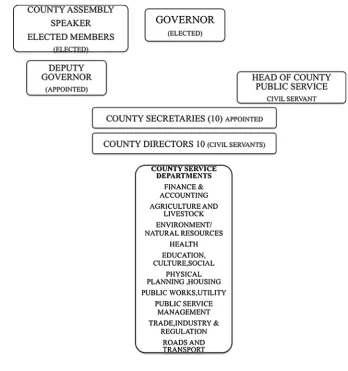
An elected governor heads each county government, which consist of an elected county assembly and a county executive. The assembly consists of elected members representing each ward in the county who are elected for a period of five terms. In its compo-sition there are provisions for special and marginalized groups-youths, women and the disabled.
Administrative decentralization
The executive authority of the county is vested in a county executive committee that consists of an elected county governor and the county executive committee. The county executive committee consists of the governor and deputy governor and membership of
persons who are not members of the assembly, appointed by the governor with the approval of the assembly. The membership cannot exceed one-third of the county assembly members if the assembly has less than thirty or ten if the assembly has thirty or more.
Members of a county executive committee are accountable to the county governor in exercising their duties and powers. The county executive is tasked with implementing county legislation and national legisla-tion within the county. It also manages and coordi-nates the functions of the county administration and its departments and any other functions conferred to it by the constitution or national legislation. Additionally it may prepare proposed legislation for consideration for by the county assembly.
At national level, a Senator in the Senate represents each county. The senate is constitutionally mandated to make decisions about revenue allocations to the counties (Fig.1) .
Fig. 1 Structure of County governmentsSource
Fiscal decentralization-revenue allocation
The Commission for Revenue Allocation (CRA) has come up with a formula for allocating the 15 % county revenue share, among the 47 counties. 84.5 % goes to the national government while the remaining 0.5 % is earmarked as an equalization fund. This formula allocates revenue based on the weight of the following parameters: 1-Population-45 %, 2-Poverty Index-20 %, 3-Land Area-8 %, 4-Basic Equal Share-25 %, 5-Fiscal Responsibility-2 % (CRA2014) (Fig.2).
Of note is that the revenue allocation is aimed to ensure equitable distribution of resources in all the 47 counties in Kenya. It implies that counties with higher population, poverty index and a large land mass will receive more revenue. Given the historical develop-ment disparities among counties in Kenya, this formula is transparent and a good start. The formula also takes into account the fixed costs of operating county governments and allocates an equal share for this purpose (Kimenyi2013) with a 2 % incentive for fiscal responsibility.
Functions of county governments
Detailed functions of county governments are found in Schedule Four of the Kenya Constitution 2010. In summary, county governments are tasked with the provision of the following services at county level including; health care, agriculture, pre-primary educa-tion, trade development, maintenance of local roads and county planning. Counties are supposed to use their allocated share of revenue to provide these services. In turn, these county governments will receive a share of national revenues. The county governments will also be expected to mobilize revenue from other sources within their counties, such as taxes on property and entertain-ment. The national government is responsible for overall policy formulation in all areas including public investment. Basically county governments are required to work within the framework of, and implement the policy formulated by national government.
The Constitution also makes it clear that national legislation shall provide for the governance and management of urban areas and cities and specifically establish criteria for classifying urban areas and cities as laid out by the Urban Areas and Cities Act, 2011. The principles of governance and management of urban areas are also vested in the national legislation as well as the provision of participation by residents in the governance of urban areas and cities.
Can devolution promote the right to the city for both rural and urban inhabitants?
Since this paper established that energy and its appropriation is the power behind urbanisation and since most of it is found in rural areas, not one group of inhabitants can lay claim to the right to the city. Both city and rural inhabitants have a legitimate claim to either space due to the inherent interdependencies of both city and country. As such the right to the city was redefined as the process of laying claim to the shaping power of enfranchisement, whether in urban or rural spaces, by all those contributing to the process of urbanisation and subsequently, de-urbanisation.
Within this context, it can be argued that devolution in Kenya has been structured to some extent, to promote both participation and appropriation by both rural and urban inhabitants towards rural and urban enfranchisement, even though this participation has been institutionalized.
This structure can be seen in three ways: firstly political decentralization where, county citizens elect their own county government in a democratically recognized process, secondly administrative decen-tralization where each county appoints an executive committee that manages county affairs and delivers on county services, thirdly, fiscal decentralization where each county draws up its own budget based on revenue allocated and tax collected as mandated by the constitution.
In the devolution structure of Kenya, the right of citizens to participate in the production of space at county level is filtered through local institutions and direct participation in such decisions like election of the county assembly members and the governor. Through the county assembly, citizens participate in vetting the county executives who will be tasked with actualizing the counties agenda.
Nine months into the implementation of devolution structure, governors’ across the country met to assess the progress and challenges encountered so far. During the Summit on Leadership and Governance (Nation Media Group2014), Attorney General of Kenya (AG), Professor Githui Mugnai pointed out that in a bid to strengthen local participation in appropriating county resources like mining minerals, his office was working with local communities to have a legal right in law to any appropriation of such minerals.
This move is reflective of Lefebvre’s ideas of right to the city as benefiting both rural and urban inhab-itants. It echoes direct participation and a seat at the negotiating table for local citizens in the decision making process, that leads to the production of space. In dispersing political and economic power to coun-ties, each community then becomes a ‘master of its destiny’ eliminating the need for perceived isolation while still maintaining Kenya as a unitary state.
However while the AG assured Governors that devolution was legally entrenched in the constitution, the governors pointed out several challenges at county level. Some of these included; weak institutional capacity which made counties vulnerable to corrup-tion. Another challenge was political power play between the Governors, National Assembly and the Senate. The AG attributed this to the effects of re-alignment of the various political houses in the face of a new constitutional dispensation. Also noted was the effectiveness of the transitional institutions that are overseeing the devolution process. The general feeling
was that these institutions were not being as effective as required.
Constitutional constraints on devolution was also a major issue that counties were grappling with espe-cially in regard to provision of services like security, education, health, agriculture, roads and transport. This is because while the overall mandate in policy formulation for these services lay with the national government, the extent of its implementation at county level was still a ‘grey’ area open to interpretation by either party (County or National government). Con-sequently Governor’s were bearing the brunt from citizens at county level where the quality of service delivery was wanting.
Nevertheless, feedback from individual governors indicated that overall, people feel more included and participated in county affairs since the advent of devolution. Keynote Speaker, Hon. Geneva Fourier— The Permanent Executive Secretary at The All Africa Ministerial Conference on Decentralization and Local Government (AMCOD) concluded that; ‘Decentral-ization is the only way to address people’s needs by taking services closer to them’. She added that decentralization is the key to Africa’s challenges (Nation Media Group2014) She pointed out that there is need to seek a form of decentralization that appeals to the African situation and singled out Kenya as having the chance to set that example.
Can devolution check and balance rural–urban migration in Kenya?
In the previous analysis, the causes of Internal urbanization in Kenya were pointed out as colonial-ism, rural–urban inequalities, under employment and unemployment in rural areas, perceived income dis-parities between rural and urban areas among others. This was unlike in the developed countries where urbanisation was underpinned by the discovery of fossil fuel energy and increased agricultural produc-tivity creating the need for trade, military and defence among other issues. It was also established that even in urban areas the promised dream of enfranchisement was more of a mirage than a reality, with chronic unemployment, congestion, increasing urban poverty and crime among others (wa Thiong’o 1987, Od-hiambo and Manda2003)
urban immigration in the first place. This is because 89 % (42 out of 47) of all the counties in Kenya are rural under the new Urban Areas and Cities Act, 2011. Under fiscal decentralisation, the formula for revenue allocation favours counties with a high population, high poverty index and large landmass
Most of the 42 rural counties meet these criteria, Like Turkana, North Eastern, Tana River, Wajir and others. These counties like Turkana have recently discovered oil and other natural resources. Conse-quently as devolution starts to take root, and rural counties start to develop capacity and offer hope, it is expected that most urban residents may react to the push factors in urban areas and the pull factors in rural counties thus precipitating urban–rural migration.
Even though rapidly urbanizing counties like Nairobi, Mombasa, Nakuru, and Thika have a high population and will enjoy higher revenue allocation, push factors like declining urban economies, increas-ing urban poverty, crime, congestion, unreliable transport, chronic unemployment with low wages and high costs of living may eventually push some residents to find opportunities in developing rural counties.
Further most of Kenya’s energy and other natural resources are largely found in the rural counties. For instance, the discovery of oil in rural Turkana in North Western Kenya, hydropower dams and geothermal springs in rift valley, rare minerals in Mombasa the coastal county and wildlife in Narok.
Devolution has politically empowered counties and subsequently the local citizens. Counties with these significant deposits of energy resources and other minerals are demanding not only a significant share of any wealth accrued from exploiting these minerals but also direct participation in the exploitation of the resources.
For instance, the recent standoff between Tullow oil (a British oil exploration company) and Turkana residents that led to a 2 week closure of the company’s operations, was mainly due to the perception by the residents that the company was not offering enough and significant jobs to the local residents. Further the discovery of hydrocarbons in the County and offshore gas deposits, has led to local communities demanding for 25 % of the revenue when commercial production starts (The EastAfrican 02/02/2013)
It is arguable that this new found agitation for grassroots participation in the appropriation of local
natural resources in East Africa can be directly linked to devolution and the new found democratic space at the grassroots level. Unlike in the past where such protest would have been silenced by deployment of security forces, in the new dispensation, most analysts are calling for clear rules of engagement between investors and hosts. The mining of rare earth minerals in Kwale county has also faced criticism and agitation from the local county government with the residents demanding greater representation in the decision making process of how the wealth should be appro-priated. As a result, the AG’s office is working with local communities at county level to have a legal right in law towards appropriation of these minerals
This all goes to show that unlike in the past where all the wealth and labour generated in the rural areas, went to ‘fatten up’ the city, (wa Thiong’o1987), with devolution, this is all set to change. Rural counties are agitating for retention of a significant share of the wealth within their boundaries.
Subsequently rapidly urbanizing counties like Nai-robi, and others who have little or no energy resources of their own to sustain urbanization will have to either find alternative means of supporting the urbanization process or enter into negotiated agreement with rural counties on how to share these resources. One way for rapidly urbanizing counties like Nairobi, Nakuru and others to manage with limited energy resources will be to de-urbanize.
Ancestral land as a pull factor
Because earlier colonial policies disenfranchised Kenyans in urban areas, and set the stage for subsequent governments to do so, most urban inhab-itants never considered the city as a permanent home. To them the city was a temporary place-more like a ‘place of work’, while rural areas were considered the real and permanent home (Otiso and Owusu2008) The definition of home in traditional Kenya was a place where one grew up and owned land, either through inheritance or purchase and constructed a house whether permanent or temporary. This place is almost always in the country.
‘home’. Most of these travellers retreat back to their rural homes where they have bought or inherited land from their families but do not have the time nor funds to develop it since they all work in the city.
Such a piece of land in the rural areas is maintained as a safety net should things not work out in the city and also for retirement and eventually as a burial place. Therefore, most urban residents work to remit money back to the rural areas to develop these pieces of property. In this way, most urban inhabitants while still preferring to live in the city, have one ‘foot’ in the country. Consequently they have essentially left the door open for return to the country should things improve in the rural or go wrong in the city.
Sceptics who perceive urban areas, as the only centres of growth tend to see this investment in rural land and property as ‘dead capital’ and as ‘contradic-tions in African poverty’ fuelled by societal culture (Fengler2011a; Ndemo2014; Warah2010). They tend to be cynical about the value of culture to economic growth and the impact of devolution on urbanization. However, peaking non-renewable energy resources will eventually lead to declining urban economies. The ‘dead capital’ could then be ‘resurrected’ through pull factors like the development of rural capacity.
The discovery and appropriation of natural resources in the rural areas towards rural capacity development, may in future act as a pull factor for these urban migrants who still have an ancestral attachment to the land and their clan. These ancestral connections to rural land in Kenya, resonates with the Malaysian experience where fertile unattended reserve land in rural Malay is protected by legislation, which has inherently left the door open for the returned migrants. Further contextual similarities between Kenya and Malaysia include;
Shared colonial history- both countries were col-onised by the British for approximately the same period and exploited for ‘photosynthetically’ produced energy: tea and coffee in Kenya, rubber in Malaysia (Henry 1983). Colonialism created international involvement such as in the economic, administration and resources exchange, which allowed industrialisa-tion and subsequently urbanizaindustrialisa-tion.
There is a comparable difference in the industrial-ization process of the two countries linked to the discovery of natural resources. While Malaysia’s is witnessing signs of de-industrialization due to deplet-ing oil and gas, Kenya has just discovered oil and gas
and is at risk of following the industrial growth model of Malaysia and other developed countries due to prescriptive urbanization policies. What can Kenya learn from the Malaysian experience of industrializa-tion, urbanization and now de-industrialization?
Another comparable difference is in the ethnic and tribal dimension in the governance structures and land law administration. In Kenya geographical location and ethnicity are almost synonymous, a legacy of colonialism. There are 42 tribes in Kenya with numerous ethnicities. The result has been that devolved units by default reflect tribal homogeneity with counties that host major cities like Nairobi and Mombasa being the exception rather than the norm (Adam et al. 1992). The 2007/08 post election violence in Kenya orchestrated massive internal migration of people of the same ethnic persuasion to return to their ancestral homes further blurring the line between geography and ethnicity.
On the other hand Malaysia does not have tribal issues but does have ethnic issues. Experience in the racial riots in 1969 has created attention and awareness on the ethnic issues, which could possibly lead to an imbalance in ethnic distribution between the urban and rural. As the protected land only covers the aboriginal and the Malays, therefore, the potential of reverse migration will mostly affect the Malays to return to land in the rural compared with other ethnicity in Malaysia. Similarly in Kenya, even though same tribes are heavily concentrated in their specific counties, the formula for revenue allocation ensures equitable dis-tribution of revenue across board, with preference given to the most poor counties, with large land mass and high population. Each county essentially has to determine its destiny. In Kenya therefore reverse migration is expected to affect all communities across board.
These similarities and differences between Kenya and Malaysia set the stage to discuss rural capacity in Malaysia as a pull factor in triggering de-urbanization. We examine the potential rural capacity in Kampong Gunong Pasir, Negeri Sembilan region in Malaysia to absorb the urban returnees from city to rural if de-urbanisation occurs.
De-urbanisation and the case of Malaysia
from rural reserve land would be an alternative to overcome de-urbanisation. Its focus is on Malaysia, which is facing trends of de-industrialization as a result of peaking fossil fuels. The intention is to investigate the capacity of rural areas to absorb the return migrants from cities.
After Independence in 1957, the opportunities offered by urban areas resulted in massive rural to urban migration. The emerging industrialization (electronic industries) was the main pull factor that attracted many obedient and diligent young-unmarried women (Ariffin1994; Byrd2012) to move into cities. This massive rural to urban migration shifted 70 % of the rural society to 70 % urban in less than two decades and created a new urban society. While the population growth in cities increased, the land in the rural areas was left unattended.
Malaysia is fortunate to have significant areas of fertile reserve land that is covered by unique legisla-tion. The legislation states that Malay reserve land can only be owned and held by the Malays and cannot be sold (Leete2007; Zaki et al.2010). This legislation has been discussed by, among others, Zaki et al. (2010) who found that although the land tenure system in Peninsular Malaysia has undergone several changes since 1957, the Malay reserve land and the customary land tenure system is still implemented especially among the rural Malay society. This has left the door open for the urban migrant to return to the land.
Against this backdrop is the dwindling supply of gas and oil in Malaysia and increasing Foreign Direct Investment (FDI) competition from neighbouring countries that is threatening Malaysia’s economic growth. These issues have provoked debates about the sustainable future of industrialisation (Whittaker et al.
2010). With scarce resources; cities stand to lose the vital components of economic growth which will affect social structure and livelihoods.
The rural capacity: case study in Kampog Gunong Pasir, Negeri Sembilan
Prior to industrialization in the 1970s, there had been a decline in agricultural development in Malaysia (Drabble1993). Over 800,000 hectares of agricultural land was abandoned or underutilised, and Negeri Sembilan was reported to be the state that faced the highest levels of decline. Kassim (1989) stated that
53.8 % of agricultural land in Negeri Sembilan was underutilised in 1981.
She added that these abandoned agricultural lands remained subject to ‘Tanah Adat’, or customary land use, meaning that they are protected by laws and cannot be sold. For these reasons, Negeri Sembilan has been purposely chosen for this study, not only because of its abandoned land, but also for the unique history and laws surrounding the customary title.
Kampong Gunong Pasir in Seri Menanti, Negeri Sembilan was chosen as the sample area based on criteria such as its location in the foothills of the North–South range which cross Peninsular Malaysia, enabling the land to be fertile but not exposed to excessive development. Kampong Gunong Pasir cov-ers approximately 127.48 hectares and consists of 122 houses, only 61 of which are still occupied by the 208 residents. This paper has deliberately selected a sample of 30 respondents to follow in regards to house and compound activities which are based on the available green area. The intention is to investigate the land capacity of inhabitants within the sample area.
Analyses of land use change were performed on a grid basis, with reference to the secondary data and observations. This approach is one of the common methods used for spatial analysis and has been applied to analysing land use patterns by Abdullah and Nakagoshi (2006); Haines-Young (1992). Grids of 1 kmx1km were developed using the GIS application of ArcView 3.2, which is suited to covering the whole study area (macro scale). For the grids at the border of the areas that were covered, less than 10 % of the total land area was omitted to avoid inaccuracy.
Figure3a shows the changing patterns of land use activities between three temporal years. Clearly, there was a significant decrease in settlement areas from the 1950s to the 1970s and up to 2011 (Fig.3b these changes occurred during the rural to urban migration period, when most of the houses (settlements) were left unattended and abandoned.
However, beginning in the early twentieth century, the 9th Malaysia Plan was revised which the attention needed to re-emphasize the importance of agriculture in Malaysia’s economic development. This effort can be seen in the Fig.4, where agricultural land has started to replace abandoned settlements. However these changes
are only possible on the Malay Reserves land, where government policy allows developments that might be of benefit to society. The customary lands remain unattended. Furthermore, this section has investigated the potential land capacity, through measuring the green area (land that is not used or is covered by a permanent building) by using the basic grid technique. The same basic grid system was also applied to measuring the potential land capacity of each sample (at micro scale). For this analysis, the sample areas were divided into 1 mx1m of grids in GIS to accurately record land use such as activities and functions, fauna and flora and other related information. Figure5a, b shows the percentage of green ratios and a ranking of land availability in the each household dwelling.
Generally, the graph shows that each house in the Kampong has a minimum of 30 msq of green area. Both graphs indicate where the ratio of the green areas in each households unit reached the minimum of 50 % of the overall house compound, showing that each house have green areas.
From the audit on land that has been done in Kampong Gunong Pasir, in Negeri Sembilan, the study revealed that there is a potential land capacity
2011
Changes in landuse settlements in Kampong Gunong Pasir
2011
Changes in agricultural land development in Kampong Gunong Pasir a
b Fig. 3 Chronology of
aHousing settlements in 1950, 1970 and 2011 and bAgricultural Land use in 1950, 1970 and 2011 in Kg Gunong Pasir—Malaysia.
SourcePilot Study based on
Population and Housing Malaysia Census Report 2010
for future utilization. The results obtained from the surveys identified the potential in the land capacity which can be reutilized. About 50 % of the unattended houses and land are available, due to rural–urban migration associated with the legislation on land ownership. This has created a significant potential for the land to be available and accessible for the return migrant, if de-urbanisation occurs.
It follows that when massive rural to urban migration in Malaysia took place in 1970s, the rural area was impacted heavily with about 50 % of its population moving out and hollowing the land. However the uniqueness of Malaysians’ laws and land legislations that reserve the ‘Malay land owner-ship’ protects the unattended land from being sold. This abandoned land was said to not only remain accessible for future but also still rich in ecological functions and resources (Nor Atiah Ismail2010). The availability of these rural reserve land means that going forward, rural capacity has the potential as one of the ‘pull factor’ to influence reverse migration from cities to rural. This situation could also become part of future alternatives in dealing with de-urbanisation.
Conclusion: can devolution and rural capacity trigger de-urbanisation?
The foregoing discussion has explored two factors; one of governance (devolution) and the second of an economic/social nature (land capacity) in Kenya and
Malaysia respectively and the potential to check and balance rapid urbanisation.
It was also established that urbanisation is under-pinned and sustained by the availability of energy resources. In the face of peaking fossil fuels, prescrip-tive rapid urbanisation especially in Africa will not be sustainable in the long run.
Therefore, there is need to find alternative pro-cesses of growth that do not necessarily depend on fossil fuel energy resources to grow. This is where the unique similarities and differences between Kenya and Malaysia come into play. Kenya can look to, and learn from Malaysia which is almost going full circle in the process of industrialization, urbanisation, and de-industrialization and hence de-urbanization. Malaysia discovered oil and gas almost 50 years ago at a time when the Kenyan Republic was being born. It is safe to assume that Kenya’s recent discovery of oil and gas will peak in 2064 (50 years from now).
Fifty years from now Kenya should see itself as Malaysia today. It therefore does not necessarily need to take a similar growth path like Malaysia towards rapid industrialization especially in cities. Kenya can skip some of the steps in this growth pattern, like rapid urbanization and deindustrialization and begin to manage sustainably and simultaneously both its industrialization and de-urbanization process.
in the country. In Kenya, the advent of devolution should afford growth opportunities of underdevelop-ment counties to relieve pressure on urban areas hence triggering urban–rural immigration. This will be one way to manage rapid urbanization. The ancestral land factor will also play a major role.
In their preliminary assessment of devolution, 1 year after its implementation, Ghai and Ghai (2014) in reporting on the views of a panel discussion on devolution organized by the Katiba Institute, stated that all the panellists believed that there was a good chance devolution will turn out to be a success with time.
They further state that overall the public perception was satisfied with the county performance, health services were improving and even people in the far off County of Mandera who had hitherto felt alienated, now felt a part of Kenya. Such positive perception may in the long run be the initial triggers, attracting urban residents to rural counties.
Additionally, it has been established that devolu-tion contributes to the producdevolu-tion of space and hence right to the city through empowering citizens at local level by charting their own agenda to participate and appropriate resources for local development. This has been reflected in the recent impeachment of the Embu County governor over misappropriation of public funds (Standard Media 04/09/14). This all goes to show that citizens are pushing for more accountability at county level as a result of livelier discussions and political debates (Ghai and Ghai2014).
Further as the process of urbanisation is under-pinned by the availability of energy resources, it follows that wherever these resources are found, (case of Turkana) which is mostly in rural areas, devolution has given power to the local residents to appropriate them. Subsequently, these resources can be appropri-ated to enhance rural capacity to support returning urban migrants who have an attachment to their ancestral land or who did not fare well in the city.
In the case of Malaysia, it has been illustrated that depleting gas and oil reserves may trigger de-indus-trialisation and hence de-urbanisation. In such a scenario rural capacity in the form of fertile reserve land is capable of supporting return immigrants.
This paper hypothesised that the devolution process in Kenya may in time be a pull factor, triggering urban–rural immigration. In the first place by provid-ing access to more democratic space and decision making at the grassroots level leading to creation of
locally based development agenda. Within this agenda, citizens will be able to directly participate and exercise their right to the city in producing the spaces they want.
One year into it implementation, the initial feed-back indicates that indeed this is happening with people demanding more accountability, discussion of policy issues at local level and engagement in lively political debates albeit with continuing challenges and threats to devolution (Ghai and Ghai2014).
Unlike cities in the developed countries that have experienced de-urbanisation but did not have the potential of rural areas, people have had to re-adapt in the cities to make a living. However, both Kenya and Malaysia have a unique potential of the ancestral land, customary and reserve land respectively that protects the land ownership and remains accessible for future utili-zation. It is arguable that the resilience of Kenyan and Malaysian cities is intertwined with the urgent develop-ment of its rural capacity.Devolution provides one way to enhance this relationship. It is possible that such a relationship will redefine the current prescriptive urban-ization model and hence trigger de-urbanurban-ization. Urban policy makers need to recognize this unique relationship and craft agenda that will enhance rather that supresss it. Therefore it is essential for this study to enhance and further this uniqueness towards future implementation in order for the society to achieve resilience.
References
Abdullah, S. A., & Nakagoshi, N. (2006). Changes in landscape spatial pattern in the highly developing state of Selangor, peninsular Malaysia. Landscape and Urban Planning, 77(3), 263–275.
Adam, C., Cavendish, W., Mistry, P. S., & House, Q. E. (1992).
Adjusting privatization: Case studies from developing
countries. London: J. Currey.
Ariffin, J. (1994).From kampung to urban factories: findings
from the HAWA study. Kuala Lumpur: University of
Malaya Press.
Bradshaw, Y. W. (1988). Urbanization, personal income, and physical quality of life: The case of kenya. Studies in
Comparative International Development, 23(4), 15–40.
Byrd H. (2012) From Kampong to City and back again. In T. N. Z. A. I. Bulletin (Series Ed.),Asia Info(pp. 5). The University of Auckland: New Zealand Asia Institute. Commission on Revenue Allocation, C. (2014).Commission on
revenue allocation. Retrieved 01/05, 2014, from http://
www.crakenya.org.
Drabble, J. (1993). Malaysia crossing the industrial divide:
Transformation in Malaysia. By Alasdair Bowie. New York: Columbia University Press, 1991. Pp. xvi, 222. Map, Notes, Bibliography, Index.Journal of Southeast Asian
Studies, 24(02), 422–424.
Fay, M., & Opal, C. (2000).Urbanization without growth: A not
so uncommon phenomenon. Washington: World Bank
Publications.
Fengler, W. (2011a, 12/09/2011).Decentralizing Kenya: Four
paradoxes. Message posted tohttp://blogs.worldbank.org/
africacan/decentralizing-kenya-four-paradoxes.
Fengler, W. (2011b, 06/03/2011). Why do Kenyans want to live in cities? Message posted tohttp://blogs.worldbank.org/ africacan/why-do-kenyans-want-to-live-in-cities. Franks, S. (2005). Our common interest: Report of the commission
for Africa.The Political Quarterly, 76(3), 446–450. Ghai, P. Y., & Ghai, J. C. (2014).Devolution: A preliminary
assessment. www.the-star.co.ke/news/article-159844/
devolution-preliminary-assesment.
Haines-Young, R. H. (1992). The use of remotely-sensed satellite imagery for landscape classification in Wales (UK).Landscape Ecology, 7(4), 253–274.
Harris, N. (1990). Urbanisation, economic development and policy in developing countries. Habitat International, 14(4), 3–42.
Henry, J. (1983).Corporate strategy and employment relations in multinational corporations: Some evidence from Kenya
and Malaysia. Cambridge: Cambridge University Press.
Kassim, A. (1988). Women, land and gender relations in Negeri Sembilan: Some preliminary findings. Southeast Asian
Studies, 26(2), 132–149.
Kassim, A. (1989). Patterns of land ownership and inheritance in Negeri Sembilan: Some implications for agricultural development.Southeast Asian Studies, 27(3), 317–338. Kelley, A. C., Williamson, J. G., Takagi, Y., Nerlove, M., Razin,
A., Sadka, E., et al. (1984). What drives third world city growth? A dynamic general equilibrium approach.
Regio-nal Science and Urban Economics, 14(2), 219–230.
Kimenyi, S. M. (2013). Devolution and resource sharing in
Kenya. Retrieved from June 01, 2014. http://www.
brookings.edu/research/opinions/2013/10/22-devolution-resource-sharing-kenya-kimeny.i.
Leete, R. (2007).Malaysia: From Kampung to Twin Towers: 50
Years of Economic and Social Development. Oxford: Fajar.
Lefebvre, H., & Nicholson-Smith, D. (1991).The production of
space. Oxford: Blackwell.
Morgan, W. T. W. (1969). Urbanization in Kenya: Origins and trends. Transactions of the Institute of British
Geogra-phers,46, 167–178.http://www.jstor.org/stable/621415.
Muia, D. M. (2008). Decentralization of governance to districts in Kenya. A case study. In T. N. Kibua & G. M. Mwabu (Eds.), Decentralization and devolution in Kenya: New
approaches(p. 77). Nairobi: University of Nairobi Press.
Mwenda, K. A. (2010).Devolution in Kenya: Prospects,
chal-lenges and the future(IEA Research Paper No. 24). 1st
Ngong Avenue-Nairobi Kenya: Institute of Economic affairs.
Nation Media Group (Producer), & Nation Media Group, N. (Director). (2014, 23/01/2014).Governor’s summit 2014.
[Video/DVD] Nairobi: Nation Media Group. Retrieved fromhttps://www.youtube.com/watch?v=7Ks9aFxnAN4.
Ndemo, B. (2014, 19/01/2014). Africa’s poverty contradictions and dead capital.Daily Nation.
Njoh, A. J. (2003). Urbanization and development in sub-sah-aran Africa.Cities, 20(3), 167–174.
Nor Atiah Ismail. (2010).Landscape alteration in urban
resi-dential area of Selangor, Malaysia.Doctor of Philosophy,
Lincoln University, New Zealand, Christchurch, NZ. Nugent, P. (2004).Africa since independence : A comparative
history/paul nugent. New York: Palgrave Macmillan
2004.
Odhiambo, W., & Manda, D. K. (2003). Urban poverty and labour force participation in Kenya.A Paper Presented at the ‘‘World Bank Urban Research Symposium’’, Wash-ington DC.
Okpala, D. C. I. (1986). Received concepts and theories in African urbanization studies and urban management strategies: A critique.Urban Studies,1987-24:187. Otiso, K. M., & Owusu, G. (2008). Comparative urbanization in
Ghana and Kenya in time and space.GeoJournal, 71(2–3), 143–157.
Polese, M. (1997). Urbanization and development. Canadian international development agency (CIDA).Development
Express, 4(156), 4–8.
Potts, D. (1995). Shall we go home? Increasing urban poverty in African cities and migration processes. Geographical
Journal, 161(3), 245–264.
Potts, D. (2005). Counter-urbanisation on the Zambian cop-perbelt? Interpretations and implications.Urban Studies, 42(4), 583–609.
Potts, D. (2006). Rural mobility as a response to land shortages: The case of Malawi.Population, Space and Place, 12(4), 291–311.
Potts, D. (2009). The slowing of sub-saharan Africa’s urbani-zation: Evidence and implications for urban livelihoods.
Environment and Urbanization, 21(1), 253–259.
Potts, D. (2012a). Challenging the myths of urban dynamics in sub-saharan Africa: The evidence from Nigeria. World
Development, 40(7), 1382–1393.
Potts, D. (2012b). Viewpoint: What do we know about urbani-sation in sub-saharan Africa and does it matter?
Interna-tional Development Planning Review, 34(1), v–xxii.
Potts, D. (2012c). Whatever happened to Africa’s rapid
urbanisation?Africa Research Institute (ARI).
Purcell, M. (2002). Excavating Lefebvre: The right to the city and its urban politics of the inhabitant. GeoJournal, 58(2–3), 99–108.
Purcell, M. (2006). Urban democracy and the local trap.Urban
Studies, 43(11), 1921–1941.
Purcell, M. (2013). To inhabit well: Counter hegemonic movements and the right to the city.Urban Geography, 34(4), 560–574.
Purcell, M. (2014). Possible worlds: Henri Lefebvre and the right to the city.Journal of Urban Affairs, 36(1), 141–154. The EastAfrican, J. R. (2013, 02/02/13). Mtwara protests expose gaps in oil gas, mineral laws management. The EastAfrican.
Todaro, M. P. (1989). Economic development in the third world. wa Thiong’o, N. (1987).Devil on the crossHeinemann. Warah, R. (2010).Devolution will definitely not stem the tide of
Whittaker, D. H., Zhu, T., Sturgeon, T., Tsai, M. H., & Okita, T. (2010). Compressed development.Studies in Comparative
International Development, 45(4), 439–467.
WorldBankReport, R. E. G. (2009).World development report
2009-reshaping economic geography. Washington, DC:
The World Bank.
Wrigley, E. A. (2010).Energy and the English industrial
rev-olution. UK: Cambridge University Press.