Rate Allocation for Layered Multicast Streaming
with Inter-Layer Network Coding
Joerg Widmer
∗, Andrea Capalbo
∗†, Antonio Fern´andez Anta
∗, Albert Banchs
∗†∗
Institute IMDEA Networks, Madrid, Spain
†University Carlos III of Madrid, Spain
Email:
{
firstname.lastname
}
@imdea.org
Abstract—Multi-layer video streaming allows to provide dif-ferent video qualities to a group of multicast receivers with heterogeneous receive rates. The number of layers received deter-mines the quality of the decoded video stream. For such layered multicast streaming, network coding provides higher capacity than multicast routing. Network coding can be performed within a layer (intra-layer) or across layers (inter-layer), and in general inter-layer coding outperforms intra-layer coding. An optimal solution to a network coded layered multicast problem may require decoding of the network code at interior nodes to ex-tract information to be forwarded. However, decoding consumes resources and introduces delay, which is particularly undesirable at interior nodes (the routers) of the network. In this paper, we thus focus on the inter-layer network coding problem without decoding at interior nodes. We propose a heuristic algorithm for rate allocation and code assignment based on the Edmonds-Karp maximum flow algorithm and perform simulations that show that our algorithm may even outperform other heuristics that do require decoding at interior nodes.
I. INTRODUCTION
Large scale video streaming is rapidly gaining in popularity. In case all receivers of a video stream are able to receive the same bitrate (and hence video quality), IP multicast is a suitable solution [1], an approach used in today’s IP-TV broadcasting systems. When multicasting to receivers with heterogeneous receive rates, layered coding allows to distribute the stream over several multicast flows such that the higher the number of flows (and thus the overall rate) a receiver obtains, the better the video quality at that receiver. The base layer provides a basic video quality and each additional enhancement layer received refines this quality [2]. A higher enhancement layer can only be decoded if the base layer and all lower enhancement layers are already available.
Multicast with network coding [3] provides capacity gains over plain multicast routing. While network coding achieves the maximum flow (max-flow) [4] to each receiver for single-rate multicast, solutions that achieve the same for the case of multi-rate multicast do not always exist [5], i.e., an optimal solution may provide less than the max-flow to some receivers. Network coding solutions for single-rate multicast networks
This research was supported in part by the European Commissions Seventh Framework Programme (FP7-ICT-2009-5) under grant agreement n. 258053 (MEDIEVAL project), Comunidad de Madrid grant S2009TIC-1692, Spanish MICINN grants TIN2008-06735-C02-01 and TEC2011-29688-C02-01, and National Natural Science Foundation of China grant 61020106002.
can be found in polynomial time [6], whereas the network coded multi-rate multicast problem is NP-hard [7].
In multi-rate multicast, network coding can be performed within a layer (intra-layer coding) or across layers (inter-layer coding). Intra-layer network coding is conceptually simpler than inter-layer network coding. A basic approach for intra-layer network coding was proposed in [8]. Receivers are grouped into subsets that support the same rates. The rate of the base layer is selected such that it is supported by all multicast receivers, and a multicast network code for the base layer is constructed using [6]. The rate of the second layer is set such that, given the remaining capacity, it can be received by the group of receivers with the second lowest rate. Then a multicast network code for the second layer is constructed, and so on. Hence, each layer is transported in its own multicast tree. The procedure is repeated until all receiver groups are served or all capacity is used.
value. The decoded layers can then be recombined to serve linear combinations coded over different numbers of layers to different children in contrast to the first algorithm.
While both algorithms are simple and can be implemented in a distributed manner, they have some disadvantages. The Min-Reqalgorithm does not require decoding at interior nodes but since it propagates minimum max-flow values, its per-formance in topologies where receivers have heterogeneous max-flow values may be low. The Min-Cut algorithm fares better in such topologies as long as some of the interior nodes have sufficiently high max-flow values, but does require decoding at interior nodes. Decoding involves computationally heavy Gaussian elimination and storing data in its entirety before decoding is possible. The resulting complexity and delay are particularly undesirable at interior nodes (the routers) of the network, where processing overhead is one of the main bottlenecks. Furthermore, both algorithms transport traffic on all upstream edges of the receivers, independent of whether they are needed for the multicast or not. This not only enforces lower layers on edges where higher layers could be transported but, more importantly, wastes capacity and thus may prohibit their use in networks where links are shared with other flows. In this paper, we focus on the inter-layer network coding problem without decoding at interior nodes. We propose a heuristic solution of polynomial complexity that is based on the Edmonds-Karp max-flow algorithm. Instead of propagating traffic along all the links of the network, each receiver runs modified version of Edmonds-Karp max-flow algorithm to find up to a number of paths that correspond to the max-flow from to the source to the receiver. Paths have layer constraints so that information carried on those paths is not coded over more layers than can be decoded at downstream receivers. While paths are node disjoint on a per-receiver basis, paths of different receivers can overlap, as long as the layer constraints of the involved receivers are compatible. Network coding (but no decoding) is required at interior nodes where paths merge. We analyze the performance of our algorithm through simulations and show that it outperforms other heuristics that do not require decoding at interior nodes, and in many cases even reaches similar or better performance than algorithms that do require decoding at interior nodes. At the same time, our algorithm uses far fewer network resources.
II. ALGORITHM
We consider single-source multicast on a directed acyclic graph G(V, E) with nodes V and edges E. We denote the source node by s ∈ V, and the set of receivers by T = {t1, t2, . . . , tr} ⊂V. Further, letIn(v)be the set of incoming edges of node v and Out(v) be set of outgoing edges of node v. The source multicasts a stream of up to k layers, L1, . . . , Lk. Due to the properties of the layered coding, layer Ll is only useful to a receiver, if the receiver also receives layers L1, . . . , Ll−1. Let y(u, v) = Plj=1gjLj denote the coded layer combination that is sent on edge(u, v)with coding coefficientsgj. We have thaty(u, v)∈ h∪(w,u)∈In(u)y(w, u)i
∀u ∈ V \T \ {s} where hYi denotes the linear subspace spanned by the set of vectors Y.
For simplicity of exposition, we assume that edges have unit capacity and layers have unit rate, as in [9]. Since our algorithm is directly based on the Edmonds-Karp max-flow algorithm, it is straightforward to extend it to non-unitary edge capacities and non-unitary layer rates.
The problem under consideration is to maximize the sum of the receive rates of all receivers, under a max-min fairness constraint. A given allocation is max-min fair if it is not possible to increase the number of layers received by any receiverti, without reducing the number of layers of another receivertjto less than that of receiverti. In a connected graph with unit capacity edges as in our model, this ensures that each receiver is at least able to receive the base layer L1. In our model, the source sends data of a layer always combined with data from all lower layers.
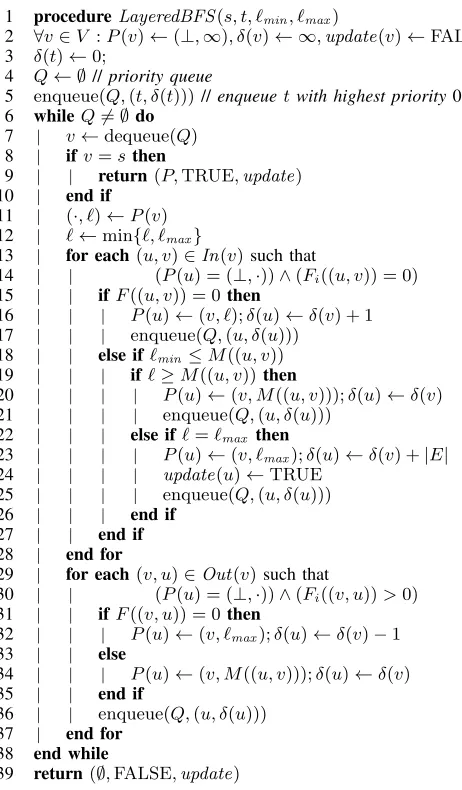
Our heuristic first determines the max-flow from the source to each receiver using the Edmonds-Karp algorithm. It then processes the receivers in ascending order of their max-flow values. This ensures that capacity is first allocated to receivers with low max-flows. The assignment is closely related to the notion of max-min fairness. For the assignment of layers to flows, we design a modified multi-layer version of the Edmonds-Karp maximum flow algorithm called MultiLayer-MaxFlow. The algorithm in turn uses a layer constrained version of breadth first searchLayeredBFS.LayeredBFS tries to find one additional edge disjoint path with specific layer constraints for the current receiver. We first present the pseudo-code and then give an example of the algorithm.
A. Algorithm Pseudocode
For simplicity we describe the algorithm as a centralized al-gorithm, but its distributed implementation is straightforward. 1) LayerAssignment (Fig. 1): The algorithm executes MultiLayer-MaxFlow for each receiver in ascending order of max-flows. MultiLayer-MaxFlow returns the set of the i -th receiver’s flow allocation Fi on edge disjoints paths, as well as the set of maximum layer constraints Mi that ensure decodability of the information received through these paths. With these, the global flow allocation F and maximum layer constraintsM are updated (Lines 11-12).
2) MultiLayer-MaxFlow (Fig. 2): The algorithm tries to find paths from sources to receivert that allow the receiver to decode the maximum number of layers `max, given the existing flow assignments (starting with`max =maxFlow(t)). This requires finding `max edge-disjoint paths that deliver linear combinations of the first`max layers. To ensure linear independence, a receiver may receive at mostl combinations coded over the first l layers, 1 ≤l ≤`max. This implies the following minimum layer constraints for the linear combina-tionsy1, . . . , y`max:
y`min =
`
X
j=1
1 algorithmLayerAssignment(G, s, T) 2 ∀(u, v)∈E:F((u, v))←0, M((u, v))← ∞ 3 for eachti∈T
4 | maxFlow(ti)←EdmondsKarp(s, ti)
5 end for
6 form←1tomaxti∈TmaxFlow(ti) 7 | for eachtisuch thatmaxFlow(ti) =m
8 | | (Fi, Mi)←MultiLayer-MaxFlow(s, ti)
9 | end for
10 | for each(u, v)∈Esuch thatMi((u, v))<∞
11 | | F((u, v))←max{F((u, v)), Fi((u, v))}
12 | | M((u, v))←min{M((u, v)), Mi((u, v))}
13 | end for
14 end for
Fig. 1. Layer assignment algorithm
1 procedureMultiLayer-MaxFlow(s, t) 2 for`max ←maxF low(t) down to1
3 | ∀(u, v)∈E:Fi((u, v))←0, Mi((u, v))← ∞
4 | `min←`max
5 | do
6 | | (P,found,update)←LayeredBFS(s, t, `min, `max)
7 | | iffoundthen
8 | | | u←s
9 | | | whileu6=t
10 | | | | (v, `)←P(u) 11 | | | | ifupdate(u)then
12 | | | | | ∀(u0, v0)upstream ofuthat carry a flow 13 | | | | | that contributes to(u, v) :
14 | | | | | | Mi((u0, v0))←min{Mi((u0, v0)), `}
15 | | | | end if
16 | | | | if(u, v)∈Out(u)then
17 | | | | | Mi((u, v))←`
18 | | | | | Fi((u, v))←1
19 | | | | else//reverse edge
20 | | | | | Mi((v, u))← ∞
21 | | | | | Fi((v, u))←0
22 | | | | end if
23 | | | | u←v
24 | | | end while
25 | | | `min←`min−1
26 | | end if
27 | while(`min≥1)∧found
28 | iffound then
29 | | return(Fi, Mi)
30 | end if
31 end for
Fig. 2. MultiLayer-MaxFlow algorithm
When assigning flows, our algorithm first searches for a flow with `min =`max, then for `min =`max−1, and so on. If LayeredBFS fails to return a layer-` pathP with`min≤`≤ `max (and thusfound = FALSE), the receiver will not be be able to decode`max layers. In that case,MultiLayer-MaxFlow reduces`max by one and all existing temporary flowsFi and maximum layer constraintsMi are removed (Lines 2-3).
Whenever LayeredBFS returns with a valid path, `min is decremented and the path is backtracked from s to t. Fi and Mi are updated on all the edges of the path (Lines 16-22). In addition, nodes maintain a table that maps incoming to outgoing edges (for simplicity, this is not shown in the pseudo-code). A two-hop path segment (w, u),(u, v) creates
1 procedureLayeredBFS(s, t, `min, `max)
2 ∀v∈V :P(v)←(⊥,∞), δ(v)← ∞,update(v)←FALSE 3 δ(t)←0;
4 Q← ∅//priority queue
5 enqueue(Q,(t, δ(t)))//enqueuetwith highest priority0
6 whileQ6=∅do
7 | v←dequeue(Q)
8 | ifv=s then
9 | | return(P,TRUE,update) 10 | end if
11 | (·, `)←P(v) 12 | `←min{`, `max}
13 | for each(u, v)∈In(v)such that
14 | | (P(u) = (⊥,·))∧(Fi((u, v)) = 0)
15 | | ifF((u, v)) = 0then
16 | | | P(u)←(v, `);δ(u)←δ(v) + 1
17 | | | enqueue(Q,(u, δ(u)))
18 | | else if`min ≤M((u, v))
19 | | | if`≥M((u, v))then
20 | | | | P(u)←(v, M((u, v)));δ(u)←δ(v)
21 | | | | enqueue(Q,(u, δ(u)))
22 | | | else if`=`max then
23 | | | | P(u)←(v, `max);δ(u)←δ(v) +|E|
24 | | | | update(u)←TRUE
25 | | | | enqueue(Q,(u, δ(u)))
26 | | | end if
27 | | end if
28 | end for
29 | for each(v, u)∈Out(v)such that
30 | | (P(u) = (⊥,·))∧(Fi((v, u))>0)
31 | | ifF((v, u)) = 0then
32 | | | P(u)←(v, `max);δ(u)←δ(v)−1
33 | | else
34 | | | P(u)←(v, M((u, v)));δ(u)←δ(v) 35 | | end if
36 | | enqueue(Q,(u, δ(u)))
37 | end for
38 end while
39 return(∅,FALSE,update)
Fig. 3. Layered BFS algorithm
an entry (w, u)7→(u, v) at the local table of nodeu. (w, u)
may map to multiple outgoing edges, and multiple incoming edges may map to(u, v). The algorithm also checks whether a special flagupdate(u)is set for a nodeuon the path. This indicates that the maximum layer constraint on edge (u, v)
had to be reduced. As a consequence, the maximum layer constraints on all upstream edgesthat contribute to(u, v)have to be updated as well (Lines 11-15). The edges can easily be identified through thein-outtables maintained at the nodes.
3) LayeredBFS (Fig. 3): The algorithm performs breadth first search to find a path from a receiver t to source s with matching layer constraints. It uses a priority queueQto store nodes to be visited next, as well as a mappingP :u7→(v, `)
to store next hop nodes for backtracking and the corresponding maximum layer constraint` for edge(u, v).
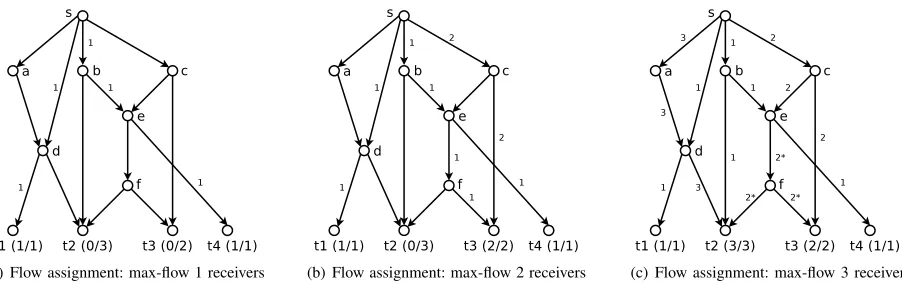
(a) Flow assignment: max-flow 1 receivers (b) Flow assignment: max-flow 2 receivers (c) Flow assignment: max-flow 3 receiver
Fig. 4. Different stages of theMultiLayer-MaxFlowalgorithm: layer assignment per link and rate achieved vs. maximum flow per receiver
δ(v) + 1, since capacity would have to be allocated on a new edge. Shared edges can only be traversed if they support a sufficiently high layer (Line 18) and can be used at cost 0 if the current maximum layer constraint M((u, v))can be kept (Line 19). If, however, the constraint has to be reduced since ` < M((u, v)), this means that other receivers downstream of
(u, v) may no longer be able to decode up toM((u, v))but only up to`layers (Line 22). This is only allowed in case no other options exist. Only when ` =`max < M((u, v)), i.e., the node is trying to obtain less layers thanM((u, v)), is the corresponding node enqueued, and it is enqueued last with a high cost ofδ(v)+|E|. The markerupdate(u)is set to indicate that the maximum layer constraints on edges upstream of u may have to be updated byMultiLayer-MaxFlow.
As in the original Edmonds-Karp algorithm, whenever ca-pacity is assigned to a flow on edge(u, v)∈E, a correspond-ing negative flow is assigned to a virtual reverse edge (v, u)
[4]. In case the LayeredBFS algorithm finds a suitable path through such a reverse edge, the flow originally assigned on the forward edge(u, v)is removed, if(u, v)is only used by the current receiver. If however, edge (u, v)is a shared edge, the flow on that edge is required by another receiver and cannot be removed. The LayeredBFS may nevertheless traverse the reverse edge to find a suitable flow, which is then combined with the existing flows in the subtree below the shared edge. When traversing reverse edges that are only used byt (Lines 31-32), the cost is set to δ(v)−1 since capacity on an edge is freed, and the layer constraint is reset to `max. Traversing shared reverse edges leaves the costδ(v)unchanged, and the maximum layer constraint is reset to that of the shared edge M((u, v)), since network coding occurs after the reverse edge. 4) Code assignment: After theLayerAssignment, the source sends (linearly independent) combinations on each outgoing link, coded over as many layers as is allowed by the link’s layer constraints.
y(s, v) =
M((s,v))
X
l=1
gl(s,v)Ll, ∀(s, v)∈Out(s) (2) An interior nodeuof the network codes according to itsin-out table.
y(u, v) = X
w:(w,u)7→(u,v)
g(w,u)y(w, u) (3)
B. Example of the Algorithm
As in the original Edmonds-Karp algorithm, we repeatedly perform a breadth-first search to find augmenting paths to the source. However, theLayeredBFS starts the search at the receivers and proceeds upstream to the source. This allows to find existing flows that can be reused, as explained later. In the example in Fig. 4(a), first receiverst1andt4with a max-flow of1 find shortest paths to obtainL1directly from the source. The max-flow 2 receiver t3 first needs to find a path to a flow coded over L1 and L2. If such a path is not found, the receiver would attempt to at least find a path toL1. In the example in Fig. 4(b), a suitableL2-path(s, c, t3)is found. The receiver then uses LayeredBFS to find an edge-disjoint path carrying L1 or a combination of L1 and L2. The algorithm may traverse edges that are already in use by other receivers at no cost, as long as the layer constraints on that path are not reduced. After traversing the two edges to reach node e, the algorithm traverses the remaining path tos before exploring any new edges that are unused as of yet. Backtracking from the source establishes path (s, b, e, f, t3), where edges (s, b) and(b, e) are shared with receivert4 and new capacity only needs to be assigned to edges(e, f)and(f, t3).
20 40 80 160 320 0
20 40 60 80 100
No. of Nodes (N)
% Happy Node Min−Req
Min−Cut ML−MaxFlow
20 40 80 160 320
0 20 40 60 80 100
No. of Nodes (N)
% Rate Achieved Min−Req Min−Cut ML−MaxFlow
20 40 80 160 320
0 20 40 60 80 100
No. of Nodes (N)
% Link Used
Min−Req Min−Cut ML−MaxFlow
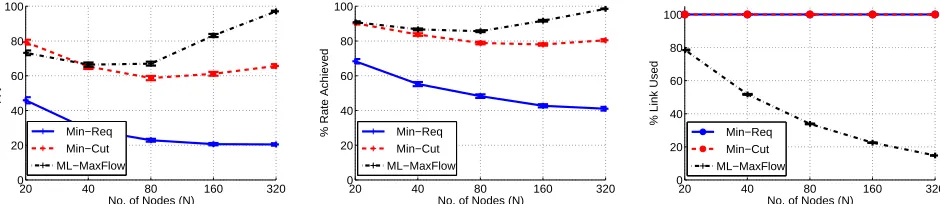
Fig. 5. Fraction of nodes that achieve their max-flow (left), normalized rate (middle), and link usage (right) for different network sizes and10receivers
L1andL2at nodecvia edge(c, e). Nodeethus forms a linear combination of L1 received from b and the combination of L1andL2received fromc and forwards it along edge(e, f). Note that while this alters the linear combination received on the subtree below edge (e, f), i.e., also receiver t3 will now receive a linear combination over the first two layers rather than just layer 1, this does not change decodability att3.
In this example, the MultiLayer-MaxFlow algorithm achieves the max-flows for all receivers, whereas neither the Min-ReqandMin-Cutalgorithms nor the intra-layer approach manage to deliver all three layers to receiver t2.
III. SIMULATIONRESULTS
For the performance analysis, we implement our MultiLayer-MaxFlow heuristic (called ML-MaxFlow in the legend of the graphs) as well as theMin-ReqandMin-Cut algorithms from [9] in Matlab. While we do not show results for intra-layer coding and Steiner-tree packing, we note that in the simulations shown in [9] these algorithms have a performance similar to the Min-Req algorithm and always perform worse than the Min-Cut algorithm. For ease of comparison, we use the same metrics of [9] of “Happy Nodes”, the fraction of nodes that achieve their max-flow value, and “Rate Achieved”, the average of actual rate achieved normalized by the max-flow value. In addition, we measure network load in terms of number of links used vs. total number of links. For the coding we use random linear network coding over a finite fieldGF(210). Simulation results are averaged over 1000 runs. We generate random, connected, cycle-free topologies with |E|= 3.7|V| links.
Fig. 5 shows the performance of the different algorithms for networks of 20−320 nodes (including 95% confidence intervals). All algorithms perform relatively well for small networks since the low max-flow values are easier to achieve. The disadvantage of theMin-Reqalgorithm becomes apparent as soon as the network size increases. The fraction of paths that intersect with low max-flow receivers increases as well, and the fraction of happy nodes that achieve their max-flow, as well as the normalized rate achieved both decrease. The Min-Cut algorithm performs significantly better. While the normalized rate achieved is relatively stable as the number of nodes increases, the fraction of happy nodes in fact increases. As the network becomes more homogeneous with increasing size, more low flow receivers manage to achieve the
max-flow but this is compensated by the loss of normalized rate at some high max-flow receivers that no longer manage to obtain the higher layers they require. ForML-MaxFlow, both the fraction of happy nodes as well as the normalized rate increase with a network size beyond 80 nodes. Similarly to the Min-Cutalgorithm, more low max-flow receivers achieve their max-flow. Since only the necessary number of paths is allocated to low max-flow receivers, high max-flow receivers can exploit the remaining paths to obtain higher layers. ML-MaxFlowalso uses much fewer links than Min-Reqand Min-Cutwhich both use 100% of the links. For a small topology of 20 nodes, less than 80% of the links are used, and as the network size increases this fraction drops to 15%.
IV. CONCLUSIONS
In this paper we investigated rate optimization for multi-rate multicast with inter-layer network coding. We designed a heuristic algorithm that does not require decoding at interior nodes of the network and delivers a rate of at least the mini-mum of all the receivers’ max-flow values to each receiver. We show that our algorithm outperforms an existing heuristic that does not require decoding at interior nodes and even provides similar or better multicast rates than a heuristicwithdecoding at interior nodes, while using fewer network resources.
REFERENCES
[1] R. Jain, “I want my IPTV,”IEEE Multimedia, vol. 12, no. 3, Jul. 2005. [2] H. Schwarz, D. Marpe, and T. Wiegand, “Overview of the scalable video coding extension of the H.264/AVC standard,” IEEE Transactions on Circuits and Systems for Video Technology, Special Issue on Scalable Video Coding, vol. 17, no. 9, Sep. 2007.
[3] R. Ahlswede, N. Cai, S.-Y. Li, and R. Yeung, “Network information flow,” IEEE Transactions on Information Theory, vol. 46, no. 4, pp. 1204–1216, July 2000.
[4] T. H. Cormen, C. E. Leiserson, R. L. Rivest, and C. Stein,Introduction to Algorithms, 3rd ed. MIT Press, Sep. 2009.
[5] R. Koetter and M. Medard, “An algebraic approach to network coding,” IEEE/ACM Trans. on Networking, vol. 49, no. 11, Nov. 2003.
[6] S. Jaggi, P. Sanders, P. A. Chou, M. Effros, S. Egner, K. Jain, and L. Tolhuizen, “Polynomial time algorithms for multicast network code construction,”IEEE Transactions on Information Theory, vol. 51, 2005. [7] X. Wu, B. Ma, and N. Sarshar, “Rainbow network flow of multiple
description codes,”IEEE Transactions on Information Theory, vol. 54, no. 10, pp. 4565–4574, 2008.
[8] N. Sundaram, P. Ramanathan, and S. Banerjee, “Multirate media stream using network coding,”43rd Annual Allerton Conference on Communi-cation, Control, and Computing, Sep. 2005.