* To whom all correspondence should be addressed. Tel.:+98-912-2613640, Fax.:+98-21-66463613 E-mail:[email protected]
Development of a Validated Liquid Chromatography Method
for the Simultaneous Determination of Water Soluble Vitamins
in Food Supplements and Pharmaceutical Dosage Forms with
Ultra-violet Detection
Roya Khosrokhavar1,2, Omid Sabzevari3, Noushin Adib1,2,
Rastergar Hossein1,2 and Maryam Shekarchi1,2*
1Food and Drug Laboratory Research Center, Food and Drug Organization, Tehran, Iran. 2Food and Drug Control Labs, Food and drug Organization, Tehran, Iran.
3Department of Toxicology and Pharmacology, Faculty of Pharmacy and Pharmaceutical Sciences Research Center, Tehran University of Medical Sciences, Tehran 141 55, Iran.
(Received: 24 April 2012; accepted: 29 May 2012)
In the present work a fast, simple and reliable method for the simultaneous isolating and determining of the vitamins [thiamin (B1), riboflavin (B2), nicotinamide (PP), pyridoxine (B6), folic acid (B9) and ascorbic acid (C)] in food supplements has been
developed. The chromatographic separation is carried out on a reversed phase ACE 5 C18 with eluting at a flow rate of 1 ml/ min using a linear gradient with phosphate buffer-methanol, starting with 0.05 M phosphate buffer pH 2.5 for 3 min, changing to 45% methanol in 13 min, changing to 80% methanol in 3 min with equilibrating for ten min. The separation was achieved within 25 min and the detection was performed at 270 nm. The calibration graphs plotted with six concentrations of each vitamin were linear with a regression coefficient R2>0.996. The statistical evaluation of the method was examined
performing intra-day (n=6) and inter day calibration which found to be satisfactory, with high accuracy and precision results. The average coefficients of variation of intra and inter-day assays were 1.2, 2.7 for thiamine hydrochloride, 2.4, 3.4 for riboflavin, 1.5, 3.3 for pyridoxine hydrochloride, 0.9, 2.3 for nicotinamide, 2.5, 2.9 for folic acid, and 2.1, 3.1 for ascorbic acid. The average of recoveries of thiamine hydrochloride, riboflavin, pyridoxine hydrochloride, nicotinamide, folic acid and ascorbic acid were % 100±1.4, %100±1.5, %104±1.1, %102±3.2, %100±0.8 and %99±2.1 respectively. The simplicity of the method should make it highly valuable for quality control of premixes and food supplements in pharmaceutical and food industries.
Key words: Water soluble vitamins, Pharmaceutical formulation, Liquid chromatography.
Vitamins are a large group of necessary compounds for the developing and normal growth of living organisms. Lake of a sufficient amount of any of them can cause serious diseases. These compounds differ in their chemical composition, physiological action and nutritional importance
contain the amount of vitamins needed for normal development and maintenance of body functions. More over, food processing and long periods of food storage may also lead to loose of vitamins. Therefore a supplementation of these substances, through food or multivitamins products is necessary.
These facts lead to a need for very powerful analytical separation techniques for the quality control of these complex preparations in analytical laboratories, manufactures and regulatory authorities to confirm the percentage of the recommended dietary allowance. Traditional methods of vitamins assay have been required that each vitamin be determined individually using widely differing spectrophotometric 1-3, fluorimetric 4, enzymatic and microbiological5-6 procedures that
are tedious and time consuming with involving pre-treatment of the sample through complex chemical, physical or biological reactions to eliminate interferences. During the last decade there has been an increasing interest for the simultaneous determination of vitamins. The most popular chromatographic techniques belong capillary electrophoresis 7-10, micellar electrokinetic chromatography and particularly high performance liquid chromatography11-19. Determination can be carried out by normal phase, ion-pairing chromatography, and reverse phase chromatography being the most common method (RP-LC). Most of these methods have used ion pair reagents and complex sample preparation.
RP-LC vs. normal phase offers certain practical
advantages, such as better column stability, reproducibility of retention times and faster equilibration. RP-LC with ion pair reagents has been applied but the complex mobile phases associated to these methods make the column
equilibration longer until 50 min20. Several
detection methods can be applied however; UV detection is the most common. Sample preparation and pre-run sample stabilization are the most important steps to ensure that subsequent HPLC analysis is effective. Sample preparation has to be carefully optimized especially for vitamins subject to degradation due to light, oxidation, pH, heat and others. Considering sample matrix and evaluated vitamin, appropriate type of extraction should be chosen. In the present study, the LC-separation of six water soluble vitamins on an ACE
C18 has been achieved within 18 min. The detection has been optimized using a diode array detector at one wavelength 270 nm. This method can separate each vitamin from neighborhood with good resolution without using ion pair reagent. In addition, the proposed method has been validated for the simultaneous quantification of vitamins: B1, C, PP, B6, B2 and B9 in premixes and food supplements and pharmaceutical dosage forms.
EXPERIMENTAL
Reagents
All the solvents were prepared from Merck (Germany). Thiamine hydrochloride (B1), ascorbic acid (C), riboflavin (B2), pyridoxine hydrochloride (B6), nicotinamide (PP) and folic acid were obtained from Dr. Ehrenstorfer (Augsburg, Germany). Potassium dihydrogen phosphate, phosphoric acid and potassium hydroxide were obtained from Merck Co. (Darmstadt, Germany). Water was purified using a Milli-Q system from Millipore (Le mont-sur-Lausanne, Switzerland). Poly vitaminated pre-mixes (I, II and III) were obtained from Nestle (Switzerland) used for fortifying of infant formula and food. Other products analyzed (multi vitamin capsules and tablets such Centrum®, Pregnacare® and Super white®) by the method were prepared from Wyeth, Vitabiotic and Kendy Companies respectively.
Instrumentation
HPLC experiment was performed using a Waters Alliance system equipped with a vacuum degasser, quaternary solvent mixing, auto-sampler and a waters 2996 diode array detector. UV spectra were collected across the range of 200–900 nm, extracting 270 nm for chromatograms. Empower software was utilized for instrumental control, data collection and data processing. The column used was an ACE C18 (4.6 × 250 mm, 5 μm). The mobile phase was a linear gradient with phosphate buffer-methanol, starting with 0.05 M phosphate buffer pH 2.5 for 3 min, changing to 45% methanol in 13 min, changing to 80% methanol in 3 min with equilibration for ten min. with a flow rate of 1 ml/ min.
Standard preparation
in 5% sodium hydrogen phosphate solution. Standard multi vitamin solutions were made by using different amount of stock solutions (3.125– 100 μg/ml for B1 and B6, 0.325-20 μg/ml for B2 and B9,12.5-300 μg/ml for PP and 400-1200 μg/ml for vitamin C). Stock and working standard solutions were prepared daily.
Premixes and food supplements composition
The premixes selected for the present study are used for fortifying of infant formula and cereal based baby food. Table 1 summarizes the range of water soluble vitamin concentration in the premixes and supplements.
Sample preparation
In all cases, samples were taken thoroughly homogenized material. 0.5 gram of premix III was transferred to a 100 mL flask. About 80 mL of 50 mM phosphate buffer pH 5.5 was added to the flask and sonicated at 40 °C for 30 min in an ultrasonic bath. For the premixes I and II the same amount transferred to a 10 mL flask. After cooling to room temperature, set the pH to 5.5 and make it up to volume with buffer. For extraction of vitamin C the buffer pH 2.5 was used. The solutions were filtered through 0.45 μm PTFE filter and 20 μL of the final solutions were injected into the HPLC system.
Statistical analysis
Data were reported as mean ± SD. The results were analyzed statistically by SPSS software and the Student’s t-test with level of significance set at P < 0.05.
RESULTS AND DISCUSSION
One of the challenging aspects of method development in quantitative analysis is the complexity of the analysis methods. The simpler the method the better it could be conducted by different operators and in different labs. However other parameters of a quantitative method such as accuracy and precision demand more complex processes.
Extraction procedure
Water soluble vitamins as it is mentioned in their name are soluble in water and could be extracted from sample at room temperature in the presence of 2 M potassium hydroxide but under this alkaline condition vitamins B1, PP, C and B6 were unstable while they are stable in acidic pH. The use of acidic pH (2.5) decreased the recovery of folic acid which was partially soluble in water. Thus an intermediate acidic pH 5.5 follow with increasing the temperature of extraction to 40°C in
Table 1. Vitamin Concentrations in premixes and food supplements
Vitamins Concentration (mg/g)
Premix I Premix II Premix III Pregnacare® Centrum® Supravit®
B1 0.26 1 5.2 4.81 1.03 0.58
B2 0.27 1.02 0.75 3.21 1.17 0.44
B6 0.39 1.3 6 16.06 2.07 0.54
PP 3.12 13.3 51.72 32 13.8 5.03
B9 0.07 0.26 0.35 0.64 0.27 0.06
C 17.9 40 410 112.42 41.38 20.66
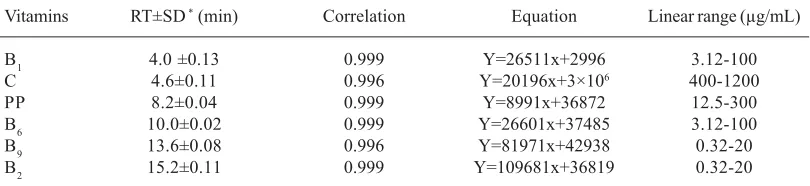
Table 2. Calibration curve parameters
Vitamins RT±SD * (min) Correlation Equation Linear range (μg/mL)
B1 4.0 ±0.13 0.999 Y=26511x+2996 3.12-100
C 4.6±0.11 0.996 Y=20196x+3×10⁶ 400-1200
PP 8.2±0.04 0.999 Y=8991x+36872 12.5-300
B6 10.0±0.02 0.999 Y=26601x+37485 3.12-100
B9 13.6±0.08 0.996 Y=81971x+42938 0.32-20
B2 15.2±0.11 0.999 Y=109681x+36819 0.32-20
an ultrasonic bath for 30 min were applied for extraction of samples. Vitamins were found to be stable in this pH about 8 hours.
Chromatographic column selection and vitamin separation
Prior to performing the validation assay chromatographic conditions for High performance chromatography method were studied in order to achieve appropriate system suitability. Determination of water soluble vitamins can be carried out by normal phase and ion-pairing chromatography while reverse phase chromatography being the most common method. The type of the column has an influence on the separation of water soluble vitamins due to
Table 3. Repeatability of vitamins analysis in premix III
Vitamins *Mean ± SD(Intraday n=6) RSD%(Intraday) RSD%(Interday n=3)
B1 25.2±0.3 1.2 2.7
C 558±11 2.1 3.1
PP 256±2.3 0.9 2.3
B6 31±0.4 1.5 3.3
B9 3.5±0.08 2.5 2.9
B2 4±0.04 2.4 3.4
*: Represents as μg/mL
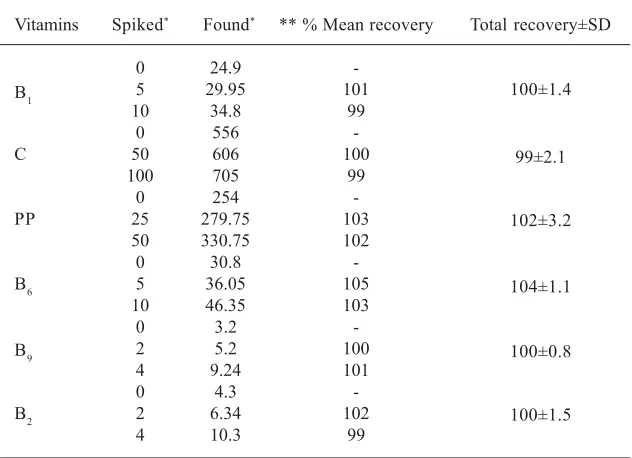
Table 4. Recovery studies of vitamins in premix III
Vitamins Spiked* Found* ** % Mean recovery Total recovery±SD
B1
0 24.9
-100±1.4
5 29.95 101
10 34.8 99
C
0 556
-99±2.1
50 606 100
100 705 99
PP
0 254
-102±3.2
25 279.75 103
50 330.75 102
B6
0 30.8
-104±1.1
5 36.05 105
10 46.35 103
B9
0 3.2
-100±0.8
2 5.2 100
4 9.24 101
B2
0 4.3
-100±1.5
2 6.34 102
4 10.3 99
*Represents as μg/mL, ** n=3
elution of vitamins was not possible. The mobile phase investigations showed that the ratio of organic modifiers, such as, the acetonitrile or methanol in the mobile phase, had a key role to a good separation. The pH value played an important role in solute ionization. So, pH values from 2.5-3.3 were tested by addition orthophosphoric acid to the mobile phase, and it was concluded that the PH should be lower than 3 to resolve the critical vitamin pairs niacin and pyridoxine. On the other hand the retention of pyridoxine hydrochloride, thiamine hydrochloride and riboflavin changed noticeably with varying acidity of the mobile phase from 2.5-3.3. To achieve the optimum resolution of vitamins the effect of methanol percentage and potassium dihydrogene phosphate concentration 50-100 mM in the mobile phase on the chromatographic separation were investigated. According to our purpose for separation and quantization of vitamins acetonitrile did not lead us to good resolutions results. In order to increase the retention of thiamine and vitamin C, the column has been washed for 3 min with buffer and then a linear gradient of buffer and methanol has been achieved by changing the percentage of them to separate vitamins from each other. According to this, the best separation was achieved by using 50 mM phosphate buffer pH=2.5 solution in a linear gradient with methanol, starting with phosphate buffer for 3 min, changing to 45%
methanol in 13 min, changing to 80% methanol in 3 min with equilibration for ten min. Each vitamin peak was resolved from the neighboring peaks and displayed excellent peak symmetry and separation with minimal interference in less than19 min. Moreover, reproducible retention times for the vitamins tested even at high percentage of buffer were observed. An example of typical sample and standard chromatogram are shown in Fig. 1.
Validation
The method validation procedure has been done based on our previous works on validation 21-22 and ICH protocol 23. The results obtained from the vitamins method validation according to linearity, selectivity, accuracy, and precision showed that the proposed method was suitable for the simultaneous analysis of B1, B2, B6, PP and B9. The vitamin C because of limitation in pH can be analyzed with this method separately.
Selectivity
Comparison between the purity threshold and purity angle reported in the Empower software showed that the method was specific for selected vitamins and the reported peaks were completely separated from the other interfering compounds.
Linearity
The linear relationship between the detector response and different concentrations of vitamins were confirmed as it was shown in Table 2.
Precision
The precision of each method indicates the degree of dispersion within a series of determinations of the unique sample. To verify the precision and repeatability of the method, the results obtained from six repeated samples (Premix III), prepared as mentioned in experimental part, at a target concentration, on one day (intraday) and on three consecutive days (interday) were analyzed. The relative standard deviations (RSD%) of the intraday and interday have been shown in Table 3. The RSDs% reported in Table 3 showed a good agreement with acceptance ranges of intra-day and inter-intra-day precisions (2-3% and 3-4% respectively). The results of intermediate precision using different analysts, different instruments, and on different days, showed that these parameters did not have any significant effect on the variation of results (data did not report).
Recovery
This parameter showed the proximity between the experimental values and the real ones. It ensured that no loss or uptake occurred during the process. The determination of this parameter was performed during the method by studying the recovery after a standard addition procedure, with two additional levels. Three replicate amounts of Premix III (1.5 g) were weighted and each of them was divided into three equal portions (0.5 g). One part was used as the real sample and others had been spiked with multivitamin standard solution containing B1, B2, PP, B9, C and B6 in two levels. In each additional level, three determinations were carried out and the recovery percentage was calculated in every case. Each sample was injected into HPLC three times. The recovery percentage in each level has been shown in Table 4. As it was reported in Table 4, the careful optimization of extraction conditions caused the good recovery for each vitamin so this method because of reaching H”100% recovery and good precision can be recommended for the quantification of several water soluble vitamins in multivitamins (pharmaceutical and premixes).
CONCLUSION
This work proposes a new method for simultaneous separating and determining of six water soluble vitamins (B1, B2, B6, B9, PP and C).
The most relevant advantage of the proposed method is the simultaneous determination of the six common vitamins in poly vitaminated premixes and supplemented foods in order to reduce of time required for quantitative extraction and analysis. It is a simple, fast, accurate and reliable in both chromatographic condition and sample preparation with minimum use of solvents and reagents. The analytical procedures are suitable for quality control of vitamins in premixes, multivitamin products and dietary supplements. It could be candidate as a routine method in quality control laboratories.
REFERENCES
1. Sane T, Doshi VJ, Jukar S, Joshi SK, Sawant SV, Pandit UR, Simple colorimetric method for determination of thiamine hydrochloride in pharmaceuticals, J. Assoc. Off. Anal. Chem ., 2005; 68: 83-85
2. Sastry CSP, Singh NR, Reddy MN, New spectrophotometric methods for the determination of riboflavin, Analysis. 1986; 14: 355-356.
3. Sane RT, Doshi VJ, Joshi SK, Simple colorimetric method for determination of pyridoxine hydrochloride (vitamin B6) in pharmaceuticals, J. AOAC. 1983; 66: 158-160.
4. Barary M, Abdel-Hamid M, Hassan E, Elsayed M, Simultaneous spectro-fluorimetric determination of thiamine, pyridoxine and riboflavine in pharmaceutical multivitamin preparations, Pharmazie. 1986; 41: 483-485. 5. Tanner JT, Barnett SA, Methods of analysis for
infant formula: Food and Drug Administration and Infant Formula Council Collaborative Study, Phase III, J.A OAC. 1986; 69: 777-785.
6. Tanner JT, Barnett, Mountford MK, Analysis of milk-based infant formula. Phase V. Vitamins A and E, folic acid, and pantothenic acid: Food and Drug Administration - Infant Formula Council: collaborative study, J. AOAC Int 1993;
76: 399-413.
7. Jedicka A, Klimes J, Determination of eight water and fat soluble vitamins in different matrices using high performance liquid chromatography, Chem. Pap. 2005; 59: 202-222.
8. Fotsing L , Fillet M, Bechet I, Hubert P, Crommen J, Determination of six water-soluble vitamins in a pharmaceutical formulation by capillary electrophoresis, J. Pharm. Biomed. Anal. 1997; 15: 1113-23.
Crommen J, Multivariate optimization approach for the separation of water-soluble vitamins and related compounds by capillary electrophoresis, Biomed. Chromatogr. 2000; 14: 10-11. 10. Jegle U, Separation of water-soluble vitamins
via high-performance capillary electrophoresis, J. Chromatogr. A 1993; 625: 495-501.
11. Mareno P, Salvado V, Determination of eight water soluble and fat soluble vitaminsin multi-vitamin pharmaceutical formulations by high-performance liquid chromatography, J. Chromatogr. A 2000; 870: 207-215.
12. Kozhanova GA, Fedorova G, Baram, Determination of Water- and Fat-Soluble Vitamins in Multivitamin Preparations by High-Performance Liquid Chromatography, J. Anal. Chem. 2002; 40-45.
13. Heudi O, kilinc T, Fontnnaz p, Separation of water soluble vitamins by reverse phase high performance liquid chromatography with ultraviolet detection: poly vitaminated premixes, J. Chromatogr. A 2005; 1070: 49.
14. Woollard DC, Indik HE, Rapid determination of thiamine, riboflavin, pyridoxine and niacinamide in infant formulas by liquid chromatography, J. AOAC Int. 2002; 85: 945-951.
15. Almagro I, San Adres MP, Vera S, Determination of water soluble vitamins in pharmaceutical preparations by reversed phase liquid chromatography with a mobile phase containing sodium dodecylsulphate and n-propanol, Chromatographia 2002; 55: 185-188.
16. Wehling RL, Wetzel DL, Simultaneous determination of pyridoxine, riboflavin, and thiamin in fortified cereal products by high-performance liquid chromatography, J. Agric.
Food Chem. 1984; 32: 1326-1331.
17. Ekinci R, The effect of fermentation and drying on the water soluble vitamin of tarhana, a traditional Turkish cereal food. Food Chem. 2005; 90: 127-132.
18. Ivanoviæ D, Popoviæ A, Raduloviæ D and Medenica M, Reversed-phase ion-pair HPLC determination of some water-soluble vitamins in pharmaceuticals, J. of Pharmaceutical and Biomedical Analysis 1999; 18: 999-1004.
19. Ke L, Simultaneous determination of nicotinamide, pyridoxine hydrochloride, thiamine mononitrate and riboflavin in multivitamin with minerals tablets by reversed-phase ion-pair high performance liquid chromatography, Biomdical chromatography 2002; 16: 504-507.
20. Albala´-Hurtado S, Veciana-Nogue´s MT, Izquierdo-Pulido M, Marine´-Font A, Determination of water soluble vitamins in infant milk by high-performance liquid chromatography, J. Chromatogr. A 1997; 778:
247-253.
21. Shekarchi M, Hajimehdipoor H, Khanavi M, Adib N, Bozorgi M, Akbari-adergani B, A validated method for analysis of Swerchirin in Swertia longifolia by high performance liquid chromatography. Phcog Mag. 2010; 6: 13-8.
22. Hajimehdipoor H, Shekarchi M, Khanavi M, Adib N, Amri M, A validated high performance liquid chromatography method for the analysis of thymol and carvacrol in Thymus vulgaris L. volatile oil. Phcog Mag. 2010; 6:154-158.