Security and Law
Security and Law
Volume 12 Number 3 Article 6
9-2017
Public Security & Digital Forensics in the United States: The
Public Security & Digital Forensics in the United States: The
Continued Need for Expanded Digital Systems for Security
Continued Need for Expanded Digital Systems for Security
Deborah G. Keeling
University of Louisville, [email protected]
Michael Losavio University of Louisville
Follow this and additional works at: https://commons.erau.edu/jdfsl
Part of the Computer Law Commons, Information Security Commons, and the Social and Behavioral Sciences Commons
Recommended Citation Recommended Citation
Keeling, Deborah G. and Losavio, Michael (2017) "Public Security & Digital Forensics in the United States: The Continued Need for Expanded Digital Systems for Security," Journal of Digital Forensics, Security and Law: Vol. 12 : No. 3 , Article 6.
DOI: https://doi.org/10.15394/jdfsl.2017.1452
Available at: https://commons.erau.edu/jdfsl/vol12/iss3/6
This Article is brought to you for free and open access by the Journals at Scholarly Commons. It has been
accepted for inclusion in Journal of Digital Forensics, Security and Law by an authorized administrator of Scholarly Commons. For more information, please contact [email protected].
Public Security & Digital Forensics in The United ... JDFSL V12N3
PUBLIC SECURITY
&
DIGITAL FORENSICS IN
THE UNITED STATES: THE CONTINUED NEED
FOR EXP ANDED DIGITAL SYSTEMS FOR
SECURITY
Deborah Keeling
University of Louisville College of Arts and Sciences Louisville, Kentucky, 40292 U.S.A.
dgwilsOl@louisville. ed u
Michael Losavio University of Louisville Department of Criminal Justice Louisville, Kentucky, 40292 U.S.A.
ABSTRACT
Digital Forensics is one of the latest challenges for the use of forensics in the investigative process in the United States. Some of the challenges are created by conditions and circumstances present for law enforcement around the world. However, many are unique to the United States and created by the standards of evidence within our courts, nature of our law enforcement organizations, and structure of our judicial and prosecutorial systems. It is essential for the preservation of public security and individual safety that competent systems of digital forensics are developed for law enforcement at all levels. The failure to do so will let the guilty avoid responsibility for their criminal actions while possibly subjecting the innocent to unprecedented government intrusion into their private lives.
Keywords: digital forensics, law enforcement, public security, technology, cyber security
1.
INTRODUCTION
Digital Forensics is: " ... use of scientifically derived and proven methods towards the preservation, collection, validation,
identification, analysis, interpretation of digital evidence derived from digital sources for the purpose of facilitation or furthering the reconstruction of events found to be criminal or helping to anticipate the unauthorized actions shown to be disruptive to planned operations"
Technology has changed the way in which we interact as a society (NRC, 2002; Rogers, 2003). The US Census Bureau estimated that in the year 2001, e-business retail sales totaled $34 billion (US Bureau of Census, 2002). Estimates of e-business retail sales for 2015 totaled $340.4 billion (US Bureau of Census, 2017). This represents an increase of 900 percent over this fourteen-year period. Similarly, individuals are increasingly using the internet. The US Census reported that in 2012, 7 4.8 percent of total US households reported that someone in the household had access to the Internet from some location. For individuals 44 years and younger, the rate of access was over 80 percent (US census, 2014).
Similarly, in 2000, 53 percent of US residents reported that someone m the household accessed the Internet from some location. In 2012, this rate of reported use had increased to 75 percent (US Census, 2014). Of those accessing the internet in 2012, 69 percent reported access from home and 75 percent from hone or some other location. In 2015, approximately 95 percent of US respondents reported owning a cell phone with 77 percent reporting owning a Smartphone. This is up from 83 percent cell phone and 35 percent smartphone ownership m 2012 (PEW Foundation, 2017).
With the advent of increased technology and increased use of technology comes misuse. Not all misuses of electronic devices are crimes. Cybercrime takes various forms but is generally defined as "crimes committed through the use of digital devices as either the object of a crime, the instrument to commit a crime, or a repository of evidence related to a crime" (Agarwal, et. al., 2011).
2. LITERATURE REVIEW
In 2011 a survey of 50 large US companies found that the median cost related to cybercrime in 2011 was $5.9 million. This represents a 56
percent increase over the median cost reported in 2010 (Cybercrime Research Center, 2011). The forms of cybercrime reported were mixed but more insidious such as malicious code, denial of service and Web-based attacks. It took an average of 18 days and $417,748 to clean up the attacks an increase from the 14 days and $247,744 reported in 2010. The average number of successful attacks reported was 72 per week, up 44 percent from the previous year (Cybercrime Research Center, 2011).
Similarly, individuals report various types of Cybercrime on an increasing frequent annual basis. In 2000, there were 16,838 complaints of internet crime to the Internet Crime Complaint Center. By 2011, the number of complaints had increased to 314,246 totaling an estimated $485.3 million in losses. The most frequently reported crimes were: advanced fee scams (9%), identity theft ( 9%), FBI-related scams ( 11 % ) and (7%) non-auction or non-delivery of merchandise (Internet Crime Complaint Center, 2011). In 2016, the number of complaints filed was 298,728 with a reported $1.33 billion in victim losses (Internet Crime Complaint Center, 2016). The US Federal Trade Commission reported that in 2009, 26 percent of all complaints involved some form of computer -related crimes. The specific crimes in included: credit card fraud ( 17%), theft of government benefits or documents (16%), and theft of phone or utilities (15%) (Federal Trade Commission, 2010).
Public Security & Digital Forensics in The United ... JDFSL V12N3
Approximately 40% of the commanders believed
cell phone evidence was involved in 51 % or more of all violent crimes and approximately 50% that cell phone evidence was involved in 51 % or
more of all drug offenses (Losavio, et. al., 2007). Digital forensics units report that more than
70% of their examinations involve cell phones (Personal Correspondence, FBI Regional
Computer Forensics Lab Program National
Advisory Committee, May 2012).
While digital evidence is becoming more prevalent, this boom in technology poses
significant challenges for law enforcement. Even today, computer security and digital forensics is evolving and will continue to do so because as
technology changes so must efforts for security and digital forensics. Digital forensics, as a
discipline, has progressed through three stages,
to date (Charters, 2009; Pollitt, 2010). Digital forensics and computer security were preceded by the development of computers in 1947 and is defined as the beginning of the Industrial Era of Computing (History of Computing Foundation,
2010). The first phase of digital forensics is the Ad Hoc (Charters, 2009) or Infancy (Pollitt, 2010) stage. Computers were generally mainframe computers and the possession of large organizations. Personal computers were in use and were powerful but were not user friendly
and had relatively few applications that could
be of general use to individual "hobbyists"
(Pollitt, 2010). This was the "pre-forensics"
stage characterized by a lack of structure, goals and clear policies and procedures to govern the
identification and collection of digital evidence.
Evidence was collected but the quality questioned due to unclear policies within organizations concerning employee "use" of
corporate property and "ownership" of
employee's work products on corporate computers. Accuracy of forensic tools and "chain-of-custody" issues were significant in that
there were few, if any, court decisions
concerning digital evidence during this era. Law
enforcement agencies were beginning to use
digital evidence, but training was limited,
examiners were often individual investigators with an "interest" in computers and therefore,
digital forensics "operated in direct conflict with
the traditional, laboratory-based practice of forensic science" (Pollitt: 8, 2010). The second phase of digital forensics, Childhood, extended
from 1995 through 2005 (Pollitt, 2010). It is
characterized by tremendous growth not only of digital forensics applications and policies, regulations and laws related to the use/misuse
of computers and other electronic devices but of individual use/misuse of electronic devices and,
most notable, the "explosion of child
pornography cases" beginning with the George Stanley Burdynskim Jr. case in 1993 (Pollitt,
2010). Additionally, this era encompassed the
events of September 11, 2001 and the use of computers by terrorists and a lack of expertise
on the part of law enforcement and the military
to handle these events. The need for specialized training due to the increased volume of cases,
increasing complexity of technology and growing knowledge within the field became increasingly evident. Field came to develop
through impetus from government agencies and specialize digital forensics organizations.
The next phase, Adolescence, covered 2005-2010 (Pollitt, 2005-2010). With this phase came
increasing legal specification that defined digital information as evidence and specified a
mechanism for eDiscovery (Manes, et.al., 2007). Academic and detailed, advanced training
programs grew as did the complexity and
maturity of devices to be examined. "Virtually
every device that use( d) electricity ha( d) some
form of digital storage. Wired or wireless networks connect(ed) many of the devices we use(d) in our daily lives" (Pollitt: 12, 2010). Organized processes and procedures for the identification, collection, analysis, preservation
developed by law enforcement, the military and the intelligence community.
The development of digital forensics within American law enforcement has and continues to face many challenges. These include: access to digital services; training and equipment needs ( economic issues); lack of standardization; legal issues related to the validity and reliability of digital evidence ( forensic science versus technology); increased complexity of digital evidence ( cloud computing, hard drive encryption, size of data to be seized/analyzed) and related digital issues. However, the over-reaching issue is that of cultural lag relative to technology and the law/ ethics that exists and continues to drive much of the social behavior related to the use of technology.
2 .1
Access
toDigital Services
The United States has approximately 18000 law enforcement agencies, each with a unique geographic and legal jurisdiction. Each funded differently with no consistent standards for law enforcement training, equipment, services, or policies and procedures. As such, the availability of digital forensics resources is extremely uneven among law enforcement agencies throughout the United States. Some law enforcement agencies, generally the federal agencies and largest US police departments have their own digital forensics units for purposes of examining, analyzing and preserving digital evidence. However, large jurisdictions, those with 1000 or more sworn personnel constitute only .4% of all local police agencies in the US. In fact, most police agencies, 95.4% have fewer than 100 sworn personnel and are responsible for jurisdictions with fewer than 25000 in population (Bureau of Justice Statistics, 2013).
A survey of law enforcement agency digital forensics resources was conducted in 2005. A total of 576 law enforcement agencies were surveyed. A majority of the agencies (72.3 percent) did not have a dedicated digital
evidence unit and another majority (58.1 percent) had no digital evidence policies. Only approximately one half had digital forensics awareness training. Similarly, most (57.5 percent) reported the collection of digital evidence in from O to 5 percent of their investigations (Pollitt, 2005). Another survey of police commanders reported that 35% responded they had failed to use digital ( cell phone) evidence in criminal cases due to a lack of access to expertise to extract and preserve the digital evidence (Losavio, et.al., 2007).
Clearly, the emphasis on local law enforcement and lack of consolidation of law enforcement within the United States has resulted in "uneven" access to digital evidence resources. This includes awareness training on digital evidence ( what is digital evidence, why it should be seized at the crime scene), as well as access to resources to extract and preserve digital evidence in criminal cases. While some of the variation in digital forensics may be the product of decisions by leadership within these agencies, it is, in all likelihood, more directly related to economic factors.
Several projects have sought to remedy this. For example, the Secret Service provided training and equipment to departments around the country willing to dedicate staff to this. Continued expansion of this capability will be crucial to public security.
2. 2
Trainingand Equipment
Nea:Js
"The collection of electronic data as evidence of crime is an important responsibility given to law enforcement. The technical constraints of this task are arguably far less significant than usability and economic ones, since police officers are non-specialists and police departments face significant budgetary limitations" (Moore: 1,
Public Security & Digital Forensics in The United ... JDFSL V12N3
digital forensics examination techniques is very
expensive, and may cost as much as $10,000 for basic training in data extraction and upwards of $20,000 for training in more specialized digital
examination techniques such as extraction of data from damaged hard drives (Personal
Correspondence, FBI Regional Computer Forensics Lab Program National Advisory
Committee, May 2012). Additionally, one-time training is not sufficient because as technology changes, skills must be enhanced, and so regular in-service training is required on at least an annual basis.
In addition to the training, digital forensics requires complex hardware and software that may cost tens of thousands of dollars. And, while the needs for data extraction on some
devices such as personal computers may be
conducted using many available tools due to standardization of hard drives, storage on devices such as cell phones and smart phones is within the phone's internal memory, is absent standardization and within locations that vary depending on the model. Even cords used to
transfer information are not standardized. As
such, cell phone examination is much costlier
and requires specialized software and cables that are ever increasing with the release of new phone models.
Because of the size of their jurisdiction, number of sworn personnel, and the frequency of crime, budgets are limited, and the start-up and ongoing costs of digital evidence equipment,
software and training may not be cost effective.
However, even with larger law enforcement agencies, the economics are pressing and bear fixed costs with some additional marginal costs associated with the extraction (Moore, 2006). When access to the digital resources of a large police agency or central state forensics unit is
available, that access may increase the marginal
costs of the data collection. For example, the time for a police investigator to drive 60 or 100
miles carrying digital devices for examination to
a centralized department results in higher personnel costs, transportation costs and may make the "chain-of-custody" more complex and
potentially problematic.
2. 3
Lack of Standardization
Lack of standardization within digital forensics is significant in several ways. 1) There is no
standardization across all law enforcement agencies concerning the appropriate
"investigative" model. For example, Agarwal,
et. al. (2011) identified and discussed four prior investigative models as well as their currently
proposed (Systematic Digital Forensic Investigative) model. The need for a standardized procedure within digital forensics is critical for the nature of the discipline, i.e., justification of the discipline as scientific rather than technical; establishing benchmarks in the investigation of crimes involving digital
evidence; meeting legal challenges based on the integrity and admissibility of digital evidence; and create comparability of investigative
techniques nationally. 2) As noted previously,
access to digital forensics resources is not standardized across law enforcement
jurisdictions and therefore, the ability to use digital forensics varies by agency and geographic
location. 3) There are no standards for what
constitutes "appropriate" digital forensics
examination training, no standards for
"appropriate" digital forensics examination techniques and no standards for "appropriate"
digital forensics tools. "Experts" within the
discipline are, for the most part, self- defined
though those within the FBI CART are generally recognized as having some of the most detailed and complete training. Proprietary
sources for the software and hardware generally
determine "adequacy" of their proprietary
training that is "purchased" along with the hardware and/or software to be used in the
be recorded by any other than the agency sponsoring (paying for) the training.
The American Society for Crime Lab
Directors has an official board (Lab
Accreditation Board) that accredits digital
forensics labs. It is currently the only
accrediting body for crime labs. Similarly, one non-proprietary group for testing computer
forensics software, National Institute for
Standards and Technology (NIST) Computer
Forensics Tool Testing ( CFTT) division is a
government entity that performs tests on
software. Similarly, the FBI's Technology
Division performs tests on digital examination
software and hardware as a means of
determining whether the devices meet the standards set for these tasks by the organization
itself. These regulatory bodies are not sufficient
to keep pace with changes in computing and electronic devices.
A survey was administered to digital
forensics examiners in 2003 (Rogers and
Siegfried, 2004). These respondents expressed
concern over an absence of national standards
for digital forensics. Specifically, they were
concerned there were no national certifications for digital forensics and the linkage between several current certifications and vendors such that the vendors certified the customers on
proprietary tools. As noted by the authors,
" ... proprietary certifications only increase the
level of fragmentation within the industry and
perpetuate the misguided belief that there is no
generic conceptual approach to computer
forensics" (Rogers and Siegfried, 2004: 15).
2.
4
Admissibility of Digital
Evidence
Evidence gathered through all forensics
disciplines must meet basic evidentiary and
scientific standards if it is to be used in legal
proceedings. The US Supreme Court set these
standards in the decision in the case of Daubert v. Merrell Dow Pharmaceuticals, Inc. (1993).
The decision set standards for determining the
scientific basis of evidence because the law views
scientific evidence as more reliable and therefore
more acceptable than non-scientific evidence.
The process under Daubert identifies four
general categories to use in the assessment of
evidentiary procedures: Testing ( Can and has
the procedure been tested?), Error rate (Is there
a known error rate of the procedure?),
Publication (Has the procedure been published
and subject to peer review?), and Acceptance
(Is the procedure generally accepted in the
relevant scientific community?).
Whether or not digital evidence meets the
standards of admissibility under Daubert is and
will continue to be a recurring issue. 1) Testing
- This legal standard asks whether a forensics
tool can and has been tested to prove that it
produces accurate results. Organizations such
as National Institute of Standards and
Technology have performed and published
digital tools but, to date, no standard testing
methodology exists. Most often, problems with
open and closed source applications are
identified by users in the field. The users then
report the problems to the vendors. The
vendors make the necessary changes but may
not be motivated to report these findings,
generally, to the public or justice practitioners
(Carrier, 2002). Similarly, 2) Error rate - This
standard asks whether there is a known error
rate for the procedure. Manufacturers of digital forensic tools do not necessarily want to provide
a "known error rate" for their tools. In fact,
promoting the error rate would simply be "bad
for business." As such, when major errors are
reported by users, the manufacturers simply
make changes to the tools ( new and in-service)
without drawing too much attention to the
problems with their "product." 3) Publication
-Whether the procedure has been published and
subject to peer review. As digital forensics has
matured as a science, so have the number of
Public Security & Digital Forensics in The United ... JDFSL V12N3
various tools. Much is, however, still
proprietary and protected with the
manufacturers conducting internal validation research on their own products, making the changes necessary, without publication of the results. Only with the field user or organization, such as the FBI that methodically validates all instruments used in the digital forensics process, are the tools validated and the results published
and distributed for general consumption. In
some instances, even these validation studies carried out by the FBI are not published since
identification of a weakness with a digital
forensics tool might call into question
convictions based on the findings from this
instrument and/or provide offenders with
information to more efficiently perform the
activities involved in cybercrime without
detection. 4) Acceptance - The last standard
assesses whether or not the procedure is one that is generally accepted in the relevant scientific community. The interpretation of this standard is varied. On the one hand, the digital
forensics tool vendors argue that numbers of
customers are a measure of "acceptance" in the
relevant scientific community. However,
customers are "users" and "users" are not
necessarily "scientists" but rather trained
professionals who use the tools developed and
vetted by the scientist. When number of
customers is not used, scientific publications
become a criterion and, as such, the limitations
discussed in the "Publication" standard would
apply.
Since 2007, the US Federal District Court
has rendered more than 1000 court opinions concerning cell phones and their use as evidence
or sources of evidence within criminal
proceedings (Law.Justia.Com, downloaded May
15, 2012). Additionally, since 2008, the US
Federal District Courts have rendered more than 500 opinions concerning digital evidence.
While not all were questions related to the
admissibility of this type of evidence in the
specific cases, the op1mons addressed various
legal issues related to this newest form of
scientific evidence (Law.Justia.Com,
downloaded May 16, 2012).
Judicial determinations are based on
findings of fact that are informed by the not only the law but the general knowledge of judges
on the specific topic. The extent to which
judges are familiar with electronic evidence and
systems may affect decisions concerning the admissibility of digital evidence. A survey of judges in 2005 found that while the majority
(75%) expected significant changes in the future
and felt they needed significant training (95%)
in digital evidence, only a minority actually had experience in digital evidence. Only 5 percent
reported handling cases involving email
evidence and 3 percent website or Internet
evidence. However, when used, 17 percent
reported email evidence was frequently or
almost always challenged with 20 percent
reporting similarly for website or Internet
evidence (Losavio, et.al., 2006). If judges do not understand digital evidence, it may be more
difficult to make a determination concerning its
admissibility and therefore challenges to digital evidence may be more numerous and affirmed more frequently.
2. 5 fucreased Complexity of
Digital Evidence
Law enforcement agencies are dealing with
increasingly large amounts of digital evidence.
The agencies have moved from analysis of bytes
to megabytes, gigabytes, terabytes and
petabytes. Personal computers now hold more information and more processing power than the
corporate mainframe of 15 years ago. Digital
examiners must have the capability to process
large amounts of information and to do it
accurately, completely and in a timely manner.
This requires advanced equipment and therefore
results in additional costs that are not
enforcement agencies. Similarly, law enforcement agencies will soon be addressing more issues related to encryption as computer
companies begin to mass produce personal
computers with self-encrypting hardware - more
training, more equipment, more costs. Lastly, issues such as "cloud computing" raise serious questions requiring legal clarification. That which is most specific is "who" owns the information an individual stores in a proprietary
"cloud" and what reasonable expectations for
privacy can an individual have when operating in a proprietary "cloud" environment. What can vendors be required to do in terms of notification to consumers and public reports on law enforcement information requests relative to "cloud" computing? Which entity should be named in the warrant - the vendor or the customer? These are complicated issues that will need to be addressed within a relatively short amount of time.
2.6
Other Issues
Perhaps the greatest challenge that faces not only US law enforcement but all law enforcement involved in digital forensics is cultural lag. Cultural lag is a term coined by William Ogburn (1922). It refers to differences between technology and the "non-material" components of a culture in which there is a "lag" between the material (technology) and non-material culture. Since technology changes at a rapid and ever-increasing rate, the ethical "guides" for use of technology are in a constant state of "lag" since social norms and values do not change at the same rate as that of technology.
Marshall (1999) raised the issue of cultural lag and argued it is appropriate and important to address whether new technologies introduce ethical problems. The development of social guidelines and norms for technology becomes even more significant when technological change creates great cultural shift due to rapid diffusion
across a wide range of human activities
(Marshall, 1999; Robinson, 1981). Such is the case with computing. Normative, legal and ethical issues surround technology and multiply as technology changes and becomes more distributed throughout the everyday lives of members of our society. Some of the issue are normative such as etiquette related to cell phone use or practical considerations related to the consequences of what individuals choose to post on Facebook pages. Others are related to ethics and include issues of Internet postings, using a roommate's computer without permission or
"sexting" on a PDA. Many are not only
unethical but also illegal. Many times, however, the illegal or unethical nature of acts is not recognized - at least not initially, until realization is made of the "harm" that occurs or can occur. Who would have thought that there would be a need for laws related to the distribution of pornographic images of children over the Internet or that a specialized form of "bullying" that is, cyber bullying would emerge?
American society is diverse. The development of values, beliefs, ethics, and laws does not occur in a controlled focused
environment. Instead, it occurs through
individuals with widely divergent backgrounds, knowledge, skills, etc. Changes in cultural norms, values and belief systems is not specific and does not emerge quickly. Unlike the development of technology, there is no market structure to reward changes in the non-material culture. That is, those who ponder and assist in the development of ethical standards are not rewarded monetarily. It is not possible to develop ethical standards until after-the-fact that is, until after the development of new technology. As such, our understandings, ethics, beliefs and social guidelines related to technology use will always "lag" behind the rate of development of technology itself.
www.wired.com/threatlevel/2012/01/scotus-gps-ruling/
Public Security & Digital Forensics in The United ... JDFSL V12N3
Supreme Court. This court has had to,
after-the-fact, develop new standards fore-Discovery, to determine whether or not cell phone companies are obligated to provide law enforcement with cell phone information that
would track the activities of their customer.
Standards of privacy and reasonable
expectations of privacy have been redefined in
response to electronic technology. In the past,
many of the Supreme Court rulings were based on the premise that individuals did not have a
reasonable expectation of privacy when in a
public area/situation. Most recently, the US
Supreme Court decided that our citizens do
have a reasonable expectation to privacy in
public places when ruling on the legality of search and seizure in a case in which law enforcement used GPS to track the movements
of a suspect in a recent case. In the ruling, one
Justice rendered a solo opinion stating that individuals had more of a right to privacy in
data held by phone and Internet companies
than the Supreme Court had held in the past
(
_____________
_
_ _ , downloaded May 16, 2012).
3.
RElVIEDIATION
POSSIBILITIES
There are a variety of possibilities for the
remediation of these obstacles to the
deployment of digital forensics resources. One
project, for example, has tested linking a federal
Bureau of investigation regional computer forensics laboratory (RFCL) with local law enforcement mini-laboratories for analysis directed using a triage model to allocate
resources to cases. Each participating agency
or agency division provided, among other
things, secure laboratory space, a dedicated
employee, employee training, and use of the
digital forensics facilities. The project provided computer hardware, digital forensics suite of examination software (AccessData's FTK and
MPE suites) and training on these systems and software.
The results demonstrated both the capacity
for greatly expanding digital forensic services
where there was commitment to use them.
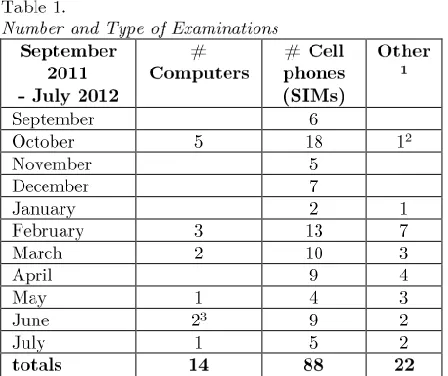
Table 1 contains the results for one agency
assigned a full-time staff/ officer to conduct
examinations, produced the following result in roughly one-year period:
These examinations included a variety of
crimes: murder, robbery, rape, unlawful
imprisonment, assault, narcotics trafficking, child pornography and child sexual exploitation.
The initial cases were child
pornography/ exploitation cases. However, over
the one-year period, use of the services had
expanded to address other kinds of cases,
including homicide, rape and robbery. This indicates the shift towards use of digital
forensics as an investigative tool across the
criminal justice spectrum. It is worth noting
that as the project evolved, these services were
used by other law enforcement agencies,
1
2
4
• • • •
3 4
Table 1.
Number and Type of Examinations
September # # Cell Other
2011 Computers phones 1
- July 2012 (SIMs)
September 6
October 5 18 12
November 5
December 7
Januarv 2 1
Februarv 3 13 7
March 2 10 3
April 9 4
Mav 1 4 3
June 23 9 2
Julv 1 5 2
totals 14 88 22
Another participating agency, which had
been conducting its own digital forensics
examinations, integrated the new tools and
training into its operations. The data from its
operations showed a significant shift from the
examination of computers and related
peripherals to the examination of cell phones for evidentiary purposes; approximately one third
of the examinations were for outside agency
seeking assistance with digital forensics
examination. Similarly, another local law enforcement agency with a pre-existing digital
forensics capacity and school online safety
program also found a strong trend towards
examination of mobile devices over that of
computers. While the majority of cases
continued to be child pornography,
examinations were also part of investigations for
drug trafficking, counterfeiting, forgery and a
car bombing.
This project demonstrates that when
provided services along with the willingness to
use them; law enforcement agencies quickly find that digital forensic services play a role in nearly
all forms of misconduct. Growth in the use of
MicroSD cards are counted as separate devices although they are associated primarily found
associated with cell phones in these examinations
TomTom GPS lEX00
digital forensic services was also furthered by
expansion of the examination of mobile devices relating to criminal misconduct.
Another project that promoted the
distribution and use of digital forensics services
were online, activated, distributed software
tools with hardware connector kits and online
training made available to qualifying law
enforcement agencies. The forensic tool
provided for data acquisition, analysis and
reporting relating to cell phone examinations. It
offered keyword searching and transactional
timeline, frequency and linkage visualization for phone, text and web activity on the device.
Analysis of data from one month of system
use showed a broad use by many agencies
municipal, county, federal and state law
enforcement, including the Office of the State
Fire Marshall, Lincoln University Police
Department and the Kansas Department of Wildlife and Parks -- examining many different
kinds of devices, cell phones predominated:
Total successful exam logins - 210
#
agencies using system - 40#
different mobile devices - 7 4#
different manufacturers - 12Data entry was inconsistent, with about one
quarter noting the crime with which the
associated device was being examined; those
crimes included homicide, aggravated rape,
aggravated assault and narcotics offenses.
The widespread and rapid adoption of this
system again supports the conclusion that where
resources and training are easily available, they
will be adopted quickly by law enforcement as
tools for crime investigation and prosecution.
Includes a tablet computer
Secure View 3 Case Management-Analytics:
Public Security & Digital Forensics in The United ...
4
.
IIVIPLICATIONS
Computer crimes are highly impersonal, in most
instances. They involve behaviors not generally
addressed through existing moral standards. There is no need to face the victim when engaging in the crime. There is no need to observe the harm created by the illegal behaviors. Offenders generally only think of the
implications of what they as one individual are
doing and do not think of the implications of spreading this harm among millions of individuals and therefore, magnifying the harm.
There exists only limited understanding of the
perpetual nature of cyberspace and consequent
harm.
Computer crimes additionally raise new challenges for the laws and only as new crimes emerge from the misuse of new technologies,
laws must be changed and developed to address
previously unknown issues. Technology also
introduces a wide range of new vulnerabilities
criminals can use to take advantage of their
victims.
5.
CONCLUSION
The expansion in both the presence of digital
devices in relation to a crime locus as well as the
use of digital devices as tools for the commission of crimes will continue, particularly as we see the growth of the Internet of Things and the present of interconnected devices everywhere.
These provide both opportunities for crime as
well as opportunities for investigation to solve
those in other crimes. It is essential for the
preservation of public security and individual
safety that competent systems of digital
forensics be available for all levels of law
enforcement. The failure to do so will let the
guilty avoid responsibility for their criminal
actions while possibly subjecting the innocent to unprecedented government intrusion into their
private lives. This is abhorrent to the rule of law
and deserves our full attention.
REFERENCES
Agarwal, A., Gupta, M., Gupta, S. & Gupta,
S.C. (2011). Systematic digital forensic investigation model. International Journal of Computer Science and Security, 5(1), 118-131.
Bureau of Justice Statistics (2003). Local Law Enforcement.
https://www.bjs.gov/index.cfm?ty=pbdeta il&iid=5279
Carrier, B. (2002) Open source digital forensics tools: The legal argument (1-11). @stake.
Charters, I. ( 2009). The evolution of digital forensics: Civilizing the cyber frontier.
Computer Crime Research Center (2011). Cybercrime costing companies more this
year. http:/ /
www.crime-research.org/ news/ 09. 08.2011 / 3880 /
Federal Trade Commission, Annual Report (2009).
https://www.ftc.gov/sites/ default/files/ doc uments/reports _annual/ annual-report-2009 /2009chairmansreport _ 0. pdf
History of Computing Foundation (2016). https://www.thocp.net/reference/info/abo ut.htm#hocf
Internet Crime Report (2011). Overall Statistics.
https:/ /pdf.ic3.gov /20111C3Report.pdf
Internet Crime Report (2016). Overall Statistics.
https:/ /pdf.ic3.gov /2016IC3Report.pdf
Losavio, M., Wilson, D., and Elmaghraby, A. (2007). Prevalence, use, and evidentiary issues of digital evidence of cellular telephone consumer and small-scale digital devices. Journal of Digital Forensic Practice, 1(4), 291-296.
Marshall, K. P. (1999). Has technology introduced new ethical problems?. Journal of business ethics, 19(1), 81-90. Library, Baltimore, MD. 30 Sep. 2009.
PEW Foundation (2017). 2015 Mobile Fact Sheet. ,http:/ /www.pewinternet.org/ fact-sheet/mobile/
Manes, G., E. Downing, L. Watson, C. Thrutchley (2007). New Federal Rules and Digital Evidence. Annual ADFSL Conference on Digital Forensics, Security
and the Law. 3.
http://commons.erau.edu/adfsl/2007 /sessio n-6/3
Moore, T. (2006, June). The Economics of Digital Forensics. In Proceedings of the Workshop on the Economics of Information Security, 2006.
NCR (2002). National Competitiveness Report. Institute of Professional Studies, Seoul,
Korea.
Ogburn, W. F. (1922). Social change with respect to culture and original nature. BW Huebsch, Incorporated.
Palmer, G. (2001, August). A road map for digital forensic research. In First Digital Forensic Research Workshop, Utica, New York (pp. 27-30).
Pollitt, M. (2010). A history of digital forensics. Advances in Digital Forensics VI, 3-15.
Public Security & Digital Forensics in The United ...
Rogers, M. (2003). The role of criminal profiling
m the computer forensics process." Computers & Security 22.4: 292-298.
Rogers, M.K., and K. Seigfried (2004). The future of computer forensics: a needs analysis survey. Computers & Security 23.l: 12-16.
United Nations Development Programme. Human Development Report Office. Human Development Report: Background papers. Human Development Report Office, United Nations Development Programme, 1999.
U.S. Census Bureau (2002). E-Stats.
https://www.census.gov/library/publicatio ns.html
U.S. Census Bureau (2014). Computer and Internet Access in the United States 2012. https://www.census.gov/library /publ ications.html
U.S. Census Bureau (2017). E-Stats 2015. https://www.census.gov/library /publ ications.html