R E S E A R C H
Open Access
Development of foraging skills in two
orangutan populations: needing to learn or
needing to grow?
Caroline Schuppli
1*, Sofia I. F. Forss
1, Ellen J. M. Meulman
1, Nicole Zweifel
1, Kevin C. Lee
1, Evasari Rukmana
2,
Erin R. Vogel
3, Maria A. van Noordwijk
1and Carel P. van Schaik
1Abstract
Background:Orangutans have one of the slowest-paced life histories of all mammals. Whereas life-history theory suggests that the time to reach adulthood is constrained by the time needed to reach adult body size, the needing-to-learn hypothesis instead suggests that it is limited by the time needed to acquire adult-level skills. To test between these two hypotheses, we compared the development of foraging skills and growth trajectories of immature wild orangutans in two populations: at Tuanan (Pongo pygmaeus wurmbii), Borneo, and Suaq Balimbing (Pongo abelii), Sumatra. We collected behavioral data on diet repertoire, feeding rates and ranging competence during focal follows, and estimated growth through non-invasive laser photogrammetry.
Results:We found that adult-like diet repertoires are attained around the age of weaning and that female immatures increase their repertoire size faster than their male peers. Adult-level feeding rates of easy techniques are reached just after weaning, but several years later for more difficult techniques, albeit always before adulthood (i.e. age at first reproduction). Independent immatures had faster feeding rates for easy to process items than their mothers, with male immatures achieving faster feeding rates earlier in development relative to females. Sumatran immatures reach adult-level feeding rates 2–3 years later than their Bornean peers, in line with their higher dietary complexity and later weaning. The range-use competence of independently ranging and weaned immatures is similar to that of adult females. Body size measurements showed, immatures grow until female age of first reproduction.
Conclusions:In conclusion, unlike in humans, orangutan foraging skills are in place prior to reproduction. Growth trajectories suggest that energetic constraints, rather than skills, best explain the length of immaturity. However, skill competence for dietary independence is reached later where the adult niche is more complex, which is consistent with the relatively later weaning age with increasing brain size found generally in primates, and apes in particular.
Keywords:Body growth, Development, Diet repertoire, Feeding rates, Foraging skills, Life history, Needing-to-learn hypothesis, Ranging, Orangutans, Skill learning
Background
Compared with other primates, great apes have an exceptionally long period of development, even after controlling for the effects of body size [1, 2]. Among them, with a developmental period of almost 20 years, humans are the most extreme case [3]. So far, the rea-sons for this delay of the reproductive period remain
poorly understood. According to classic life history the-ory, although the developmental period is needed to grow both the body and brain to adult size, the repro-ductive phase should be reached as early as possible to maximize reproductive outcomes. Thus, the relative length of the immature phase is determined by the optimization of developmental and reproductive sched-ules in the face of allocation tradeoffs and externally imposed mortality [1, 3–5]. However, variation in the length of the immature phase cannot be explained * Correspondence:[email protected]
1Department of Anthropology, University of Zürich, Winterthurerstrasse 190,
8057 Zürich, Switzerland
Full list of author information is available at the end of the article
completely by these tradeoffs, particularly among great ape species.
Much of this remaining variance has been explained by brain size. When controlling for body size, larger-brained species have a relatively longer period of devel-opment than smaller brained species [3, 6, 7]. The pro-longed immature period of the large-brained great apes is largely in line with this. However, the question re-mains why such a correlation exists in the first place. Two main theoretical frameworks have been proposed to explain the correlated evolution between the length of the developmental period and brain size.
First, it has been suggested that larger-brained animals show an extended developmental period because they need time to acquire more and increasingly complex skills required for adult survival and reproduction ( need-ing-to-learn hypothesis: [8]). In this view, the length of the developmental time is constrained by the number and complexity of skills a species must acquire. This hy-pothesis therefore predicts that at least some vital skills needed for adult survival reach adult levels just before the age at first reproduction. This prediction holds for birds, whose adult-level foraging skills are attained around the time of first reproduction [9–11]. In most mammals, however, skill competence is reached well be-fore the age at first reproduction [11, 12]. In contrast to birds, most mammals need to be self-supporting right after weaning due to the lack of post-weaning provision-ing [13]. Since the consequences of food acquisition in-competence are especially severe during development [12], at weaning a juvenile’s skills must have reached a level sufficient to support their smaller but still growing body. It is thus likely that for most mammals, skill ac-quisition may determine the timing of weaning, even though it does not directly constrain the age of first reproduction [3].
The competing hypothesis is that energetic constraints of large brains on somatic development prolong the length of the developmental period (expensive brain framework: [14, 15]). This framework encompasses sev-eral hypotheses proposed earlier, including the effects of maturational constraints and malnutrition avoidance [16]. Brain tissue is among the most energetically expsive tissues to maintain [17] and requires even more en-ergy to develop [18]. Also, because developing brains are especially susceptible to temporary energy shortages [19], brain development must be conservative so it can be constantly supplied by sufficient energy. Brain growth is completed before somatic growth [20, 21]. Accord-ingly, the high energetic investment of larger-brained species into brain development during infancy and ju-venility results in a delay in the physical development of the body, and thus a delayed onset of the reproductive period [14, 16, 22]. The expensive brain frameworkis in
line with the interspecific correlation between large brains and delayed maturation. Within species, it pre-dicts that body growth is only completed around the age of fist reproduction, particularly in females.
A comparative study has shown that in most mam-mals, foraging skills are in place well before the age of first reproduction and thus unlikely to be limiting the onset of reproduction [11]. Data on chimpanzees (Pan troglodytes) and gorillas (Gorilla gorilla beringei and Gorilla gorilla gorilla) suggest that adult-like diet reper-toires and feeding rates are reached around the age of weaning, with the exception of chimpanzee tool use and cooperative hunting, for which competence is reached well after weaning [23, 24]. Most other primate species seem to follow this pattern of all major foraging skills being reached by weaning, whereas top-end-complexity techniques without systematic dependence (e.g. tool use) may be reached later. Thus, competence in all foraging skills roughly coincides with weaning in chacma baboons (Papio ursinus, [25]), bonnet macaques (Macaca radiata, [26]), common marmosets (Callithrix jacchus, [27]), squirrel monkeys (Saimiri sciureus, [28]) and Mayotte brown lemurs (Eulemur fulfus, [29]). In very few primate species, foraging competence is reached sig-nificantly later than weaning, such as in brown capu-chins (Cebus apella, [30, 31]), or even only around the age at first reproduction as in Japanese macaques (Macaca fuscata, [32, 33]) and hamadryas baboons (Papio hamadryas, [34]). However, in the latter cases, lower foraging performance can arguably be attributed to a lack of strength (due to smaller body size of the im-matures) rather than a lack of skills. Overall, this pattern suggests that in primates, the need to acquire sufficient foraging skills determines the age of dietary independ-ence rather than the age of first reproduction.
At the same time, compared with other great apes, orangutans have a rather solitary lifestyle, with the de-gree of sociability ranging from semi-solitary to low level fission-fusion, depending on populations [40–43]. After having been in constant and close associations with their mothers during infancy, juvenile orangutans start to range more independently within 1–2 years of complet-ing weancomplet-ing [37, 44]. Dependcomplet-ing on species and popula-tion (Sumatran orangutans tend to be more sociable than Borneans), independent immatures spend 30–80 % of their time on their own, whereas for the remaining time they mainly associate in small peer groups [37, 44, 45]. Unlike most other primates, therefore, orangutans begin to range primarily alone soon after weaning, and thus cannot systematically rely on social information for any of the skills they depend on (see below). It is there-fore possible that the late weaning of orangutans, rela-tive to other primates, is linked to the need to sustain themselves independently soon afterwards.
The aim of this paper is to investigate whether the ex-ceptionally late age at weaning and first reproduction of wild orangutans (Pongo spp.) is best explained by the time needed to develop adult-levels skills or by the ener-getic constraints imposed from competition for energy between brain and body growth and differentiation. Given their lack of regular coalitions or other complex social interactions, social skills are unlikely to be a con-straining factor on orangutan development. For all non-food subsistence skills (e.g., nest building) competence is already reached during infancy [44]. Thus, probably the most crucial skills immature orangutans have to acquire are foraging skills. Orangutans live in a complex foraging niche: food availability in most orangutan habitats fluc-tuates during and across years without following any clear seasonal pattern [46]. They have very broad diets and rely on a variety of difficult to process food items. Some populations habitually use tools in the foraging context [47–49]. Foraging skills can be divided into food selection competence (what to eat), food processing competence (how to eat), and food locating competence (where and when to eat; [50]). Given their broad diets, complex processing techniques, and highly fluctuating food availability, each of these three aspects may limit orangutan skill development and their ability to compete in the adult niche. For any foraging skills to limit devel-opment, they must be learned rather than innate. In-deed, it takes immature orangutans multiple years to acquire their foraging skills. Also, there is evidence that they do so by a combination of social- and individual learning [37, 51, 52].
We first test the predictions of the needing-to-learn hypothesis. These are that full adult competence is reached (i) around the age at first reproduction if skill levels limit reproduction or (ii) around weaning if skill
levels limit the age of nutritional independence. For this we will follow Rapaports and Brown’s [50] functional division of foraging skills by looking at the development of diet repertoires (what to eat), feeding rates (how to eat), and ramble ratios of the travel routes, i.e. the actual path length divided by distance between beginning and end of daily path (when and where to eat). Theneeding
-to-learn hypothesis further predicts that (iii) if foraging skills are learned, more complex skills are attained later than less complex skills, and that (iv) life history differ-ences between the populations will be reflected in skill trajectories and dietary complexity of the population, such as that later age at first reproduction or later wean-ing should go in hand with a later age of skill compe-tence and a more complex diet. Finally, since male and female orangutans have different energetic needs and time budgets [53], it is possible that females focus more on the development of ecological skills compared to males, and thus that we will find sex differences in ac-quisition trajectories.
To test the predictions of the expensive brain frame-work, we will estimate growth trajectories of the imma-tures in the two populations. If, as under the assumptions of the expensive brain framework, energetic constraints are limiting the age at first reproduction, we predict that immature females should continue growing until at least the age of first reproduction.
Methods
Data collection
Data were collected at Suaq Balimbing (3°42′N, 97°26′E, Aceh Selatan, Indonesia) and at Tuanan (2°09′S, 114°26′ E, Kalimantan Tengah, Indonesia), on a population of wild Sumatran (Pongo abelii) and Bornean orangutans (Pongo pygmaeus wurmbii), respectively. Both study sites consist mainly of peat swamp forest and have high orangutan densities (7 individuals per km2at Suaq and 4 at Tuanan, [54]). Only at Suaq do the orangutans use tools in the foraging context. Tool use can be divided into two broad classes: insect tool use, where sticks are used to get access to insects or their products in tree holes, nests and other substrates, and fruit tool use, where sticks are inserted into the valves of the fruits of
independent immatures (juveniles), who are between weaning and female age at first reproduction. Weaning age at Suaq is around 7–9 years and at Tuanan around 6– 7.5 years, whereas female age at first reproduction is around 13–14 years at Tuanan and 15–16 years at Suaq ([39], and van Noordwijk and Schuppli unpublished data).
Diet repertoires
Diet repertoires were assessed with the help of long-term behavioral databases compiled at the two field sites. At Tuanan, data have been collected since 2003 and at the time of analysis the database contained 33′200 fol-low hours on adult females and immatures. At Suaq, data have been collected since 2007, and around 8′400 h of data have been collected on adult females and imma-tures. These data were collected during focal follows, following the same protocol for orangutan data collec-tion (http://www.aim.uzh.ch/de/research/orangutannet-work/sfm.html), using focal animal sampling including instantaneous scan sampling at two minutes intervals. Inter-observer reliability was assessed based on simul-taneous follows by multiple observers on the same focal animal without verbal exchange about the activity of the focal animal. New observers had to reach an index of concordance of at least 85 % with experienced observers before their data was included in the database.
When the focal animal was feeding, we recorded the species as well as the food item. For the analysis, we used the broad categories of fruits, leaves (and other green vegetative matter in the case of vines and lianas), inner-bark, pith and insects. Each species – part com-bination was considered as one specific “food item”. Adult females at Tuanan each have diets comprising around 170 or more food items from around 110 plant species. It took more than 1500 follow hours collected over multiple years before the recorded repertoire sizes of these females started to stabilize (see Additional file 2: Figure S1) and even after 4000 follow hours, new items are still being recorded. Thus, the development of diet repertoires could only be analyzed at Tuanan where the database is currently far more extensive than at Suaq.
We examined the development of the diet repertoire in 6 immatures at Tuanan (3 females and 3 males) on which we had multiple years of continuous and dense data (at least 400 follow hours for each year of data collection) covering 4.5–7.5 years of their infancy (for details on the used data set, see Additional file 1: Table S1). The overlap with the mother was calculated for con-tinuous consecutive blocks of 450–500 follow hours, which correspond to 9–13 months each. Since for each data point the overlap calculations are based on data simultaneously taken on the offspring and its mother (followed on the same days), they are based on exactly the same amount of hours for both mother and
offspring. However, to correct for the fact that older in-fants have been followed longer and are compared to a longer follow period of their mothers, we included fol-low effort as a factor in the statistical model.
Feeding rates
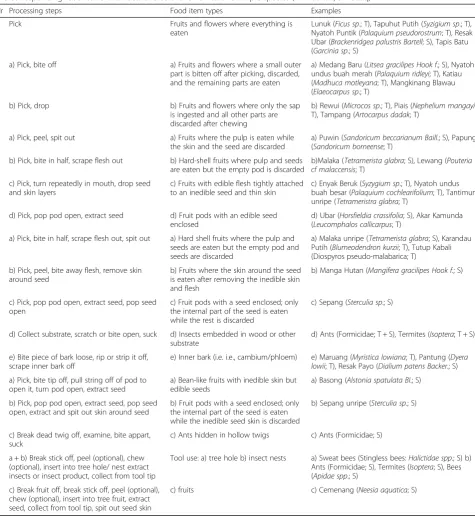
Feeding rates were collected directly during focal follows by CS from 2010–2015 as well as from close-up videos of the focal animals feeding, taken by various observers in 2012–2015. We calculated how much time it took an individual to process a food item from picking to inges-tion. In the field this was accomplished using a stop-watch. The videos were coded using the interact software (Interact 9). Feeding rates that were taken dir-ectly in the field did not differ from those obtained by video coding on the same food item by the same adult focal animal (Additional file 1: Table S2). The complexity of the food items was determined by the number of steps it takes to process an item (for details see Table 1).
Feeding rates were collected for 11 and 10 immature in-dividuals and their mothers at Tuanan and Suaq, respect-ively. Rates were averaged over a minimum of five individual samples (of the same individual feeding on the same food item). To capture the development of feeding rates with age, if there was a gap of more than 5 months between two groups of measurements of the same individ-ual feeding on the same species, these measurements were treated as a different data points. To account for the fact that we thus had multiple data point of the same individ-ual feeding on the same food item (at different stages of its development), we analyzed our data using mixed models (see below). To avoid the possible confounding ef-fect of different stages of ripeness of the fruits on feeding rate, whenever possible (60 % of all cases), feeding rates of the immatures were calculated as a percentage of their mothers’feeding rates when feeding in the same tree at the same time. However, in the remaining 40 % of the cases (mainly for older, independently ranging immatures), the mother’s data were not available and thus the average feeding rate of the adult female feeding on the same food item closest to the measurement date of the immature was taken as an adult reference. The presence or absence of simultaneous samples of the mother had no effect when we included it as a binary variable in the model (see Add-itional file 1: Table S3).
Ranging competence
78). Ramble ratios were then calculated in Arc GIS [55], using Hawth’s tool [56] and represent the total path length divided by the distance between start and end point of the follow (nest locations for full day follows). Average daily ramble ratios were calculated based on 5– 17 (X = 9) follow days within the same 5 months, to capture one specific developmental state of the juvenile individuals, which resulted in a total of 17 age/individual
data points of 8 different juvenile individuals (see Additional file 1: Table S1 for more details). To ensure maximal comparability (e.g. in terms of possible season-ality effects), as adult references, ramble ratios of the mothers followed during the same periods (within the same 5 months) were used. Because this often resulted in >1 data points per individual, we used a mixed model approach (see below).
Table 1Processing steps of food items: the most frequent combinations of the different processing steps, as well as descriptions of the corresponding food items with local and scientific names of example species (T = Tuanan, S = Suaq)
Nr Processing steps Food item types Examples
0 Pick Fruits and flowers where everything is
eaten
Lunuk (Ficus sp.; T), Tapuhut Putih (Syzigium sp.; T), Nyatoh Puntik (Palaquium pseudorostrum; T), Resak Ubar (Brackenridgea palustris Bartell; S), Tapis Batu (Garcinia sp.; S)
1 a) Pick, bite off a) Fruits and flowers where a small outer part is bitten off after picking, discarded, and the remaining parts are eaten
a) Medang Baru (Litsea gracilipes Hook f.; S), Nyatoh undus buah merah (Palaquium ridleyi; T), Katiau (Madhuca motleyana; T), Mangkinang Blawau (Elaeocarpus sp.; T)
b) Pick, drop b) Fruits and flowers where only the sap is ingested and all other parts are discarded after chewing
b) Rewui (Microcos sp.; T), Piais (Nephelium mangayi; T), Tampang (Artocarpus dadak; T)
2 a) Pick, peel, spit out a) Fruits where the pulp is eaten while the skin and the seed are discarded
a) Puwin (Sandoricum beccarianum Baill.; S), Papung (Sandoricum borneense; T)
b) Pick, bite in half, scrape flesh out b) Hard-shell fruits where pulp and seeds are eaten but the empty pod is discarded
b)Malaka (Tetramerista glabra; S), Lewang (Pouteria cf malaccensis; T)
c) Pick, turn repeatedly in mouth, drop seed and skin layers
c) Fruits with edible flesh tightly attached to an inedible seed and thin skin
c) Enyak Beruk (Syzygium sp.; T), Nyatoh undus buah besar (Palaquium cochlearifolium; T), Tantimun unripe (Tetrameristra glabra; T)
d) Pick, pop pod open, extract seed d) Fruit pods with an edible seed enclosed
d) Ubar (Horsfieldia crassifolia; S), Akar Kamunda (Leucomphalos callicarpus; T)
3 a) Pick, bite in half, scrape flesh out, spit out a) Hard shell fruits where the pulp and seeds are eaten but the empty pod and seeds are discarded
a) Malaka unripe (Tetramerista glabra; S), Karandau Putih (Blumeodendron kurzii; T), Tutup Kabali (Diospyros pseudo-malabarica; T)
b) Pick, peel, bite away flesh, remove skin around seed
b) Fruits where the skin around the seed is eaten after removing the inedible skin and flesh
b) Manga Hutan (Mangifera gracilipes Hook f.; S)
c) Pick, pop pod open, extract seed, pop seed open
c) Fruit pods with a seed enclosed; only the internal part of the seed is eaten while the rest is discarded
c) Sepang (Sterculia sp.; S)
d) Collect substrate, scratch or bite open, suck d) Insects embedded in wood or other substrate
d) Ants (Formicidae; T + S), Termites (Isoptera; T + S)
e) Bite piece of bark loose, rip or strip it off, scrape inner bark off
e) Inner bark (i.e. i.e., cambium/phloem) e) Maruang (Myristica lowiana; T), Pantung (Dyera lowii; T), Resak Payo (Dialium patens Backer.; S)
4 a) Pick, bite tip off, pull string off of pod to open it, turn pod open, extract seed
a) Bean-like fruits with inedible skin but edible seeds
a) Basong (Alstonia spatulata BI.; S)
b) Pick, pop pod open, extract seed, pop seed open, extract and spit out skin around seed
b) Fruit pods with a seed enclosed; only the internal part of the seed is eaten while the inedible seed skin is discarded
b) Sepang unripe (Sterculia sp.; S)
c) Break dead twig off, examine, bite appart, suck
c) Ants hidden in hollow twigs c) Ants (Formicidae; S)
5 a + b) Break stick off, peel (optional), chew (optional), insert into tree hole/ nest extract insects or insect product, collect from tool tip
Tool use: a) tree hole b) insect nests a) Sweat bees (Stingless bees:Halictidae spp.; S) b) Ants (Formicidae; S), Termites (Isoptera; S), Bees (Apidae spp.; S)
c) Break fruit off, break stick off, peel (optional), chew (optional), insert into tree fruit, extract seed, collect from tool tip, spit out seed skin
Body size measurements
For body size measurements, we relied on laser photo-grammetry [57, 58] using a camera (Nikon D 90) with 3 parallel lasers attached at a constant distance. The laser points visible in the pictures were used as a reference scale bar. The camera was calibrated by taking pictures of a known reference scale at various distances in the forest before the actual measurements. We focused on three measures of arm length: forearm (elbow to wrist), upper arm (shoulder joint to elbow) and whole arm (shoulder joint to wrist) as a proxy for overall body size.
Laser pictures were taken at Suaq Balimbing in 2013– 2014 by various observers. Distances in the pictures were calculated by KL using Paint.net Software. Data points represent averages of 4 – 22 (X= 9.1) measure-ments of the same individual taken within the same 5-month-period. Only pictures showing the arms perpen-dicular to the field of view of the camera were used. The results presented here are preliminary because only a handful of individuals were available and the standard deviations of the measurements were also still high (see results). The data from Suaq was compared to data on the Tuanan immatures taken by Abigail Philips in 2009– 2010 on the same focal individuals as observed in the current study and using the same measurement tech-nique and camera set up [58].
Dietary complexity
We assessed the dietary complexity of the four adult fe-males on whom we had the most data available at each site (Tuanan: 4098–5161 h, X= 4644 h, Suaq: 320–1168 h, X= 679). We determined the number of processing steps of all the food items that together make up 90 % of their diets (in terms of feeding time). Processing steps and examples are described in detail in Table 1.
Data analysis
All analyses and plots were done using R [59]. Data were analyzed using general linear mixed models (GLMM), using lmer as implemented in the package lme4 [60], with individual included as a random factor, to account
for the fact that data were collected on the same individ-uals at multiple times, at different stages of their devel-opment. Also, in the analysis of the feeding rates, the food item was included as random factor since the same food items occurred multiple times in the data set (eaten by different immatures at different ages). Statistical sig-nificance of the fixed effects was assessed using cftest of the multcomp package [61]. Models and their factors were selected based on the Akaike information criteron (AIC). In the case of diet repertoires and feeding rates the best description of age effects was sigmoid, for which we used the pracma package [62].
For the figures, nonlinear relationships in the data were drawn after the respective general linear model (GLM of the stats package, with age as a sigmoid factor), excluding the random factor (individual and species).
Results
Testing the needing-to-learn hypothesis
What to eat: food selection competence
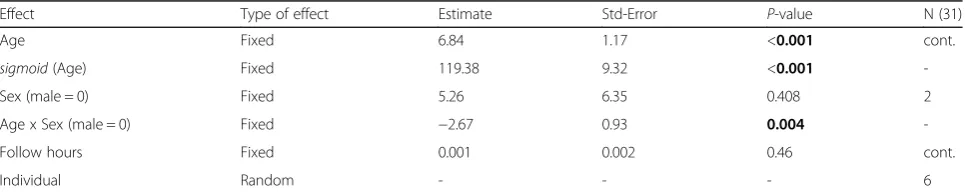
To assess the development of food selection competence, we examined the immatures’diet composition as a func-tion of age. We found that with increasing age, immatures ate an increasing number of food items, and at the age of weaning they reached a repertoire size that is between 80 and 99 % of their mothers’repertoire size. When examin-ing sex differences, we found a significant interaction effect between age and sex, implying that female imma-tures attained a broader diet earlier than their male peers, who by the age of weaning seemed to reach only 80 % of their mother’s diet repertoire size (Table 2, Fig. 1).
How to eat: food processing competence
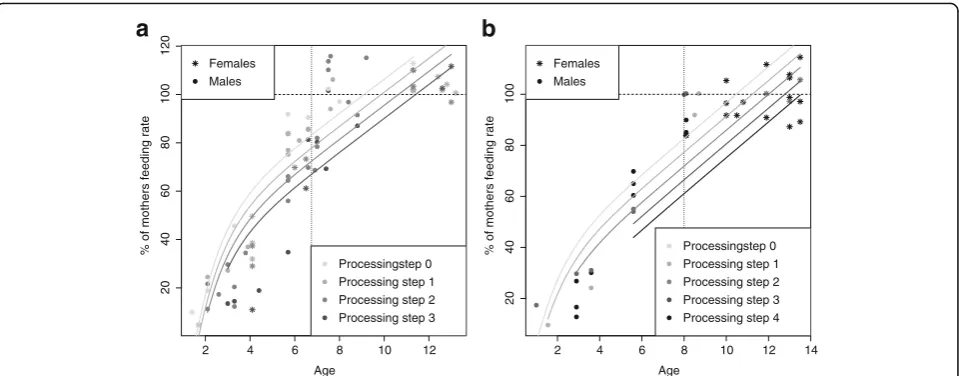
In terms of food processing competence, we tested the effects of age, food processing complexity, sex and site on feeding rates simultaneously, using GLMM. We found that feeding rates increased with age. For the more difficult to process food items, adult-level feeding rates were reached later relative to easier to process items (Table 3a, Fig. 2). Also, immatures started feeding on more difficult to process food items later in their
Table 2GLMM with diet repertoire size in percentage of the mother’s diet as a dependent variable: Effects, estimates, standard errors and p-values as well as number of levels for the categorical variables
Effect Type of effect Estimate Std-Error P-value N (31)
Age Fixed 6.84 1.17 <0.001 cont.
sigmoid(Age) Fixed 119.38 9.32 <0.001
-Sex (male = 0) Fixed 5.26 6.35 0.408 2
Age x Sex (male = 0) Fixed −2.67 0.93 0.004
-Follow hours Fixed 0.001 0.002 0.46 cont.
Individual Random - - - 6
0 2 4 6 8
0
20
40
60
80
100
Age
% of mothers diet spectrum
Females Males Females Males
Fig. 1Development of diet repertoire at Tuanan: Diet repertoire size in percentage of the mother’s diet repertoire size in relation to age (in years) for immatures that are still in permanent associations with their mothers. The dotted vertical line shows mean weaning age at the Tuanan population. The dashed horizontal line marks the mothers’diet repertoire sizes (100 %)
Table 3GLMMs of feeding rate, expressed as percentage of the mothers’feeding rates, as a dependent variable, with (a) and without (b) including the number of processing steps as an independent variable
Effect Effect type Estimate Std-Error P-value N (128) AIC
a)
Age Fixed 7.96 0.94 <0.001 cont. 964
sigmoid(Age) Fixed −36.34 56.24 0.52
-Processing steps Fixed −4.77 1 <0.001 5
Sex (male = 0) Fixed −19.58 10.5 0.062 2
Site (Tuanan = 0) Fixed −120.91 70.31 0.085 2
Age x Sex Fixed 4.94 1.27 <0.001
-sigmoid(Age) x Site Fixed 126.58 71.67 0.078
-Individual Random - - - 21
Food Item Random - - - 34
b)
Age Fixed 7.88 0.9 <0.001 cont. 981
sigmoid(Age) Fixed −69.13 55.47 0.212
-Sex (male) Fixed −21.27 10.09 0.035 2
Site (Tuanan = 0) Fixed −130.81 69.44 0.06 2
Age x Sex Fixed 5.56 1.24 <0.001
-sigmoid(Age) x Site Fixed 139.4 70.88 0.049
-Individual Random 21
Food Item Random 34
Shown are effects, estimates, standard errors and p-values as well as number of levels for the categorical variables and AIC values of the models. The number in parentheses represents the total number of individual - age - species combinations
development compared to easier items (Fig. 2), in line with the notion that feeding techniques are learned ra-ther than intrinsic [51, 52].
At both sites, adult-level feeding rates for all processing classes were reached after weaning but well before age at first reproduction (Fig. 2). In relation to absolute age, Suaq immatures reached adult-like feeding rates later than their Bornean peers (Fig. 2). There was a trend for a site differ-ence in the development of feeding rates, as indicated by a trend for an interaction of age with site (sigmoid(age) x site, Table 3a). If processing steps were excluded from the model, the site difference, as well as the interaction term of age with site (sigmoid(age) x site, Table 3b) became signifi-cant, which showed that without correcting for food com-plexity, Suaq immatures developed adult-level feeding rates later than Tuanan immatures (Table 3b). Including pro-cessing steps significantly improved the overall fit of the model, showing that processing complexity of the food ex-plained a significant proportion of the variance in our data (Table 3a + b, model comparison: Chi2= 97.6,p< 0.001).
After weaning, at both sites, but more so at Tuanan, feeding rates of independent immatures exceeded those of their mothers, especially for easier to process items (Fig. 2). Interestingly, at both sites males acheived higher feeding rates faster compared to same-aged females at both sites (Table 3a, Fig. 2).
To assess whether in general, slower feeding rates of the immature individuals could be a consequence of smaller body size or the lack of strength, we controlled for the effects of fruit size (average length) and the toughness of the fruits (see [63]). Including toughness and fruit size as factors led to an improvement in the overall fit of the model but the effects themselves were not significant (Additional file 1: Table S4).
When and where to eat: food locating competence
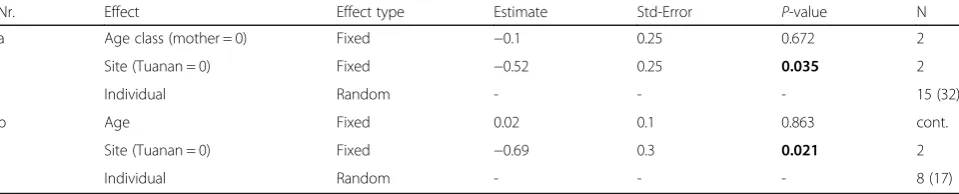
Regarding competence in locating food sources and exploiting them efficiently, we found that ramble ratios of the travel routes of the independently ranging imma-tures did not differ from those of their mothers: Average daily ramble ratios of the adult females ranged from 1.6 –3.9 at Tuanan and 2.1–3.8 at Suaq, with standard de-viations across the different days of the same individual ranging from 0.3–1.5 at Tuanan and 0.5 to 2.2 at Suaq. Independent immatures showed average daily ramble ra-tios ranging from 1.7 - 3.2 at Tuanan and 2.1 – 4 at Suaq, with standard deviations ranging from 0.6 - 2.8 at Tuanan and 0.5 - 1.9 at Suaq. Thus, there was no evi-dence that independently ranging immatures showed higher or more variable ramble ratios in their travel routes than adults (Fig. 3 and Additional file 2: Figure S2, Table 4 a). However, there was a significant differ-ence in ramble ratios between the two sites with Tuanan individuals showing lower values and thus more direct travel routes than individuals at Suaq (Fig. 3, Table 4a). We found no age effect on the average daily ramble ra-tios among the independently ranging immatures (Fig. 3, Table 4b): even the youngest and thus newly independ-ently ranging immatures showed ramble ratios in the range of adult females. We also found no difference be-tween mothers and immatures using a paired design in which we compared each independently ranging imma-ture with its mother (Fig. 3).
Dietary complexity of the two sites
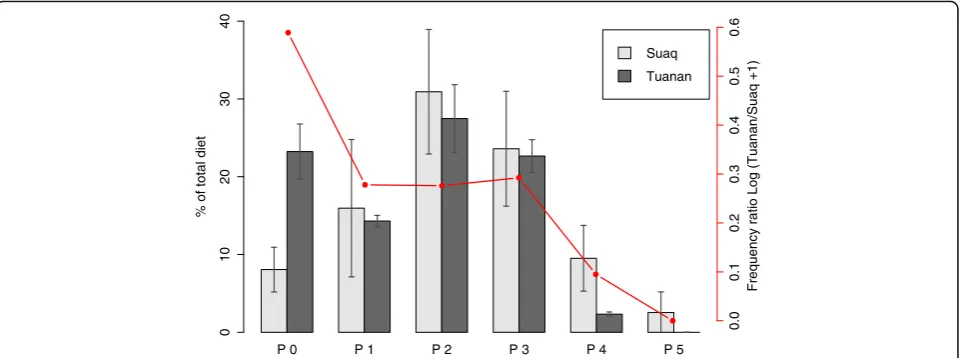
In terms of dietary complexity, we found that the two study sites showed different distributions of the frequen-cies of the different processing steps (Fig. 4). Whereas at Tuanan individuals ate a higher share of items that can
2 4 6 8 10 12
20
40
60
80
100
120
Age
% of mothers feeding rate
Females Males
Processingstep 0 Processing step 1 Processing step 2 Processing step 3
a
2 4 6 8 10 12 14
20
40
60
80
100
Age
% of mothers feeding rate Processingstep 0
Processing step 1 Processing step 2 Processing step 3 Processing step 4 Females
Males
b
be ingested without any processing (steps = 0) than Suaq individuals, they ate a lower number of items with 4 cessing steps relative to Suaq individuals. Moreover, pro-cessing requiring 5 steps (tool use) only occurs at Suaq. Frequencies of processing steps 1–3 were very similar for the two sites. Overall, therefore, the relative fre-quency of a given processing step at Tuanan (its value divided by the corresponding value at Suaq) decreased with increasing processing complexity (Spearman: r =
−0.83, p= 0.058, n= 6). The diet at Suaq is therefore more complex than the diet at Tuanan.
Testing the expensive brain framework
Body growth
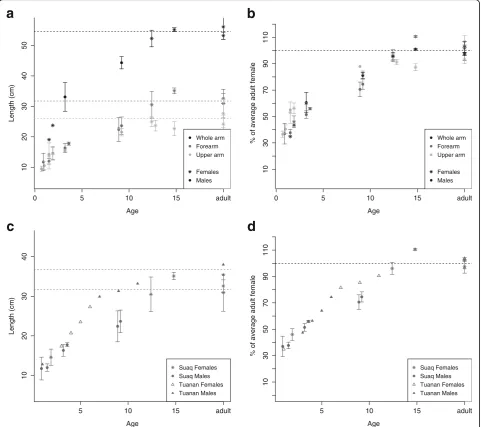
Preliminary data on body growth suggest that immatures grow until around the age at female first reproduction (Fig. 5a + b), even though males are known to continue growing after this age. We discerned a trend for Suaq im-matures to show smaller body sizes in absolute values as
well as relative to the adult female body size than their Tuanan peers after weaning (Fig. 5 c + d). At the current state, these data are insufficient for any detailed statistics.
Discussion
Needing to learn or needing to grow?
To investigate whether the late age at first
reproduction and the late age of weaning in orangu-tans is best explained by the time needed to acquire skills (needing-to-learn hypothesis) or rather by tra-deoffs in energy allocations to brain and body (ex-pensive brain frame work), we examined foraging skill development and body growth trajectories of immatures of two populations of wild orangutans. Our results showed that adult like diet repertoires (a measure of food selection competence) are reached around the age of weaning. Adult like feeding rates (a measure of food processing competence) are attained shortly thereafter and adult like ramble
Juveniles Mothers
1.5
2.0
2.5
3.0
3.5
4.0
Average ramble ratios
8.1y
9.1y 9.8y
10.6y 11.8y
12.2y
12.2y 13.1y
Juveniles Mothers
1.5
2.0
2.5
3.0
3.5
4.0
Average ramble ratios
11.8y 12.3y
12.8y 10.3y 10.8y
11.1y
11.6y 12.9y 13.4y
a
b
Fig. 3Development of Ramble ratios: Average daily ramble ratios for independently ranging immatues (juveniles) and mothers at Tuanan (a) and Suaq (b). The numbers next to the juvenile data points indicate ages (in years). The juvenile points are always paired with a data point of their mother collected in the same 5 month period (in 3 cases this data was not available)
Table 4GLMM with average daily ramble ratio of the mothers and independent immatures as dependent variable, age class and site as fixed effect as well as individual as random effect
Nr. Effect Effect type Estimate Std-Error P-value N
a Age class (mother = 0) Fixed −0.1 0.25 0.672 2
Site (Tuanan = 0) Fixed −0.52 0.25 0.035 2
Individual Random - - - 15 (32)
b Age Fixed 0.02 0.1 0.863 cont.
Site (Tuanan = 0) Fixed −0.69 0.3 0.021 2
Individual Random - - - 8 (17)
Shown are estimates, standard errors,p- values and number of levels for the categorical variables (a). GLMM with average daily ramble ratios of the independently
ranging immatures animals as dependent variable, age and site as fixed effects as well as individual as random effect. Estimates, standard errors, p- values and number of levels for the categorical variables (b). The numbers in parentheses indicate the total number of age individual means
ratios (a measure of food locating competence) are at adult levels right at the start of ranging independ-ence, soon after weaning. Thus, in orangutans, the acquisition of foraging skills does not impose a direct limit on age at first reproduction, as proposed by the classic version of the needing-to-learn hypothesis. On the other hand, body size measurements showed that immatures continue to grow until female age at first reproduction. This suggests that as predicted by the expensive brain framework, the need to reach adult body size might determine the length of the develop-mental period in orangutans.
Evidence for an altered version of the needing-to-learn hypothesis
Although reaching adult-level feeding skills doesn’t dir-ectly limit the onset of reproduction, we found evidence that foraging skills might play a crucial role for the timing of weaning. In contrast to all other gregarious primates, by the age of weaning, immature orangutans have to be fully self-sufficient: in most populations weaned imma-tures increasingly range alone and thus can’t rely on social information and are fully dependent on their own know-ledge and skills [37, 44]. Weaned immatures must have reached sufficient skill levels to support their small but growing body (see below). The development of the diet repertoire showed that food selection competence is reached around the age of weaning, but that adult-level processing of these foods is achieved later, especially for food items requiring more processing steps. Ramble ratios did not differ between adults and independently ranging immatures. Although these may also be influenced by factors other than food locating competence, such as avoiding or associating with other individuals, the absence
of any systematic difference between age classes suggests that independently ranging immatures from the beginning of independence have no difficulty to locate food sources in the forest. This is consistent with the results of an earlier study showing that shortly before the age of wean-ing, immatures at Tuanan seem to recognize at least 50 % of their food patches before their mothers [64]. It thus seems that the critical skills for dietary independence in orangutans are competence in food selection and food processing, rather than in food locating.
The diets of adult female orangutans at Tuanan com-prise of more than 170 food items of more than 110 dif-ferent plant species (Additional file 2: Figure S1). These numbers are very comparable to findings of long-term studies on wild chimpanzees (e.g. [65, 66]). However, for the adult females at Tuanan, even after 4000 observation hours, collected over multiple years, new items are still added to the diet (Additional file 2: Figure S1), suggest-ing there is no such thsuggest-ing as a true diet. This findsuggest-ing also reflects the fluctuating food availability in most orangutan habitats and the lack of consistent seasonal patterns in fruiting [46]. Thus, it is plausible that it takes an immature orangutan multiple years to witness all the items in their mothers’ diets and probably even more time to memorize them. In general, juvenile animals are very vulnerable to food shortages ([12], see below). A broad diet is crucial to buffer episodes of food scarcity in a habitat with fluctuating food availability. It is un-likely that the incomplete diet repertoires of the imma-tures are purely an artifact of insufficient processing competence: even though we found that immatures start to feed on more difficult to process items later relative to easy ones, even items of the highest processing classes (including the ones that require tool use) are eaten by
P 0 P 1 P 2 P 3 P 4 P 5 Suaq Tuanan
% of total diet
01
0
2
0
3
0
4
0
0.0
0.1
0.2
0.3
0.4
0.5
0.6
Frequency ratio Lo
g
(Tuanan/Suaq +1)
the age of 6 years, albeit at a much lower rate [67]. Because toughness of the food item does not affect feeding rates (see Additional file 1: Table S5) and the diets of adults and immatures do not differ in their physical properties [53], it is unlikely that strength differ-ences can explain age patterns in feeding rates. However, feeding rates on the more difficult items, but not on the easy ones, increase after weaning, which suggests that learning continues during juvenility. It thus appears that the age of dietary independence is determined by the time it takes to acquire broad enough repertoires and to reach high enough feeding rates to ensure sufficient energy intake during the next phase of immature development.
The developmental trajectories of the feeding rates showed that from a certain age on, independent immatures feed faster than adult females on easier to process food items. In a study on long-tailed macaques (Macaca fascicu-laris), it was found that larger body size allows for faster processing of large food items [68]. If gape size in relation to food item size determines ingestion rates, a smaller body size may entail advantages for processing smaller items. At weaning, immatures are still significantly smaller than adult females. The smaller body size may explain their higher picking rates for small items for which they reached profi-ciency earlier. Indeed, all of the items in which immatures exceeded the feeding rates of adult females were flowers and small to medium sized fruits.
Age
Length (cm)
0 5 10 15 adult
10
20
30
40
50
Whole arm Forearm Upper arm
Females Males
Age
% of average adult female
0 5 10 15 adult
10
30
50
70
90
110
Whole arm Forearm Upper arm
Females Males
Age
Length (cm)
5 10 15 adult
10
20
30
40
Suaq Females Suaq Males Tuanan Females Tuanan Males
Age
% of average adult female
5 10 15 adult
10
30
50
70
90
110
Suaq Females Suaq Males Tuanan Females Tuanan Males
a
b
c
d
As they reach foraging skills around the age of weaning, orangutans follow the classic primate pattern of skill acqui-sition in relation to life history [11]. Interestingly however, orangutans seem to attain their foraging skills several years later than chimpanzees and gorillas [69–71]. Diet reper-toire sizes of wild chimpanzees are highly comparable to the ones of wild orangutans [65, 66] and obvious system-atic differences in the skill intensity of their diets are also unlikely. It is possible that the age difference in reaching foraging competence is just a side effect of the overall fas-ter development of chimpanzees and gorillas. However, an equally plausible suggestion is that because orangutans cannot rely on social inputs after weaning they have to reach higher levels of competence before they can be weaned.
All in all, in orangutans, the acquisition of foraging skills does not impose a direct limit on age at first reproduction, as proposed by the classic version of the needing-to-learn hypothesis and competence in knowing what, how, and where to eat is reached long before the age at female first reproduction.
Evidence for the expensive brain hypothesis
Growth trajectories obtained by laser photogrammetry showed that by the age of weaning, immature orangu-tans have only reached around 75 % of adult female body size in terms of arm length, which probably corre-sponds to around 50 % of adult volume and weight. Interestingly, this % of adult size at weaning seems highly comparable for immatures at Suaq and Tuanan (Additional file 2: Figure S3). Apart from substantial body growth, there is also considerable brain develop-ment during the juvenile period: even though the great ape brain is fully grown by the age of weaning [21, 72], it undergoes a period of synaptic remodeling (overpro-duction of axons and synapses followed by rapid prun-ing) and restructuring during juvenility and adolescence [73–76]. Thus, the energetic needs during juvenility im-posed by body growth and brain fine-tuning are high [18]. However, constant energy flow to the developing brain is vital since it cannot adjust to temporary energy shortages [16, 19]. Brain starvation causes permanent cognitive impairments and thus reduced adult per-formance later in life [77, 78]. The optimal body size at the age of weaning and the conservative growth likely act to minimize the risk of starvation but do so at the expense of a longer juvenile period and delayed reproduction [12].
Evidence for a combination of needing-to-learn and expen-sive brain
One option that has not yet been discussed in the litera-ture is that the two limiting factors of the two hypoth-eses are competing with each other and are thus limiting
at the same time. It might be that energetic investment into learning implies a reduced investment into body growth and vice versa. Also, given that the brain is the structure that allows for learning developing, the brain must be tightly linked to learning rates. Accordingly, in humans it has been shown that brain differentiation dur-ing childhood requires peak levels of brain glucose up-take and happens at the expense of body growth [22]. Here and in previous studies we show that immature orangutans learn most of their skills during infancy [51, 52]. It might thus be that during this learning intense period, energy is primarily used for learning to reach sufficient skill levels by the time of nutritional independ-ence. During juvenility, when skills are more or less in place, the body then has to catch up before reproduction can start. This scenario is in line with the species difference in weaning age: in a population where there is less to learn, adult skill levels can be reached faster and thus nutritional independence is reached earlier. The deducted growth trajectories suggest that after weaning the immatures at Suaq probably show a slower growth than their Bornean peers. This preliminary finding fur-ther supports the argument that growth competes with learning: since skills are generally reached later at Suaq, it is likely that also during the juvenile period the invest-ment in fine tuning and perfecting these skills is higher. The most extreme example for this is tool use, where proficiency is reached only during late juvenility or even adulthood [67]. A higher energetic investment into con-tinued learning during the unprovisioned juvenile period could explain the difference in growth rate during this period.
Thus, even though in the end body size appears to be directly limiting on age at first reproduction, the connection between body growth and skill learning might be more interactive than previously assumed. Consequently the classic needing-to-learn hypothesis as well as classic life history might have to be modified into a combined approach, which takes a potential interdepend-ence of growth and learning into account.
Sex differences
unflanged and at least initially well within the range of female sizes, eventually grow into flanged males, which are much bigger than adult females [86]. However, re-cent findings show that in orangutans, there is remark-ably little variation in total daily energy intake across age sex classes [80].
As in all mammals, orangutan females have to be able to sustain pregnancy and lactation. Reproducing females increase their food intake relative to basic need by only about 25 % [85]. During pregnancy, females are probably more dependent on high food quality, in terms of nutri-ent composition and plant allelochemicals. Also, repro-ducing orangutan females likely have more stable energy intakes compared males because their nutritional state directly influences the development of her offspring, for which energy shortages are detrimental (see below). Thus, female diets are likely to be broader and thus more balanced and less susceptible to fluctuations of food availability.
It has been proposed that, depending on the under-lying mechanisms, sex differences in foraging are closely correlated with female reproductive status [83] or emerge parallel to the developmental onset sexual size dimorphism [82, 84, 87]. Our findings of sex differences in diet composition and feeding rates among juvenile orangutans are not in line with these predictions. Fur-thermore, just as in orangutans, immature ring-tailed le-murs (Lemur catta; [82]), long-tailed macaques [88] and tufted capuchin monkeys (Cebus nigritus: [81]) are char-acterized by sex differences in several aspects of feeding that match those of adults. Also, immature female chim-panzees acquire proficiency in termite fishing tool use earlier, spend more time watching others termite-fish than their male peers [84], whereas greater female profi-ciency in tool use has been reported for captive bonobos [89]. The most parsimonious alternative hypothesis for many species, namely that sex differences are caused by resource partitioning [82, 90], is unlikely to apply in the chimpanzee and bonobo examples and can be ruled out in the largely solitary Bornean orangutan (see also [42]). In conclusion, in species where repertoires and techniques are learned rather than intrinsic, differences caused by the balance between reproductive load and sexual dimorph-ism in adult size might already emerge during the juvenile period, suggesting that female and male immatures pre-pare for sex specific adult niches at this stage of develop-ment. In general, to determine the biological significance of these sex differences in immature orangutan diet reper-toires and feeding rates, one would have to look in more detail at sex differences in adults.
Between-site differences
We found that immatures at Tuanan may possibly grow faster than at Suaq, which could be linked to their earlier
weaning and a lower overall complexity of their diet. Since the toughness of the food item did not affect feed-ing rates (see Additional file 1: Table S5) and immature and adult diets are similar in toughness [53], it is un-likely that differences in feeding rates are due to the smaller body size and thus reduced strength of the im-matures. Interestingly, when we controlled for the com-plexity of the food items by including it as a factor in the model, the difference in age of skill competence (i.e. how fast feeding rates increase as a function of age) be-tween Suaq and Tuanan became non-significant (Fig. 3, Table 3 a + b). Thus, it seems as if skills of equal com-plexity develop at a very similar pace at both popula-tions, but that due to the higher complexity of their diet, Suaq immatures have more to learn, so weaning gets de-layed. Immatures in both populations are weaned at the same level of feeding skills relative to the overall skill level of the population: by the age of weaning, adult feeding rates are reached for the easier items whereas for the more complex items, adult-like feeding rates are reached after around two thirds of the juvenile period. The fact that even after controlling for their higher com-plexity level, there remains a trend that Suaq individuals reach adult-like feeding rates later than Tuanan individ-uals (i.e. a trend for a positive interaction between site and age on skill competence; see Table 3 a) could be the result of investments in acquiring more complex skills, which reduce the amount of time and energy available to learn the more basic skills and slow down the learn-ing process of those.
Only at Suaq individuals show tool use, the most com-plex class of food processing. Competence in tool use is difficult to quantify but there is evidence that orangutans reach full competence in tool use only during late juven-ility or even early adulthood [67]. However, since not all populations of Sumatran orangutans use tools, it is unlikely to be essential for an individual’s survival. None-theless, even if we ignore tool use, the overall complexity of the diet is higher at Suaq than at Tuanan. The near absence of processing step 4 at Tuanan suggests that the probability to develop a highly complex technique, such as tool use, is higher in populations where techniques with long chains of functionally dependent actions are more prevalent.
is important for individuals within a given population to acquire the full range of skills. However, top-end com-plexity skills seem to only develop and be maintained in a population under certain preconditions, such as a prolonged mother offspring association or in general increased opportunities for social learning. Perhaps after weaning, juveniles are too busy surviving to focus on learning totally new skills. More generally, this might also apply to the overall complexity level of the diets of differ-ent orangutan populations. Our findings are therefore consistent with the finding that there is a correlation between the complexity of the diet niche and (i) the pace of development, as found in primates, and (ii) the relative length of food provisioning, as found in carnivores [91]. More specifically, applied across mammal species, our results suggest a correlation between weaning age in relation to the age at first reproduction and the complex-ity of the diet as well as body size at the age of weaning.
Conclusions
We could show that in orangutans, both the need to learn foraging skills and energetic constraints have se-vere impacts on life history. Whereas the age at first reproduction seems to be primarily determined by com-peting energetic investments in brain and body, the age at weaning seems to be connected to how fast foraging skills are acquired. However, it is likely that energetic investment in learning competes with the development of brain and body such as that growth can only be completed after the intense learning period of infancy. Accordingly, both factors may be limiting overall devel-opment at the same time. In populations with a higher dietary complexity, immatures have more to learn and thus reach adult skill levels later. At the same time, they seem to grow more slowly and are weaned later than im-matures at populations with lower dietary complexity, where the minimum skill set to survive seems to be reached earlier. Sex differences in the development of foraging skills suggest that immature female and male orangutans prepare for sex specific adult niches. Thus, the overall adult niche (in terms of the population’s overall complexity level of foraging techniques as well as in terms of sex specific foraging complexity) has a sig-nificant impact on immature skill development. Applied across different primate species, this implies that wean-ing should be reached later when there is more to learn.
Additional files
Additional file 1: Table S1.Overview of the data used for the different analyses. Study site, focal individual, sex and date of birth of the focal individual, mother of the focal individual, as well as the years in which the different types of data (diet data, feeding rates, ramble ratios and laser measurements) were taken.Table S2.GLMM with absolute feeding
rate of the adult females as dependent variable. To see if the if there is a difference between feeding rates obtained by video coding as opposed to direct observation this was included as as a binary variable (“Video”). Shown are effects, estimates, standard errors and p-values as well as number of levels for the categorical variables. The number in parentheses represents the total number of individual feeding rates included in the analyses: Only rates of fruits on which we had data from the same individual obtained via video coding as well as via direct observation were included.Table S3.GLMM with feeding rate in percentage of the mothers feeding rates as a dependent variable. To see if the presence absence of a simultaneous feeding rate taken on the mother has an effect it was included as a binary variable (“Simultaneous mother sample”). Effects, estimates, standard errors and p-values as well as number of number of levels for the categorical variables and AIC values of the models. The number in parentheses represents the total number of individual age -species combinations. Table S4.GLMM with feeding rate of the Tuanan immatures in percentage of the mothers feeding rates as a dependent variable without (a) and with fruit toughness and size included as a fixed effect (b). Effects, estimates, standard errors and p-values as well as number of levels for the categorical variables and AIC values of the model. (ZIP 23 kb)
Additional file 2: Figure S1.Diet repertoire size in relation to follow effort: The number of recorded food items versus the number of hours of follow data collected for the three adult females with the most data available at Tuanan. 500 follow hours correspond to roughly 1 year (X = 13.1 months), the overall observation time was 9.5 years. The total number of plant species recorded for each of these females was 109– 113 (X =110.3). For insects we only counted termites, ants, bees (honey) and caterpillars as food items and did not distinguish between the different species. Thus, the number of non-plant food items was 4 for each adult female.Figure S2.Development of ramble ratios over age: Average daily ramble ratios versus age for immatures at Suaq and Tuanan.Figure S3.Body size comparisons: Estimated growth trajectories bases on forearm measurements for immatures at Suaq and Tuanan. The solid lines were attained via smoothing functions in R (smooth.spline in the stats package). The horizontal lines show average weaning ages at both populations. The Tuanan data were retrieved from [54]. (DOCX 36 kb)
Acknowledgements
We acknowledge all students, volunteers and local field assistants involved in the collection of standard behavioral data for the long term data bases of Suaq Balimbing and Tuanan. We are thankful to Adrian Jaeggi and Lynda Dunkel who did a lot of ground work for this project. We are also grateful to Alison Ashbury, Alysse Moldawer, Benjamin Nolan, Christiaan Conradie, Hannes Wiese, and Eric Balke Ricki Oldenkamp, Meret Heidmann, Paula Willi for helping to collect the detailed behavioral data on the immature focal animals. We thank Anna Marzec, Julia Kunz, Mardianto Djinu, Paige Prentice, Sonja Falkner, Wilhelm Osterman and Yann Quenet for recording feeding videos used for the analyses on feeding rates. We also thank Reto Maier and his team from the Physics lab of the University of Zürich for their support with the laser camera. We are grateful to the local staff at both field sites and to all the associated offices. We gratefully acknowledge the Indonesian Institute of Science (LIPI), the Indonesian State Ministry for Research and Technology (RISTEK), the Director General Departemen Kehutanan (PHKA), Departamen Dalam Negri, the local government in Central Kalimantan and South Aceh, the BKSDA Palangkaraya, the Bornean Orangutan Survival Foundation (BOSF) and MAWAS in Palangkaraya as well as the Sumatran orangutan conservation Program (SOCP) and Taman Nasional Gunung Leuser (TNGL) in Medan, for their permission and support to conduct this research. We also thank the Fakultas Biologi Universitas Nasional (UNAS) in Jakarta for their collaboration and support for the Tuanan project. We are in particularly grateful to Dr. Tatang Mitra Setia and Dr. Suci Utami Atmoko for their expertise, support and collaboration.
Funding
Availability of data and materials
Please contact author for data requests.
Authors’contributions
CS collected a major part of the data, did the analyses and wrote the paper. SF contributed to data collection and commented on the manuscript. EM, NZ, and ER contributed to data collection. KL contributed to data collection and did the laser measurements. EV provided the data on fruit sizes and toughness and commented on the manuscript. MvN was involved in developing the project and commented on the manuscript. CvS designed and supervised the project and co-wrote the manuscript. All authors read and approved the final manuscript.
Competing interests
The authors declare that they have no competing interests.
Consent for publication
Not applicable.
Ethics approval and consent to participate
All research protocols were approved by the Ministry of research and technology (RISTEK) (Research Permit No.: 152/SIP/FRP/SM/V/2012) and adhered to the legal requirements of Indonesia. As a strictly observational study on wild animals, we did not interact with our study animals in any way.
Author details
1Department of Anthropology, University of Zürich, Winterthurerstrasse 190,
8057 Zürich, Switzerland.2Fakultas Biologi, Universitas Nasional, Jl. Sawo Manila, RT.14/RW.3, Ps. Minggu, DKI, Jakarta, Indonesia.3Department of Anthropology, Rutgers, The State University of New Jersey, New Brunswick, NJ 08904, USA.
Received: 25 May 2016 Accepted: 19 September 2016
References
1. Charnov EL, Berrigan D. Why do female primates have such long lifespans and so few babies?orLife in the slow lane. Evolutionary Anthropology. 1993;1:191–4.
2. Read AF, Harvey PH. Life history differences among the eutherian radiations. J Zool (Lond). 1989;219:329–53.
3. van Schaik CP, Barrickman N, Bastian ML, Krakauer EB, Van Noordwijk MA. Primate life histories and the role of brains. In: Hawkes K, Paine RR, editors. The Evolution of Human Life History. Santa Fe: School of American Research Press; 2006. p. 127–54.
4. Charnov EL. The optimal balance between growth rate and survival in mammals. Evol Ecol Res. 2004;6:307–13.
5. Kirkwood TBL. Evolution of ageing. Mech Ageing Dev. 2002;123:737–45. 6. Barrickman NL, Bastian ML, Isler K, van Schaik CP. Life history costs and
benefits of encephalization: a comparative test using data from long-term studies of primates in the wild. J Hum Evol. 2008;54(5):568–90. doi:10.1016/j. jhevol.2007.08.012.
7. Barton RA, Capellini I. Maternal investment, life histories, and the costs of brain growth in mammals. Proc Natl Acad Sci. 2011;108(15):6169–74. 8. Ross C, Jones KE. Socioecology and the evolution of primate reproductive
rates. Cambridge Studies in Biological Anthropology. 1999;22:73–110. 9. Ashmole NP, Tovar SH. Prolonged parental care in royal terns and other
birds. Auk. 1968;85(1):90.
10. Marchetti K, Price T. Differences in the foraging of juvenile and adult birds: the importance of developmental constraints. Bio Rev. 1989;64:51–70. 11. Schuppli C, Isler K, van Schaik CP. How to explain the unusually late age at
skill competence among humans. J Hum Evol. 2012;63(6):843–50. doi:10. 1016/j.jhevol.2012.08.009.
12. Janson CH, van Schaik CP. Ecological Risk Aversion in Juvenile Primates: Slow and Steady Wins the Race. In: Fairbanks MEPALA, editor. Juvenile Primates. Life History, Development, and Behavior. New York: Oxford University Press; 1993. p. 57–74.
13. van Schaik CP. The Primate Origins of Human Nature. Hoboken, NJ.: Wiley; 2016.
14. Isler K, van Schaik CP. The expensive brain: a framework for explaining evolutionary changes in brain size. J Hum Evol. 2009;57(4):392–400. doi:10.1016/j.jhevol.2009.04.009.
15. Navarrete A, van Schaik CP, Isler K. Energetics and the evolution of human brain size. Nature. 2011;480(7375):91–4. doi:10.1038/nature10629. 16. Deaner RO, Barton RA, Van Schaik CP. Primate Brains and Life Histories:
Renewing. 2003.
17. Rolfe DFS, Brown GC. Cellular energy utilization and molecular origin of standard metabolic rate in mammals. Physiol Rev. 1997;77(3):731–58. 18. Bauernfeind AL, Babbitt CC. The appropriation of glucose through
primate neurodevelopment. J Hum Evol. 2014;77:132–40. doi:10.1016/j. jhevol.2014.05.016.
19. Tanner JM. 1 Normal growth and techniques of growth assessment. Clin Endocrinol Metab. 1986;15(3):411–51.
20. Leigh SR. Evolution of human growth. Evol Anthro. 2001;10:223–36. 21. Leigh SR. Brain growth, life history, and cognition in primate and human
evolution. Am J Primatol. 2004;62:139–64.
22. Kuzawa CW, Chugani HT, Grossman LI, Lipovich L, Muzik O, Hof PR, Lange N. Metabolic costs and evolutionary implications of human brain development. Proc Natl Acad Sci U S A. 2014;111:13010–5.
23. Matsuzawa T. Field experiments on use of stone tools in the wild. In: Wrangham RW, McGrew WC, de Waal FBM, Heltne PG, Marquandt LA, editors. Chimpanzee Cultures. Cambridge, MA: Harvard University Press; 1994. p. 351–70.
24. Boesch C, Boesch-Achermann H. The chimpanzees of the Taï forest: behavioural ecology and evolution. Oxford: Oxford University Press; 2000. 25. Byrne RW, Whiten A, Henzi SP, McCulloch FM. Nutritional constraints on
mountain baboons (Papio Ursinus) - implications for baboon socioecology. Behav Ecol Sociobiol. 1993;33(4):233–46. doi:10.1007/bf02027120. 26. Krishnamani R. Diet composition of the bonnet macaque (Macaca radiata)
in a tropical dry evergreen forest of southern India. Tropical Biodiversity. 1994;2(2):285–302.
27. Schiel N, Souto A, Huber L, Bezerra BM. Hunting strategies in wild common marmosets are prey and Age dependent. Am J Primatol. 2010;72(12):1039– 46. doi:10.1002/ajp.20860.
28. Stone AI. Foraging ontogeny is not linked to delayed maturation in squirrel monkeys (Saimiri sciureus). Ethology. 2006;112(2):105–15. doi:10.1111/j.1439-0310.2005.01121.x.
29. Tarnaud L. Ontogeny of feeding behavior of Eulemur fulvus in the dry forest of Mayotte. Int J Primatol. 2004;25(4):803–24. doi:10.1023/b:ijop. 0000029123.78167.63.
30. Gunst N, Boinski S, Fragaszy DM. Acquisition of foraging competence in wild brown capuchins (Cebus apella), with special reference to conspecifics’ foraging artefacts as an indirect social influence. Behaviour. 2008;145:195– 229. doi:10.1163/156853907783244701.
31. Gunst N, Boinski S, Fragaszy DM. Development of skilled detection and extraction of embedded prey by wild brown capuchin monkeys (Cebus
apella apella). J Comp Psychol. 2010;124(2):194–204.
32. Hanya G. Age differences in food intake and dietary selection of wild male Japanese macaques. Primates. 2003;44(4):333–9.
33. Nakayama Y, Matsuoka S, Watanuki Y. Feeding rates and energy deficits of juvenile and adult Japanese monkeys in a cool temperate area with snow coverage. Ecol Res. 1999;14(3):291–301. doi:10.1046/j.1440-1703. 1999.143306.x.
34. Johnson SE, Bock J. Trade-offs in skill acquisition and time allocation among juvenile chacma baboons. Human Nature-an Interdisciplinary Biosocial Perspective. 2004;15(1):45–62. doi:10.1007/s12110-004-1003-y.
35. Wich SA, Utami-Atmoko SS, Setia TM, Rijksen HD, Schurmann C, van Schaik C. Life history of wild Sumatran orangutans (Pongo abelii). J Hum Evol. 2004; 47(6):385–98. doi:10.1016/j.jhevol.2004.08.006.
36. Pontzer H, Brown MH, Raichlen DA, Dunsworth H, Hare B, Walker K, Schoeller D. Metabolic acceleration and the evolution of human brain size and life history. Nature. 2016.
37. van Noordwijk MA, Sauren SEB, Nuzuar Abulani A, Morrogh-Bernard H, Utami SA, van Schaik CP. Development of independence: Sumatran and Bornean orangutans compared. In: Wich SA, Mitra Setia T, Utami Atmoko SA, Van Schaik CP, editors. Orangutans Compared: Geographic Variation in Behavioral Ecology and Conservation. Oxford: Oxford University Press; 2009. p. 189–203. 38. Knott CD, Emery Thompson M, Wich SA. The ecology of female reproduction