210
Generation of Strongly Regular Graphs from
Normalized Hadamard Matrices
A. A. C. A. Jayathilake, A. A. I. Perera, M. A. P. Chamikara
Abstract: - This paper proposes an algorithm which can be used to construct strongly regular graphs from Hadamard matrices.A graph is strongly regular if there are integers and such that every two adjacent vertices have common neighbours and every two non adjacent vertices have common neighbors. Proposed method is mainly based on basic matrix manipulations. If the order of the normalized Hadamard matr ix is the resulting strongly regular graph will have number of vertices. Therefore the simplest strongly regular graph generated from this method has 16 vertices since its predecessor normalized Hadamard matrix has the order of 4. This algorithm was implemented using C++ programming lan guage. Then the algorithm was tested for large Hadamard matrices and the results proved that this method is correct and works for any normalized Hadamard m atrix of order greater than or equal to 4.
Index Terms: - Adjacency matrix , Hadamard Matrices ,k-regular graphs , Latin Square , Simple Graphs ,Strongly Regular Graphs, Tensor Product .
————————————————————
1
I
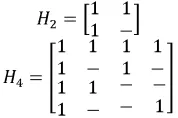
NTRODUCTIONA hadamard matrix of order is an matrix with entries , such that where is the identity matrix of order .[1] The examples for the smallest orders are,
&
Figure 1-The smallest order Hadamard matrices where, we write – for -1.
Also, note that multiplying a row/column by (-1) or permuting a row/column of a Hadamard matrix yields another Hadamard matrix. If is a Hadamard matrix of order ,then or .[2]The most preliminary way of constructing Hadamard matrices is to use the Tensor (Kronecker) product.
Tensor Product: [3] Let be matrix and be a matrix.Then the Tensor product of and is defined as,
Figure 2- The Tensor product of two matrices
If H is a Hadamard matrix of order ,then the partition matrix is a Hadamard matrix of order .[4]This can be applied repeatedly and results the following sequence of matrices,
Figure 3-Sylvester’s method of constructing Normalized
Hadamard matrices
where denotes the kronecker product.This results the normalized Hadamard matrix for which the first row and first column is all ones.[5]Using the Sylvester’s method the first few Hadamard matrices that can be obtained are,
Figure 4-First two normalized matrices constructed from Sylvester construction
Further, if and are Hadamard matrices, then
is also a Hadamard matrix.[6] These Hadamard matrices which are constructed by the Sylvester’s method can be used to construct certain graphs.One can recall the definition of graphs as follows; A Graph is an ordered pair of sets, the elements of are called vertices and the elements of E are called edges.The vertex set of is denoted by and the set of edges is denoted by Further,for a graph denote and and the value of is called the order of the graph and the value of is called the size of the graph.[7] For an edge , vertices and are its ends.Further,the vertices and are adjacent or neighbours if and the edge is said to be incident to the vertices and .[8]A graph can be represented in a plane figure by drawing a line between two vertices. Moreover, the graphs can be generalized by allowing loops and multiple edges between vertices.[9] In figure 5 below, the vertex set of the graph can be written as and the set of edges can be ————————————————
Department of Mathematics, Faculty of Science, University of Peradeniya
E-mail: [email protected]
Department of Mathematics, Faculty of Science,
University of Peradeniya. E-mail: [email protected]
Postgraduate Institute of Science, Faculty of Science, University of Peradeniya.
expressed as .The point has loop and the vertices and are connected with multiple edges.
Figure 5-The diagram of a graph with vertices . Among the extensive combination of graphs the fundamental type of graphs are known as simple graphs.
Simple graph[10]- A graph is called a simple graph if it has no loops and multiple edges. Figure 6 shows a simple graph with three vertices.
Figure 6-A simple graph
Through these simple graphs, the interesting class of graphs are known to be the -regular graphs.
-Regular graph[11]-A simple graph with vertices of equal degree is known as a -regular graph.
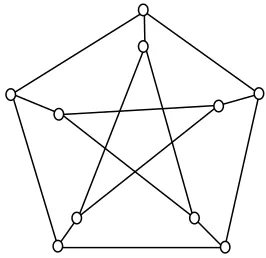
Figure 7- A 3-regular graph (Peterson Graph) The action of -regular graphs appear to be the origination of another collection of important graphs which are known to be the strongly regular graphs.
A strongly regular graph, is a regular graph with vertices of degree such that every two joined vevrtices have exactly common neighbours and every two non-joined vertices have exactly common neighbours.[11] The parameters of a strongly regular graph satisfies the equation .[12]
These several types of graphs can be represented with their adjacency matrix.[13] The correspondence between the graph and the adjacency matrix is as follows.
The adjacency matrix [14] for a graph with vertices is an matrix if its entry is,
For the graph in figure 5, the adjacency matrix is shown below.
Figure 8-the adjacency matrix of the graph in figure 5 Moreover, a graph is a strongly regular graph if and only if for the adjacency matrix of holds,
and , where and are the identity matrix and the matrix with all ones respectively.[15] The Latin squares play an important role in constructing graphs in certain situations. There are several types of Latin squares. For this objective, we may use the symmetric Latin squares. The Latin square of order is an array such that each cell contains a single element from an such that each element occurs in exactly once in each row.[16] For this intention, it will be important to have the set of indices for the rows and columns and the set of symbols be the same set. For some finite index the ―obvious‖ choice for the index sets will be or , but we could use any finite set. For a specific order , there will be more than one Latin squares..A Latin square of order is symmetric if for and a Latin square of side is in standard form if the symbols in the first row and column occur in natural order.[17]
,
Figure 9-Latin squares of order 2
Figure 10-Symmetric Latin square of order 3 To accomplish the mission of generating a strongly regular graph from a normalized Hadamard matrix, we used the Symmetric Latin Squares where lower triangle separated by the diagonal has a mirror image of the upper triangle. Order 4 symmetric Latin square depicted by Figure 11 and order 8 Latin symmetric Latin square depicted by Figure 12 show two such Latin squares which follows the format of Latin squares used in this research.
u
v
w
b
212 Figure 11- Latin square of order 4
Figure 12- Latin square of order 8
In this paper we have proposed an algorithm which can be used to generate strongly regular graphs from normalized Hadamard matrices of order for .
2
M
ETHODOLOGYThe proposed method constructs a graph from a normalized Hadamard matrix. Since, the finite projective plane is known to be the smallest design ,this method is developed to begin with the normalized Hadamard matrix of order 4.
2.1 Mathematical Background Of The Proposed
Method
For any integer the normalized Hadamard matrix of order can be constructed using the Sylvester’s construction. Hence, the Sylvester construction cited in figure 3 can be applied to the smallest order Hadamard matrices defined in figure 1 to obtain the Hadamard matrix of order .For an example, The normalized Hadamard matrix of order 4 can be constructed using as follows:
Figure 13 –The normalized Hadamard matrix of order 4
constructed by Sylvester construction In the next step label each column vector as for
.For the above example, there are four column vectors .
Figure 14- The column vectors of the matrix
Then, multiply each column vector by its transpose and label the resulting matrices as , for .For the above example, each ’ s can be constructed as follows.
Using the first column vector , the construction of the first block matrix is as follows:
Figure 15-The construction of the first block matrix Then, applying the above matrix multiplication method to the column vector gives the next block matrix .
Figure 16-The second block matrix
Similarly, the matrix operation on the third column vector yields the next block
Figure 17-The third block matrix
Since the illustration uses the matrix , there are four scolumn vectors and the last one being . Hence matrix product on gives the required last block .
Figure 18-The last block matrix
Then consider the symmetric Latin square with entries with constant diagonal 1 and replace each by . For the above example, the symmetric Latin square of four elements is required. The resulting Latin square will be as follows,
Hence, by replacing each element with the corresponding matrix, following large matrix of order 16 can be obtained.
Figure 20-The constructed matrix which is replaced by the block matrices
Figure 21-The matrix obtained by substituting the block matrices
Then, replacing 1 to 0 and -1 to 1 yields to the adjacency matrix of the strongly regular graph obtained from the normalized Hadamard matrix of order .For the Hadamard matrix of order 4 we have the following adjacency matrix.
Figure 22-The adjacency matrix of the strongly regular graph obtained from
The same method is applicable for the other normalized Hadamard matrices of order for .
2.2 Implementation Of The Proposed Method
This algorithm was implemented using C++ programming language. The first task of this computer program is to generate a normalized Hadamard matrix with a specified order. This task is achieved by implementing the kronecker
product of matrices starting from the normalized Hadamard matrix of order two mentioned above. User can input the value of the required Hadamard matrix of order for
.Depending on the user input, the program generates the relevant normalized Hadamard matrix and stores it in an external file (File 1) to reduce the burden of holding large matrices in the computer RAM (Random Access Memory). In the same way, the program creates the relevant symmetric Latin Square and stores it in another external file (File 2).
Next the program reads column vectors (simple c's ex: ,....) from the normalized Hadamard matrix stored in that external file (File 1) and execute the product of its transpose to get the resulting matrices (capital C's ex , ..). In the latter part of the computer program the generated matrices ..etc will be substituted to the relevant locations of the above generated Latin square. The resulting matrix will then be saved in another external file (File 3) Finally, it will automatically replace with and with and results the required adjacency matrix of the strongly regular graph will be generated and this resulting adjacency matrix will be saved as another external file (File 4). This File 4 will finally be used to draw the strongly regular graph on the computer display by drawing lines between all the adjacent vertices.
3
R
ESULTS ANDD
ISCUSSIONIt is easy to observe that, each block that are constructed by the operation for are symmetric. That is for .Since the normalized Hadamard matrices have been used, in every construction the first column vector will be a column matrix with all entries being one. Hence the first block in each construction is a matrix of order whose entries are equal to one. That is,
,where is a matrix of order with all entries equal to one. Further, it can be seen that for . The implementation of the above method was tested for several normalized Hadamard matrices of order for . For the program, the following Hardware and software were used.
Hardware:
System Model: Inspiron N5110
Computer: Intel(R) Core(TM) i7-2670QM CPU @ 2.20GHz (8 CPUs), ~2.2 GHz
Memory: 8192 MB RAM
Software:
Operating System: Windows 7 Home Basic 64-bit (6.1, Build 7601)
IDE: Turbo C++; Version 3.0; Copyright(c) 1990, 1992 by Borland International, Inc;
DosBox 0.74
214 Figure 23-The user input interface
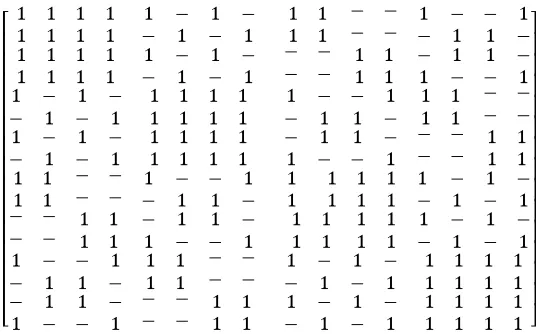
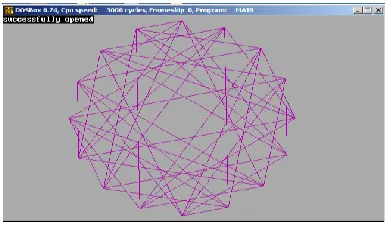
Using the Hadamard matrix of order 4,we can obtain SRG (16,6,2,2), that is the graph consists of 16 points for which each vertex has the degree 6 and each pair of adjacency vertices appear exactly twice and each non-adjacency pair of vertices have 2 common neighbours.Hence the required Regular graph is drawn as follows.
Figure 24-The strongly regular graph obtained from The corresponding adjacency matrix of the above graph is shown below.
Figure 25-The adjacency matrix of the graph obtained from
Moreover, the regular graph (64,28,12,12) which can be obtained from the Hadamard matrix of order 8 is shown below.
Figure 26- The regular graph obtained from
Thus, from this method, one can obtain the strongly regular graph of order from the normalized Hadamard matrix of order .At the same time, one can get the adjacency matrix of the relavant graph.
4
C
ONCLUSIONThe adjacency matrix of each graph is symmetric and the diagonal elements are all zeros and satisfies the properties and ,where denotes the identity matrix of order and denotes the matrix with all ones. Hence, all the graphs generated from this method are strongly regular graphs with , ,
.
5
R
EFERENCES[1] Wallis, J. S. (1975). On Hadamard matrices. Journal of Combinatorial Theory , 149-164.
[2]Craigen, R. (1996). Hadamard matrices and designs. In J. H. C. J. Colbourn, CRC Handbook of Combinatorial Designs (pp. 370-377). CRC Press.
[3]Graybill, F. A. (1983). Matrices, with Applications in Statistics. Belmont: Wadsworth International Group.
[4]J.J.Sylvester. (1867). Thoughts on orthogonal matrices,simultaneous sign successions and tessellated pavements in two or more colours with applications to Newton’s rule,ornamental tile work and the theory of numbers. 461-475: Phil.Mag .
[5]K.J.Horadam. (2007). Hadamard matrices and generalizations . In Hadamard matrices and their applications (pp. 10-12). New Jersy: Princeton University Press.
[6]Jennifer Seberry, M. Y. (1992). Hadamard matrices, sequences, and block designs. In D. J.H.Dinitz, Contemporary design theory-A collection of surveys (pp. 431-560). John Wiley and sons.
[7]Harju, T. (2011). Lecture notes on graph theory. [8]David Joyner, M. V. Algorithmic graph theory.
[9]Diestel, R. (1991). Graph Theory, Graduate Texts in Mathematics. Berlin: Springer Verlag.
[10]Prajapati, M. C. (n.d.). Distance In Graph Theory And Its Application. International Journal of Advanced Engineering Technology .
[11]West, D. (2000). Introduction to Graph Theory. Prentice Hall. [12]Cameron, P. .. (2001). Strongly Regular Graphs. London:
University of London.
[14]Cormen, T. H. (2001). Representations of graphs. In Introduction to Algorithms (pp. 527-531). MIT Press and McGraw-Hill.
[15]R.C.Bose. (1963). Strongly Regular graphs,partial geometries and partially balanced designs. Pacific Journal of Mathematics.
[16]G.H. J. van Rees. (2009). More greedy defining sets in Latin squares. Australasian Journal Of Combinatorics , 183-198. [17]Charles .J. Colbourn, (2007). The Latin square . In Handook
of Combinatorial designs (pp. 135-137). CRC Press.
A.A.C.A.Jayathilake is an
undergraduate at the University of Peradeniya, Sri Lanka. She is following a BSc (Special) degree in Mathematics, University of Peradeniya, Sri Lanka (2013). Her research interests are Combinatorics, Graph theory, Differential equations and design theory.
A.A.I.Perera is a Professor in Mathematics at the Department of Mathematics , University of Peradeniya, Sri Lanka. His research interests are Combinatorics,Graph theory,Design Theory and Group Theory.