© 2017 IJSRST | Volume 3 | Issue 8 | Print ISSN: 2395-6011 | Online ISSN: 2395-602X Themed Section: Science and Technology
Fault Hub Replacement Algorithm for a Wireless Sensor Network
S Srikanth
M. Tech, Department of ECE, Sree Dattha Institute of Engineering and Sciences, Telangana, Tamil Nadu, India
ABSTRACT
A wireless sensor network comprises of various number of sensor hubs, which is utilized to gather and exchange information from source hub to sink hub at customary time interims. The power of each sensor hub in WSN is generally constrained. So the power consumption issue is major concern of WSN. Amid transmission, the sensor hub will lose their battery control and progress toward becoming flaw hub when it is utilized drawn out stretch of time. The fault may likewise happen because of sudden drop of battery control in sensor hubs or because of some other cataclysmic event. Therefore, the non-working hub recuperation is fundamental undertaking for expanding the lifetime of WSN. The proposed Fault Hub Replacement (FHR) algorithm is based review Grade diffusion (GD) algorithm joined with Genetic algorithm use to decrease the information loss and improved the life-span of WSN by supplanting some non-working hub.
Keywords : Sensor hub, Grade diffusion, Genetic Algorithm, Fault hub Replacement Algorithm, WSN.
I.
INTRODUCTION
Wireless sensor network is a most risen field of researchers from the last twentieth century, and their endeavors in investigate have brought a profound transmute our lifestyle. Mechanical advances in remote system innovation and small scale hardware have made the improvement of little, low cost, less power sensing devices, which is efficiently transmitting and getting local data.
Such device are called sensors hub. In WSN sensor hubs are deployed ad-hoc [1] manner and give better solutions to those applications are very costly to deploy in an unfriendly and harsh area. Sensors hubs are generally equipped with a remote receiver and transmitter; they communicate to each other via omnidirectional wireless links [2]. Sensor hubs usually deploy in ad-hoc manner in an area to monitoring the collecting the physical data about the environment. Examples are Area monitoring, military surveillances, habitat monitoring, traffic monitoring, smart space, air water and soil [3].
II.
PROBLEM DESCRIPTION
An ad-hoc Wireless sensor networks contains many number of sensors hubs communicating to each other with a bi-directional link and performs a common tasks. Generally, each sensor hubs equipped with low batteries power and wireless transmitter.
Figure 1. Fault occurs in WSN
replacement is a serious issue to maintain the continuance of a WSN.
III.
RELATED WORK
In previously lots of traditional routing technique and energy efficient algorithms are used. DD algorithm [6] is information driven and query driven transmission protocol. DD algorithm is used to reduce data relay for better power consumption. The live event data only sent if query is fitted which is transmitted from the central (sink) hub. Also data is generated by application aware sensor hubs is named using attributes-value pairs, when its categorized under both flat routing and attribute-based routing. J.H.Hoet. all proposed GD algorithm [13] by improved LD algorithm [7] and ant colony optimization(ACO) [6] for wireless sensor network. GD algorithm is used to reduce energy consumption and transmission load problem. GD algorithm creates a routing table for each sensor hubs by identifying its neighbouring hub. GD algorithm also updates grade value, pay load value and routing path for each sensor hubs in real time, so the live data can easily be send to the central (sink) hub. Firstly the central hub broadcast a grade packed with a grade value of zero and data transmission takes place from higher level to lower level grade value hence it is name grade diffusion algorithm. The GD algorithm also update records about some data relay. The GD algorithm fetch the routing table after creating grade value of all sensor hubs and then take the hub from surrounding coverage area and checking if neighbors hub contain destination next fetch hub is forward Direction and select the hub from forward direction and final again go for another source hub. This procedure proceeds until the point when it discover every sensors hub in WSN.
IV.
FAULT HUB REPLACEMENT ALGORITHM
This paper proposes Fault Hub Replacement (FHR) algorithm is based on grade diffusion algorithm (GD) [7] is combining with genetic algorithm (GA) [10] [11] will reduce the live data packet loss and improve the life time of a wireless sensor network (WSN) by replacing some non-functioning hub. This algorithm creates routing table, grade value, pay load value, and neighbor hub for each sensors hub by using GD algorithm. The sensor
hubs are sending live data to the sink hub according to grade diffusion algorithm (GD).
Figure 2. Fault Hub Replacement algorithm Flow chart
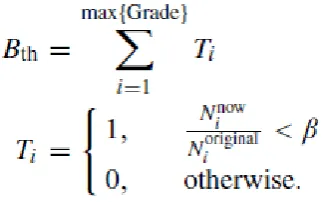
The FHR algorithm, calculated the number of faulty sensor hubs during the wireless sensor network operation and the Bth [12] value is calculated. Fig.2 Shows step of Fault Hub Replacement algorithm (FHR) flow chat for replacing non-functioning hubs in a wireless sensor network.
If the Bth value is greater than zero then the FHR algorithm will be executed and replace the faulty hubs by the healthy hubs that is selected by genetic algorithm (GA). This process continues as long as the parameters are willing to replace non-functioning hub in a WSN.
(1)
NOriginal = the number of sensor hubs are currently active state with grade value i.
Β is a parameter (1) which set by the user and range value lies between 0 and 1. If the value of healthy sensor hubs with respect to grade is less than β then become 1, and the value of Bth will be greater than zero. Then the genetic algorithm will executed and perform the replacement process and replace non-functioning sensor hubs by active sensor hubs. After, completions the value of Bth for all non-function sensor hubs are generated as a binary string.
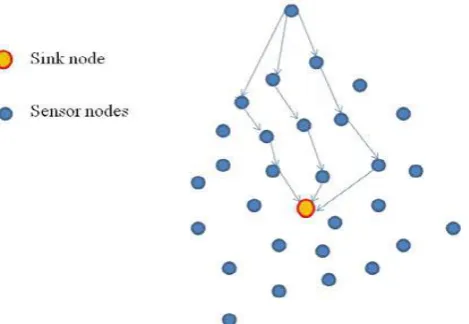
Figure 3. Routing paths and active hubs in a WSN
Figure 4. Routing paths when some hubs not functioning in a WSN
V.
GENETIC ALGORITHM
There are five steps in genetic algorithm- (1) Initialization, (2) Evaluation, (3) Selection, (4) Crossover, and (5) Mutation.
A. Initialization
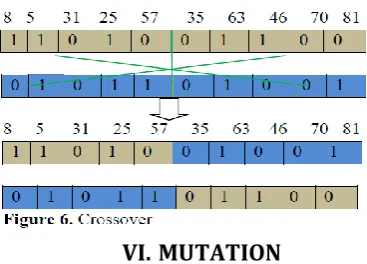
This is a primary step of genetic algorithm. In this step GA algorithm will generate a chromosome and each elements (or bits) of a chromosome are represent as a genes (either 0 or 1). The number of chromosome depends on population size, which is set by the user. The length of a chromosome is number of sensor hubs that are either effective or faulty hub. Genes of chromosomes are representing by either 0 or 1. A 0 represent for hub not replaced and a 1 represent for hub should be replaced. For this case 10 numbers of non-functioning sensor hubs are selected randomly. The hub numbers are 8, 5, 31, 25, 57, 35, 63, 46, 70, and 81.
B Evaluation
In this step, fitness value is calculated for each hubs i.e chromosome genes according to the fitness function (2). In this function, chromosome genes are cannot put directly, because chromosome genes are represented sensor hubs whether it is replaced or not. The main of FHR algorithm is reuse the best routing path by replacing some number of non-functioning hubs.
(2)
C Selection
In this progression, the high wellness estimation of chromosomes are chosen and erased bring down wellness estimation of chromosomes. At first the high wellness estimation of chromosomes are chosen and put into the mating pool and afterward send to the hybrid procedure for better wellness chromosome.
D. Crossover
roulette-wheel selections to develop the new chromosome offspring. Fig.4 Shows crossover process.
VI.
MUTATION
In mutation step, the chromosome can modify by just randomly flip one hub to 0 to 1. After mutation operation the changing chromosomes are very effective compare the previous one. After the final step of genetic algorithm, the non-functioning hub will be replaced by functioning hubs
VII.
SIMULATION
A wireless sensor network is established within boundary of 500X500 m by using Network simulator- 2 (NS-2) [7]. The network consists of 100 hubs and each single hub is configured with routing protocol, link layer, and media access control. Initially energy of each single hub is provided 10 jule, and each single hub have been assigned tx 1.0 (transmitting power) and rx 0.8 ( receiving power) by using energy model. In this network, sink hub position is fixed but all other hubs position moveable
A Neighbor hub Estimation
Each sensor hubs in a wireless sensor network know details about its neighbor hubs, by broadcasting query message to the neighbor hubs. This neighbour hub estimation is done by proposed algorithm. This proposed algorithm also update the routing path and record about data transmission information.
Figure 8.Neighbor hub estimation
B. Fault hubs Identification
Fault hubs are identified by calculating the value of Bth. According to the Nnow /Noriginal is the ration of current time active hub and original hubs. Nnow is represent for current time functioning sensor hub and Noriginal is represent for original hubs. so if the value of the Bth is greater than zero the the proposed algorithm is invoked and replace the idle hubs by active sensor hub through genetic algorithm (GA). These processes continue until all idle hub replaced by the functioning sensor hubs.
Figure 9. Fault hub Identification
VIII.
CONCLUSION & FUTURE SCOPE
influence the whole systems execution. The proposed algorithm depends on review grade diffusion algorithm with consolidate genetic algorithm will replace non-working hub by non-working when a few hubs are sit out of gear because of exhaustion of battery control and re-establishing the exhibitions of the systems. In future greater security strategy will utilize like exceedingly secure encryption plan and reinforcement hubs procedures can be used to enhance the life time WSN.
IX.
REFERENCES[1]. R. Kay, F. Mattern. "The Design Space of Wireless Sensor Networks", IEEE Wireless Communications, Dec. 2004.
[2]. T. H. Liu, S. C. Yi, and X. W. Wang, "A fault management protocol for low-energy and efficient wireless sensor networks", Journal Information Hiding Multimedia Signal Process., vol. 4(1), pp. 34-45, 2013
[3]. P. Daniele, H. Martin."Wireless sensor networks:
applications and challenges of ubiquitous
sensing", Circuits and Systems Magazine, IEEE, Vol. 5(3), pp. 19-31, 2005.
[4]. Z. He, B. S. Lee, and X. S. Wang, "Aggregation in sensor networks with a user-provided quality of service goal", Information Science., Vol. 178(9), pp. 2128-2149, 2008.
[5]. S. Gowrishankar, T. G. Basavaraju, D. H.
Manjaiah, S. K. Sankar, "Issues in Wireless sensor networks", Proceeding of the world congress on Engineering on London, UK, Vol. No. 1, July 2-4, 2008.
[6]. C. Intanagonwiwat, R. Govindan, D. Estrin, J. Heidemann, and F. Silva,"Directeddiffusion for
wireless sensor networking",IEEE/ACM
Transactions on Networking, Vol. 11(1), pp. 2-16, Feb. 2003.
[7]. J. H. Ho, H. C. Shih, B. Y. Liao, and J. S. Pan, "Grade diffusion algorithm", in Proc. 2nd Int. Conf. Eng. Technol. Innov.,pp. 2064-2068. 2012. [8]. J. H. Ho, H. C. Shih, B. Y. Liao, and S. C. Chu,
"A ladder diffusion algorithm using ant colony optimization for wireless sensor networks", Information Science., vol. 192, pp. 204-212, Jun.2012.
[9]. A. Salami, M. Nada. "Ant colony optimization algorithm", UbiCC Journal , Vol.4(3), pp. 823-826,2009.
[10]. D.J.Kenneth,"Genetic algorithm based learning", 1990.
[11]. J. A. Carballido, I. Ponzoni, and N. B. Brignole, "CGD-GA: A graphbased genetic algorithm for sensor network design", Information. Science., Vol. 177(22), pp. 5091-5102, 2007.