Implementation Methods for Delivery Room
Management: A Quality Improvement Comparison Study
WHAT’S KNOWN ON THIS SUBJECT: Quality improvement (QI) studies generally do not account for concurrent trends of improvement and it is difficult to distinguish the impact of a multihospital collaborative QI project without a contemporary control group.
WHAT THIS STUDY ADDS: A multihospital collaborative QI model led to greater declines in hypothermia and invasive ventilation rates in the delivery room compared with an individual NICU QI model and NICUs that did not participate in formal QI activities.
abstract
BACKGROUND:There is little evidence to compare the effectiveness of large collaborative quality improvement versus individual local projects.
METHODS: This was a prospective pre-post intervention study of neonatal resuscitation practice, comparing 3 groups of nonrandomized hospitals in the California Perinatal Quality Care Collaborative: (1) collaborative, hospitals working together through face-to-face meetings, webcasts, electronic mailing list, and data sharing; (2) individual, hospitals working independently; and (3) nonparticipant hospitals. The collaborative and individual arms participated in improvement activities, focusing on reducing hypothermia and invasive ventilatory support.
RESULTS:There were 20 collaborative, 31 individual, and 44 nonparticipant hospitals caring for 12 528 eligible infants. Each group had reduced hypothermia from baseline to postintervention. The collaborative group had the most significant decrease in hypothermia, from 39% to 21%, compared with individual hospital efforts of 38% to 33%, and nonparticipants of 42% to 34%. After risk adjustment, the collabora-tive group had twice the magnitude of decrease in rates of newborns with hypothermia compared with the other groups. Collaborative im-provement also led to greater decreases in delivery room intubation (53% to 40%) and surfactant administration (37% to 20%).
CONCLUSIONS:Collaborative efforts resulted in larger improvements in delivery room outcomes and processes than individual efforts or nonparticipation. Thesefindings have implications for planning quality improvement projects for implementation of evidence-based practices. Pediatrics2014;134:e1378–e1386
AUTHORS:Henry C. Lee, MD, MS,a,bRichard J. Powers, MD,c
Mihoko V. Bennett, PhD,a,bNeil N. Finer, MD,dLouis P.
Halamek, MD,aCourtney Nisbet, RN, MS,a,bMargaret
Crockett, MS, CNS, NNP-BC,eKathy Chance, MD,fDavid
Blackney, RCP, RRT-NPS,eConnie von Köhler, RNC, MSN,
CPHQ,gPaul Kurtin, MD,hand Paul J. Sharek, MDb,i,j
Divisions ofaNeonatal & Developmental Medicine andiGeneral
Pediatrics, Department of Pediatrics, Stanford University, Palo Alto, California;bCalifornia Perinatal Quality Care Collaborative,
Palo Alto, California;cDivision of Neonatology, Department of
Pediatrics, Good Samaritan Hospital, San Jose, California;
dDivision of Neonatology, Department of Pediatrics, University
of California San Diego, San Diego, California;eSutter Medical
Center, Sacramento, California;fCalifornia Children’s Services,
Sacramento, California;gMiller Children’s Hospital Long Beach,
MemorialCare Health System, Long Beach, California;hRady
Children’s Hospital, San Diego, California; andjCenter for Quality
and Clinical Effectiveness, Lucile Packard Children’s Hospital, Palo Alto, California
KEY WORDS
quality improvement, collaborative, neonatal resuscitation, very low birth weight
ABBREVIATIONS
CPAP—continuous positive airway pressure CPQCC—California Perinatal Quality Care Collaborative IHI—Institute for Healthcare Improvement
NRP—Neonatal Resuscitation Program QI—quality improvement
VLBW—very low birth weight
Dr Lee conceptualized and designed the study, and drafted the initial manuscript; Dr Powers conceptualized and designed the study, coordinated and supervised the study, and critically reviewed the manuscript; Dr Bennett contributed to the study design, developed statistical models for the study, coordinated and supervised data analyses, and critically reviewed the manuscript; Drs Finer and Halamek contributed to study design, served on the expert panel that guided the collaborative quality improvement arm, and critically reviewed the manuscript; Ms Nisbet contributed to study design, coordinated the expert panel, participated in data collection, and critically reviewed the manuscript; Ms Crockett, Drs Chance and Kurtin, Mr Blackney, and Ms von Köhler contributed to the intervention design, served on the expert panel that guided the collaborative quality improvement arm, and critically reviewed the manuscript; Dr Sharek contributed to study design, led the expert panel of the quality improvement arm, coordinated and supervised the study team, and critically reviewed the manuscript; and all authors approved thefinal manuscript as submitted.
Recent updates of the Neonatal Re-suscitation Program (NRP)1and other evidence emphasize the importance of teamwork and safety climate in effective implementation of complex tasks.2–6 Adopting evidence-based changes has been enhanced by participation in collaborative quality improvement (QI) projects, where changes are bundled together and implemented by teams from different centers sharing common strategies.7,8
Collaborative QI, based on the Insti-tute for Healthcare Improvement’s (IHI) model,9 has been successful in set-tings such as the California Perinatal Quality Care Collaborative (CPQCC).6,7–10 This model brings together teams from different institutions, providing struc-tured learning with face-to-face meet-ings, Web-based discussions, electronic mailing lists, expert panel access, and unblinded outcome and process data display, with incremental learning through reporting of successes, barriers, and lessons learned.
In 2010, CPQCC planned a collabora-tive QI project to improve manage-ment of high-risk deliveries, with a best practice bundle constructed from published evidence and guide-lines for temperature and respiratory management for very low birth weight (VLBW; birth weight,1500 g) infants.1,2,11–17Specific interventions in-cluded strategies to avoid hypothermia; establishment of lung volume in the least-invasive manner; and support-ing teamwork with checklists, brief-ings, and debriefings.
Although the collaborative model has been successful, significant barriers to participation occur, including costs, personnel availability, and limitations on number of sites. Therefore, CPQCC constructed a novel single-site QI model (NICU QI) not requiring interaction with other sites. In this arm, the same bundle was provided, but implementation was directed by individual centers.
The purpose of this study was to pro-spectively test 2 different QI methods (collaborative QI and NICU QI) against a third group of nonparticipants. This comparison would minimize the
in-fluence of biases frequently seen in QI study designs that compare the in-tervention over time against baseline data without controls.18–21A compari-son group of nonparticipants can ac-count for secular, concurrent trends in practices. Furthermore, comparison with a group also pursuing QI with a differing strategy would limit selec-tion bias of participant motivaselec-tion. Our hypothesis was that there would be incremental increases in improvement from nonparticipants to NICU QI to collaborative QI.
METHODS
Study Design and Setting
This was a prospective longitudinal cohort study of a collaborative QI model compared with a single-site QI model (NICU QI) and a nonpartici-pant population when implementing an evidence-based practice bundle for delivery room management. The CPQCC collects clinical data prospec-tively for infants born at 132 California hospitals by using an expanded ver-sion of the Vermont Oxford Dataset.22,23 Participation in collaborative QI was offered to all CPQCC members and open to the first hospitals that responded until spaces were filled. Remaining hospitals were offered participation in NICU QI. The institutional review board at Stanford University reviewed and approved a waiver of consent for this project.
Study Groups
Collaborative QI
The collaborative QI group adhered to the IHI model previously used by CPQCC.7–9An expert panel developed an evidence-based change package
and corresponding metrics. The group participated in 3 face-to-face learning sessions: at collaborative launch, 4 months, and 12 months. Other com-ponents included monthly webcasts to share progress and barriers, an electronic mailing list, submission of unblinded outcome and process data to a Web-enabled database exclusively for members, and expert panel guid-ance. The entire group’s data were presented in monthly meetings and each center had real-time data access at all times. A key aspect of imple-mentation involved teamwork training in a readiness bundle, including pre-resuscitation checklist, briefing, and debriefing. There was an administra-tive charge for joining this group in addition to costs for travel to several 1-day learning sessions, paid for by each hospital.
NICU QI
The elements of the NICU QI group were based on a design intended to provide centers with the change package and framework for implementation with-out interaction with other centers. NICU QI centers were given the same change package and metrics grid as Collaborative QI and were instructed to implement all interventions, report the same metrics monthly via electronic forms (not visible to other sites), and to meet with local QI experts at least quarterly. NICU QI centers were en-couraged to seek practical assistance from internal QI experts and, if nec-essary, outside content experts. Table 1 lists key characteristics distinguish-ing the Collaborative and NICU QI groups.
Nonparticipant Group
Eligible patients for analysis in-cluded inborn patients with birth weight #1500 g or gestational age between 22 and 29 weeks. As hos-pitals were not randomly assigned groups, we restricted the analyses to hospitals that had at least 10 eligible infants born during each of the 3 study periods to have similar comparison groups.
Intervention
The expert panel reviewed multiple sources for potential best practices, including the NRP and randomized controlled trials demonstrating op-timal outcomes with specific deli-very room strategies targeting VLBW infants. The interventions in the change
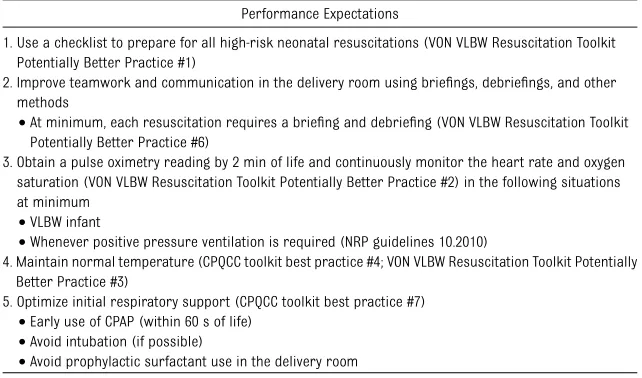
package (Table 2) included (1) main-taining normal core body tempera-ture (36.5–37.5°C), by equipment use (radiant warmer, polyethylene wrap, chemical blankets, caps) and raising ambient room temperature, (2) mon-itoring of oxygen saturation within 2 minutes, (3) emphasizing continuous positive airway pressure (CPAP) over intubation and prophylactic surfac-tant, and (4) using checklists, brief-ings, and debriefings.
Study Outcomes
The primary outcome, percentage of VLBW newborns with hypothermia, was selected because (1) evidence cor-relates hypothermia with increased risk of death and morbidities such
as intraventricular hemorrhage,24,25 (2) first temperature is a standard metric collected by all CPQCC mem-bers, and (3) hypothermia preven-tion has been a consistent target of QI.26 Secondary outcomes included frequency of delivery room CPAP (goal of increasing frequency), and intuba-tion and surfactant administraintuba-tion in the delivery room (goal of reducing frequency, which may help to prevent bronchopulmonary dysplasia).27 The CPQCC data set was the source of mea-surement; these data are collected by trained abstractors by using standard definitions and methods.23
Balancing measures included (1) hyperthermia (temperature .37.5°), (2) the need for epinephrine and chest compressions, and (3) pneumothorax rates. These were selected to assess the possibility that a narrow focus on improving temperature control, max-imizing CPAP, and reducing intubation could inadvertently lead to increased resuscitative efforts.
Data Analysis
Outcome variables were compared across 3 time periods: baseline (in-fants born June 2010 to May 2011), intervention (June 2011 to May 2012), and postintervention (June 2012 to May 2013). The baseline period oc-curred before any intervention. The intervention period encompassed the time from the first Learning Ses-sion to 12 months afterward, during which there were monthly meetings among the collaborative QI group, 3 face-to-face Learning Sessions, and active group E-mail dialogue. The post-intervention time frame encompassed the 12 months after Learning Session 3. There was a final virtual Learning Session during the midpoint of this period to review the status of the ini-tiative. Temperature was categorized as hypothermic (,36.5°) versus not. The temperature recorded is thefirst TABLE 1 Characteristics of Intervention Models Comparing Collaborative Versus NICU QI Groups
Component CPQCC QI Collaborative Model CPQCC NICU QI Model Technical
knowledge
Expert Panel uses Toolkit to draft charter and change package. Expert Panel devotes 1 day plus follow-up discussions to help NICUs develop much of the charter and change package, then facilitates
finalization of these with the NICUs.
Use of CPQCC Toolkit with user friendly 1- to 2-page change package.
QI principles QI Experts from Expert Panel provide teaching on QI principles at initial face-to-face Learning Session and reinforce teaching on monthly calls and each face-to-face Learning Session.
A basic understanding of QI principles (view training module online and participate in kick-off webinar or workshop with Local QI Expert, defined as a person at the hospital trained in QI methods). AIM
statement
Expert Panel devotes 1 day plus follow-up discussions to develop much of the Collaborative AIM statement then facilitatesfinalization of the AIM statement with the NICUs. NICUs develop individual AIM statements.
QI Expert helps NICU project team create local AIM statement. AIM Statement sent into CPQCC.
Outcome data
Monthly report out by each NICU; time for sharing and asking one another questions; data for the collaborative reviewed in detail each month.
Primary outcome data sent into CPQCC monthly.
Process metrics
Monthly report out by each NICU; extensive data collection with downloadable graphs and reports; entry into extranet; expert assistance with entering data and understanding graphs; QI Expert(s) graph collaborative results.
Process Metrics sent into CPQCC monthly.
Meetings 3 face-to-face, full-day meetings, all 3 Learning Sessions with full Expert Panel. Monthly Web-based/teleconference meetings (60–90 min) with full Expert Panel and presentation each month by 1 Expert; report out by each NICU; time for sharing and asking one another questions; data for the collaborative reviewed in detail each month.
temperature recorded on NICU ad-mission and must be recorded within 1 hour after birth. Temperature was missing for 1% of records. Rates were compared by using thex2test.
Multivariable analyses were conducted at the patient level. The main predictor variable was time period. We accounted for the following risk adjustment vari-ables: NICU-eligible patient volume (categorized in terciles), birth weight, gender, maternal age, race, multiple gestation, small for gestational age, congenital anomaly, receipt of antena-tal steroids, and mode of delivery. Birth weight and small for gestational age were used rather than gestational age alone as predictors along with the hos-pital of care being accounted for as a random effect, by using methods sim-ilar to those described previously.7,28,29
We determined the statistical signifi -cance of the observed heterogeneity of outcome change over time by in-corporating study period and study group interactions. A P,.05 for the interaction term would indicate evi-dence of study group effect.
RESULTS
Ninety-five CPQCC member hospitals (20 collaborative QI, 31 NICU QI, 44
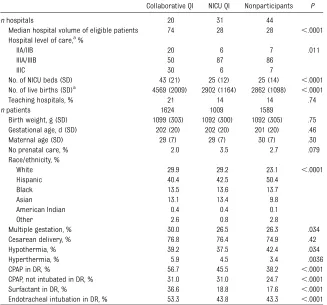
nonparticipant hospitals) were eli-gible. In these 95 hospitals, there were 12 528 eligible inborn infants (collaborative QI hospitals,n= 4625; NICU QI, n = 3229; nonparticipants, n = 4674). There were 37 CPQCC hospitals excluded (collaborative QI 4, NICU QI 4, nonparticipants 29) for not meeting the minimum number of 10 eligible infant deliveries for each of all 3 study periods. Base-line characteristics by group are shown in Table 3. For the collaborative QI group, the 3 face-to-face Learn-ing Sessions had an average of 105 participants.
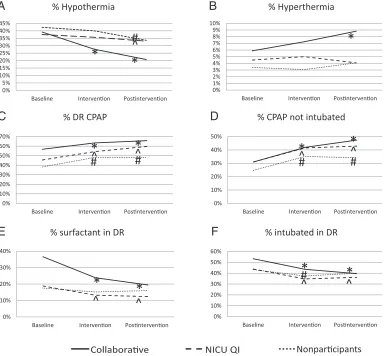
All 3 groups had decreased hypo-thermia rates over time (Fig 1A). The collaborative QI group had the largest decrease in prevalence of hypother-mia from 39.2% at baseline, 27.7% during the intervention period, and 20.7% during the postintervention period (P , .0001 compared with baseline for intervention and post-intervention). The NICU QI and non-participant groups also had decreased prevalence of hypothermia (Fig 1A). Hyperthermia increased in the collabo-rative QI group from 5.9% in the baseline period to 8.8% in the postintervention period (P= .0015), but did not change in other groups (Fig 1B).
CPAP use (Fig 1C), and CPAP without intubation (Fig 1D) increased from baseline to postintervention for all groups. Delivery room surfactant de-creased for collaborative QI (36.6% baseline to 19.5% postintervention, P,.0001) and NICU QI (18.8% baseline to 12.4% postintervention,P,.0001), but did not change in nonparticipants (17.6% baseline to 16.1% postintervention, P= .26, Fig 1E). Delivery room endotracheal intubation decreased for collaborative QI (53.3% to 39.6%, P , .0001) and NICU QI (43.8% to 36.2%,P= .0003) but not for nonparticipants (43.3% base-line to 40.0% postintervention,P= .06, Fig 1F).
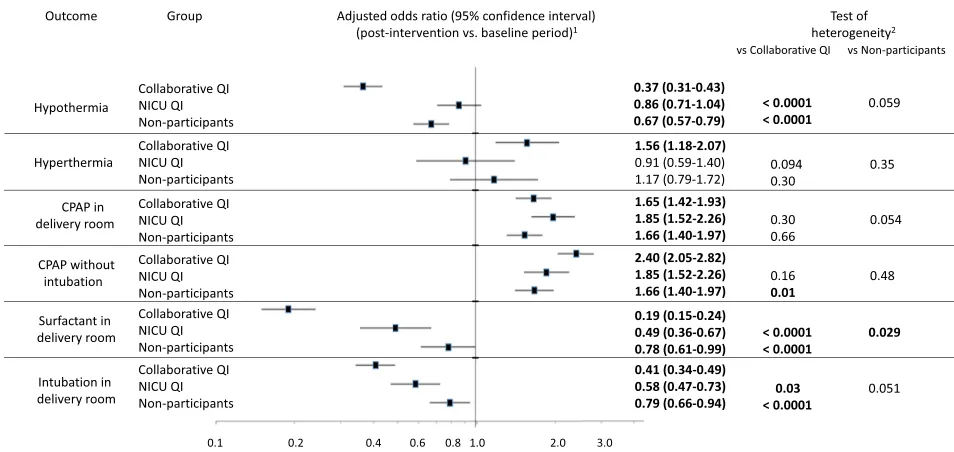
In mixed effects multivariable logistic regression analyses, there was general improvement across all groups in temperature and respiratory man-agement (Fig 2). However, there was a larger degree of improvement for collaborative QI compared with NICU QI and nonparticipants, in reduction of hypothermia, intubation, and surfac-tant use. The greater improvement seen in the collaborative QI group compared with the NICU QI and nonparticipant groups was significant based on test for heterogeneity and by nonoverlapping confidence intervals for the collabora-tive QI group compared with the other groups. The NICU QI group had a more significant improvement in reduc-tion of surfactant use compared with nonparticipants.
For both unadjusted rates and in multivariable models, there was no change in cardiac compressions, epinephrine use, or pneumothorax across time periods for all groups.
Of the collaborative QI group, 90% of NICUs saw an improvement in hypo-thermia rates from baseline to post-intervention (defined as any decrease in hypothermia rate), compared with 61% of NICU QI centers and 59% of nonparticipant centers. CPAP use in-creased for 90% of collaborative QI, 71% TABLE 2 CPQCC Delivery Room Management Collaborative Change Package
Performance Expectations
1. Use a checklist to prepare for all high-risk neonatal resuscitations (VON VLBW Resuscitation Toolkit Potentially Better Practice #1)
2. Improve teamwork and communication in the delivery room using briefings, debriefings, and other methods
•At minimum, each resuscitation requires a briefing and debriefing (VON VLBW Resuscitation Toolkit Potentially Better Practice #6)
3. Obtain a pulse oximetry reading by 2 min of life and continuously monitor the heart rate and oxygen saturation (VON VLBW Resuscitation Toolkit Potentially Better Practice #2) in the following situations at minimum
•VLBW infant
•Whenever positive pressure ventilation is required (NRP guidelines 10.2010)
4. Maintain normal temperature (CPQCC toolkit best practice #4; VON VLBW Resuscitation Toolkit Potentially Better Practice #3)
5. Optimize initial respiratory support (CPQCC toolkit best practice #7)
•Early use of CPAP (within 60 s of life)
•Avoid intubation (if possible)
•Avoid prophylactic surfactant use in the delivery room
for NICU QI, and for 64% of nonparticipants. Ventilation by endotracheal tube de-creased for 75% of collaborative QI centers, 68% of NICU QI centers, and 64% of nonparticipants. A similar num-ber of centers across the 3 groups (65% to 70%) had an increase in hyperthermia rates.
DISCUSSION
Our goals were to (1) compare the ef-fectiveness of the IHI’s collaborative QI model with a single-site QI model in which both groups were supplied with the same change package, metrics grid, and data-tracking requirements over the same time frame, and (2) to compare both of those models to a nonparticipant group. For the first goal, the difference in the 2 models was the participation of the collaborative QI sites in a “community of practice” in
which each site had access to expert panel members, comparative data, and each other, whereas the NICU QI group had none of those elements. For the second goal, the nonparticipants did not have the change package, metrics grid, data-tracking recommenda-tions, or the community of practice. By comparing the 2 models with non-participants, we were able to demon-strate the incremental effect of each QI model, while accounting for secular trends.
Patients in all 3 groups had significant reductions in hypothermia, surfactant use, and delivery room intubation and significant increases in CPAP use. The frequency of surfactant administration in the collaborative QI was higher at baseline than nonparticipants, sug-gesting that the collaborative QI group had more room to improve. In fact, the
postintervention rate for collaborative QI remained higher than both the baseline and postintervention rates of the other 2 groups. The lower rate of surfactant use at baseline for non-participants may have been 1 reason that these NICUs were not as interested in joining either QI project.
A previous single-center study of im-proving delivery room management for preterm infants had similar goals and led to reduced hypothermia and oxygen use, but not a decrease in intubations.30That study did not have a nonparticipant group for compar-ison. A similar single-center study found a reduction in hypothermia (defined in that study as temperature
,36°) from 55% to 6%.31It is difficult to compare our groups with theirs because of differing definitions and their much higher baseline rate of hypothermia. Comparing the 3 groups in our study allowed us to control for secular trends toward better de-livery room temperature regulation and establishment of lung volumes during resuscitation, even without QI participation. We speculate that nonparticipant hospital improve-ments resulted from generic knowl-edge dissemination, partly due to release of the 2011 NRP guidelines. Interaction through state meetings, conferences, and other communica-tions could have also spread to this group, a potential benefit of belong-ing to an informal community of practice.
We were able to identify the incre-mental effect of a collaborative ap-proach compared with similar QI efforts outside of a formal collabo-rative environment. Specifically, al-though collaborative QI participation resulted in greater reductions in hypothermia and intubation, there was not a significant incremental ef-fect in NICU QI compared with non-participants. There were increased TABLE 3 Baseline Characteristics by Study Group
Collaborative QI NICU QI Nonparticipants P
nhospitals 20 31 44
Median hospital volume of eligible patients 74 28 28 ,.0001 Hospital level of care,a
%
IIA/IIB 20 6 7 .011
IIIA/IIIB 50 87 86
IIIC 30 6 7
No. of NICU beds (SD) 43 (21) 25 (12) 25 (14) ,.0001 No. of live births (SD)a
4569 (2009) 2902 (1164) 2862 (1098) ,.0001
Teaching hospitals, % 21 14 14 .74
npatients 1624 1009 1589
Birth weight, g (SD) 1099 (303) 1092 (300) 1092 (305) .75 Gestational age, d (SD) 202 (20) 202 (20) 201 (20) .46 Maternal age (SD) 29 (7) 29 (7) 30 (7) .30
No prenatal care, % 2.0 3.5 2.7 .079
Race/ethnicity, %
White 29.9 29.2 23.1 ,.0001
Hispanic 40.4 42.5 50.4
Black 13.5 13.6 13.7
Asian 13.1 13.4 9.8
American Indian 0.4 0.4 0.1
Other 2.6 0.8 2.8
Multiple gestation, % 30.0 26.5 26.3 .034
Cesarean delivery, % 76.8 76.4 74.9 .42
Hypothermia, % 39.2 37.5 42.4 .034
Hyperthermia, % 5.9 4.5 3.4 .0036
CPAP in DR, % 56.7 45.5 38.2 ,.0001
CPAP, not intubated in DR, % 31.0 31.0 24.7 ,.0001
Surfactant in DR, % 36.6 18.8 17.6 ,.0001
Endotracheal intubation in DR, % 53.3 43.8 43.3 ,.0001
DR, delivery room
trends toward improvements in several outcomes when comparing NICU QI hospitals to nonparticipants for crude rates (Fig 1), but only surfactant use remained prominent in multivariable analyses (Fig 2). As the interventions used by both groups relied on a com-mon toolkit, the processes related to intercenter collaboration may have led to the significantly greater degree of improvement seen for the collabora-tive QI group.
Of note, the collaborative QI group had an increase in hyperthermia. The 8.8% incidence of hyperthermia in the col-laborative group compared with 4.1% in both NICU QI and nonparticipants rep-resents a potentially concerning risk of
temperature control elements. We did not find an association of decreased hypothermia to increased hyperther-mia (P = .47) when categorizing the collaborative QI into terciles of perfor-mance. Careful attention to avoiding excessive warming is necessary when pursuing QI in this area. Analyses of other balancing measures (epinephrine use and chest compressions in the de-livery room, and pneumothorax) were reassuring.
Reports of multicenter collabora-tive QI projects in adult and pediatric medicine settings have demonstrated improvements over time when com-paring outcomes at the end of the collaborative with baseline.32–36 A
limitation of these studies is the lack of prospective controls. Some re-ports have incorporated simultaneous control groups, including cluster ran-domization protocols.37–39 Although the studies by Horbar et al38 and Scales et al39 reported significant improvements in primary outcomes based on process implementation, the large multicenter NICHD trial by Walsh et al37 failed to demonstrate significant differences in the pri-mary outcome of survival without bronchopulmonary dysplasia despite wide adoption of practices. The study of collaborative multicenter prac-tice may have some advantages to traditional randomized controlled FIGURE 1
Outcomes by study group over time. A, % hypothermia (first temperature before 1 hour,36.5°); B, % hyperthermia (first temperature before 1 hour
trials in understanding strategies for effective QI.40
This study was subject to several lim-itations. We did not actively collect process metrics for the NICU QI or nonparticipant populations. However, surrogate measures of engagement were as follows. The average number of individuals on the leadership team for each NICU was 3.8 for collabora-tive QI and 2.7 for the NICU QI hospitals (P= .01), and all members of the col-laborative QI group entered extranet data for 100% of the months during the intervention, whereas only 22 of the 35 NICU QI hospitals submitted electronic data forms (of those cen-ters, forms were submitted for 92% of the months). Study groups were not selected randomly, but by volun-tary enlistment on afirst-come basis, introducing potential bias related to degree of commitment, interest in the topic, and general culture for QI at in-dividual centers. Nonparticipants that did not volunteer for either group would be expected to have less in-trinsic motivation. Centers with more
motivation and QI organization may have better results. The collaborative QI hospitals generally had higher patient volume (Table 3), which may signify more baseline resources to perform QI, and perhaps a greater opportunity to refine practices due to more patients. We do not yet know the sustainability of the intervention beyond the 12-month postintervention period.
CONCLUSIONS
In this study, sites participating in a formal IHI style collaborative QI initiative had improved delivery room outcomes compared with both a for-mal single-site QI initiative, and non-participation. The interaction and exchange of experiences between sites within a QI collaborative project may have led to measurable gains in outcomes as compared with sites that implemented a similar change package locally without interaction with other sites. We hypothesize that building a community of practice
could be 1 reason for the incre-mental improvement seen for col-laborative QI over single-site QI. Our collaborative project also included and emphasized the use of checklists and debriefing to improve team per-formance and communication. This may have facilitated the ability to learn and adapt from the simulta-neous experience of teams from sim-ilar organizations, leading to greater success. We also have shown the im-portance of tracking outcomes in nonparticipants to adjust for concur-rent trends in clinical practice when reporting results of QI projects. With-out the prospective data collection from this group, mistaken conclusions regarding efficacy of both QI methods may have occurred.
ACKNOWLEDGMENTS
We thank the participating CPQCC member hospitals and the members of the Perinatal Quality Improvement Panel (http://cpqcc.org/about_us/pqip_ panel).
FIGURE 2
Delivery room outcomes from baseline to postintervention.aAdjusted odds ratios reflect results of mixed effects logistic regression analyses
comparing postintervention to baseline period for each group. Odds ratios withP,.05 are noted in bold.bAP,.05 in this column denotes
REFERENCES
1. Kattwinkel J, Perlman JM, Aziz K, et al; American Heart Association. Neonatal re-suscitation: 2010 American Heart Asso-ciation Guidelines for Cardiopulmonary Resuscitation and Emergency
Cardio-vascular Care. Pediatrics. 2010;126(5).
Available at: www.pediatrics.org/cgi/content/ full/126/5/e1400
2. Simpson KR. The context and clinical evi-dence for common nursing practices
dur-ing labor.MCN Am L Matern Child Nurs.
2005;30(6):356–363
3. Simpson KR, James DC, Knox GE.
Nurse-physician communication during labor
and birth: implications for patient safety.
J Obstet Gynecol Neonatal Nurs. 2006;35(4): 547–556
4. Simpson KR, Lyndon A. Clinical disagree-ments during labor and birth: how does real life compare to best practice?MCN Am J Matern Child Nurs. 2009;34(1):31–39
5. Kennedy HP, Lyndon A. Tensions and team-work in nursing and midwifery
relation-ships. J Obstet Gynecol Neonatal Nurs.
2008;37(4):426–435
6. Pronovost P, Needham D, Berenholtz S, et al. An intervention to decrease catheter-related bloodstream infections in the ICU.N Engl J Med. 2006;355(26):2725–2732
7. Lee HC, Kurtin PS, Wight NE, et al. A quality improvement project to increase breast milk use in very low birth weight infants.
Pediatrics. 2012;130(6). Available at: www. pediatrics.org/cgi/content/full/130/6/e1679
8. Wirtschafter DD, Powers RJ, Pettit JS, et al. Nosocomial infection reduction in VLBW infants with a statewide
quality-improvement model.Pediatrics. 2011;127
(3):419–426
9. The Breakthrough Series. IHI’s Collabora-tive Model for Achieving Breakthrough Im-provement. IHI Innovation Series White Paper. Boston, MA: Institute for Healthcare Improvement; 2003
10. Sharek PJ, McClead RE Jr, Taketomo C, et al. An intervention to decrease narcotic-related adverse drug events in children’s hospitals. Pediatrics. 2008;122(4). Avail-able at: www.pediatrics.org/cgi/content/ full/122/4/e861
11. Vohra S, Roberts RS, Zhang B, Janes M, Schmidt B. Heat Loss Prevention (HeLP) in the delivery room: a randomized controlled trial of polyethylene occlusive skin wrap-ping in very preterm infants. J Pediatr. 2004;145(6):750–753
12. Watkinson M. Temperature control of pre-mature infants in the delivery room.Clin Perinatol. 2006;33(1):43–53, vi
13. Morley CJ, Davis PG, Doyle LW, Brion LP, Hascoet JM, Carlin JB; COIN Trial Inves-tigators. Nasal CPAP or intubation at birth
for very preterm infants. N Engl J Med.
2008;358(7):700–708
14. Finer NN, Carlo WA, Walsh MC, et al; SUPPORT Study Group of the Eunice Kennedy Shriver NICHD Neonatal Research Network. Early CPAP versus surfactant in extremely preterm infants.N Engl J Med. 2010;362(21): 1970–1979
15. Rojas MA, Lozano JM, Rojas MX, et al; Colombian Neonatal Research Network. Very early surfactant without mandatory ventilation in premature infants treated with early continuous positive airway pressure: a randomized, controlled trial. Pediatrics. 2009;123(1):137–142
16. Sandri F, Ancora G, Lanzoni A, et al. Pro-phylactic nasal continuous positive airways pressure in newborns of 28-31 weeks gestation: multicentre randomised con-trolled clinical trial.Arch Dis Child Fetal Neonatal Ed. 2004;89(5):F394–F398
17. Dunn MS, Kaempf J, de Klerk A, et al; Vermont Oxford Network DRM Study Group. Randomized trial comparing 3 approaches to the initial respiratory management of preterm neonates. Pediatrics. 2011;128(5). Available at: www.pediatrics.org/cgi/content/ full/128/5/e1069
18. Mittman BS. Creating the evidence base for
quality improvement collaboratives. Ann
Intern Med. 2004;140(11):897–901
19. Shojania KG, Grimshaw JM. Still no magic bullets: pursuing more rigorous research
in quality improvement.Am J Med. 2004;
116(11):778–780
20. Auerbach AD, Landefeld CS, Shojania KG. The tension between needing to improve
care and knowing how to do it.N Engl J
Med. 2007;357(6):608–613
21. Shojania KG, Grimshaw JM. Evidence-based quality improvement: the state of the sci-ence.Health Aff (Millwood). 2005;24(1):138– 150
22. Vermont Oxford Network. Available at: www. vtoxford.org/about/about.aspx. Accessed May 25, 2012
23. CPQCC network database manual of defi
-nitions for infants born in 2013. Available at: http://cpqcc.org/data/cpqcc_downloads. Accessed February 22, 2014
24. Miller SS, Lee HC, Gould JB. Hypothermia in very low birth weight infants: distribution,
risk factors and outcomes. J Perinatol.
2011;31(suppl 1):S49–S56
25. Costeloe K, Hennessy E, Gibson AT, Marlow N, Wilkinson AR. The EPICure study: outcomes
to discharge from hospital for infants born at the threshold of viability.Pediatrics. 2000;106 (4):659–671
26. Lee HC, Ho QT, Rhine WD. A quality im-provement project to improve admission temperatures in very low birth weight infants.J Perinatol. 2008;28(11):754–758
27. Fischer HS, Bührer C. Avoiding endotracheal ventilation to prevent bronchopulmonary dysplasia: a meta-analysis.Pediatrics. 2013; 132(5). Available at: www.pediatrics.org/cgi/ content/full/132/5/e1351
28. Lee HC, Bennett MV, Schulman J, Gould JB. Accounting for variation in length of NICU stay for extremely low birth weight infants.
J Perinatol. 2013;33(11):872–876
29. Lyndon A, Lee HC, Gilbert WM, Gould JB, Lee KA. Maternal morbidity during childbirth hospitalization in California.J Matern Fetal Neonatal Med. 2012;25(12):2529–2535
30. DeMauro SB, Douglas E, Karp K, et al. Im-proving delivery room management for very preterm infants. Pediatrics. 2013;132 (4). Available at: www.pediatrics.org/cgi/ content/full/132/4/e1018
31. Russo A, McCready M, Torres L, et al. Re-ducing hypothermia in preterm infants following delivery. Pediatrics. 2014;133(4). Available at: www.pediatrics.org/cgi/content/ full/133/4/e1055
32. Mills PD, Weeks WB. Characteristics of suc-cessful quality improvement teams: lessons fromfive collaborative projects in the VHA.
Jt Comm J Qual Saf. 2004;30(3):152–162
33. Lannon CM, Peterson LE. Pediatric collabo-rative improvement networks: background and overview.Pediatrics. 2013;131(suppl 4): S189–S195
34. Schulman J, Stricof R, Stevens TP, et al; New York State Regional Perinatal Care Centers.
Statewide NICU central-line-associated
bloodstream infection rates decline after bundles and checklists. Pediatrics. 2011; 127(3):436–444
35. Wirtschafter DD, Pettit J, Kurtin P, et al. A statewide quality improvement collaborative to reduce neonatal central line-associated blood stream infections. J Perinatol. 2010; 30(3):170–181
36. Lee HC, Kurtin PS, Wight NE, et al. A quality improvement project to increase breast milk use in very low birth weight infants.
Pediatrics. 2012;130(6). Available at: www. pediatrics.org/cgi/content/full/130/6/e1679
improvement to improve rates of survival free of bronchopulmonary dysplasia for infants with birth weights of less than 1250 grams.Pediatrics. 2007;119(5):876–890
38. Horbar JD, Carpenter JH, Buzas J, et al. Collaborative quality improvement to pro-mote evidence based surfactant for preterm
infants: a cluster randomised trial. BMJ. 2004;329(7473):1004
39. Scales DC, Dainty K, Hales B, et al. A mul-tifaceted intervention for quality improve-ment in a network of intensive care units: a cluster randomized trial.JAMA. 2011;305 (4):363–372
40. Eppstein MJ, Horbar JD, Buzas JS, Kauffman SA. Searching the clinicalfitness landscape.
PLoS ONE. 2012;7(11):e49901
41. Stark AR; American Academy of Pediatrics Committee on Fetus and Newborn. Levels of neonatal care. Pediatrics. 2004;114(5): 1341–1347
(Continued fromfirst page)
www.pediatrics.org/cgi/doi/10.1542/peds.2014-0863 doi:10.1542/peds.2014-0863
Accepted for publication Aug 20, 2014
Address correspondence to Henry C. Lee, MD, Division of Neonatal and Developmental Medicine, Stanford University, 750 Welch Rd, Ste 315, Palo Alto, CA 94304. E-mail: [email protected]
PEDIATRICS (ISSN Numbers: Print, 0031-4005; Online, 1098-4275). Copyright © 2014 by the American Academy of Pediatrics
FINANCIAL DISCLOSURE:The authors have indicated they have nofinancial relationships relevant to this article to disclose.
FUNDING:Supported by grant K23HD068400, Eunice Kennedy Shriver National Institute of Child Health and Human Development, and a grant from the Neonatal Resuscitation Program (American Academy of Pediatrics). The sponsors had no active role in relation to study design, data collection, analysis and interpretation, or manuscript preparation and review. The content is solely the responsibility of the authors and does not necessarily represent the official views of the Eunice Kennedy Shriver National Institute of Child Health and Human Development, National Institutes of Health, or the Neonatal Resuscitation Program. Funded by the National Institutes of Health (NIH).
DOI: 10.1542/peds.2014-0863 originally published online October 20, 2014;
2014;134;e1378
Pediatrics
Connie von Köhler, Paul Kurtin and Paul J. Sharek
Halamek, Courtney Nisbet, Margaret Crockett, Kathy Chance, David Blackney,
Henry C. Lee, Richard J. Powers, Mihoko V. Bennett, Neil N. Finer, Louis P.
Services
Updated Information &
http://pediatrics.aappublications.org/content/134/5/e1378
including high resolution figures, can be found at:
References
http://pediatrics.aappublications.org/content/134/5/e1378#BIBL
This article cites 35 articles, 16 of which you can access for free at:
Subspecialty Collections
http://www.aappublications.org/cgi/collection/neonatology_sub
Neonatology
sub
http://www.aappublications.org/cgi/collection/fetus:newborn_infant_
Fetus/Newborn Infant
sub
http://www.aappublications.org/cgi/collection/quality_improvement_
Quality Improvement
e_management_sub
http://www.aappublications.org/cgi/collection/administration:practic
Administration/Practice Management
following collection(s):
This article, along with others on similar topics, appears in the
Permissions & Licensing
http://www.aappublications.org/site/misc/Permissions.xhtml
in its entirety can be found online at:
Information about reproducing this article in parts (figures, tables) or
Reprints
http://www.aappublications.org/site/misc/reprints.xhtml
DOI: 10.1542/peds.2014-0863 originally published online October 20, 2014;
2014;134;e1378
Pediatrics
Connie von Köhler, Paul Kurtin and Paul J. Sharek
Halamek, Courtney Nisbet, Margaret Crockett, Kathy Chance, David Blackney,
Henry C. Lee, Richard J. Powers, Mihoko V. Bennett, Neil N. Finer, Louis P.
Improvement Comparison Study
Implementation Methods for Delivery Room Management: A Quality
http://pediatrics.aappublications.org/content/134/5/e1378
located on the World Wide Web at:
The online version of this article, along with updated information and services, is
by the American Academy of Pediatrics. All rights reserved. Print ISSN: 1073-0397.