IJEDR1704045
International Journal of Engineering Development and Research (
www.ijedr.org
)
297
Improving the Recognition of Faces using LBP and
SVM Optimized by PSO Technique
1
Nisha,
2Maitreyee Dutta
1 ME Scholar , Dept. of ECE , NITTTR, Chandigarh , India 2 Professor, Dept. of CSE , NITTTR, Chandigarh, India
________________________________________________________________________________________________________ Abstract— A face is the distinctive feature of the person providing an identity in the society. Face recognition is an important and challenging technique used for two primary tasks that is identification (or recognition) and verification (or authentication) purposes. There are various challenges in the field of face recognition like variations of illumination, pose, aging, identity, hairstyle, facial expressions etc. This research aims to develop a method to increase the efficiency of recognition using Particle Swarm Optimization (PSO) technique. In this paper, two feature extraction algorithms namely Principal Component Analysis (PCA) and Local Binary Pattern (LBP) techniques are used to extract features from images. The Local Binary Pattern (LBP) has been proved to be effective for image representation. In the recognition process, we used Support Vector Machine (SVM) for classification combined with Particle Swarm Optimization. The classifier performance and the length of selected feature vector are considered for performance evaluation using the Faces94 database. From the experimental results, it is observed that the proposed method could increase the recognition accuracy rate.
IndexTerms— Face Recognition, Kernel Functions, Local Binary Pattern (LBP), Principal Component Analysis (PCA), Support Vector Machine (SVM), Particle Swarm Optimization (PSO).
________________________________________________________________________________________________________
I.INTRODUCTION
Face recognition is a biometric software computer application used for identifying or verifying a specific individual from a digital image or a video source by comparing the selected face with the image stored in database [1]. Recognition of faces mainly fall into two categories: identification and verification. Face verification that compares a face images against a template face image and face identification that compares a probe face image against all image templates in a face database. Face recognition is a very difficult problem due to substantial variations in light direction (illumination), different face poses, facial expressions, occlusions, aging [2]. Due to its various important applications in security access control, identity authentication, human-computer interaction, video databases as the success of face recognition system depends on the particular choice of the features used by the classifier. Face recognition starts with the detection of face images proceeds by normalizing the face images to account for geometrical and illumination changes, possibly using information about the location and appearance of facial landmarks, identifies the faces using appropriate classification algorithms, and post processes the results using model-based schemes and logistic feedback [3]. Face recognition system consists of three main stages: (1) Preprocessing (2) Feature Extraction (3) Classification. The first stage includes face detection, normalization and elimination of background which may affect the recognition rate. The second stage is divided into two groups, namely featured based and holistic based. In the feature based methods, facial features like nose, eyes, mouth and chin are analyzed and find the position and relationship between them. On the other hand in the holistic approaches whole images are analyzed. Various algorithms are used for feature extraction and dimension reduction such as Principal Component Analysis (PCA), Independent Component Analysis (ICA), Discrete Wavelet Transform (DWT), Local Binary Pattern (LBP), Discrete Cosine Transform (DCT). The third stage is classification that provides the best match of image with database images. There are several methods used for classification of face recognition such as K-nearest neighbor (K-NN), Support Vector Machine (SVM) with different kernel functions such as polynomial, Gaussian, radial basis function and hyperbolic tangent function, Feed forward Back Propagation Neural Network (BPNN).
Applications of Face Recognition System: There are various applications of face recognition such as It is used in commercial applications such as credit cards, cellular phones, ATMs, Network logins.
It is used to identification documents (Passport, Driver’s License, and ID cards) of any person in face recognition. It can be used to control the physical access to cars, building areas and doors.
IJEDR1704045
International Journal of Engineering Development and Research (
www.ijedr.org
)
298
It can be used for automated surveillance to recognise and track people who are on a watchlist.The process of face recognition system is shown in Fig.1.
Fig. 1: Process of Face Recognition System
In this paper, a face recognition algorithm using a PSO-based optimization technique is presented. The proposed algorithm was found to generate good recognition results with less selected features. The main contribution of this work is:
1. Formulation of a new optimization algorithm for face recognition using PSO technique. The algorithm is applied to LBP and PCA feature vectors and is used to search for the optimal feature subset to increase recognition rate.
2. Evaluation of the proposed algorithm using database and comparing its performance with a based feature selection algorithm.
The rest of this paper is organized as follows. The LBP and PCA feature extraction methods are described in Section 2. An overview of Particle Swarm Optimization (PSO) and PSO-SVM Method is presented in Section 3. The experimental results are then shown in section 4. Finally, Section 5 concludes the paper.
II.FEATURE EXTRACTION
In any face recognition system, first step is the extraction of the feature matrix. Feature extraction is the most important step in the process of face analysis because redundant information in input data affects the performance of classification. It is the process of obtaining reduced set of features from input data to represent original data without redundancy. Principal component analysis (PCA), and Local Binary Pattern (LBP) are explained in this section which are used to extract the features of the image.
Principal component analysis (PCA)
Principal Component Analysis (PCA) is one of the most popular method developed by Turk and Pentland [5] in 1991 used for image recognition with dimensionality reduction. It is also known as Karhunen-Loeve Transform. Mathematically, eigenfaces are the eigenvectors of the covariance matrix, which represents the set of faces or principal components of the faces distribution. Every image from training set with size M x N is to be stored in a vector size MN as:
𝐷𝑗= [𝑑 1
𝑗 , 𝑑2
𝑗 𝑑3
𝑗
, … … . , 𝑑𝑚𝑛 𝑗
] (1)
It includes a mathematical technique in which a number of possibly correlated variables will converted into principal components which are uncorrelated variables less than correlated variables [6]. Eigenvectors and corresponding eigenvalues are evaluated from covariance matrix Ω. The The eigenspace is approximated from the eigenfaces. Face recognition involves following steps in PCA.
1. Creating Data Matrix D: All the training images of each subject are converted in 1-D vector and concatenated to form a final 2-D matrix in which each row is corresponding to each image.
2. Normalized Data Matrix: Mean corresponding to each image is subtracted from the data matrix.
Captured Image Image Normalization
Detection of facial Regions
Extracting the Features
IJEDR1704045
International Journal of Engineering Development and Research (
www.ijedr.org
)
299
3. Covariance Matrix Computation: The covariance matrix is calculated by multiplying the normalized data matrix with it transpose.4. Eigenvalues and Eigenvector Computation:
ΩV = μV (2)
5. Eigenvectors of Normalized Data Matrix: Multiplying the transpose by eigenvectors of covariance matrix provides the eigenvectors of original data set.
C = DT X V , such that C = {c1,c2,c3,...ck} (3) 6. Projection of Training images: Every face is then projected on to the eigenspace by multiplying the normalized data matrix with eigenvector of normalized data matrix.
Training_projection = D X C (4) 7. Projection of test images: The projection of the test images is obtained by the same way as calculated for training images.
8. Finally the projected test image is matched with the test projections using different classifiers.
Local binary pattern (LBP)
Local binary pattern (LBP) is majorly designed for texture analysis and texture description. It is mainly used because of its excellent light invariance property and low computational complexity. This approach was first introduced in 1996 by Timo Ojala et al. [7]. LBP operator works with a 3 x 3 pixel matrix where center pixel which is surrounded by eight neighbours is used as threshold. Pixels surrounding the central pixel are marked as 1 if they have higher or equal gray value than center pixel, otherwise marked as 0. Finally, Decimal equivalent of obtained code is calculated and placed at center pixel. Fig. 2 illustrates the LBP operator [8].
Fig. 2 Example of basic LBP Operator [8]
Since the original LBP operator has limitation because of its small 3 x 3 neighborhood which is unable to capture the required features with large scale structure. In order to enhance the original LBP operator, it is extended that uses different sizes of neighbourhood. A circle of radius R from center is made to compare the P sampling points which are located on the edge of circle. The neighbourhood is designated as LBP(P,R). Fig. 3 shows three neighboring sets with different values of P and R [9].
Fig. 3 Extended LBP for Circular neighbours with three different values of P and R
IJEDR1704045
International Journal of Engineering Development and Research (
www.ijedr.org
)
300
𝐿𝐵𝑃𝑃,𝑅= ∑ 𝑆(𝑔𝑘− 𝑔𝑐)2𝑘𝐾=𝐿−1
𝐾=0
Where S(k) is defined as:
S(k) = {1, 𝑘 ≥ 0
0, 𝑘 < 0} (5)
Local binary pattern has been used for analysis of various images like biomedical image analysis, facial image analysis, motion analysis and aerial image analysis. It is possible to describe the shape, texture and other features of a gray scale image using Local Binary Pattern. It provides a binary code for an image pixel which tells us something about the local neighbourhood of that pixel. By producing a binary code of a pixel the gray value of that pixel is compared to the gray value of pixels in its neighbourhood. The basic LBP operator preserves pixel intensity order in the local neighbourhood as it is constant to monotonic gray-scale transformations [10].
III. METHODOLOGY
The following points describe the flow of process employed in our experimental program for the evaluation of face recognition. 1. The first step is data acquisition of training images; for this we select the images from database consisting of training images to be processed.
2. Face detection for each person in the database takes place using Viola-Jones algorithm followed by image resizing and cropping into 70 x 70 pixel image for the purpose of extracting only the face region.
3. The next step is to apply contrast limiting adaptive histogram equalization. Once the images are preprocessed LBP are performed separately to extract features of training images.
4. After training, we select the test image and preprocess in the same manner as the training images. The feature vectors of test image are extracted.
5. For classification, the feature vectors of training images, testing images and class label are input to the SVM classifier which predicts the class of the test image.
6. After classification, the optimization PSO technique is applied to be optimizing the parameters of SVM.
Support Vector Machine used as the classifier. Kernel function is the heart of SVM. In the application of SVM during face recognition, it identifies an suitable kernel function for selected face database. SVM finds a support vector to perform pattern recognition between two classes. This support vector is a decision surface in the training set which has maximum distance to the closest points. The main aim of SVM classifier is to reduce generalization error upper bound through maximizing margin between separating hyper plane and data [11]. Support Vector Machine became most popular supervised classification method due to its superior classification performance in different applications [12]. Lets suppose (xi, yi), i = 1,...,n ϵ Rd to be the set of sample, y ϵ {+1, -1} is labels of class, the linear classify function of the d-dimension space is g(x) = w.x + b, Equation of Hyper-plane is:
(6) The optimal hyper-plane problem turns into the following constrained quadratic programming problem:
Minimize
(7) Subject to
(8) Best possible classification function can be determined by computing above problem as follow:
IJEDR1704045
International Journal of Engineering Development and Research (
www.ijedr.org
)
301
PSO- SVM MethodPattern recognition classifies data based on a priori knowledge or statistical information from raw data, a powerful tool in data separation. Particle swarm optimization (PSO) proposed by Dr. Eberhart and Dr. Kennedy in 1995 is an effective optimizer based on the idea of collaborative behaviour and swarming in biological populations inspired by the social behaviour of bird flocking [13]. This technique consists of a swarm particles which are trying to find the best position corresponding to best solution till the convergence is achieved. Each particle moves towards its best personal and global position during each generation [14]. Computation time in Particle Swarm Optimization (PSO) technique is less than Genetic Algorithm (GA) as all the particles are tend to converge towards best solution in PSO technique [15]. In order to find out the optimal solution, Particle Swarm
Optimization (PSO) randomly generates the particles from initial population using evolutionary computation. The first search is Pbest which is optimal individual variable memory and the other is Gbest which is optimal global variable memory [16]. In the space of the SVM, it requires the design of an important parameter w. Therefore, PSO is applied to optimize this parameter and the best parameter w of the SVM could be found to reduce the computing time of the face recognition system.
IV. EXPERIMENTAL RESULTS
4.1 Database used
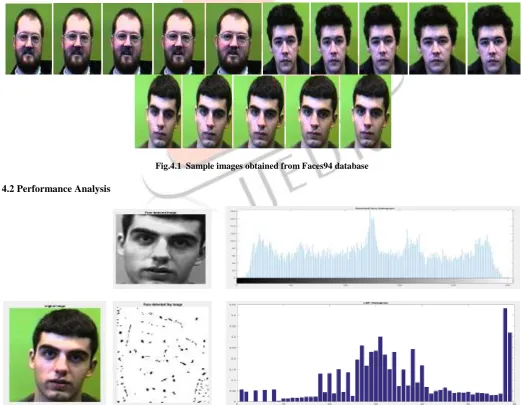
In this paper, Faces94 Database of faces was used and comprises of set of face images taken at the lab during April 1992 to April 1994. There are twenty different images of 40 distinct subjects. The image size in this database is 92 x 112 pixels, with 256 grey levels per pixel. One for each subject, the images are organized in 40 directories. There are twenty different images of that subject, which are named as Y.jpg, where Y is the image number for that subject. For each person, 20 images were taken. 15 images used for training and 5 images were used for testing. The recognition rate for various techniques is evaluated.
Fig.4.1 Sample images obtained from Faces94 database
4.2 Performance Analysis
IJEDR1704045
International Journal of Engineering Development and Research (
www.ijedr.org
)
302
Fig.4.2 shows the histogram of detected face and the texture of facial region and corresponding local binary pattern.After features extraction using LBP, the input test image will be checked with set of train images, if test image doesn’t match with first train image then it checks for second train image and the process continues for all train images until match is found.The recognition rate achieved for different type of features and classifiers is tabulated in Table 1.Table I. COMPARISON PERFORMANCE OF DIFFERENT TECHNIQUES USED FOR FACE RECOGNITION
From the results in Table I, our proposed approach presents very good results with faces94 database which indicates that this approach has an important effectiveness against to the variations in different factors like partial occlusion and illuminations variation.
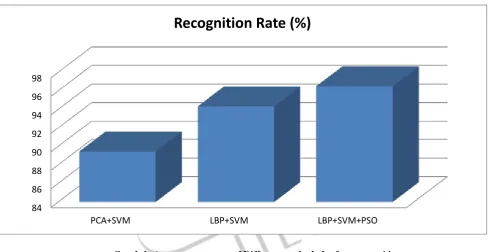
Graph 1: Accuracy measure of Different methods for face recognition
From the Graph 1, it is observed that LBP+SVM+PSO algorithmic chain for face recognition attains maximum recognition rate as compared to other methods. The recognition accuracy rate of all these methods are 89.44%, 94.33% and 96.54% respectively. The optimization of SVM by PSO method had a great effect of recognition accuracy rate.
V. CONCLUSION
In this paper, features were optimized by employing PSO algorithm optimization results in improved 96.54% classification accuracy rate using Faces94 database. The proposed method is based on SVM classification. The most important property of the LBP operator in real-world applications is its tolerance against illumination changes. As shown in the comparison with other techniques, the experimental results show that the optimized face recognition using PSO gives better accuracy than existing technique. We also plan to conduct further experiments on different databases with more subjects. The research will be focused to develop the computational model for face recognition that will be fast, simple and accurate in different environment.
REFERENCES
[1] Deepshikha Bhati, Vandana Gupta, “ Survey- A Comparative Analysis of Face Recognition Technique”, International Journal of Engineering Research and General Science, Vol. 3, No. 2, pp. 597-609, Mar 2015.
[2] Seema Rani, R. C. Gangwar, “ On The Design Optimization for Enhanced Face Recognition”, International Journal of Innovative Research in Computer and Communication Engineering, Vol. 4, No. 4, pp. 7677- 7683, April 2016.
84 86 88 90 92 94 96 98
PCA+SVM LBP+SVM LBP+SVM+PSO
Recognition Rate (%)
Techniques used Recognition RatePCA features -SVM 89.44% LBP features- SVM 94.33%
IJEDR1704045
International Journal of Engineering Development and Research (
www.ijedr.org
)
303
[3] A. S. Tolba, A. H. El-Baz, and A. A. El-Harby, “ Face Recognition: A Literature Review”, International Journal ofComputer, Electrical, Automation, Control and Information Engineering, Vol. 2, No. 7, pp. 2556-2571, 2008.
[4] M. Hassaballah, Saleh Aly, “ Face Recognition: Challenges, Achievements and Future Directions”, IET Journals of Computer Vision, Vol.9, No.4, pp. 614-626, 2015.
[5] Bhumika Pathya, Sumita Nainan, “ Performance Evaluation of Face Recognition using LBP, PCA and SVM”, International Journal of Computer Science and Engineering, Vol. 3, No. 4, pp. 85-88, April 2016.
[6] M.S.R.S. Prasad, S.S. Panda, G. Deepthi, and V. Anisha, “ Face Recognition using PCA and Feed Forward Neural Networks”, International Journal of Computer Science and Telecommunications, Vol. 2, No. 8, pp. 79-82, Nov. 2011. [7] T. Ojala, M. Pietikainen, and T. Maenpaa, “ Multiresolution Gray-scale and Rotation Invariant Texture Classification with
Local Binary Patterns”, IEEE Transactions on Pattern Analysis and Machine Intelligence, Vol. 24, No. 7, pp. 971-987, Jul. 2002.
[8] Di Huang, Caifeng Shan, Mohsen Ardabilian, Yunhong Wang, and Liming Chen, “ Local Binary Patterns and its Application to Facial Image Analysis: A Survey”, IEEE Transactions on Systems, Man and Cybernetics, Vol. 41, No. 6, pp. 765-781, Nov. 2011.
[9] Md. A. Rahim, Md. N. Hussain, T. Wahid, and Md. S. Azam, “ Face Recognition using Local Binary Pattern (LBP)”, Global Journal of Computer Science and Technology, Vol. 13, No. 4, pp. 1-7, 2013.
[10]D. Haritha, K.S. Rao and C. Satyanarayana, “ Performance Evaluation on the effect of Combining DCT and LBP on Face Recognition System”, I.J. Modern Education and Computer Science, Vol. 11, pp. 21-32, Dec. 2012.
[11]O. Rama Devi, L.S.S.Reddy, E.V.Prasad, “ Face Recognition Using Fused Spatial Patterns”, International Journal of Advanced Trends in Computer Science and Engineering, Vol. 4, No. 2, pp. 15-21, Mar 2015.
[12]M Hakeem Selamat, Helmi Md Rais, “ Enhancement on Image Face Recognition Using Hybrid Multiclass SVM “, International Conference on Computer and Information Sciences, pp. 424-429, Mar 2016.
[13]J. Kennedy and R. C. Eberhart, “ A Discrete Binary Version of the Particle Swarm Algorithm”, Proc. IEEE International Conference on Systems, Man and Cybernetics, Vol. 5, pp. 4104-4108, Oct. 1997.
[14]Jin Wei, Zhang Jian-qi, and Zhang Xiang, “Face Recognition Method based on Support Vector Machine and Particle Swarm Optimization”, ELSEVIER Expert Systems with Applications, Vol. 38, pp. 4390-4393, 2011.
[15]Rabab M. Ramadan and Rehab F. Abdel- Kader, “ Face Recognition Using Particle Swarm Optimization-Based Selected Features”, International Journal of Signal Processing, Image Processing and Pattern Recognition, Vol. 2, No. 2, pp. 51-65, June 2009.
[16]Ming-Yuan Shieh, Juing-Shian Chiou, Yu-Chia Hu, and Kuo-Yang Wang, “ Applications of PCA and SVM-PSO Based Real-Time Face Recognition System”, Research Article on Mathematical Problems in Engineering, pp. 1-12, May 2014.
Miss Nisha : Miss Nisha is currently working as a Assistant Professor in the Sri Sukhmani Institute of Technology and Engineering, Derabassi , India since 2014. She is currently pursuing M.E National Institute of Technical Teachers Training and Research, Chandigarh, India. She has completed her B.Tech from Sri Sukhmani Institute of Technology and Engineering, Derabassi. She is having 3.5 years of teaching experience.
Maitreyee Dutta is working as a Professor in the Computer Science and Engineering Department at
NITTTR, Chandigarh, India. She has a Ph.D. (Engineering and Technology) with specialization in Image
Processing and M.E. in Electronics Communication and Engineering from Panjab University, Chandigarh
and a B.E. in Electronics Communication and Engineering Guwahati University, India. She has over
seventeen years of teaching experience. Her research interests include digital signal processing, advanced
computer architecture, data warehousing and mining, image processing. She has more than 90 research
publications in reputed journals and conferences. She is currently supervisingeight Ph.D. candidates in the
area of Image Processing, Data Mining and Cloud computing. Three students have awarded Ph.D. degree under her guidance.
One student recently submitted Ph.D. thesis. More than70 Master’s theses have been completed so far under her supervision.She
completed one sponsored research project “Establishment of Cyber Security Lab” funded by Ministry of IT, GOI, New Delhi
![Fig. 2 Example of basic LBP Operator [8]](https://thumb-us.123doks.com/thumbv2/123dok_us/8206245.1370884/3.595.40.558.584.697/fig-example-basic-lbp-operator.webp)