English Perception Verbs
Nikolas Simon Gisborne
Thesis submitted for the PhD degree
University College London
All rights reserved
INFORMATION TO ALL USERS
The quality of this reproduction is dependent upon the quality of the copy submitted.
In the unlikely event that the author did not send a complete manuscript and there are missing pages, these will be noted. Also, if material had to be removed,
a note will indicate the deletion.
uest.
ProQuest 10045496
Published by ProQuest LLC(2016). Copyright of the Dissertation is held by the Author.
All rights reserved.
This work is protected against unauthorized copying under Title 17, United States Code. Microform Edition © ProQuest LLC.
ProQuest LLC
789 East Eisenhower Parkway P.O. Box 1346
This thesis is an investigation into the syntax and semantics of English verbs of
sensory perception. There are six chapters including the introduction and the
conclusion. In the first chapter, I outline the classes of verbs that are investigated:
they are described by the verb for the auditory sensory modality, so there are
LISTEN-class, HEAR-class and SOUND-class verbs. Each class o f verbs includes a
verb o f vision, hearing, feeling, smelling and tasting. I outline the reasons for
including some verbs in the study and excluding others. I also discuss models of
semantic structure and linking between syntax and semantics that have been proposed
before. The final section o f this chapter outlines the theoretical model used in this
thesis.
In Chapter 2 , 1 describe the syntax of the various constructions that the
selected verbs may occur in on a class-by-class basis. In Chapter 3 , 1 describe the
semantics of HEAR-class verbs. The majority of the chapter is taken up with a
consideration o f the semantics o f SEE; the analysis of SEE provides a basis for the
study of the remaining verbs of the class. In Chapter 4 , 1 describe the semantics of
LISTEN-class verbs, drawing out the differences and similarities between those verbs
which select for an object, and LISTEN, which is complemented by a prepositional
phrase, and LOOK, which does not have a complement. In Chapter 5 ,1 describe the
semantics of SOUND-class verbs. In this chapter, I describe the differences between
three semantic classes o f SOUND-class verbs, looking at their interaction with
restrictions on the complementation of the verbs.
Chapter 6 is the conclusion. I draw some general conclusions about the nature
o f semantic structure and I discuss some of the verb-particular observations that my
Most o f all, I would like to thank Dick Hudson, who supervised me. And Rosta, and,
in particular, Caroline Lewis.
I owe a debt of gratitude to Sylvia Adamson, Gill Brown, Bill Croft, David
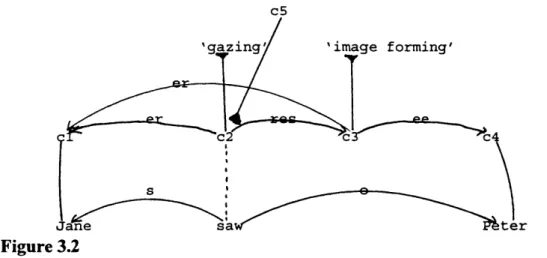
21 Example (15a). This is probably a metaphorical use of SEE rather than an example of SEE with just ‘gazing’ as part of its meaning as I claim in the text. Some people do not find examples that purport to show SEE meaning only that the perceiver’s gaze has reached the percept convincing. It should be noted that the argument is essentially one for the decomposition of the sense of SEE. If you agree that the sense of SEE can be decomposed into an element of where the perceiver’s gaze meets the percept and another element where the perceiver forms a mental image of the percept, then whether or not you find such examples convincing is immaterial: the examples are only invoked to support the case that the sense of SEE can be decomposed.
63 The pied-piping criterion for adjuncthood is simply wrong. This obviates the case made from the examples in (15). First, the examples in (15a-b) are actually fine: empty complement prepositions can be pied-piped. Second, some semantically full prepositions are, by the other criteria, complements.
124 when the sense o f SEE is an instance o f gazing —at this point in the text, the sense of SEE has been decomposed into a ‘gazing’ element and an ‘image- forming’ element. The claim is that when the sense of SEE involves gazing, it constitutes an example of gazing and so aspects of its meaning draw upon the properties inherent to gazing, such as the aktionsart of gazing. The sense of SEE belongs in a category of gazing, so that the properties of the sense of SEE are the same as the properties of gazing. Essentially, the claim is that the properties of a word’s meaning are subject to default inheritance (discussed on pp 51-52) in much the same way as a word inherits various properties such as its form from its lexeme.
144-145 The FROM examples. The examples with FROM are intended to display the secondary theme, or perceptual trace of the sense of SEE. However, the examples in (24) and (25) are perhaps not as convincing as they might be. The following are better examples, one for SEE, and one for HEAR.
[i] Every day, I go down to the pier for one last look at the sea, and an inhalation of ozone. It’s always very comforting to see the lightship winking away on my left. It reminds me of how many lives must have been saved just through its being there. But yesterday, something was very wrong. I stood in my normal place on the pier, and looked out to sea, but I couldn’t see the lightship in its usual place. Instead, I could see it from my right, winking away as usual, but on the wrong side of the sound.
[ii] The man at number 25 is very odd. Every day as I walk past I hear him doing his Mario Lanza impression. I usually hear him singing from the
bathroom: he evidently likes the echo. This morning though, I heard him from the coalhole. He must have lost his keys, or found a better echo chamber.
261 The earliest instances —a caveat is in order. There is insufficient data explored here and later (p 287) to substantiate this claim. On further examination, the Fourteenth Century examples look much less certainly attributary at all times. First, some Fourteenth Century examples look as though they are cases where the perceiver has directed their sight in a certain manner, as in [he]...loked grym as he were wood, an example where the statue of Mars looks on in a grim way. Second, some early examples could be evidential rather than attributary.
283 The evidential-2 sense is, arguable, the most subjective o f the three possible senses. The reason for making this assertion is that the only participants in the situation denoted by a verb with an evidential-2 sense are the proposition and the speaker. The evidential-1 sense, on the other hand, makes the subject a participant in the situation denoted by the verb and so it is less focused on the speaker’s interpretation. However, this is not to deny that evidential-1 senses may also be subjective, and that such fine-grained judgments are subject to other factors such as what the context offers.
284-285 Example (57). This has an evidential sense rather than an attributary one. My claim that it is attributary is wrong.
286 The discussion of (55) [p 283-284] is organised back to front. It is looked holwe that provides the evidence for an attributary analysis, not looked sobrely.
1 Introduction 8
1.1 Motivations and data 8
1.2 Semantic issues 12
1.2.1 Related perception verbs 12
1.2.2 Polysemy 17
1.2.3 The polysemy of SEE 19
1.2.4 Semantic relations 24
1.2.5 Semantic information in the grammar 27
1.2.6 The identification of semantic relations 30
1.2.7 Localism and force-dynamics 38
1.2.8 The status o f the semantic role called experiencer 43
1.2.9 Do we need (Predicate) Argument Structure? 47
1.3 The theoretical model 50
1.3.1 Syntax and complementation 50
1.3.2 Semantics 51
2 Complementation and Syntax 56
2.1 Introduction 56
2.2 LISTEN-class verbs 56
2.2.1 LOOK/A 57
2.2.2 The relation between LOOK/A & AT and LISTEN & TO 60
2.2.2.1 The argument criterion 61
2.2.2.2 The obligatoriness criterion 63
2.2.2.3 The form criterion 65
2.2.2.4 The iterability criterion 66
2.2.2.5 The inversion criterion 67
2.2.2.6 The anaphoric DO criterion 68
2.2.3 The relation between LOOK/A and other adjuncts 69
2.2.4 LOOK/A and AT revisited 72
2.2.6 The complementation of FEEL/A, SMELL/A and TASTE/A 75
2.3 The complementation of HEAR-class verbs 76
2.3.1 Direct objects and clausal complements 77
2.3.2 SEE 80
2.3.2.1 Syntactic patterns and the valency of SEE 84
2.3.2.2 The subject of xcomps 85
2.3.2.3 Control versus raising 86
2.3.2.4 Diathetic SEE 89
2.3.3 HEAR, FEEL/E, SMELL/E, and TASTE/E 94
2.3.3.1 Syntactic ambiguities 96
2.3.4 Conclusions 97
2.3.5 Passivisation facts 98
2.4 The complementation of SOUND-class verbs 100
2.4.1 LOOK/P 101
2.4.1.1 Non-verbal xcomps 101
2.4.1.2 TO xcomps 102
2.4.1.3 Complementation by LIKE and AS THOUGH 104
2.4.1.4 Complementation by THAT 105
2.4.1.5 How may arguments does LOOK/P have? 106
2.4.2 SOUND 109
2.4.3 FEEL/P 110
2.4.4 SMELL/P 111
2.4.5 TASTE/P 112
2.4.6 Issues in the complementation of SOUND-class verbs 113
3 The semantics of HEAR-class verbs 114
3.1 Introduction 114
3.1.1 An introductory sketch of SEE 115
3.2 The senses of SEE 119
3.2.1 ‘s e e l’ 121
3.2.3 Propositions and situations 131
3.2.4 Propositions, and presupposition and assertion 134
3.2.5 Perception and the truth of the percept 135
3.2.6 Complement types and propositional referents 136
3.2.7 Conclusions 137
3.3 Wider issues in the semantics of seeing 137
3.3.1 Figures 3.1 and 3.2 137
3.3.2 The thematics of SEE 139
3.3.2.1 The themes o f ‘se el’ 141
3.3.2.2 The representation of the themes of ‘seel’ 146
3.3.3 The force-dynamics of ‘ see 1’ 150
3.3.3.1 A force-dynamic characterisation 151
3.3.3.2 Croft’s view 153
3.3.3.3. Langacker’s perspective 156
3.3.4 Some theoretical considerations for WG 157
3.4 The temporal duration of ‘ see 1’ 165
3.4.1 Need the referent of the xcomp of SEE be dynamic? 166
3.4.2 The semantics of -ing participles and bare infinitives 170
3.4.3 Simultaneity 174
3.5 The aktionsart of SEE 177
3.5.1 The V endler/Dowty typology 178
3.5.1.1 Duration tests 182
3.5.1.2 Telicity tests 183
3.5.1.3 Homogeneity 186
3.5.1.4 Dynamicity 187
3.5.2 Aspectual conclusions 189
3.6 SEE and CAN 190
3.7 Other HEAR-class perception verbs 190
3.7.1 HEAR 191
3.7.2 FEEL/E 192
3.7.4 TASTE/E 193
4 The semantics of LISTEN-class verbs 195
4.1 Introduction 195
4.2 What the sense of a LISTEN-class verb isa 196
4.2.1 Arguments for an actional and agentive sense o f LOOK/A 199
4.3 Semantic relations and situation types 200
4.3.1 Unpacking the er prototype 203
4.3.2 Discourse patients and undergoer subjects 206
4.3.3 The force-dynamics of LOOK/A and LISTEN 208
4.3.4 The force-dynamics of FEEL/A, SMELL/A and TASTE/A 208
4.3.5 Defining Participants and the seh*4ic role o f the object 211
4.4 Pinker, Jackendoff, Croft, Talmy, and Dowty 214
4.4.1 Pinker 214
4.4.2 Jackendoff 215
4.4.3 Croft and Talmy 216
4.4.4 Dowty 217
4.5 LOOK/A and AT 221
4.6 LISTEN and TO 225
5 The semantics of SOUND-class verbs 227
5.1 Introduction 227
5.2 The semantic entries for SOUND 234
5.2.1 Evidential SOUND-class verbs 237
5.2.2 Gradability as evidence for epistemic modality 242
5.2.3 The TO-phrase data 246
5.2.3.1 Subjectivity 251
5.2.4 The force-dynamics of SOUND-class verbs and aktionsarts 252
5.2.5 The relationship of ‘sounding’ to ‘hearing’ 255
5.2.6 Attributary SOUND-class verbs 257
5.3 Use and complementation 263
5.3.1 Nominal xcomps of SOUND-class verbs 264
5.3.2 SGUND-classverbs and adjective xcomps 265
5.3.3 SOUND-class verbs with LIKE/preposition and OF 267
5.3.4 SOUND-class verbs and LIKE, AS THOUGH, and AS IF 270
5.3.5 The syntax o f LIKE/clausal 271
5.3.6 The semantics of hypothetical LIKE/clausal 281
5.4 The history of SOUND-class verbs 283
5.4.1 The classification of the predicative complement 283
5.4.2 Development of the senses 287
5.4.3 Changes in contemporary English 287
5.4.4 Conclusions 291
6 Conclusions 292
6.1 Semantic consequences 292
6.1.1 Relationships between the senses 292
6.1.2 The nature o f semantic relations 294
6.2 Relations between syntax and semantics 295
Bibliography 298
Tables
Introduction
1.1 Motivations and data
In this thesis I explore the semantics of the perception verbs in Table 1 below. The
table is divided into three classes o f verbs which are grouped according to the
semantic role of the subject.
Table 1 Agentive verbs
LOOK (AT) LISTEN FEEL SMELL TASTE
Experiencer Verbs
SEE HEAR FEEL SMELL TASTE
Percept Verbs
LOOK SOUND FEEL SMELL TASTE
The classification according to the semantic role o f the subject is indicated in
the columns of Table 1. The verbs in the first column all have agent subjects, those in
the second column all have experiencer subjects, and those in the third column all
have subjects which are the stimulus of perception, or the percept. We can distinguish
between the agent subject verbs and the experiencer subject verbs according to
whether they can collocate with DELIBERATELY^ or not. The ability to occur with
this adverb is sometimes used as a test of agentivity, and I shall use it here as an initial
diagnostic.^ The use of DELIBERATELY is not relevant for identifying verbs with
percept subjects because they may, or may not, occur with DELIBERATELY
depending on whether the subject is animate, and depending on whether the situation
is one over which the percept might have any control.
’ The representational conventions are that capitals represent lexemes; italics represent words in utterances or texts; and single quotation marks represent concepts or meanings.
(1) a. Jane was deliberately listening to the music
b. !Jane deliberately heard the music/ ! Jane was hearing the music
c. Jane (deliberately) sounded bored
In (la), I have also shown was...listening in the present progressive because the ability
to occur with progressive aspect is often taken as a criterion for a verb’s having an
agentive subject; the fact that HEAR is peculiar with both the adverb and with the
progressive aspect suggests very strongly that its subject is not agentive. The rows of
the table are indicative o f the sensory modality o f perception.
For perspicuity, the verbs will be identified by a front slash and the initial
letter o f the semantic relation of their subject: I shall want to make a distinction
between FEEL/A and FEEL/P, for example. The classes o f verbs will be referred to
according to the auditory modality, as LISTEN-class, HEAR-class, or SOUND-class
verbs. Therefore, FEEL/A means “LISTEN-class FEEL”. The sensory modalities
that I shall refer to are seeing, hearing, feeling, smelling and tasting.
There are two main relevant questions. First, how are the different words
within the sensory modalities related? I take it that there is a common thread o f
meaning between all of the words along any of the rows in Table 1. It is one o f my
concerns to find out what semantic factors are constant for each sensory modality.
Secondly, what are the semantic criteria according to which the columns are formed?
If they are a reflection o f some aspect of semantic organisation, what is it? How
important is it?
These questions are intimately bound up with the issue of how we write our
semantic descriptions. How much information is it appropriate to include in the
semantics? A minimum semantic description might be as much as is necessary to be
able to come up with a correspondence between syntax and semantics; such a
minimum might, however, be far too little to demonstrate the relation between the
lexemes. A maximum semantic description could include all of conceptual structure.
I assume, therefore, that the amount of information that we have to include in our
semantic entries is sufficient to show the relations between the words in Table 1, and
These lines of enquiry are related to other important questions in lexical
semantics. At least one such issue is whether syntax is predictable from semantics or
not. This question has been addressed in works like Chomsky (1981), Fillmore
(1968), Grimshaw (1990), Levin and Rappaport (1988), Levin and Rappaport Hovav
(1991), Jackendoff (1983, 1990, 1993), Pinker (1989), and Rappaport and Levin
(1988), to name but a few. The issue is important, because it is concerned with the
extent to which syntactic subcategorisation has to be listed in the lexical entry for a
word and to what extent syntactic subcategorisation is actually predictable from the
semantic entry for a word. It is relevant here, because as well as the semantic
differences which are evident in the three classes of verbs in Table 1, there are
differences of complementation pattern which we can observe, too. Some examples
are presented in (2).
(2) a. Peter looked at the picture/*that the picture was interesting/*nice
b. Peter saw that the picture was interesting/(*at) the picture/*nice
c. the picture looked nice/*at the picture/*that it was interesting
While the LISTEN-class verbs can only have a noun as their complement, or perhaps
a prepositional complement, the HEAR-class verbs can have a clausal complement of
some kind, and the SOUND-class verbs have a predicative complement. Why? This
fact is, presumably, related to the different semantics of the classes, but how, exactly?
There is a further factor. None of these questions can be theoretically naive,
because different theories will make different predictions about the nature of semantic
representation, about the relation between syntax and semantics, and about the
possibilities of indicating relatedness between lexemes. This thesis is an exercise in
semantic description within the theory of Word Grammar (henceforth WG), as
outlined in Hudson (1984, 1990, 1992, 1995b). The description that is provided in
these pages will examine the verbs in their possible complementation patterns. The
complementation patterns themselves may reveal systematic regularities that are best
explained in terms of the semantics of the words concerned, as Levin (1993) suggests.
where the significance o f complementation has been amply demonstrated. Telicity is
a property that is related to the countability of the objects of verbs like DRINK for
example (Dowty, 1979; Mourelatos, 1978; Brinton, 1988).
My ambition in this thesis is constrained to providing a description of the
semantics of the words listed in Table 1, in relation to a discussion of their
complementation. I do not expect to establish whether syntax is predictable from
semantics or not, neither do I anticipate making any major theoretical advances.
1.2 Semantic issues
1.2.1 Related perception words
It is not necessarily obvious that the words in Table 1 form a separate class of their
own, and that other words should be excluded from this study. In this subsection, I
consider a range of other candidates, WATCH, PERCEIVE, OBSERVE, NOTICE,
GLIMPSE, and SPOT.
Rogers (1973) does not include LOOK/A as the word for the visual modality
in his column for LISTEN-class verbs; rather, he argues that WATCH is the
appropriate lexeme. I think that it is clear that LOOK/A is more appropriate than
WATCH. Rogers’ judgement was motivated by his desire to establish a
transformational account for the relation between LISTEN-class and SOUND-class
verbs because he thought that there was a certain resemblance to Psych-movement, as
outlined in Postal (1971).^ My theoretical model makes different requirements o f me.
I shall not proceed on the basis that these classes of verbs are transformationally
related to each other. Furthermore, I am looking for systematic aspects of meaning
that the verbs in Table 1 have in common. The meaning of WATCH entails that of
LOOK/A, but not vice versa. ‘Watching’ is a special kind of ‘looking’, as are
‘squinting’ and ‘gazing’/ It is as inappropriate to claim that WATCH is the relevant
lexeme at this point as it would be to claim that SQUINT or GAZE was.
In addition, the meaning of WATCH includes the notion that the thing which
is being watched is expected to change. Typically, a watched object is animate and it
is being watched to observe some aspect of its behaviour. If it is not animate, it must
still have the potential for change. I take it that we watch precious objects, because
they are at risk of theft, and we wish to prevent their undergoing a change o f
ownership. In the case o f the other words in the LISTEN-class, it is not expected that
the percept will change: you may listen to a single note at a constant volume
indefinitely; you may feel an unchanging mole on your upper lip indefinitely, too; the
potential for change is not required of the percepts of any of the LISTEN-class verbs.
It may be argued that WATCH is relevant to my concerns, although not as
centrally as the verbs in Table 1. I agree. If I am able to establish a convincing
account for the semantic relatedness of the verbs in Table 1 ,1 expect that it will
extend to include WATCH as well or, at the very least, that it should be possible to
sketch the lineaments of how WATCH might be related to the verbs in Table 1,
precisely because ‘looking’ will be part of the definition of WATCH and other similar
words.
Other potential verbs for inclusion, such as PERCEIVE, OBSERVE,
NOTICE, GLIMPSE, and SPOT, are discounted for different reasons. In terms o f the
semantic role of their subject, they belong in the HEAR-class. We can test for this by
showing that it is not possible to have the adverb DELIBERATELY modifying the
verb. As it is not, it follows that it is necessary to find out what other aspects o f their
semantics these verbs have in common with HEAR-class verbs.
(3) a. ! Peter deliberately perceived the situation
b. ! Jane deliberately observed the cat in the garden^
The convention is that ‘watching’ is the sense of WATCH.
c. ! Peter deliberately noticed the boys’ bad behaviour
d. ! Jane deliberately glimpsed the enemy flag
e. ! Peter deliberately spotted them crossing the road
The examples in (3) show that these verbs are all examples of involuntary perception.
If they belong with any of the classes in Table 1, then it is with the HEAR-class.
There is good evidence, however, to suggest that these verbs are not central to the
enquiry here, and that like WATCH, an account o f their properties will in fact rest on
the description o f the verbs in Table 1 being in place first.
The first reason why they are not central to my enquiry is that, apart from
GLIMPSE, they are all neutral in terms of their sensory modality as the examples in
(4) show.
(4) a. Jane perceived the garlicky odour/salty flavour/gritty texture of the soup
b. Jane observed the garlicky odour/salty flavour/gritty texture of the soup
c. Peter noticed the garlicky odour/salty flavour/gritty texture of the soup
d. Jane spotted the garlicky odour/salty flavour/gritty texture of the soup
GLIMPSE belongs in the realm of visual perception.
(5) a. Peter glimpsed “The Scream” as the thieves were running off with it
b. * Jane glimpsed the smell of garlic as she ate the soup
A modality neutral verb of perception is presumably further away from the “basic
level category” (in Lakoff s 1987 terms) of what constitutes perception than a verb
that actually specifies the perceptual channel. The second reason is that these verbs
also have a more clearly defined temporal element than the HEAR-class verbs of
Table 1. NOTICE, GLIMPSE and SPOT are all punctual; OBSERVE and
with OBSERVE in examples like (i) Peter is deliberately observing Jane’s first lesson
PERCEIVE are durative. As these five verbs can all apply to vision, and as
GLIMPSE only has a visual meaning, we can compare them with SEE. SEE may be
punctual or durative, depending on the semantics of its complement.
(6) a. Jane saw Peter cross the road
b. Peter saw Jane crossing the road
In (6a) saw is punctual. In (6b) it is durative. SEE does not specify its temporal
semantics itself, its complement does.
(7) a. * Jane perceived/observed/noticed/glimpsed/spotted Peter cross the road
b. Jane perceived/observed/noticed/glimpsed/spotted Peter crossing the road
In (7a) the main verbs under question are quite incapable of occurring with a bare
infinitive complement. In (7b), they can all occur with an -ing participle complement,
but the temporal semantics are not specified by the nature of the complement. The
complement is durative in all cases in (7b), but each o f the main verbs in (7) specifies
its own temporal semantics. Only perceived and observed are durative, the others are
all punctual. This fact is peculiar: why do the punctual verbs not occur with cross'?
As far as complement selection for PERCEIVE, OBSERVE, NOTICE, GLIMPSE
and SPOT is concerned, the punctual/durative dimension is not relevant to
complement selection. What is clear is how different from HEAR-class verbs all of
these verbs are as far as their complement selection is concerned. I return to the issue
o f complement selection and the duration of HEAR-class verbs in Chapter 3.
In these two respects, therefore, these verbs are different from HEAR-class
verbs. In addition, they cannot take the remaining wide range of complements that
HEAR-class verbs are able to. It is possible to have examples like / heard it raining
but not ! I perceived it raining. These verbs also differ from HEAR-class verbs in
their ability to occur in the simple present, or the present progressive. HEAR-class
verbs are oddly uncomfortable in both the simple present and the present progressive,
(8) a. !Jane sees Peter
b. !Jane is seeing Peter^
c. Jane can see Peter
These facts are not exactly the same for OBSERVE et al. NOTICE cannot depend on
CAN at all, and all of the other words collocate with CAN more happily when there is
a place adverbial like from here in the following examples. No place adverbial is
necessary with HEAR-class verbs.
(9) a. Jane can observe Peter !(from here)
b. Jane can perceive Peter !(from here)
c. ! Jane can notice Peter !(from here)
d. Jane can glimpse Peter !(from here)
e. Jane can spot Peter !(ffom here)
Perhaps more tellingly, the behaviour of OBSERVE, PERCEIVE, NOTICE,
GLIMPSE, and SPOT is exactly as we should predict from their temporal semantics.
(10) a. Peter is observing the animals/ observes the animals
b. Peter
c. Peter
d. Peter
is perceiving/ perceives the animals
is noticing/ notices the animals
is glimpsing/ glimpses the animals
e. Peter !is spotting/ spots the animals
OBSERVE is fine in the present progressive. In the simple present, the best
interpretation is a habitual one.^ This fact alone makes it potentially very different
from the verbs of the HEAR-class. PERCEIVE is fine in the simple present, and this
^ This example is to be read as an example of physical perception, and not in the sense that Jane is dating Peter.
also makes it very different from the HEAR-class verbs. It is stative. The remaining
three verbs are all punctual, and they are not iterable, so they cannot occur in the
progressive. They can occur in the simple present.
All of these facts indicate that PERCEIVE, OBSERVE, NOTICE, GLIMPSE
and SPOT are not central to the concerns of the thesis. This discussion raises another
point. Rogers (1973), claims that there are four classes of perception verb, because
the HEAR-class divides into punctual and durative verbs. His argument rests on the
observation that SEE may be either stative or punctual depending on the nature o f its
complement. As we have shown here, there is no systematic way in which HEAR-
class verbs belong in one group with NOTICE if they are complemented by a bare
infinitive clause, and belong in smother with PERCEIVE if they are complemented by
a clause headed by an -ing participle. HEAR-class verbs have a very different
complementation from other verbs and, more importantly, their aktionsart is
determined by the aktionsart of their complement, whereas the verbs discussed here
have a fixed aktionsart.
There are other verbs that it may be appropriate to discuss such as SEEM,
which has syntactic and semantic facts in common with SOUND-class verbs and
HEARKEN (TO), HARK (AT), GAZE (AT) and STARE (AT) which have relevance
to the discussion of LISTEN-class verbs. SEEM is mentioned in Chapter 5 and the
other verbs, in passing, in Chapter 4.
1.2.2 Polysemy
The verbs under discussion do not only have the experience o f physical perception as
their meanings. We could include the question of what it is that links ‘understanding’
to (physical) visual perception in I see what you mean, or why look after has a
particular idiosyncratic meaning.
The polysemy of perception verbs is discussed in, for example. Cooper
(1974b), and Lehrer (1990). Landau and Gleitman (1985) discuss the meaning of
SEE for a blind child. Sweetser (1990) provides an excellent discussion o f the
multiple senses of verbs o f perception, especially the extended senses of SEE and
other hand, I shall need to discuss certain non-physical senses of verbs of perception.
For example, when SEE is complemented by a THAT-clause, it may be interpreted as
an example of physical perception; alternatively it may be a sense of SEE where the
THAT-clause is a reporting clause, and if the sense of SEE has any vestige of physical
perception about it, then it is merely as an indication of the means by which the
information came to hand.
(11) a. I see that Jane has been elected president
b. I see that Peter is crossing the road
(1 la) is a sentence which could felicitously be used in a context such as reading the
paper, where the information was gathered visually. (11b) may possibly be used of a
context where the speaker can observe the road and the activity on the road. It may be
a possible answer to a question such as what do you see? However, I find such an
interpretation of (1 lb) a little implausible, and would suggest that t f is ^ 5^6"
to Lt complemented by a THAT-clause when it has direct physical perception as its
sense. It is more likely when the physical perception is mediated, and if I were a
security guard observing the action on a given street through security cameras, then I
should be far more inclined to utter ( l i b) than if I were a speaker v/ith an
unobstructed or unmediated view of the road. It is in examples like those in (11) that
the meaning of SEE comes close to that of ‘understanding’; and so I have to stray a
little way from direct physical perception in the course of the discussion.
A further example where I shall not be able to constrain myself exactly to
direct physical perception is in my discussion of SOUND-class verbs. These verbs
have a meaning that is complicated, and which goes far beyond simple physical
perception as we can see in (12).
(12) a. The cake looks pink (!but it isn’t)
There is a difference in the meanings of the examples in (12) which is brought out by
the material in brackets. (12a) is concerned with visual evidence and it is odd to
suggest that an attribute o f the cake, which is information gathered visually, should
turn out not to be the case. (12b) is concerned with a mental evaluation or belief of
the evidence. In this case, it is more straightforward to override the assessment with
the material in brackets. In both cases, we have moved away from direct physical
perception as the central element in the verb’s meaning.
I think that an appropriate course of action at this point is to provide an
account o f the polysemy o f SEE. This is for two reasons: the first is that in the
subsequent discussion it should be possible to isolate exactly which sense o f this verb
is under discussion; the second is that it is necessary to recognise that the possible
implications o f work in lexical semantics extend far beyond the primary concerns of
this thesis. I discuss SEE, rather than any of the other verbs in Table 1, because it
displays a high degree of polysemy that moves a long way from haptic perception.
SEE has meanings that are associated with thought, understanding, and cognition.
The following discussion is quite short, and is merely intended to be suggestive.
1.2.3 The polysemy of SEE
The following discussion concentrates on the way in which different senses of SEE
are related to each other. I shall give some indications of the range of senses that are
available, and I shall give examples, most of which come from the Oxford English
Dictionary (henceforth CED), although I have modified some of them slightly. The
discussion is not exhaustive, but is intended to be suggestive of how we might
consider relations between the senses of words.
The senses of SEE that I shall discuss are the ability to see, mental
comprehension, active perception, and personal knowledge or experience.
• Physical perception through the modality of vision.
(13) a. I saw you through the area railings
c. they have just seen the little party crossing the summit
In the sense of physical perception, as in the examples in (13), there is typically a
perceiver, the subject, a percept, the object, and optionally the object o f SEE may be
the subject of a participle, or an infinitive. As far as physical perception is concerned,
it does not matter whether the percept is simply observed, or whether it is observed
participating in a particular situation; the verb SEE has the same sense in either case.
Does physical perception have a prototype?
We could look at the case o f CLIMB, as discussed by Fillmore (1982),
Hudson (1990), Jackendoff (1990) and Taylor (1989) to see whether there are
comparisons that we can draw. Two aspects of the meaning of CLIMB have to be
borne in mind; either of them is a sufficient condition for CLIMB to be used. The
different senses of CLIMB appear in different contexts. The elements in the meaning
of CLIMB are ‘clamber’, and ‘ascend’. Thus, the plane climbed to 20000feet is a
legitimate use of CLIMB. Also, the cat climbed down the tree is an appropriate use of
CLIMB: the cat is clambering even though it is not ascending. The protoypical use of
CLIMB is the one where it means both ‘ascend’ and ‘clamber’ as in the cat climbed to
the top o f the tree.
Jackendoff (1990: 36) gives the following examples which suggest that the
prototype for the meaning of SEE is that (i) the perceiver’s gaze makes contact with
the percept, and that (ii) the perceiver has a visual experience o f the percept.
Jackendoff (1990: 290) states that this analysis of the sense of SEE, which is also
found in Jackendoff (1983), draws on Miller and Johnson-Laird (1976).
(14) a. Bill saw Harry
b. Bill saw a vision of dancing devils
c. Bill saw the sign, but he didn’t notice it at the time
d. *Bill saw a vision of dancing devils, but he didn’t notice it at the time
(14b) fits requirement (ii), (14c) fits requirement (i), and (14d) fits neither. (14a) is an
example o f prototypical vision, where both requirements are met. As in the case of
CLIMB, either requirement is a sufficient condition for the use of SEE, and neither is
necessary. We can find examples from the OED which meet condition (i), as in (15a),
or condition (ii) as in (15b):
(15) a. the satellite...can see more of the the earth...
b. he saw himself, in his mind’s eye, put meekly into a hackney coach
The majority of examples of SEE with this sense in the OED fit the prototype.
• Ability to see. Typically this occurs in collocation with CAN in modem English.
(16) a. it was a bad day to see
b. he was generally so drunk he could not see
c. Peter can see clearly with his new glasses
To see something entails that you are able to see it, in that the prototype for the sense
of SEE involves both a mental image and a gaze. I discuss this sense further in
Chapter 3. Notably, the sense ‘ability to see’ typically collocates with CAN. This is
quite unremarkable in that CAN is used in this same fashion with a large number o f
other verbs, but it is telling that SEE is often only marginally acceptable unless it
occurs with CAN. I argue that the reason why ‘ability to see’ is intimately bound up
with the sense of SEE is contingent on the direct embodiment of SEE. Being able to
see something entails seeing it; having your sight restricted through deficient eyesight,
or through bad weather, or through some other impediment to sight often results in not
being able to see something. Naturally, seeing is only possible if there is an ability to
see, and it is this fact that conditions the common occurrence with CAN.
• To comprehend mentally. This is a metaphorical extension of the physical sense of
relation between this, and related senses of SEE and the physical sense that Sweetser’s
(1990) discussion concentrates on. Examples are found in (17).
(17) a. it was easy to see the course which the government would take
b. I see that you are speaking your mind
c. everyone must see this to be highly absurd
In these cases, there are differences in meaning that we have to look at: (17a) means
‘predict’ and is related to the metaphorical use of course. In this case, the course is a
course of action, taken out of its localist sense, where it means a physical path, into a
sense where it refers to the direction that the government’s political decisions will
take. The whole sentence, then, works around a number of metaphors, in the sense of
Lakoff (1987) and Sweetser (1990). As with the other examples in (17), (17a) comes
in the category that Sweetser calls “intellection”. Here, seeing is related to
comprehension.
In the next sentence, there is no percept that can be seen, either mentally, in a
metaphorical sense, unlike (17a), or in a direct physical sense. This example is even
more clearly an example o f intellection; it means ‘understand’. Sweetser claims that
the metaphor by which seeing is analogous to understanding is due to seeing being
our primary source of data about the world. Furthermore, vision gives us data from a
distance, which enables us to isolate that data from our emotional faculties; in this
respect, vision is quite different from touch or feeling. THAT-clauses typically
introduce indirect percepts after SEE, and their content is not directly perceivable by
any means. Here, this fact is made manifest: there is no way that that you are
speaking your mind could refer to something that was visually perceived. I look
further at the relation between complementation and meaning in Chapter 2; for now it
is worth observing that THAT-clauses are typically associated with non-physical
perception.
(17c) shows that there is a relation between the complementation o f a verb and
its meaning; here the this to be highly absurd construction is semantically like the
means ‘understand’ or ‘recognise’ in this sentence, it is clearly related to both the
other senses in (17), but it is not so transparently metaphorical as is (17a) for example.
• Active perception. This sense of SEE means something like ‘go and see’, it is
quite closely related to LOOK/A.
(18) a. it was worth going miles to see
b. I saw the “Mona Lisa” when I went to the Louvre
In (18b), saw does not just fulfill the prototype for the sense o f SEE that was sketched
out in the discussion of the examples in (14). It does entail direct perception, but it
also indicates a further element of effort. This additional notion of effort is
particularly present in (18a), where the two elements are spelt out; in (18b), it is
present because the “Mona Lisa” is static, and cannot be seen without making a
particular effort to go and find her location. This sense extends into ‘meet’: it is
possible to say I saw my sister yesterday, meaning that I met my sister yesterday,
where saw is clearly related in sense to the instances of SEE in (18). The difference
rests in the fact that the SEE of (18a) includes the sense of physical perception as a
part of the purpose of this sense of SEE, whereas the sense o f going to meet someone
does not have the physical perception of them as its primary intention, rather it is a
consequence o f meeting them. This sense o f SEE is therefore only related to the sense
of LOOK/A in a partial way, by virtue of the element of agentivity which must be
assumed.
• Personal knowledge or experience (this is the final sense o f SEE that I discuss).
(19) a. I won’t see sixty again
In (19a), the sense of SEE is that o f ‘experience’; the speaker o f the sentence means
that they will not experience being sixty again. In (19b), the issues are marginally
more complicated: as well as meaning ‘experience’, this example possibly includes
the sense of direct physical perception, and could mean something like she watched
him err. Alternatively, it could mean that she saw that he had erred.
It is clear that in identifying different senses of SEE, we may not be able to
establish exactly what those sense are in all cases: there is a degree of overlap between
some o f the senses. Furthermore, in looking at polysemy, it becomes clear that as
predicted by Lakoff (1987), there are at least two ways of extending the meaning of a
word. Some extended senses are arrived at through regular metaphorical processes.
Others include extensions of meaning which do not involve a metaphorical mapping
from one domain to another, but which involve conflating additional meaning with the
core o f the sense of the verb. Despite being convinced that an exploration of the
different possible extended senses of all of these verbs would be an interesting and
extremely useful study, I should state that I have no intention o f pursuing it beyond
the discussion in this section. My intention here is to identify the issues which would
need to be addressed, and also to be able to state in subsequent chapters which of the
possible senses of SEE is under discussion. The initial sections of Chapter 3 are
concerned with a sub-part o f this polysemy.
1.2.4 Semantic relations^
The discussion to this point has suggested that the complementation of the verbs in
Table 1 will be significant in the analysis of their meanings. One strategy is Fillmore’s
Frame Semantics (Fillmore and Atkins, 1992; Fillmore, 1982, 1985; Atkins 1994). In
this model, words which typically collocate with the word under discussion provide
some idea of the underlying beliefs, attitudes and background to the word’s meaning.
Another approach to semantics which is concerned with the complementation
o f a word is the “thematic roles” approach. Perhaps the most famous example is the
Gruber/Jackendoff system (Gruber, 1965, 1976; Jackendoff, 1972, 1983, 1990, 1991,
1993, 1996; Pinker, 1989), but there are others such as Fillmore’s (1968,1977) Case
Grammar; Dowty’s (1991) “proto-roles” approach; Talmy’s system using localist and
force-dynamic elements (1983, 1985a, 1985b, 1988); and the numerous systems where
semantic relations are used as part of a general grammatical theory. Examples include
Dik’s Functional Grammar (Siewierska, 1991), Lexical Functional Grammar
(Bresnan, 1982; Bresnan and Kanerva, 1989; Bresnan and Moshi, 1992), Langacker’s
Cognitive Grammar (1987, 1991), and Halliday’s Systemic-Functional Grammar
(Butler, 1985). Thematic roles also play a part in Government and Binding Theory
(Chomsky, 1981; Haegeman, 1991; Radford, 1988) but as this theory is in a period of
rapid evolution it is unclear how great a part thematic relations will play in any future
version. The existence of semantic roles, or their relevance to linguistic description, is
questioned in Ravin (1990).
The systems listed above do not have a great deal in common. Some are
primarily interested in semantics without having a great deal of concern for whether
semantic relations have a part to play in grammatical descriptions; this approach is
probably true of later Jackendoff. Other theorists are little concerned with the actual
semantic content of semantic relations. All that is required is for there to be some
semantic relation, and once that has been determined its content is immaterial. This
approach is true of Chomsky. These theories treat semantic relations as argument-
indexing devices. Some other theorists use semantic relations to place constraints on
the grammar without paying much attention to the status of those relations. For
example, Brekke (1988) has an Experiencer Constraint which limits the class of verbs
that can undergo -ing participle adjective formation to a class of verbs with non
subject experiencers. Similarly, Maling (1994) has a constraint (applying to themes)
on middle-formation in German. Typically, constraints formulated in this way apply
either to diathetic alternations or to word-formation. The function of such constraints
is to limit the applicability of a rule. Brekke (1988) and Maling (1994) are not
concerned about the semantic content or the syntactic status of semantic roles.
From the above, it is possible to identify at least three uses of the notion of
semantic relations in linguistic theory. First, a semantic relation may indicate a
characterisation. Secondly, a semantic relation may be used within the syntactic
description. Radford (1988) argues that whether a thematic role has been assigned to
a dependent of a verb or not is a useful diagnostic of whether that dependent has been
raised. Finally, a semantic role may be used to identify a semantic class o f verbs
which may undergo a particular grammatical operation as in the Brekke and Maling
papers discussed above.^
An influential solution to the problems caused by this wide range o f usages has
been that o f Levin and Rappaport Hovav. They have argued convincingly in a number
o f papers (Levin and Rappaport, 1986, 1988, 1989; Levin and Rappaport Hovav,
1991, 1992; Rappaport and Levin, 1988) that grammatical rules make no mention of
particular semantic relations at all, although they do refer to a level of representation
which they call Predicate Argument Structure (henceforth PAS). PAS indicates
whether a participant in a situation is an argument of a verb or not, and it also
identifies whether the participant is strictly subcategorised, or whether it is the
“external” argument. The external argument is equivalent to a valency list subject.
Levin and Rappaport Hovav have shown that a number of phenomena which were
assumed to be related to particular semantic relations elsewhere in the literature are in
fact tractable entirely within a PAS system. These include adjectival-passive
formation, -er nominalisation formation, and the locative alternation. However, Levin
and Rappaport Hovav’s PAS raises questions about its status. Is it syntactic or
semantic? Does it consist o f gross semantic categories that are tied to syntax in some
way? How are the different participant types to be identified? How is it related to
conceptual structure?
Elsewhere, Levin and Rappaport Hovav have argued for the need to identify
the semantic classes of verbs which also belong to particular syntactic classes. Instead
o f arguing that there is a constraint referring to a particular semantic relation and there
is a grammatical rule referring to that relation. Levin and Rappaport Hovav (1991)
claims that the correspondence should be stated in terms of an explicit semantic
analysis which is more thorough than a mere statement of semantic relations. That is,
if there is a particular regularity, such as a valency changing alternation, which affects
the semantic interpretation of the participants, then it is legitimate to look for any
semantic regularity which might delimit the class of verbs that participates in the
alternation. Levin and Rappaport Hovav (1991) identifies classes of verbs very
carefully, so that an analysis which states that an alternation was sensitive only to
objects that are themes is insufficient for their strategy.
Their analysis o f CLEAR-WIPE verbs rests on a highly detailed identification
o f the different senses o f verbs which pattern with CLEAR, CLEAN, and WIPE. They
show that semantic differences go beyond a characterisation of the semantic roles of
the arguments of the verbs; this fact is home out by their observation that the semantic
arguments of these verbs all have the same semantic role.
The question o f how to proceed involves a lot of choices: do we want
• semantic information actually in the grammar? If we do, do we want it as semantic
roles, or do we want it in some other form?
• to define semantic roles? If we do, how do we define them, and for what purpose?
What function can they play in our semantic analysis?
• to have more than one level of semantic analysis, with, perhaps, a mediating level
which comes between syntax and semantics?
There are answers to these questions in the WG literature, but I take it that any answer
should be motivated, and not just accepted because it is part o f the theory that I am
assuming. We can take these issues in turn.
1.2.5 Semantic information in the grammar
It is necessary to refer to semantic information in the grammar. There are two main
reasons: first, without referring to semantic information, we have no means of
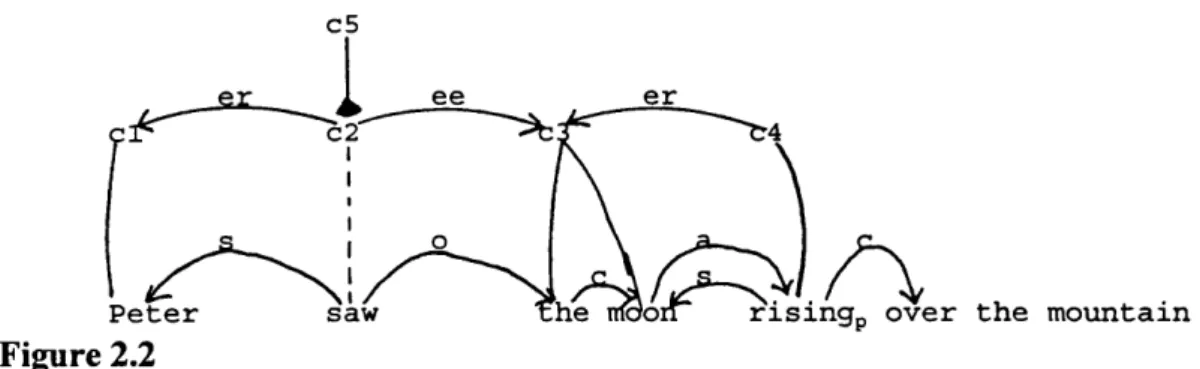
identifying the difference between control and raising structures as in (20) and (21);
secondly, we need to refer to semantic information in the grammar to understand how
(20) a, Peter seems a nice man
b. Peter is anxious to be a nice man
(21) a. Jane expects Peter to be late
b. Jane persuaded Peter to be late
In (20a) and (21a), there are raising structures, in (20b) and (21b) there are control
structures. In essence, the difference between raising and control structures is that a
raising structure does not assign a semantic relation to one of its syntactic dependents.
In (20a), it is incoherent to suggest that Peter is the agent, theme, actor, goal, source
or whatever of the sense of seems. Peter does not even appear to be the “seem-er” of
seems, because the seem-er of seems is most felicitously taken as the whole
proposition: ‘Peter (be) a nice man’. At this level of analysis, SEEM appears to be a
one-place predicate in its semantics, with a proposition as its argument. (20b),
however, has a different semantic structure. Peter is the “anxious-be-er” and to be a
nice man looks as if it is the “anxious-be-ee”; that is, the sense of the expression BE
ANXIOUS is a two-place predicate, in distinction to (20a).
A similar analysis holds for (21a-b). In (21a), the sense of expects is a two-
place predicate, with Jane as one argument, and Peter to be late as the other. Peter is
not the “expect-ee”: if we utter a sentence like Jane expects Peter it is Peter that is
expected, not the proposition Peter to be late; in (21a), however, it is not Peter who is
expected, but the whole proposition. Persuaded in (21b), on the other hand, is a three-
place predicate. Both Peter and the proposition encoded by Peter to be late are
semantic arguments of persuaded. Furthermore, the object’s semantic relation is
stable, irrespective of whether the instance o f PERSUADE occurs with an infinitive
complement or not. In this respect, PERSUADE is very different from EXPECT.
This information about the different semantic structures of SEEM and
EXPECT on the one hand, and BE ANXIOUS and PERSUADE on the other, is
important because of their possible analysis. In the literature, the differences have
much as the differences are semantic, the similarities are syntactic: both SEEM and
ANXIOUS in (20) have a subject and a “xcomplement”.'® In (21), both PERSUADE
and EXPECT have a subject, an object and an xcomp.
Furthermore, the xcomps in (20) and (21) behave exactly as we should expect:
they all require a subject. In (20), in both cases, the subject o f the xcomp is the
subject of the main verb; in (21) in both cases, the subject o f the xcomp is the object
of the main verb. This is the simplest analysis available, and it is translatable directly
into the terminology of a number of other theories. But, as I have already noted, there
are very real differences between the raising verbs and the control ones.
It follows, therefore, that exactly similar syntactic structures may mask entirely
different semantic ones, and that here is the kind of difference that is observable in
(20) and (21). There is no reason to assume that the kind of difference in (20) and (21)
is, in fact, a syntactic one: no syntactic rules rest on the distinction between control
and raising. One possible solution is simply to recognise the facts as we have
observed them. A raising verb can then be defined as a verb that has one semantic
argument less than its number of dependents, whereas a control verb has exactly the
same number of semantic arguments as it has syntactic dependents. To include this
information in the grammar, we have to accept that syntactic and semantic information
are quite separate, and that the grammar makes reference to two discrete levels of
representation. So far, though, the only semantic information that we have to include
in the grammar is information about how many semantic arguments the sense of a
word has, as opposed to the number of syntactic dependents it has.
Other semantic information that we might want to refer to in the grammar
involves passivisation as in (22).
(22) a. Jane hit Peter
b. Peter was hit (by Jane)
Without entering into a diversionary analysis of passive, I think that it is appropriate to
observe that the chief property is that one of the semantic arguments is unlinked from
the position which links it to the subject. That is, the two-place predicate ‘hit’
becomes a one-place passive one. One of the semantic arguments is removed,
specifically the argument of the non-derived verb which maps onto the subject.
Consequently, in at least one grammatical rule, I have to mention the argument o f the
verb which maps onto the subject. As Rosta (1995) shows, mediopassives work in the
same way.
So far, it looks as though the semantic information that the grammar requires
(in terms o f grammatical rules) is a specification of how many participants there are in
the situation indicated by the verb, and a specification of which of those participants is
the referent of the subject in a non-derived instance of the verb. For now, I take it that
there are no other parts o f the grammar that make reference to semantic information.
I shall leave the question of whether the grammar makes reference to semantic
classes o f verbs open: this is an issue on which I am agnostic. I am happy to accept
the judgement of those like Gropen et al (1991), Levin and Rappaport Hovav (1991),
and Pinker (1989), -w h o all believe that it is possible to identify the subcategorisation
of verbs from their semantic class— that if we do have to refer to semantic classes of
verbs in the grammar, we do it by referring not to particular semantic roles, but to a
full description of the different semantic classes of verbs.
1.2.6 The identification of semantic relations This issue falls into more than one part.
• Why do we need semantic relations?
• How many relations are there?
How do we identify the different semantic relations?
If we do not refer to semantic relations in the grammar why might we need to have
them? So far, I have claimed that all the grammar needs is to identify how many
arguments a verb has, and to identify the argument of the verb which maps onto its
subject. It is also necessary to identify this argument for those cases where the verb
has no grammatical subject, but it patently has some kind of semantic subject, as in
imperatives (indeed, we also need a covert object for examples like go and be easy to
please). Do we need a more fine grained analysis of semantic relations than this?
I think that the answer is that as far as grammar is concerned, we do not need a
finer grained analysis than this. But there are two possible areas where we might find
an analysis of individual semantic relations useful. One is in linking. It is clear that
there is a correlation between certain semantic relations and particular syntactic ones.
For example, agents always come out as subjects. In order to make any kind of sense
o f linking, we need to have an idea about what the possible semantic relations are, and
therefore how they might be defined. It may be the case that certain semantic relations
are primitives and others are not, so that not all semantic relations are definable in the
same way. This issue recurs at several points throughout the thesis.
Another reason why it might be necessary to have individual semantic
relations comes down to the way in which we define our semantic structures. If, like
Levin and Rapoport (1988), I adopt a model of lexical subordination, where some
senses are subordinate to others, I shall need to have an explication of the semantic
relations involved because the subordination itself will involve some (presumably
primitive) relations. It will be necessary to identify the relations that can hold between
the senses of words. In a subordination model, it might also be appropriate to identify
other semantic relations which can hold between a single participant and more than
one sense.
The upshot is that the answer to the question of why we need semantic
relations is partly contingent on fact because if we can predict the linking of
some theoretical models can do without semantic relations while others cannot. I
consider the issue of linking to be very important.'^
The next issue, that of how many semantic relations there are, is an open
question. The answer rests on the model that is applied to the semantics in order to
determine what actually constitutes a semantic relation. It is intimately linked with
the question of how we identify the semantic relations, so I shall deal with these two
issues together.
We have the following options.
• We could assume a strategy like Dowty’s (1991) “proto-role” approach. In this
system, there are two major semantic relations, which are designed to link to syntactic
relations. The arguments of the verb will then be picked out on the “best fit”
principle, so that the argument that has the most “proto-agent” properties links to
subject, and the argument that has most “proto-patient” properties links to object.
According to this account, semantic relations are defined in terms of situation types so
that an argument is defined in terms of the logical entaiIments of the situation. 1 can
see the following problems with this proposal: how do you capture the generalisation
that most indirect objects are potential or actual possessors; how do you capture the
semantic relation between situation types and extra arguments like fo r in Peter paid
Jane £5 fo r the bike; and how do you decide whether £5 ov Jane is the proto-patient in
that example?'^ Effectively, Dowty gives us only two participant roles.
It could be argued that linking and the predictability o f syntax from semantics are the same issue, but 1 think that they are only related. Predictability presupposes that for any
sem antically^ lass o f verbs X it is possible to identify the syntactic valents o f a member o f X. Linking merely states what is possible: if linking is probabilistic, and it is possible to com e up with hard and fast rules for linking 90% o f semantic participants in a situation, then this is the information that it is important to include. I think that we need to identify as many linking possibilities as we can without prejudicing the outcome as far as an investigation into the predictability o f syntax from semantics is concerned.
U sin g a WG interpretation o f Dowty’s system, it is possible to analyse Jane p a id P eter £5 f o r the bike like this: Jane is the subject; P eter is the indirect object; £5 is the object;/or is an
• Alternatively, we could assume a list of ordered arguments and an ontology of
situation types, as in Jackendoff s system. In a system like this, basic situation types
might include ‘state’ and ‘event’, there might also be ‘going’, ‘causing’, ‘reacting’,
‘possessing’ or even ‘perceiving’. A verb’s sense could then be decomposed into its
constituent elements, so transitive MOVE, for example could be analysed as an event
which is composed of a ‘causing’ and a ‘going’, something like (23). (23) is an
analysis in line vdth Jackendoff (1983); the (1990) model is more sophisticated. I
have chosen the simpler (1983) version here for the purpose of sketching a possible
account.
(23) [ E v e n t ([CAUSE ([jhing^ls [EventCO(['n,ingy])])])]
Example (23) identifies two different major ontological categories: Things and Events.
CAUSE is a Conceptual Structure predicate, and part of the semantic decomposition
of the sense of transitive move. GO is another Conceptual Structure predicate, and is
also part of the decomposition of move. GO is embedded under CAUSE, so it is an
argument of CAUSE. CAUSE has only two arguments on this model: x and GO. The
variables x and y are variables for the possible arguments of the whole situation
comprising the sense of move. X is the first argument variable, in that it is the
argument of the outermost predicate, and y is the second argument variable, in that it
is the argument of the innermost predicate.
The possible problems that we run into with an account like (23) include a
failure to recognise that the y variable is an argument of CAUSE as well as of GO.
(23) says that there is a semantic relation that obtains between CAUSE and GO
(precisely that GO is the second argument of CAUSE, which would make it the
patient); however, it does not include an account of whether y is an argument of
In addition, as ‘pay’ represents a complex situation, there are subordinate structures, and so the participants in ‘pay’ participate in ‘exchange’, and ‘counter-exchange’ too, and their semantic relations will be defined in terms of the requirements of those situations too.
CAUSE or not. Jackendoff (1990) refines the analysis of causation by separating the
action tier from the thematic tier, with the result that the y variable is the affectee of
the causing situation.
The advantages of an account like that in (23) are that it allows us to state very
precisely what the content of a given semantic relation is. (23) tells us that x is the
first argument of CAUSE. Typically, the subject o f transitive move is analysed as an
agent. From (23) we can deduce that an agent is the first argument of CAUSE in
conceptual structure. It is also possible to deduce that a theme is the first argument of
GO. However, in order to make these assumptions, it is necessary to assume ordered
lists o f arguments, which may be undesirable. An ordered list raises the problem of
how to order the list: why should one participant be prioritised over another? Indeed,
the predicate calculus approach to ordered lists is one that rests on the syntactic
realisation o f the argument, which defeats the object. The point, surely, is to identify
what is going on in the semantics, not to mirror the syntax in the semantics.
Pinker's (1989) system is very similar to Jackendoff s (1983, 1987, 1990)
system outlined here.
• It is also possible to assume a number of situation types, as Jackendoff does, but
organise them in terms o f states of affairs identified by aktionsarts. Siewierska (1991 :
43) says that States of Affairs in Dik’s Functional Grammar are “situations and events
that a nuclear predication may designate, viewed from the perspective of internal
temporal constituency and a restrictive conception of agentivity.” Furthermore,
Functional Grammar’s typology of States of Affairs is organised hierarchically
(Siewierska 1991: 45-46) In an account like this, the sense of a word would not
decompose, but would inherit the situation type that it belongs to. I explore
hierarchies and inheritance in section 1.3.2. This sort of system is also found in
Halliday’s Systemic Grammar (Butler, 1985).
• Yet another alternative is to assume a model that locates the sense of the verb in a
perspective on a scene. This strategy is similar to that of Fillmore (1977), and it is
(1991). Rather than identify a range of predicate types or situation types which define
particular arguments o f verbs, these authors find ways of construing scenes. They do
this in two domains: one is essentially localist and involves a “figure” and a “ground”,
possibly a “landmark” too. These notions are identified as part of a list which may
include “viewpoint”, “orientation”, “foreground”, and “background”. Another way in
which a scene may be perspectivised is in looking at its force-dynamic qualities.
Force-dynamics is a system which analyses the semantic encoding of energy transfer
and resistance. For the authors listed in this subsection, these matters are inherently
part of semantic structure, but for others like Dowty, such a gestalt-based construal of
a scene is not semantic but rather belongs in the realm of “discourse pragmatics”. It
is, however, possible to take account of force-dynamic notions in a model based on
situation types. Jackendoff (1990: 125-151) shows how this can be done. The localist
element in the strategies o f the authors reviewed here can be compared to Jackendoff s
localist approach as well as that of Anderson (1971, 1977). Pinker (1989) adopts a
strategy which incorporates elements from the localist and force-dynamic domains
which he organises into a system of situation types.
• Finally, it is possible to assume a semantic model tied to syntax. As 1 argued in the
account of Jackendoff above, this defeats the whole object: the resulting system looks
like Fillmore’s (1968) system, and is deeply unsatisfactory because it makes
insufficient mention o f relevant semantic factors, while not really contributing to the
syntax at all. Such accounts are usually found in syntactic theories which use semantic
relations to signal that a particular position in a syntactic configuration is associated
with the possession o f a semantic relation.
I think that these points demonstrate very clearly that the number of
participants admitted in a semantic relations system will depend to a very large
measure on the approach adopted.
The systems outlined earlier offer four main ways of identifying the participant roles.
These are localist, force-dynamic, aktionsart-based, and aligned to grammatical