Page 95 www.ijiras.com | Email: [email protected]
Undergraduates’ Attitude Towards The Utilization Of Information
And Communication Technology For Learning In National Open
University Of Nigeria
Attah Justina Ojoma
Bachelor and Masters Degree at the University of Ilorin, Ilorin, Nigeria, Certified Teacher and Currently works as a
Class Teacher at Jalala Gago LGEA Tanke Ilorin Kwara State, Nigeria
Daramola F.O
Lecturer at Department of Educational Technology, University of Ilorin
Abiodun Christiana Bada
Bachelor and Masters Degree at the University of Ilorin, Ilorin, Nigeria, Certified Elementary and Secondary Teacher
Duly Registered with the Teachers Registration Council of Nigeria
Abdu Danyaro
Lecturer at Department of Educational Technology, Sa’adatu Rimi college of Education, Kumbotso, Zaria Road,
Kano, Kano State Nigeria
I. INTRODUCTION
The advent of Information and Communication Technology (ICT) in all aspect of life has brought about fast changes in approach, methodology and content delivery. The use of ICT in the field of education has yielded tremendous results such as improvement of quality in teaching and learning. ICT are all the electronic systems, computer
hardware and software and telecommunication gadgets involved in creating, storing, transmitting, and receiving immediate information through computer network (Ibenyenwa, 2011). ICT comprises all that are involved in interactive communication technologies such as communication satellite, radio, television, video, tape recorders, compact discs, floppy diskettes and other related equipment so that the output generated can reach a vast Abstract: This paper assessed undergraduates’ attitude towards the utilization of information and communication technology for learning in National Open University of Nigeria. Information and Communication Technology facilities make lesson more realistic and practical. ICT effectiveness for learning process in any educational community depends on the attitude of learners towards ICT competence and utilization. However the print materials which should have been supplemental materials have become a major source of instructional delivery, even the course materials printed by National Open University of Nigeria (NOUN) headquarters are not equitably distributed to all study centres. Distance education is technology-driven, therefore in a developing nation like Nigeria absence of necessary infrastructure for technological development, poses a threat to distance education. The research was a descriptive research design of the survey method, The sample for this study was drawn from NOUN Ilorin and Offa Study Center. A total of 346 undergraduates were sampled for the study. A researcher-designed questionnaire and checklist were used to obtain information from the respondents. The result of the study showed that National Open University students had a negative attitude towards the use of ICT for learning, however, there was no significant difference between male and female undergraduates attitude towards the utilization of ICT for learning based on gender, although the male students attitude was slightly higher than the female counterpart.
Keywords: undergraduates, Attitude, utilization, open and distance learning, National Open University of Nigeria.
Page 96 www.ijiras.com | Email: [email protected] number of users who may be differently dispersed from the
sender across the globe (Ezekoka, 2007)
ICT provides both learners and instructors with wide access to qualitative educational possibilities, it aids students to access digital information effectively, ICT is used as a tool for students to learn practical skills and training, and interact through social networking. ICT makes knowledge acquisition easy as students can learn in their comfort and convenience, learners can learn concepts and basics while engaging in the application of ICT (Ju, 2013). Similarly, Hew and Brush (2007) asserted that the use of ICT leads to greater discovery of knowledge, innovations, vocabulary building, games related to reading skills and promotes innovative ways to meet a variety of learning needs, it also promotes interactive learning in a distance learning environment, through ICT flexibility sequences of study can take place and learners can interact with modules or instruction independently even when they are far from the teacher in space and time, they can take materials step-by step through an instructional process, take up self-assessment exercise and send feedback to their teachers. Various ICT related policies and laws have been developed by the Federal Government of Nigeria with the purpose of growing the sector and increasing its efficacy for national development.
FRN (2012) stated that the goals of national Policy on ICT are to: produce a framework for streamlining the ICT sector and increase its versatility so as to address some socio-economic and growth barriers while enabling the transformation of Nigeria into a intellect oriented economy in addition, the ICT policy is being used to develop blueprints, segment of sectional policy and specific integration guidelines as appropriate. The vision statement of ICT policy in Nigeria is to transform Nigeria to a knowledge based and globally competitive society while the mission statement is to fully integrate ICT in the socio-economic development and transformation of Nigeria base economy. The objectives of ICT policy in education are to facilitate the teaching and learning process, promote problem solving, critical thinking enhance the various teaching and learning strategies required to meet the needs of the population, foster research and development, support effective and efficient education administration, enhance universal access to education and the range of instructional options at the convenience of the learners.
Various administrations have always sorted solutions to the problems of access to higher education, it was to this effects that Open and Distance Learning (ODL) was conceived in 2002. National Open University of Nigeria (NOUN) is the first full-fledged university that operates in an exclusively ODL mode of education. NOUN is designed to: increase access to formal and non-formal education to Nigerians in a manner convenient to their circumstances, cater for educational opportunity to those who because of distance, physical inadequacies, work commitment and so forth cannot avail themselves for a normal schooling and balance inequalities without discrimination to age, gender, ethnic or religion (Olatokun & Maka, 2010) Kaufman, Walkins and Guera (2000) stated that ODL is the means of delivering effective learning opportunities at convenient place and time for learners irrespective of institution providing the learning
opportunity. Alaezi (2005) described ODL as an educational form, methods and strategies that permit people to learn with no barricades in respect of time and space, age, and previous educational qualification-no entry qualification, no age limit, no regard to gender, race tribe, state of origin etc.
ODL is a form of delivery, where the acts of teaching and learning between students and lecturers are separated in time and space, and technology plays a significant supporting role. ODL uses synchronous and asynchronous modes of delivery instruction. Synchronous means that the teacher and the students interact with each other while in asynchronous delivery there is no structured face to face contacts between the students and the teachers, instead high quality, self-directed learner centred instructional materials are available to students. The various types of technology used in ODL instructional delivery are: audio conferencing, audio graphics conferencing, video conferencing, compressed video conferencing, desktop conferencing, interactive instructional television, print broadcast television and radio (Koustourakis, Panagiotakopoulos & Dimitris, 2008)
However, in developing countries ODL has expanded equal educational opportunities to the adult population, teachers’ training, initial training of teachers for formal qualification, in-service supplementary training for formal upgrading, and continuing in service training in particular subjects and topics. The use of open and distance learning for teacher education is therefore a crucial strategy for teachers training at a distance, large groups of teachers can learn via ICT facilities and it fosters development of national education system, ODL is enforced with the potential to; generate new patterns of teaching and learning, development of new learning needs and new patterns of information access, application and learning (UNESCO, 2002). Oyadonghan and Eke, (2011) stated that the factors that affect the utilization of ICT by students in Nigeria Universities varies from availability of resource materials management and administration to student’s attitude and disposition.
Yusuf and Balogun(2008) posited that attitude as a mental predisposition to an act that is expressed by evaluating a particular entity with some degree of favour or disfavour, individual, generally have attitudes that focus on objects people or instruction. Attitude is an acquired tendency to act in specific ways either positive or negative. Attitude refers to one’s positive or negative judgment about a concrete subject, attitude are learnt, modable, observable and they vary with experience of the stimulus objects and with social rules, norms or institution (Binder & Niederle, 2007). More positive attitudes towards the computer were associated with a higher level of computer experience. Based on the above definition attitude can be seen as a general feeling about something or situation.
Page 97 www.ijiras.com | Email: [email protected] key to how those tools are used depends greatly on the
learners, unlike conventional classroom, in distance learning learners are left to study on their own pace; therefore students must embrace and develop positive attitude to the use of ICT (Kadel, 2005). Student’s confidence towards ICT in distance learning can be explained through attitude and behaviours because heir whole learning process is revolved round ICT. Additionally, lack of confidence leads to reluctant use of computers by the learners (Kumar & Kamar, 2003).
Academic discipline is a paramount factor to be considered and its influence on undergraduate’ attitude towards Minikutty and Sandhya (2015) studied higher institution students ICT literacy. Their findings indicated that undergraduates had low ICT literacy with hardly any difference found between the ICT literacy among students of faculty of science and arts. The study further revealed that efforts geared towards the integration of ICT into the school system, have not made much impact. There are some problems such as diversity of the students population, time constraints, poor maintenance culture and so on that militate against these efforts.
Ajadi (2010)outlined some challenges that can influence attitudes of students to the effective use of ICT in distance learning: unreliable electricity supply, inadequate training, inappropriate skills by the students to access technological tools or facilities effectively, high cost of ICT in education, non-availability of up-to date content and so on. Similarly Manir (2009)asserted that the Nigerian educational system is witnessing uncomplimentary shortage in teaching materials and ineffective system for digital learning resources creation, shortage, administration and maintenance. Open and distance learning (ODL) students have no computer education background; hence they are afraid of using one. Some of them go to the extent of hiring expert at a cost to fill their admission, registration and other documents meant for them to fill online (Jimoh, 2013).
Furthermore, the influence of gender as its relates to the utilization in ODL is a paramount issue to be examined, gender plays a significant influence on the use of ICT. Gender is a socio-economic variable for analysing roles, responsibilities, constraints, and needs of men and women in a given context. It also refers to the socio and cultural constructs that each society assigns to behaviours, characteristics and values attributed to men and women (Sanda & Kurfi, 2013). In a similar vein Primo (2003) asserted that males showed more positive attitudes towards the use of ICT than females while Graff (2003) opined that females were less likely to use ICT confidently than males. Moreover, Kaloglanakis, Makis and Ertner (2008) reported that both males and females had similar engagement with ICT.
RESEARCH QUESTIONS
The following research questions were answered in this study:
What are the Information and Communication Technology (ICT) facilities available in NOUN?
How accessible are the ICT facilities to Undergraduates’ for learning in NOUN?
What is undergraduates’ frequency of use of ICT facilities for learning in NOUN?
What is undergraduates’ attitude towards the utilization of ICT for learning in NOUN?
How does gender influence undergraduates’ attitude towards the utilization of ICT for learning in NOUN?
What is the influence of academic discipline of undergraduates’ towards the utilization of ICT for learning in NOUN?
2.1 Research Hypotheses
The following hypotheses were tested at 0.05 level of significance:
Ho1: There is no significant difference between male and
female undergraduates attitude towards the utilization of ICT for learning;
Ho2: There is no significant difference in undergraduates
attitude towards the utilization of ICT for learning based on their academic discipline.
II. METHODOLOGY
This study was a descriptive research method of the survey type. A researcher-designed questionnaire and checklist were used to obtain information from the respondents. A trial testing was carried out using 20 undergraduates of Oyo state National Open University of Nigeria, Cronbach Alpha was used to analyse and test the reliability coefficient at significant level of 0.05. The value of the reliability using Cronbach Alpha was 0.68 on Availability and Accessibility, 0.77 on Frequency of Use and 0.79 on the Attitude of National Open University Students Towards the Utilization of ICT for learning. The information obtained was on undergraduate’s attitude towards information and communication technology in National Open University of Nigeria (NOUN), Ilorin and Offa study centres. The population for this study comprised all NOUN undergraduates’ in Nigeria. The target population of this study was NOUN Ilorin and Offa study centres. A total of 346 undergraduates were sampled for the study.
NOUN Study Center
Undergraduates’ Population
Sample Size
Offa 102 15
Ilorin 2921 334
Total 3023 346
Source: Director’s Office (2017).
Table 1: Sampling frame of undergraduates in NOUN Ilorin and Offa study center Using Research Advisor’s Model (2006)
Therefore based on the estimated population of 3023 undergraduates for the study, research advisor model (2006) was used to randomly select 346 undergraduate students at 95% confidence level and significant level of 0.05.
Page 98 www.ijiras.com | Email: [email protected] Cronbach Alpha was 0.68 on Availability and Accessibility,
0.77 on Frequency of Use and 0.79 on the Attitude of National Open University Students Towards the Utilization of ICT for learning.
III. RESULTS AND DISCUSSION
RESEARCH QUESTION ONE: What are the Information and Communication Technology (ICT) facilities available in NOUN?
S/N ICT Facilities Mean
1 Fax 1.63
2 Audio conferencing 1.55
3 Podcast 1.70
4 Satellite delivery 1.51
5 Broadcast video 1.53
6 Computer 1.12
7 Video Conferencing 1.59
8 Voicemail 1.59
9 Mobile Devices(Cell Phone, PDAs, Tablets etc)
1.34 10 Videotape and DVD 1.45
Grand Mean 1.5
Table 2
Table 2, shows the mean responses of the available ICT facilities for learning. Fax has a mean score of 1.63, audio conferencing has a mean value of 1.55, podcast follows with a mean of 1.70, satellite delivery 1.51, broadcast video likewise has a mean of 1.53 the least available devices is the computer system with a mean of 1.12, video conferencing has a mean of 1.59 mobile devices (cellphone, PDAs, Tablets etc) has a mean of 1.34 and videotape and DVD has a mean value of 1.45 Using a bench mark of 1.5 of a 2 response mode of available and not available, it was observed that ICT facilities were available.
RESEARCH QUESTION TWO: How accessible are the ICT facilities to Undergraduates’ for learning in NOUN?
S/N ICT Facilities Mean
1 Fax 1.79
2 Audio conferencing 1.59
3 Podcast 1.73
4 Satellite delivery 1.56
5 Broadcast video 1.59
6 Computer 1.19
7 Video Conferencing 1.67
8 Voicemail 1.64
9 Mobile Devices(Cell phone, PDAs, Tablets etc)
1.40
10 Videotape and DVD 1.52
Grand Mean 1.6
Table 3
Table 3, shows the mean responses of NOUN students accessibility to ICT facilities for learning. The highest mean response is 1.79 (Fax) in this respect, the item mean was greater than the bench mark. Therefore the statement is positively rated. Podcast is ranked second with item mean of 1.73 which is also greater than bench mark of 1.5. Next is video-conferencing with item mean of 1.67 which is also greater than the benchmark, it is therefore positively rated.
The fourth in the rank is satellite delivery and voicemail with mean scores of 1.64 and video tape and DVD has a mean score of 1.52 However, others were negatively rated; which are computers (1.19), Mobile devices (cell phone, PDAs, Tablets) (1.40), Therefore these resources are adequately utilized by the students.
RESEARCHES QUESTION THREE: What is undergraduates’ frequency of use of ICT facilities for learning in NOUN?
Table 4
Table 4, shows the mean responses of National Open University students’ frequency of use of ICT facilities. In ranking order, the findings revealed that respondents frequently uses Fax machine (2.77) secondly followed by item 2 (Audio conferencing) with a mean of 2.52 thirdly followed on the frequency of use is Podcast (2.72), item 5, 7 and 8 had a mean score of 2.56, 2.68 and 2.49 respectively. The grand mean score was given 2.40 which was less than the benchmark of 2.5. This implies that the frequency of utilization of ICT facilities by the students in NOUN is low.
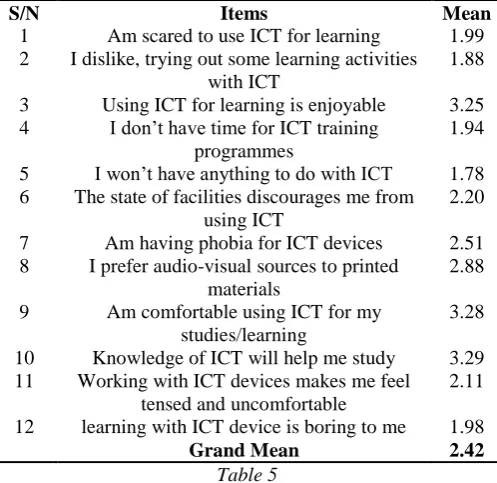
RESEARCH QUESTION FOUR: What is undergraduates’ attitude towards the utilization of ICT for learning in NOUN?
S/N Items Mean
1 Am scared to use ICT for learning 1.99 2 I dislike, trying out some learning activities
with ICT
1.88 3 Using ICT for learning is enjoyable 3.25 4 I don’t have time for ICT training
programmes
1.94 5 I won’t have anything to do with ICT 1.78 6 The state of facilities discourages me from
using ICT
2.20 7 Am having phobia for ICT devices 2.51 8 I prefer audio-visual sources to printed
materials
2.88 9 Am comfortable using ICT for my
studies/learning
3.28 10 Knowledge of ICT will help me study 3.29 11
12
Working with ICT devices makes me feel tensed and uncomfortable learning with ICT device is boring to me
Grand Mean
2.11 1.98 2.42 Table 5
Table 5, shows the mean responses of National Open University students’ attitudes towards the use of ICT for learning. With the mean score of 1.99 item 1 shows that the
S/N ICT Facilities Mean
1 Fax 2.77
2 Audio conferencing 2.52
3 Podcast 2.72
4 Satellite delivery 2.44
5 Broadcast video 2.56
6 Computer 1.99
7 Video Conferencing 2.68
8 Voicemail 2.49
9 Mobile Devices (Cell Phone, PDAs, Tablets etc)
1.79
10 Videotape and DVD 2.34
Page 99 www.ijiras.com | Email: [email protected] respondents were indeed scared to use ICT for learning, item 2
mean score of 1.88 showed that the respondents disliked trying out some learning activities with ICT, 1.94 mean score for item 4 showed that the respondents have no time for ICT. Item 6 had a mean score of 2.20 it showed that the available ICT facilities were in good state and the students were ready to integrate it for learning. Item 7 has a mean score of 2.52 this indicate that the respondents does not have a phobia in the use of ICT for learning. Item 10 had the highest mean value of 3.29 this indicates that the students were aware that knowledge of ICT will assist students to study effectively, item 11 and 12 had a mean score of 2.11 and 1.98 respectively this depicted that the respondents feels comfortable working with ICT devices. It can be deducted that majority of the items are less the 2.5 benchmark and thus the implication is that National Open University students had a Negative attitude towards the utilization of ICT for learning.
RESEARCH QUESTION FIVE: What is the Influence of Gender on Undergraduates’ Attitude Towards the Utilization of ICT for Learning in NOUN?
Table 6
Table 6, shows the attitude of male and female National Open University students towards the utilization of ICT. The findings revealed that 24.9% and 21.6% male respondents have a positive attitude towards the utilization of ICT resources while 21.9% and 31.6% demonstrated a negative attitude towards the utilization of ICT resources. On the other hand, 22.3% and 18.4% female respondents showed a positive attitude towards the utilization of ICT resources, while 29.9% and 29.4% hold a negative attitude towards the utilization of ICT resources. Therefore, it was deduced from the results gotten that male students have a more positive attitude towards the utilization of ICT resources than female students.
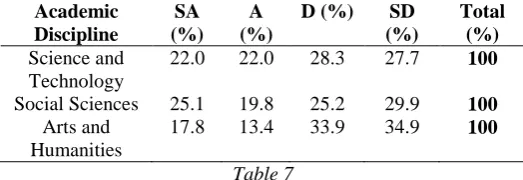
RESEARCH QUESTION SIX: What is the Influence of Academic Discipline of Undergraduates’ Towards the
Utilization of ICT for
Learning in NOUN?
Academic Discipline of Undergraduates Towards the Utilization of ICT for Learning
Academic Discipline
SA (%)
A (%)
D (%) SD (%)
Total (%) Science and
Technology
22.0 22.0 28.3 27.7 100 Social Sciences 25.1 19.8 25.2 29.9 100
Arts and Humanities
17.8 13.4 33.9 34.9 100 Table 7
Table 7, shows the attitude of National Open University students towards the utilization of ICT based on different academic disciplines. The findings reveal that 44.0% of respondents who are in science and technology have a positive attitude towards the utilization of ICT resources while 56% demonstrated a negative attitude towards the utilization of ICT resources. On the other hand, 44.9% of respondents from social science showed a positive attitude towards the
utilization of ICT resources, while 55.1% hold a negative attitude towards the utilization of ICT resources. Also, 31.2% of respondents from arts and humanities showed a positive attitude towards the utilization of ICT resources while 68.8% show a negative attitude towards it. Therefore, it can be deduced from the results gotten that respondents from social science undergraduates had a more positive attitude towards the utilization of ICT facilities than respondents from other academic discipline.
RESEARCH HYPOTHESIS 1
H01: There is no significant difference between male and
female undergraduates attitude towards the utilization of ICT for learning;
An independent sample t-test was used to compare the attitude of National Open University students for males and females. Data collected from the respondents was analysed and tested at significant level of 0.05. Results of the analysis are shown in table 6 with subsequent interpretation.
Gender N Mean SD Df T Sig. (2-tailed)
Remark
Male 157 28.6 4.9
271 .981 .328 Accepted Female 116 27.9 5.6
Table 8: t-test Analysis of Male and Female National Open University Undergraduates Attitude towards ICT for Learning
From Table 8, it can be deduced that there was no significant difference between attitude of National Open University students towards the use of ICT for learning based on gender. This is reflected in the findings of the hypotheses tested as df (271) t=-.154, p > 0.05. Thus, the hypothesis which states that “there is no significant difference between male and female undergraduates attitude towards the utilization of ICT for learning” is accepted. The results presented in table 10 in line with research question five reveals that both male and female have a positive attitude towards the use of ICT for learning although the male students attitude is slightly higher than their female counterpart. RESEARCH HYPOTHESES 2
H02: There is no significant difference in undergraduate’s
attitude towards the utilization of ICT for learning based on their academic discipline.
A one-way analysis of variance was used to compare the attitude of students in faculty of science and technology, social science and arts and Data collected from the respondents was analysed and tested at significant level. Results of the analysis are shown in table 10 with subsequent interpretation.
Sum of Squares
Df Mean
Square
F Sig.
(2-tailed)
Remark
Between Groups
1499.64 2 61.39 2.87 .000 Rejected Within
Groups
4251.03 255 22.48
Total 5750.66 258
Table 9: One- Way Analysis of Variance on Attitude Based on Academic Discipline
Gender SA (%)
A (%) D (%) SD (%)
Total (%)
Male 31 23.9 21.1 24 100
Page 100 www.ijiras.com | Email: [email protected] From Table 9, It can be deduced that there is significant
difference between attitude of National Open University students in arts and humanities, social studies and science and education towards the use of ICT for learning based on academic discipline This is reflected in the findings of the hypotheses tested as df (258) t=-.287 p > 0.05. Thus, the hypothesis which states that “there is no significant difference between male and female undergraduates attitude towards the utilization of ICT for learning based on academic discipline” is rejected.
IV. DISCUSSION OF RESEARCH FINDINGS The research findings on availability of ICT facilities for learning in NOUN revealed there are adequate available ICT facilities for learning in NOUN. The results obtained from this study are in contrast with Yusuf (2006) which indicated that education is poorly funded in Nigeria, lack of facilities and where available they are few, small budgets are allocated to ODL programmes and the soft and hard wares are costly, the softwares are very expensive because they are not developed locally. Based on the findings of this study researcher observed that the magnitude of importance that the government has place on education recently has brought about obvious changes in the infrastructural development in the educator sector large budgets are now being allocated to procure ICT facilities..
Moreso, results on the accessibility and frequency of use of ICT facilities in NOUN showed that though there are adequate ICT facilities available for learning to the students, but these resources are under utilized by the students. This is in line with Idowu and Esere (2013) who submitted that NOUN has not fully employed the ICT media that are currently made available but still patronize the use of study centres, and face-to-face weekend/evening conventional methods/classes which were found a bit ineffective especially considering the students’ population involved. Similarly, Manir (2009)asserted that Open and distance learning (ODL) students have no computer education background; hence they are afraid of using one. Some of them go to the extent of hiring expert at a cost to fill their admission, registration and other documents meant for them to fill online and the few who have access to the computer do not know to use it and take advantage of its usage.
Furthermore, It can be deducted on the the findings on the attitude towards the utilization of ICT for learning, that majority of the items are less the 2.5 benchmark and thus the implication is that National Open University students have a negative attitude towards the use of ICT for learning. In spite of adequate available of ICT resources undergraduate attitude towards the utilization is negative These finding is in line with Kadel, (2005) which states that ICT effectiveness for learning process in any educational community depends on attitude of learners towards its competence and utilization, merely having ICT in schools is not a yardstick to its effectiveness, regardless of the quality and quality of technology imbedded in any resource centre, the key to how those tools are used depends greatly on the learners unlike conventional classroom in distance learning learners are left to study on their own pace;
therefore students must embrace and develop positive attitude to the use of ICT.
The study was also revealed through that gender differences exist in undergraduates attitude towards the utilization of ICT for learning by National Open University students male students demonstrated a positive attitude towards ICT for learning. However, there was no significant difference on male and female attitude towards the use of ICT for learning. Supporting this view, Gallagber, Bridgeman and Gahalan (2002) Observed that there was a difference between males and females as regards to the use of technological tools and equipment. In congruent with this is Wood and Li (2005) observed that males are more willing to integrate new technologies that female.
Furthermore On the influence of academic discipline of undergraduates’ towards the utilization of ICT for learning in NOUN. The study revealed that Social science undergraduates have a more positive attitude towards the utilization of ICT facilities than respondents from other academic discipline this is in contrast with Minikutty and Sandhya (2015) study revealed that respondents in Faculty of Social Sciences were found to have poor skills in the use of computer and the Internet, respondents in Faculty of Arts were found to have poor skills in the use of the telephone. This may be because information in materials in the Social Sciences and Arts do not get outdated as quickly as those in the Sciences.
V. CONCLUSION
Information and communication technology has gained recognition by and large and it is making tremendous impart in all facet of life. ICT provides both learners and instructors with wide access to educational possibilities and affordance, it aids students to access digital information effectively, ICT is used as a tool for students to learn practical skills and training, and interact through social networking, ICT make knowledge acquisition easy as students can learn in the comfort and convenience and Learners can learn concepts and basics while engaging students in the application of ICT. Even with this immense benefit undergraduates attitude to explore the use of ICT for learning is negative researcher has varied the factors impeding the use of ICT to adequate infrastructure, however this study has shed more light to the issue to be tackled by administrators and leadership of NOUN, emphasis should be made on the use of ICT for learning and instruction delivery should be more technical so that the students will have no choice but to use these facilities to learn.
VI. IMPLICATIONS OF THE RESEARCH
Page 101 www.ijiras.com | Email: [email protected] lecturers and students interaction. Although this study
indicated that there are adequate available ICT facilities for learning these facilities are under utilized by the students this is an indication that undergraduates are not proficient to the use of ICT facilities for learning. This calls for ICT integration into ODL curriculum so that students would develop its usage for learning.
VII.LIMITATIONS OF THE STUDY
The study was limited to only NOUN Kwara State hence, findings from the study may not be generalized to National Open University in other states. The study only focused on undergraduates students of the National Open University of Nigeria, other stakeholders like postgraduate students, lecturers and administrators were not put into consideration.
VIII. SUGGESTIONS FOR FURTHER STUDIES Further researches could be replicated on undergraduates attitude towards the utilization of ICT for learning in study centers in other states of the country. Also other issues like investigating the attitude of lectures to ICT facilities to teach is recommended, putting into consideration their qualifications, experience and specialities and readiness and proficiency of NOUN facilitators to the use of ICT for instrution
REFERENCES
[1] Alaezi, O. (2005). National Open University plan: Enhancing higher education in Nigeria through Open and distance Learning delivery system. Lagos NOUN
[2] Awe B., (2012) The challenges of Distance Education in Nigeria. www.academia.edu
[3] Binder, M., & Nierdele, U. (2007) Institution as Determinants of Preference Change- A one way Ration
Retrieved from
https://paper.econ.mpg.de/evo/discussionpaper/pdf [4] Ezekoka, G. (2007). Evaluation of secondary school
teachers’ use of information and communication. Journal of Women in Academics (JOWACS). 9(1) 210-219 [5] Federal Government of Nigeria. (2002). Blue Printand
implementation for the National Open and Distance learning Programme. Abuja: Federal Ministry of Education.
[6] Federal Republic of Nigeria.(2012). National Policy on Information and Communication Technology. Nigeria Education Research and Development Commission. [7] Gallagber, A., Bridgeman, B., & Gahalan, C. (2002). The
effects of computer based test on racia-ethnic and gender groups. Journal of Educational Measurement. 39 (7), 133-147
[8] Graff, D. (2003). Educators technology level of use and method for learning technology integration. Texas: University of North Texas.
[9] Hew, K, F., & Brush, T. (2007). Integration technology into K-12 teaching and teaching: current knowledge gaps and recommendation for future research. Educational Technology Research and Development.55(1) 223-252 [10]Ibenyenwa. (2011). An Investigation of Lecturers’ and
students’ use of ICTs in. Humanities and Social Science. [11]Igwe, D. O. (2012). The roles of ICT development in
open and distance education; Achievement, prospects and challenges. Africa Journal of Education 6(4)12-15. [12]Jimoh, M. (2013). An Appraisal of the Open and Distance
Learning Programme in Nigeria. Journal of Education and Practice 4(1)24-27
[13]Ju, D. S. (2013). ICT Strategies and Tools for the Improvement of Instructional supervision. Turkish Online Journal of Educational Technology 6(3) 16-19
[14]Kadel. (2005). How teacher attitude affect technology. Learning and Leading with technology, Internationalv Society for technology in Education www.iste.org.32(5) 34-47
[15]Kaloglanakis, C., Makis,, F., & Ertner, S. (2008). Training with ICT for ICT from the tranee's perspective. A local ICT teacher training eperience. Education and information Technologies Journal. 7(1) 3-17
[16]Kumar, P., & Kamar, A. (2003). Effect of a web-based project on preservice and inservice teachers’ attitudes toward computers and technology skills. Journal of Computing in Teacher Education.19(3) 87-92
[17]Lou, S., & Dixon, K. C. (2008). Planned behaviour: Student attitudes towards the use. Retrieved september 1, 2016, from Proceedings ascilite Melbourne 2008.: http://www.ascilite.org.au/conferences/melbourne08/proc s/siragusa.pdf
[18]Manir, A. K. (2009). Problems, chanllenges and benefits Benefits of implementing e-learning in Nigeraian universities. International Journal of Emerging Technologies in Learning (IJET).4(1) 16-32
[19]Minikutty A; Sanhya Ray M 2015 Information and communication technology (ICT) literacy among higher secondary school students. Indian Journal of Research. www.worldwidejournal.com
[20]Ogunlade, O. O., Afolayan, S. A., Ogunlade, A. A., & Amosa, A. A. (2013). Undergraduates Attitude Toward Information and Communication Technology in University of Ilorin, Nigeria. International Journal of Learning and Development, 3.
[21]Olatokun, W. M., & Mala, A. (2009). Assessing Students’ Satisfaction with an E-Learning System:. African Journal Comptemporary and ICTs.5(2)11-20
[22]Oyadongba, J. C & Eke, F. M (2011) factors affecting student use of Information Technology A comparative Study of Federal University of Technology, Owerri and Niger Delta University, Amazoma
[23]Primo, N. (2003). Gender Issues in the Information Society. UNESCO publications.
[24]Sanda, U. H., & Kurfi, H. M. (2013). Gender and Information and Communication Technology in Nigeria; Challenges and Prospects. Journal of Human Science and Sociology and Culture.
Page 102 www.ijiras.com | Email: [email protected] and Communication Technology: A Case Study in a