e-ISSN: 2278-067X, p-ISSN: 2278-800X, www.ijerd.com
Volume 3, Issue 8 (September 2012), PP. 36-43
Performance analysis of nickel-coated stainless steel bipolar
plates in direct methanol fuel cells
Ching Chiang Hwang
1, Ing-Bang Huang
21
Department of Biotechnology, Mingdao University, Taiwan
2 Department of Materials Science and Engineering, National Formosa University, Huwei, Yulin, 63201, Taiwan.
Abstract—In this study, computer-aided design and manufacturing (CAD / CAM) technology were applied to develop and produce stainless steel bipolar plates for DMFC (direct methanol fuel cell). Effect of surface modification on the cell performance of DMFC was investigated. Surface modifications of the stainless steel bipolar plates were made by the electroless plating method. A DMFC consisting of nickel coated stainless steel as anode and uncoated stainless steel as cathode was assembled and evaluated. The methanol crossover rate (Rc) of the proton exchange membrane (PEM) was decreased by about 28 %, the efficiency (Ef) of DMFC increased about 2.7% and amounts of methanol electro-oxidation at the cathode side (Mco) were decreased by about 10.8 %, as compared to uncoated anode polar plates. These measurements were determined by the transient current and mathematical analysis.
Keywords—Direct methanol fuel cell; Bipolar plates; Crossover rate; Methanol
I.
INTRODUCTION
Bipolar plates, which are a type of multifunctional component, are one of the most important components in a PEMFC stack. The main functions of bipolar plates are to distribute and separate the cathodic and anodic reactant gases and to collect and transmit electric current. Usually, bipolar plates are fabricated from graphite, carbon composites and metallic materials, among which, metallic materials are most attractive owing to good mechanical properties and chemical stability, electrical conductivity and thermal conductivity and good machining properties. Metallic materials which can be recycled, such as titanium, aluminum, stainless steel, have been tested as possible candidates for bipolar plates. Unfortunately, metals are prone to corrosion and the resulting metal ions can readily migrate to, and poison, the membrane in a PEMFC environment. The dissolved metal ions can lower the ionic conductivity of the membrane and the performance of the PEMFC. Furthermore, any corrosion layer lowers the electrical conductivity of the bipolar plate, and increases potential loss because of higher electrical resistance. Hence, in order to act as suitable materials for bipolar plates, metals should have both very high corrosion resistance and high electrical conductivity [1, 2].
In order to improve the corrosion resistance and electrical conductivity of the bare substrate, several coating materials and processes have been proposed [1, 2]. Gold (Au) has been studied as a coating material on stainless steel substrate by some researchers. Gold has high excellent corrosion resistance and electrical conductivity, and the use of very thin gold coating on bare substrates has proven very successful [3, 4].
Methanol crossover, which causes significant voltage loss and waste of fuel, is a serious problem in DMFC. Thus, it has attracted attention worldwide. Several methods have been used to measure methanol crossover in DMFC [5-10]. Hikita et al. determined methanol crossover rates by continuously measuring the concentration of CH3OH, CO and CO2 in the exhaust gas of the cathode [5]. Narayanan et al. measured the methanol crossover rates by estimating the carbon dioxide content of the cathode exit stream. Crossover rates were reported as an equivalent current density of methanol oxidation [6]. Ramya and Dhathathreyan directly measured methanol flux rates across Nafion® membranes by an electrochemical method using a flooded electrolyte cell with two compartments separated by a membrane, with various concentrations of methanol [7]. A potentiometric method reported by Prakash et al. [8] showed that the slope (dE/dt) of the E versus t (time) curve is proportional to the crossover rate. The CH3OH crossover rate was calculated from the time required to reach the equilibrium concentration of CH3OH on either side of the polymer electrolyte membrane. Han et al. determined the methanol crossover rates by measuring the carbon dioxide concentration at the cathode exit in real time [9]. Kin et al. proposed a relatively easy method for estimating the methanol crossover rate of a proton exchange membrane (PEM) and the efficiency of a direct methanol fuel cell (DMFC) by using current transient analysis [10]. However, the mathematical expression should be modified in order to satisfy the practical application condition.
In this study, computer-aided design and manufacturing (CAD / CAM) technology were applied to develop and produce bipolar plates composed of type 304 stainless steel for DMFC application. Surface modification of the 304 stainless steel was made by electroless Ni-plating. Methanol crossover from the anode to the cathode through the Nafion® PEM detrimentally influenced the performance of direct methanol fuel cells. The methanol crossover rate of PEM, the efficiency of DMFC and the amount of methanol electro-oxidation at cathode side were estimated by measuring the transient voltage and current at the DMFC when methanol was introduced into the anode.
II.
MATHEMATICAL
Before carrying out mathematical analysis, the following terms must be defined. MT: total amount of methanol charged (mole); Mao: amount of methanol electro-oxidized at anode side (mole); Mmo: amount of bipolar plates corrosion oxidation at anode side (mole); Mco: amount of crossover methanol electro-oxidized at cathode side (mole); Ef: efficiency of DMFC (%); RC: crossover rate (mol cm-2 s-1); t: time required for electro-oxidation current to fall from I to zero (s); A: active area of electro-oxidation (cm2 ); I: current (A); n: number of electrons exchanged; F: Faraday’s constant (96480A s mol-1).
A relatively easy method for estimating the methanol crossover rate of proton exchange membrane (PEM) and the efficiency of direct methanol fuel cell (DMFC) has already been proposed [10]. However, the mathematical expression must be modified in order to be use this method under in the practical application conditions; the modified equations are expressed as follows,
0
)
1
(
M
M
E
R
t
A
M
T ao T f c(1) Where
%
100
co T o a fM
M
M
E
(2)The net charge quantity during the operation of a direct methanol fuel cell when methanol is introduced into the anode can be expressed by the following equation,
mo
co
o
a
M
FM
M
F
Idt
6
(
)
2
(3) at the right hand side of Eq. (3), the first term, 6F(Mao-Mco) , stands for the net oxidation charge quantity of
methanol on the anode side and the amount of methanol crossover on the cathode side.
The second term, 2FMmo , indicates the corrosion charge quantity of the metal bipolar plates on the anode side. In
four experiments under identical operating conditions, but with different charging volumes of methanol solution, Eq. (1) becomes the following simultaneous equations:
0
)
1
(
0
)
1
(
0
)
1
(
0
)
1
(
4 4 4 4 4 3 3 3 3 3 2 2 2 2 2 1 1 1 1 1A
t
R
E
M
M
M
A
t
R
E
M
M
M
A
t
R
E
M
M
M
A
t
R
E
M
M
M
c f T ao T c f T o a T c f T o a T c f T o a T (4) After rearranging, we get:
F
dt
I
t
M
M
A
t
R
E
M
F
dt
I
t
M
M
A
t
R
E
M
F
dt
I
t
M
M
A
t
R
E
M
F
dt
I
t
M
M
A
t
R
E
M
CO mo C f T CO mo C f T CO mo C f T CO mo C f T6
0
3
1
6
0
3
1
6
0
3
1
6
0
3
1
4 4 4 4 4 3 3 3 3 3 2 2 2 2 2 1 1 1 1 1 (5)
F
dt
I
t
M
A
t
R
E
M
F
dt
I
t
M
A
t
R
E
M
F
dt
I
t
M
A
t
R
E
M
CO C f T CO C f T CO C f T6
0
6
0
6
0
3 3 3 3 3 2 2 2 2 2 1 1 1 1 1 (6)The above simultaneous equations can be transformed into matrix form as A x = b (7)
Where
and
The simultaneous equations can be easily solved by the inverse matrix:
b
A
X
1 (8)The methanol crossover rate of PEM (Rc), the efficiency of DMFC (Ef), and the amount of methanol electro-oxidation on the cathode side can be easily computed from Eq. (8) using Microsoft Excel®.
III.
EXPERIMENTAL
3.1 Computer-aided design and manufacturing of the DMFC device
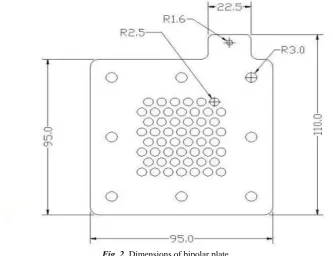
The Direct Methanol Fuel Cell device consists of two supporting plates (PMMA), stainless steel bipolar plates and a membrane electrode assembly (MEA). The CAD / CAM software I-DEAS was employed to conduct 3D solid modeling design, as shown in Fig. 1. Bipolar plates were designed with the mirror symmetry which enables the positive and negative stacking. All the holes on the plate should be aligned with each other after stacking, as shown in Fig. 2. Stainless steel bipolar plates were manufactured by a Japanese Mitsubishi laser cutting machine (3500W ML3015LVPlus).
Fig. 1. 3D solid modeling design of DMFC device: supporting plates, stainless steel bipolar plates and MEA.
Fig. 2. Dimensions of bipolar plate.
3.2 Electroless nickel-plating
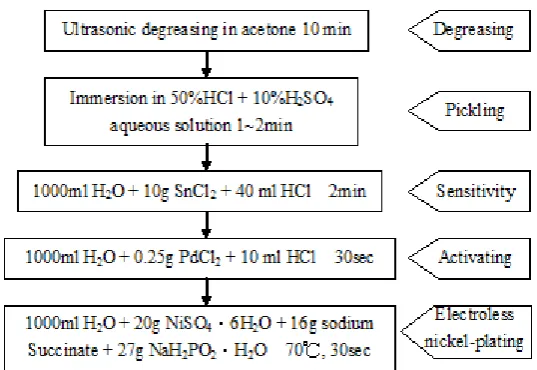
In this study, type 304 stainless steel plates were chosen as the bipolar plates of a DMFC. Before electroless plating, the stainless steel plates were polished on 200, 600, 800, 1000 and 1200 grit silicon carbide papers and a final polish with 1.0μm alumina powder. The polished plates were thoroughly cleaned with distilled water in an ultrasonic bath for 15 min and dried with air before passing through the procedure of the electroless method. The operating conditions and steps of this method are illustrated in Fig. 3.
Fig. 3. Flow chart of preparing the nickel - plating by an electroless method.
3.3 Cell performance testing
The experimental system uses a DMFC that includes an anode chamber for the electrochemical oxidation of the methanol, a cathode chamber for the electrochemical reduction of oxygen and a membrane electrode assembly (MEA) arranged between the anode and the cathode. On the anode side, the bare and coated SS304 stainless steels served as anode polar plates, respectively. On the cathode side, the bare SS304 stainless steel served as cathode polar plate only. A load unit was connected to the DMFC. An aqueous solution of the methanol was fed to the anode chamber while the load unit was operated at 10Ω in a loading state, enabling the methanol to crossover to the cathode, where it was oxidized. The transient voltage and current were measured using a digital-meter and the methanol crossover rate, the efficiency of direct methanol fuel cell (DMFC) and the amount of methanol electro-oxidation on the cathode side were determined from the transient current analysis. In this work, the membrane electrode assembly (MEA) was made according to the method proposed by Kin et al [10].
The fuel chamber (0.7 cm thick with an area of 25 cm2) was filled with 1.1 cm3, 3.3 cm3 and 4.4 cm3 10 vol% aqueous methanol solution, for the first, second and third measurements, respectively. All tests were performed at an ambient temperature of 25℃ and at atmospheric pressure. The voltage and current of the DMFC were monitored for approximately 36 hours to ensure a stable approach to zero current.
IV.
RESULTS
AND
DISCUSSION
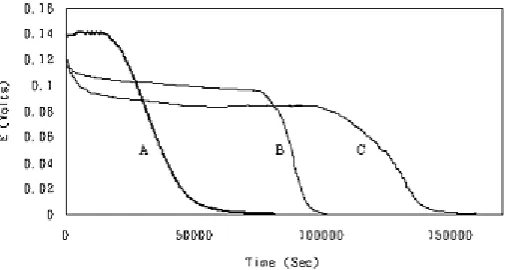
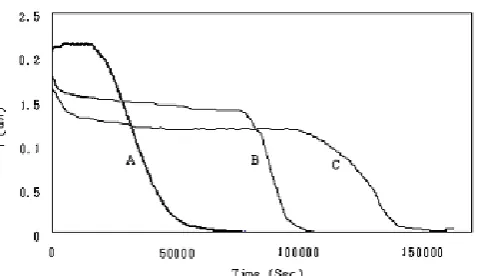
Figs. 4- 7 show the changes of transient voltage and current of the DMFC with time after each measurement was performed at a different charging volume (1.1 cm3, 3.3 cm3 and 4.4 cm3) with a particular fuel solution of 10 Vol.% methanol in water when Ni-coated and uncoated SS304 stainless steels served as anode polar plates, respectively. We compared the cell voltage and current response of the DMFC with the Ni-coated and uncoated stainless steels serving as anode polar plates, respectively. When the Ni-coated stainless steel served as the anode polar plate, we found higher cell voltage and current values than in the case of the uncoated stainless steel. These values can be attributed to the decreased crossover rate (Rc), increased efficiency (Ef) and decreased amounts of methanol electro-oxidation on the cathode side
Fig. 4. Voltage transients monitored during electro-oxidation using 10 vol. % methanol solution for DMFC with Ni-coated anode polar plate: (A) 1.1 cm3, (B) 3.3 cm3 and (C) 4.4 cm3.
Fig. 5. Current transients monitored during electro-oxidation using 10 vol. % methanol solution for DMFC with Ni-coated anode polar plate: (A) 1.1 cm3, (B) 3.3 cm3, and (C) 4.4 cm3.
V.
CONCLUSIONS
In this study, a stainless steel bipolar plate was designed and fabricated using computer-aided design and manufacturing (CAD / CAM) technology. Surface modification of the stainless steel bipolar plate was made by the electroless Ni-plating method. The methanol crossover rate of the proton exchange membrane (PEM) decreased by about 28 %, the efficiency of DMFC increased by about 2.7% and the amount of methanol electro-oxidation on the cathode side was decreased by about 10.8%, in comparison to the results of the uncoated anode polar plates. These findings were determined by transient current and mathematical analysis.
REFERENCES
[1]. Hermann A, Chaudhuri T, Spagnol P,“ Bipolar plates for PEM fuel cells: A review” Int. J. Hydrogen Energy ,2005; Vol.30,pp.1297-1302,2005.
[2]. Tawfik H, Hung Y, Mahajan D, “Metal bipolar plates for PEM fuel cell- A review.” J. Power Sources ,Vol.163, pp.755-767,2007.
[3]. Yoon W, Huang X, Fazzino P, Reifsnider KL, Akkaoui MA, “Evaluation of coated metallic bipolar plates for polymer electrolyte membrane fuel cells” J. Power Sources ,Vol.179, pp.265-273, 2008.
[4]. Kumar A, Ricketts M, Hirano S, “Ex situ evaluation of nanometer range gold coating on stainless steel substrate for automotive polymer electrolyte membrane fuel cell bipolar plate.” J. Power Sources, Vol. 195, pp.1401-1407,2010.
[5]. Satoru Hikita, Kimitaka Yamane, Yasuo Nakajima, “Measurement of methanol crossover in direct methanol fuel cell” JSAE Review,Vol. 22, pp.151-156,2001.
[6]. Narayanan SR, Kindler A, Jeffries-Nakamura B, Chun W, Frank H, Smart M, et al. “Recent advances in PEM liquid-feed direct methanol fuel cells.” Proceedings of Annual Battery Conference on Applications and Advances “ Vol. 11, pp.113-122, 1996.
[7]. Ramya K, Dhathathreyan KS, “Direct methanol fuel cells: determination of fuel crossover in a polymer electrolyte membrane.” Journal of Electroanalytical Chemistry,Vol. 542, pp.109-115, 2003.
[8]. Munichandraiah N, McGrath K, Prakash G, Aniszfeld R, Olah G,“ A potentiometric method of monitoring methanol crossover through polymer electrolyte membranes of direct methanol fuel cells.” J. Power Sources,Vol. 117, pp.98-101,2003.
[9]. Han J, Liu H, “Real time measurements of methanol crossover in a DMFC.” J. Power Sources ,Vol.164, pp.166-173, 2007.