e-ISSN: 2278-067X, p-ISSN: 2278-800X, www.ijerd.com
Volume 12, Issue 7 (July 2016), PP.69-76
Deploying a Quality Approach in the Engineering Schools in
Morocco
Zinab Aalaoui
1, Jamal Echaabi
2, Souad Ben Souda
3, Amine Rahoui
4,
Aziz Maziri
51,4,5Applied Research Team On Polymers, ENSEM, University Hassan II Of Casablanca, Morocco 2
Applied Research Team On Polymers, ESGB, University Mohammed VI of Health Sciences, Morocco 3 Laboratory Of Signals, Distributed Systems And Artificial Intelligency, ENSET Mohammedia, University
Hassan II Of Casablanca, Morocco
Abstract:-
Faced with a national vision of development, institutions of higher education in Morocco are taxed to promote the quality of their consensus governance, training and research. The following article describes a type of deployment project for a Quality Management System within an engineering department according to ISO 9001. The universal character of the employability of ISO 9001 establishes a generic quality system and adaptable to the specificities of the training sector and especially in engineering schools.Keywords:-
Quality Management System (QMS), continuous amelioration, quality assurance, higher education, quality standards.I.
INTRODUCTION
The complexity of the social and economic situation nowadays compel institutions of higher education to move from a traditional knowledge transmission strategy to a more modernized policy institution oriented to the satisfaction of its stakeholders.
In this context, the sector of higher education is faced with the need to integrate a dynamic management namely the quality one [5].
Based on three basic components: control, assurance and continuous improvement, the introduction of a Quality Management System (QMS) within an engineering school will help cover the development goals terms of governance, teaching and research.
Being involved in several development projects national and international, Morocco needs a new modeling and valuing major sector of higher education. In this sense, university courses should be tailored to these expectations [4].
The positive impact of the deployment of a Quality Management System on the effectiveness of organizations led to the reflection on the value of the projection of this model on the education system [9]. ISO 9001 from the industrial field for department is used to draw a QMS framework without trapping the organization in a tiny requirements loop.
The principle of the study is to take a formal and rational approach to quality.
Clearly, the implementation of this large project requires the establishment of a driving platform change which will ensure the support of all players in the system of training. Also, the establishment of values, initiative taking and collective interest are key issues of this new perspective.
II.
QUALITY APPROACH
Being one of the factors determining the thriving of an institution, membership in a quality approach can only bring about best practices, understanding the conditions of development of education and establishing a measurable continuous improvement device [11].
It is:
• Establishing the strategic vision of the institution, • Engaging in a quality policy,
A. Study Context
The higher education sector in Morocco is composed of two major areas: public and private [2]. Fig. 1
Fig. 1: Organization of the higher education sector in Morocco
This article examines the case of engineering schools governed by educational standards specifications that describes the conditions of recruitment of applicants, accreditation specifications, the organization and conduct of the training and the assessment methods [3].
In terms of quality of education, higher education in Morocco does not have a national repository bringing together the norms and standards that govern its operation.
The quality approach to deployment, applied to the design of an engineering program, joined the development effort to an appropriate pedagogy to facilitate the employability of future graduates. Some of the indicators are precisely the issues related to the establishment of a training process competency, namely the design and construction of repositories Engineers covering the following areas:
• Business Skills Repository for the engineer to help future graduates to understand the construction and management of their employability
• Training reference promoting the "quality" approach to engineering sciences to ensure the consistency of all training
• Study Guide adopting pedagogical innovation and relying on the skills approach and project-based learning to improve educational quality of education.
• Evaluation Toolkit: The quality assurance process is the practice of a set of actions to provide harmonization with national and international objectives. Indeed, the evaluation conducted internally by the institution will gain in credibility when it is completed by an external quality assurance.
B. Quality Management System
The series of ISO 9000 establishes a minimum standard of Quality Management System standards which are generic.
According to ISO 9001, the Quality Management System (QMS) is defined as a management system to direct and control an organization with regard to quality [8]. It thus provides for establishing a structure and a set of principles providing a good quality management strategy.
Nevertheless, the QMS implementation requires, first, a collective awareness. Indeed, membership of various stakeholders was a real challenge for the success of this project.
C. Quality assurance
Quality assurance is the practice of a set of actions to ensure compliance of services with the requirements of ISO 9001 and effective response to the needs of beneficiaries [10].
In an institution of higher education, customers benefit from the training service are many: students, ministry, recruiters …
The standardization will cover the procedures that ensure that the customer will be treated according to best practices. This quality approach aims to harmonize the principles and processes rather than standardize practices.
It is possible to experience the site on the process of teaching an engineering department to capitalize on the results and translate them to other educational departments of the school.
Public sector
Universities Faculties
Private sector
Specialized institutes Engineering
schools
Private universities
D. Quality control
The deployment of a QMS requires an operational organization in order to achieve the objectives of the quality policy. We must therefore take into account all parameters to ensure quality control at the highest level [12].
The quality control is the set of techniques and activities used to fulfill the requirements and guarantee the performance of the organization process.
E. Continuous Improvement
The quality of teaching is often associated with concepts as diverse as insurance, continuous improvement, control, governance and evaluation.
Continuous improvement is the mobilizing element of QMS will be promoted through measurement and evaluation tools.
ISO 9001 recommends the implementation of an iterative optimization process according to the model of Deming. The Deming or PDCA cycle (William Edwards Deming, 1950), consists of four stages Plan (plan), Do (develop) Check (control) and Act (act) is a systematic and progressive process. It represents a major step problem solving used by professionals [8], [13].
III. QUALITY POLICY
The foundation of any management approach, the quality policy should be established in order to provide a forum to meet at best the expectations of all stakeholders. The latter must also be tailored to the organization's objectives.
The quality policy is a short-term translation of the strategic directions of the quality chain. Such operating advantage, namely quality policy, will act on the priorities to achieve a more long-term goal.
Once this policy expressed, it must be communicated to staff (at all levels) ensuring that it is understood and accepted [1].
A. Quality commitment and policy
In an environment where higher education is a challenge for the demanding and competitive labor market, on the one hand, and applicants of highly qualified professionals in various fields of engineering on the other, the engineering sector must set a quality policy based around a set of measurable objectives to:
• Meet the requirements of the labor market (employers and recruiters trainees) and regulatory requirements • Be attentive to students, teachers and stakeholders
• Ensure the resources skills
• Improve the effectiveness of the QMS training continuously while relying on facts and data on the system • Improve the efficiency of the QMS of the sector
• Develop a partnership with suppliers of the sector in the win-win spirit
The implementation of the Quality Management System (QMS) per ISO 9001 is the tool used to achieve these aims. The quality manager is responsible for the implementation of the QMS. He must ensure that this policy is understood, implemented and maintained at all levels. He is required to ensure quality control of education in the engineering sector and its relevance to the labor market and to meet the expectations of all stakeholders. General management commitment in this carrier profits progress to all stakeholders. It provides the necessary resources for the implementation and dissemination of the policy and measurable targets rolled out of it.
B. Implementation of the quality policy
The application and understanding of the quality policy are evaluated continuously by the responsible sector. It plans and coordinates the resources to be implemented to achieve the predefined objectives. Also, it must ensure that the regulations are properly enforced [1], [8].
As a monitoring approach, leadership and process reviews will be conducted regularly. The scope of this study consists of the quality of the initial training of engineers.
C. Process approach
Processes are a set of activities correlated, which interact to transform input data into output data. Manage activities as processes achieves the goals more rationally and efficiently.
The process approach will:
• Improve readability of the organization of the sector
• Help in decision making and optimizing the functioning of the sector • Better integration of different customer needs
• An optimization resulting in the creation of benefit • A dynamic exchange between stakeholders
IV.
DEPLOYMENT OF PROJECT TYPE OF QMS IN ENGINEERING DEPARTEMENT
The implementation of a Quality Management System (QMS) will contribute to improve the quality of education, in a sustainable way, while meeting the needs of all stakeholders (students, professors, partners ...) [9], [10].
For the design of a QMS in an engineering program, we propose the following steps.
A. Clarification of the situation
This is firstly to find and highlight the strengths, weaknesses and constraints from observable elements during the inspection has taken place in an observation phase to position themselves in relation to the
requirements ISO 9001 and set targets for improvement.
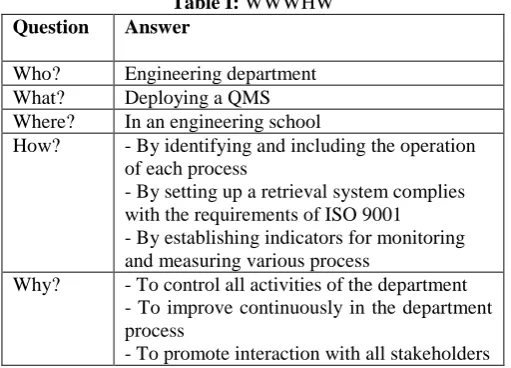
To clarify the mission of the project, the use of WWWHW tool (Table I) used to identify the scope of the problem [6], [7].
Table I: WWWHW
Question Answer
Who? Engineering department What? Deploying a QMS Where? In an engineering school
How? - By identifying and including the operation of each process
- By setting up a retrieval system complies with the requirements of ISO 9001 - By establishing indicators for monitoring and measuring various process
Why? - To control all activities of the department - To improve continuously in the department process
- To promote interaction with all stakeholders
The WWWHW above shows the critical issue to solve and provides clarification of the initial problem. Also, it defines the purpose at this stage, the business, the customers of the sector and their expectations, then, from the results of this reflection, formalizing the scope, that is to say identifying activities which are covered by the provisions of the Quality Management System.
Finally, we must define the scope of the Quality Management System (geographic area, customer typology, activities, etc.).
B. The department process
The Quality Management System in accordance with the recommendations of the series of ISO 9000, is organized by major process. The process brings together the various activities that are necessary for the realization of products and services in a given sector. These activities are generally "interrelated and interactive." The various processes are themselves interconnected.
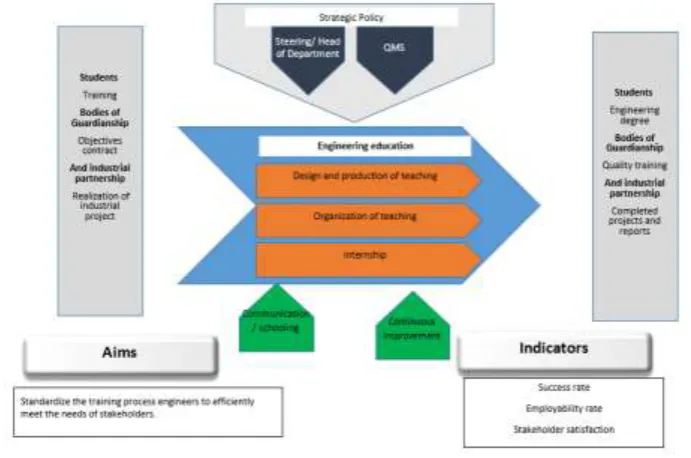
Fig. 2 shows the processes that have been identified to bring together the various activities of the department.
Fig. 2: Process mapping
Each process includes a sum of activities that need to be defined. The process approach induced the concept of customer / supplier by the fact that all processes interact with each other. It should identify interactions and ensure the integrity of the flow. To highlight this interaction provided by the hotel for a process of interaction grid is essential.
The strength of the approach lies in the cross process that it induces. Indeed, reasoning process is to remove the walls between services, optimize workflows and improve the flow of information.
The information must therefore be optimized for better movement in favor of greater customer satisfaction.
There are many naturally interactions between these processes explained in Table 2 below. Activities within each process are described by means of procedures.
Table 2: Description of interactions between processes
Steering/ Head of
Department QMS
Engineering education Communication/ Schooling Continuous improvement
Steering/ Head of Department Quality Policy Quality objectives Improvement strategy Planning /
engineering training / evaluation
Information / Reviews / Rules
Audit and assessment / improvement approaches QMS Audit Reports State corrective and preventive actions Report of the management review
Documentation Quality
Terms of placement
Documentation Quality Audit and assessment / Improvement approaches Engineering education
Quality objectives / strategic development project of the establishment
Evaluation of training reports
Planning / Display / absence management / management notes Audit and assessment / Improvement approaches Communication/
Schooling Absence management
Quality Policy / Quality Manual
Planning / Display / absence management / management notes
Dissemination of evaluation reports / Archive
Continuous improvement
Report of corrective and preventive action / continuous improvement
Report of corrective and preventive action / continuous
Report of corrective and preventive action / continuous
C. Documentation system
The quality manual, records processes, procedures, forms and records are filled documents necessary for the planning, operation and control of processes.
The quality manual is intended to formalize the rules and procedures ensuring the functioning of the Quality Management System (QMS) in the sector. This manual is organized according to ISO 9001 requirements [8]. Based on eight management principles by quality ISO 9001:
1) The focus on customers’ satisfaction in the sector. 2) Commitment of the sector to work through the QMS. 3) Development of human resources.
4) The management of the sector by process.
5) The process is the basic unit of the management quality system. 6) Continuous improvement of the system.
7) Making decisions based on facts. 8) Win-Win relationship with suppliers.
Quality Manual will address all the partners and employees of the engineering department to: • meet their expectations by transforming their requirements satisfaction,
• put the policy at the service of quality, • ensure a quality exchange,
• engage our sustained and sustainable growth policy, • setting the policy to their service quality.
V.
EXAMPLE: THE DESIGN AND PRODUCTION OF TEACHING PROCESS
The process of design and production of teaching is an operational process in which the pilot is the teacher [13].
The teacher will through analysis procedures, understand and satisfy the need of the student and measure the performance and efficiency of its processes and continuously improve based on objective measures [6]. In addition, ISO 9001 insists on:
• The orientation and customer focus: The professor and his class dependent students should therefore understand their present and future needs, meet their requirements and strives to go beyond their expectations. • Leadership: The teacher, driver of the process, will define thxe course of development mode and set qualitative and quantitative objectives, while communicating to students and raising awareness on shares. • Involvement: After the sensitization phase, it is time to empower students and involve them in making them understand the importance of their contribution in the classroom.
Engaging students in research improvement opportunities to enhance their skills knowledge and attitudes and the creation of benefit.
• The system approach to management: Providing a better understanding of roles and responsibilities necessary for achieving common objectives.
• Continuous improvement: Continuous improvement is the mobilizing element of the process that the teacher promotes through measurement and evaluation tools.
Depending on the model of Deming (PDCA), there are two loops to rotate and optimize toward meeting the expectations of students together with the labor market’s needs ensuring by this the continuity of the improvement of the educational process.
• Factual approach to decision making: According to the standard, "Effective decisions are taken following the analysis of data / facts and real information" [8]. This would mean, in class, analyzing data and information using valid methods.
Then he should take decisions and actions based on factual analysis, rational and balanced. And lately, in addition to the process approach we mentioned earlier, the eighth principle of ISO 9001 is: • The beneficial supplier relationships: In our case, the teacher is not only the driver of the process but she/he and beneficial relationship for all increases the possibilities. to the quality ... " [8]. is considered also as a supplier "An organization and its suppliers are interdependent and a healthy
Moreover, the fact of establishing strong relationships between partners (teacher and student) increases their ability to make better progress.
For this, a clear and open communication is essential.
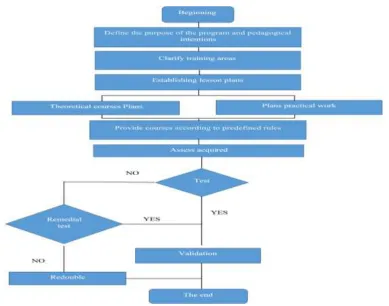
Fig. 3: Flowchart of the design and production of teaching process
Modeling in the design process and realization of training interventions will guide teachers in an optimal relationship between theory and practice. Fig.3
The relevance of this conceptualization is related to the invariance of the process that they are contextual variables of a teaching situation.
VI. CONCLUSIONS
Globally, the socio-economic issues have led to the evolution of the aims of education. Morocco, a developing country, is trying to compete, in turn, this complex situation by integrating into an improved quality of higher education construction. However, it is important to note that the definition of a standardized standard concerning the specifications for training is essential for the quality control of the education process.
This article focuses on the case of engineering colleges governed by the terms of educational standards that describes the conditions of recruitment of candidates, the specificities accreditation, organization and conduct of the training and the assessment methods.
ISO 9001 will be a mechanism to provide better customer service, a high level of quality assurance and a dynamic of continuous quality improvement of the sector.
Thus, the integration of a normative approach at a national repository can only help the promotion of engineering schools.
However, to exploit this qualitative study, experimentation is possible to capitalize on the results and standardize conceptualization.
REFERENCE
[1]. Romuald Normand, «The Measurement of School: Standards Policy and Quality Management », Cahiers de la recherche sur l’éducation et les savoirs, Hors-série n°1 | 2005.
[2]. La loi N° 01-00 portant sur l’organisation de l’enseignement supérieur marocain. [3]. Cahier des normes pédagogiques nationales du cycle ingénieur au Maroc, 2014.
[4]. Une étude du programme Tempus: Améliorer La Qualité De L’enseignement Supérieur, 2009.
[7]. Dominique Frugier, Caroline Verzat, « Un défi pour les institutions éducatives », L'Expansion Management Review 2005/1 (N° 116), p. 42-48.
[8]. Norme ISO 9001 :2015, Quality Management System.
[9]. Michèle Bailly, Catherine Cabanes, Jean- Marie Gogue, Le management de la qualité dans l’éducation, extrait du livre La qualité à l’école, Economica Paris 1998- 207 pages.
[10]. S. Karapetrovic, D. Rajamani and W. Willborn, ISO 9001 Quality System: An Interpretation for the University, Int. J. Engng Ed. Vol. 14, No. 2, p. 105±118, 1998.
[11]. Kelada J., Comprendre et réaliser la qualité totale, Dollard-des-Ormeaux, Editions Quafec, 1991. [12]. Anie Vinokur, Quality assessment of education services and the restructuring of education sectors,
Cahiers de la recherche sur l’éducation et les savoirs, Hors-série n° 1 | 2005: Pouvoirs et mesure en éducation.