p
Abstract— It is widely accepted in the brain computer interface
research community that neurological phenomena are the only source of control in any BCI system. Artifacts are undesirable signals that can interfere with neurological phenomena. They may change the characteristics of neurological phenomena or even be mistakenly used as the source of control in BCI systems.
Independent component analysis is a method that blindly separates mixtures of independent source signals, forcing the components to be independent. It has been widely applied to remove artifacts from EEG signals. Preliminary studies have shown that ICA increases the strength of motor-related signal components in the Mu rhythms, and is thus useful for removing artifacts in BCI systems.
Genetic algorithm is a type of randomized search strategy. The applicability of GAs to the optimum feature subset selection problem is obvious, and there has been considerable interest in this area in the last decade. In this paper, genetic algorithms are applied to optimum Independent component selection, and select a subset of ICs contain the best neurological phenomena suited for BCI system. We introduce novel automatic artifact removal method by means of ICA and Genetic algorithm.
Index Term— Artifact; Brain computer interface; Genetic Algorithm and Independent Component Analysis.
I. INTRODUCTION
Over the last three decades, the development of a technology called brain computer interface (BCI), has provided a novel and promising alternative method for interacting with the environment [1].
T his work was supported in part by the Iran, Computer Department of Islamic Azad University Science and Research branch and Electrical
Engineering Department K. N. T oosi University of T echnology, Intelligent System Lab.
A. Asadi Ghanbari is with the Computer Department of Islamic Azad University Science and Research branch, T ehran, Iran (e-email:
M.R. Nazari Kousarrizi is with the Biomedical Engineering Group , Electrical Engineering Department K. N. T oosi University of T echnology, T ehran, Iran (e-email: [email protected]). M. T eshnehlab is with the Control Group, Electrical Engineering Department K. N. T oosi University of T echnology , T ehran, Iran
(e-email: T [email protected]).
M. Aliyari shoorehdeli is with the Mechatronics Group, Electrical Engineering Department K. N. T oosi University of T echnology ,
T ehran, Iran (e-email: [email protected]).
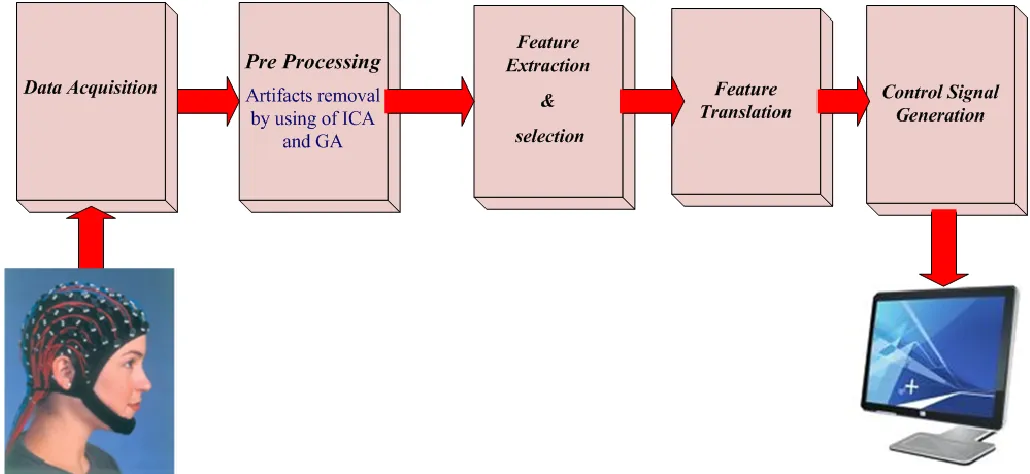
A BCI system provides a communication channel between a user‘s brain and a device the user intends to control. A successful BCI system enables a person to control some aspects of his or her environment (such as lights in the room, a television, a neural prosthesis or a computer) by analyzing his or her brain signals (see Fig. 1). Specific features of the user‘s brain activity (or ‗‗neurological phenomenon‘‘) that relate to their intent to control a device are measured. These features are then translated to control commands that are used to control the device [2].
Two major problems in this novel technology are identifies the brain signal features best suited for communication and artifacts that can occur during the signal acquisition. Artifacts are undesired signals that can introduce significant changes in brain signals and ultimately affect the neurological phenomenon. Artifacts are attributed either to non -physiological sources (such as 50/60 Hz power-line noise, changes in electrode impedances, etc.) or physiological sources, such as potentials introduced by eye or body movements.
Different methods for artifact removal are proposed in the literature. One of the most successful methods is Independent component analysis (ICA) [3]. This method based on a common successful assumption in EEG research is that signals are generated by a linear mixing of independent sources in the brain and other external components and used for artifact removing of EEG signals [4]. In this paper, we introduce a navel method for artifacts removal by using of ICA and genetic algorithm (GA).
Feature selection is one of the major tasks in classification problems. The main purpose of feature selection is to select a number of features used in the classification and at the same time to maintain acceptable classification accuracy. Various algorithms have been used for feature selection in the past decades. One of the best methods that can be used for features selection is GA [5].
performance of the classifiers.
In this research, we show how we can convert EEG activity into cursor movement by a BCI using an appropriate feature extraction scheme. The proposed automated method for the classification of EEG activity is based on signal preprocessing, feature extraction and classification. The power spectrum, variance and mean of the Daubechies mother wavelet transform used for feature extraction. Finally, we implemented a feed-forward multi-layer perceptron (MLP) with a single hidden layer with five neurons, a probabilistic neural network (PNN).and support vector machine (SVM) classifier with Gaussian RBF kernel.
II. MATERIALS AND METHODS
In this research, EEG signal used as the basic data for classification. The EEG data is from an open EEG database of University of Tuebingen. Two types of the EEG database are employed as [6].
A. Dataset I:
The datasets were taken from a healthy subject. Th e subject was asked to move a cursor up and down on a computer screen, while his cortical potentials were taken. During the recording, the subject received visual feedback of his slow cortical potentials (Cz-Mastoids). Each trial lasted 6s. During every trial, the task was visually presented by a highlighted goal at either the top or bottom of the screen to indicate negativity or positivity from second 0.5 until the end of the trial. The visual feedback was presented from second 2 to second 5.5. Only this 3.5 second interval of every trial is provided for training and testing. The sampling rate of 256 Hz and the recording length of 3.5s results in 896 samples per channel for every trial. This dataset contain 266 trials that 70% of this dataset is considered as train dataset and the rest are
considered as test. B. Dataset II:
The datasets were taken from an artificially respirated ALS patient. The subject was asked to move a cursor up and down on a computer screen, while his cortical potentials were taken. During the recording, the subject received auditory and visual feedback of his slow cortical potentials (Cz-Mastoids). Each trial lasted 8s. During every trial, the task was visually and auditorily presented by a highlighted goal at the top or bottom of the screen from second 0.5 until second 7.5 of every trial. In addition, the task ("up" or "down") was vocalised at second 0.5. The visual feedback was presented from second 2 to second 6.5. Only this 4.5 second interval of every trial is provided for training and testing. The sampling rate of 256 Hz and the recording length of 4.5s results in 1152 samples per channel for every trial. This dataset contain 200 trials that 70% of this dataset is considered as train dataset and the rest are considered as test.
Firstly Artifacts removed from the dataset. In the second step, features are extracted from the EEG signals using the Wavelet (WT), which demonstrated to be the most promising feature extraction method in other studies. Finally, support vector machine (SVM) and two different neural network types (MLP, PNN) are employed as classifiers to classify moving a cursor up and down on a computer screen.[7-11].
III. ART IFACT S INBCISYSTEMS
physiological sources. Non-physiological artifacts originate from outside the human body (such as 50/60 Hz power-line noise or changes in electrode impedances), and are usually avoided by proper filtering, shielding, etc.
Physiological artifacts arise from a variety of bodily activities. Electrocardiography (ECG) artifacts are caused by heart beats and may introduce a rhythmic activity into the EEG signal. Respiration can also cause artifacts by introducing a rhythmic activity that is synchronized with the body‘s respiratory movements. Skin responses such as sweating may alter the impedance of electrodes and cause artifacts in the EEG signals. Physiological artifacts such as ocular (EOG) and muscle (EMG) artifacts are much more challenging to handle than non -physiological ones. Moreover, controlling them during signal acquisition is not easy. There are different ways of handling these types of artifacts in BCI systems. In Section A, we examine the methods for handling Physiological artifacts in BCI systems.
a. Methods of Handling Artifacts
b. In this section, we briefly address methods of handling artifacts. Our focus throughout this section will be on Artifact removal in BCI systems.
c. Artifacts Avoidance
The first step in handling artifacts is to avoid their occurrence by issuing proper instructions to users. For example, users are instructed to avoid blinking or moving their body during the experiments. Instructing users to avoid generating artifacts during data collection has the advantage of being the least computationally demanding among the artifact handling methods, since it is assumed that no artifact is present in the signal (or that the presence of artifacts is minimal). However, it has several drawbacks. First, since many physiological signals, such as the heart beats, are involuntary, artifacts will always be present in brain signals. Even in the case of EOG and EMG activities, it is not eas y to control eye and body movements during data recording. Second, the occurrence of ocular and muscle activity during an online operation of any BCI system is unavoidable. Third, the collection of a sufficient amount of data without artifacts may be difficult, especially in cases where a subject has a neurological disability. Finally, avoiding artifacts may introduce an additional cognitive task for the subject. For example, it has been shown that refraining from eye blinking results in changes in the amplitude of some evoked.
experiments and perform the required tasks, especially those individuals with motor disabilities. Also, the ‗‗secondary‘‘ cognitive task, resulting from a s ubject trying to avoid generating a particular artifact, will not be present in the EEG signal.
e. Artifacts Removal
Artifact removal is the process of identifying and removing artifacts from brain signals. An artifact-removal method should be able to remove the artifacts as well as keeping the related neurological phenomenon intact. In this paper we introduce novel artifact removal methods that contain ICA and GA. Proposed method is an automatic removal method. In automatic removal, the BCI system automatically removed artifacts in trials that are contaminated with artifacts.
f. Independent component analysis
ICA was originally developed for blind source separation whose goal is to recover mutually independent but unknown source signals from their linear mixtures without knowing the mixing coefficients.
ICA is a computational technique for revealing hidden factors that underlie sets of measurements or signals. ICA assumes a statistical model whereby the observed multivariate data, typically given as a large database of samples, are assumed to be linear or nonlinear mixtures of some unknown latent variables. The mixing coefficients are also unknown. The latent variables are nongaussian and mutually independent and they are called the independent components of the observed data. By ICA, these independent components, also called sources or factors, can be found. Thus ICA can be seen as an extension to Principal Component Analysis and Factor Analysis. ICA is a much richer technique, however, capable of finding the sources when these classical methods fail completely.
1. ( . ) .
2.
3.
4. , 2.
T T
Choose an initial e g random weight vector w
let w E xg w x g w x w
w w w
If not converged go back to
(1)
Where
g
u
exp
u
22
, x observed data and w is a weight matrix that does ICA. Note that convergence means that the old and new values of w point in the same direction, i.e. their dot-product are (almost) equal to 1.g. Genetic Algorithm
Genetic Algorithms are adaptive heuristic search algorithm premised on the evolutionary ideas of natural selection and genetic [14]. The basic concept of GAs is designed to simulate processes in natural system necessary for evolution. The main operator of GA to search in pool of possible solutions is Crossover, Mutation and selection.
The genetic search process is iterative: evaluating, selection and recombining string in the population during each one of iterations (generation) until reaching some termination condition. Evaluation of each string is based on a fitness function that is problem-dependent. It determines which of the candidate solutions are better. This corresponds to the environmental determination of survivability in national selection. Selection of a string, which represents a point in the search space, depends on the string‘s fitness relative to those of other strings in the population, those points that have relatively low fitness.
Mutation, as in natural systems, is a very low probability operator and just flips bit. The aim of mutation is to introduce new genetic material into an existing individual; that is, to add diversity to the genetic characteristics of the population. Mutation is used in support of crossover to ensure that the full range of allele is accessible for each gene.
Crossover in contrast is applied with high probability. It is a randomized yet structured operator that allows information exchange between points. Its goal is to preserve the fittest individual without introducing any new value.
h. Artifacts Removal Using ICA AND GA
The step of proposed method as fallow: at first using ICA algorithm extract Independent components (ICs) of each trial
then GA select the best and related ICs among the hole ICs this steps illustrated in ―Fig. 2‖.
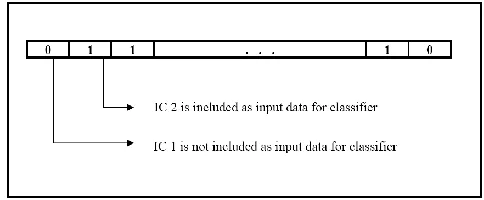
The proposed approach to the use of GAs for Artifact removal involves encoding a set of d, ICs as a binary string of d elements, in which a 0 in the string indicates that the corresponding IC is to be omitted, and a 1 that it is to be included. This coding scheme represents the presence or absence of a particular IC from the IC space (see Fig. 3). The length of chromosome equal to IC space dimension s.
Then the selected ICs used as input data for classifiers. This paper used the fitness function shown below to combine the two terms:
Fitness classification error *(Number of ActiveGens )
(2)
Where error corresponds to the classification error that used elected ICs and active Gens corresponds to the number of ICs selected (i.e., ones in the chromosome). In this function α is considered between (0, 1) and the higher α results in less selected features. In this paper α = 0.01 is chosen.
FEATURE EXTRACTION
For features extraction from the raw EEG data many methods such as time domain, frequency domain, and time–frequency domain are used. Since the EEG is non-stationary in general, it is most appropriate to use time–frequency domain methods like
wavelet transform (WT) as a mean for feature extraction [15]. The WT provides a more flexible way of time–frequency representation of a signal by allowing the use of variable sized windows. In WT long time windows are used to get a finer low-frequency resolution and short time windows are used to get high-frequency information. Thus, WT gives precise frequency information at low frequencies and precise time Fig. 2. steps of proposed Artifacts removal method using ICA and GA
TABLEI
RESULTS OBTAINED BY THE DIFFERENT ARTIFACT REMOVAL METHODS FOR DATASET I
artifact handling
method ICA Liner
filtering
ICA + GA
Classifier
MLP Train 96.9 98.32 99.7 Test 83.87 82.36 92.45
PNN Train 100 100 100 Test 87.65 85.67 91.75
SVM Train 98.86 100 99.95 Test 87.90 85.35 94.55
TABLEII
RESULTS OBTAINED BY THE DIFFERENT ARTIFACT REMOVAL METHODS FOR DATASET II
artifact handling
method ICA Liner
filtering
ICA + GA
Classifier
MLP Train 97.85 96.21 99.5 Test 84.33 81.05 90.36
PNN Train 100 99.85 100 Test 84.37 87.85 92.35
SVM Train 98.75 100 99.95 Test 85.21 86.13 92.37 Daubechies or other sharp mother wavelets, when the data has discontinuities. In this research, based on the analysis of the data, Daubechies mother wavelet was used in the decomposition. The power spectrum, variance and mean of the signal (each channel) are extracted as features. So the feature set for each subject in each trial consisted of 3*number of channels. As a result, the feature matrix was 266*18 and 200*21 for subject A and B respectively. Finally the feature matrix is normalized.
SIMULATION RESULTS
To classify cursor movements two types of the EEG database are used, 70% of each dataset used for training and the rest for test classifiers. Generally, the classification accuracy over files, which were included in training, is higher than the accuracy for the testing set. Tables I and II indicate the results of classification accuracy during training and test stages for both dataset [18].
For comparison the proposed method with other methods we use ICA and liner filtering for artifact handling separately. The result showed that using ICA and GA In comparison with ICA and liner filtering has a better performance.
CONCLUSIONS
We presented our approach to handling Physiolo gical artifacts in BCI systems and apply this method for analysis of EEG signals.
This automatic artifact handling has many advantages. First, automatic removal it is less labor intensive, especially if the paper involves a large number of subjects or a large amount of recorded data. Second, the process of selecting the artifact-free ICs didn‘t become subjective. It has been argued that because of the selection bias, the sample trials that are
artifact free may not be representative of the entire populatio n of the trials [16]. However, automatic rejection still suffers from sampling bias and loss of valuable data [17]. This method could be a solution for new BCI systems that use many channels, over 500, for data acquisition and select the best subset of related channels.
REFERENCES
[1] T . Ebrahimi, J. Vesin, and G. Garcia, ―Brain-computer interface in multimedia communication,‖ IEEE Signal Processing Magazine, pp. 14–24, Jan 2003.
[2] G. Dornhege, B. Blankertz, G. Curio, and K.-R. Muller, ― Boosting bit rates in noninvasive EEG single-trial classifications by feature combination and multiclass paradigms,‖ IEEE Transactions on Biom edical Engineering, vol. 51, no. 6, pp. 993–1002, Jun 2004. [3] N. Xu, X. Gao, B. Hong, X. Miao, S. Gao, and F.Yang, BCI
Competition 2003—Data set IIb: Enhancing P300 wave detection using ICA-based subspace projections for BCI applications, in IEEE Trans. Biom ed. Eng., vol. 51, pp. 1067–1072, June 2004.
[4] Hyvärinen, A. and Oja, E, ―Independent Component Analysis: Algorithms and Applications,‖ Neural Computation, vol 9, 1483– 1492, 2000.
[5] T e-Sheng Li, ― Feature Selection For Classificatin By Using a GA-Based Neural Network Approach‖, Journal of the Chinese Institute of Industrial Engineers, Vol. 23, No. 1, pp. 55 -64, 2006.
[6] BCI Competition 2003.
http://ida.first.fraunhofer.de/projects/bci/competition.
[7] M. R. Nazari Kousarrizi
,
A. Asadi Ghanbari, A. Gharaviri, M. T eshnehlab, M. Aliyari, ―Classification of Alcoholics and Non-Alcoholics via EEG Using SVM and Neural Networks,‖ IEEE International Conference on Bioinform atics and Biom edical Engineering, 2009.[8] M. Hagan, H. Demuth, and M. Beale, ―Neural Network Design,‖
PWS Publishing Com pany, 1995.
[9] D. K. Kim and S. K. Chang, ―Advanced Probabilistic Neural Network for the prediction of concrete Strength‖, ICCES, vol. 2, pp. 29-34, 2007.
[11] S. Chandaka, A. Chatterjee, S. Munshi, ― Cross-correlation aided support vector machine classifier for classification of EEG signals,‖ Expert Systems with Applications, 2008.
[12] Goncharova II, McFarland DJ, Vaughan T M, Wolpaw JR. "EMG contamination of EEG: spectral and topographical characteristics," Clin Neurophysiol, 2003.
[13] McFarland DJ, Sarnacki WA, Vaughan T M, Wolpaw JR, ―Brain – computer interface (BCI) operation: signal and noise during early training sessions,‖ Clin Neurophysiol; vol. 116, pp. 56–62, 2005. [14] Andries P. Engelblrecht, ―Computational Intelligence An
Introduction Second Edition,‖ John Wiley & Sons, Ltd. 2007. [15] A. Asadi Ghanbari, M. R. Nazari Kousarrizi, M. T eshnehlab, and
M. Aliyari, ―Wavelet and Hilbert T ransform-based Brain Computer Interface‖, IEEE International Conference on advances tools for engineering application. Notre dame university - Lebanon, 2009.
[16] Gratton G. ―Dealing with artifacts: the EOG contamination of the event related brain potential,‖ Behav Res Methods, Instrum, Comput; vol. 30, pp. 44–53. 1998.
[17] Millan JdelR, Mourino J. ―Asynchronous BCI and local neural classifiers: an overview of the adaptive brain interface project‖, IEEE T rans Neural Syst Rehabil Eng, Vol. 11, pp. 159 –61, 2003. [18] M. R. Nazari Kousarrizi, A. Asadi Ghanbari, M. T eshnehlab,M.