Design and Development of Meta Search
Engine Framework using Horizontal
Partitioning Relevancy Criteria and Result
Integration Factor Algorithms for Efficient
Data Retrieval
Sudeepthi Govathoti,
Research Scholar, Andhra University, Visakhapatnam & Assistant Professor, Department of CSE, Anurag Group of Institutions, Hyderabad, India.M.S.Prasad Babu,
Professor, Department of CS&SE, Andhra University, Visakhapatnam, India.Abstract—In recent years World Wide Web has tremendous growth in the volume of information that makes very difficult to locate information that is relevant to user’s interest. The search engine is the most important tool used to discover information in World Wide Web, but they are not appropriate nowadays as they do not crawl the deeper web [1]. Hence the concept of Meta search engine that is built on top of traditional search engines is adapted. This paper is aimed at the design and development of Meta search engine framework using horizontal partitioning relevancy criteria and result integration factor algorithm for efficient data retrieval. The input query given by the user gets forwarded to selected member search engines namely Google, Yahoo, and Bing. The data retrieved from member search engines are fused/merged and stored in the database. The proposed Meta Search engine framework has two core operations namely pruning and result integration. The data stored in fusion database is pruned by removing the null and irrelevant data by applying data validation and proposed “Horizontal partitioning relevancy criteria” algorithm. The pruned data is given as an input to result integration that performs re-ranking by applying result integration factor algorithm for effective display of the relevant content as per user’s interest.
Index Term— Meta search engine, Fusion database, Partitioning, Page ranking, Pruning.
I. OVERVIEW OF META SEARCH ENGINE
The search engine is a web software program that searches for information on World Wide Web. It extracts relevant information and displays the list of results based on respective page ranking mechanism. The search engine results page (SERP) is the page displayed by a web search engine in response to a keyword query given by the user [2]. The top Web-based search engines are Google, Bing, and Yahoo. The amount of information now on the World Wide Web is overwhelming as a result it makes very difficult to locate information relevant to user’s interest using these search engines. In order to provide a solution to the above problem the concept of Meta search engine also termed as “Aggregator” came into existence [3]. The Meta search engine is a search tool that accepts input from the user and simultaneously redirects it to multiple search engines and
search engines are integrated and presented to the user. Meta search engine enhances the user’s experience in retrieving information with less effort.
The remaining paper is arranged as follows: In Section 2 Motivation for implementing Meta search engine, the related work and proposed work is presented in Section 3 and 4.The methodology is discussed in Section 5. The results are presented in Section 6 and the paper is concluded in Section 7.
II. MOTIVATION
The motivation towards implementing Meta search engine depicts that it is able to synthesize the advantages from each member search engine, and the result integration could improve the quality of searching results. The primary factors for implementing Meta search engine are listed as follows:
a) Provides a broader overview of a topic searched. b) It increases the web coverage.
c) Improves convenience for users.
d) It provides an effective mechanism to reach the deeper web.
e) Helps user to reduce the overhead of searching multiple search engines.
f) It provides fast and easy access to the desired search
III. RELATED WORK
domain. Dr. Daya Gupta et.al [11] combined fuzzy AHP with a genetic algorithm to get more comprehensive and optimized results. Manika Dutta et.al [12] analysed five major search engines i.e. Google, Yahoo, AltaVista, Ask and Bing based on some features. Jai Manral et.al [13] developed an intelligent Meta search engine which aggregates results from various search engines. Abdelbaki Issam et.al [14] defined a fusion method based on user profile and improvements are suggested based on background clicks to meet the specific needs of users. M.M.E Gayar et.al [15] proposed enhanced crawling algorithm to make the retrieval process becomes faster. Hossein Jadidoleslamy et.al [16] investigated a variety of result merging methods. Lin Guoyuan et.al [17] reviewed the concept of Meta search and key technologies that greatly improve the user experience.
IV. PROPOSED WORK
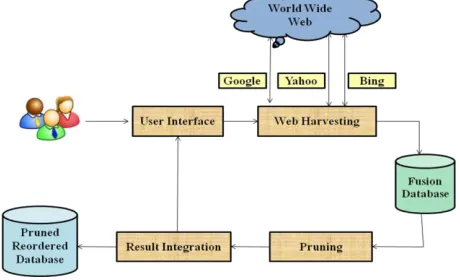
The proposed work aims at design and development of Meta search engine framework using “Horizontal partitioning relevancy criteria” and “Result Integration factor” Algorithms for efficient data retrieval. The proposed work is carried out in three steps namely Web harvesting , Pruning, and Result Integration that is depicted in figure 1:
Fig. 1. Proposed Framework of Meta search engine
A Meta search engine user interface is designed by the authors through which user can post the input search query and specifies the category of the search keyword. Three top web search engines namely Google, Yahoo, and Bing are considered as member search engines to retrieve the data. The input search query is then forwarded to the selected member search engines and results are retrieved. Every member search engine has its own page ranking mechanism. The retrieved results are fused/merged and stored in fusion database for further processing. Pruning and result integration are the two major step in the proposed MSE framework. Pruning is performed on the fused database by applying Data validation and proposed “Horizontal partitioning relevancy criteria algorithm” (HPRC Algorithm) which has three steps namely: data validation, horizontal partitioning followed by content relevancy. The pruned data is analyzed and reordered as per user’s interest by suggesting a mathematical approach that considers three parameters namely reranking, weight and
keyword relevancy score respectively with respect to a page Pi using result integration factor algorithm.
V. METHODOLOGY
The users face difficulties in finding their desired information because of the explosive growth of information on the Web. The proposed work aims at providing a solution by developing a Meta Search engine framework using proposed “Horizontal partitioning relevancy criteria” and “Result integration factor” algorithm. Implementation of the Meta search engine framework proposed in section 4 is carried out in three steps namely Member Search engine selection & Query forwarding, Pruning, and Result Integration. The details are given below:
Step -1: Web Harvesting:
Web harvesting, also referred as screen scraping fetches and extract the data from a web document using HTML parsing techniques.Three top web search engines namely Google, Yahoo, and Bing are considered as member search engines to retrieve the information from heterogeneous global information repository. A query in the form of the keyword is given as an input to this step. Member search engine selection and specifying category of search keyword facility is provided to the user. Every member search engine has its own ranking mechanism. Google search engine result page is prioritized using page rank (PR) algorithm [18], Bing prioritizes pages that are related to recent events and click-through rate (CTR) factor. The title of the website is considered as one of the major factors in Yahoo's ranking algorithm.
Fig. 2. Sections of the Web page
a) Fusion Database:
The concept of fusion can be defined as merging and storing the data obtained from multiple member search engines. The results retrieved from member search engines are given as an input to the fusion database. A sample record retrieved from document section of search engine result page(SERP) when "Data mining" is given as a input query keyword is shown in figure 3:
Fig. 3. Sample retrieved record of Document section of SERP
The fusion database maintains information in the form rows and column which consists of the following attributes namely <Title, URL, Description, Category of Keyword Specified and Input Query Keyword>. The retrieved results are fused/merged and stored in fusion database for further processing. A sample fused database is shown below in table 1:
Table I
Sample Fused table Input Query = "Data mining"
Step 2: Pruning
Pruning is a crucial step which has a huge impact on the performance of proposed framework. Pruning is necessary as data retrieved from member search engines may have Null values, redundant values and irrelevant data. These discrepancies may affect the performance as a result pruning is performed by applying data validation followed
by proposed “Horizontal partitioning relevancy criteria algorithm” (HPRC Algorithm). However, it is experienced by the end user that results are not proper and thus, keeps end user navigating within the search results for a long time.Pruning involves three steps namely: data validation, horizontal partitioning and content relevancy. The fused database is given as an input to pruning step.
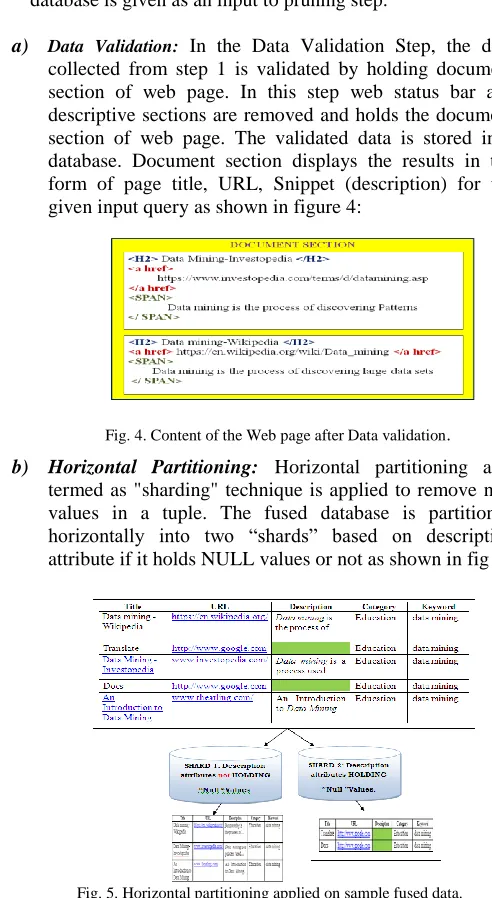
a) Data Validation: In the Data Validation Step, the data collected from step 1 is validated by holding document section of web page. In this step web status bar and descriptive sections are removed and holds the document section of web page. The validated data is stored in a database. Document section displays the results in the form of page title, URL, Snippet (description) for the given input query as shown in figure 4:
Fig. 4. Content of the Web page after Data validation.
b) Horizontal Partitioning: Horizontal partitioning also termed as "sharding" technique is applied to remove null values in a tuple. The fused database is partitioned horizontally into two “shards” based on description attribute if it holds NULL values or not as shown in fig 5:
Fig. 5. Horizontal partitioning applied on sample fused data. Each partition is termed as “shard” and all the partitions have the same schema. Each partition has its own specific subset of data.
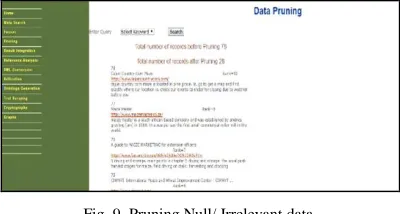
matching, then the results are redirected to the next step. If the data is found irrelevant it is partitioned as a separate relation and irrelevant data is discarded The final result obtained after applying pruning presents the relevant data by discarding Null and irrelevant values.
The illustration of “Horizontal partitioning relevancy criteria algorithm” (HPRC Algorithm) is as follows:
5.1 Algorithm: Horizontal partitioning relevancy criteria (HPRC) Input: Fusion Database
D= {T1, T2...Tn} Ti {i=1, 2…n} ,. Output: Pruned Database
PD= {T1, T2...Tn} Ti {i=1, 2…n} Attributes {A1, A2,..An}, Ai {i=1, 2…n} Represent set tuples and attributes in PRD. Parameters:
D= Database. PD=Pruned Database. Ti= Selected tuple. Ai= ith Attribute.
A (Q) = Set of attributes for input Query.
T(Q)=Set of Tuples retrieved Qk= User input Query K=1, 2,..n.
T2 (Q) = Set of relevant Tuples.
T1 (Q) = Set of Tuples after discarding NULL Values
1. For i=0; i<i+α; i≤ D do. 2. Ai = Query (D,i); 3. if (Ti !=’ ‘|| ‘NULL’ ||0)
a.T (Q) = Ti i=1, 2,..n. b.A (Q) = Ai i=1, 2,..n. c.D= A (Q). T (Q). Else
//Remove null / inconsistent// 4. Match=Compare (Qk,(Ai U Aj))
a.if(Match. equals(NULL)) Partition T (Q) into T1 (Q) discard null values
b. Result= {Compare (Qk, Ai) || Compare (Qk, Aj)} Partition T1 (Q) into T2 (Q) = {T1, T2...Tn} Final Database PD= {T2 (Q)} is with set of relevant data.
Step 3: Result Integration
The pruned data in step 2 is given as an input to result integration step. The pruned data is analyzed and reordered as per user’s interest by suggesting a mathematical approach that considers three parameters namely re-rank, weight and keyword relevancy score.
a. Reranking:
The Page rank is a query-independent concept proposed by the authors Brin and Page in their Research work on “The Anatomy of a Large-Scale Hyper Textual Web Search Engine” [19]. The concept of page rank depends upon the link structure of the web pages. The rank of each page is
determined by the number of links (in links and out links) connected with each page, where “in link” refers to the links connecting to the current page and “out links” refers to the number of pages connecting from the current page. The reranking strategy applied for the Page Pi is expressed as:
Pi = represents ith page D= Damping factor
OL (Pi) = Out bound links of page Pi
The results retrieved from member search engines have their own r anking mechanism but the results presented needs to be further refined by considering the other parameters like weight and keyword relevancy score The average score of these three parameters present the effective presentation of results with the highest precedence.
a. Weight:
The pruned data in step 2 is given as an input to result integration step. The attributes <Title/ Description> are considered for weight calculation of the page. The weight of a page is determined by calculating the frequency of the Title/ description attributes obtained from different member search engines in a recursive manner. The results are rearranged basing on the maximum weight in ascending order. The weight calculation of a page using attribute frequency is given as follows:
W (Pi) = Weight of Page Pi. Ak= Kth Attribute of selected page. F = Frequency of the Kth attribute.
b. Keyword relevancy score:
The keyword relevancy score of each page is analyzed by comparing input query with the description attribute. The relevancy of a keyword is calculated by matching the input query with the content of description attribute. The Expression for keyword relevancy score can be defined as:
Pi = represents ith page
F= Frequency of search keyword, Qk = Input query keyword Pi = represents ith page
F= Frequency of search keyword Qk = Input query keyword
Ak= Kth Attribute of selected page.
aggregate of reranking, weight and Keyword relevancy score can be given as follows:
W (Pi) = Weight of Page Pi
RR (P
i) = Rerank of P
iKRs (Pi) =Keyword relevancy score of Pi
5.2 Algorithm: Result Integration Factor algorithm (RIF)
Input: Pruned Database PD= {T1, T2...Tn} Ti {i=1, 2…n}
Output: RIF = Result integration factor for each tuple
{T1, T2...Tn} Ti {i=1, 2…n}
Parameters: PD= Pruned Database
RIF= Result Integration Factor
PR (Pi) =Page Rank of page Pi
D=Damping Factor (0.85)
OL=Number of Out bound links
W (Pi) = Weight of page Pi
F (Ak) =Frequency of an attribute Ak.
W (Pi) = Weight of Page Pi.
KRS(Pi) = Keyword relevancy Score
N= Number of Results retrieved.
Qk=User input Query
1. For i=0; i<i+α; i≤ PD do.
2. Arrange PD = PR(Pi)
// Data stored as per retrieved PR//
3. Calculate Result Integration Factor(RIF)
a) Calculate RR (Pi) =((1-d)+(d* PR(Pi)/OL(Pi)))
b) Calculate W(Pi) = F(Ak)
c) Calculate KRS(Pi)= F(Qk ,Ak)
d) RIF (Pi) = (RR (Pi) +W (Pi) +KRs (Pi))/3.
4. Rerank the PD Database as per RIF’s value.
5. Return Reordered Pruned Database.
6. End for
VI.
RESULTS AND DISCUSSION
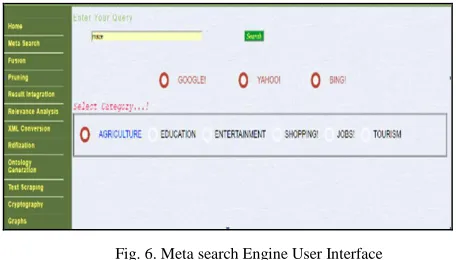
The proposed Meta search engine framework aims for efficient data retrieval using “Horizontal partitioning relevancy criteria” and “Result Integration factor” Algorithms is implemented in in PHP version: 5 (Open Source scripting language) and MySQL version: 5 (open-source relational database management system) environments. The home page of Meta search engine interface designed by the authors for the proposed work is shown in Figure 6:
Fig. 6. Meta search Engine User Interface
The user interface designed provides a facility to select member search engines and mention category of the input search query. The results retrieved after selecting member search engines and specifying category of input query keyword is shown in figure 7:
Fig. 7. Query Forwarding
The input query in the form of the keyword is then forwarded to the selected member search engines and retrieved results are stored fused /merged into the database and displayed according to the order it is retrieved. The fused data is shown in figure 8:
Fig. 8. The Fused Data from Member search engines
Fig. 9. Pruning Null/ Irrelevant data.
The pruned data is given as an input to result integration step for reordering the results based on result integration factor calculated by considering the average of three parameters namely reranking, weight and keyword relevancy score is shown in figure 10:
Fig. 10. Result integration
The relevancy analysis of sample input query keyword “Maize” is shown in Figure 11:
Fig. 11. Relevancy Analysis
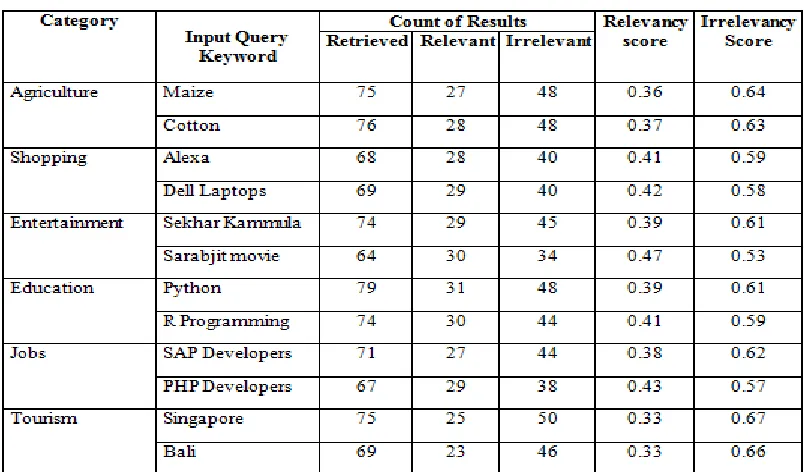
The proposed framework is tested by giving sample input queries. The count of results retrieved ,relevant and irrelevant with respect to input query is analyzed based on two parameters namely: Relevancy score and Irrelevancy score. The relevant results refers to exact match of data with respect to the user input query and the irrelevant results does not match for the given input search query that holds Null/ Irrelevant values like from YouTube, translate, images data as a part of search from google, yahoo, Bing member search engines.The efficiency of a search system is measured using two metrics namely : Relevancy score and Irrelevancy score. Relevancy Score is calculated as the ratio of the relevant results to the number of results that are retrieved. Irrelevancy Score is calculated as as the ratio of the irrelevant results to the number of results that are retrieved. The formula is as shown below:
---(1)
---(2)
TABLE II
RESULTS ANALYSIS FOR SAMPLE INPUT QUERIES
Graphical representation of Relevancy and irrelevancy Analysis for different queries searched with respect to the member searc engines selected is shown in figure 12:
Fig. 12. Graphical representation of Relevancy and Irrelevancy Analysis
TABLE III
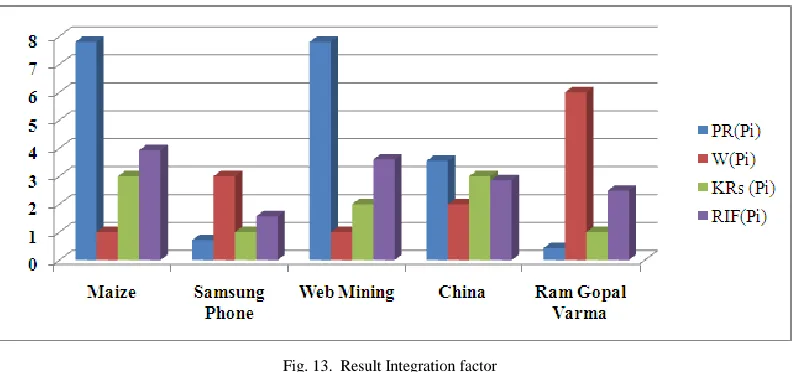
SAMPLE CALCULATION OF RESULT INTEGRATION FACTOR
A graphical representation of result integration factor calculation performed by considering the random page with their respective weights and keyword relevancy score is shown in figure 13:
Fig. 13. Result Integration factor
VII.
CONCLUSION
The Meta search engines that are built on top of traditional search engines enhance search capability of the user by integrating data from multiple member search engines. Meta search engine does not have a unique indexing mechanism to re-organize the data in its local copy of database. The inclusion of steps like Pruning and Result integration plays major role in the implementation of proposed Meta search engine framework. In proposed work pruning is performed to remove Null and irrelevant data by applying data validation and proposed “Horizontal Partitioning relevancy criteria algorithm". The pruned data is reorganized by considering the three parameters namely Reordered rank, weight, and Keyword relevancy score using “Result Integration factor algorithm". The relevant results are displayed as per user’s interest in descending order of RIF value. Semantic web capabilities can be applied to the data retrieved from Meta search engine framework for any kind of input query given by user. Application of security through cryptographic approach is carried out as future work.
REFERENCES
[1] Shama Rani and Jaiteg Singh: “Getting Bulk Data Through Google: An empirical study”, Journal of Technology Management for Growing Economies Vol. 7, No. 2, Pages 39-48, October 2016.
[2] Keerthana.I.P and Aby Abahai.T:“An Intelligent Meta Search Engine for Efficient Web Document Retrieval”, IOSR Journal of Computer Engineering (IOSR-JCE), Volume 17, Issue 2, Ver: V, Pages 45-54, (Mar– Apr 2015). [3] Aritra Banerjee, Shrey Choudhary: “Advanced Page rank algorithm with
semantics, in links, Out Links and Google Analytics”, International journal of Computer trends and technology (IJCTT)-Volume 50 Number 3 August 2017, ISSN: 2231-2803.
[4] G Sudeepthi, M Surendra Prasad Babu,” A survey on Meta search engine in semantic web” International Journal of Computer technology and applications., 2011, IJCTA, Volume 2 Issue 6 Pages 3051-3055, ISSN:2229-6093.
[5] Dr. Naresh Kumar: “Document Clustering Approach for Meta Search Engine”, Materials Science and Engineering, Doi:10.1088/1757-899X/225/1/0122, 2017.
[6] Gurneet kaur: “Role and importance of search engine optimization”, International journal of research granthaalayah, ISSN- 2350-0530(o), ISSN- 2394-3629(p).
[7] Khattab O. Khorsheed, Magda M. Madbouly and Shawkat K. Guirguis: “Search engine optimization using data mining approach”, International Journal of Computer Engineering and Applications, Volume IX, Issue VI, Part I, June 2015.
[9] Kayalvizhi.C and Swaraj Paul.C: “Refinement in Meta Search Engine for Effective Results Based on Relevance Feedback”, NCISECT Conference 2015.
[10] Suruchi Chawla: “Cluster wise optimization of clicked web pages using Genetic algorithm for effective Personalized Web Search”, International Journal of Emerging Trends & Technology in Computer Science (IJETTCS), Volume 4, Issue 1, January-February 2015.
[11] Dr. Daya Gupta Devika Singh: “MetaFusion: An Efficient Meta search Engine using Genetic Algorithm”, IEEE 2016.
[12] Manika Dutta and Dr. K. L. Bansal: “A Review Paper on Various Search Engines (Google, Yahoo, AltaVista, Ask and Bing)”, International Journal on Recent and Innovation Trends in Computing and Communication ISSN: 2321-8169, Volume: 4, Issue: 8.
[13] Jai Manral and Mohammed Alamgir Hossain: “An Innovative Approach for online Meta Search Engine Optimization”, 6th Conference on Software,
Knowledge, Information Management and Applications, China, September 2012.
[14] Abdelbaki Issam, Benlahmar E habib, and Librans Elhoussin: “Result merging for Meta search engine”, IEEE, 2013.
[15] M.M.E-gayar, N.Mekky and A.Atwan:“Efficient Proposed Framework for Semantic Search Engine using New Semantic Ranking Algorithm”, International Journal of Advanced Computer Science and Applications (IJACSA), Vol. 6, No. 8, 2015.
[16] Hossein Jadidoleslamy: “Search Result Merging and Ranking Strategies in Meta-Search Engines: A Survey”, IJCSI International Journal of Computer Science Issues, Vol. 9, Issue 4, No 3, July 2012.
[17] Lin Guoyuan and Tang Jiutao: “Studies and Evaluation on Meta Search Engines”, in proceedings of IEEE, 2011
[18] Hema Dubey and Prof. B. N. Roy:” An Improved Page Rank Algorithm based on Optimized Normalization Technique”, (IJCSIT) International Journal of Computer Science and Information Technologies, Vol. 2 (5), Pages: 2183-2188, 2011.
[19] Sergey Brin and Lawrence Page: “The Anatomy of a Large-Scale Hyper textual Web Search Engine”, Stanford Digital Libraries Project.
Prof. M.S.Prasad Babu was born on 12 -08-1956 in Andhra Pradesh, India. He
obtained his bachelors to doctoral degrees from Andhra University. He has 39 years of teaching and research experience. He guided 12 PhD's and 210 PG students for their thesis. He was the president of ICT section of ISCA in 2006-07. He attended about 50 National and International Conferences in India and abroad and presented keynotes. He contributed about 250 papers National and International journals and conferences. He developed 10 international reputed Web portals. He won ISCA Young Scientist Award in 1986, State Best teacher award for engineering in 2015 and Dr. Sarvepalli Radha Krishnan Best Academician Award of Andhra University for 2014. He was the Conference Steering Chair for eight IEEE ICSESS of Beijing, China from 2010 to 2017. Prof Babu is presently working as Vice Principal of AU Engg College, Chairman, Faculty of Engineering of Andhra University and senior Professor in Computer Science & Systems Engineering discipline.
G. SUDEEPTHI was born in, Rajahmundry, Andhra
Pradesh, India in 1983. She received B. TECH from National Institute of Technology Warangal, India in 2005 and M. Tech in Computer Science & Engineering from KLC Vijayawada, India in 2007. She is working as part time research scholar in the Dept. of CS & SE, Andhra University and as a Assistant Professor at Anurag Group of Institutions Hyderabad, India. She has got more than ten years of teaching experience. She Qualified FET-2011 Conducted by JNTUH. She contributed seven research papers in International journals and Presented one research paper at International conference in Beijing, China and another in Warangal, India.