Abstract
—Designing two-way slabs under transverse
concentrated loads is one of the challenges in designing such
structures. No certain method can be found in the design codes
or references for designing two-way slabs subjected to
concentrated loads. However, plastic method can be the best
method for designing such cases of two-way slabs. This method
requires various formulas for different conditions of RC slab
and so, is practically not simple and not usable in designing
offices. In this paper, plastic method is used for different
conditions of RC slabs and also various dimensions, in order to
derive the essential formulas followed by calculating the
positive and negative moment coefficients for concentrated
loading located in different points of a two-way slab. The
efficiency of this method is shown by a numeric example at the
end of the paper.
Index Terms
—Concentrated loading, plastic method, RC
two-way slab, yield lines.
I.
INTRODUCTION
Accurate analysis of two-way slabs having different
continuity conditions at their edges is very difficult and for
practical purposes is almost impossible. Thus, there are
several simplified methods for determining the moments,
shear forces and support reactions [1]-[2]. The methods used
for designing RC members are mostly based on elastic
analysis of the structure subjected to the ultimate loads
though, the actual behavior of an indeterministic structure is
that when one or more member reach its bending resistance,
the elastic diagrams of this part will change to some extend
and so, the elastic analysis results cannot be used anymore. In
such case if the structure has sufficient ductility, each time
that the section reaches its bending resistance, the bending
moments will redistribute until some plastic hinges or plastic
lines form and, the structure becomes unstable. In such
circumstances, the structure cannot resist any more load and
collapses (see Fig. 1). Such type of analysis in which the
bending moment diagrams at the failure point are used as a
basis for the design, is called plastic analysis [3]. Although
there are some other methods for analyzing and designing RC
slabs subjected to concentrated load such as finite elements,
finite difference methods, and also using the plate’s theory
method, but still the best and most practical available method
is the plastic method.
Manuscript received April 15, 2013; revised July 2, 2013.
Morteza Fadaee and Atefeh Iranmanesh are with Civil Eng. Dept., Shahid Bahonar Univ. of Kerman, Kerman, Iran (e-mail: [email protected]; [email protected]).
M. Javad Fadaee is with Civil Eng. Dept., Shahid Bahonar Univ. of Kerman, Kerman, Iran (e-mail: [email protected]).
Fig. 1. Failure mechanism in a slab.
In plastic method which is also known as the yield lines
method, it is assumed that the resistance of the slab is
determined by bending only, and the other factors such as
shear or displacement should be considered separately.
It must be noted that in the yield lines method the behavior
of the slab can be considered better. Many of slab systems
which cannot be analyzed with other methods such as
equivalent frame method, direct method and moment
coefficients method because of the slab specific shape or
loading type, can be designed by plastic method. In fact, by
the plastic method it is possible to design any type of slabs
with any shape subjected to any type of loadings.
Yield lines method is used for slabs which are reinforced at
any direction, which means that the section area of the
reinforcement is assumed constant per unit length, although
the value of the reinforcement can vary in the upper face or
the bottom face of the slab. It is also possible to use the yield
line analysis for slabs with non-uniform reinforcement
distribution, though it may be more difficult [3].
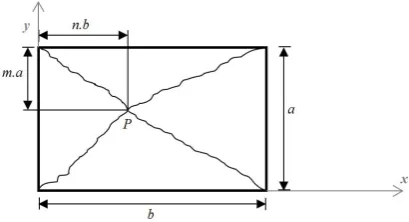
Fig. 2. Triangular failure schema for concentrated load.
II.
Y
IELDL
INEP
ATTERN FORC
ONCENTRATEDL
OADIn the case of existence of a concentrated load, the schema
of failure may include the yield lines around of the load. The
failure schema that contains the curved yield lines for the
negative moment and the radial yield lines for the positive
A Simplified Method for Designing RC Slabs under
Concentrated Loading
moment would be more critical than the failure schema with
triangular segments among the yield lines [1], However, in
this paper the triangular failure schema is used for the
concentrated load and the calculations are based on this type
of schema, (see Fig. 2).
III.
EQUATIONS FOR MOMENT COEFFICIENTS CALCULATION
In this section, the relations of the plastic method for the
rectangular slabs having simple or fixed supported edges are
obtained. For this purpose, the internal work is considered
equal to the external work based upon the following
equation,
∑
m
uxθ
xl
y+
∑
m
uyθ
yl
x=
P
δ
(1)
where
m
uy,
m
uxare moments per unit length about the
x
and
y
axes, respectively,
θ
y,
θ
xare the yield lines’ rotation angles
about the
x
and
y
axes, respectively,
l
y,
l
xare the yield lines’
lengths along the
x
and
y
axes, respectively,
P
is the
concentrated load and
δ
is the displacement under the
application point of the concentrated load. In this work, the
slab is assumed to be isotropic, therefore,
m
ux=
m
uy=
m
u.
For a rectangular slab with simple supported edges, the
following relation can be obtained from (1),
)
1
(
)
1
(
b
n
a
m
a
b
nb
a
ma
b
P
m
u−
+
−
+
+
=
(2)
)
1
(
)
1
(
1
1
1
n
r
m
r
n
r
mr
f
−
+
−
+
+
=
(3)
where,
b
a
r
=
. For rectangular slabs with fixed supported
edges, (1) results in the following equation,
)
1
(
)
1
(
b
n
a
m
a
b
nb
a
ma
b
P
m
m
u u−
+
−
+
+
=
+
− +(4)
)
)
1
(
)
1
(
1
1
(
5
.
2
1
n
r
m
r
n
r
mr
f
−
+
−
+
+
=
(5)
By similar calculations the relations needed for other
conditions of the slab edges, can be determined.
IV.
INTRODUCING DIFFERENT SLAB EDGES CONDITIONS
In this paper different conditions of the slab edges are
taken the same as are defined in [4] numbered 1 to 9. In all of
these conditions of the slab edges, the four edges are
supported and the fixing conditions only are different (see
Fig. 3).
Fig. 3. Different slab edges conditions.
Case 1: None of the edges are fixed (see Fig. 3-a).
Case 2: All of the four edges are fixed (see Fig. 3-b).
Case 3: The two shorter edges only are fixed (see Fig. 3-c).
Case 4: The two adjacent edges only are fixed (see Fig.
3-d).
Case 5: The two longer edges only are fixed (see Fig. 3-e).
Case 6: One of the longer edges only is fixed (see Fig. 3-f).
Case 7: One of the shorter edges only is fixed (see Fig.
3-g).
Case 8: One of the longer edges only is
not
fixed (see Fig.
3-h).
Case 9: One of the shorter edges only is
not
fixed (see Fig.
3-i).
V.
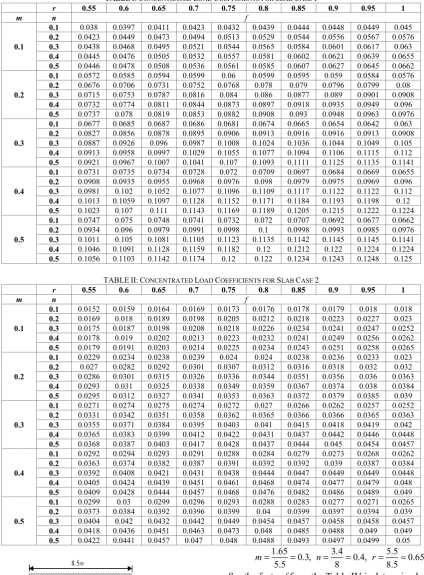
MOMENT COEFFICIENTS TABLESBase upon the equations provided in the previous section,
the values of moment coefficient are calculated for various
ratios of dimensions of two-way slabs from 0.55 to 1,
concentrated load located in different positions of the slab,
and different conditions of the edges supports as shown in the
Tables I to IV as samples. Similar tables can be prepared for
the other cases. The location of the concentrated load is
defined by the parameters
m
and
n
as shown in Fig. 2.
It must be noted that the factors calculated for parameters
m
and
n
in the tables are in values of 0.1 to 0.5 only, because
the moments for intervals of 0.5 to 1 are the same, regarding
geometry of the slab.
VI.
NUMERICAL EXAMPLE
A rectangular RC slab having dimensions of 8.5
m
×
5.5
m
for which only two adjacent edges are fixed supported is
subjected to a concentrated load of 900
kN
at a point as shown
in Fig. 3. In this example, the weight of the slab is not
accounted for. Reinforcements for positive and negative
In which
m
uis the positive moment per unit length along
the yield lines and the other parameters are defined as in Fig.
2. If it is assumed that
m
u=
f
.
P
, then the factor f can be
found from the following equation,
In which,
−u
m
is the negative moment per unit length for
the fixed supported edges and
+u
m
is the positive moment per
unit length. In this paper it is assumed that the reinforcement
in the slab is such that the slab edges can resist negative
moment about 1.5 times of the positive moment
)
5
.
1
(
−=
+ u um
moments at the edges are calculated as follows.
Parameters needed for calculating the factor
f
can be found
as follows,
TABLEI:CONCENTRATED LOAD COEFFICIENTS FOR SLAB CASE 1
r 0.55 0.6 0.65 0.7 0.75 0.8 0.85 0.9 0.95 1
m n f
0.1
0.1 0.038 0.0397 0.0411 0.0423 0.0432 0.0439 0.0444 0.0448 0.0449 0.045
0.2 0.0423 0.0449 0.0473 0.0494 0.0513 0.0529 0.0544 0.0556 0.0567 0.0576
0.3 0.0438 0.0468 0.0495 0.0521 0.0544 0.0565 0.0584 0.0601 0.0617 0.063
0.4 0.0445 0.0476 0.0505 0.0532 0.0557 0.0581 0.0602 0.0621 0.0639 0.0655
0.5 0.0446 0.0478 0.0508 0.0536 0.0561 0.0585 0.0607 0.0627 0.0645 0.0662
0.2
0.1 0.0572 0.0585 0.0594 0.0599 0.06 0.0599 0.0595 0.059 0.0584 0.0576
0.2 0.0676 0.0706 0.0731 0.0752 0.0768 0.078 0.079 0.0796 0.0799 0.08
0.3 0.0715 0.0753 0.0787 0.0816 0.084 0.086 0.0877 0.089 0.0901 0.0908
0.4 0.0732 0.0774 0.0811 0.0844 0.0873 0.0897 0.0918 0.0935 0.0949 0.096
0.5 0.0737 0.078 0.0819 0.0853 0.0882 0.0908 0.093 0.0948 0.0963 0.0976
0.3
0.1 0.0677 0.0685 0.0687 0.0686 0.0681 0.0674 0.0665 0.0654 0.0642 0.063
0.2 0.0827 0.0856 0.0878 0.0895 0.0906 0.0913 0.0916 0.0916 0.0913 0.0908
0.3 0.0887 0.0926 0.096 0.0987 0.1008 0.1024 0.1036 0.1044 0.1049 0.105
0.4 0.0913 0.0958 0.0997 0.1029 0.1055 0.1077 0.1094 0.1106 0.1115 0.112
0.5 0.0921 0.0967 0.1007 0.1041 0.107 0.1093 0.1111 0.1125 0.1135 0.1141
0.4
0.1 0.0731 0.0735 0.0734 0.0728 0.072 0.0709 0.0697 0.0684 0.0669 0.0655
0.2 0.0908 0.0935 0.0955 0.0968 0.0976 0.098 0.0979 0.0975 0.0969 0.096
0.3 0.0981 0.102 0.1052 0.1077 0.1096 0.1109 0.1117 0.1122 0.1122 0.112
0.4 0.1013 0.1059 0.1097 0.1128 0.1152 0.1171 0.1184 0.1193 0.1198 0.12
0.5 0.1023 0.107 0.111 0.1143 0.1169 0.1189 0.1205 0.1215 0.1222 0.1224
0.5
0.1 0.0747 0.075 0.0748 0.0741 0.0732 0.072 0.0707 0.0692 0.0677 0.0662
0.2 0.0934 0.096 0.0979 0.0991 0.0998 0.1 0.0998 0.0993 0.0985 0.0976
0.3 0.1011 0.105 0.1081 0.1105 0.1123 0.1135 0.1142 0.1145 0.1145 0.1141
0.4 0.1046 0.1091 0.1128 0.1159 0.1182 0.12 0.1212 0.122 0.1224 0.1224
0.5 0.1056 0.1103 0.1142 0.1174 0.12 0.122 0.1234 0.1243 0.1248 0.125
TABLEII:CONCENTRATED LOAD COEFFICIENTS FOR SLAB CASE 2
r 0.55 0.6 0.65 0.7 0.75 0.8 0.85 0.9 0.95 1
m n f
0.1
0.1 0.0152 0.0159 0.0164 0.0169 0.0173 0.0176 0.0178 0.0179 0.018 0.018
0.2 0.0169 0.018 0.0189 0.0198 0.0205 0.0212 0.0218 0.0223 0.0227 0.023
0.3 0.0175 0.0187 0.0198 0.0208 0.0218 0.0226 0.0234 0.0241 0.0247 0.0252
0.4 0.0178 0.019 0.0202 0.0213 0.0223 0.0232 0.0241 0.0249 0.0256 0.0262
0.5 0.0179 0.0191 0.0203 0.0214 0.0225 0.0234 0.0243 0.0251 0.0258 0.0265
0.2
0.1 0.0229 0.0234 0.0238 0.0239 0.024 0.024 0.0238 0.0236 0.0233 0.023
0.2 0.027 0.0282 0.0292 0.0301 0.0307 0.0312 0.0316 0.0318 0.032 0.032
0.3 0.0286 0.0301 0.0315 0.0326 0.0336 0.0344 0.0351 0.0356 0.036 0.0363
0.4 0.0293 0.031 0.0325 0.0338 0.0349 0.0359 0.0367 0.0374 0.038 0.0384
0.5 0.0295 0.0312 0.0327 0.0341 0.0353 0.0363 0.0372 0.0379 0.0385 0.039
0.3
0.1 0.0271 0.0274 0.0275 0.0274 0.0272 0.027 0.0266 0.0262 0.0257 0.0252
0.2 0.0331 0.0342 0.0351 0.0358 0.0362 0.0365 0.0366 0.0366 0.0365 0.0363
0.3 0.0355 0.0371 0.0384 0.0395 0.0403 0.041 0.0415 0.0418 0.0419 0.042
0.4 0.0365 0.0383 0.0399 0.0412 0.0422 0.0431 0.0437 0.0442 0.0446 0.0448
0.5 0.0368 0.0387 0.0403 0.0417 0.0428 0.0437 0.0444 0.045 0.0454 0.0457
0.4
0.1 0.0292 0.0294 0.0293 0.0291 0.0288 0.0284 0.0279 0.0273 0.0268 0.0262
0.2 0.0363 0.0374 0.0382 0.0387 0.0391 0.0392 0.0392 0.039 0.0387 0.0384
0.3 0.0392 0.0408 0.0421 0.0431 0.0438 0.0444 0.0447 0.0449 0.0449 0.0448
0.4 0.0405 0.0424 0.0439 0.0451 0.0461 0.0468 0.0474 0.0477 0.0479 0.048
0.5 0.0409 0.0428 0.0444 0.0457 0.0468 0.0476 0.0482 0.0486 0.0489 0.049
0.5
0.1 0.0299 0.03 0.0299 0.0296 0.0293 0.0288 0.0283 0.0277 0.0271 0.0265
0.2 0.0373 0.0384 0.0392 0.0396 0.0399 0.04 0.0399 0.0397 0.0394 0.039
0.3 0.0404 0.042 0.0432 0.0442 0.0449 0.0454 0.0457 0.0458 0.0458 0.0457
0.4 0.0418 0.0436 0.0451 0.0463 0.0473 0.048 0.0485 0.0488 0.049 0.049
0.5 0.0422 0.0441 0.0457 0.047 0.048 0.0488 0.0493 0.0497 0.0499 0.05
Fig. 4. Numerical example.
65
.
0
5
.
8
5
.
5
,
4
.
0
8
4
.
3
,
3
.
0
5
.
5
65
.
1
≈
=
=
=
=
=
n
r
m
So, the factor
f
from the Table IV is determined as 0.0574,
thus,
.
0.0574
u0.0574 900 51.66
kN m
f
m
m
+=
⇒
=
×
=
TABLEIII:CONCENTRATED LOAD COEFFICIENTS FOR SLAB CASE 3
r 0.55 0.6 0.65 0.7 0.75 0.8 0.85 0.9 0.95 1
m n f
0.1
0.1 0.0282 0.0284 0.0284 0.0283 0.0281 0.0277 0.0273 0.0268 0.0263 0.0257
0.2 0.0347 0.0359 0.0367 0.0373 0.0377 0.0379 0.0379 0.0379 0.0377 0.0374
0.3 0.0374 0.039 0.0403 0.0413 0.0421 0.0427 0.0431 0.0434 0.0435 0.0434
0.4 0.0386 0.0404 0.0419 0.0432 0.0442 0.045 0.0456 0.046 0.0463 0.0465
0.5 0.0389 0.0408 0.0424 0.0437 0.0448 0.0457 0.0464 0.0468 0.0472 0.0474
0.2
0.1 0.0375 0.0369 0.0361 0.0352 0.0343 0.0333 0.0323 0.0313 0.0303 0.0294
0.2 0.0501 0.0505 0.0506 0.0503 0.0499 0.0492 0.0485 0.0476 0.0467 0.0457
0.3 0.0558 0.0569 0.0576 0.0579 0.0579 0.0577 0.0572 0.0566 0.0559 0.0551
0.4 0.0585 0.06 0.061 0.0617 0.0619 0.0619 0.0617 0.0613 0.0607 0.06
0.5 0.0593 0.0609 0.0621 0.0628 0.0632 0.0632 0.0631 0.0627 0.0622 0.0615
0.3
0.1 0.0418 0.0406 0.0394 0.0381 0.0368 0.0355 0.0342 0.033 0.0318 0.0307
0.2 0.058 0.0578 0.0572 0.0564 0.0553 0.0542 0.053 0.0517 0.0504 0.0491
0.3 0.0658 0.0663 0.0664 0.0661 0.0655 0.0646 0.0636 0.0625 0.0613 0.06
0.4 0.0695 0.0705 0.0709 0.071 0.0706 0.07 0.0692 0.0682 0.0671 0.0659
0.5 0.0706 0.0718 0.0723 0.0724 0.0722 0.0717 0.0709 0.07 0.0689 0.0677
0.4
0.1 0.0438 0.0424 0.0409 0.0394 0.0379 0.0365 0.0351 0.0338 0.0325 0.0313
0.2 0.0618 0.0613 0.0604 0.0592 0.0579 0.0565 0.055 0.0535 0.052 0.0505
0.3 0.0708 0.071 0.0707 0.07 0.069 0.0679 0.0666 0.0652 0.0637 0.0622
0.4 0.0752 0.0758 0.0759 0.0755 0.0748 0.0738 0.0727 0.0714 0.07 0.0686
0.5 0.0765 0.0773 0.0775 0.0772 0.0766 0.0757 0.0746 0.0734 0.072 0.0706
0.5
0.1 0.0443 0.0429 0.0413 0.0397 0.0382 0.0367 0.0353 0.034 0.0327 0.0315
0.2 0.063 0.0623 0.0613 0.0601 0.0586 0.0571 0.0556 0.054 0.0525 0.051
0.3 0.0724 0.0724 0.072 0.0712 0.0701 0.0689 0.0675 0.066 0.0644 0.0629
0.4 0.0769 0.0774 0.0774 0.0769 0.0761 0.075 0.0737 0.0724 0.0709 0.0694
0.5 0.0783 0.0789 0.079 0.0787 0.0779 0.0769 0.0757 0.0744 0.0729 0.0714
TABLEIV:CONCENTRATED LOAD COEFFICIENTS FOR SLAB CASE 4
r 0.55 0.6 0.65 0.7 0.75 0.8 0.85 0.9 0.95 1
m n f
0.1
0.1 0.0183 0.0195 0.0206 0.0216 0.0225 0.0225 0.024 0.0247 0.0252 0.0257
0.2 0.0261 0.0279 0.0295 0.031 0.0324 0.0324 0.0347 0.0357 0.0366 0.0374
0.3 0.0302 0.0323 0.0342 0.0359 0.0375 0.0375 0.0403 0.0415 0.0425 0.0434
0.4 0.0326 0.0348 0.0368 0.0386 0.0403 0.0403 0.0432 0.0444 0.0455 0.0465
0.5 0.0339 0.0361 0.0381 0.0399 0.0416 0.0416 0.0443 0.0455 0.0465 0.0474
0.2
0.1 0.0219 0.0232 0.0244 0.0254 0.0264 0.0264 0.0279 0.0285 0.029 0.0294
0.2 0.0339 0.036 0.0378 0.0395 0.0409 0.0409 0.0433 0.0443 0.0451 0.0457
0.3 0.0412 0.0437 0.0459 0.0478 0.0496 0.0496 0.0523 0.0534 0.0543 0.0551
0.4 0.0458 0.0484 0.0507 0.0528 0.0545 0.0545 0.0574 0.0584 0.0593 0.06
0.5 0.0484 0.051 0.0532 0.0552 0.0569 0.0569 0.0594 0.0603 0.061 0.0615
0.3
0.1 0.0233 0.0246 0.0258 0.0269 0.0278 0.0278 0.0293 0.0299 0.0304 0.0307
0.2 0.0374 0.0395 0.0414 0.0431 0.0446 0.0446 0.0469 0.0478 0.0485 0.0491
0.3 0.0464 0.049 0.0513 0.0533 0.055 0.055 0.0576 0.0586 0.0594 0.06
0.4 0.0522 0.055 0.0574 0.0594 0.0612 0.0612 0.0638 0.0647 0.0654 0.0659
0.5 0.0557 0.0584 0.0606 0.0625 0.0641 0.0641 0.0663 0.067 0.0675 0.0677
0.4
0.1 0.0239 0.0252 0.0265 0.0275 0.0285 0.0285 0.0299 0.0305 0.0309 0.0313
0.2 0.0389 0.0411 0.043 0.0447 0.0462 0.0462 0.0485 0.0493 0.05 0.0505
0.3 0.0489 0.0515 0.0538 0.0558 0.0575 0.0575 0.06 0.061 0.0617 0.0622
0.4 0.0554 0.0582 0.0606 0.0626 0.0643 0.0643 0.0668 0.0676 0.0682 0.0686
0.5 0.0592 0.0619 0.0642 0.0661 0.0675 0.0675 0.0695 0.0701 0.0705 0.0706
0.5
0.1 0.0241 0.0254 0.0266 0.0277 0.0286 0.0286 0.0301 0.0307 0.0311 0.0315
0.2 0.0394 0.0416 0.0435 0.0452 0.0467 0.0467 0.0489 0.0498 0.0504 0.051
0.3 0.0496 0.0522 0.0545 0.0565 0.0582 0.0582 0.0608 0.0617 0.0624 0.0629
0.4 0.0563 0.0591 0.0615 0.0635 0.0652 0.0652 0.0676 0.0684 0.069 0.0694
0.5 0.0603 0.063 0.0653 0.0671 0.0686 0.0686 0.0705 0.071 0.0713 0.0714
1.5
1.5 51.66 77.49
. /
u u
m
−=
m
+=
×
=
kN m m
Now the reinforcement of positive and negative moments
can be determined based upon a design Code. In this example
CCI (Concrete Code of Iran) [5] is used. The thicknesses of
the slab
h,
and the effective depth
d
are taken as 18
cm
and
15
cm
, respectively. The concrete’s compressive strength
f
cand steel’s yield stress
f
yare 21
MPa
and 400
MPa
,
respectively
.
Thus,
m
mm
A
m
m
kN
m
u s2
82
.
1153
,
66
.
51
⇒
=
=
++
m
mm
A
m
m
kN
m
u−=
77
.
49
.
⇒
s−=
1902
.
38
2in longitudinal direction,
⎪⎩
⎪
⎨
⎧
⇒
=
⇒
=
− +mm
USE
mm
A
mm
USE
mm
A
s s
230
@
24
23
.
16170
220
@
18
47
.
9807
2 2
φ
φ
in latitudinal direction,
⎪⎩
⎪
⎨
⎧
⇒
=
⇒
=
− +
mm
USE
mm
A
mm
USE
mm
A
s s
230
@
24
09
.
10463
220
@
18
01
.
6346
2 2
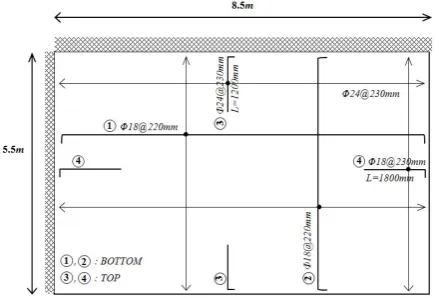
The plan of the slab’s reinforcement is shown in Fig. 5:
Fig. 5. Reinforcement of the example.
VII.
CONCLUSION
As no practical method for designing two-way RC slabs
subjected to concentrated load can be found in RC books,
publications and codes, in this research using the plastic
method (yield lines method) which is an appropriate method
for designing the slabs subjected to concentrated load,
moment coefficients for different conditions of slab edges
supports and various slab dimensions and different points of
application of the loadings have been provided that can be
used for designing RC slabs practically at the engineering
offices.
REFERENCES
[1] A. M. Kaynia, Calculation and Designing of Concrete Structures, 6th ed. Isfahan: Isfahan’s Jahad Daneshgahi, 1996, ch. 11, pp. 533-564. [2] F. Pourshahsavari and M. J. Fadaee, “Comparing the Moment
Coefficients Method and the Plastic Method in RC Slabs Designing,” in Proc. of 5th National Congress of Civil Engineering, Mashhad, 2010, pp.
[3] A. R. Rahaii, Reinforced Concrete Structures (Design and Calculation), 1st ed. Tehran: Amir-Kabir University of Technology, 1999, ch. 15, pp. 544-552.
[4] G. Winter, L. C. Urquhart, C. E. O. O’Rourke, and A. H. Nilson, Design of Concrete Structures, 7th ed. New York, McGraw-Hill, 1964, ch. 4, pp 200-203.
[5] Concrete Code of Iran, Iranian Standard-2000.
Morteza Fadaee was born in December 7, 1989 in Kerman, Iran. Morteza has spent some of his school classes in Waterloo, Canada. After coming back to Iran, he spent his secondary and high school grades at Kerman’s Allameh-Helli (NODET) high school. Now he is studying at Civil Engineering Department of Shahid Bahonar University of Kerman.
He is also working for a consulting engineers co. in Kerman for 2 years and have been worked for some other companies in his past. He is teacher assistant in some courses in his university now, and was TA in Besat College of Kerman last year.
Atefeh Iranmanesh was born in March 9, 1990 in Kerman, Iran. She spent her secondary and high school grades at Kerman’s Farzanegan (NODET) high school. Now she is studying at Civil Engineering Department of Shahid Bahonar University of Kerman.
She is working for a consulting engineers co. in Kerman for one year.
Mohammad Javad Fadaee was born in July 7, 1958 in Kerman, Iran. He completed his B.Sc. and M.Sc. degrees at University of Tehran, Tehran, Iran. He got his Ph.D. degree in 1996 from University of Waterloo, Ontario, Canada.
He has worked in various organizations and companies after his graduation. He is now an associate professor in his hometown university; Shahid Bahonar University of Kerman, Kerman, Iran. He has more than 26 years’ experience of teaching and researching. He has published more than 120 papers in journals and conference proceedings in his main field, optimization and other Civil Engineering fields.