ISSN: 2319-6505
DIPOLAR ADDITION REACTION
Balakrishna Kalluraya
UGC- SAP Coordinator, Department of Chemistry, Mangalore University, Mangalagangothri - 574 199, India
A R T I C L E I N F O A B S T R A C T
Dipolar addition forms a novel route for the synthesis of five membered heterocyclic compounds with high degree of regio and stereo selectivity. hence they form a versatile method for the synthesis of novel bioactive heterocycles useful as drug molecules in combinatorial synthesis. Although these 1,3-dipolarcycloadditon reaction does not replace existing methods of drug synthesis but rather it complements and extends them.
INTRODUCTION
Heterocycles constitute one of the biologically important class of compounds in organic chemistry1. The selection of heterocycles by nature as the basis of most essential biological systems may be due to the fact that the introduction of heteroatom into cyclic compound imparts new properties and its chemical flexible nature leading to better response to the many demands of biochemical systems. Furthermore all biological processes being chemical in nature and ability of heterocycles to manifest substituents around a core scaffold in defined three dimensional representations, heterocyclic ring systems have become the predominant architectural constituents of pharmaceuticals and allow variable interactions with the biological target systems.
Contemporary medicinal chemistry is targeting the synthesis of libraries of pure optically active chiral heterocyclic compounds through combinatorial chemistry during the process of drug discovery or lead optimization and thus involved in development of new synthetic methodologies that allow rapid construction of lead heterocyclic molecules.2The development of such rapid synthetic strategies would allow the medicinal chemist to assemble a large number of novel pure optically active chiral biologically active compounds in a very short period of time, thus speeding up the process of drug discovery and lead optimization. Yet alongside being rapid, the key features of the ideal synthesis are efficiency, versatility and selectivity3. To date, the most popular reaction that has adapted to fulfil these criterias for the synthesis of novel five membered heterocycles which are present widely in nature and in drugs is dipolar cycloaddition. 1,3-Dipolar cycloaddition is also a highly potential, wide ranging, nearly perfect synthetic method used in the pharmaceutical industry to generate heterocycle containing molecules of biological interest. Thus, we decided to focus mainly on the synthesis of novel five-membered heterocycles wherein atleast in any one of the steps 1,3-dipolar cycloaddition was used during their synthesis.
1,3-Dipolar cycloaddition reaction doesnot replace the existing methods of drug discovery, but rather it complements and extends them. It works well in conjunction with structure based design and combinatorial chemistry techniques and through the choice of appropriate building blocks, can provide derivatives or mimics of traditional ‘pharmacophores’, chiral drugs and natural products. However, the real power of cycloaddition lies in its ability to generate novel unconventional structures that might not necessarily resemble known pharmacophores.
Five membered heterocycles, an immensely important group of compounds that occur in a diversity of natural products and drugs4 can be synthesized efficiently from 1,3-dipolar cyclo addition reaction. Due to the common presence of five membered heterocyclic compounds in nature, they are known to interact with the receptor sites on enzymes, and hence their synthesis opens new horizons in enzyme receptor interactions for curing physiological disorders. Thus, 1,3-dipolar cyclo addition, introduced by Huisgen allow medicinal chemist to keep pace with the synthesis of pure optically active chiral five membered heterocyclic combinatorial libraries containing simple to complex ring systems, thus generating vast array of biologically important heterocyclic compounds.
The history of 1,3-dipolar cyclo addition reaction starts with Curtius, who discovered a dipole diazoacetic ester in 18835. Five years later, Buchner from Curtius group studied the reactions of diazoacetic ester withα,β- unsaturated esters and he described the first 1,3-dipolar cyclo addition reaction6. At the same time, 1,3-dipolar cyclo addition reaction of diazoalkanes7 and alkyl azides8were reported. Very shortly, Beckmann discovered azomethine oxides/ nitrones9. Nitrile oxides were discovered by Werner and Buss10. However, the scope of 1,3-dipolar cyclo addition reaction as a synthetic tool was limited, even the structure of the 1,3-dipoles and the products could not be properly assigned.
Later in 1960’s, Huisgen established the general concept and
Available Online at http://journalijcar.org
International Journal
of Current Advanced
Research
International Journal of Current Advanced Research Vol 4, Issue 5, pp 98-111, May 2015
Article History:
Received25th, April, 2015
Received in revised form30th, April, 2015 Accepted15th, May, 2015
Published online 28th, May, 2015
© Copy Right, Research Alert, 2015, Academic Journals. All rights reserved.
the synthetic scope of 1,3-dipolar cycloaddition11 by publishing a large number of research articles. He classified 1,3 dipolar cycloaddition reactions and formulated the basic definitions12. Gradually, 1,3-dipolar cycloaddition became one of the standard method for the preparation of five membered heterocycles4.
1,3-DIPOLAR CYCLOADDITION
1, 3-Dipolar cycloaddition reaction, where two organic molecules, a 1, 3-dipole I and a dipolarophile II combine to give a five-membered heterocycle III, is one of the typical reactions in synthetic organic chemistry. Starting from relatively simple and easily accessible molecules 1,3-dipolar cycloaddition reaction can offer a very powerful high yielding, regio- and stereoselective method for the synthesis of wide variety of simple as well as complex heterocyclic compounds11 including those of biological importance. Furthermore, many pretty complex heterocycles thus obtained can be readily transformed into a variety of other cyclic as well as acyclic functionalized organic molecules4.
1,3-Dipolar cycloadditions are an excellent method for constructing highly diverse, unambiguous five membered rings with a wide variety of 1,3-dipoles commercially available today. Much more diversity and novelty can be achieved by starting with non-commercial building block agents.
1,3-DIPOLE
The 1,3-dipole, also known as a ylide, is defined by Huisgen as an a-b-c structure, with a positive and a negative charge distributed over three atoms and has four π electrons13.
Based on electronic makeup, Huisgen categorized 1,3-dipoles into two general classes namely, allyl anion type and propargyl/allenyl anion type 1,3-dipoles.
Allyl Anion Type 1,3-Dipoles
The allyl anion type 1,3-dipoles are characterized by the
presence of four π electrons in three parallel p-orbitals perpendicular to the plane of 1,3-dipole and possessing a bent structure. Two resonance structures in which three centers have an electron octet, and two structures in which a or c has an electron sextet, can be drawn. The central atom b can be nitrogen, oxygen or sulfur.
Propargyl/Allenyl Anion Type 1,3-Dipoles
The propargyl/allenyl anion type has an extra π bond in the plane perpendicular to allyl anion type molecular orbital and the former orbital is for that reason not directly involved in resonance structures as well as reactions of 1,3-dipoles. Usually, the occurrence of this extra π bond makes 1,3 -dipoles of propargyl/allenyl anion type linear. Generally, the central atom b is limited to nitrogen.
1,3-Dipoles consist of mainly elements from group 14, 15, and 16. Since the parent 1,3-dipoles composed of elements from second row, and considering the above limitations on the central atom of dipole, a limited number of structures can be
formed by permutations of nitrogen, carbon, and oxygen. Higher row elements such as sulfur and phosphorus can also be incorporated in 1,3-dipoles, but according to our knowledge, only few asymmetric reactions involving these types of dipoles have been published. Hence, 12 dipoles of the allyl anion type and 6 dipoles of the propargyl/allenyl anion type are obtained. The classification and presentation of the parent 1,3-dipoles is depicted in following tables.
Meso-ionic compounds are relatively stable cyclic compounds that react as dipoles in 1,3-dipolar cycloadditions. Among them, the most common mesoionic compounds are azomethine ylide-type münchnones and azlactones and azomethine imine-type sydnones. The 1,3-dipolar cycloaddition of münchnones,14azlactones,15 and sydnones16 with alkynes was first reported by Huisgen and co-workers. Mesoionic dipoles are more stable than the corresponding non-cyclic dipoles and so are easier to handle in parallel synthesis.
*******
+
d e
a
b
+
c
-a
b
e
c
d
I II
III #
a
b
+
c
-a
-
b
+c
a
+b
c
-a
-
b
c
+ O c t e t s t r u c t u r eS e x t e t s t r u c t u r e
A lly l a n io n t y p e 1 , 3 - d ip o le s
a c
Interestingly, 1,3-dipoles are not very polar compounds, which may be explained as the polarity will be smalleras there will be balanced distribution of negative charge. Better the balanced distribution of negative charge, the smaller will be the polarity. In other words, dipole moment of various dipole depends relative contribution of the canonical forms. This can be illustrated by measuring the dipole moments of the dipoles diazomethane and N-methyl-C-phenylnitrone.
The lower values of dipole moment can be attributed to the
μ =6.2D μ =5.5D μ =1.5D
(Cal) (cal) (exp)
considerable charge cancellation that occurs in the resonance hybrid, which makes it difficult to identify exact electrophilic and nucleophilic centres within the dipolar species. Hence 1,3-dipole is always an ambivalent compound, which shows both electrophilic and nucleophilic activity at terminal atoms or reacts in the 1,3-position as a spin coupled diradical.
1,3-DIPOLAROPHILES
The multiple-bonded component, which reacts with 1,3-dipole in a cycloaddition reaction is commonly termed as the dipolarophile. For example, it can contain C≡N, C≡C, C=C, C=N, C=O, C=S etc. functional groups. The ᴫ bond in the dipolarophile may be a conjugated one, part of cumulative
Allyl anion type 1,3-dipoles
C H2
N+ C- C
-N+ C
C H2
N+ N
-C -N+
N
C H2
N+O
-C- N+ O
N H
N+N
- N
-N+ N
N N+ O
-N -N+
O
O N+O
-O -N+ O
C- O
+
C C
O+C
-C- O+ N C O
+
N
C O+O
-C -O+O
N O+ N
-N -O+N
N O+ O
-N -O+ O
O O
+
O- O
-O+ O
Azomethine imines
N itrones
Azoimines
N itro compounds Azoxy compounds
C arbonyl ylides
C arbonyl imines
C arbonyl oxides
N itrosimines
N itrosoxides
O zone
Azomethine ylides Nitrilium betaines
C N+ C- C- N+ C Nitrile ylides C N+ N- C- N+ N Nitrile imines C N+ O- C- N+ O Nitrile oxides Diazonium betaines
N N+ C- N- N+ C Diazoalkanes N N+ N- N- N+ N Azides N N+ O- N- N+ O Nitrous oxide
Propargyl/Allenyl anion type 1,3-dipoles
O N
N+ O
-R2 R1
O
N+ R3
R2 R1
O
-Munchnones
Sydnones
a b+ c-a+ b c- a- b c+ a- b+ c
O c te t s tru c tu re
S e x te t s tru c tu re
P ro p a rg y l/A lle n y l a n io n ty p e
a b c
N+ O -C H3
H
Ph
C -N+
O C H3
H
Ph
N+ OH C H3
H
Ph
N N+ CH2
-N- N+ CH2 N N +
-bond or it can be an isolated one.17-18 The most common dipolarophiles used in 1,3-dipolar cycloadditions are reactive molecules with a double or triple bond - alkenes and alkynes.
α,β-Unsaturated aldehydes, ketones, and esters, allylic alcohols, allylic halides, vinylic ethers etc. are examples of dipolarophiles that can readily react with 1,3-dipoles. In addition to these compounds, molecules with a double bond such as carbonyls, thiocarbonyls, imines etc. can also undergo cycloaddition with 1,3-dipoles.
MECHANISTIC ASPECTS
The mechanism of 1,3-dipolar cycloaddition has been intensively investigated. The first mechanistic study was published by Huisgen in 196319. A few years later, Woodward and Hoffman20defined the concept of pericyclic reactions and orbital symmetry and developed the interacting π electron model. Fukui21discovered that the chemical reactivity can be explained in terms of interacting frontier molecular orbitals: the highest occupied molecular orbital (HOMO) and the lowest unoccupied molecular orbital (LUMO). The transition state of the cycloaddition reaction has been thoroughly studied and reviewed22. Whether the mechanism of the cycloaddition is a stepwise diradical mechanism23 or a concerted mechanism sparked considerable debate24,25.
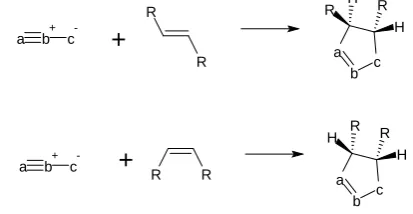
According to Huisgen, the perfect synchrony, the simultaneous formation of the two new sigma bonds, will be attained with symmetrical dipoles and dipolarophiles. So in the case of unsymmetrical reactants, the formation of one bond may lag behind the closure of the second bond in the transition state. In the end, it was concluded that the mechanism may be an asynchronous concerted reaction mechanism in which the forming bonds in the transition state are of unequal length26. The aromatic transition state of 1,3-dipolar cycloaddition has been considered as evidence for the concerted reaction mechanism27. Likewise, stereospecificity of the cycloaddition reaction has been cited to support the concerted reaction: 1,3-dipolar cycloaddition to trans- and cis-alkenes produces stereospecifically diastereomeric cycloadducts.
Effect of solvent on cycloaddition reactions has contributed additional information regarding mechanism. Many factors such as dipole-dipole attraction, coulombic forces, dispersion forces, hydrogen bonding, electrophilic and nucleophilic interactions etc contribute to the term solvent polarity. If 1,3-dipolar cycloadditions proceed through a zwitter-ionic intermediate, the rate of the reaction should be dependent on solvent polarity. On the other hand, if it is a concerted mechanism, solvent polarity will not affect the rate of the reaction. Huisgen et al studied the cycloaddition reaction between N-methyl-C-phenylnitrone and ethyl acrylate in a variety of solvents.28
They observed that change in solvent polarity did not influence reaction rates apparently. Slight retardation in the rate could be observed while moving from relatively non-polar toluene to highly non-polar ethanol was proposed to be due to the formation of activated complex. The dipolar cycloaddition reaction of phenyldiazomethane to norbornene and acrylic ester29, azomethine imine and DMAD30, phenyl azide and enamines31 etc revealed similar trends. All the above discussed studies recommended a concerted pathway for 1,3-dipolar cycloaddition reaction.
Huisgen’s group has nevertheless reported exceptions to the concerted reaction mechanism: the first two-step32 stereospecific stepwise addition and the first non-stereospecific 1,3-dipolar cycloadditions of sulfur-containing X
R1O2C X
CO2R 1
X X X
X R1O2C
CO2R1
O
R1 O
R1
R1 R1
OR1 O
R1
X
R1= H , A r , R , O R ; X = O H , C N , C l
a b+
c -d e
a b d
c e
a b d
c, e,
Huisgen Mechanism
Firestone mechanism
a b+ c
-R
R c
b a
R R H
H
a b+ c
-c b a
R H R
H
+
R R
+
Stereochemistry of 1,3-dipolar cycloaddition to trans and cis alkenes
Table 1 Effect of solvents on cycloaddition between N-methyl-C-phenyl nitrone and ethyl acrylate
Solvents ET(kcalmol-1)104k2(Lmol-1sec-1)
Toluene 33.9 4.8 Benzene 34.3 4.2
Dioxane 36 2.8
Ethyl acetate 38.1 2.6 pyridine 40.5 2.2 Acetone 42.2 1.9 Dimethyl formamide 43.2 1.7
DMSO 45.1 1.8
dipoles33, which react via zwitter-ionic intermediates.
REGIOSELECTIVITY AND REACTIVITY
Both steric and electronic factors contribute to the reactivity as well as to the regioselectivity of 1,3-dipolar cycloaddition reactions. The reactivity of 1,3-dipoles and dipolarophiles varies, and the variation has been explained with a frontier molecular orbital (FMO) model34,35.
Fukui used the interaction between highest occupied molecular orbital (HOMO) and lowest unoccupied molecular orbital(LUMO) of the reactant to predict the favourable pathway. 1,3-Dipolar cycloadditions are HOMO–LUMO controlled reactions where the reactivity depends on the nature of the dipole and dipolarophile and the energy gap between the HOMO and LUMO orbitals. The overlap of the HOMO and LUMO orbitals is maximized during the cycloaddition. According to Fukui, the charge transfer interaction between the electron donating part and electron accepting part of the reactants is the driving force for most reactions. Electron donating substituents on either the dipole or the dipolarophile raise the level of both the HOMO and LUMO, electron withdrawing substituents lower the energy of both, while conjugating groups raise the HOMO energy, but lower the energy of LUMO.
On the basis of predominant FMO interactions, the 1,3-dipolar cycloaddition reactions are classified into three types by Sustmann: type-I, type-II, and type-III.34
Type I 1,3 dipolar cycloaddition
In type-I 1,3-dipolar cycloaddition reaction, the dominant FMO interaction is that of HOMO dipole with LUMO dipolarophile. Generally this type of 1,3-dipolar cycloaddition reaction is referred to as “normal electron demand” or
“HOMO controlled” reactions. Figure shows symmetry allowed MO interactions. In Figure, the solid arrow represents low energy interactions and dotted arrow represents high energy symmetry allowed interactions. Cycloadditions of dipoles of type-I are accelerated by the presence of edg in 1,3-dipole. The reason here is that as electrons are donated into the HOMO of the dipole, it becomes less stable and rises in energy towards the LUMO of dipolarophile. On the other hand, ewg in the dipolarophile will lower the energy of the
LUMO towards the HOMO of the dipole. In both cases HOMO-LUMO separation of the predominant interaction is diminished.
Type II 1,3-dipolar cycloaddition
In type-II, since FMO energies of the dipole and alkene are similar, both HOMO-LUMO interactions are to be considered. Adding either an edg or ewg to the dipole or dipolarophile can accelerate these reactions. Figure shows symmetry allowed MO interactions. The azide system which is obtained by substitution of carbon atom of diazoalkanes by nitrogen belongs to this category. Electronegativity difference between carbon and nitrogen is sufficient to convert a 1,3-dipole of type-I to type-II. Phenyl azide shows very high reactivity towards enamines, low reactivity towards normal alkenes such as cyclohexene and rate increases when α,β -unsaturated esters (eg. DMAD) are partners in this cycloaddition. Thus, the reactivity shows a minimum for simple alkenes, while releasing as well as electron-attracting substituents increase rate of cycloaddition.
Type III 1,3-dipolar cycloaddition
Type-III 1,3-dipoles react in a manner opposite to that of I 1,3-dipoles. 1,3-Dipolar cycloaddition reaction of type-III is dominated by interaction between LUMO dipole and HOMO dipolarophile. The term‘inverse electron demand’is used to refer to this type of 1,3-dipolar cycloaddition. This is also known as “LUMO controlled” reactions. Since the dominant interaction is between LUMO dipole and HOMO dipolarophile, edgs on dipolarophile and ewgs on dipole will accelerate the reaction. Type-III dipoles are referred to as electrophilic because they tend to react more efficiently with electron rich dipolarophiles. Figure shows symmetry allowed MO interactions for the reaction between type-III dipole and dipolarophile.
1,3-Dipolar cycloaddition of azomethine ylides and azomethine imines are typical examples for type-I. The reactions of nitrones are normally classified as type-II. 1,3-Dipolar cycloadditions of nitrile oxides are also classified as type-II, but they are better classified as borderline to type-III, since nitrile oxides have relatively low lying HOMO energies. Examples of type-III interactions are 1,3-dipolar cycloaddition of ozone and nitrous oxide. However, introduction of electron-donating or electron-withdrawing
substituents on the dipole or alkene can alter the relative FMO energies, and therefore the reaction type dramatically.
Factors which stabilize/destabilize the MOs of reactants affect the reactivity. Thus, electron withdrawing substituents stabilize the MOs, electron donating substituents raise the MO energy and aromatic substituents raise the HOMO and lower the LUMO. A reduction of the MO energy of an electron-poor dipolarophile leads to a decrease of MO energy.36
The presence of a Lewis acid in 1,3-dipolar cycloaddition can alter the orbital coefficients of reacting atoms as well as the energy of the frontier orbitals of both 1,3-dipole and dipolarophile depending on the electronic properties of these reagents or the Lewis acid.37 Catalytic effect of Lewis acids on 1,3-dipolar cycloaddition reaction can be accounted for by the FMOs of either the 1,3-dipole, or the dipolarophile, when coordinated to the metal.
The increase in reactivity of 1,3-dipole and alkene in presence of metal catalysts can be attributed to a change in the FMO energy of substrate interacting with the catalyst. However, several examples of Lewis acid inhibition of dipolar cycloaddition reaction are also known which can be attributed to the facts like hydrogen bonding.
Other methods that enhance the rate of 1,3-dipolar cycloaddition include the use of ultrasound radiation,38 microwave radiation39, 40as well as biocatalysis.41
SOLVENT EFFECTS
Huisgen studied solvent effects on the rate of 1,3-dipolar cycloaddition reaction using different combinations of dipoles and dipolarophiles. He found that, over a wide range of polarities, rate of 1,3-dipolar cycloadditions showed a remarkably small solvent dependence. The small solvent effect has been generally explained as a logical consequence of early transition state i.e., a reactant-like structure for the transition state.42 Huisgen summarized these results as, the very small solvent dependence are in accordance with a concerted cycloaddition and it contradicts the formation of a zwitterionic intermediate in the rate determining step. Therefore the choice of solvents for 1,3-dipolar cycloaddition is generally based on criteria such as inertness, solubility of reactants, convenience of adduct isolation, or price and availability.43
REGIOCHEMISTRY OF CYCLOADDITION
1,3-Dipolar cycloaddition can be regioselective. The observed regioselectivity is controlled by steric as well as electronic factors. Sometimes pure cycloadducts are isolated and occasionally a mixture of isomers is obtained.
Regiochemistry of the reaction depends on which frontier molecular orbital interaction is dominant44. If the energy difference between the HOMO and LUMO reactions is small, a mixture of regioisomers is formed. Substituents also affect atomic orbital coefficients, and thereby the regiochemistry of the cycloaddition.
Recently, more accurate density functional theory (DFT) has been applied in the mechanistic studies on 1,3-dipolar cycloadditions45, and the reactivity and regiochemistry of the cycloadditions have been predicted on the basis of electron densities derived from quantum mechanical calculations.
STEREOSELECTIVITY
Most of the 1,3-DC reactions are highly stereoselective and this may be due to the concerted nature of the reaction. When two chiral centres are formed, one arising from the dipole and the other from the dipolarophile, diastereomeric products (cis-and trans-) may be produced via endo (cis-and exo transition states. The predominant formation of each diastereomer depends on attractive p-orbital overlap of unsaturated substituents (favouring an endo transition state) and repulsive vander Walls stearic interactions (favouring an exo transition state), in most of the cases, a mixture of diastereomer is obtained.
This can be demonstrated by the reaction of C-(p-methoxyphenyl)-N-phenylnitrone with methyl crotonate.46-48 After the reaction, the products were obtained in the diastereomeric ratio of 70:30(endo:exo). Here the preference for the endo-isomer is due to the stabilizing interaction of the nitrogen p orbital with the p-orbital of carbonyl carbon. Use of chiral catalyst is another way for achieving non-racemic products.49
Though secondary orbital interactions are used to explain the endo-exo selectivity in 1,3-dipolar cycloaddition reactions, it is very weak compared to Alder reactions. Like Diels-Alder reactions, the factors such as the effect of the solvent, steric interactions, hydrogen bonding and electrostatic force also effect the exo-endo selectivity in a particular [3+2] cycloaddition reaction. Generally the governing factors of stereoselectivity in a 1,3-DC are the structure of the substrate and the presence of catalyst.50-52
a b+ c- R a
b c
R
a b
c
R
+
+
Regiochemistry of the cycloaddition
D i p o l a r o p h i l e
D i p o l e
Endo selectivity
SYNTHETIC APPLICATIONS OF 1,3-DIPOLAR CYCLOADDITIONS
Now a days, 1,3-dipolar cycloaddition reaction is extensively employed for the construction of heterocycles containing simple to complex ring systems.4The simplicity of reaction, swift accretion of polyfunctionality in a fairly small molecular skeleton, high stereochemical control, and superior predictability of its regiochemistry have contributed to the popularity of 1,3-dipolar cycloaddition reaction in organic syntheses53-59. The pretty complex heterocycles thus obtained can be readily transformed into a variety of other cyclic as well as acyclic functionalized organic molecules.41,3-Dipolar cycloaddition reaction is for that reason generally described as the single most important method for the construction of five membered heterocyclic rings in the field of synthetic organic chemistry.4
A few emerging areas in 1,3-dipolar cycloaddition reaction include transition metal catalyzed 1,3-dipolar cycloaddition reaction60-62. Some of the major reported synthetic applications of 1,3-dipolar cycloaddition chemistry include: solid phase syntheses using 1,3-dipolar cycloaddition for the synthesis of heterocycles with high degree of regioselectivity63 and enantioselectivity,64,65 polymer modification i.e., transformation of polymers into reactive polymers via 1,3-dipolar cycloaddition,66-68 generation of nano-structured semiconductors,69 surface modification of ordered mesoporous carbons,70 synthesis of fluorescent single-walled carbon nano-tubes, which is used for the diagnosis and controlled drug delivery in medical field,71 synthesis of modified DNA and RNA as molecular diagnostic tools,72-74etc.
The chemistry of the 1,3-dipolar cycloaddition reaction has thus evolved for more than 100 years, and a variety of different 1,3-dipoles have been discovered. Therefore, enormous amount of literature is available in the field. The present literature review will mainly focus on the 1,3-dipolar cycloaddition reactions of nitrones, nitrile oxides, azides and sydnones as 1,3-dipoles as they are helpful in synthesizing biologically important novel optically active nitrogen and oxygen containing heterocycles within short time interval, which is the prime focus of our study.
1,3-Dipolar cycloaddition: Application to the synthesis of bioactive agents
The 1,3-dipolar cycloaddition is very versatile synthetic tool allowing the presence of many functional groups in dipoles as well as dipolarophiles. Yields of heterocycles are elevated with a few and easily removable impurities. Apart from being efficient, rapid, versatile and selective, up to four stereogenic centres can be unambiguously generated in only one reaction
step whether a diastereo- or enantioselective approach is performed.4 Although approach of using 1,3-dipolar cycloaddition is not used to the larger extent, this field has enormous advantage over the time for the novel synthesis of pharmacologically important heterocycles.
Atorvastatin (Lipitor), the best selling drug substance of last few years, does contain a penta-substituted pyrrole ring. This drug is an example of a competitive HMG-CoA-reductase inhibitor. In atorvastatin, important syn-1,3-diol moiety is connected to the other functional constituents through a fully substituted pyrrole ring instead of the more elaborate systems which are encountered in other members of this family.
The initial synthetic method for the creation of pyrrole core in atorvastatin, reported by the Warner–Lambert company75 proved to be less successful for more complex pyrrole atorvastatin. In order to prepare the 5-isopropylpyrrole derivative a more efficient [3 + 2] cycloaddition between N,3-diphenylpropynamide component and an in situ generated mesoionic species was developed as one of the probable methods which furnished the desired pyrrole core of atorvastatin regiospecifically.76
Celecoxib belongs to the group of selective COX-2 inhibitors acting on the prostaglandin G/H synthase 2 as well as 3-phosphoinositide-dependent protein kinase 1 and is marketed by Pfizer. Interestingly, celecoxib has also been approved for familial adenomatous polyposis demonstrating its ability to induce apoptosis in certain cancer cell lines.77As this activity is not shared with all COX-2 inhibitors, it is believed that the structural features, such as the polar sulphonamide group, the lipophilic tolyl moiety and the trifluoromethylated pyrazole core with its negative electrostatic potential play a key role in apoptosis induction. In a recent study78, celecoxib has also been shown to be a rapid, freely reversible, competitive inhibitor of COX-1.
+
OCH3
C H3
O N Ph
C H3 H
H CO2Me
R H
O N Ph
C H3 H
H CO2Me
H R
+
endo (70%) exo (30%)
OMe N+ Ph
O
-N
O
N H
O H
O H
CO 2 H
F
F N
CO2H
O O O
DCC, Ac2O
90oC
F C -N+ O O
O O
-CO
2
NH O
N O
NH F O O
N N
CF 3
S O O
A novel 1,3-dipolar cycloaddition between a nitrile imide and an appropriately substituted olefin has also been used to obtain the corresponding trisubstituted pyrazole core of celecoxib79 regioselectively. Since this is a LUMO-dipole/HOMO-dipolarophile controlled reaction, an electron-rich alkene is required. Therefore, when the morpholine derived enamine was used, the desired 1,3,5-tri-substituted pyrazole was formed with 100% regioselectivity. This high regioselectivity is only obtained when a 1,1-disubstituted enamine is used, the corresponding 1,2-disubstituted enamine yields mainly the other regioisomer.
Rufinamide (Inovelon) is Novartis new CNS-active compound used in the treatment of epilepsy. The common route80,81 to the triazole ring present in this compound involves the reaction of 2,6-difluorobenzyl azide with 2-chloro acrylonitrile at temperatures around 80 °C in aqueous medium. This transformation involving [3 + 2] cycloaddition, followed by elimination was found to work best in a biphasic system, where the resulting HCl was retained in the aqueous phase thereby reducing overall amounts of polymerisation of the 2-chloroacrylonitrile starting material. In the final step the nitrile group is quantitatively hydrolysed under basic conditions to the primary amide.
Apart from this route, an improved approach has recently been described82. In this work it was shown that the highly toxic and flammable 2-chloroacrylonitrile can be readily substituted with the less toxic and less expensive methyl 3-methoxyacrylate. After thermal cycloaddition, the methyl ester is converted to the corresponding amide by the addition of methanolic ammonia. Overall, this process can be performed as a single pot procedure on a large scale to afford rufinamide in a similarly high yield and generating less waste.
The tetrazole motif as a bioisostere for a carboxyl group is a well documented structural replacement represented by five angiotensin II antagonists in the top selling 200 drugs. In order to generate the tetrazole ring, a nitrile is reacted with an azide, most commonly tributyltin azide. This is illustrated by the Novartis/Ciba-Geigy synthesis of valsartan (Diovan), where the tetrazole ring is constructed in the last step of the sequence83.
The same approach is repeated in other angiotensin AT2 antagonists, such as olmesartan, candesartan or irbesartan.
The tetrazole ring has also been introduced at the beginning of the synthesis, however, the heterocyclic ring, which has to be carried through all subsequent steps, often requires protection. One common protecting group is the trityl group as used in the synthesis of losartan84-85.
The tetrazole ring also appears in cilostazol (Pletal) which is a selective PDE3 phosphodiesterase inhibitor used as a platelet aggregation inhibitor. The tetrazole ring is prepared via the reaction of an in situ generated imidoyl chloride and hydrazoic acid delivered as a 10% solution in benzene86,87. Subsequent alkylation under Williamson conditions provides the final compound in good yield.
Many derived compounds of AZT (a reverse transcriptase inhibitor) and others were prepared through a 1,3-DC between organic azides and alkynes with the objective of decreasing the viral replication and lowering their cytotoxicity are employed in the highly active antiretroviral therapy. Nucleosidic molecules and the non-nucleosidic structures are examples of triazole-containing entities able to inhibit HIV proliferation.
SO2NH2
N H
NH2. HCl
MeCN
F3C O
O CF3 O
SO2NH2 N H NH O C H3 EtOAc S O O Cl
SO2NH2 N H N
OSO2Ph F3C
Et3N
SO2NH2 N -N+ CF3 THF N O N N CF3 S O O N H2 F F N3
H2O, 80oC, 24 h
CN Cl N N N CN F F
1 M NaOH
100oC, 1 . 5 h
N N N F F NH2 O Rufinamide, 99% 98% CN N O
CO2Me i) Bu3SnN3 ii) NaOH
iii) HCl
N O
CO2Me
N H N N N Valsartan, 65% N N OH O O O O O N H N N N Olmersartan N H N N N N N O O O O O OEt candesartan N H N N N N N O irbesartan N N N N H
Ph3CCl,
Et
3N,
THF
N N N N Ph3C
i) n -BuLi ii) B(OiPr)
3
iii) iPrOH, NH4Cl
N N N N Ph3C
B(OiPr)2 N NH N N N N O H Cl 94%
90% overall losartan
N H O Cl N N N N Cl
i) PCl5, benzene
ii) HN3 / benzene
N H O H O N N N N O NH O KOH, iPrOH
A series of compounds has been synthesized by 1,3-dipolar cycloaddition whose structure is very similar to zanamivir. In fact, compound A where R1= CH(OH)C2H5, R2= H is almost as active as zanamivir against avian influenza virus (AIV) H5N1.88
Ribavirin and their analogues are widely used for treating HCV infections. Searching for a highest inhibition of the HCV and lowest cytotoxicity, 1,2,3-triazole derivative families were prepared. Although the antiviral activity of their dibenzoylated surrogates was moderate, it was noticeable that the high regioselectivity achieved with Cuº/CuSO4 couple (favouring the 1,4-regioisomer), and the reverse regioselectivity (favouring the 1,5-regioisomer) obtained when Cp*RuCl(PPh3)2complex was employed.
There is currently substantial interest in the use of nucleic acids for modifying gene expression for therapeutic purposes. The lipid-conjugated oligonucleotides via 1,3-DC potentiates the cellular uptake of oligonucleotides and allows their intracellular delivery. These non-toxic lipid conjugates efficiently inhibit HCV internal ribosome entry site-mediated translation in human hepatic cells. The specific target was the subdomain IIId of the mentioned internal ribosome entry site at the 5’ end of the viral RNA.89
One of the most relevant applications of cycloadditions is the generation of the key intermediate in the preparation of potent and promising inhibitors of the HCV polymerase. This enveloped single-stranded RNA virus (belonging to the Flaviviridae family) is present in six major genotypes in the world industrialized nations, genotype 1 being the most prevalent, followed by genotype 2 and 3.90-92
To the best of our knowledge the synthesis of antiviral agent GSK625433 has not been reported yet,93and it appeared as a consequence of evolutive structural modifications of the precedent inhibitors, namely potency of the molecule, cell penetration and pharmacokinetics. Product (GSK625433) is the most potent and selective drug having a good pharmacokinetic profile in phases I and II. This compound does not inhibit human DNA polymerases, can be administrated in low concentrations and no significant cytotoxicity was observed.94
Cycloaddition approach for the synthesis of designed aminoacids, peptides
Synthetic aminoacids are the key component for recent developments in peptides or protein research. These synthetic aminoacids are incorporated into peptides to enhance proteolytic stability and to confer peculiar properties. By using these well designed aminoacids, conformational flexibility, selectivity and bioavailability can also be tuned in the peptides. Synthetic aminoacids are also used as polymerization precursors and also in the field of nanotechnology. Using 1,3-dipolar cycloaddition technique, synthesis of structurally important aminoacids were reported by various groups. The quaternary α-aminoacid unit inclusion
O
N N
N N
N N H
NHR O
O
O H
O
N N N
N N H
O O
O H
O N N H O
O
Triazole containing nucleoside molecules showing anti-HIV activity
O N S N
CO2H
But OMe MeO
O N S N
CO2H
N N
But OMe MeO
G S K 6 2 5 4 3 3 O
N S HO2C
CO2H
CF3
O N S N
HO2C
CO2H
Bu
t Lipid
Lipid =
= H
H H O
N N N
N NH O
lipid
O P O
O O
-P -P
O
O
P P Lipid
O
N
N N
R
OBz
BzO
BzO
O
N
N N
OBz
BzO
BzO
R
O
N N
N
CO 2 R 2 H
O H
O H O
H
R 1 AcHN
( A )
OMe
O2S
N OH
N Bn
N N O
NH O
O H
P N N N Ar O
OH R1
R2
R3
can restrict the conformational flexibility, thus improving the lipophilicity of a peptide chain.
The cycloaddition of azides to alkynes is one of the most important synthetic routes to 1H-[1,2,3]-triazoles. Tornoe et al95 reported a novel regiospecific copper (I)-catalysed 1,3-dipolar cycloaddition of terminal alkynes to azides on solid-phase system for producing diversely 1,4-substituted-[1,2,3]-triazoles in peptide backbones or side chains. The reaction conditions were fully compatible with solid-phase peptide synthesis on polar supports. The copper (I) catalysis is mild and efficient (>95% conversion and purity in most cases).
(2S, 3R, 4S)-4-Hydroxyisoleucine, found in fenugreek, is an insulin secretagogue molecule. Non-natural analogues of (2S, 3R, 4R)- and (2R, 3S, 4S)-4-hydroxyisoleucine were efficiently prepared from 1,3-dipolar cycloaddition reactions of chiral nitrones derived from either (−)- or (+)-menthone to alkenes by Aouadi et al96. The cycloadducts, obtained via the exo-approach of the alkenes to the nitrone’s through less hindered face, led after a reductive step and cleavage of the chiral auxiliary, to enantiopure non-natural amino acids in good yield.
Cycloaddition approach for the synthesis of designed carbohydrates
Bodine et al97synthesized β-cyclodextrin analogues, utilizing preferential cyclodimerization of an azido-alkyne trisaccharide via Cu(I)-catalyzed [3+2] dipolar cycloaddition of the alkyne and azide functional groups. The resultant oligosaccharide macrocycle retains the binding propensity of cyclodextrins, as demonstrated by the similar ANS association constants measured for macrocycle 1 and β -cyclodextrin. This new synthetic strategy opens up new avenues for modular preparation of functionally diverse cyclodextrin analogues that are otherwise inaccessible.
Dipolar cycloaddition in the synthesis of alkaloids
Various pharmacologically relevant alkaloids can be synthesized by 1,3-dipolar cycloaddition chemistry.
A synthetic route to the cylindricine skeleton as well as to the reported structure of the marine alkaloid lepadiformine has been achieved using an intramolecular nitrone/1,3-diene dipolar cycloaddition as the key step by Werner et al98. The synthesis began with sequential alkylations of acetone oxime to afford key intermediate oxime, which is further transformed to nitrone and underwent an intramolecular 1,3-dipolar cycloaddition to provide isoxazolidine. The tricyclic alkaloid core was later formed stereoselectively by a tandem oxidation- Michael addition of amino alcohol derived from isoxazolidine, which followed by cleavage of the O-phenyl ether of 2-epi-cylindricine C.
Kano et al99 synthesized chiral 2-pyrazolines containing a quaternary stereogenic center by a titanium BINOLate catalysed asymmetric 1,3-dipolar cycloaddition reaction between α-substituted acroleins and alkyl diazoacetates in high to excellent enantioselectivities (up to 95% ee). The synthetic utility of the optically enriched 2-pyrazoline thus obtained was demonstrated in the short synthesis of manzacidin A.
The core structure of the complex pentacyclic 5,11-methanomorphanthridine alkaloids is constructed stereospecifically in one step employing an intramolecular [3+2]-cycloaddition of non-stabilized azomethine ylide as the key step by Pandey et al100. The strategy is demonstrated by accomplishing the formal total synthesis of (±)-pancracine.
Dipolar cycloaddition in the synthesis of lactams
Alcaide et al101 reacted 2-azetidinone-tethered nitrones with various dipolarophiles which yielded isoxazolinyl-, is ..
N N N
peptide peptide
N N N
C H3
R
peptide
N N+N -R
C Cu peptide
N N+ O
-O
(-)-1
+
R OH R1
O H
R2
NH2 CO2H
R = OH, Me; R1=OH, Me, OMe; R2=Et, CH2OH, CH2OMe or enantiomers from (+)-1
CHO R2
N2CHCO2R 1
T i-B IN O L a te
( 5 - 1 0 m ol% ) C H2C l2
N N H
CHO R2
R1O 2C
u p to 9 5 % e e
N N H
CHO Me EtO2C
4 s te p s
+
N H N
HO2C O N
H B r
O m a n z a c id in A N+O
-H PhO
R
N O
H
R
H PhO
H
N
H O H
H H H13C6
O O
O
N TMS
TMS OBz
O
O N
O H
H OBz
A g (I)F C H3C N
O
O N H
oxazolidinyl-, or fused polycyclic-β-lactams, exhibiting good regio- and facial stereoselectivity, which on transformation yielded aziridinyl β-lactams or functionalized β -alkoxycarbonyl γ-lactams (derivatives of the aza analogue of paraconic acid).
1,3-dipolar cycloaddition as a tool for Synthetic intermediates
Molander et al102carried out the thermal intramolecular azide-enone 1,3-dipolar cycloaddition to yield aza-spirocyclic keto aziridines which on furtherα-hydroxylation and oxidation to the corresponding diketo aziridine provided an intermediate in a synthetic approach toward cephalotaxine.
1,3-dipolar cycloaddition as a method to develop novel Organocatalysts
Another important application of 1,3-dipolar cycloaddition is in the synthesis of organocatalysts. The in situ generated azomethine ylide on cycloaddition reaction with levoglucosenone yielded the chiral pyrrolidine derivative.103 The use of this cellulose derived pyrrolidine as efficient organocatalyst was well established from the success of asymmetric Diels-Alder reaction catalysed by it.
1,3-dipolar cycloaddition as a method to develop designed Nucleosides
Argyropoulou et al104synthesized isoxazole, isoxazoline and isoxazolidine analogues of C-nucleosides related to pseudouridine by 1,3-dipolar cycloaddition reactions of nitrile oxides and nitrones derived from mono and disubstituted
uracil-5-carbaldehydes and 2,4-dimethoxypyrimidine-5-carbaldehyde. The dimethoxy derivatives have been easily deprotected to the corresponding uracils bearing the heterocyclic ring instead of a sugar moiety.
1,3-dipolar cycloaddition in functionalization of carbon nanotubes and fullerenes
Georgakilas et al105described a general and versatile method for functionalizing different types of carbon nanotubes, using the 1,3-dipolar cycloaddition of azomethine ylides. Approximately one organic group per 100 carbon atoms of the nanotube is introduced, to yield remakably soluble bundles of nanotubes, as seen in transmission electron micrographs. The solubilization of the nanotubes generates a novel, interesting class of materials, which combines the properties of the nanotubes and the organic moiety, thus offering new opportunities for applications in materials science, including the preparation of nanocomposites.
Few-layer graphenes (FLG) produced by dispersion and exfoliation of graphite in N-methylpyrrolidone were successfully functionalized using the 1,3-dipolar cycloaddition of azomethine ylides by Quintana et al106. The amino groups attached to graphene ring selectively bind to gold nano rods, which were introduced as contrast markers for the identification of the graphene reactive sites. It was identified exfoliated. Graphene was considerably more reactive structure than graphite and hence opening the possibility to control the functionalization for use as a scaffold in the construction of organized composite nanomaterials.
A soluble, functionalized Py-SWNT has been synthesized from 1,3-dipolar cycloaddition of a nitrile oxide on the SWNT walls, similar to 1,3-dipolar cycloadditions that are common for fullerene functionalization by Avaro et al.107 The resulting Py-SWNT forms a complex with a zinc porphyrin (ZnPor) in a way similar to that reported for pyridyl-functionalized [60]-fullerenes.
N N
O N
H PhSe
O R2
H H
H H H
O Ph
O
N
O R2
O H H R1
N N
O R4
R5
R3 H H H R1
O R2
N O
O H
MeO 2C
R3 H
N H
MeO 2C
R2 R1
O
OMe O
O
CO
2H
s t e p s
O O O
N3
R
O O
O
R
R = O T B S , C l C e p h a l o t a x i n e
O
O O
C
H3 N
C H3
CO2Me
N H
O O
O H H MeO2C
C H3
Ph
AgOAc/DBU ( 0. 3 eq), MeCN
N N
OCH3
H3CO
N N H
O O
R
N N O R
O
R
N H N H O
O A r =
Ar CHO
N O R
Ar
Application of 1,3-dipolar cycloaddition in the synthesis of dendrimers
Cycloaddition reactions have attracted recently strong interest for the synthesis and modification of dendritic architectures. Various cycloaddition reactions are applied in the field of dendrimers and especially hyperbranched polymers108. High selectivity, thus high tolerance towards additional functionalities, high yields and often moderate to mild reaction conditions makes cycloaddition reactions an efficient method to synthesize hyperbranched polymers. Thus cycloaddition reactions proved very suited to prepare new types of hyperbranched structures, besides the high potential in the synthesis and modification of perfectly branched dendrimers.
ADVANTAGES OF 1,3-DIPOLAR CYCLOADDITION
Among the numerous types of known organic reactions available to use in1,3-dipolar cycloadditions are particularly attractive. Cycloadditions utilize olefins to generate new five membered hetrocycles that can be reacted further to get motifs of pharmacological interest. Cycloadditions can often be run under mild conditions, and are amenable to Lewis acid catalysis. Cycloadditions are also capable of creating multiple carbon-carbon bonds, rings, and stereo centers in a single step. By properly controlling the reaction conditions and carefully choosing substrate it is possible to obtain high levels of regio- and stereochemical control. Greater diversity of the bioactive libraries can be achieved in fewer steps, rendering to the tolerance of cycloaddition towards variations in nature of their components. Given the ready availability of starting materials, highly diverse unambiguous libraries become available quickly. The real advantage of cycloaddition over other available methods lies in its ability to generate novel structures that might not necessarily resemble known pharmacophores.
LIMITATIONS OF 1,3-DIPOLAR CYCLOADDITION
The 1,3-dipolar cycloaddition is both enabled and constrained by its reliance on a few nearly perfect reactions and this naturally raises concerns about limitations on its access to chemical diversity. The 1,3-dipolar cycloadditions yield only 5-membered rings. While these are common ring sizes, it is not possible to directly generate larger or smaller rings with
these reactions. Difficult cycloadditions may actually require harsh conditions such as extreme heating or pressure. Obviously, sensitive or unstable substrates may not be able to withstand these conditions. Finally, the products generated in these reactions are usually racemic. This is because addition can occur on opposite faces of the double bond or dipole, yielding different stereoisomers.
FUTURE PERSPECTIVE OF THE WORK
With the prevalence of cyclic structures in natural products that possess medicinal relevance and increased demand for pure optically active compounds in contemporary medicinal chemistry, new developments in dipolar cycloaddition reactions, are excelling at an ever increasing pace. Being able to meet the increasing demands of atom economy, reaction efficiency, stereoselectivity, streamlined total synthesis as well as product diversity, cycloaddition reactions have found great use in efficient assembly of numerous diverse natural products and drugs.
Cycloaddition has proven to be a powerful tool in biomedical research, ranging from lead finding through combinatorial chemistry and target template in situ chemistry, to proteomics and DNA research, using bioconjugation reactions and thus have fascinated the chemical community for generations. Still it promises to accelerate both lead finding and optimization due to its ability to install multiple stereocentres and rapid constructability of core skeletal structure of complex products.
Still there exists a drive to discover new efficient asymmetric methods in which assay of pure optically active chiral compounds can be synthesized in a regioselective and stereoselective manner. The development of these reactions might be a difficult task to overcome, but not impossible. Future developments will no doubt continue to enhance the synthetic utility of dipolar cycloaddition reaction. After a century of research in this field, there is no end in sight.
References
1. (a)M. M. Andrade, M. T. Barros, Arkivoc, 11, 299(2009). (b) B. Baruah, D. Prajapathi, A. Baruah, J. S. Sandhu, Synth. Commun., 27, 2563(1997). 2. A. Eckell, M. V. George, R. Huisgen, A. S. Kende,
Chem Ber, 110, 578(1977)
3. A. M. Sarotti, R.. A. Spanevello, A. G. Suarez, G. A. Echeverria, O. E. Piro, Org. Lett., 14, 2556(2012) 4. A. Padwa and W. H. Pearson in Synthetic
Applications of 1,3-Dipolar Cycloaddition Chemistry Toward Heterocycles and Natural Products, John Wiley & Sons, Inc., New York, 2002, 7.
5. A. Padwa, Angew. Chem., Int. Ed. Engl., 15, 123(1976).
6. A. Werner, H. Buss, Ber. Dtsch. Chem. Ges., 27, 2193(1894).
7. B. Alcaide , P. Almendros , J. M. Alonso, M. F. Aly, C Pardo, E. Sáez, M. R. Torres, J. Org. Chem., 67 (20), 7004(2002)
Newton, C. S. Sekerke, D. R. Sliskovic, M. Wilson, J. Med. Chem., 34, 357(1991)
9. B. D. Roth, U.S. Patent 4,681,893, July 21, 1987. 10. B. Voit, New J. Chem., 31, 1139(2007)
11. C. Najeera, J. M. Sansano, Angew .Chem. Int. Ed., 44, 6272(2005).
12. C. Alemparte, G. Blay, K. A. Jørgensen, Org. Lett., 7, 4569(2005).
13. C. L. Yoo, M. M. Olmstead, D. J. Tantillo, M. J. Kurth., Tetrahedron Lett., 47, 477(2006)
14. C. Nájera, J. M. Sansano, Org. Biomol. Chem.,7, 4567(2009)
15. C. W. Tornøe , C. Christensen , M. Meldal, J. Org. Chem., 67 (9), 3057 (2002)
16. D. Carmona, M. P. Lamata, F. Viguri, R. Rodriguez, L. A. Oro, F. J. Lahoz, A. I. Balana, T. Tejero, P. Merino, J. Am. Chem. Soc., 127, 13386(2005). 17. D. H. Ess, G. O. Jones, K. N. Houk, Adv. Synth.
Catal., 348, 2337(2006).
18. E. Beckmann, Ber. Dtsch. Chem. Ges., 23,
3331(1890).
19. E. Büchner, Ber. Dtsch. Chem. Ges., 21, 2637(1888). 20. E. C. Argyropoulou, P. Lianis, M. Mitakou, A. Giannoulis, J. Nowak, Tetrahedron, 62(7), 1494(2006)
21. F. Amblard, J. H. Cho, R. F. Schinazi, Chem. Rev., 109, 4207(2009).
22. G. A. Molander, M. Hiersemann, Tetrahedron Lett., 38(25), 4347(1997)
23. G. Godeau, C. Staedel, P. Barthélémy, J. Med. Chem., 16, 8427(2008).
24. G. J. Griffiths, M. B. Hauck, R. Imwinkelried, J. Kohr, C. A. Roten, G.C. Stucky, J. Gosteli, J. J. Org. Chem., 64, 8084(1999).
25. G. Pandey , P. Banerjee , R. Kumar, V. G. Puranik, Org. Lett., 7 (17), 3713 (2005)
26. G. Rimon, R. S. Sidhu, D. A. Lauver, J. Y. Lee, N. P. Sharma, C. Yuan, R.A. Frieler, R. C. Trievel, B. R. Lucchesi, W. L. Smith, Proc. Natl. Acad. Sci. U. S. A., 107, 28(2010).
27. H. V. Pechmann, Ber. Dtsch. Chem. Ges., 27, 1888(1894).
28. I. Morao, B. Lecea, F. P. Cossio, J. Org. Chem., 62, 7033(1997).
29. I. Oura, K. Shimizu, K. Ogata, S. Fukuzawa, Org. Lett., 12, 1752(2010).
30. I. Singh, Z. Zarafshani, J. F. Lutz, F. Heaney, Macromolecules, 42, 5411 (2009).
31. J. A. Joule, K. Mills, Heterocyclic Chemistry, 4thEd., Blackwell Publishing, 2000, 369.
32. J. Geittner, R. Huisgen, H. U. ReiBing, Heterocycles(sendai), 11, 109 (1978)
33. J. Ju, T. S. Seo, Z. Li, Z. Tetrahedron Lett., 45, 3143(2004)
34. J. Li., M. Zheng, W. Tang, P.-L. He, W. Zhu, T. Li, J.-P. Zuo, H. Liu, H. Jiang, Bioorg. Med. Chem. Lett. 16, 5009(2006).
35. J. Yu, L. He, X. Chen, J. Song, W. Chen, L. Gong, Org. Lett., 11, 4946 (2009).
36. J. Zhu, X. Song, H. P. Lin, D. C. Young, S. Yan, V. E. Marquez, C. S. Chen., J. Natl. Cancer Inst., 94, 1745(2002).
37. K. Aouadi, E. Jeanneau, M. Msaddek, Jean-Pierre Praly, Tetrahedron Asymmetry, 19(9), 1145( 2008) 38. K. D. Bodine , D. Y. Gin , M. S. Gin, J. Am. Chem.
Soc., 126 (6), 1638(2004)
39. K. Fukui, Acc. Chem. Res., 4, 57(1971).
40. K. Gutsmiedl, C. T. Wirges, V. Ehmke, T. Carell, Org. Lett., 11, 2405(2009).
41. K. Harju, M. Vahermo, I. Mutikainen, J. Y. Kauhaluoma, J. Comb. Chem., 5, 826 (2003). 42. K. Harju, Yli-Kauhaluoma, J. Recent Res. Devel.
Organic Chem., 8, 111 (2004).
43. K. Kavitha, P. Venuvanalingam., J. Chem. Soc. Perkin Trans. 2, 2130(2002)
44. K. M. Werner , J. M. de los Santos , S. M. Weinreb, M. Shang, J. Org. Chem., 64 (13), 4865(1999) 45. K. N. Houk, J. Am. Chem. Soc., 95, 4092(1973) 46. K. N. Houk, J. Gonzalez, Y. Li, Acc. Chem. Res., 28,
81(1995).
47. K. N. Houk, J. Sims, C. R. Watts, L. J. Luskus, J. Am. Chem. Soc., 95, 7301 (1973).
48. K. N. Houk, R. A. Firestone, L. L. Munchausen, P. H. Mueller, B. H. Arison, L. A. Garcia, J. Am. Chem. Soc., 107, 7227(1985).
49. K. R. Roa, N. Bhanumathi, T. N. Srinivasan, P. B. Sattur, Tetrahedron Lett., 31, 899(1990)
50. K. V. Gothelf, K. A. Jorgensen., Chem Rev, 98, 863(1998)
51. K. V. Gothelf, K. A. Jorgenson, Chem. Com., 2000, 1449(2000).
52. K. V. Gothelf, R. G. Hazell, K. A. Jorgensen., J. Org. Chem., 61, 346(1996)
53. K. V. Gothelf, S. Kobayashi, K. A. Jorgensen., Cycloaddition Reactions in Organic Synthesis; Ed.: Wiley-VCH Verlag GmBH, 2001, 217.
54. L. M. Oh, Tetrahedron Lett., 47, 7943(2006). 55. L. Vretik, H. Ritter, Macromolecules, 36,
6340(2003).
56. M. A. Ueber, J. Prakt. Chem., 48, 94(1893).
57. M. Alvaro, P. Atienzar , P. de la Cruz, J. L. Delgado, V. Troiani, H. Garcia, F. Langa, A. Palkar, L. Echegoyen, J. Am. Chem. Soc., 128 (20), 6626 (2006)
58. M. Baumann, I. R. Baxendale, S. V. Ley and N. Nikbin, Beilstein J. Org. Chem. 7, 442(2011)
59. M. Joucla, D. Gree, J. Hamelin, Tetrahedron, 29, 2315(1973)
60. M. Joucla, F. Tonnard, D. Gree, J. Hamelin, J Chem Res, 7, 20(1978)
61. M. Joucla, J. Hamelin., J. Chem Res(S), 8, 276(1978) 62. M. K. Bayazit, K. S. Coleman, J. Am. Chem. Soc.,
131, 10670(2009).
63. M. K. Meilahn, B. Cox, M. E. Munk., J Org chem., 40, 819(1975)
64. M. Mendelovici, N. Finkelstein, G. Pilarski, U.S. Patent 6,515,128, Feb 4, 2003.
65. M. P. Sibi, L. M. Stanley, T. Soeta, Org. Lett., 9, 1553(2007)
66. M. Pineiro, T. Melo, Eur. J. Org. Chem., 31, 5287(2009).
67. M. Quintana, K. Spyrou, M. Grzelczak,
68. P. Bühlmayer, P. Furet, L. Criscione, M. de Gasparo, S. Whitebread, T. Schmidlin, R. Lattmann, J. Wood, Bioorg. Med. Chem. Lett., 4, 29(1994).
69. P. H. Wender, S. T. Handy, D. L. Wright, Towards the ideal synthesis. Chem Ind., 19, 765(1997) 70. R. Portmann, WO Patent 98/02423, Jan 22, 1998. 71. R. A. Firestone, J. Org. Chem., 33, 2285(1968). 72. R. B. Woodward, R. Hoffmann, Angew. Chem., Int.
Ed., 8, 781(1969).
73. R. Gish, “The HCV Advocate Medical Writers’
Circle”, February, 1, 2006.
74. R. Huisgen, Angew. Chem., int. Ed. Eng., 2, 565(1963).
75. R. Huisgen, Angew. Chem., Int. Ed., 2, 633(1963). 76. R. Huisgen, Angew. Chem., Int. Ed., 7, 321(1968). 77. R. Huisgen, G. Mloston, E. Langhals, J. Org. Chem.,
51, 4085(1986).
78. R. Huisgen, G. Mloston, E. Langhals, J. Am. Chem. Soc., 108, 6401(1986).
79. R. Huisgen, H. Gotthard, H. O. Bayer, F. C. Schaefer, Chem. Ber., 103, 2611 (1970).
80. R. Huisgen, H. Gotthardt, H. O. Bayer, Angew. Chem., Int. Ed., 3, 135(1964).
81. R. Huisgen, H. Seidl, I. Bruning, Chem Ber., 102, 1102(1969)
82. R. Huisgen, in 1,3-Dipolar Cycloaddition Chemistry, Padwa, A. Ed.; Wiley Interscience: New York, 1, 3(1984).
83. R. Huisgen, in 1,3-Dipolar Cycloadditions-Introduction, Survey, Mechanism. In 1,3-Dipolar Cycloaddition Chemistry, Padwa, A. Ed.;Wiley Interscience: New York, 1984, Vol.1, 83.
84. R. Huisgen, J. Org. Chem., 33, 2291(1968). 85. R. Huisgen, J. Org. Chem., 41, 403(1976) 86. R. Huisgen, J. Org. Chem., 41, 403(1976).
87. R. Huisgen, R. Grashey, Angew. Chem., Int. Ed., 74, 29(1962).
R. Portmann, C. Hofmeier, A. Burkhard, W. Scherrer, M. Szelagiewicz, US Patent 6,740,669 B1, May 25, 2004.
88. R. Sustmann, Pure Appl. Chem., 40, 569(1974). 89. R. Sustmann, Tetrahedron Lett., 2717(1971).
90. S. Bakbak, P. J. Leech, B. E. Carson, S. Saxena, W. P. King, U. H. F. Bunz, Macromolecules, 39,6793(2006).
91. S. K. Armstrong, S. Warren, E. W. Collington, A. Naylor, Tetrahedron Lett., 32, 4171(1991).
92. T. Curtius, Ber. Dtsch. Chem. Ges., 16, 2230(1883). 93. T. Hashimoto, Y. Maeda, M. Omote, H. Nakatsu, K.
Maruoka, J. Am. Chem. Soc., 132, 4076(2010). 94. T. Kano , T. Hashimoto , K. Maruoka, J. Am. Chem.
Soc., 128 (7), 2174 (2006)
95. T. L. Tellinghuisen, M. J. Evans, T. von Hahn, S. You, C. M. Rice, J. Virol., 81, 8853(2007).
96. T. Nishi, K. Nakagawa, U.S. Patent, 4,277,479, July 7, 1981
97. T. Swan, “Hepatitis C: New Treatments in the Pipeline” (Treatment Action Group, New York, April, 2008).
98. V. Georgakilas , K. Kordatos, M. Prato, D. M. Guldi , M. Holzinger , A. Hirsch, J. Am. Chem. Soc., 124 (5), 760(2002)
99. V. Ramamoorthy, C. Meenakshi, S. Muthusubramanian,S. Sivasubramanian, J. Incl. Phenom. Macrocyclic Chem., 36, 425(2000).
100. W. H. Hudd, E. P. Stevens, Tetrahedron Lett., 51, 3229(2010).
101. W. S. Jen, J. J. M. Wiener, D. W. C. MacMillan, J. Am. Chem. Soc., 122, 9874(2000).
102. www.CEN-ONLINE.ORG, May 7, 2007, p. 56 103. X. Wang, D. Jiang, S. Dai, Chem. Mater., 20,
4800(2008).
104. X. Yan, X. Hou, Y. Wu, Angew. Chem. Int. Ed., 45, 1979(2006).
105. Y. Kim, J. Kim, S. B. Park, Org. Lett., 11, 17(2009). 106. Y. Lee, Y. Koyama, M. Yonekawa, T. Takata,
Macromolecules, 42, 7709 (2009).
107. Y. Wang, Y. Li, Y. Li, G. Zheng, Y. Li, WO Patent 2006/081807, Aug 10, 2006.