Measuring Practicing and Prospective
Elementary Teachers’ Beliefs: Development
and Validation of the Efficacy for Classroom
Management Scale
S. Michael Putman
University of North Carolina at Charlotte
Research has shown efficacy exerts a powerful influence on behavior. Classroom management represents one vehicle for demonstrations of these behaviors, yet few instruments focus solely on the measurement of this domain-specific form of efficacy. This research explored the relationship between teacher self-efficacy and classroom management through the development and validation of the Efficacy for Classroom Management Scale (ECMAN). Results indicated two factors may contribute to teachers’ self-efficacy for classroom management. Additional analyses revealed scores on ECMAN were correlated with a previously validated instrument for measuring efficacy. Implications are described relative to additional validation efforts and prospective uses for the instrument.
La recherche a démontré que l’efficacité exerce une grande influence sur le comportement. Alors que la gestion de la classe représente une façon de démontrer ce comportement, peu d’outils portent uniquement sur l’évaluation de cette forme d’efficacité spécifique au domaine. Cette recherche a exploré le rapport entre l’auto-efficacité des enseignants et la gestion de la classe par une échelle nommée Efficacy for Classroom Management Scale (Échelle de l’efficacité en gestion de classe - ECHAM). Les résultats indiquent que deux facteurs pourraient contribuer à l’auto-efficacité des enseignants relativement à la gestion de la classe. Des analyses complémentaires ont établi une corrélation entre les résultats obtenus avec l’échelle ECHAM et des résultats découlant d’un instrument déjà validé et mesurant l’efficacité. Nous discutons des incidences relatives à d’autres efforts de validation et des emplois éventuels pour l’instrument.
Introduction
ineffective are likely to find it challenging to meet instructional goals due to the resulting display of disruptive behaviors by students.
Regardless of skill level, many teachers have identified classroom management as an area of significant concern (Chambers, 2003). This apprehension has been linked to perceptions of too little training in classroom management and, subsequently, a lack of skills critical for success (Siebert, 2005). Concerns about management (and teaching, in general) can manifest themselves in various ways, but, ultimately, a perceived lack of knowledge may cause teachers to question their capacity to effectively handle disruptions in the classroom. These beliefs about ability, generally referred to as teacher self-efficacy, serve as a mediator between thoughts and action. In short, individuals are guided by their beliefs about their ability to effectively use knowledge in a given situation to be moved to action (Bandura, 1986; Raudenbush et al., 1992). With respect to management, teacher self-efficacy ultimately impacts the decisions of teachers for various courses of action as they implement specific classroom management strategies (Woolfolk, Rosoff, & Hoy, 1990). Efficacious teachers are more likely to use various strategies that attend to the multiple elements that impact the classroom, including preventive measures (Chacón, 2005), while less efficacious teachers demonstrate a greater reliance on consequences and punishment (Gordon, 2001).
Approaches to classroom management and teacher self-efficacy, individually and collectively, represent significant factors in a variety of decisions and actions in the classroom. As a result, there is growing interest in measuring teachers’ efficacy for classroom management, as shown by the increasing numbers of items related to classroom management on scales to measure general teacher self-efficacy (see O’Neill & Stephenson, 2011). Despite this fact, O’Neill & Stephenson (2011) have called for continued efforts to create theoretically sound items and subscales/scales that have been rigorously evaluated to measure the construct. Acknowledging the researchers’ recommendation, this research was undertaken as a preliminary step in the development and validation of a new instrument to specifically measure teachers’ efficacy for classroom management.
Review of Literature
Teacher Self-Efficacy
Teacher self-efficacy was built upon the tenets of self-efficacy described within Bandura’s (1986) social cognitive theory. Bandura defined self-efficacy as “people’s judgments of their capabilities to organize and execute courses of action required to attain designated types of performances” (p. 391). Extending this to be encompassing of beliefs relative to teaching, Tschannen-Moran and Woolfolk Hoy (2001) defined a teacher’s sense of efficacy as the “judgment of his or her capabilities to bring about desired outcomes of student engagement and learning” (p. 783).
performance. Development of teacher self-efficacy is recursive in nature. That is, if the teacher is successful in holding student engagement or increasing achievement using specific strategies, efficacy is likely to increase relative to the performance of similar tasks in the future (Tschannen-Moran & Woolfolk Hoy, 2001; Woolfolk et al., 1990). On the contrary, when the performance does not accomplish the goals of the task, the teacher’s sense of efficacy is likely to be diminished.
Teacher self-efficacy represents an important mediator in the relationship between knowledge and action. Teachers who were described as efficacious were likely to exhibit practices that included
• effective planning and instruction (Ashton & Webb, 1986; Bandura, 1997);
• the ability to teach within challenging situations (Woolfolk et al., 1990); and
• the capacity to maintain student engagement (Ashton & Webb, 1986).
Researchers have identified positive correlations between these specific practices and improvements in student achievement (Bakar, Konting, Jamian, & Lyndon, 2008; Raudenbush et al., 1992). Additionally, efficacious teachers were more likely to experiment with novel practices and materials or alternative pedagogies as they sought methods to improve their teaching (Allinder, 1994; Ashton & Webb, 1986). Teachers who would be characterized as having poor sense of teaching efficacy, on the other hand, were less likely to differentiate instruction, collaborate with peers, or view inclusive practices positively (Soodak, Podell, & Lehman, 1998).
It is important to note teachers may not feel efficacious in all areas and beliefs could be task specific (e.g., particular to reading instruction or classroom management). As a result, refinements that enable researchers to view of efficacy as more than a single, generalized factor have been proposed to more accurately determine levels of efficacy within the range of “typical” areas of teaching tasks (see Tschannen-Moran & Woolfolk Hoy, 2001). Focusing concurrently on areas such as classroom management and student engagement may lead to conclusions regarding the how these individual processes are related to as well as impact the development of overall teacher self-efficacy.
Classroom Management
Over the years, explanations of what constitutes classroom management have undergone multiple revisions. Traditionally, the notion of classroom management has been linked with discipline and the creation of behavioral standards to ensure an environment that is conducive to learning. However, some researchers (e.g., Emmer & Hickman, 1991) contend classroom management and discipline are not analogous. The former has been defined as a more encompassing term that includes aspects such as the physical organization of the classroom, the rules, routines, and procedures implemented, and the consequences for misbehaviors (Doyle, 2006). The latter is focused more on the administration of consequences for behavioral transgressions. Emmer and Hickman (1991) have argued that each differs in its ability to impact student achievement, which is reinforced by a view that a focus on classroom management as a process should include organizational as well as instructional components to ensure student learning.
expectations, proactively determining student’s needs, and teaching students how to develop self-control and responsibility (Jones & Jones, 2012). Comprehensive classroom management also involves factors associated with teaching students communication skills to successfully enable them to interact and connect with other students. To facilitate this, teachers must be able to model and effectively reinforce attitudes and behaviors that enhance classroom interactions. According to several experts, these actions improve both teacher-student and student-student interactions and relationships and, subsequently, the overall climate of a classroom (see Pianta, 2006; Wentzel, 2006).
Relationship building and effective communication have also been identified as important aspects of working with students from diverse backgrounds and are encompassed in culturally responsive classroom management (CRCM) (Monroe & Obidah, 2004; Weinstein, Curran, & Tomlinson-Clark, 2003). Additional principles associated with CRCM include:
• developing knowledge of students’ cultures;
• establishing relationships with children;
• using communication processes that are culturally congruent;
• assertiveness;
• using a variety of management techniques; and
• clearly stating expectations that are regularly enforced (see Brown, 2004; Weinstein, Tomlinson-Clark, & Curran, 2004)
Culturally responsive management frameworks also include a focus on the inclusion of various components that are representative of students’ home and community lives (Monroe & Obidah, 2004).
Weinstein and colleagues (2004) contend that “the literature on classroom management has paid scant attention to issues of cultural diversity” (p. 26). Given that many teachers note feelings of a lack of preparedness for working with diverse populations, this is an important consideration that has broad educational implications. When teachers are already concerned with issues surrounding classroom management, teaching students whose cultures, languages, and ethnicities may be highly diverse may intensify apprehension (Milner, 2008). This could contribute to a disconnect between teachers and students and cause management conflicts in the classroom. The resulting tension associated with impending disciplinary issues may inhibit the use of successful management strategies, limiting the success of both teachers and students.
Teacher Self-Efficacy for Classroom Management
interactive management strategies and positive expectations for student behavior.
On the other hand, when a teacher maintains a poor sense of efficacy for classroom management, she is likely to hold an interventionist ideology, resulting in a greater focus on rules and discipline (see Glickman & Tamashiro, 1980). Such teachers rely on negative consequences and punishment as a means to influence student behavior. Additionally, Gordon (2001) found these teachers were more likely to become angry with students and felt less affection for students with behavior problems. This contradicts the relationship-building tenets inherent in comprehensive classroom management as well as CRCM, thereby potentially creating a cyclical effect of conflict, punishment, and diminished efficacy for teachers working with diverse children.
Various instruments have been created to measure teachers’ general sense of efficacy (see Gibson & Dembo, 1984; Tschannen-Moran & Woolfolk Hoy, 2001); however, the measurement of efficacy for classroom management has received far less attention in both past and present literature. In a search for instruments that measure teacher self-efficacy for classroom management, O’Neill and Stephenson (2011) examined articles published between 1965 and 2009. Their search yielded 25 articles that included teacher self-efficacy scales that contained items that referenced classroom management or a subscale for classroom management within a more generalized instrument for teacher efficacy. While this appears to represent a significant number, the researchers identified only thirteen that either constituted an individual scale to measure teacher self-efficacy for classroom management or contained a subscale measuring the construct. The remaining instruments included items relevant to efficacy for classroom management, but were directed towards what O’Neill and Stephenson termed “a broader range of capabilities” (p. 266).
Further analyses by the O’Neill and Stephenson (2011) revealed a great deal of variability within the instruments. For example, while the average number of items specific to classroom management was just under six, there were eight scales that contained three or fewer items, which raises concerns per Gaudagnoli and Velicer’s (1988) guidelines regarding the interpretation of factor analyses. Additional analysis of the instruments revealed that the number of novel items specific to classroom management ranged from a high of 13 (see Emmer & Hickman, 1991) to a low of 1, which occurred within multiple scales. In other words, many of the instruments in the literature have relied upon items found within previously written scales as opposed to creating and validating new items. This may explain why nearly half of the scales also failed to complete a factor analysis or incorporated a limited number of classroom management items within a general efficacy scale. Finally, only five met all the criteria for rigor within the development and validation process, which included consulting literature for item development, expert review of the items, pilot testing the instrument, and reporting all facets of the factor analytic techniques. Of these, only one instrument, the Teachers’ Sense of Efficacy Scale (Tschannen-Moran & Woolfolk Hoy, 2001), was validated using data from both preservice and inservice teachers. Acknowledging the long-term implications beliefs exhibit on behaviors, this is significant as research may not be able to adequately measure efficacy beliefs developed within teacher education programs (see Pajares, 1992; Woolfolk Hoy & Spero, 2005).
1. What is the underlying factor structure of the Efficacy for Classroom Management Scale? 2. What is the relationship between the scores associated with the Efficacy for Classroom
Management Scale and scores on the Teachers’ Sense of Efficacy Scale?
General Method
Overview
The following is a description of two studies that were conducted to address the aforementioned research questions. Recruitment procedures for each study were identical. However, as the research was focused upon the development of an instrument to measure teacher self-efficacy for classroom management, instrumentation within each study varied.
Procedure
Initial activities began with a thorough examination of literature regarding teacher self-efficacy for classroom management. Concurrent with this examination, items for the proposed instrument were constructed. The first draft of the instrument, which contained 38 potential items, was sent to three content area experts to establish the content validity. The reviewers were asked to provide feedback in the form of comments or questions regarding the overall scale and individual questions. This process resulted in the removal of eight questions and revisions to four questions due to question content and specificity. The instrument was then administered to 13 teachers enrolled in a graduate class at the university where the research occurred. The teachers examined all 30 items and agreed that all questions were clear and were directly relevant to classroom management, establishing the face validity of the proposed instrument.
Recruitment of each of the samples used in the two studies described herein consisted of an email that was sent to preservice teachers enrolled in undergraduate courses in elementary and early childhood education and practicing teachers completing graduate courses in elementary education at a midsize university in the Midwest. The email instructed those interested in participation to access an electronically published copy of the instrument through a link provided. As follow-up, the instructor of each section of the aforementioned courses was asked to mention the research and encourage participation, although no controls were maintained to document whether this was completed and no incentives were provided to the instructor or potential participants. Reminder emails were sent approximately two and three weeks after the initial recruitment email to all potential participants.
Study 1
Participants
represented 111 full-time teachers in a Master of Arts in Elementary Education program. Demographic information for both groups of teachers is presented in Table 1. The average number of years of experience for the practicing teachers was slightly over six years.
Instrument
The Efficacy for Classroom Management scale (ECMAN) was developed to measure teachers’ efficacy for classroom management. The version of the instrument administered to participants within Study 1 contained 30 self-report items, which are presented within Table 2. All items were written in a 4-point response scale from strongly disagree to strongly agree. The
Table 1
Demographic Information of Participants (Study 1)
Participants Variable (N = 293) Preservice Teachers (n = 182)
Gender
Female 165
Male 17
Major
Early Childhood 2
Elementary Education 180 Practicing Teachers (n = 111)
Gender
Female 107
Male 4
Years of Experience
< 3 years 18
3-5 years 46
6-10 years 29
More than 10 years 18 School Classification
Urban 29
Rural 41
Suburban 41
Percentage of Families Meeting Criteria for
Free and Reduced Lunch
< 20% 31
21-40% 20
41-60% 19
61-80% 21
81-100% 18
Note. Participation in the federal free and reduced lunch program indicates a family income near or
instrument was scored with the most positive response receiving four points and each subsequent less positive response awarded one less point. Seven items required reverse-coding to access the most positive response. For these items, a “1” was recoded as a “4” prior to computation of the final score on the instrument. The sum of the scores on the items represented the participants’ self-efficacy for classroom management.
Method
To uncover the underlying factor structure of the instrument and reduce the number of items into a smaller set of factors (Stevens, 1996; Tabachnick & Fidell, 2001), an exploratory factor analysis was completed. Suitability of the data for the analysis was confirmed through a Kaiser-Olkin Measure of Sampling Adequacy value of .88 and a significant Bartlett’s Test of Sphericity (p <.001). The size of the sample (N=293) was noted to be slightly smaller than the recommended ratio of 10 cases per item to be analysed within a factor analysis (see Tabachnick & Fidell, 2001). However, Tabachnick and Fidell (2001) suggest that as few as five items per item is acceptable if solutions have several high loading marker values. Given the latter criteria was met in combination with the overall proximity to 10 cases per item for this study, it was deemed acceptable to proceed with the investigation using the factor analysis.
Results
The non-rotated principal axis factor analysis revealed six factors with an eigenvalue greater than or equal to 1 that accounted for 61% of the variance. Visual examination of the scree plot (Cattell, 1966) revealed a break after four factors and a second, smaller drop at six factors. A parallel analysis (Horn, 1965) was also conducted and yielded five factors. As a result, the decision was made to test four, five, and six factors.
_____________________ Table 2
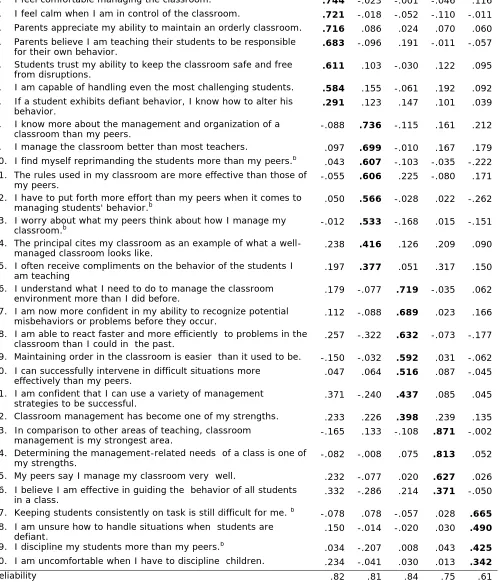
Rotated Pattern Matrix-Principal Axis Factor Analysis (Study 1)
Factora
Item 1 2 3 4 5
1. I feel comfortable managing the classroom. .744 -.023 -.001 -.046 .116 2. I feel calm when I am in control of the classroom. .721 -.018 -.052 -.110 -.011
3. Parents appreciate my ability to maintain an orderly classroom. .716 .086 .024 .070 .060 4. Parents believe I am teaching their students to be responsible
for their own behavior. .683 -.096 .191 -.011 -.057 5. Students trust my ability to keep the classroom safe and free
from disruptions. .611 .103 -.030 .122 .095 6. I am capable of handling even the most challenging students. .584 .155 -.061 .192 .092 7. If a student exhibits defiant behavior, I know how to alter his
behavior. .291 .123 .147 .101 .039
8. I know more about the management and organization of a
classroom than my peers. -.088 .736 -.115 .161 .212 9. I manage the classroom better than most teachers. .097 .699 -.010 .167 .179 10. I find myself reprimanding the students more than my peers.b .043 .607 -.103 -.035 -.222
11. The rules used in my classroom are more effective than those of
my peers. -.055 .606 .225 -.080 .171 12. I have to put forth more effort than my peers when it comes to
managing students' behavior.b .050 .566 -.028 .022 -.262
13. I worry about what my peers think about how I manage my
classroom.b -.012 .533 -.168 .015 -.151
14. The principal cites my classroom as an example of what a
well-managed classroom looks like. .238 .416 .126 .209 .090 15. I often receive compliments on the behavior of the students I
am teaching .197 .377 .051 .317 .150 16. I understand what I need to do to manage the classroom
environment more than I did before. .179 -.077 .719 -.035 .062 17. I am now more confident in my ability to recognize potential
misbehaviors or problems before they occur. .112 -.088 .689 .023 .166 18. I am able to react faster and more efficiently to problems in the
classroom than I could in the past. .257 -.322 .632 -.073 -.177 19. Maintaining order in the classroom is easier than it used to be. -.150 -.032 .592 .031 -.062 20. I can successfully intervene in difficult situations more
effectively than my peers. .047 .064 .516 .087 -.045 21. I am confident that I can use a variety of management
strategies to be successful. .371 -.240 .437 .085 .045 22. Classroom management has become one of my strengths. .233 .226 .398 .239 .135 23. In comparison to other areas of teaching, classroom
management is my strongest area. -.165 .133 -.108 .871 -.002 24. Determining the management-related needs of a class is one of
my strengths. -.082 -.008 .075 .813 .052 25. My peers say I manage my classroom very well. .232 -.077 .020 .627 .026 26. I believe I am effective in guiding the behavior of all students
in a class. .332 -.286 .214 .371 -.050 27. Keeping students consistently on task is still difficult for me. b -.078 .078 -.057 .028 .665
28. I am unsure how to handle situations when students are
defiant. .150 -.014 -.020 .030 .490 29. I discipline my students more than my peers.b .034 -.207 .008 .043 .425
30. I am uncomfortable when I have to discipline children. .234 -.041 .030 .013 .342
Reliability .82 .81 .84 .75 .61
Note. N = 293.
The first factor contained seven items and explained 25.6% of the variance. Examination of the items within the factor revealed one item (If a student exhibits defiant behavior, I know how to alter his behavior) slightly below the factor structure coefficient of .30 considered salient for the interpretation of variable–factor correlations (Tabachnick & Fidell, 2001). As a result it was flagged for potential removal. Internal consistency was measured using the coefficient alpha, which was calculated to be α = .82. The analysis revealed a small improvement (+.01) in Cronbach’s alpha, to α = .83, if the item was removed. Upon further review, due to the perceived importance of the item in relation to classroom management and minimal improvement in the coefficient alpha, it was determined that the item would be retained and modified to reflect a greater emphasis on the subsequent impact on the student’s behavior. Thus, the first factor retained seven items.
Factor 2 contained eight items and explained 14.7% of the variance. One item (I often receive compliments on the behavior of the students I am teaching) cross-loaded on two factors at levels that were in close proximity. Additionally, a review of the item revealed that it represented a specific behavior of others that may or may not impact overall efficacy. The item was therefore removed. The coefficient alpha of the factor was computed to be α = .81. Cronbach’s alpha was improved to α = .84 with the removal of one item (I find myself reprimanding the students more than my peers). Removal was also deemed appropriate due to the conceptual similarity of the item with another (I can successfully intervene in difficult situations more effectively than my peers). Thus, the item was removed and six items were retained for further analysis.
The third factor accounted for 6.7% of variance with seven items. This factor contained two items that loaded onto two factors above .3, which would warrant consideration for removal. For the first item (I am able to react faster and more efficiently to problems in the classroom than I could in the past), the relative “strength” of loading on the second factor for two items in comparison to the primary factor facilitated the decision to retain it. Examination of the second item (I am confident that I can use a variety of management strategies to be successful) revealed a non-specificity with respect to what it means to be “successful”, which may have impacted the association between the two factors. The item was subsequently identified for rewording to ensure an accurate description of “success” through the use of a variety of management strategies. Finally, a third item (Classroom management has become one of my strengths) was identified and removed based on the relative levels of cross-loadings across four factors. Overall, the factor demonstrated a high internal consistency (α = .84), which was not improved with the removal of any items. As a result, six items were retained.
Factor 4 contained four items. It explained 5.8% of the variance. Reliability was acceptable, as indicated by an alpha coefficient of α = .75. Analysis of the factor structure and Cronbach’s
Table 3
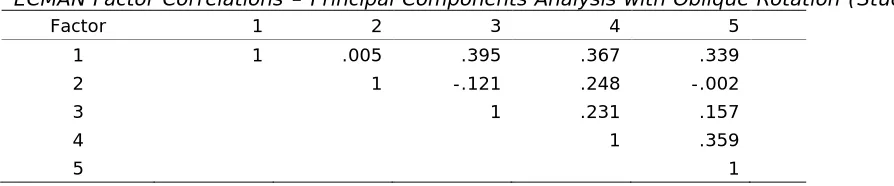
ECMAN Factor Correlations – Principal Components Analysis with Oblique Rotation (Study 1)
Factor 1 2 3 4 5
1 1 .005 .395 .367 .339
2 1 -.121 .248 -.002
3 1 .231 .157
4 1 .359
alpha values led to the decision to remove one item (I believe I am effective in guiding the behavior of all students in a class). Notably, the item loaded above .30 on two factors and Cronbach’s alpha improved to α = .81 if the item was deleted. Thus, three factors were retained.
Factor 5 also contained four items initially and explained 5.5% of the variance. One item (I am uncomfortable when I have to discipline children) was identified for removal from the instrument due to cross-loading with Factor 1 as well as a conceptual similarity to item #2, which represented the highest loading item on Factor 1. The alpha coefficient of .61 was the lowest among the five factors. Analysis revealed no improvements in the reliability with the removal of any item; however, the decision was made to remove the previously mentioned item due to the potential redundancy in information. As a result, three items were retained for further analysis.
As a result of this exploratory factor analysis, 25 of the original 30 items were retained for additional testing. Among the remaining 25 items, two were specifically identified for rewording to add specificity and clarity as a result of the analysis conducted in Study 1. Additional items were also flagged for modification to overcome potential measurement and interpretation errors that have been associated with instruments that contain both positively and negatively worded items (DiStefano & Motl, 2006). The subsequent rewording of the items was intended to create items with affirmative connotations. For example, “Keeping students consistently on task is still difficult for me” would be modified to “Keeping students on task is not difficult for me”. As a result of the latter modifications, no reverse-coding of responses would be necessary within future administrations.
Study 2
Participants
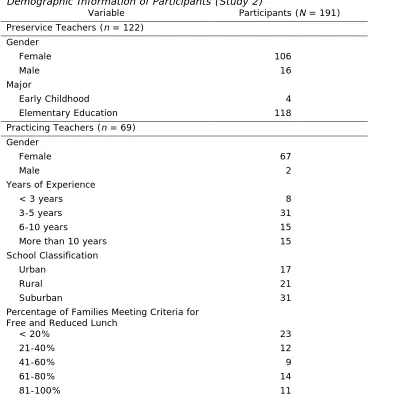
A total of 191 subjects participated in the second study. The sample consisted of 173 females and 18 males. The sample consisted of 122 preservice teachers majoring in elementary or early childhood education and 69 practicing teachers enrolled in a Master of Arts in Elementary Education program. The average number of years of experience for the practicing teachers that comprised the graduate students was 4.8 years. Additional demographic information for the both groups is shown in Table 4.
Instruments
which is more indicative of the teacher’s beliefs and consistent with efficacy scale development (see Bandura, 2006). The second item (I am confident that I can use a variety of management strategies to be successful) underwent significant changes, although these changes did not alter the conceptual meaning of the item. Instead, the vague notion of being “successful” was superseded by a statement (to maintain control of my classroom/students) directed towards informing the respondent how success would be defined. This would also add specificity within the task being measured, per Bandura’s (1986) recommendations. Another item (If a student exhibits defiant behavior, I know how to alter his behavior) was given the additional quantifier “to diffuse the situation” to provide added specificity and an outcome associated with the teacher’s action. Minor modifications were made to two additional items to add clarity to each item. One item (I understand what I need to do to manage the classroom environment more than I did before) remained semantically equivalent, but the researcher felt the revised item (My understanding of what I need to do to manage the classroom environment has improved) more
Table 4
Demographic Information of Participants (Study 2)
Variable Participants (N = 191) Preservice Teachers (n = 122)
Gender
Female 106
Male 16
Major
Early Childhood 4
Elementary Education 118 Practicing Teachers (n = 69)
Gender
Female 67
Male 2
Years of Experience
< 3 years 8
3-5 years 31
6-10 years 15
More than 10 years 15 School Classification
Urban 17
Rural 21
Suburban 31
Percentage of Families Meeting Criteria for
Free and Reduced Lunch
< 20% 23
21-40% 12
41-60% 9
61-80% 14
81-100% 11
Note. Participation in the federal free and reduced lunch program indicates a family income near or
clearly articulated the underlying idea within the item. For the remaining item (I am now more confident in my ability to recognize potential misbehaviors or problems before they occur), in addition to minor wording changes (e.g., removing “now more”), a quantifier “and take care of them before a disruption occurs” was included to address the outcome associated with the concepts addressed within the item. Finally, the response scale of the ECMAN was expanded to a seven point scale to increase the ability to differentiate among levels of responses. The ECMAN was again scored using the most positive response with the sum of all responses indicating an overall level of efficacy for classroom management.
Teachers’ Sense of Efficacy Scale. The Teachers’ Sense of Efficacy Scale (TSES) (Tschannen-Moran & Woolfolk Hoy, 2001) was used to assess the sense of efficacy of all participants due to its recognized acceptance within the field. There are two versions of the TSES – a long form, which consists of 24 items, and a short form, which includes 12 items. For this research, the long form was used. The teachers’ sense of efficacy score is based upon responses to 24 items written along a 9-point continuum from 1 (nothing) to 9 (a great deal). As the scale is designed to measure domain-specific efficacy, the scale can be subdivided to measure the related constructs of efficacy in: student engagement, instructional strategies, and classroom management. Each subscale on the long form features eight questions focused upon the respective construct. The long form of the instrument has a high overall reliability (α = .90), as does each subscale: α = .87 for student engagement, α = .91 for instructional strategies, and α = .90 for management. The validity of the TSES was measured through its correlation with other existing scales of teaching efficacy and suggested that the TSES effectively assesses the construct of teacher self-efficacy (Tschannen-Moran & Woolfolk Hoy, 2001).
Method
Per the creators’ guidelines, a principal axis factor analysis of the responses from the TSES was conducted to verify the consistency of the underlying three-factor structure of the TSES for this sample (Tschannen-Moran & Woolfolk Hoy, 2001). The data analysis for the ECMAN scale was initiated through the computation of descriptive statistics for each item (see Table 4). As a result of the changes made to the ECMAN within the creation of the revised version, a principal axis factor analysis was utilized to continue to refine and understand the factors within the proposed instrument. Upon completion of the factor analysis, total scores were computed for the ECMAN and TSES, including the classroom management subscale, as well as scores for the factors of ECMAN, as identified by the analysis. Pearson correlation coefficients were computed to note the relationship between the scores on each variable as well as to establish the convergent validity of the ECMAN.
Results
with factors 1, 2, and 3 representing 25.5%, 23.1%, and 20.9% of the variance respectively. The results of the analysis support the suitability of measurement of the three subscales as described by Tschannen-Moran and Woolfolk Hoy (2001).
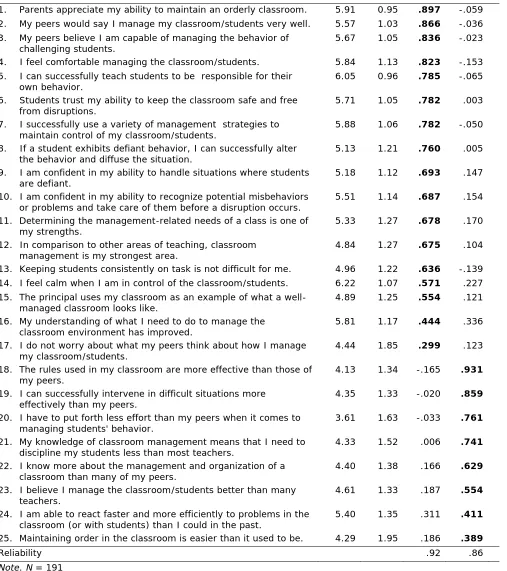
The analysis of the data representing responses on the ECMAN was deemed appropriate for factor analytical techniques due to a Kaiser-Olkin Measure of Sampling Adequacy value of .93 and significant Bartlett’s Test of Sphericity (p< .001). A principal axis factor analysis was completed, revealing four factors that had an eigenvalue greater than 1. The scree plot and parallel analysis however, appeared to indicate three factors. Acknowledging the suggestion of Costello and Osborne (2005) to test the number of factors “above and below” (p. 3) those identified by the various methods, it was deemed necessary to test solutions with two, three, and four factors using a principal axis factor analysis with direct oblimin rotation. The four factor solution was deemed unacceptable due to the prevalence of low factor loadings on several factors and significant number of items that cross-loaded onto three factors above the previously identified threshold of .30. Next the three factor solution was considered. Analysis of the component matrix again revealed the presence of multiple cross-loadings, with each item of the factor loading on an additional factor above .30. The two factor solution proved to be the most parsimonious and was selected due to moderate correlations between factors and a simple, yet substantial and meaningful structure (see Tables 5 and 6).
Factor 1 encompassed 17 items. This factor explained 33.8% of the variance. One item (My understanding of what I need to do to manage the classroom environment has improved) loaded onto both factors above the .3 threshold, and a decision was made to remove the item. Another item (I do not worry about what my peers think about how I manage my classroom/students) did not demonstrate factor structure coefficient above .30 and was flagged for removal. Confirmation of the decision for removal of this item was indicated within the measurement of the internal consistency of the factor. The coefficient alpha was calculated and measured α = .92 when the item was included. However, this value was improved slightly to α = .93 when it was not included. Fifteen of the original seventeen items associated with the factor were retained.
The eight items contained in Factor 2 explained 19.6% of the variance. Item analysis was conducted to note whether any items should be noted for potential removal. One item (I am able to react faster and more efficiently to problems in the classroom (or with students) than I could in the past) demonstrated similar loadings above .30 across both factors, and was selected for removal. Overall, the factor demonstrated a high internal consistency (α = .86). Thus, seven of the original eight items were retained.
As a result of the previously described analyses, the ECMAN (see Appendix) was reduced to 22 items and was comprised of two factors. Factor 1 was labeled general management efficacy (15 items) and Factor 2 as social comparisons for management (7 items). Overall, internal consistency of the instrument with the revisions was high (α = .94). No further improvements were noted with the removal of any additional items.
Table 5
Rotated Pattern Matrix-Principal Axis Factor Analysis (Study 2)
Factora
Item M SD 1 2
1. Parents appreciate my ability to maintain an orderly classroom. 5.91 0.95 .897 -.059 2. My peers would say I manage my classroom/students very well. 5.57 1.03 .866 -.036 3. My peers believe I am capable of managing the behavior of
challenging students. 5.67 1.05 .836 -.023 4. I feel comfortable managing the classroom/students. 5.84 1.13 .823 -.153 5. I can successfully teach students to be responsible for their
own behavior. 6.05 0.96 .785 -.065 6. Students trust my ability to keep the classroom safe and free
from disruptions. 5.71 1.05 .782 .003 7. I successfully use a variety of management strategies to
maintain control of my classroom/students. 5.88 1.06 .782 -.050 8. If a student exhibits defiant behavior, I can successfully alter
the behavior and diffuse the situation. 5.13 1.21 .760 .005 9. I am confident in my ability to handle situations where students
are defiant. 5.18 1.12 .693 .147
10. I am confident in my ability to recognize potential misbehaviors
or problems and take care of them before a disruption occurs. 5.51 1.14 .687 .154 11. Determining the management-related needs of a class is one of
my strengths. 5.33 1.27 .678 .170
12. In comparison to other areas of teaching, classroom
management is my strongest area. 4.84 1.27 .675 .104 13. Keeping students consistently on task is not difficult for me. 4.96 1.22 .636 -.139 14. I feel calm when I am in control of the classroom/students. 6.22 1.07 .571 .227 15. The principal uses my classroom as an example of what a
well-managed classroom looks like. 4.89 1.25 .554 .121 16. My understanding of what I need to do to manage the
classroom environment has improved. 5.81 1.17 .444 .336 17. I do not worry about what my peers think about how I manage
my classroom/students. 4.44 1.85 .299 .123 18. The rules used in my classroom are more effective than those of
my peers. 4.13 1.34 -.165 .931
19. I can successfully intervene in difficult situations more
effectively than my peers. 4.35 1.33 -.020 .859 20. I have to put forth less effort than my peers when it comes to
managing students' behavior. 3.61 1.63 -.033 .761 21. My knowledge of classroom management means that I need to
discipline my students less than most teachers. 4.33 1.52 .006 .741 22. I know more about the management and organization of a
classroom than many of my peers. 4.40 1.38 .166 .629 23. I believe I manage the classroom/students better than many
teachers. 4.61 1.33 .187 .554
24. I am able to react faster and more efficiently to problems in the
classroom (or with students) than I could in the past. 5.40 1.35 .311 .411 25. Maintaining order in the classroom is easier than it used to be. 4.29 1.95 .186 .389
Reliability .92 .86
Note. N = 191
a Oblimin Rotation: Factor 1 = General Management Efficacy; Factor 2 = Social Comparisons for
statistically significant at p<.01 Also notable were the results of the analysis of the correlations between the two factors of the ECMAN with the TSES total score and classroom management subscale. As shown in Table 7, Factor 1, general management efficacy, was strongly correlated with both, demonstrating statistical significance. However, while statistically significant, the relationships between Factor 2 and both measures were fairly weak, potentially decreasing the overall correlation between the scales.
Discussion and Implications
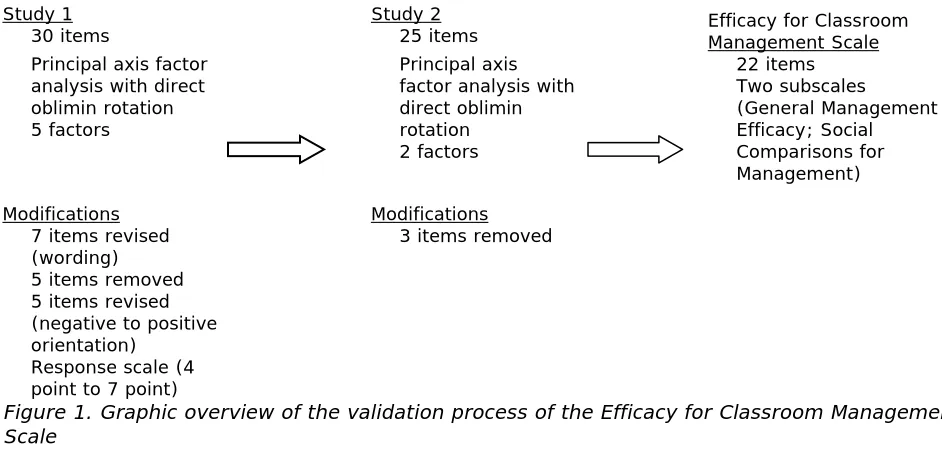
The Efficacy for Classroom Management scale represents a new instrument with 22 novel items focused entirely on classroom management. A systematic approach (see Figure 1) was used
Table 6
ECMAN Factor Correlations–Principal Components Analysis with Oblique Rotation (Study 2)
Factor 1 2
1 1 .500
2 1
Table 7
Correlations Between ECMAN, TSES, and Subscales
PMES Total Factor 1 Factor 2 TSES Total TSES-CM PMES Total 1 .944* .77* .57* .56*
Factor 1 1 .51* .66* .61*
Factor 2 1 .29* .27*
TSES-Total 1 .92*
TSES-CM 1
* p < .01
Note. Factor 1: General Management Efficacy; Factor 2: Social Comparisons for Management
Study 1 Study 2 Efficacy for Classroom Management Scale
− 30 items − 25 items
− Principal axis factor analysis with direct oblimin rotation
− 5 factors
− Principal axis factor analysis with direct oblimin rotation
− 2 factors
− 22 items
− Two subscales
(General Management Efficacy; Social Comparisons for Management)
Modifications Modifications
− 7 items revised
(wording) − 3 items removed
− 5 items removed
− 5 items revised (negative to positive orientation)
− Response scale (4 point to 7 point)
within the development of ECMAN to ensure psychometric requirements were met. This process began with the establishment of content validity through examinations of the literature and consultation with experts in the field and proceeded through several administrations of the instrument with efforts to refine and improve it. During this process, preliminary work towards establishing construct validity was initiated through the assessment of the underlying factor structure of the instrument as measured in two separate studies. Within each study the instrument satisfied criteria established by Gaudagnoli and Velicer (1988) regarding levels of factor loadings as well and sample sizes. These factors and related analyses assisted in the identification of two potential subscales within the instrument. Finally, ECMAN demonstrated convergent validity through the moderate to strong correlations with the TSES and its classroom management subscale, which has consistently demonstrated reliable and valid scales measuring teaching efficacy.
ECMAN was built on the understanding of the content and context specificity of beliefs and self-efficacy (see Tschannen-Moran & Woolfolk Hoy, 2001). It represents a new avenue to broaden understandings related to classroom management in several ways. One of the strengths of the version of the ECMAN established after the second study is that it measures beliefs about classroom management at several points in time relative to misbehavior. ECMAN includes multiple items that request teachers to consider their ability to identify management related needs of students or potential issues prior to the necessity of intervention as well as their ability to teach students responsibility for their own behavior. Similarly, reactions to misbehavior form an important component in successfully managing the classroom, and ECMAN includes items that are directed towards whether the teacher believes she can successfully intervene or diffuse a situation.
ECMAN also incorporates Bandura’s (1997) recommendations for the inclusion of barrier items that facilitate the differentiation of levels of efficacy as well as items that include specific tasks or actions. Accordingly, multiple items were directed towards working with challenging students and maintaining control and order as these have been previously identified as serving for the former criteria. O’Neill and Stephenson (2011) further note that words such as “discipline, control, behave, and behavioural” (p. 289) as contributing to an overall identification of unique factors associated with classroom management efficacy in the development of other instruments. To address the latter recommendation, within the second study on ECMAN, several items were modified to ensure specificity within the language as well as the outcomes. For example, the item “If a student exhibits defiant behavior, I know how to alter his behavior to diffuse the situation” presents a specific action “alter his behavior,” in relation to a student’s behavior. This item also addresses maintaining order, which was associated with the key words identified by O’Neill and Stephenson.
open-prompt for comments at the end of the survey. One teacher wrote, “I don’t like comparing myself to my peers as those who see this do not know what my peers are like.” Another quote was especially descriptive in this regard: “I don't want to compare myself to my peers as 'better than or more than'. We all have different students with different needs and I try my best to meet the needs of my students as I am sure they do.” While, overall, very few comments were made, this noted lack of comfort in comparing themselves to peers suggests the necessity of remaining vigilant for similar responses in further studies using ECMAN.
As with any research, there are potential limitations within the current study. First, the sample sizes as well as the small population from which the participants were drawn, may impact the overall findings relative to the scale. Additional research on larger, more diverse samples may yield information on the current factor structure of the ECMAN as well as the related subscales. Based on the previously included comments, it was clear that several participants were not comfortable in comparing their perceptions of their actions and strategies relative to those of their peers. This may have resulted in instances of a social desirability response bias, which would represent a confounding variable for items within the social comparisons for management subscale. Furthermore, several instances of item cross-loadings were still observed across factors at levels greater than .3 in Study 2. This would suggest reasonable association between the two factors, which is not surprising given that the intended purpose is focused upon the measurement of efficacy. However, the lack of “clean” factors suggests the need to further examine the wording of items or the feasibility of two subscales, as a one factor solution may form a more distinct domain-specific factor.
Implications
Acknowledging information presented as part of the limitations, further efforts to validate ECMAN with a larger, more diverse sample represent a significant focus moving forward. Doing so will facilitate confirmation of the factor structure, providing additional validation of the scale. While falling outside of the research questions used for this investigation, it is interesting to note that teachers who self-identified as teaching in an urban context demonstrated the lowest mean on each measure among the groups of practicing teachers, with the exception of the social comparison subscale. Given that only seventeen participants were represented in this group, the lowest among three, conclusions are notably limited, but specific attention should be directed toward recruiting participants from among teachers at urban institutions to further examine this outcome.
Given the importance of relationship-building as a management strategy, there is a noted lack of items related to the development of interpersonal relationships within and among students. Research has confirmed that actions specific to the development of these relationships is challenging for teachers (Chan, 2008), yet represents an important component within culturally responsive classroom management. Acknowledging the suggestion of Bandura (1997) in regard to the construction of barrier items to ensure variability within responses, it may prove impactful to include additional items reflecting relationship building in any subsequent revisions to the instrument as additional research is conducted.
general efficacy for management. Calibrating beliefs with performances may also facilitate task and efficacy analysis. Similarly, researchers have noted that it is important to help preservice teachers establish an accurate sense of efficacy for teaching, especially in relation to classroom management (O’Neill & Stephenson, 2011; Woolfolk Hoy and Spero, 2005). Given the validation efforts included preservice teachers as participants, the instrument can be utilized in helping them develop this capacity, as assisted by university personnel. As a note of caution, however, O’Neill and Stephenson (2011) speculated that the inexperience of preservice teachers may contribute to findings that indicate a one-dimensional factor within scales where multiple domains are hypothesized. It will be important to verify the factor structure of results obtained if the instrument is used with this population.
Conclusion
According to O’Neill & Stephenson (2011), investigations into methods to strengthen and develop efficacy relative to classroom management are still needed. The development of ECMAN represents one step in this process. Experts continue to agree that the beliefs of the teacher form a vital link between effective teaching, classroom management and, subsequently, student learning. Thus, measuring efficacy in specific domains of teaching such as classroom management may have long-term implications on professional knowledge, student academic growth and, as education continues to change and evolve, it represents another method that could be employed to ensure knowledgeable and efficacious teachers remain in the field.
References
Allinder, R. M. (1994). The relationship between efficacy and the instructional practices of special education teachers and consultants. Teacher Education and Special Education, 17, 86-95. doi:10.1177/088840649401700203
Ashton, P. T., & Webb, R. B. (1986). Making a difference: Teachers’ sense of efficacy and student achievement. New York: Longman.
Bakar, A. R., Konting, M. M., Jamian, R., & Lyndon, N. (2008). Teaching efficacy of Universiti Putra Malaysia science student teachers. College Student Journal, 42, 493-509. Retrieved from http://www.projectinnovation.com/College_Student_Journal.html
Bandura, A. (1986). Social foundations of thought and action: A social cognitive theory, Englewood Cliffs, CA: Prentice-Hall.
Bandura, A. (1997). Self-efficacy: The exercise of control. New York: W. H. Freeman and Company. Bandura, A. (2006). Guide for constructing self-efficacy scales. In F. Pajares & T. Urdan (Eds.),
Self-efficacy beliefs of adolescents (pp. 307–337). Greenwich, CT: Information Age.
Brophy, J. (1988). Educating teachers about managing classrooms and students. Teaching and Teacher Education, 4, 1-18. doi:10.1016/0742-051X(88)90020-0
Brouwers, A., & Tomic, W. (2000). A longitudinal study of teacher burnout and perceived self-efficacy in classroom management. Teaching and Teacher Education, 16, 239-253.
doi:10.1016/S0742-051X(99)00057-8
Brown, D. F. (2004). Urban teachers’ professed classroom management strategies. Theory Into Practice, 42, 277-282. doi:10.1207/s15430421tip4204_3
Cattell, R. B. (1966). The scree test for the number of factors. Multivariate Behavioral Research, 1, 245– 276. doi:10.1207/s15327906mbr0102_10
Venezuela. Teaching and Teacher Education, 21, 257-272. doi:10.1016/j.tate.2005.01.001 Chambers, S. M. (2003, February). The impact of length of student teaching on the self-efficacy and
classroom orientation of preservice teachers. Paper presented at the Annual Meeting of the Southwest Educational Research Association, San Antonio, TX. Retrieved from
http://www.eric.ed.gov/PDFS/ED477509.pdf
Chan, D. (2008). Dimensions of teacher self-efficacy among Chinese secondary school teachers in Hong Kong. Educational Psychology, 28, 181-194. doi:10.1080/01443410701491833
Costello, A. B., & Osborne, J. W. (2005). Best practices in exploratory factor analysis: Four recommendations for getting the most from your analysis. Practical Assessment, Research & Evaluation, 10(7), 1-9. Retrieved from http://pareonline.net
DiStefano, C., & Motl, R. W. (2006). Further investigating method effects associated with negatively worded items on self-report surveys. Structural Equation Modeling: A Multidisciplinary Journal, 13, 440-464. doi:10.1207/s15328007sem1303_6
Doyle, W. (2006). Ecological approaches to classroom management. In C. M. Evertson and C. S. Weinstein (Eds.), Handbook of classroom management: Research, practice, and contemporary issues (pp. 97-126). Mahwah, NJ: Lawrence Erlbaum Associates.
Emmer, E. T., & Hickman, J. (1991). Teacher efficacy in classroom management and discipline. Educational & Psychological Measurement, 51, 755-765. doi:10.1177/0013164491513027 Gaudagnoli, E., & Velicer, W. (1988). Relation of sample size to the stability of component patterns.
Psychological Bulletin, 103, 265-275.
Gibson, S., & Dembo, M. H. (1984). Teacher Efficacy: A construct validation. Journal of Educational Psychology, 76, 569-582.
Glickman, C. D., & Tamashiro, R. T. (1980). Clarifying teachers’ beliefs about discipline. Educational Leadership, 37, 459–464.
Gordon, L. M. (2001, Fall). High teacher efficacy as a marker of teacher effectiveness in the domain of classroom management. Paper presented at the Annual Meeting of the California Council on Teacher Education, San Diego, CA. Retrieved from http://www.eric.ed.gov/PDFS/ED465731.pdf
Horn, J. L. (1965). A rationale and test for the number of factors in factor analysis. Psychometrika, 30, 179-185. doi:10.1007/BF02289447
Jones, V., & Jones, L. (2012). Comprehensive classroom management: Creating communities of support and solving problems (10th ed.). Upper Saddle River, NJ: Pearson.
Main, S., & Hammond, L. (2008). Best practice or most practiced? Pre-service teachers’ beliefs about effective behavior management strategies and reported self-efficacy. Australian Journal of Teacher Education, 33, 28-39. Retrieved from http://ro.ecu.edu.au/ajte/vol33/iss4/3
Milner, H. R. (2008). Disrupting deficit notions of difference: Counter-narratives of teachers and community in urban education. Teaching and Teacher Education, 24, 1573-1598.
doi:10.1016/j.tate.2008.02.011
Monroe, C. R., & Obidah, J. E. (2004). The influence of cultural synchronization on a teacher’s
perceptions of disruption: A case study of an African-American middle school classroom. Journal of Teacher Education, 55, 256-268. doi:10.1177/0022487104263977
O’Neill, S. C., & Stephenson, J. (2011). The measurement of classroom management self-efficacy: A review of measurement instrument development and influences. Educational Psychology: An International Journal of Experimental Educational Psychology, 31(3), 261-299.
doi:10.1080/01443410.2010.545344
Pajares, F. (1992). Teachers' beliefs and educational research: Cleaning up a messy construct. Review of Educational Research, 62, 307-332. doi:10.2307/1170741
Lawrence Erlbaum Associates.
Raudenbush, S. W., Rowan, B., & Cheong, Y. F. (1992). Contextual effects on the self-perceived efficacy of high school teachers. Sociology of Education, 65, 150-167. doi:10.2307/2112680
Siebert, C. J. (2005). Promoting preservice teachers’ success in classroom management by leveraging a local union’s resources: A professional development school initiative. Education, 125(3), 385-392. Retrieved from http://www.projectinnovation.com/Education.html
Soodak, L. C., Podell, D. M., & Lehman, L. R. (1998). Teacher, student and school attributes as predictors of teachers’ responses to inclusion. Journal of Special Education, 31, 480–497.
doi:10.1177/002246699803100405
Stevens, J. (1996) Applied multivariate statistics for the social sciences (3rd ed.). Mahwah, NJ: Lawrence Erlbaum Associates.
Tabachnick, B. G., & Fidell, L. S. (2001). Using multivariate statistics (4th ed.). New York: Harper Collins.
Tschannen-Moran, M., & Woolfolk Hoy, A. (2001). Teacher efficacy: Capturing and elusive construct. Teaching and Teacher Education, 17, 783-805. doi:10.1016/S0742-051X(01)00036-1
Weinstein, C., Curran, M., & Tomlinson-Clarke, S. (2003). Culturally responsive classroom management: Awareness into action. Theory into Action, 42(4), 269-276. doi:10.1353/tip.2003.0053
Weinstein, C., Tomlinson-Clark, S., & Curran, M. (2004). Toward a conception of culturally responsive classroom management. Journal of Teacher Education, 55(1), 25-38. doi:10.1177/0022487103259812 Wentzel, K. R. (2006). A social motivation perspective for classroom management. In C. M. Evertson and
C. S. Weinstein (Eds.), Handbook of classroom management: Research, practice, and contemporary issues (pp. 619-643). Mahwah, NJ: Lawrence Erlbaum Associates.
Woolfolk, A. E., Rosoff, B., & Hoy, W. K. (1990). Teachers’ sense of efficacy and their beliefs about managing students. Teaching and Teacher Education, 6, 137-148. doi:10.1016/j.tate.2005.01.007 Woolfolk Hoy, A., & Spero, R. B. (2005). Changes in teacher efficacy during the early years of teaching: A
comparison of four measures. Teaching and Teacher Education, 21, 343-356. doi:10.1016/j.tate.2005.01.007
Appendix
Efficacy for Classroom Management Scale
Directions: Listed below are statements that reflect your beliefs regarding classroom
management. On each line please indicate the degree that you agree or disagree with each statement on a scale from 1 (Strong Disagree) to 7 (Strongly Agree).
1. Parents appreciate my ability to maintain an orderly classroom. 2. My peers would say I manage my classroom/students very well.
3. My peers believe I am capable of managing the behavior of challenging students. 4. I feel comfortable managing the classroom/students.
5. Students trust my ability to keep the classroom safe and free from disruptions. 6. I successfully use a variety of management strategies to maintain control of my
classroom/students.
7. I can successfully teach students to be responsible for their own behavior.
8. If a student exhibits defiant behavior, I can successfully alter the behavior and diffuse the situation.
9. I am confident in my ability to handle situations where students are defiant.
10. I am confident in my ability to recognize potential misbehaviors or problems and take care of them before a disruption occurs.
11. Determining the management-related needs of a class is one of my strengths.
12. In comparison to other areas of teaching, classroom management is my strongest area. 13. I feel calm when I am in control of the classroom/students.
14. Keeping students consistently on task is not difficult for me.
15. The principal uses my classroom as an example of what a well-managed classroom looks like.
16. The rules used in my classroom are more effective than those of my peers. 17. I can successfully intervene in difficult situations more effectively than my peers.
18. I have to put forth less effort than my peers when it comes to managing students' behavior. 19. My knowledge of classroom management means that I need to discipline my students less
than most teachers.
20. I know more about the management and organization of a classroom than many of my peers.