www.technology.matthey.com
Jessica Andrews*, Daniel Button and
Ian M. Reaney
Functional Materials and Devices Group, Department of Materials Science and Engineering, The University of Sheffield, Western Bank, Sheffield, S10 2TN, UK
*Email: [email protected]
Ceramics are traditionally sintered at high temperatures (~80% melting temperature (Tm)).
There are numerous incentives to reduce processing temperature: the reduction in processing energy; integration of polymeric and non-noble metals; greater control of microstructure and final component geometries. ‘Cold sintering’ has been developed as a novel method of densification which uses a transient liquid phase, pressure and heat to achieve dense ceramics. This review explores the process of cold sintering and its potential to densify various ceramic materials and components at low temperatures (<300°C), primarily describing recent results at The University of Sheffield, UK.
1. Introduction
Sintering is a crucial stage in the manufacturing of dense ceramic products from a green body. Archaeologists have dated some of the earliest ceramic artefacts to 24,000 BCE (1) and sintering was empirically developed over thousands of years prior to the appearance of modern sintering theories (1). Traditionally, sintering to create dense products requires heat treatment up to 80% of Tm to promote the transport of material to eliminate pores. Such high temperatures are costly in terms of energy and can be restrictive in the manufacture of functional ceramic devices which often require
integration of metals and polymers that suffer
from volatility, melting, interaction and mismatch in thermal expansion with the ceramic. This leads to complications in the production of components, which include warping, delamination and the high cost of inert noble metals such as platinum and palladium. Figure 1 shows the compatibility of several materials at various sintering temperatures.
Reducing sintering temperatures is a critical strategy in the goal of decarbonising foundation industries. A number of methods have been proposed to reduce sintering temperature, or
more precisely the energy for densification, these
include the addition of sintering aids, the utilisation of Joule heating through processes such as spark
plasma sintering (SPS) and flash sintering and
most recently cold sintering (2). There have also been some investigations into combinations of cold
sintering and SPS-flash sintering.
Sintering aids are often utilised to reduce conventional sintering temperatures and typically
form a liquid phase flux through which mass is more
rapidly transported than within the solid state. In electroceramics, lithium-doping of barium titanate has been shown to successfully reduce sintering
temperatures: Kimura et al. demonstrated a reduction from 1300°C to 1000°C (3) and Randall et al. to 750°C by the addition of 15 mol% lithium
fluoride (4). Many other sintering aids have been
investigated, but none have been found to reduce BaTiO3 sintering temperatures to <900°C (2, 5), which is desirable for metal internal electrode technologies in multilayer devices (6).
Flash sintering is a field assisted sintering
technique (FAST) for the consolidation of ceramics. A green body is placed in contact with electrodes in
a furnace, an electric field is applied and the furnace heated until a specific temperature or field and the ‘flash’ phenomenon occurs (7). The densification occurs rapidly and significantly reduces the
sintering temperature, for example Downs et al.
Advances in Cold Sintering
densified cubic yttria-stabilised zirconia (8YSZ) at
390–1000°C below conventional temperatures (8). There are a number of challenges to be overcome
in flash sintering including the formation of hot
spots in larger components due to the electric current concentration (7).
SPS is a field assisted, high pressure method
which is particularly useful for materials that are
difficult to fabricate using conventional technology
such as bismuth telluride-based thermoelectrics
(9). It typically utilises a graphite die filled with
powder which is subjected to high pressure and
temperature in the presence of a field. Not only is the temperature to achieve densification reduced
but also the sintering time (<1 min). Oxides
however, require re-oxidation post densification as
the graphite die reduces the compound, which to
some extent negates the benefits of SPS.
Cool SPS exploits high pressure in a vacuum to densify materials with low decomposition temperatures or unfavourable phase transitions at <400°C (10, 11). Compounds such as manganese(II) sulfate (96%), potassium bis-(carbonato)cuprate(II) (94–95%), sodium bis-(carbonato)cuprate(II) (97–98%), ammonium
iron(III) diphosphate (95–98%) and zirconia (66– 80%) have been densified via this method at 300–600 MPa and 300–400°C.
The highly energy intensive nature of conventional ceramic sintering contributes heavily to the cost of the materials and products and to
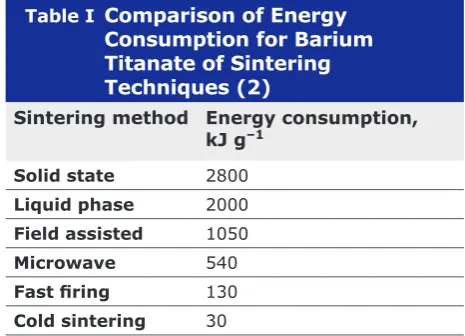
the environmental impact of manufacturing. The energy required to sinter BaTiO3 conventionally is 2800 kJ g–1. A comparison of energy consumption for several sintering methods is shown in Table I. Compared with conventional sintering, an energy reduction of ~99% has been reported for BaTiO3 cold sintered at 300°C (2), thereby demonstrating its potential importance to foundation industries such as ceramics which are required to decarbonise.
2. Cold Sintering
Cold sintering or the cold sintering process (CSP) is a novel method of sintering ceramics
first introduced by Jantunen and coworkers (12)
but developed further at Pennsylvania State University, USA, by Randall and colleagues. CSP utilises a liquid phase to aid rearrangement and
interdiffusion of the particles alongside pressure
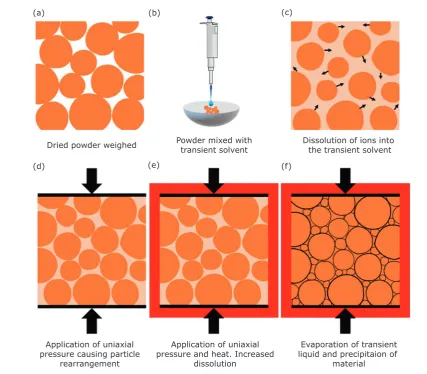
and modest heat to dramatically reduce the sintering temperature (Figure 2). The proposed
mechanisms of CSP densification are closely
related to those in liquid phase sintering (2). During cold sintering, powdered material is mixed with a transient liquid in which it is partially soluble. The moistened powder is then placed into a die and pressure (100–500 MPa) and heat (<300°C) are applied to aid rearrangement of the particles and the reprecipitation of the solid material (13). The development of the process has mainly been on a material by material basis, optimising parameters empirically.
Prior to research emerging from Randall et al.
at Pennsylvania State University, Yamasaki et al. described a combined process of hydrothermal reactions with isostatic pressing referred to as hydrothermal hot pressing (HHP) to densify ceramics at <200°C in 1986 (14). The process
was used to demonstrate the densification of a
Fig. 1. Material compatibility with ceramic sintering temperatures
1800°C Metal
compatibility
W, Mo
High T
Low T
Ultra-low T
Cold
Cu, Au, Ag
Cu, Au, Ag, Al
Most metals some polymers 1200°C
1000°C 900°C
700°C
400°C 300°C
Table I
Comparison of Energy
Consumption for Barium
Titanate of Sintering
Techniques (2)
Sintering method Energy consumption, kJ g–1
Solid state 2800
Liquid phase 2000
Field assisted 1050
Microwave 540
Fast firing 130
range of materials including silicates, cements, BaTiO3, porous anatase and hydroxyapatite ceramics (14–16). The process was applied to bonding hydroxyapatite with metal and densifying ceramics which decompose at low temperatures. Cold sintering has many similarities with HHP such as the requirement for a liquid phase to facilitate mass transport and the occurrence of dissolution and precipitation reactions. HHP was inspired by natural geographical phenomenon and is now
considered to be a subset of the broader definition
of CSP and the equipment for HHP (17).
2.1 Congruently Dissolving Materials
2.1.1 Molybdates
Lithium molybdate (LMO) is a hygroscopic material which is congruently soluble in water and was one
of the first materials used to demonstrate cold
sintering (4, 13, 18). LMO is conventionally sintered
at 540°C but via cold sintering it can be densified
at 120°C with the addition of 2–10 wt% distilled water under applied pressure (12, 17, 18). The properties of cold sintered LMO are comparable with conventional samples but a slight increase in dielectric loss is thought to relate to residual hydroxyl groups at the grain boundaries (12).
Materials related to LMO such as sodium
molybdate (NMO) can also be densified via cold
sintering. Whilst NMO is not hygroscopic, it is
highly soluble in water making it another ideal
candidate for cold sintering. NMO is conventionally
sintered at 610°C, whilst the material can be cold sintered at 150°C with the addition of 5–10 wt% water and the application of 200 MPa of pressure. Wang et al. achieved relative densities of 87% after conventional sintering but 96% after cold
sintering. The dielectric properties of NMO are
also comparable between conventional and cold sintered. An increase in permittivity (εr) is observed
(conventional: 11.6, CSP: 12.7), due to increased
Fig. 2. Schematic illustrating the different stages of the cold sintering process
Dried powder weighed Powder mixed withtransient solvent Dissolution of ions into the transient solvent
Application of uniaxial pressure causing particle
rearrangement
Application of uniaxial pressure and heat. Increased
dissolution
Evaporation of transient liquid and precipitaion of
material
(a) (b) (c)
density whilst residual hydroxyl groups increased dielectric loss (19, 20).
As LMO and NMO are readily densified via cold sintering, they have been used as a starting point to create many composites with other materials with more favourable properties, but which are harder to cold sinter such as barium hexaferrite, sodium bismuth molybdate and bismuth lithium vanadium molybdate (19, 21, 22).
2.1.2 Zinc Oxide
Zinc oxide has also gained interest as a material that can be densified via cold sintering. ZnO is wide
band-gap (3.4 eV) semiconductor traditionally used in electronics such as varistors and requires temperatures in excess of 1100°C to sinter (23, 24). The high temperatures for conventional
sintering leads to grain coarsening and other effects
deleterious to the electrical properties and therefore methods of reducing sintering temperature have been widely investigated. Several studies have
successfully cold sintered ZnO at ≤300°C. Unlike
molybdate compounds, ZnO has limited solubility
in water and therefore an alternative transient
solvent such as aqueous acetic acid or zinc acetate (Zn-Ac) is utilised to achieve sufficient dissolution to promote densification (25, 26).
Recent work at The University of Sheffield has investigated the effects of pressure and temperature on the cold sintering of ZnO. Samples of ZnO
were produced at temperatures 125–300°C and pressures of 187–375 MPa with 25–30 wt% of 1 M acetic acid. Scanning electron microscopy (SEM)
of cold sintered ZnO showed that temperature and pressure have a significant effect on grain growth
and morphology, helping to corroborate previous work by Funahashi et al. and Kang et al. (25, 26).
Funahashi studied cold sintering of ZnO using
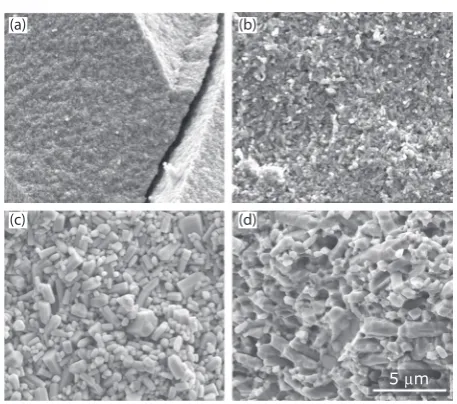
a wide variety of pressures, temperatures and concentrations of acetic acid (0.1–17.5 M) and water for comparison. The presence of the acetic acid was critical to achieve high density, with 1.0 M the optimal concentration. Pressures of 387 MPa combined with 300°C were reported to produce the highest densities from the test pressures and temperatures. The lower pressure of 77 MPa did produce high densities however no neck-growth was observed (26), in agreement with work done
in The University of Sheffield. Pellets pressed at
250 MPa at 300°C showed high density (>98% theoretical) and grain growth but no necking, Figure 3(c). When pressure was increased to 374 MPa necking is observed (Figure 3(d))
producing a sample with a microstructure similar to conventional sintering.
Kang et al. studied a large range of processing conditions, including the use of various solvent
chemicals and the effect of pressure, temperature, pH and ion concentration. Initial findings agreed
with Funahashi with pressure promoting necking
and temperature having the largest effect on grain
growth (25, 26). However, it was proposed that pressure has a threshold below which densities
are significantly affected. Beyond this threshold, densification becomes pressure independent. Other chemicals explored by Kang et al. (other
than acetic acid or Zn-Ac) include hydrochloric acid, sulfuric acid, zinc chloride and zinc sulfate
but only 70–75% densities were achieved, as well as unwanted cement and hydroxide phases (25).
Densification was independent of pH due mainly to the presence of Zn2+ and acetate ions. The exchange of Zn2+ ions through solution enabled by applied pressure is the largest contributor to
densification (25). Secondary phases observed by Kang et al. were also present, contradicting earlier suggestions that samples were single phase (26). Raman analysis showed evidence of residual
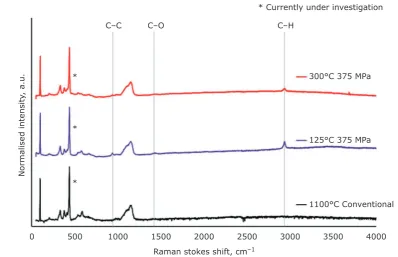
acetate or Zn-Ac (25) which was confirmed in our
studies. Figure 4 shows a comparison of ZnO
cold sintered at 125°C and 300°C compared to a conventionally sintered sample produced at The
University of Sheffield. At 125°C and 300°C, three
Fig. 3. Fracture surface SEM micrographs of
cold sintered ZnO fabricated at The University of Sheffield at a range of temperatures and
pressures: (a) 120°C and 250 MPa; (b) 200°C and 250 MPa; (c) 300°C and 250 MPa; (d) 300°C and 375 MPa. All micrographs are at same
magnification
(a) (b)
(c) (d)
peaks are observed which are not present in the conventional sample. The peak at ~943 cm–1 is typical of a C–C bond, ~1435 cm–1 a C–O bond and finally at ~2930 cm–1 a mode characteristic of a C–H and the peak ~650 cm–1 is still under investigation. These organic peaks are weaker in the 300°C sample, suggesting that some of the acetate has been removed. Acetate decomposes at ~225°C consistent with this hypothesis.
Gonzalez-Julian et al. densified ZnO via cold sintering and a combined cold sinter-FAST/SPS
method, using Kelvin probe force microscopy (KPFM) on resulting samples, to better understand
the mechanisms behind cold sintering (27). For both CSP and CSP-SPS, powders were moistened with
1.6– 3.2 wt% distilled water or a 0.5% Zn–Ac solution.
Samples were then sintered according to parameters in Table II. The addition of Zn–Ac to the transient solvent was found to significantly reduce the onset temperature of densification from 90–130°C to
~25°C at all pressures. This demonstrates the
crucial role of powder dissolution in densification via cold sintering.
KPFM was used to analyse the surface potentials
of samples sintered via CSP-SPS at 150 MPa. The addition of water increased surface potential compared to the as-received powder, which implies an increase in defect concentration. A contrasting
effect is seen with the addition of Ac-H2O, where
surface potentials are reduced indicating a lower defect concentration, which the authors attribute to the observed grain growth. The increase in surface potential indicates that the solvent phase not only promotes transport but also raises the sintering potential through the creation of activation energy lowering defects, as OH– and H+ ions diffuse into the surface of the crystal structure (25–27).
From impedance spectroscopy, ZnO densified
using Ac-H2O had the highest conductivity with significantly lower total activation energy than
other conditions. The bulk activation energy of
ZnO was found to be significantly reduced by
sintering with both water and acetate, whereas
C–C
*
*
*
C–O C–H
* Currently under investigation
300°C 375 MPa
125°C 375 MPa
1100°C Conventional
0 500 1000 1500 2000 2500 Raman stokes shift, cm–1
Normalised intensit
y,
a.u.
3000 3500 4000
Fig. 4. Raman spectra of ZnO comparing sintering conditions. Conventional sintering at 1100°C for 2 h, cold
sintering performed at 125°C, 375 MPa and 300°C, 375 MPa with 30 wt% 1 M acetic acid
Table II
Parameters Used by
Gonzalez-Julian
et al.
(27) to Create
CSP and CSP-SPS Samples
CSP CSP-SPS
Solvent content, wt%
1.6–3.2
H2O
3.2 H2O +
0.5 Zn-Ac
1.6 H2O
1.6 H2O
+ 0.5
Zn-Ac Temperature ramp rate,
°C min–1 20 100
Holding temperature, °C 250 250
the grain boundary (Ea) was found to be increased with H2O and decreased with Ac-H2O. This lowering of activation energy is thought to be due
to the manufacture of highly defective diffusion
pathways, which helps to encourage sintering at low temperatures.
Overall Gonzalez-Julian et al. theorised the liquid
phase has five main roles during the CSP in ZnO:
(a) a better initial packing of the powder material due to interparticle friction; (b) dissolution of
Zn2+ and O2– ions from the powder surface; (c) formation of defects in ZnO crystals due to
H+ and OH– diffusion; (d) formations of highly defective diffusion pathways between grains and (e) elimination of carbonates. These effects are
thought to be further enhanced by the presence of the acetate phase by improving dissolution. This paper indicates that the liquid phase has a more
complex role than first suggested by initial studies; better understanding of defect chemistry effects
is in understanding and improving the results achieved from the CSP.
To unite cold and flash sintering, Nie et al. studied
the effect of an aqueous transient liquid phase on flash sintered ZnO. An electrode green body produced by uniaxial pressing was placed in a flash chamber and flowing wet argon + 5% hydrogen
was introduced after 1 h. The conductivity of the hydrated pellet increased by a factor of four compared to the unhydrated form (3 × 10⁻⁷ S cm–1 to ~7 × 10⁻³ S cm–1). The presence of water was found to trigger flash sintering at room temperature
due to the higher conductivity, producing relative densities of ~98%. The water was also proposed to
assist with densification via mass transport due to partial dissolution of the substrate (28).
2.2 Non-Congruently Dissolving
Materials
As already discussed, Li, NMO and ZnO are
relatively easy to cold sinter and coarse powders
can be densified with the addition of water or
acetic acid as the transient solvent. To cold sinter a wider variety of materials, with a broader range of properties, several methods are employed, such
as reducing the particle size to nanoscale, thereby
increasing the reactivity of the powder and altering liquid additive to include more complex acids, alkalis or ionic solvents.
In cases where the powder dissolves incongruently, a method of hydrothermal assisted cold sintering is utilised through reactive intermediate phases. The liquid utilised in cold sintering of incongruent materials is often a solution containing a deep eutectic reaction precursor to form the desired products at temperatures below that of a solid-state process (29–32).
When particles of BaTiO3 are exposed to water, Ba ions leach from the surface, leaving a titanium-rich layer (33). To cold sinter BaTiO3, Guo et al. utilised nanoscale particles of BaTiO3 and a barium hydroxide on titania suspension in deionised water. This prevents the dissolution of Ba during cold sintering and the Ba(OH)2 and TiO2 react to form BaTiO3 during annealing at 700–900°C.
Strontium titanate is conventionally sintered at over 1400°C (34). Boston et al. developed a method of cold sintering for SrTiO3 which utilised reactive intermediate phases (29). Nanoscale
SrTiO3 and TiO2 powders were mixed with 0.2 ml of a 1.5 M strontium chloride aqueous solution with 1.5 M equivalent of anatase nanoparticles. The mixture was pestle and mortared to produce
a free-flowing powder which was then pressed at
750 MPa for 10 min at room temperature before increasing to 180°C for 60 min. After cold sintering, a 4 h heat treatment at 950°C was utilised to promote microreactions between SrCl2 and TiO2 intermediate phases, forming SrTiO3. Electrical testing of cold sintered SrTiO3 showed similar trends to conventionally sintered materials, however the relative permittivity values exhibited frequency
dependence. Particle size in the conventionally sintered samples is shown to affect the permittivity
and loss (Table III).
2.3 Challenges for Cold Sintering
Cold sintering is an exciting area for development in ceramic science. There are however a number of challenges which will need to be overcome toTable III Relative Permittivity and Tan δ from 25–250°C for Cold vs. Conventional Sintered SrTiO3 (29)
Nanoscale Micron-scale
Permittivity Tan δ Permittivity Tan δ
Conventional 130–210 0–0.55 120–180 0–0.14
improve the commercial prospects of this new technology.
2.3.1 Processing Parameters
Most developments in cold sintering so far have
been on an empirical, material-specific, ‘trial
and error’ basis. A greater understanding of the mechanisms and how they relate to processing parameters will allow a wider range of materials
to be densified via cold sintering. There are numerous processing parameters which can be
altered to tailor the densification of material during
cold sintering, including composition of transient liquid phase, volume of transient liquid required,
pressure, temperature and powder particle size.
The transient phase should allow for the congruent dissolution of the solid phase or react to form a desirable composition upon heating during sintering or subsequent heat treatment. Therefore, it is important to understand the dissolution behaviour of the ceramic within the temperature range of sintering. The amount of liquid used during cold sintering is mostly quoted in weight percent of
the solid phase. This does not consider the effect
of surface area, far greater for nano- as opposed to micropowders. The purpose of pressure during cold sintering is the rearrangement of particles, but it also plays a more complex role in dissolution, grain growth and activation of reactions due to inhomogeneous pressure distributions.
The temperatures used during cold sintering are largely dependent on the evaporation point of the solvent. Grain growth has also been observed in
some materials cold sintered significantly above
the solvent evaporation temperature but below conventional sintering temperatures, this could be
used to achieve specific grain sizes and structures.
2.3.2 Residual Secondary Phases
In some cases, secondary phases can form during cold sintering, due to reactions between the solid phase and transient solvent or residual solventafter sintering completion. Kang et al. used a
number of acids in the cold sintering of ZnO to observe their effectiveness as solvent phases. For a ZnCl2 solution, significant amounts of zinc oxychloride phases were observed, with similar results produced when sulfate and nitrate based solvents were used. While the use of such strong solvents is an extreme example, it demonstrates the importance of correct solvent choice for the sintering process to prevent secondary phase
formation. Even for more successful solvent phases
used to densify ZnO, such as acetic acid and Zn-Ac,
small amounts of residual acetate phases have
been detected and affect properties.
When BaTiO3 interacts with distilled water, Ba is leached from the material leading to an amorphous Ti-rich surface layer. This preferential leaching is overcome using a solution containing high concentrations of Ba and Ti ions but amorphous material forms which requires a further post CSP crystallisation step at high temperatures.
2.3.3 Nanoparticle Manufacture
While the amount of energy required to densify material via cold sintering has shown to be
significantly reduced, the energy of nanopowder
production has not been routinely considered when evaluating the total energy consumed. To
produce nanopowders significant amounts of
energy or complex chemical reactions are often required, transferring the energy consumption
and environmental costs to a different stage of the
manufacturing process.
3. Applications of Cold Sintering in
Radiofrequency Technology
3.1 Microwave Dielectric Composites
Microwave (MW) dielectric materials show strong interactions with electromagnetic waves, making them extremely important in modern
communications as resonators, filters and
substrates (22, 35). The three selective parameters of MW dielectric ceramics are high quality factor (Qf), near-zero temperature coefficient of resonant
frequency (TCF) and high εr (19, 22, 35).
With fifth generation (5G) network technologies
beginning to be utilised and installed in numerous countries, the material challenge is to develop systems of very high resonant frequency and low latency. Whilst fourth generation (4G) systems
operate in the 2–8 GHz range, the operating range of 5G systems will eventually be up to 30 GHz. For
these 5G systems, the dielectric loss of polymeric substrates used in 4G is too high and other substrates must be investigated (36–39).
Cold sintering has shown promise within this area
at The University of Sheffield with the densification
of several known MW ceramics achieved at low temperatures. However, none of the early materials
such as LMO and NMO exhibited near zero TCF.
several, two component temperature stable MW ceramic composites via CSP.
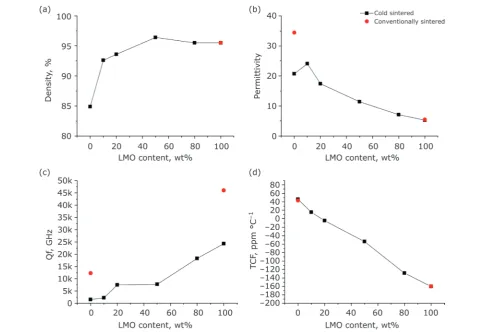
Na0.5Bi0.5MoO4-Li2MoO4 (NBMO-LMO) composite samples were produced by mixing NBMO and LMO
powders with 5–10 wt% of deionised water and pressing pellets 30 min at 150°C and 200 MPa. Sintered pellets were dried for 24 h at 120°C to
remove any residual moisture (22). The NBMO-LMO
ceramic composites in this study showed no chemical reaction between the phases during
cold sintering and near zero TCF was achieved at
~20% LMO with εr = 17 and Qf = 8000 GHz (22)
(Figure 5).
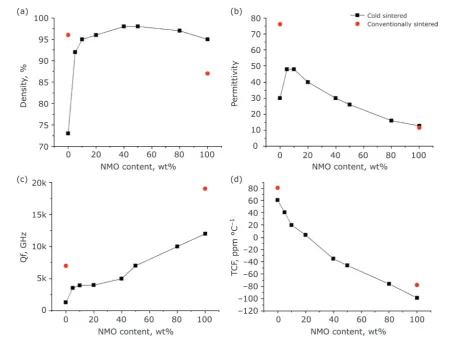
(Bi0.95Li0.05)(V0.9Mo0.1)O4-Na2Mo2O7 (BLVMO-NMO) composites were also sintered by combining the mixtures with 5–10 wt% of deionised water and hot pressing for 30 min at 150°C and 200 MPa. A post sintering drying step of 120°C for 24 h was performed to remove residual moisture (19).
Electrical and MW analysis of the BLVMO-NMO showed similar trends to the NBMO-LMO and near zero TCF was obtained at ~20% NMO with εr ~40
and Qf = 4000, Figure 6.
Although the Qf values of these composites do not compete with conventionally sintered ceramics for resonator applications, their properties, ease of integration and low energy consumption show promise for a wide range of novel devices.
3.2 Graded-Index Lenses
Graded-index (GRIN) lenses (19, 43) are able to
convert a point electromagnetic source to a planar wave and vice versa. They are normally used in optics but CSP can be used to fabricate devices
from ceramics in MW applications. A MW GRIN lens
(19, 22) consists of concentric rings of material, with decreasing εr towards the outer edge of the
structure, preferably reaching values close to εr = 1. Dimensions and εr of the layers are tailored
to ensure they have the same focal point (O) to convert the incident spherical wave to a plane
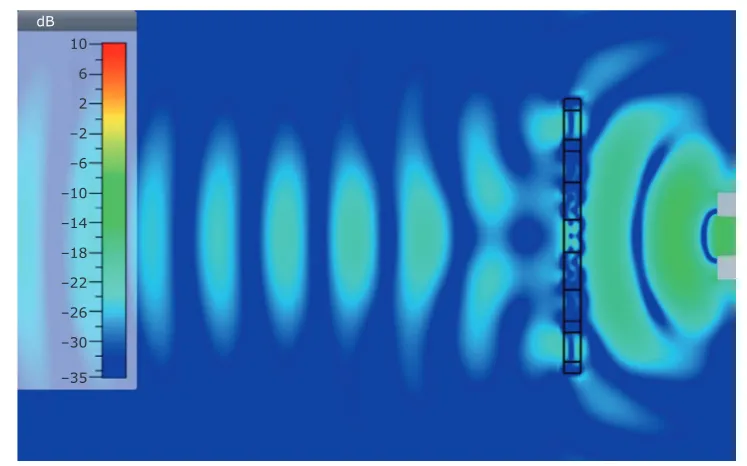
wave; a schematic GRIN lens design is shown in Figure 7 and a simulation (CST Microwave Studio, Dassault Systèmes, France)of a working GRIN lens
is shown in Figure 8.
Fig. 5. (a) Density; (b) permittivity; (c) Qf; and (d) TCF of NBMO-xLMO composite ceramics produced by
cold sintering, comparing permittivity to conventional samples produced and measured by Zhou et al. (19).
The simulated lens was illuminated with an
open-ended Ka-band waveguide (7.112 mm × 3.556 mm). Across the whole frequency range the boresight directivity was increased
from 26 GHz to 40 GHz, the relative increase
compared to the case with no lens was between
4.6 dB and 8.5 dB. The simulated BLVMO-NMO and NBMO-LMO lenses exhibited an aperture efficiency ~70% at 26 GHz and ~78% at 34 GHz
respectively (19, 22).
Fig. 6. (a) Density; (b) permittivity; (c) Qf; and (d) TCF of cold sintered BLVMO-NMO composite ceramics and conventionally sintered BLVMO and NMO. Adapted from (19) under Creative Commons Attribution 4.0 International (CC BY 4.0)
εr1
εr1
εr1>εr2>εr3>εr4>εr5
θ
D
F
O εr2
εr2 εr3
εr3 εr4
εr4 εr5
εr5
Fig. 7. Schematic of a GRIN lens design principal. Where D is the external diameter of the layer, θ is the
Due to the ability to control lateral dimensions during cold sintering, it is possible to co-sinter multiple layers of ceramics without the
detrimental effects of differential shrinkage and divergent thermal expansion coefficients.
Wang et al. co-sintered three layers of ceramic
in the LMO-NBMO system (LMO, NMBO-10 wt% LMO and NMBO-50 wt% LMO) to create a
macroscopic ceramic-ceramic composite (22). This demonstrated the ability to utilise cold sintering to produce graded dielectrics and thus illustrated
proof of concept for the fabrication of a MW GRIN
lens. Simulations were performed to understand
the potential efficiency of lenses composed of six
concentric rings of radially reducing εr, illuminated with a Kα-band waveguide between 26–40 GHz. Peak aperture efficiencies were 78% at 34 GHz for the NBMO-LMO lens and 70% at 26 GHz for the BLVMO-NMO lens. Demonstrating high conversion
rates between input and output of the lens.
3.3 Microstrip Patch Antennas
Microstrip patch antennae (MPA) are a low-profile form of antenna that can be integrated effectively
where space and weight restrictions apply and maybe printed onto polymer-based printed circuit boards (PCBs) for mobile device applications (44, 45).
At The University of Sheffield, Wang et al. made use of cold sintering to produce an MPA from a
calcium titanite-potassium molybdate (CTO-KMO)
composite. Composites were produced at 150°C under a uniaxial pressure of 200 MPa for 30 min, achieving high density for all compositions. From energy-dispersive X-ray spectroscopy (EDS) mapping, the authors showed that two chemically discrete regions are present in the composites after cold sintering indicating that no reaction occurs between the two phases during sintering (45).
For 5G antenna substrates, materials should have low εr (<15), a near-zero TCF and high-quality
factor (45, 46). In previous studies, the dielectric properties of composites approximately follow known mixing laws and can therefore be tailored
to suit specific applications. A CTO-KMO composite produced with 92 wt% KMO had TCF ~–4 ppm °C–1, εr = 8.5 and Qf ~11,000 GHz. This composition
was then used to create a cold sintered MPA which
operates at 2.51 GHz with a 62% radiation efficiency
(Figure 9). The combination of high antenna
performance and low temperature densification
demonstrate the potential for the direct fabrication of antenna substrates onto PCBs (45).
3.4 Multilayer Ceramic Capacitors
Multilayer ceramic capacitors (MLCCs) consist of alternate layers of ceramic and metallic electrode and over three trillion are produced every year (20). MLCCs are conventionally sintered at high temperatures which presents several challenges, not least the electrode melting point and chemical compatibility with the ceramic.Fig. 8. Simulation of electric fields as a GRIN lens transforms spherical wave fronts into planar waves. Reproduced from (19) under Creative Commons Attribution 4.0 International (CC BY 4.0)
dB 10
6
2
–2
–6
–10
–14
–18
–22
–26
–30
Capacitors are used in a wide variety of applications and conditions and they are characterised by the temperature dependency of their properties. C0G
(or NP0) Class 1 dielectric materials do not show a significant variation in capacitance over a wide
range of temperatures. Materials with positive and
negative temperature coefficients of capacitance
(TCC) can be mixed to create a temperature stable ceramic composite. Figure 10 compares the TCC of several common Class 2 and C0G capacitors.
The TCC of BLVMO and NMO ceramics are
approximately +81 ppm °C–1 and –99 ppm °C–1 respectively. The combination of these materials creates temperature stable composites <10 ppm °C–1 with low dielectric loss (tan
δ ≈ 0.001) and εr = 40 (19, 20). Using BLVMO-xNMO
(x = 0.2) composites, researchers at The University
of Sheffield have demonstrated the use of cold
sintering to produce multilayer ceramic capacitors with comparable properties to conventional
calcium zirconate C0G MLCCs manufactured at
1100°C (20). Laminated stacks were made from
tape cast BLVMO-NMO with screen printed silver
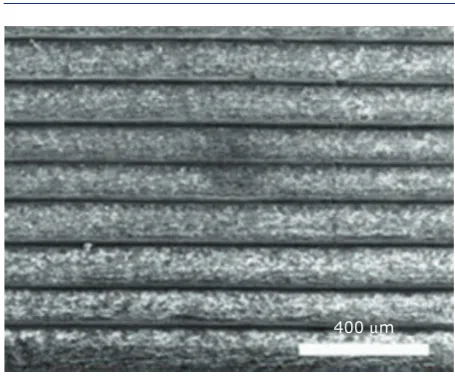
electrodes. After binder burnout, at 180°C for 3 h, stacks were exposed to water vapour in a sealed beaker at 80°C. The moistened stacks were then cold sintered at 150°C under 100 MPa of pressure for 30 min. The SEM image of the cross-section of the cold sintered MLCC in Figure 11 shows the
dielectric layers are well densified, well laminated
20 10 0
0 25
Temperature, °C
50 75 100 125 150
TCC,
%
–10 –20 –30 –40 –50 –60 –70 –80
–75 –50 –25
Fig. 10. Comparison of commonly used capacitor
categories, according to TCC and temperature Fig. 11. Cold sintered multilayer capacitor with C0G characteristics fabricated at 150°C from
BLVMO-0.2NMO. Reproduced with permission from (20) 400 µm
0
–5
1 1.5 2 2.5 3 4 Frequency, GHz
3.5
s11, dB
–10
–10 0 0 30
60
90
120
150 –150 –120
–90 –60 –30
–30 –20
180
E-plane H-plane
–15
(a) (b)
and unwarped. The Ag electrodes also appear well
defined indicating no reaction at the metal-ceramic
interface (20). The room temperature εr and loss at 1 MHz were found to be 39 and 0.01 respectively
and the TCC was within 0.013% up to 150°C.
4. Commercialisation: Challenges for
Scale-up and Complex Structures
Some ceramic materials require high pressures toachieve the desired densification. To scale up the CSP to produce larger components therefore, a significant
increase in applied pressure will be required compared to laboratory scale. Cold sintering is currently a batch process with a small number of samples produced. For this technology to be adopted more widely, rates of manufacture should be increased. Currently only simple two-dimensional and pellet shapes have been reported. Many potential applications for cold sintering ceramics will require more complex shapes, which could be achieved by creating near net-shape die pieces, although this brings its own challenges
of die filling and variations in pressure across the
component during sintering.
5. Conclusion
Alongside the reduction in manufacturing energy consumption, lower sintering temperatures allow
densification of materials that would otherwise react,
decompose or volatilise. This new area of research is gaining traction as more materials and prototype components are developed. Cold sintering has the potential to be a game changing technology in ceramic processing and component manufacturing
and work at The University of Sheffield has
demonstrated several potential avenues for cold sintering to create devices and composites which are not achievable through conventional sintering.
Acknowledgements
The authors would like to acknowledge the support of the Johnson Matthey Strategic Fund and the Engineering and Physical Science Research Council
(EPSRC) grants, EP/L017563/1 and EP/N010493/1.
References
1. R. M. German, Powder Metall., 2013, 56, (2), 117 2. D. S. B. Heidary, M. Lanagan and C. A. Randall,
J. Eur. Ceram. Soc., 2018, 38, (4), 1018
3. T. Kimura, Q. Dong, S. Yin, T. Hashimoto, A. Sasaki and T. Sato, J. Eur. Ceram. Soc., 2013, 33, (5), 1009
4. C. A. Randall, S. F. Wang, D. Laubscher, J. P. Dougherty and W. Huebner, J. Mater. Res., 1993, 8, (4), 871
5. H.-I. Hsiang, C.-S. Hsi, C.-C. Huang and S.-L. Fu, J. Alloys Compd., 2008, 459, (1–2), 307
6. “Sintering of Advanced Ceramics”, eds. C. A. Handwerker, J. E. Blendell and W. Kaisser, Ceramic Transactions, Vol. 7, American Ceramic Society, Ohio, USA, 1990, 789 pp
7. M. Biesuz and V. M. Sglavo, J. Eur. Ceram. Soc., 2019, 39, (2–3), 115
8. J. A. Downs and V. M. Sglavo, J. Am. Ceram. Soc., 2013, 96, (5), 1342
9. M. Al. Minnath, ‘Metals and Alloys for Biomedical Applications’, in “Fundamental Biomaterials: Metals”, eds. P. Balakrishnan, M. S. Sreekala and S. Thomas, Ch. 7, Elsevier Ltd, Duxford, UK, 2018, pp. 167–174
10. T. Herisson de Beauvoir, A. Sangregorio, I. Cornu, C. Elissalde and M. Josse, J. Mater. Chem. C, 2018, 6, (9), 2229
11. C. Elissalde, U.-C. Chung, M. Josse, G. Goglio, M. R. Suchomel, J. Majimel, A. Weibel, F. Soubie, A. Flaureau, A. Fregeac and C. Estournès, Scripta Mater., 2019, 168, 134
12. H. Kähäri, M. Teirikangas, J. Juuti and H. Jantunen, J. Am. Ceram. Soc., 2014, 97, (11), 3378
13. J. Guo, H. Guo, A. L. Baker, M. T. Lanagan, E. R. Kupp, G. L. Messing and C. A. Randall, Angew. Chemie, 2016, 128, (38), 11629
14. N. Yamasaki, K. Yanagisawa, M. Nishioka and S. Kanahara, J. Mater. Sci. Lett., 1986, 5, (3), 355
15. K. Yanagisawa, K. Ioku and N. Yamasaki, J. Am. Ceram. Soc., 2005, 80, (5), 1303
16. K. Hosoi, T. Hashida, H. Takahashi, N. Yamasaki and T. Korenaga, J. Am. Ceram. Soc., 1996, 79, (10), 2771
17. J.-P. Maria, X. Kang, R. D. Floyd, E. C. Dickey, H. Guo, J. Guo, A. Baker, S. Funihashi and C. A. Randall, J. Mater. Res., 2017, 32, (17), 3205
18. H. Kähäri, M. Teirikangas, J. Juuti and H. Jantunen, J. Am. Ceram. Soc., 2015, 98, (3), 687
19. D. Wang, S. Zhang, D. Zhou, K. Song, A. Feteira, Y. Vardaxoglou, W. Whittow, D. Cadman and I. M. Reaney, Materials, 2019, 12, (9), 1370 20. D. Wang, D. Zhou, K. Song, A. Feteira, C. A. Randall
and I. M. Reaney, Adv. Electron. Mater., 2019, 5, (7), 1900025
Y. Vardaxoglou and I. M. Reaney, Acta Mater., 2019, 166, 202
22. D. Wang, D. Zhou, S. Zhang, Y. Vardaxoglou, W. G. Whittow, D. Cadman and I. M. Reaney, ACS Sustain. Chem. Eng., 2018, 6, (2), 2438
23. T. K. Gupta, J. Am. Ceram. Soc., 1990, 73, (7), 1817
24. T. K. Roy, D. Bhowmick, D. Sanyal and A. Chakrabarti, Ceram. Int., 2008, 34, (1), 81 25. X. Kang, R. Floyd, S. Lowum, M. Cabral, E. Dickey
and J.P. Maria, J. Am. Ceram. Soc., 2019, 102, (8), 4459
26. S. Funahashi, J. Guo, H. Guo, K. Wang, A. L. Baker, K. Shiratsuyu and C. A. Randall, J. Am. Ceram. Soc., 2016, 100, (2), 546
27. J. Gonzalez-Julian, K. Neuhaus, M. Bernemann, J. Pereira da Silva, A. Laptev, M. Bram and O. Guillon, Acta Mater., 2018, 144, 116
28. J. Nie, Y. Zhang, J. M. Chan, R. Huang and J. Luo, Scripta Mater., 2018, 142, 79
29. R. Boston, J. Guo, S. Funahashi, A. L. Baker, I. M. Reaney and C. A. Randall, RSC Adv., 2018,
8, (36), 20372
30. H. Guo, J. Guo, A. Baker and C. A. Randall, J. Am. Ceram. Soc., 2016, 100, (2), 491
31. C. Vakifahmetoglu, J. F. Anger, V. Atakan, S. Quinn, S. Gupta, Q. Li, L. Tang and R. E. Riman, J. Am. Ceram. Soc., 2016, 99, (12), 3893
32. J.-P. Ma, X.-M. Chen, W.-Q. Ouyang, J. Wang, H. Li and J.-L. Fang, Ceram. Int., 2018, 44, (4), 4436 33. M. C. Blanco-Lopez, B. Rand and F. L. Riley, J. Eur.
Ceram. Soc., 1997, 17, (2–3), 281
34. M. Bäurer, H. Kungl and M. J. Hoffmann, J. Am. Ceram. Soc., 2009, 92, (3), 601
35. N. M. Alford, S. J. Penn, A. Templeton, X. Wang, J. C. Gallop, N. Klein, C. Zuccaro and P. Filhol, ‘Microwave Dielectrics’, IEE Colloquium on Electro-Technical Ceramics – Processing, Properties and Applications, The Institution of Engineering and Technology, London, UK, 14th November, 1997 36. I. F. Akyildiz, S. Nie, S.-C. Lin and
M. Chandrasekaran, Comput. Networks, 2016,
106, 17
37. E. Hossain and M. Hasan, IEEE Instrum. Meas. Mag., 2015, 18, (3), 11
38. G. Ancans, V. Bobrovs, A. Ancans and D. Kalibatiene, Procedia Comput. Sci., 2017, 104, 509
39. P. Wang, Y. Li, L. Song and B. Vucetic, IEEE Commun. Mag., 2015, 53, (1), 168
40. D. Zhou, C. A. Randall, L.-X. Pang, H. Wang, J. Guo, G.-Q. Zhang, Y. Wu, K.-T. Guo, L. Shui and X. Yao, Mater. Chem. Phys., 2011, 129, (3), 688 41. J. Guo, S. S. Berbano, H. Guo, A. L. Baker,
M. T. Lanagan and C. A. Randall, Adv. Funct. Mater., 2016, 26, (39), 7115
42. D. Zhou, C. A. Randall, H. Wang, L.-X. Pang and X. Yao, J. Am. Ceram. Soc., 2010, 93, (4), 1096 43. S. Zhang, R. K. Arya, S. Pandey, Y. Vardaxoglou,
W. Whittow and R. Mittra, IET Microwaves Antennas Propag., 2016, 10, (13), 1411
44. L. V. Blake and M. W. Long, “Antennas: Fundamentals, Design, Measurement”, 3rd Edn., SciTech Publishing, Raleigh, USA, 2009, 503 pp 45. D. Wang, S. Zhang, G. Wang, Y. Vardaxoglou,
W. Whittow, D. Cadman, D. Zhou, K. Song and I. M. Reaney, Appl. Mater. Today, 2020, 18, 100519
46. I. M. Reaney and D. Iddles, J. Am. Ceram. Soc., 2006, 89, (7), 2063
The Authors
Jessica Andrews completed an MEng in Materials Science and Engineering in 2016. She is now a PhD student within the Functional Materials and Devices Group at The University
of Sheffield. Supervised by Professor Reaney and sponsored by Johnson Matthey, her
project is focused on developing methods of cold sintering for several ceramic materials and polymer-ceramic composites.
Daniel Button originally graduated at The University of Sheffield with an MEng in Materials
Science and Engineering in 2017 and is currently a PhD student in the Functional Materials and Devices at the same university. He is working on a project sponsored by Johnson
Matthey, investigating the cold sintering of ZnO and its possible use cases for industrial
Ian M. Reaney was appointed Professor in Ceramics in 2007 and in 2017 to the Dyson Chair
in Ceramics at The University of Sheffield. Ian’s research interests are in development of MW and piezoelectric materials and functional glasses. He’s published more than 400
papers and given over 100 invited, keynote and plenary talks at international conferences. His h-index is 63 and his papers have received >16,000 citations. He won the Edward C. Henry award in 2002, best knowledge transfer partnership building on EPSRC funded research in 2009 and the Verulam Medal in 2017. He is European site director of the Centre