Licensed under Creative Common Page 570 http://ijecm.co.uk/
RETHINKING APPROACH TO PUBLIC
FINANCIAL MANAGEMENT: LESSONS FROM
THE DEVOLVED UNITS IN KENYA
Oseno Ben
Masinde Muliro University of Science and Technology, Kenya
[email protected], [email protected]
Abstract
Auditor General of Kenya Mr. Edward Ouko once observed that Kenya’s strive to become a
middle income economy by 2030 may not be realized because of the sad state of affairs about
revelations on questionable financial malpractices covering the entire spectrum in the public
sector. Halving poverty by 2015 as outlined in the Millennium Sustainable Goals Agenda has
not be achieved perhaps due to poor management of public financial resources, exposing an
estimated number of nearly 800 million people living in extreme poverty globally as the World
Bank estimates. This raises interesting questions: Why are the malpractices continuing in the
face of various commissions and state agencies set-up by the Constitution to check
malpractices? Are the constitutional provisions, Acts of Parliament and regulations risk mapping
and highlighting risk prone areas in the public financial transactions that should be closely
monitored? Are we too slow or too late in reacting to the malpractices in a deterrent manner?
Could we then rethink our approach to Public Financial Management? This paper is interested
in answering these questions by analysing the Constitutional provisions, Acts of Parliament and
Regulations in light of the state of public financial management at the devolved units in Kenya.
A census study design was adopted for this study with the target population of 47 county
governments’ Chief Officer of each County Treasury was discretionally chosen as key
informants although only 45 respondents filled are returned the questionnaires. Both primary
and secondary data were used in this study with primary data collected by use of questionnaires
while secondary data was obtained from analysis of annual audit reports from the Office of the
Licensed under Creative Common Page 571 statistics in terms of percentages and frequencies. The results showed that 73.30 per cent of
the respondents acknowledging adequate measures of Public Financial Management being
provisioned, and that need for personal gain by the Public Officers significantly motivate in
overriding checks and balances in the management of public financial resources at the county
governments.
Keywords: Public financial management, Devolved units, Financial malpractices, Kenya
INTRODUCTION
Kenya’s strive to become a middle income economy by 2030 may not be realised because of
the sad state of affairs about revelations on questionable financial malpractices covering the
entire spectrum in the public sector. The major flagship projects of the vision 2030 in the
economic and social pillars are under threat due to malpractices involved in the execution be it
procurement operations, design works, planning activities, or disbursement of funds hardly meet
the threshold of chapter two of the constitution of Kenya, 2010 section 10 (2) on the national
values of governance which include; good governance, integrity, transparency and
accountability.
The purpose of Public Procurement and Assets Disposal (PPAD) Act, 2015 is to help the
public entities achieve specific objectives such as to maximize economy and efficiency; as well
as promote the integrity and fairness of the transparency and accountability in those
procurement procedures. Besides, the Public Finance Management (PFM) Act 2012, in part IV
section 104 (1) on County Governments responsibilities with respect to management and
control of public finance require the county governments to comply with the Act and effectively,
efficiently and transparently manage their funds through proper accountability for the
expenditure of those funds.
In the face of all these provisions on the public financial management tools, a number of
pertinent questions on Public Financial Management arise; why are malpractices continuing a
mid various established commissions and state agencies set up by the Constitution to check
malpractices? Is the constituonal provision, Acts of parliament and regulations risk mapping and
highlighting risk prone areas in the Public Financial transactions that should be closely
monitored? Are systems of Public Financial Management too slow or too late in reacting to the
malpractices in deterrent manner? Could we then rethink our approach to public finance
management?
This paper is interested in answering these questions by analysing the constitutional
Licensed under Creative Common Page 572 management at the devolved units in Kenya. Specifically the paper examined the relevant
provisions of the tools in guiding the management of financial resources at the devolved units
against the backdrop of the situational evaluation on spiralling wage bill, cumulating pending
bills, nature of audit opinion, state of Own Source Revenue (OSR), low development fund
absorption rate as well as significant travelling expenses of the devolved units. The paper then
contrasted that state of financial management at the devolved units with the measures put in
place by the relevant public financial management tools in presenting a preposition of rethought
alternative approaches to public financial management at the county governments in Kenya.
SITUATIONAL ANALYSIS OF THE DEVOLVED UNITS
Situational analysis provides an overview of the state of Public Financial Management of the
devolved units in terms of nature of audit opinion, own source revenue, pending bills, wage bill,
absorption rate of development fund and travelling expenses.
Nature of audit opinion of the county governments
According to the 2017/2018 county executive reports by the Auditor General, counties
have made improvement in the audit opinions they receive, although a lot needs to be done to
improve their reporting.
Table 1: Audit opinion of some counties
County 2013/14 2014/15 2015/16 2016/17 2017/18
Tharaka-Nithi Disclaimer Adverse Adverse Adverse Qualified
Isiolo Adverse Adverse Qualified
Samburu Adverse Adverse Qualified
Embu Adverse Adverse Qualified
Meru Disclaimer Adverse Adverse Adverse Qualified Mandera Disclaimer Adverse Adverse Adverse Qualified Marsabit Disclaimer Adverse Adverse Adverse Qualified
Makueni Adverse Adverse Unqualified
Nyandarua Adverse Adverse Unqualified
Nairobi Disclaimer Disclaimer Disclaimer Disclaimer Disclaimer Source: GoK, (2018)
Qualified opinion- meaning the Auditor General received all the information required for the
audit, but it revealed gaps that often arise from failure to stick to procedures and budget limits.
This shows failure to follow laid-down procedures or the law. An adverse opinion- This is the
Licensed under Creative Common Page 573 misleading or incomplete. Such an opinion means problems singled out by the audit are
pervasive and require a great deal of changes to rectify.
Disclaimer opinion- meaning financial documents and statements provided were
misleading or incomplete. Such opinion means problems singled out by the audit are pervasive
and require a great deal of changes to rectify. Unqualified opinion- It shows that all the money
was accounted for with the proper documentation provided. Since the advent of devolution, it is
only Makueni and Nyandarua counties that have got an unqualified audit opinion. Instructively,
getting an unqualified opinion is the minimum that Kenyan taxpayers must expect from all
counties. Article 229 (6) of the constitution requires the Auditor General to confirm whether or
not public money has been spent well.
According to the National Taxpayers Association (NTA) report of 2018 most of the
county governments are stagnant in raising Own Source Revenue (OSR) and are relying merely
on Central Government transfers. This is against guidelines from the National Treasury.
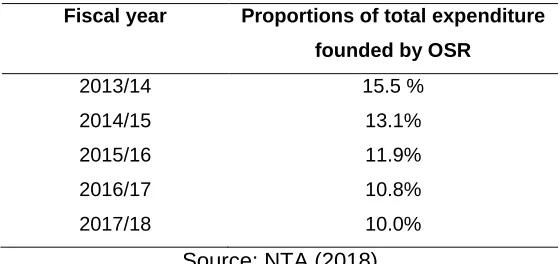
In 2017/18 the county governments targeted Kshs. 49.2 billion in OSR but only
managed to collect Kshs. 32.5 billion similar to collection realized in 2016/17 fiscal year. County
governments OSR has deterioration in the last five years both as appropriation of the targeted
collections and absolute terms.
Table 2: Counties own source revenue proportion
Fiscal year Proportions of total expenditure
founded by OSR
2013/14 2014/15 2015/16 2016/17 2017/18
15.5 % 13.1% 11.9%
10.8% 10.0% Source: NTA (2018)
Counties are holding on Kshs. 44.3 billion in pending bills owned to suppliers as at June 2018.
However, as at June 2018 accumulated Kshs. 108.41 billion claims from contractors and
suppliers, an increase from Kshs. 35.84 billion as at June 2017.
The Auditor General’s Report of 201/18 where for instance in Bungoma county, Kshs. 18
million was spent on ghost projects (Dairy Commercialisation project at Bukembe for Ksh 9.3
million, Mihuu water project at a cost of Ksh 4.1 million, and Data Center at a cost of Ksh 4.9
Licensed under Creative Common Page 574 2019 with less than a half of the allocation of its annual development budget at Kshs. 413 million
against disbursement of Ksh 936.4 million on development budget absorbed.
In Trans Nzoia county, its referral hospital has stolled with Ksh 182.7 million paid for the
project and interim certificates for works issued by a private consultant. The issuance of the
certificate by a private consultant had contravened section 48 of the PPAD Act 2015, which
requires an Inspection and Acceptance Committee to issue the interim and completion
certificates. Tharakanithi County audited accounts of 2017/18 show that, the county assembly
spent Ksh 12 million on foreign travel and subsistence. This included Kshs. 9 million paid to
Members of the County Assemblies (MCAs), workshops, and training in foreign countries. The payments grossly abused the use of “temporary imprests” because the payments were made as
reimbursements through temporary imprests after they returned from the foreign trips contrary
to PFM Act 2012 which states that temporary imprests shall be issued mainly in respect to
official journeys and are intended to provide officers with funds with which they can meet
travelling accommodation and incidental expenses.
A non-prequalified supplier was given tender to organise seminars, workshops and
training for the county assembly against the PPAD Act, 2015. Besides the audit report shows
that the Deputy Speaker of the county was paid Kshs. 317,515 to travel to Denmark for six
days (May 20 to June 5, 2018) for a workshop. However, records show that she attended
plenary sittings at the same period.
Figure 1: County Official’s Travel budgets (Shs. Mn)2017/2018
Licensed under Creative Common Page 575 In travelling expense the audit report of 2017/2018 reveal a sad state of affairs in millions spent
on travelling, some of which were not supported with appropriate documentation.
METHODOLOGY
The study adopted descriptive survey research design which censured all the 47 county
governments in Kenya. In each county, one key informant was given a questionnaire to fill and
that was the County Chief Officer. The questionnaire was self administrated by the researcher in
obtaining primary data. Besides, document analysis method was employed in accessing
secondary data more especially the government reports such as the annual audit reports by the
Auditor General as well as the Budget Controller. The response rate was 95.74 percent with 45
out of 47 County Chief Officers filling are returning the questionnaires. Data was purely
analysed descriptively by use of frequencies and percentages. Tables, graphs and pie-charts
were used in the presentation of the study findings.
ANALYSIS AND FINDINGS
Demographic characteristics of the respondents
A census study of the 47 counties in Kenya was conducted with 45 key informants filling and
returning the questionnaires while respondents from 2 counties of Kilifi and Samburu did not.
This translated to a response rate of 95.70 per cent. The study targeted 47 key informants from
the treasury department of each county. In each county one key informant was identified and
the Chief Officer of a County Treasury was discretionally chosen because the study believed
that the respondent was quite knowledgeable on the financial management practices at the
county government.
The study sought to establish the duration the respondents have served in their positions
at the counties in order to examine their familiarity with the financial management practices at
the county governments. The study results indicate that, majority of the respondents had
worked for a period between 1-5 years; which accounted for 48.90 per cent of the respondents
as shown in table 3
Table 3: Work experience of the respondents
Period Frequency Per cent Cumm per cent
1-5 years 22 48.90 48.90
5-10 years 10 22.20 71.10
10-15 years 6 13.30 84.40
Licensed under Creative Common Page 576 These findings may be informed by the facts that county governments have been inexistence for
7 years now.
The study sought to establish both the academic and professional qualifications of the
respondents to determine whether they were upto the task at their disposal. The study results revealed that most of the respondents had bachelors’ degree at 55.60 per cent of the
respondents as shown in table 4. In terms of professional qualifications, it was found out that a
bigger percentage of the respondents had CPA (K) qualifications accounting for 71.10 per cent
of the respondents.
The County Public Service Boards charged with the responsibility of selection and
recruitment of the county employees sets the minimum job qualifications in-respect to the job
requirements. This is a common practices where Finance Officers are required to have CPA (K)
and other academic qualifications and Chief Officer of a County Treasuries are an equivalent of
such position.
Table 4: Qualifications of the respondents
Risk assessment (The Constitution, Acts of Parliament and Regulations)
Risk assessment was evaluated by the study in order to determine the provisions of prudential
financial management practices through appreciate tools guiding the management of public
financial resources at the county governments.
The study found out that the Constitutions of Kenya 2010, Acts of parliament as well as
the regulations such as Public Finance Management Act 2012, Public Procurement are Assets
Disposal Act 2015 and Public Procurement and Assets Disposal Regulations of 2016, provide
sufficient and relevant guideline on the management of public financial resources. Seventy three
point three percent (73.30%) of the respondents acknowledged the adequacy of the prudential
financial management practices being provided in the relevant documents in guiding Public
Officers in executing their responsibilities as shown in figure 2:
N= 45
Academic qualifications
N= 45
Professional qualifications
Frequency Per
cent
Cumm
percent
Frequency Per
cent
Cumm
percent
Diploma 8 17.80 17.80 CPA (K) 32 71.10 71.10
Bachelors 25 55.60 73.40 CPA (II) 6 13.30 84.40
Masters 12 26.70 100.00 ACCA or CFE 5 11.10 95.50
Licensed under Creative Common Page 577
84.40
%
4.50%
11.10
%
YESNOT SURE
NO
Figure 2: State of provisional clauses guiding public financial management
The study results indicate that only 11.10 per cent of the respondents believed that the
constitutional provisions and other relevant Acts and regulations do not provide sufficient
guideline on the management of public financial resources. This is justified by the fact that
constitutional amendment is being called for as well as amendments which were done to the
Public Finance Management Act in 2016.
Knowledge of the Public Officers about the specific provisions of public documents was
also sought by the study. However, it was discovered that 84.40 per cent are fully aware of the
relevant provisions guiding the operations at the devolved units with less than 20 per cent of
the respondents either are not aware or are not sure as shown in figure 3.
Figure 3: Knowledge state of the Public Officers about the financial management provisions.
After the establishing the availability of the relevant documents which guide on the management
of public financial resources as well as the knowledge of the Public Officers over the same, the
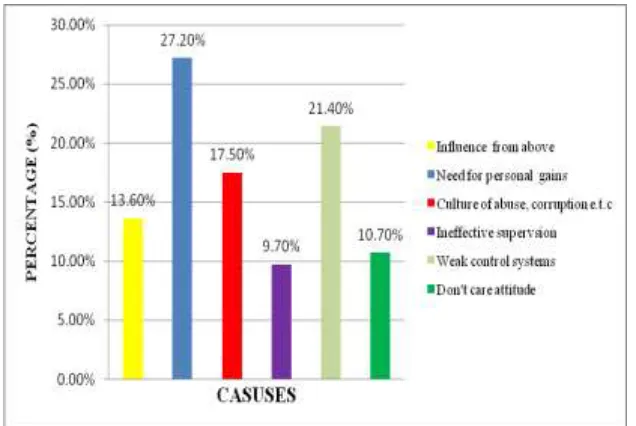
study further examined the causes as to why Public Officers act contrary to the provisions of
relevant laws, rules and regulations. The following causes were mentioned and ranked as
Licensed under Creative Common Page 578 Figure 4: Cause of poor public financial management at the devolved units.
Need for personal gain by the Public Officers was the most cited cause by the respondents
followed by weak internal control systems of the county governments at 27.20 per cent and
21.40 per cent respectively.
Risk of abuse of office, wastage, misappropriate and corruption prone departments or
sections was also examined by the study and the findings indicate that supplies and
procurement is the most vulnerable section because it was ranked first by the respondents at
48.40 per cent followed by revenue and expenditure sections at 31.30 per cent as shown in
figure 5.
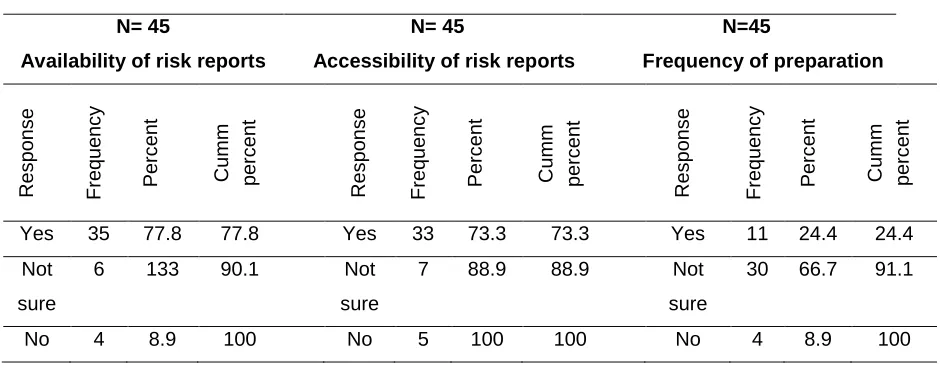
Licensed under Creative Common Page 579 Risk assessment reports availability, as well as accessibility and frequency of preparation by the
relevant departments such as the internal audit as well as external bodies such as the Office of
Controller of Budget was also determined by the study. The findings show that most of the
counties prepare the risk analysis report and its often done by many counties on quarterly basis
as outlined in table 5.
Table 5: Risk Assessment Parameters
N= 45
Availability of risk reports
N= 45
Accessibility of risk reports
N=45
Frequency of preparation
Res po ns e F req ue nc y P erc en t
Cumm perc
en t Res po ns e F req ue nc y P erc en t
Cumm perc
en t Res po ns e F req ue nc y P erc en t
Cumm perc
en
t
Yes 35 77.8 77.8 Yes 33 73.3 73.3 Yes 11 24.4 24.4 Not
sure
6 133 90.1 Not
sure
7 88.9 88.9 Not
sure
30 66.7 91.1
No 4 8.9 100 No 5 100 100 No 4 8.9 100
Risk assessment reports are important because they map the risk prone areas and give
recommendations on mitigation measures to minimise on the identified risks in the management
of public financial resources.
Risk Management (Action on risk management reports, handling of wastage and
corruption cases as well as commitment by the tone at the top)
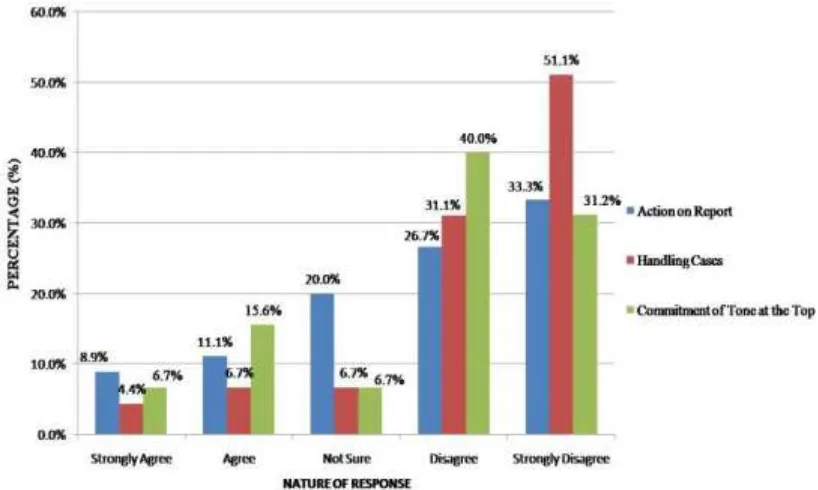
The study sought to find out if the risk assessment reports are acted upon by the relevant
authorities at the devolved units. The study revealed that most of the respondents either
disagreed or strongly disagreed that the risk assessment reports are used in guiding decisions
on the management of public financial resources at the county governments in Kenya.
The same trend was witnessed when respondents’ opinion was sought on whether the
cases of abuse of office, wastage, misappropriate and corruption issues are taken seriously by
the management of the county governments with the majority of the respondents disagreeing on
the commitment of the county executive to prudent financial management.
Tone at the top/or control environment was evaluated by the study to determine its
appropriateness to the control measures established at the devolved units. The study found out
that a significant number of respondents either disagreed or strongly disagreed on the
Licensed under Creative Common Page 580 Figure 6: An evaluation of the Commitment of the managers of the
county governments on specific financial management aspects
Challenges of Risk Assessment and Management
The study further determined the challenges affecting the risk assessment and management of
public financial resources and it was found out that inadequate facilitation of the institutions of
oversight such as the Office of the Controller Budget and Auditor General’s Office, capacity
challenges of the county assemblies, the senate as well as the national assembly in terms of
expertise know -how was often cited. Besides, lack of commitment by the county executives and
the reporting systems are some of the major factors affecting risk assessment and management
of county government resources. The other factors are low-up take of technology, culture of
wastage and weak internal control system. Inadequate supervision and greed for personal
gains, were also mentioned by the respondent to be undermining risk assessment and
management of the devolved public financial resources.
CONCLUSION
The paper found out that while the public financial management document contain appropriate
provisions in guiding public financial management, some gaps are still existing which require
improvement. Also while the risk assessment reports are being prepared by the relevant
departments and agencies, the county executives are to some extent not using the reports to
Licensed under Creative Common Page 581 the oversight bodies such as the county assemblies are posing major challenges to prudent
financial management at the devolved units in light of technical know-how. Finally, the tone at
the top in the county governments is not favourable for effective and efficient risk assessment
and management for better public financial management practices.
RECOMMENDATIONS
The paper therefore recommends;
i) Institutional intervention which requires design of a system of incorporating experts in
the county assemblies, the senate and the national assembly. Funding to be improved to the
Office of the Controller of Budget and Office of Auditor General to finance manpower.
ii) Policy intervention. Need to develop supplementary procedures to be incorporated in the
county financial regulations and procedures manual.
iii) Technological intervention. Improve the IFMIS by examining its efficiency, audit trail
gaps to be bridged as well as encouraging the county government to automate their revenue
collection to plague revenue leakage.
AREAS FOR FURTHER STUDY
The paper suggests the following grey areas for further investigation by other researchers;
i) There is need to interrogate the institutional capacity in terms of funding and human
capital investment in the management public financial resources.
ii) Besides, there is need to investigate the devolved functions which are not prioritized by
the county governments in their financial plans.
iii) Relationship between the county governments and the national government in terms of
erratic funds disbursement.
ACKNOWLEDGEMENTS
The author wishes to thank the Chief Officers of the 45 county governments who provided vital information on management of public financial resources at the devolved units in Kenya. I wish to appreciate the Office of the Controller of Budget as well as the Auditor General’s Office for availing relevant financial documents in evaluating the state of Financial Management of the County Governments.
REFERENCES
E.Ouko, Alterative Approaches to Oversight. Government Printers, 2016. Government of Kenya 1, Vision 2030. Government Printers, 2003.
Licensed under Creative Common Page 582 Government of Kenya 4, Public Procurement and Assets Disposal Act 2005. Government Printers, 2005.
Government of Kenya. Audit Report 2017/18. Government Printers, 2018.