ARTICLE
Effect of Computer Order Entry on Prevention of
Serious Medication Errors in Hospitalized Children
Kathleen E. Walsh, MDa,b, Christopher P. Landrigan, MDc, William G. Adams, MDb, Robert J. Vinci, MDb, John B. Chessare, MDb,d,
Maureen R. Cooper, RNb, Pamela M. Hebert, RNb, Elisabeth G. Schainker, MDb,e, Thomas J. McLaughlin, ScDa,f, Howard Bauchner, MDb
Departments ofaPediatrics andfPsychiatry, University of Massachusetts Medical School/UMass Memorial Medical Center, Worcester, Massachusetts;bDepartment of
Pediatrics, Boston University School of Medicine/Boston Medical Center, Boston, Massachusetts;cDepartments of Medicine, Brigham and Women’s Hospital and
Children’s Hospital Boston, Boston, Massachusetts;dNorwood Caritas Hospital, Norwood, Massachusetts;eDepartment of Pediatrics, Tufts University School of
Medicine/New England Medical Center, Boston, Massachusetts
The authors have indicated they have no financial relationships relevant to this article to disclose.
ABSTRACT
OBJECTIVE.Although initial research suggests that computerized physician order entry reduces pediatric medication errors, no comprehensive error surveillance studies have evaluated the effect of computerized physician order entry on children. Our objective was to evaluate comprehensively the effect of computerized physician order entry on the rate of inpatient pediatric medication errors.
METHODS.Using interrupted time-series regression analysis, we reviewed all charts, orders, and incident reports for 40 admissions per month to the NICU, PICU, and inpatient pediatric wards for 7 months before and 9 months after implementation of commercial computerized physician order entry in a general hospital. Nurse data extractors, who were unaware of study objectives, used an established error surveil-lance method to detect possible errors. Two physicians who were unaware of when the possible error occurred rated each possible error.
RESULTS.In 627 pediatric admissions, with 12 672 medication orders written over 3234 patient-days, 156 medication errors were detected, including 70 nonintercepted serious medication errors (22/1000 patient-days). Twenty-three errors resulted in patient injury (7/1000 patient-days). In time-series analysis, there was a 7% decrease in level of the rates of nonintercepted serious medication errors. There was no change in the rate of injuries as a result of error after computerized physician order entry implementation.
CONCLUSIONS.The rate of nonintercepted serious medication errors in this pediatric population was reduced by 7% after the introduction of a commercial computerized physician order entry system, much less than previously reported for adults, and there was no change in the rate of injuries as a result of error. Several human-machine interface problems, particularly surrounding selection and dosing of pediatric medications, were identified. Additional refine-ments could lead to greater effects on error rates.
M
EDICATION ERRORS AFFECT1 in 10 pediatric hospital admissions and injure thousands of children annually.1–4The Institute of Medicine and the American Academy of Pediatrics advocate for implementation of comput-erized physician order entry (CPOE) as 1 promising intervention to prevent pediatric medication errors.5,6 In
hospitalized adults in a single hospital, CPOE was shown to reduce nonintercepted serious inpatient medication errors (errors that had the potential to injure the patient and were not caught by hospital staff) by 55%.7Because of
these and other positive findings, more than half of the nation’s hospitals are planning to implement CPOE in the next several years.8
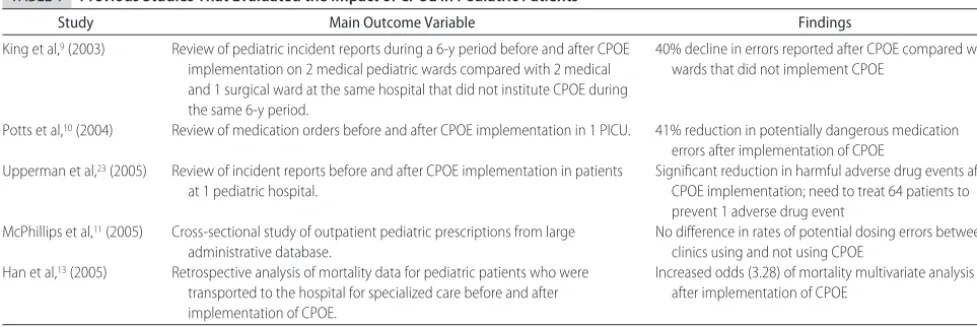
Among hospitalized children, initial research on CPOE was promising, but recent reports have been less positive (Table 1). An analysis of pediatric incident reports showed a 40% reduction in reported medication errors,9and a
study of a pediatric critical care unit found a 41% reduction in potentially dangerous errors after implementation of CPOE10; however, McPhillips et al,11 in a review of outpatient pediatric pharmacy administrative data, found no
www.pediatrics.org/cgi/doi/10.1542/ peds.2007-0220
doi:10.1542/peds.2007-0220
Key Words
patient safety, medication errors, medical errors, computer order entry, quality improvement
Abbreviations
CPOE— computerized physician order entry
CI— confidence interval IRR—incidence rate ratio Accepted for publication Jul 21, 2007 Address correspondence to Kathleen E. Walsh, MD, Department of Pediatrics, Benedict Second Floor, UMass Medical Center, 55 North Lake St, Worcester, MA 01655. E-mail: [email protected]
difference in rates of potential overdosing or underdos-ing errors between clinics that used basic CPOE and those that did not use CPOE.11A recent evaluation of the
potential benefit of CPOE over pharmacist review for ordering errors demonstrated that CPOE could reduce potentially dangerous prescribing errors but would have no effect on administration errors, which have a high risk of patient injury.12A study of hospital mortality data
reported increased mortality among PICU transfers after implementation of CPOE.13 The ecologic nature of this
study and seasonal imbalance between before and after periods may have confounded the results, or, alterna-tively, mortality may have been related to the method of implementation of the CPOE system.13,14Several other
studies reported errors that were caused by health infor-mation technology, including CPOE.15,16Overall,
contro-versy remains in the current literature about the value of CPOE for pediatric patients.
None of the pediatric studies to date has used compre-hensive error surveillance methods as used in the initial work in adult inpatients by Bates et al.7 Comprehensive
error surveillance methods review all incident reports and all parts of the medical chart (orders, physician and nursing notes, medication administration records, and discharge notes) for medication errors. In addition, pre–post designs do not adequately account for any possible changes in the background rate of errors unrelated to the introduction of the CPOE system. The objective of this interrupted time-series study was to measure the effect of a commonly used commercial CPOE system on rates of pediatric noninter-cepted serious medication errors. We hypothesized that the rate of pediatric nonintercepted serious medication errors would decline by 50% on the basis of results by Bates et al7
and of early reviews of incident reports in pediatrics.9,10
METHODS
We determined monthly rates of errors for 7 months before CPOE and 9 months after CPOE among children who were hospitalized at 1 hospital. We allowed 6 months between the before and after period for system implementation and residents’ learning the system. At the time of study design, we considered it possible that the CPOE system might have more of an effect the longer it was in use or might have a
good impact initially with less impact over time. For this reason, 2 extra months (April and May) were included in the post-CPOE sampling frame to capture any later impact of CPOE on medication error rates. Study methods were reviewed and approved by the Boston University institu-tional review board.
Study Site and CPOE System
The study site and CPOE system have been described in detail elsewhere.17Boston Medical Center is an urban
hos-pital with 4 PICU beds, 15 NICU beds, and 40 surgical and medical pediatric ward beds. The Sunrise Clinical Manager CPOE System, by Eclipsys, was implemented on the pedi-atric inpatient wards in April 2002 and in the PICU and NICU by June 2002. For each medication, the user has the option to select a pediatric version or an unspecified ver-sion (eg, the users could choose “pediatric ceftriaxone” or “ceftriaxone”). For pediatric medications, after the order is signed, the system uses a weight-based dosage calculator to automatically check medication dosages on the basis of the child’s weight, generating wrong-dosage alerts. When writing medication orders, before signing them, the user may opt to use a pediatric weight-based dosage calculator to assist in calculating medication dosages. Other features include drug– drug interaction alerts and allergy alerts. Pe-diatric order sets are available for nonnarcotic pain control (eg, sucrose, acetaminophen, fluoromethane spray) and newborn care (eg, hepatitis vaccine, vitamin K injection), for which the user may select all of a list of medications or select individual medications from the list. All CPOE users attended a 2-hour training session before being given a password. Nursing medication administration records were, at the time of the study, paper based. Before imple-mentation of this system, only the hospital pharmacy was automated with a system that had drug– drug interaction and drug allergy checking.
Inclusion Criteria
Patients who were admitted to the pediatric inpatient wards, NICU, or PICU between September 2001 and March 2002 (pre-CPOE) and between September 2002 and May 2003 (post-CPOE) were included in the
sam-TABLE 1 Previous Studies That Evaluated the Impact of CPOE in Pediatric Patients
Study Main Outcome Variable Findings
King et al,9(2003) Review of pediatric incident reports during a 6-y period before and after CPOE
implementation on 2 medical pediatric wards compared with 2 medical and 1 surgical ward at the same hospital that did not institute CPOE during the same 6-y period.
40% decline in errors reported after CPOE compared with wards that did not implement CPOE
Potts et al,10(2004) Review of medication orders before and after CPOE implementation in 1 PICU. 41% reduction in potentially dangerous medication
errors after implementation of CPOE Upperman et al,23(2005) Review of incident reports before and after CPOE implementation in patients
at 1 pediatric hospital.
Significant reduction in harmful adverse drug events after CPOE implementation; need to treat 64 patients to prevent 1 adverse drug event
McPhillips et al,11(2005) Cross-sectional study of outpatient pediatric prescriptions from large
administrative database.
No difference in rates of potential dosing errors between clinics using and not using CPOE
Han et al,13(2005) Retrospective analysis of mortality data for pediatric patients who were
transported to the hospital for specialized care before and after implementation of CPOE.
pling frame. Identical months were included in the pre-CPOE and post-pre-CPOE sampling frame to control for sea-sonal effects on errors rates with 2 additional months (April and May) in the post-CPOE period. Forty patients per month were randomly selected from all pediatric admissions for study inclusion. When after at least 3 attempts we were unable to obtain the selected chart, another admission was selected and matched to the pa-tient with the missing medical chart on unit of admis-sion, date of admisadmis-sion, length of stay, and patient age.
Comprehensive Error Surveillance Methods
Error surveillance methods that were used in this study are described in detail elsewhere17 and followed
previ-ously well-established methods.18–21 All components of
the inpatient record, including all medication orders, medication administration records, progress notes, nurs-ing notes, and the discharge summary, were reviewed for possible medication errors and possible adverse drug events by trained pediatric nurses who were unaware of the study objectives. Nurses then presented a description of possible medication errors to 2 pediatricians who were unaware of whether the possible errors occurred before or after CPOE.
An adverse drug event was defined as an injury as a result of medication use; a preventable adverse drug event was an adverse drug event that was caused by an error. A medication error was defined as an error in drug ordering, transcribing, dispensing, administering, or monitoring. Because the study focused on CPOE- related errors, ordering errors were further categorized into wrong or incomplete orders, which CPOE should pre-vent; computer-related errors; and other ordering errors. Wrong or incomplete orders were orders that did not contain all of the normal parts of a medication order, such as excluding dosage or medication name. Com-puter errors were errors that were highly unlikely to occur in a paper-based system and had a clear computer-based mechanism.17A serious medication error was
de-fined as a medication error that caused harm or had substantial potential to cause harm and included pre-ventable adverse drug events, nonintercepted serious medication errors, and intercepted serious medication errors. Intercepted errors were defined as errors that were caught by hospital staff before reaching the patient. Hospital incident reports for all included patients were obtained. Physicians reviewed and rated these in-cidents using the same physician review process as for chart review. One incident report described an adverse drug event already detected in chart review, and that incident report was not included in the analysis to avoid counting any single adverse event more than once.
Pediatrician Reviews
Pediatricians (Drs Walsh, Landrigan, and Schainker) who were trained in error identification and analysis made judgments about whether a possible error should be classified as (1) an adverse drug event (injury), (2) a serious medication error without injury, (3) an error with little or no potential for harm, or (4) neither an
error nor an adverse drug event (exclusion). For all serious medication errors or adverse drug events, phy-sicians were asked to rate severity as (1) fatal, (2) life-threatening, (3) serious, or (4) significant. The prevent-ability of all errors was rated as (1) intercepted error, (2) definitely preventable, (3) probably preventable, (4) probably not preventable, or (5) definitely not prevent-able. Preventability was defined as able to be avoided. We intentionally did not constrain reviewers into defin-ing “preventable” in a precise way; rather, it was an implicit judgment based on their expertise. If a patient had been administered a medication to which he was known to be allergic and developed an allergic reaction, then this would be considered definitely preventable. If a patient had developed an allergic reaction to a medi-cation to which he was previously not known to be allergic, then this would be considered definitely not preventable.
Interrater reliability scores for pediatrician judgments during review were calculated usingscores. Interrater reliability for judgments about the classification of the possible error was 0.7 (95% confidence interval [CI]: 0.68 – 0.84), about the severity of the error was 0.4 (95% CI: 0.26 – 0.57), and about the preventability of the error was 0.8 (95% CI: 0.67– 0.82).
Analysis
The primary study outcome was the rate of noninter-cepted serious medication errors per 1000 patient-days. The number of patient-days was the sum of the lengths of stay for each included patient. The number of nonin-tercepted serious medication errors was divided by the number of patient-days and multiplied by 1000 to cal-culate the rate of nonintercepted serious medication er-rors per 1000 patient-days. We used linear, interrupted time-series analysis to estimate sudden changes in levels or trends in the time series of the study outcome. Re-gression models included a constant term, a term for linear time trend, and terms to estimate changes in the level or trend of nonintercepted serious medication er-rors that coincided with the introduction of CPOE. We controlled for autocorrelation by assuming a first-order autoregressive process (correlation between 2 consecu-tive observations), and we used residual analysis to test the adequacy of the resulting models. We determined the statistical significance of regression coefficients by means of 2-tailedttests. The time-series regression mod-els were performed using Proc Autoreg in SAS 9.1.3 (SAS Institute, Cary, NC).
RESULTS
Demographics
white, 3% Asian/Pacific Islander, and 9% other or not available. The most common diagnoses included asthma, bronchiolitis, sickle cell disease, pneumonia, hypovole-mia, and single live newborn (NICU admission).
The majority of admissions were to the inpatient wards (74%), followed by PICU (15%) and NICU (11%). Although NICU admissions constituted a minority of all admissions, the length of hospital stay was long, so the percentage of patient-days that were contributed by the NICU (1397 patient-days) was similar to that for the inpatient wards (1483 patient-days) and larger than that for the PICU (354 patient-days). The only difference noted in admission patterns between pre-CPOE and post-CPOE periods was an increase in the percentage of NICU admissions, increasing from 9% to 13%.
In the pre-CPOE and post-CPOE study periods, we were unable to obtain 22 (8%) and 32 (9%) medical charts, respectively (P ⫽ .95), and replaced these pa-tients with missing medical charts with admissions matched by unit of stay, length of stay, and age. There was no statistical difference in length of stay or unit of stay (both of which have been previously shown to be associated with rates of errors2) between missing charts
and those included in the study. Nine charts before CPOE and 20 charts after CPOE were incomplete (3.3% before and 5.7% after; P ⫽ .2; details available on re-quest). An additional 5 charts before CPOE and 8 charts after CPOE were excluded because many parts were missing at the time of review, making adequate review impossible. After CPOE, 7 charts contained a total of 24 (0.3%) handwritten orders.
Nonintercepted Serious Medication Errors
Overall rates of medication errors, serious medication errors, and nonintercepted serious medication errors (those that were not caught by hospital staff) for the total period of study (pre-CPOE and post-CPOE periods
combined) were 48.2 per 1000 patient-days, 32.5 per 1000 patient-days, and 21.6 per 1000 patient-days, re-spectively (Table 3), and on univariate analysis were unchanged after CPOE implementation. Overall rates of nonintercepted serious medication errors for the inpa-tient wards, NICU, and PICU were 29.7 per 1000 painpa-tient- patient-days, 12.8 per 1000 patient-patient-days, and 36.7 per 1000 patient-days, respectively. There was no statistically sig-nificant change in rates of nonintercepted serious med-ication errors on the inpatient wards (29.7 vs 30.3; in-cidence rate ratio [IRR]: 1.02), NICU (12.8 vs 14.7; IRR: 1.15), or PICU (36.7 vs 34.7; IRR: 0.95) after implemen-tation of CPOE on univariate analysis.
Time-series regression models demonstrated a down-ward trend in the rate of nonintercepted serious medi-cation errors in the 7-month pre-CPOE period, declining from 38 per 1000 patient-days in September 2001 to 8 per 1000 patient-days in March 2002 (Fig 1). The model that best fit this data was a saw-tooth model with 1 tooth per year. After a 6-month implementation period of CPOE, the rate of nonintercepted serious medication errors decreased from 38 per 1000 patient-days in Sep-tember 2002 to 12 per 1000 patient-days in March 2003. Rates increased in April and May 2003 to 13 and 32 per 1000 patient-days, respectively. Consistent with previ-ous research, rates of errors toward the beginning of the academic year (September or October) were higher than later in the academic year (February or March). The rates of errors in September of both time periods were more than twice the rates of errors in March. Time-series regression analysis indicated a statistically significant 7% drop in the level of rates of nonintercepted serious med-ication errors (P⫽.0495) after implementation of CPOE. There was no statistically significant change in
time-TABLE 2 Demographic Comparison Before and After CPOE
Parameter Admissions Patient-Days Patient-Days Per Admission
Medications Medications Per Admission
No. of NICU Admissions
No. of PICU Admissions
No. of Ward Admissions
Pre-CPOE 275 1386 5.0 5777 21 24 44 207
Post-CPOE 352 1848 5.25 6895 19.5 47 51 254
Totals 627 3234 5.16 12 672 20.2 71 95 461
P — — .72 — .69 .055 .6 .38
TABLE 3 Rates of Errors Per 1000 Patient-Days for All Admissions, pre-CPOE, and post-CPOE
Parameter Rate/1000 patient-days
Overall Pre-CPOE Post-CPOE IRR (95% CI)
Errors 48.2 44.7 50.9 1.14 (0.80–1.51) Serious medical errors 32.5 31.7 33.0 1.04 (0.70–1.54) Nonintercepted serious
medical errors
21.6 23.1 20.6 0.89 (0.69–1.78)
Preventable adverse drug events
7.1 7.9 6.5 0.83 (0.37–1.87)
There was no statistically significant change in these outcomes in univariate analysis using incident rate ratios.
0 5 10 15 20 25 30 35 40 45
Sep 2001Nov 2001Jan 2002Mar 2002May 2002Jul 2002Sep 2002Nov 2002Jan 2003Mar 2003May 2003 FIGURE 1
series analysis of all medication errors or all serious medication errors in the post-CPOE period compared with the preintervention period.
Rates of Injuries Caused by Error
The overall rate of preventable adverse drug events (in-juries caused by medication error) was 7.1 per 1000 patient-days. The incidence of preventable adverse drug events was 7.9 before CPOE and 6.5 after CPOE (IRR: 0.83; 95% CI: 0.37–1.87). Similarly, in time-series anal-ysis, there was no significant change in level or slope of the rate of preventable adverse drug events after imple-mentation of CPOE. Six children were injured by order-ing errors before CPOE and 7 after CPOE. Orderorder-ing errors that injured patients after CPOE included a patient who was admitted with hemoptysis and received several doses of ibuprofen for headache, a preterm infant who had subtherapeutic theophylline dosages and levels and had apnea and bradycardia spells, and children who were treated with opiate therapy for several days and were not treated with stool softeners and developed constipation.
Types of Nonintercepted Serious Errors
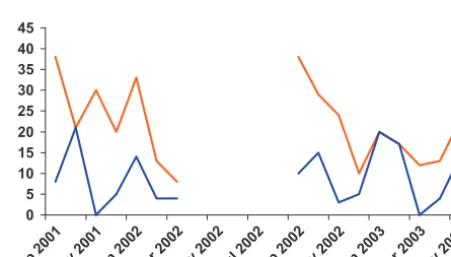
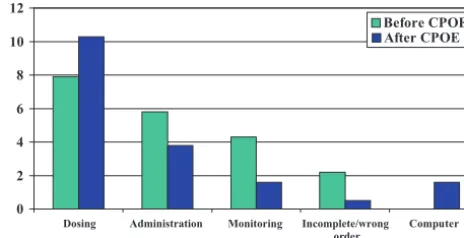
Although the CPOE system under study did contain automated pediatric weight– based dosage checking for all pediatric medications, the rate of dosing errors, the most common form of pediatric medication error, did not change in time-series analysis (Fig 2). An example of a dosing error is a 10-year-old child with sickle cell and acute chest who is ordered an underdose ceftriaxone on admission (30 mg/kg per day). After 3 days, the error is noted and the dosage is increased. In univariate analysis, the rate of nonintercepted serious dosing errors was 8 per 1000 patient-days (n⫽11) before CPOE and 10 per 1000 patient-days after CPOE (n⫽19) (IRR: 1.25; Fig 3). Of the 19 nonintercepted serious dosing errors after CPOE, only 2 generated computer alerts. Both alerts were overridden by the ordering physician without a change in the order. The second most common nonin-tercepted serious medication error was missed or extra dose administration errors, which accounted for 6 errors per 1000 patient-days before CPOE and 4 errors per
1000 patient-days after CPOE. Three serious noninter-cepted medication errors were computer related (1.6 per 1000 patient-days).17An example of a computer-related
error is a 5-year-old boy for whom both Tylenol infant drops and suspension each at maximum dosages are ordered because the computer will not allow 1 order with a choice of either formulation. Although 1 might expect fewer computer-related errors as resident physi-cians became more familiar with the CPOE system that they were using, there was no improvement in the rate of computer-related errors during the period of this study.
DISCUSSION
On a pediatric service in a general hospital, we found a 7% decline in the rate of nonintercepted serious medi-cation errors and no change in the rate of injuries as a result of error after implementation of a commercially available CPOE system. The rate of incomplete/wrong order errors did decline after CPOE implementation. The rate of dosing errors, the most common form of pediatric medication error, did not decrease after implementation of CPOE, despite automated weight-based dosage check-ing that is designed to prevent doscheck-ing errors.
These findings are substantially different from those in adult inpatients, for whom the introduction of CPOE was followed by a 55% reduction in nonintercepted serious medication errors.7We used the same
compre-hensive error surveillance methods used in the study by Bates et al7 in adult inpatients and the same outcome
measure, and we had similar pre-CPOE serious error rates to paper-based systems previously studied.2,7 We
believe that there are at least 3 possible explanations for the differences in rates between these studies. First, we studied a commercially available system, whereas Bates et al studied a “homegrown” system developed specifi-cally for use within the hospital of study. It is possible that the homegrown system studied previously was bet-ter tailored to meet the needs of the institution where it was designed and implemented than the version of the commercial system studied here. Second, the CPOE sys-tem that was evaluated in this study was not optimally designed to prevent common pediatric medication er-rors, such as using weight-based dosing calculation to prevent dosage errors, but was better designed to
pre-0 5 10 15 20 25 30 35 40 45
Sep 2001Nov 2001Jan 2002Mar 2002May 2002Jul 2002Sep 2002Nov 2002Jan 2003Mar 2003May 2003
Implementation
FIGURE 2
Time-series data showing rates of nonintercepted serious medication dosing errors per 1000 patient-days before and after CPOE. There was no statistically significant change in the rate of dosing errors after implementation of CPOE.
0 2 4 6 8 10 12
Dosing Administration Monitoring Incomplete/wrong order
Computer
Before CPOE After CPOE
FIGURE 3
vent common adult errors, such as overdoses based on adult maximum dosages or drug interactions. Our find-ing that the rate of dosfind-ing errors, the most common type of pediatric medication error, did not decrease after CPOE supports this second explanation. Last, the smaller impact of CPOE on pediatric errors in this study may result from differences in local implementation of this particular CPOE system.
We also found a smaller effect than early studies of pediatric inpatients using incident report review and medication order review that showed a 40% reduction in incident reports of errors after CPOE9 and a 41%
reduction in potentially dangerous ordering errors, re-spectively.10 We used comprehensive error surveillance
methods, which have been shown to be more sensitive for detecting ordering errors than incident reports19and
more intensive than simple medication order review. Using these methods, we found rates of serious medica-tion errors similar to those in previous research.2 In
examining ordering errors alone, to compare with the previous study of order-writing errors, we found no statistically significant change in the incidence of serious ordering errors after CPOE compared with before CPOE. Similar to a study of outpatient pediatric pharmacy data that showed no difference in potential dosing errors between clinics that were and were not using CPOE,11
we found no effect on rates of pediatric nonintercepted serious dosing errors.
There was a decrease in nonintercepted serious med-ication error rates from September to March in both the pre-CPOE and post-CPOE periods: from 38 per 1000 patient-days in September 2001 and also in September 2002 to 12 per 1000 patient-days in March 2002 and 8 per 1000 patient-days in March 2003. This three- to fourfold decline in nonintercepted serious errors is larger than the 55% decline in serious error rates originally reported with CPOE use7; however, the rate of errors
increased in May 2003 to 23 nonintercepted serious errors per 1000 patient-days; still a 40% decline from the rate in September. This highlights the importance of time-series research in accounting for relatively large seasonal trends in the evaluation of error prevention interventions. A simple pre–post study sampling a pre– data point in the fall and a post– data point in the spring could attribute a large seasonal change to the interven-tion of study.
Although this study used comprehensive active error surveillance and time-series analysis, there are a number of limitations to consider. First, findings may not be easily generalizable to other CPOE systems or hospitals. The CPOE system of study, the Eclipsys system, is a commercially available system that is the leading vendor of CPOE.22As more hospitals use commercially available
systems that are not specially created or adapted for the institution, studies of commercial systems are of partic-ular importance.
Second, although this study used an interrupted time-series design, considered 1 of the best quasi-experimen-tal methods, a randomized clinical trial was not possible within our single hospital because CPOE was used in particular units on the basis of different medication
or-dering characteristics, such as pediatric inpatient wards versus pediatric emergency department, which would make selection of control subjects from other units im-possible. In interrupted time-series design, several time periods are assessed, improving control for possible background changes in the outcome of study. The hos-pital did not implement any other major systemic change at the time of implementation of CPOE. We did not include a case-mix measure in our analyses to ac-count for disease severity. Although severity of disease would affect rates of medication errors, a change in severity of disease from the pre-CPOE period to the post-CPOE period would be gradual, changing the back-ground rate of errors, which we control for using time-series methods. Only in the case that severity of disease changed abruptly at the same time that CPOE was im-plemented would it confound the results of the study.
Other limitations include the possibility that the effect of CPOE was delayed even further than 1 year after CPOE or that the time period that was permitted for implementation and learning of the system (3– 6 months) did not allow trainees enough time to learn the system adequately. The number of NICU admissions in-creased after CPOE implementation, although not statis-tically significantly. The rate of NICU errors was smaller than in other units, so this increase would have biased the study toward inflating the effect of CPOE. Finally, the comprehensive error surveillance method that we used is an insensitive method for detecting certain administration errors that are not recorded in the chart19; however,
be-cause CPOE would be expected to have only a limited effect on administration errors, missing some administra-tion errors would bias this study toward overestimating the effect of CPOE on overall error rates.
The move from a paper-based health care system to a technology-based system holds promise of improving care in many domains beyond patient safety, such as facilitation of physician communication and provision of discharge instructions. It is possible that CPOE systems will require redesign and adaptation to meet the needs of children better. Changes in CPOE to facilitate weight-based dosing better are needed to prevent pediatric dos-ing errors, because dosdos-ing errors are the most common form of pediatric medication error.
monitor, continually modify, and improve CPOE sys-tems on the basis of data derived from their own insti-tution.
CONCLUSIONS
Initial research in adult patients, in whom CPOE showed substantial potential for preventing errors, led hospitals across the country to begin planning for and implement-ing CPOE. This study, which focused on children who were cared for in a general hospital, found that a com-mercial CPOE system caused a 7% decline in noninter-cepted serious error rates and had no effect on pediatric injuries caused by error. CPOE has potential to acceler-ate the momentum of pediatric health care systems change but may require additional improvements to support complex medication ordering better to prevent more effectively errors in hospitalized children.
ACKNOWLEDGMENTS
This study was sponsored by the National Library of Medicine (R03 LM008289-01), Boston Medical Center Risk Management Department; and T32HP100014. Dr Landrigan is the recipient of a career development award from the Agency for Healthcare Research and Quality (K08 HS13333); Dr Bauchner is a recipient of a career development award from the National Institute of Child Health and Human Development (K24HD042489). Dr Walsh is the recipient of the Robert Wood Johnson Physician Faculty Scholar award.
REFERENCES
1. Holdsworth MT, Fichtl RE, Behta M, et al. Incidence and im-pact of adverse drug events in pediatric inpatients.Arch Pediatr Adolesc Med.2003;157(1):60 – 65
2. Kaushal R, Bates DW, Landrigan C, et al. Medication errors and adverse drug events in pediatrics inpatients. JAMA. 2001; 285(16):2114 –2120
3. Miller MR, Zhan C. Pediatric patient safety in hospitals: a national picture in 2000.Pediatrics.2004;113(6):1741–1746 4. Walsh KE, Kaushal R, Chessare JB. How to avoid paediatric
medication errors: a user’s guide to the literature. Arch Dis Child.2005;90(7):698 –702
5. Lannon CM, Coven BJ, Lane France F, et al. Principles of patient safety in pediatrics.Pediatrics.2001;107(6):1473–1474 6. Institute of Medicine.To Err Is Human: Building a Safer Health
System. Washington, DC: National Academy Press; 2000
7. Bates DW, Leape LL, Cullen DJ, et al. Effect of a computerized physician order entry and a team intervention on prevention of serious medication errors.JAMA.1998;280(15):1311–1316
8. Kilbridge P. Computer crash: lessons from a system failure.
N Engl J Med.2003;348(10):881– 882
9. King WJ, Paice N, Rangrej J, Forestell GJ, Swartz R. The effect of computerized physician order entry on medication errors and adverse drug events in pediatric inpatients.Pediatrics.2003; 112(3 pt 1):506 –509
10. Potts AL, Barr FE, Gregory DF, Wright L, Patel NR. Comput-erized physician order entry and medication errors in a pedi-atric critical care unit.Pediatrics.2004;113(1 pt 1):59 – 63 11. McPhillips HA, Stille CJ, Smith D, et al. Potential medication
dosing errors in outpatient pediatrics.J Pediatr.2005;147(6): 761–767
12. Wang JK, Herzog NS, Kaushal R, Park C, Mochizuki C, Wein-garten SR. Prevention of pediatric medication errors by hospi-tal pharmacists and the potential benefit of computerized phy-sician order entry. Pediatrics. 2007;119(1). Available at: www.pediatrics.org/cgi/content/full/119/1/e77
13. Han YY, Carcillo JA, Venkataraman ST, et al. Unexpected increased mortality after implementation of a commercially sold computerized physician order entry system [published correction appears in Pediatrics. 2006;117(2):594]. Pediatrics.
2005;116(6):1506 –1512
14. Longhurst C, Sharek P, Hahn J, Sullivan J, Classen D. Per-ceived increase in mortality after process and policy changes implemented with computerized physician order entry.
Pediat-rics.2006;117(4):1450 –1451; author reply 1455–1456
15. McDonald CJ. Computerization can create safety hazards: a bar-coding near miss.Ann Intern Med.2006;144(7):510 –516 16. Koppel R, Metlay JP, Cohen A, et al. Role of computerized
physician order entry systems in facilitating medication errors.
JAMA.2005;293(10):1197–1203
17. Walsh K, Adams W, Bauchner H, Vinci R, Chessare J, Land-rigan C. Medication errors related to computer order entry for children.Pediatrics.2006;118(5):1872–1879
18. Bates DW, Cullen DJ, Laird N, et al. Incidence of adverse drug events and potential adverse drug events: implications for pre-vention.JAMA.1995;274(1):29 –34
19. Kaushal R. Using chart review to screen for medication errors and adverse drug events.Am J Health Syst Pharm.2002;59(23): 2323–2325
20. Gurwitz JH, Field TS, Harrold LR, et al. Incidence and prevent-ability of adverse drug events among older persons in the ambulatory setting.JAMA.2003;289(9):1107–1116
21. Landrigan CP, Rothschild JM, Cronin JW, et al. Effect of re-ducing interns’ work hours on serious medical errors in inten-sive care units.N Engl J Med.2004;351(18):1838 –1848 22. Industry Recognitions for Eclipsys Solutions and Customers.
Eclipsys, 2006 Annual Report and 10K. Available at: http:// investors.eclipsys.com/phoenix.zhtml?c⫽78585&p⫽irol-IRHome. Accessed January 28, 2008
DOI: 10.1542/peds.2007-0220
2008;121;e421
Pediatrics
Thomas J. McLaughlin and Howard Bauchner
John B. Chessare, Maureen R. Cooper, Pamela M. Hebert, Elisabeth G. Schainker,
Kathleen E. Walsh, Christopher P. Landrigan, William G. Adams, Robert J. Vinci,
Hospitalized Children
Effect of Computer Order Entry on Prevention of Serious Medication Errors in
Services
Updated Information &
http://pediatrics.aappublications.org/content/121/3/e421 including high resolution figures, can be found at:
References
http://pediatrics.aappublications.org/content/121/3/e421#BIBL This article cites 20 articles, 9 of which you can access for free at:
Subspecialty Collections
chnology_sub
http://www.aappublications.org/cgi/collection/health_information_te Health Information Technology
following collection(s):
This article, along with others on similar topics, appears in the
Permissions & Licensing
http://www.aappublications.org/site/misc/Permissions.xhtml in its entirety can be found online at:
Information about reproducing this article in parts (figures, tables) or
Reprints
DOI: 10.1542/peds.2007-0220
2008;121;e421
Pediatrics
Thomas J. McLaughlin and Howard Bauchner
John B. Chessare, Maureen R. Cooper, Pamela M. Hebert, Elisabeth G. Schainker,
Kathleen E. Walsh, Christopher P. Landrigan, William G. Adams, Robert J. Vinci,
Hospitalized Children
Effect of Computer Order Entry on Prevention of Serious Medication Errors in
http://pediatrics.aappublications.org/content/121/3/e421
located on the World Wide Web at:
The online version of this article, along with updated information and services, is
by the American Academy of Pediatrics. All rights reserved. Print ISSN: 1073-0397.