R E V I E W
Open Access
Trans-species polymorphism in humans
and the great apes is generally maintained
by balancing selection that modulates the
host immune response
Luisa Azevedo
1,2,3*, Catarina Serrano
1,2,3, Antonio Amorim
1,2,3and David N. Cooper
4Summary
Known examples of ancient identical-by-descent genetic variants being shared between evolutionarily related species, known as trans-species polymorphisms (TSPs), result from counterbalancing selective forces acting on target genes to confer resistance against infectious agents. To date, putative TSPs between humans and other primate species have been identified for the highly polymorphic major histocompatibility complex (MHC), the histo-blood ABO group, two antiviral genes (ZC3HAV1andTRIM5), an autoimmunity-related geneLAD1and several non-coding genomic segments with a putative regulatory role. Although the number of well-characterized TSPs under long-term balancing selection is still very small, these examples are connected by a common thread, namely that they involve genes with key roles in the immune system and, in heterozygosity, appear to confer genetic resistance to pathogens. Here, we review known cases of shared polymorphism that appear to be under long-term balancing selection in humans and the great apes. Although the specific selective agent(s) responsible are still unknown, these TSPs may nevertheless be seen as constituting important adaptive events that have occurred during the evolution of the primate immune system.
Introduction
Trans-species polymorphisms (TSPs) are ancient genetic variants whose origin predates speciation events, result-ing in shared alleles between evolutionarily related spe-cies [1]. Shared polymorphisms are only considered to be TSPs sensu stricto when there is convincing evidence to show that they are identical-by-descent rather than recurrent mutations occurring independently in different lineages (i.e. identical-by-state); the latter often involve the CpG dinucleotide [2, 3] whose hypermutability is directly attributable to its role as the major site of cytosine methylation, with the attendant risk of spontaneous de-amination of 5-methylcytosine to yield thymine. It follows that, even in a genomic region which manifests signals of balancing selection, a specific shared polymorphism that
is located within a CpG dinucleotide is, by its very nature, more likely to be identical-by-state due to recurrent mutation in distinct lineages rather than it is to be identical-by-descent. In such cases, any of the strong signals of balancing selection observed may emanate from functionally relevant balanced polymorphisms that are closely linked to the CpG site in question but which are not themselves shared across lineages.
The long-term (i.e. post-speciation) preservation of bona fide identical-by-descendent TSPs is inherently unlikely under a purely neutralist model of evolution [4, 5], and hence the action of selection must invariably be assumed. In passing, it should be noted that positive selection is also implicit in the case of independently occurring identical-by-state polymorphisms in different lineages. Here, we review the small number of relatively well-characterized examples of TSPs that are shared be-tween the genomes of great apes (human, common chimpanzee, bonobo, gorilla and orangutan), focusing
* Correspondence:[email protected] 1
Instituto de Investigação e Inovação em Saúde, Universidade do Porto, Porto, Portugal
2
IPATIMUP-Institute of Molecular Pathology and Immunology, University of Porto, Rua Dr. Roberto Frias s/n, 4200-465, Porto, Portugal
Full list of author information is available at the end of the article
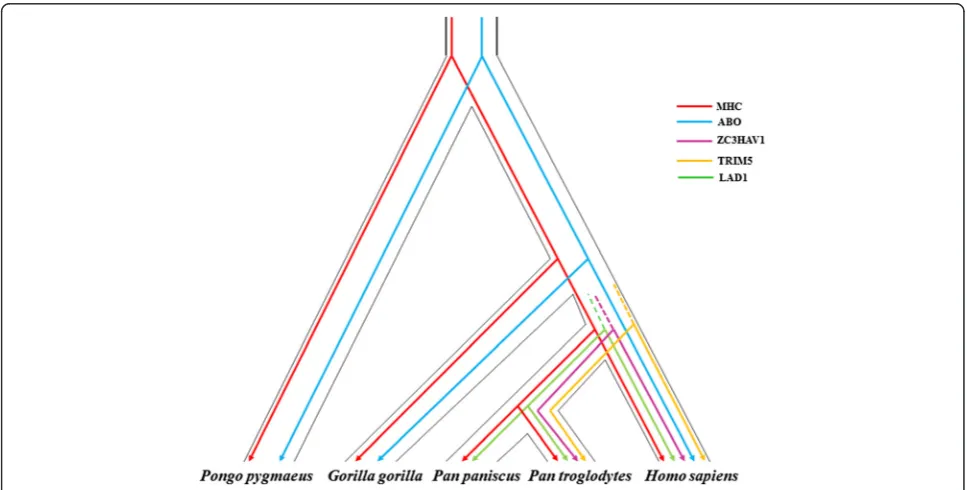
specifically on those for which there is a body of evi-dence for long-standing balancing selection (Fig. 1).
TSPs maintained by balancing selection: the MHC and ABO loci
Evidence for the common ancestral origin of an ex-tant TSP shared by humans and one or more of the great apes was first documented about three decades ago when orthologous sequences from the highly polymorphic major histocompatibility complex (MHC) loci were compared between species [4, 6]. MHC (known as HLA, human leucocyte antigen, in humans) loci play a key role in the adaptive response to pathogens [7, 8], and some of the allelic lineages of the human HLA-DQ alpha locus (DQA1, DQA3 and HLA-DQA4) were deduced to have been present in the most recent common ancestor of the human, chimpanzee and gorilla lineages [4] and must therefore have sur-vived for at least 8 million years [9, 10]. More recently, the human MHC lineage most strongly associated with delayed HIV-1 progression (HLA-B*57) was found to exhibit a high degree of similarity to a lineage fre-quently found among SIV-infected chimpanzees [11]. Other comparisons have reached a similar conclusion, namely that many alleles at the MHC locus have sur-vived for an extended period of evolutionary time and hence are currently shared by multiple primate line-ages. One example is provided by the MHC-DQB1*06 allele which predates the separation of the hominid and Old World monkey lineages more than 35 million years ago [12]. Shared alleles at the MHC locus have also
been found in other primates such as the rhesus and cynomolgous macaques [13], between Madagascan le-murs in which some alleles appear to have been main-tained for more than 40 million years [14] and between several non-primate lineages such as mice and rats [15], the brown bear (Ursus arctos) and the giant panda (Ailuropoda melanoleuca) [16], South American mouse opossums (Gracilinanus microtarsus and Marmosops incanus) [17] and between equines [18] among others (reviewed in [19]). The maintenance of these shared polymorphisms over such extended periods of evolu-tionary time implies strong selective pressure on the host immune response elicited by the pathogenic agent. However, it should be borne in mind that the potential contribution of recurrent mutation to the origin of these shared variants has not always been unequivocally excluded. It may therefore be that some of these‘shared variants’ are actually identical-by-state rather than identical-by-descent. At the same time, direct evidence for a functional role for the balanced variant, or group of variants, is lacking in most cases. Although these caveats do not necessarily challenge the now well-established role of balancing selection acting on MHC loci, it precludes the acquisition of a clear picture of how often the TSPs are actually identical-by-descent as opposed to simply being identical-by-state.
Another well-established example of long-term balan-cing selection operating in the primate genome is pro-vided by the ABO blood group locus. In humans, three main alleles account for the diversity at this locus, corre-sponding to the A, B and O blood groups. The A and B
alleles are functionally distinguished by the co-occurrence of two missense mutations (Leu266Met and Gly268Ala, respectively) in the encoded glycosyltransferase whereas the human O allele results from an inactivating single-nucleotide deletion (261delG) that impairs enzymatic function, resulting in failure to convert H antigen into A or B [20]. A and B alleles are shared between humans and non-human primates [21–23]. Although one of the alleles has been lost in some lineages during great ape speciation (e.g. common chimpanzees and bonobos exhibit only the A antigen, whereas the gorilla harbours the B antigen), other lineages have retained both the A and B identical-by-descent alleles, e.g. the orangutan which shared a com-mon ancestor with humans more than 16 million years ago [24]. Although pathogen-driven selective pressure operating on the balanced A/B alleles appears less in-tuitive than it perhaps is for the MHC locus, one must recall that there are several instances of histo-blood group antigens being associated with differential pro-tection against multiple infectious microbes [25–27]. For example, infection byHelicobacter pylorihas been shown to be reduced in A and B blood types as com-pared with carriers of the O type [25]. Moreover, a link between pathological conditions associated with H. pyloricolonization, such as gastric [28, 29] and pancre-atic cancer [30, 31], and the ABO phenotype has also been established in humans. Assuming that the persist-ence of the A/B polymorphism is maintained by pathogen-driven balancing selection, one may reason-ably extend these considerations to the other great ape species.
Beyond the MHC and ABO loci
Apart from the well-established examples of trans-species polymorphisms at the MHC and ABO loci which are maintained by balancing selection, few other properly substantiated examples of TSPs have been documented. One particularly interesting case is provided by the zinc-finger CCCH-type antiviral pro-tein 1 (ZC3HAV1, also known as poly(ADP-ribose) polymerase 13-PARP13), a protein that is known to protect host cells from viral infection [32–35] and cellular stress [36]. The ZC3HAV1 polymorphic sub-stitution Thr851Ile (rs3735007) is shared between humans and common chimpanzees and does not
occur in a hypermutable CpG site (Table 1), support-ing its candidacy as a true TSP [37]; an exhaustive analysis of the genomic region adjacent to this TSP has shown that the polymorphism has been selectively maintained in both species, probably as a result of its broad protective effect against viral infection.
Another potential example of trans-species poly-morphism under balancing selection is provided by the TRIM5 gene. This gene also encodes an antiviral pro-tein [38–40] (TRIM5, tripartite motif-containing 5), one that is known to act as a blocking factor of HIV-1 reverse transcription thereby limiting the efficiency of the infection in primates [41]. In non-primate species, TRIM5 is also active as an antiviral protein [42–45] and the reconstruction of TRIM5 evolutionary history has provided evidence for a long-term interaction with several different viruses prior to the origin of primate lentivirus [46].
A previous study has evidenced balanced TSPs in the primate TRIM5 genes [47]. In a separate investi-gation, two intragenic TRIM5 polymorphisms were found to be shared between human and common chimpanzee (Table 1): an intron 1-CTC insertion/deletion and an intron 1 transition (rs34506684), the latter occur-ring at an CpG dinucleotide [48]. Although the func-tional significance of these variants has not yet been established, the authors suggested that the intron 1 variant rs34506684 might impact transcription factor-binding sites leading to allelic differences in transcrip-tional activity which could underpin inter-individual differences in susceptibility to infection. However, be-cause this shared polymorphism occurs at a hyper-mutable CpG site (Table 1), its candidacy as a true TSP must be in some doubt; in the absence of any convincing evidence that this variant is of direct func-tional significance, it may simply be a marker in link-age disequilibrium with another variant that is under balancing selection.
The discovery of these putative regulatory variants within intron 1 of the TRIM5 gene between humans and the great apes provides evidence for the mainten-ance of balmainten-anced regulatory polymorphisms across spe-cies (as distinct from balanced coding sequence variants), as well as yet another example of a TSP which may impact the host pathogen response. Trans-species
Table 1Properties and allelic frequencies of human single-nucleotide putative TSPs shared with bonobos and common chimpanzees
Gene SNP ID SNP flanking sequencea MAFa AA Change Presence
ZC3HAV1 rs3735007 GTTTA(C/T)TGAAG 0.47 (C) Thr851Ile Human and common chimpanzee
TRIM5 rs34506684 TCTGG(C/T)GCCTC 0.46 (T) Intronic Human and common chimpanzee
LAD1 rs12088790 GGGCC(A/G)GCGAC 0.12 (G) Leu257Pro Human, bonobo and common chimpanzee
a
regulatory polymorphism has been functionally inves-tigated at the MHC-DQA1 locus in eight non-human primates [49]. Numerous trans-species polymorphisms were identified within transcription factor binding sites in the MHC-DQA1 promoter region. Loisel et al. [49] assessed the functional consequences of these variants using a reporter gene assay and identified significant dif-ferences between baboon DQA1 promoter haplotypes in terms of their ability to drive transcription in vitro. Taken together with the high levels of sequence variation in this region, these findings suggest a role for balancing selection in the evolution of DQA1 transcriptional regula-tion in primates although the biological mechanism under-lying the assumed increase in fitness remains unclear.
More recently, a scan of the human genome yielded good evidence for six non-coding genomic regions where ancestral polymorphisms shared between humans and chimpanzees have been under the influence of bal-ancing selection [2]. The closest genes to these regions (FREM3,MTRR,PROKR2,HUS1,IGFBP7andST3GAL1) are all to some extent related to the innate immune re-sponse, a finding which would concur with a balancing selection mode of evolution. For three of these six re-gions (nearHUS1, IGFBP7andST3GAL1), a regulatory role for the polymorphisms involved was demonstrated, indicating that physiological differences resulting from a balanced polymorphism can also be exerted at the level of gene expression. A role for regulatory variants as targets of balancing selection is not surprising since many studies have reported an important role for het-erozygote advantage in the evolution of gene expression [50–52]. Although many of these variants may indi-vidually be associated with deleterious effects, they may nevertheless provide fitness advantages under certain environmental conditions [51, 53] by potentiating an optimal level of gene expression [52]. It is also quite possible that some of these regulatory balanced alleles have persisted for long periods of time in immunity-related genes thereby providing further likely examples of TSPs between humans and the great apes.
The most recently reported example of a putative TSP is that in exon 3 of the ladinin 1 (LAD1) gene (rs12088790) (Table 1) which has been claimed to be maintained by long-term selection in humans, common chimpanzees and bonobos [54]. However, once again, the shared polymorphism occurs at a CpG dinucleotide and hence may not in reality be identical-by-descent. The resulting missense change (Leu257Pro) influences the expression ofLAD1: the minor allele, which occurs at a frequency of 0.12 in humans (Table 1), is associated with an increased level of LAD1 expression. Irrespect-ive of whether this is a direct effect, or whether the missense variant is in linkage disequilibrium with an-other polymorphic variant with a regulatory role, it
provides further evidence for the important role of shared polymorphism in modulating gene expression.
TheLAD1gene encodes a collagenous anchoring fila-ment protein that serves to maintain dermal-epidermal cohesion and is associated with IgA bullous dermatosis, an autoimmune disease [55]. Apart from its pathogenic role in the context of IgA bullous dermatosis, there is no information as to how LAD1 might contribute to the host response against a pathogen. However, many autoimmune diseases are triggered by infectious agents in addition to environmental factors [56], and this has been specifically reported to be the case in IgA bullous dermatosis [57].
Overdominance vs. pathogen-driven frequency-dependent selection
The maintenance of TSP by long-term balancing selec-tion has long been held to be mediated by heterozygote advantage (overdominance) or frequency-dependent se-lection [19]. Previous studies have claimed that the most important factor for the maintenance of MHC polymorphism is overdominant selection [58, 59]. In support of this postulate, MHC heterozygosity has been experimentally demonstrated to enhance resistance to multiple-strain infections [60]. However, a simulation-based approach has demonstrated that polymorphism at the MHC locus results not merely from overdomi-nant selection but also from frequency-dependent host-pathogen coevolution for rare MHC alleles [61].
Conclusion
The presence of shared polymorphisms across evolution-arily related species is a strong indicator of balancing se-lection. Although most of the studies to date have focussed on the classical examples of the MHC and ABO loci, a few additional examples are known between humans and the great apes. Herein, we have reviewed these cases and noted that a common feature of virtually all well-established cases of balanced TSP is their associ-ation with the host-immune response, presumably trig-gered by infectious agents. The diversity observed at immunity-related loci is certainly shaped by the dynamic process of host-pathogen coevolution [65], and there-fore, key aspects of a species’adaptation to challenging environments are likely to have been pathogen-driven [66–68]. This raises the question of the potential rele-vance of TSP identification to improving our under-standing of the host immune response; indeed, the study of these ancient variants could lead to new insights into immune system function with important implications for preventive medicine. Finally, it may be that the iden-tification of additional balanced TSPs in humans and their closest relatives among the great apes might be fa-cilitated by a guided search (e.g. by targeting immune system/autoimmune disease-associated genes specific-ally). The difficulty inherent in any such quest would be to prove that a newly detected shared polymorphism is descent rather than simply identical-by-state. This would be especially true for polymorphisms residing within CpG sites where the balance of probabil-ity must lie firmly on the side of their being identical-by-state, at least until functional evidence to the contrary can be provided.
Abbreviations
LAD1:ladinin 1; HLA: human leucocyte antigen; MHC: major
histocompatibility complex; TRIM5: tripartite motif-containing 5; TSP: trans-species polymorphism; ZC3HAV1: zinc-finger CCCH-type antiviral protein 1.
Competing interests
The authors declare that they have no competing interests.
Authors’contributions
LA and DNC conceived the idea, performed the literature search and wrote the manuscript. CS performed the data searches and comparative genomic analyses. AA critically revised the manuscript. All authors read and approved the final version of the manuscript.
Acknowledgements
IPATIMUP integrates the i3S Research Unit, which is partially supported by FCT, the Portuguese Foundation for Science and Technology. This work is funded by FEDER funds through the Operational Programme for Competitiveness Factors—COMPETE and National Funds through the FCT-Foundation for Science and Technology, under the projects“PEst-C/ SAU/LA0003/2013”. DNC gratefully acknowledges financial support from QIAGEN Inc. through a License Agreement with Cardiff University.
Author details
1Instituto de Investigação e Inovação em Saúde, Universidade do Porto,
Porto, Portugal.2IPATIMUP-Institute of Molecular Pathology and
Immunology, University of Porto, Rua Dr. Roberto Frias s/n, 4200-465, Porto,
Portugal.3Department of Biology, Faculty of Sciences, University of Porto,
Rua do Campo Alegre, s/n, 4169-007, Porto, Portugal.4Institute of Medical Genetics, School of Medicine, Cardiff University, Heath Park, Cardiff, CF14 4XN, UK.
Received: 9 July 2015 Accepted: 20 August 2015
References
1. Klein J. Origin of major histocompatibility complex polymorphism: the trans-species hypothesis. Hum Immunol. 1987;19(3):155–62. 2. Leffler EM, Gao Z, Pfeifer S, Ségurel L, Auton A, Venn O, et al. Multiple
instances of ancient balancing selection shared between humans and chimpanzees. Science. 2013;339(6127):1578–82.
3. Cagliani R, Fumagalli M, Riva S, Pozzoli U, Comi GP, Menozzi G, et al. The signature of long-standing balancing selection at the human defensinβ-1 promoter. Genome Biol. 2008;9(9):R143-R.
4. Gyllensten UB, Erlich HA. Ancient roots for polymorphism at the HLA-DQ alpha locus in primates. Proc Natl Acad Sci U S A. 1989;86(24):9986–90. 5. Asthana S, Schmidt S, Sunyaev S. A limited role for balancing selection.
Trends Genet. 2005;21(1):30–2.
6. Mayer WE, Jonker M, Klein D, Ivanyi P, van Seventer G, Klein J. Nucleotide sequences of chimpanzee MHC class I alleles: evidence for trans-species mode of evolution. EMBO J. 1988;7(9):2765–74.
7. Spurgin LG, Richardson DS. How pathogens drive genetic diversity: MHC, mechanisms and misunderstandings. Proc R Soc B. 2010;277(1684):979–88. 8. Sommer S. The importance of immune gene variability (MHC) in
evolutionary ecology and conservation. Front Zool. 2005;2(1):16. 9. Langergraber KE, Prüfer K, Rowney C, Boesch C, Crockford C, Fawcett K,
et al. Generation times in wild chimpanzees and gorillas suggest earlier divergence times in great ape and human evolution. Proc Natl Acad Sci U S A. 2012;109(39):15716–21.
10. Scally A, Dutheil JY, Hillier LW, Jordan GE, Goodhead I, Herrero J, et al. Insights into hominid evolution from the gorilla genome sequence. Nature. 2012;483(7388):169–75.
11. Wroblewski EE, Norman PJ, Guethlein LA, Rudicell RS, Ramirez MA, Li Y, et al. Signature patterns of MHC diversity in three Gombe communities of wild chimpanzees reflect fitness in reproduction and immune defense against SIVcpz. PLoS Biol. 2015;13(5), e1002144.
12. Otting N, de Groot N, Doxiadis G, Bontrop R. Extensive Mhc-DQB variation in humans and non-human primate species. Immunogenetics. 2002;54(4):230–9.
13. Yao Y-F, Dai Q-X, Li J, Ni Q-Y, Zhang M-W, Xu H-L. Genetic diversity and differentiation of the rhesus macaque (Macaca mulatta) population in western Sichuan, China, based on the second exon of the major histocompatibility complex class II DQB (MhcMamu-DQB1) alleles. BMC Evol Biol. 2014;14(1):130.
14. Go Y, Satta Y, Kawamoto Y, Rakotoarisoa G, Randrianjafy A, Koyama N, et al. Mhc-DRB genes evolution in lemurs. Immunogenetics. 2002;54(6):403–17. 15. Figueroa F, Gunther E, Klein J. MHC polymorphism pre-dating speciation.
Nature. 1988;335(6187):265–7.
16. Kuduk K, Babik W, Bojarska K,Śliwińska EB, Kindberg J, Taberlet P, et al. Evolution of major histocompatibility complex class I and class II genes in the brown bear. BMC Evol Biol. 2012;12:197.
17. Meyer-Lucht Y, Otten C, Püttker T, Sommer S. Selection, diversity and evolutionary patterns of the MHC class II DAB in free-ranging neotropical marsupials. BMC Genet. 2008;9:39.
18. Kamath P, Getz W. Adaptive molecular evolution of the Major Histocompatibility Complex genes, DRA and DQA, in the genusEquus. BMC Evol Biol. 2011;11(1):128.
19. Těšický M, Vinkler M. Trans-species polymorphism in immune genes: general pattern or MHC-restricted phenomenon? J Immunol Res. 2015;2015:838035.
20. Yamamoto F, Clausen H, White T, Marken J, Hakomori S. Molecular genetic basis of the histo-blood group ABO system. Nature. 1990;345(6272):229–33. 21. Martinko JM, Vincek V, Klein D, Klein J. Primate ABO glycosyltransferases:
evidence for trans-species evolution. Immunogenetics. 1993;37(4):274–8. 22. Yamamoto F, Cid E, Yamamoto M, Saitou N, Bertranpetit J, Blancher A. An
23. Ségurel L, Thompson EE, Flutre T, Lovstad J, Venkat A, Margulis SW, et al. The ABO blood group is a trans-species polymorphism in primates. Proc Natl Acad Sci U S A. 2012;109(45):18493–8.
24. Steiper ME, Young NM. Primate molecular divergence dates. Mol Phylogenet Evol. 2006;41(2):384–94.
25. Boren T, Falk P, Roth KA, Larson G, Normark S. Attachment ofHelicobacter
pylorito human gastric epithelium mediated by blood group antigens. Science. 1993;262(5141):1892–5.
26. Anstee DJ. The relationship between blood groups and disease. Blood. 2010;115(23):4635–43.
27. Harris JB, Khan AI, LaRocque RC, Dorer DJ, Chowdhury F, Faruque ASG, et al. Blood group, immunity, and risk of infection withVibrio choleraein an area of endemicity. Infect Immun. 2005;73(11):7422–7.
28. Duell EJ, Bonet C, Muñoz X, Lujan-Barroso L, Weiderpass E, Boutron-Ruault M-C, et al. Variation atABOhisto-blood group andFUTloci and diffuse and intestinal gastric cancer risk in a European population. Int J Cancer. 2015;136(4):880–93.
29. Rizzato C, Kato I, Plummer M, Muñoz N, Stein A. Jan van Doorn L, et al. Risk of advanced gastric precancerous lesions inHelicobacter pyloriinfected subjects is influenced by ABO blood group and cagA status. Int J Cancer. 2013;133(2):315–22.
30. Amundadottir L, Kraft P, Stolzenberg-Solomon RZ, Fuchs CS, Petersen GM, Arslan AA, et al. Genome-wide association study identifies variants in the
ABOlocus associated with susceptibility to pancreatic cancer. Nat Genet. 2009;41(9):986–90.
31. Risch HA. Pancreatic cancer:Helicobacter pyloricolonization, N-Nitrosamine exposures, and ABO blood group. Mol Carcinogen. 2012;51(1):109–18. 32. Gao G, Guo X, Goff SP. Inhibition of retroviral RNA production by ZAP,
a CCCH-type zinc finger protein. Science. 2002;297(5587):1703–6. 33. Mao R, Nie H, Cai D, Zhang J, Liu H, Yan R, et al. Inhibition of hepatitis B
virus replication by the host zinc finger antiviral protein. PLoS Pathog. 2013;9(7), e1003494.
34. Kerns JA, Emerman M, Malik HS. Positive selection and increased antiviral activity associated with the PARP-containing isoform of human zinc-finger antiviral protein. PLoS Genet. 2008;4(1), e21.
35. Guo X, Carroll J-WN, MacDonald MR, Goff SP, Gao G. The zinc finger antiviral protein directly binds to specific viral mRNAs through the CCCH zinc finger motifs. J Virol. 2004;78(23):12781–7.
36. Todorova T, Bock FJ, Chang P. Poly(ADP-ribose) polymerase-13 and RNA regulation in immunity and cancer. Trends Mol Med. 2015;21(6):373–84. 37. Cagliani R, Guerini FR, Fumagalli M, Riva S, Agliardi C, Galimberti D, et al.
A trans-specific polymorphism inZC3HAV1is maintained by long-standing balancing selection and may confer susceptibility to multiple sclerosis. Mol Biol Evol. 2012;29(6):1599–613.
38. Bieniasz PD. Intrinsic immunity: a front-line defense against viral attack. Nat Immunol. 2004;5(11):1109–15.
39. Kaiser SM, Malik HS, Emerman M. Restriction of an extinct retrovirus by the human TRIM5αantiviral protein. Science. 2007;316(5832):1756–8. 40. Goldschmidt V, Ciuffi A, Ortiz M, Brawand D, Muñoz M, Kaessmann H, et al.
Antiretroviral activity of ancestral TRIM5α. J Virol. 2008;82(5):2089–96. 41. Stremlau M, Owens CM, Perron MJ, Kiessling M, Autissier P, Sodroski J. The
cytoplasmic body component TRIM5[alpha] restricts HIV-1 infection in Old World monkeys. Nature. 2004;427(6977):848–53.
42. Schaller T, Hué S, Towers GJ. An active TRIM5 protein in rabbits indicates a common antiviral ancestor for mammalian TRIM5 proteins. J Virol. 2007;81(21):11713–21.
43. Fletcher AJ, Hué S, Schaller T, Pillay D, Towers GJ. Hare TRIM5αrestricts divergent retroviruses and exhibits significant sequence variation from closely related lagomorphaTRIM5genes. J Virol. 2010;84(23):12463–8. 44. Ylinen LMJ, Keckesova Z, Webb BLJ, Gifford RJM, Smith TPL, Towers GJ.
Isolation of an active Lv1 gene from cattle indicates that tripartite motif protein-mediated innate immunity to retroviral infection is widespread among mammals. J Virol. 2006;80(15):7332–8.
45. Jáuregui P, Crespo H, Glaria I, Luján L, Contreras A, Rosati S, et al. Ovine TRIM5αcan restrict Visna/Maedi virus. J Virol. 2012.
46. Sawyer SL, Wu LI, Emerman M, Malik HS. Positive selection of primate TRIM5αidentifies a critical species-specific retroviral restriction domain. Proc Natl Acad Sci U S A. 2005;102(8):2832–7.
47. Newman RM, Hall L, Connole M, Chen GL, Sato S, Yuste E, et al. Balancing selection and the evolution of functional polymorphism in Old World monkey TRIM5alpha. Proc Natl Acad Sci U S A. 2006;103(50):19134–9.
48. Cagliani R, Fumagalli M, Biasin M, Piacentini L, Riva S, Pozzoli U, et al. Long-term balancing selection maintains trans-specific polymorphisms in the humanTRIM5gene. Hum Genet. 2010;128(6):577–88.
49. Loisel DA, Rockman MV, Wray GA, Altmann J, Alberts SC. Ancient polymorphism and functional variation in the primate MHC-DQA1 5′cis-regulatory region. Proc Natl Acad Sci U S A. 2006;103(44):16331–6.
50. Arbiza L, Gronau I, Aksoy BA, Hubisz MJ, Gulko B, Keinan A, et al. Genome-wide inference of natural selection on human transcription factor binding sites. Nat Genet. 2013;45(7):723–9.
51. Schaschl H, Huber S, Schaefer K, Windhager S, Wallner B, Fieder M. Signatures of positive selection in thecis-regulatory sequences of the human oxytocin receptor (OXTR) and arginine vasopressin receptor 1a (AVPR1A) genes. BMC Evol Biol. 2015;15:85.
52. Sellis D, Callahan BJ, Petrov DA, Messer PW. Heterozygote advantage as a natural consequence of adaptation in diploids. Proc Natl Acad Sci U S A. 2011;108(51):20666–71.
53. Siegert S, Wolf A, Cooper DN, Krawczak M, Nothnagel M. Mutations causing complex disease may under certain circumstances be protective in an epidemiological sense. PLoS One. 2015;10(7), e0132150.
54. Teixeira JC, de Filippo C, Weihmann A, Meneu JR, Racimo F, Dannemann M, et al. Long-term balancing selection inLAD1maintains a missense trans-species polymorphism in humans, chimpanzees, and bonobos. Mol Biol Evol. 2015;32(5):1186–96.
55. Marinkovich MP, Taylor TB, Keene DR, Burgeson RE, Zone JJ. LAD-1, the linear IgA bullous dermatosis autoantigen, is a novel 120-kDa anchoring filament protein synthesized by epidermal cells. J Invest Dermatol. 1996;106(4):734–8.
56. Ercolini AM, Miller SD. The role of infections in autoimmune disease. Clin Exp Immunol. 2009;155(1):1–15.
57. Ahkami R, Thomas I. Linear IgA bullous dermatosis associated with vancomycin and disseminated varicella-zoster infection. Cutis. 2001;67(5):423–6.
58. Hughes AL, Nei M. Pattern of nucleotide substitution at major histocompatibility complex class I loci reveals overdominant selection. Nature. 1988;335(6186):167–70.
59. Takahata N, Nei M. Allelic genealogy under overdominant and frequency-dependent selection and polymorphism of major histocompatibility complex loci. Genetics. 1990;124(4):967–78.
60. Penn DJ, Damjanovich K, Potts WK. MHC heterozygosity confers a selective advantage against multiple-strain infections. Proc Natl Acad Sci U S A. 2002;99(17):11260–4.
61. Borghans JM, Beltman J, De Boer R. MHC polymorphism under host-pathogen coevolution. Immunogenetics. 2004;55(11):732–9.
62. Ségurel L, Gao Z, Przeworski M. Ancestry runs deeper than blood: the evolutionary history of ABO points to cryptic variation of functional importance. Bioessays. 2013;35(10):862–7.
63. Villanea FA, Safi KN, Busch JW. A general model of negative frequency dependent selection explains global patterns of human ABO polymorphism. PLoS One. 2015;10(5), e0125003.
64. Fumagalli M, Sironi M, Pozzoli U, Ferrer-Admettla A, Pattini L, Nielsen R. Signatures of environmental genetic adaptation pinpoint pathogens as the main selective pressure through human evolution. PLoS Genet. 2011;7(11), e1002355.
65. Sironi M, Cagliani R, Forni D, Clerici M. Evolutionary insights into host-pathogen interactions from mammalian sequence data. Nat Rev Genet. 2015;16(4):224–36.
66. Siddle KJ, Quintana-Murci L. The Red Queen’s long race: human adaptation to pathogen pressure. Curr Opin Genet Dev. 2014;29:31–8.
67. Andrés AM, Hubisz MJ, Indap A, Torgerson DG, Degenhardt JD, Boyko AR, et al. Targets of balancing selection in the human genome. Mol Biol Evol. 2009;26(12):2755–64.
68. Key FM, Teixeira JC, de Filippo C, Andrés AM. Advantageous diversity maintained by balancing selection in humans. Curr Opin Genet Dev. 2014;29:45–51. 69. Database of Single Nucleotide Polymorphisms (dbSNP). Available from: