Copyright © 2005, American Society for Microbiology. All Rights Reserved.
The
RIM101/pacC
Homologue from the Basidiomycete
Ustilago maydis
Is Functional in Multiple pH-Sensitive Phenomena
Elva T. Are
´chiga-Carvajal and Jose
´ Ruiz-Herrera*
Departamento de Ingenierı´a Gene´tica, Unidad de Biotecnologı´a y Gene´tica de Plantas, Centro de Investigacio´n y de Estudios Avanzados del IPN, Irapuato, Gto., Mexico
Received 19 October 2004/Accepted 18 April 2005
A homologue of the gene encoding the transcription factor Rim101 (PacC), involved in pH signal
transduc-tion in fungi, was identified in the pathogenic basidiomyceteUstilago maydis. The gene (RIM101) encodes a
protein of 827 amino acid residues, which shows highest similarity to PacC proteins fromFusarium oxysporum
andAspergillus niger. The gene had the capacity to restore protease activity torim101mutants fromYarrowia lipolytica, confirming its homologous function, and was expressed at both acid and neutral pH. Null⌬rim101
mutants were not affected in the in vitro pH-induced dimorphic transition, their growth rate, resistance to
hypertonic sorbitol or KCl stress, and pathogenicity. However, similar topacC(rim101) mutants in other fungi,
they displayed a pleiotropic phenotype with alterations in morphogenesis, impairment in protease secretion,
and increased sensitivity to Naⴙand Liⴙions. Other phenotypic characteristics not previously reported in
fungalpacC(rim101) mutants (morphological changes, increased sensitivity to lytic enzymes, and augmented
polysaccharide secretion) were also observed inU. maydismutants. All these modifications were alleviated by
transformation with the wild-type gene, confirming that all were the result of mutation inRIM101. These data
indicate that the Pal/Rim pathway is functional inU. maydis(and probably in other basidiomycetes) and plays
complex roles in pH-sensing phenomena, as occurs in ascomycetes and deuteromycetes.
Ustilago maydis, the basidiomycete responsible for corn smut disease, displays a complex life cycle that requires the plant host for completion. In its haploid nonpathogenic phase the fungus grows like yeast. Mating of compatible yeasts (sporidia) gives rise to the formation of a pathogenic dikaryotic mycelium that may invade the host. Abundant mycelial growth and karyogamy occur in the plant, which develops galls or tumors full of dark teliospores (see reference 3). Germination of te-liospores produces basidiospores that bud to reinitiate the life cycle (for reviews see references 1, 7, and 27). Dimorphic transition ofU.maydisin vitro was reported to occur in haploid or diploid strains as a response to the external pH (38). At neutral pH the fungus grows as a homogeneous population of budding yeast, whereas at acid pH it develops the mycelial form.
As occurs with different physical and chemical stimuli, pH of the medium affects the physiological behavior of fungi in many ways. Nevertheless, specific responses may occur as a result of a change in external pH. The most studied responses of fungi to changes in pH include secretion of different enzymes such as proteases and phosphatases, permease induction, and alter-ations in the production of some secondary metabolites, etc. (reviewed in references 15, 32, and 33). Studies on the mech-anism of the regulation of protein secretion by the external pH led to the discovery in Aspergillus nidulans of a specialized signal transduction pathway responsive to pH (8). This path-way, named Pal/Rim, involves the action of different proteins that convey the pH stimulus to a key zinc finger transcription
factor, PacC (Rim101), which activates transcription of genes induced at alkaline pH and represses genes induced at acid pH (8, 15, 26, 44). Further studies proved the wide distribution of similar (although not identical) pathways in other ascomycetes and deuteromycetes (9, 13, 25, 34, 43). These studies have demonstrated that the function of PacC/Rim101 is more com-plex than simply regulating the transcription of pH-dependent specific enzymes. Additional processes in which PacC/Rim101 plays a regulatory role include meiosis, morphogenesis, and salt stress tolerance (9, 23, 36, 43; reviewed in references 32 and 33).
Interestingly, the Pal/Rim pathway has also been reported to play a role inCandida albicansdimorphism. This fungus grows in the mycelial form at neutral pH, and as pH decreases, a yeast-like morphology is developed (reviewed in reference 30). Mutation ofpacC/RIM101blocks mycelium formation at neu-tral pH (34) and reduces pathogenesis (12). In contrast, it does not seem to affect the pH-dependent dimorphic transition in
Yarrowia lipolytica, whose RIM101 mutants still grow in the mycelial form in serum medium (19).
Considering that the in vitro dimorphic transition ofU. may-disis regulated by pH, we investigated whether the Pal/Rim pathway was involved in the process. Accordingly, we have proceeded to the isolation and deletion of theRIM101/pacC
homologue gene (RIM101). The data obtained show that the Pal/Rim pathway is operative in this basidiomycete, where, as in other fungi, it controls a series of cellular functions but is not involved in dimorphism.
MATERIALS AND METHODS
Strains and growth conditions. The following microbial strains were used in this study:Ustilago maydiswild-type strains FB1 (a1b1) and FB2 (a2b2) (2);
U. maydis mutants BMA1 and BMA7 (a1b1⌬rim101::hyg) and BMA2 and BMA4 (a2b2⌬rim101::hyg), isolated in this work;U. maydiscomplemented
* Corresponding author. Mailing address: Departamento de In-genierı´a Gene´tica, Centro de Investigacio´n y de Estudios Avanzados del IPN Unidad Irapuato, Km. 9.6 Libramiento Norte, Carretera Irapuato-Leo´n, 36500 Irapuato, Gto., Me´xico. Phone: 52 (462) 623-9652. Fax: 52 (462) 623-9650. E-mail: [email protected].
999
on September 8, 2020 by guest
http://ec.asm.org/
strains PGM1 and PGM2 (a2b2 ⌬rim101::hyg/pUpacC23) and AAP1(a2b2
⌬rim101::hyg/pUpacC22), also isolated in this work;Yarrowia lipolyticaFL3⌬R (A rim101-1113 ura3 lys11) and E121 (A lys11) (24);Y. lipolyticastrain ETA1 (A
rim101-1113 lys11/pUpacC44), isolated in this work; andEscherichia coliDH5␣, which was used as a host for plasmid amplification.
U. maydisandY. lipolyticastrains were maintained at⫺70°C in 50% (vol/vol) glycerol.U. maydiscells were transferred to liquid complex medium (CM) (21) and shaken at 28°C for 2 to 3 days.Y. lipolyticawas propagated in yeast extract-peptone-glucose medium (5). These cultures were used as inocula for all subse-quent experiments. Yeast or mycelial growth ofU. maydisin liquid minimal medium (MM) (21) was obtained as earlier reported (38). Liquid media were supplemented when necessary with hygromycin (100 to 350g/ml) and/or 6M carboxin. ForU. maydistransformant selection, protoplasts were plated on CM (see above) containing 1 M sorbitol plus the appropriate selective agent(s). Skim milk agar plates were used for alkaline protease induction (31). Plate mating assays were carried out as described in reference 2.
Growth rate of fungal strains was measured in liquid medium. Cells (106
per ml) were inoculated into MM or CM (150 ml in 500-ml Erlenmeyer flasks), and shaken (180 rpm) in a water bath at 28°C. At intervals, aliquots were withdrawn and cell numbers were measured with a Neubauer cell counting chamber. The effect of different stress conditions on cell growth was measured in plates of solid MM of pH 3 or 7 (46).
PCR conditions and plasmid constructions.Amplifications described were performed usingU. maydisDNA, and the primers and annealing temperatures are described in Table 1. After an initial denaturing temperature of 94°C for 4 min, 30 cycles of the following program were applied: 1 min at 94°C, 1 min at the annealing temperature (Table 1), and extension time (calculated as 1 min per kb of the expected amplification fragment) at 72°C. This program was followed by 5 min at 72°C for final extension.
A 120-bp fragment containing part of the zinc finger coding region of the
RIM101gene was amplified by PCR, using the degenerate oligonucleotides 1892 and 1894 (Table 1). This fragment was cloned in the pCR2.1 plasmid (Invitro-gen) to generate pUznf16.
A partial fragment of theRIM101gene of approximately 3,000 bp was ob-tained by amplification with oligonucleotides JRH-G182 and JRH-G181 (Table 1) and cloned in pUC19 using EcoRI and HindIII sites included in the primers to generate pUpacC.
Plasmid pUpacH was constructed as follows: plasmid pUpacC was digested with StuI and BamHI, eliminating a 1,289-bp fragment that contained the region encoding the threeRIM101zinc fingers. The BamHI site was filled with the Klenow fragment (Invitrogen) and an EcoRV-EcoRV fragment from pHyg1 (see below) containing theE. coli Hph gene open reading frame (ORF), which confers hygromycin resistance, was cloned in frame at this site. This construction was confirmed by sequencing.
Plasmid pHyg1 was derived from pCR2.1 (Invitrogen) and contained the ORF of theHphgene fromE. coliobtained by PCR with primers JRH-G174 and JRH-G173 (Table 1).
Plasmid pUpacC4 was derived from pCR2.1 (Invitrogen) and contained a 3,832-bp fragment with the completeRIM101ORF and 1,175 bp of the promoter region, as well as 172 bp of the terminator, obtained by PCR with oligonucleo-tides JRH-G182 and 2833.
Plasmids pUpacC22 and pUpacC23 were derived from pCBX122 carrying the carboxin resistance gene (22). pUpacC22 contained a 3,000-bp EcoRI fragment from pUpacC (promoter and partial ORF ofRIM101), whereas pUpacC23
contained a 3,832-bp fragment from pUpacC4 (1,175 bp of promoter region,
RIM101ORF, and 172 bp of terminator).
The plasmid used to transformY. lipolyticawith theU. maydisgene encoding Rim101 (pUpacC44) was constructed through a series of intermediates.Y. lipo-lyticaplasmid pINA404 (5) was digested with BamHI to excise thelacZORF regulated by theY. lipolytica Xpr2gene promoter and terminator. Next, an 1,809-bp fragment containing a truncatedRIM101ORF, without the promoter region (amplified with oligonucleotides G-654 and G-655 [both containing a KpnI site; see Table 1]), was cloned at the KpnI site to generate plasmid pRpacC. The following step involved the ligation of an EcoRI-SalI fragment (ca.3,000 bp) from pRpacC containing theRIM101fragment, plus theXpr2gene promoter and terminator, into the same sites of pUC18, to generate plasmid pYpacC. Finally pYpacC was digested with EcoRI and HindIII, and the resulting fragment containing the truncatedRIM101gene ORF plus theXpr2gene promoter and terminator was cloned in plasmid pINA444 (18), which carries theY. lipolytica URA3gene and aY. lipolyticaautonomously replicating sequence.
DNA procedures.DNA was obtained as described in reference 20. Transfor-mation ofU. maydisprotoplasts was performed by standard methods (see ref-erence 45). Transformed cells were recovered and further grown on CM-sorbitol plates (see above) containing 350-g/ml hygromycin B or 6M carboxin as described previously (4, 22, 45).Y. lipolyticawas transformed by the lithium acetate/LiCl method (5), and transformants were recovered in yeast nitrogen broth medium without amino acids (Difco) supplemented with 1 mM lysine, but not uracil.
Standard procedures were followed for molecular cloning. Southern analyses were made with DNA digested with HincII, using as a probe a 1,289-bp StuI-BamHIRIM101fragment. Probes were labeled with [␣-32
P]dCTP by random priming with the Rediprime II random prime labeling system (Amersham Bio-sciences). DNA was sequenced with a Big Dye Terminator v3.1 cycle sequencing kit according to the manufacturer’s recommendations (Applied Biosystems). Universal and sequence-specific primers (Sigma Genosys) were used. Analyses of sequences were performed using DNASTAR software (DNASTAR, Madison, WI) and the BLAST program at the National Center for Biotechnology Infor-mation. Specific analyses of theRIM101promoter sequence were done in the BLAST program found at http://www.motif.genome.ad.jp. Sequences in theU. maydisgenome were searched at http://mips.gsf.de/genre/proj/ustilago.
RNA procedures.RNA was prepared by the Trizol technique (Invitrogen) using the manufacturer’s suggested conditions. Northern blot analyses were performed with 25g total RNA, using ethidium bromide-stained rRNAs as a loading control. Hybridizations were made at 68°C in Church’s buffer [5 mM EDTA, 0.25 M Na2HPO4(7H2O), 1% casein hydrolysate, 7% sodium dodecyl
sulfate, 0.17% H3PO4] for 12 h, and the membrane was washed twice for 10 min
at 68°C with 0.05% sodium dodecyl sulfate (39). As a probe we used a 1,289-bp StuI-BamHIRIM101fragment labeled as described above.
Pathogenicity assays in maize plants and teliospore isolation and germina-tion.Assays of pathogenicity ofU. maydisstrains in maize cv. Cacahuazintle plants were made essentially as previously described (28). Plants were inoculated with 0.1-ml aliquots of suspensions containing equal numbers of sexually com-patible yeast cells (105, 104, 103, or 102cells/aliquot). Plants were incubated in a
greenhouse, and disease symptoms (development of chlorosis, anthocyanin pro-duction, and tumor formation) were recorded normally after 15 days. Tumors were excised and treated as described previously (10, 28). After this, teliospores were diluted to 1,000/ml, and 0.1-ml aliquots were distributed on plates of solid
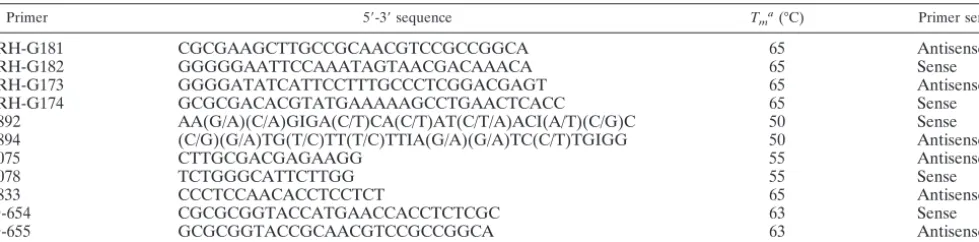
TABLE 1. Oligonucleotides used for PCR
Primer 5⬘-3⬘sequence Tma(°C) Primer sense
JRH-G181 CGCGAAGCTTGCCGCAACGTCCGCCGGCA 65 Antisense
JRH-G182 GGGGGAATTCCAAATAGTAACGACAAACA 65 Sense
JRH-G173 GGGGATATCATTCCTTTGCCCTCGGACGAGT 65 Antisense
JRH-G174 GCGCGACACGTATGAAAAAGCCTGAACTCACC 65 Sense
1892 AA(G/A)(C/A)GIGA(C/T)CA(C/T)AT(C/T/A)ACI(A/T)(C/G)C 50 Sense
1894 (C/G)(G/A)TG(T/C)TT(T/C)TTIA(G/A)(G/A)TC(C/T)TGIGG 50 Antisense
2075 CTTGCGACGAGAAGG 55 Antisense
2078 TCTGGGCATTCTTGG 55 Sense
2833 CCCTCCAACACCTCCTCT 65 Antisense
G-654 CGCGCGGTACCATGAACCACCTCTCGC 63 Sense
G-655 GCGCGGTACCGCAACGTCCGCCGGCA 63 Antisense
a
Tm, melting temperature.
on September 8, 2020 by guest
http://ec.asm.org/
CM. After 12 to 18 h of incubation at 28°C, teliospores had germinated to produce sporidia.
Miscellaneous procedures.Proteolysis in solid medium was measured by the development of clear halos on skim milk agar plates.
The polysaccharide secreted to the culture medium was measured at different times of growth in cultures inoculated with 1⫻106
cells/ml. Cells were elimi-nated by centrifugation, and ice-cold ethanol (50% final concentration) was added to the cell-free medium. After 12 h at 0°C, the mixture was centrifuged at 3,000 rpm for 5 min, and the precipitated material was dried at ambient tem-perature and weighed. Its content of neutral sugars was measured by the an-throne procedure (16), using glucose as a standard.
Cell wall sensitivity toTrichodermalysing enzymes (Sigma catalog no. L1412) was determined by protoplast formation. Cells grown in CM were recovered at the end of the log phase by low-speed centrifugation, washed with distilled water twice by centrifugation, and finally resuspended in SCS (1 M sorbitol, 20 mM sodium citrate, pH 5.8). To 1-ml aliquots of SCS containing 108
cells, 50 mg of enzyme was added, and every 20 min 10l of the mixture was mounted on a glass slide and observed under the microscope. Photographs of different fields were taken, and the ratio of protoplasts to whole cells was determined.
Cells were observed with a Leica DMRE model microscope using phase contrast and photographed with a Spot camera (Diagnostic Instruments). In some experiments cells were stained with a solution containing 0.05 mg/ml of Calcofluor white, thoroughly washed by centrifugation, and observed by epiflu-orescence. Cell measurements were made with the Image-ProPlus 4.0 program of Media Cybernetics. We measured 30 cells randomly selected from fungal cultures. Frequency of septation was measured per 30m of cell length. Statis-tical significance of data was analyzed by2determination. Experiments where
numerical data were obtained were repeated at least three times with two replicates per experiment.
Nucleotide sequence accession number.The gene sequence has been regis-tered at the EMBL Nucleotide Sequence Database with the accession no. AJ748125.
RESULTS
Isolation of RIM101gene. To analyze whether U. maydis
possessed a homologue of theRIM101/pacCgene, we used two degenerate primers (1892 and 1894, Table 1), designed on the basis of the amino acid sequences of the most conserved re-gions (second and third zinc fingers of the coding region) from severalpacC/RIM101homologues, to amplify a putative frag-ment by PCR. A single product of 172 bp was obtained, whose DNA sequence revealed an ORF with the same consensus of the zinc finger regions as that of other reported PacC/Rim101 proteins (not shown). Using the information on theU. maydis
genome sequence available from the Center for Genome Re-search (Cambridge, MA), we designed two specific oligonucle-otides (JRH-G182 and 2883 [Table 1]) to amplify the complete ORF and promoter region of the gene homologue ofpacC/ RIM101. The amplified fragment of 3,832 bp was cloned in pUC19 and sequenced (pUpacC4). It was found to contain a 5⬘ region of 1,175 bp, plus a single 2,484-bp ORF with no con-sensus introns, encoding a protein of 827 amino acid residues with a molecular mass of 88.5 kDa, and including a 3⬘fragment of 172 bp. This sequence has been registered at the EMBL Nucleotide Sequence Database with the accession no. AJ748125. It is identical to ORF um10426 from theU. maydis
genomic bank (http://mips.gsf.de/genre/proj/ustilago). In com-parison with the GenBank-deposited sequences from several organisms the best BLAST similarity scores were obtained with PacC proteins of Fusarium oxysporum and Aspergillus niger. Homology was very high at the zinc finger zone and low at the C-terminal domain (ca.51 and 22% and 51 and 21%, respec-tively). In the 5⬘region we identified two adjacent putativeA. nidulans PacC consensus binding sites at positions ⫺614 to
⫺598 from the ATG start codon.
Deletion of theRIM101gene and isolation of null mutants.
Deletion of theRIM101gene was obtained using plasmid pU-pacH. The plasmid was linearized with HindIII and used to transformU. maydisFB2 and FB1 wild-type strains, to obtain
RIM101replacement by theHphgene through double-cross-over homologous recombination. Under these conditions the
HphORF stays under the control of the RIM101gene pro-moter. This strategy made it possible to analyze later on the transcriptional regulation ofRIM101by means of hygromycin resistance (see below). Hygromycin-resistant clones were iso-lated, and homologous recombination was confirmed by PCR with primers 2075 and 2078 (Table 1). These should amplify a 1,662-bp fragment from null mutants (Fig. 1A, lanes 1 to 3) and a 1,925-bp product from wild-type strains (Fig. 1A, lane 4). Since two EcoRI sites were present in the PCR products (Fig. 1D and 1E), these were digested with EcoRI, giving rise to the expected different products in the wild-type and mutant strains (Fig. 1B, lanes 2 and 4 for mutant and lane 6 for wild-type strains). Gene disruption was also confirmed by Southern anal-ysis (Fig. 1C). For this we used the 1,289-bp StuI-BamHI fragment of the RIM101 ORF as a probe, present only in wild-type strains (Fig. 1D). Two of the transformants obtained from each FB1 and FB2 strain (see Materials and Methods) where homologous gene replacement had occurred were se-lected for further studies. Strain BMA2 (a2b2⌬rim101::hyg) was used in most of the further analyses.
Analysis of RIM101 gene expression.As indicated above,
expression of theE. coli Hphgene, and therefore hygromycin resistance in our⌬rim101 mutants, was under the control of theRIM101promoter (see Materials and Methods). This con-struction allowed the determination of RIM101 expression through the hygromycin resistance of the mutants. We ob-served that these strains, in contrast to wild type, were resistant to hygromycin at concentrations over 150g per ml under acid or neutral conditions in different media, providing evidence thatRIM101was expressed at both acid and neutral pH (not shown). Quantitative determination of expression of the
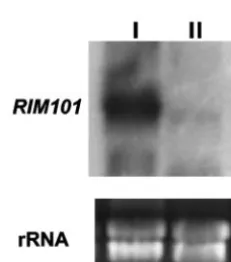
RIM101gene was done by Northern blotting. The results ob-tained (Fig. 2) showed that indeed the transcript was observed at both pH values of growth, although expression was much higher at neutral pH.
Phenotypic analysis of⌬rim101mutants. (i) Growth
char-acteristics.The growth rates of BMA2 and BMA4 (mutants)
and FB2 (wild-type) strains in liquid CM or MM at pH 7.0 did not display any significant difference (data not shown). Further phenotypic characterization included the use of several stress conditions on solid MM at different cellular concentrations. These included salt stress by addition of 0.6 M KCl, 1 M NaCl, or 0.05 M LiCl at pH 7.0 or 3.0; hyperosmotic stress with 1 M sorbitol; growth at temperature above optimum (32 to 33°C); and incubation in media with different concentrations of Cal-cofluor white (300 to 500g/ml). No significant differences in growth and colonial morphology between the different
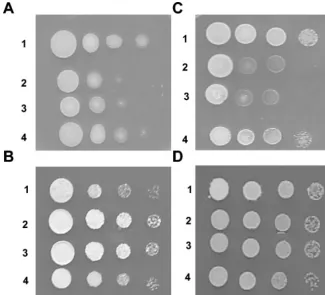
⌬rim101mutants and the wild-type strain were observed under most conditions (not shown). However, exposure to salt stress elicited differential reactions for the mutants and the wild type. Addition of 0.05 M LiCl or 1 M NaCl strongly inhibited the growth of the mutants, in contrast to wild-type strains (Fig. 3). Salt sensitivity occurred only at pH 7 (Fig. 3A and C). KCl had no inhibitory effects at either pH (not shown).
on September 8, 2020 by guest
http://ec.asm.org/
(ii) Dimorphic transition and cellular morphology.We ob-served that the several ⌬rim101 mutants analyzed were not affected in their dimorphic capacity (Fig. 4). Nevertheless, my-celial morphology and the distribution of septa were different from those of the wild-type strain (Fig. 4A and B). Mycelia of
⌬rim101mutant BMA2 displayed a significantly higher relative number of septa than did the wild-type FB2 strain (Table 2). Also mutant yeast cells were significantly longer (Table 2), and some of them presented septa (Fig. 4D and E). In contrast, the width of yeast cells was indistinguishable in the mutant (2.83⫾ 0.38 m) and wild-type (2.96 ⫾ 0.38 m) strains (2 value
of 1).
(iii) Cell wall sensitivity to lytic enzymes and polysaccharide
secretion.When performing transformation experiments with
the standard protocol, we observed that protoplast formation
FIG. 1. Confirmation analyses ofRIM101mutation. A. DNA was subjected to PCR with primers 2075 and 2078. Lanes 1 to 3,⌬rim101mutants (BMA1, BMA2, and BMA4, respectively); lane 4, FB2 wild-type strain; lane 5, plasmid pUpacH; lane 6, plasmid pUpacC4. B. EcoRI digestion of PCR products. Lane 2, BMA1; lane 4, BMA2; lane 6, FB2; lane 8, pUpacH; lane 10, pUpacC4. Lanes 1, 3, 5, 7, and 9, controls with no restriction enzyme added to BMA1, BMA2, FB2, pUpacH, and pUpacC4, respectively. C. Southern blot hybridization of HincII-digested DNA with the 1.2-kb StuI-BamHIRIM101-specific probe. Lane 1, FB1; lane 2, BMA1; lane 3, BMA7; lane 4, FB2; lane 5, BMA2; lane 6, BMA4. Note absence of hybridization in mutants compared to wild-type strains. Arrows show positions of the molecular size standards. D. Restriction map ofRIM101
locus of the wild-type strain showing the primer (solid arrow) and probe (solid line) positions. E. Restriction map ofRIM101locus of the mutant allele used in the experiment showing the position of the primers (solid arrows) and theHphgene (large open arrow).
FIG. 2. Determination ofRIM101expression. Shown are results of Northern analysis ofRIM101gene expression in strain FB2 grown for 24 h in MM, pH 7 (lane I) or pH 3 (lane II), using the 1.2-kb StuI-BamHIRIM101-specific probe. rRNAs stained with ethidium bromide are shown as a loading control.
on September 8, 2020 by guest
http://ec.asm.org/
occurred faster in the⌬rim101 mutants than in the wild-type strains. Accordingly, we proceeded to perform quantitative experiments and verified that cell wall sensitivity to lytic en-zymes was higher in the mutants than in wild-type cells (Table 2). Perhaps related to cell wall alterations, we observed that, when mutant strains were grown in liquid CM at pH 7, the culture medium became highly viscous after a few days. It was presumed that viscosity was related to secretion of a polysac-charide to the medium. Accordingly, the culture medium was treated with cold ethanol, and neutral sugars were measured in the precipitate formed. It was observed that the BMA2
⌬rim101mutant secreted about 8 times more polysaccharide than did the FB2 strain after 48 h and 9.5 times more after 72 h of incubation (Fig. 5A). Interestingly, polysaccharide secretion was pH dependent (Fig. 5B).
(iv) Mating. We analyzed mating of mutant strains BMA2
(a2b2⌬rim101::hyg) and BMA7 (a1b1⌬rim101::hyg) and wild-type strains FB2 (a2b2) and FB1 (a1b1) in all the different possible combinations. It was observed that all mixtures of sexually compatible strains developed a positive Fuz reaction, independently of theirRIM101gene status (not shown).
(v) Virulence and development in maize plants.Virulence of
⌬rim101 strains was analyzed by inoculation of mixtures of sexually compatible mutants (BMA2 and BMA7) or wild-type strains (FB1 and FB2) in maize seedlings. No qualitative or quantitative differences in virulence symptoms were observed between mutant and wild-type mixtures (Table 3). To analyze
whether the normal life cycle of the mutant strains was being completed in the maize plants, teliospores were recovered from the galls formed in the infected plants. Teliospores from mutants or wild-type strains showed no morphological differ-ence, and when inoculated on solid complete medium, they displayed no differences in their germination capacity (not shown), suggesting that they had no defects in meiosis. It has been reported previously thatSaccharomyces cerevisiae rim101
mutants have alterations in meiosis (43).
(vi) Protease secretion.Secretion of alkaline proteases was
analyzed in agar plates containing skim milk as the sole nitro-gen source at pH 6.8 or 8.0. After 5 days, wild-type strains developed clear halos of proteolysis on the plates, whereas none of the ⌬rim101 mutants analyzed showed this capacity (Fig. 6A).
Complementation of the RIM101 mutation. The BMA2
strain was transformed with pUpacC22 or pUpacC23 carrying respectively the truncated or the complete versions of the
RIM101ORF (see Materials and Methods). Carboxin-resistant clones were recovered, and their resistance to carboxin and hygromycin was confirmed. For further studies, we selected one strain obtained by transformation with pUpacC22 (AAP1) and two (PGM1 and PGM2) obtained after transformation with pUpacC23. AAP1 and PGM1 transformants recovered the capacity to secrete the alkaline protease comparable to FB2 (Fig. 6A). Other phenotypic characteristics of the wild-type strains that had been altered byRIM101disruption were
FIG. 3. Effect of salt stress onU. maydisgrowth. DifferentU. maydiscell numbers (107, 106, 105, or 104cells/aliquot) were inoculated on plates
of solid MM and incubated for 96 h. Panels A and C, MM, pH 7; panels B and D, MM, pH 3. Panels A and B, 0.05 M LiCl added to the medium; panels C and D, 1 M NaCl added to the medium. Rows 1, FB2; rows 2, BMA1 (⌬rim101); rows 3, BMA2 (⌬rim101); rows 4, PGM1 (⌬rim101::hyg/pUpacC23).
on September 8, 2020 by guest
http://ec.asm.org/
FIG. 4. Cell morphology ofU. maydiswild-type and mutant strains. Strains were grown in MM at pH 3 (A, B, and C) or pH 7 (D, E, and F) and stained with Calcofluor white. A and D, FB2 (wild type); B and E, BMA2 (⌬rim101); C and F, PGM1 (⌬rim101::hyg/pUpacC23). Bar, 10m.
on September 8, 2020 by guest
http://ec.asm.org/
also recovered in strain PGM1. Accordingly, its sensitivity to
Trichodermalytic enzymes was reduced (Table 2). Also poly-saccharide secretion was restrained: the PGM1 strain pro-duced 0.500⫾0.03 mg/ml and PGM2 produced 0.630⫾0.05 mg/ml, after 48 h of growth in CM, pH 7, compared to 0.567⫾ 0.04 mg/ml synthesized by the wild-type strain FB2. Tolerance to Li⫹and Na⫹salts was also recovered in PGM1 (Fig. 3), and the cell shape of the complemented strain PGM1 was very similar to that of the wild type at either pH 3 or pH 7 (Table 2; Fig. 4C and F).
Complementation of a nullrim101 Y. lipolyticamutant with
U. maydis RIM101.Y. lipolyticastrain FL3 (A rim101-1113 ura3 lys11) was transformed with the autonomous replication plas-mid pUpacC44 bearing the truncated form of theU. maydis RIM101ORF under the control of the promoter and termina-tor of theY. lipolytica Xpr2gene. Transformants were isolated
in uracil-free medium, and their uracil prototrophy was con-firmed by transfer to fresh plates of the same medium. One hundred transformants were inoculated on skim milk plates at pH 6.8, and we observed that about 70% of the isolates recov-ered alkaline protease activity (not shown). Figure 6B shows proteolysis in skim milk plates by one transformant (strain ETA1) compared to Y. lipolytica wild-type strain E121 and contrasting with FL3⌬R (rim101 mutant). Five strains recov-ered after transformation with the empty plasmid pINA444 carryingUra3, but not theRIM101gene, recovered uracil pro-totrophy but not protease activity (not shown).
DISCUSSION
Signaling by pH in fungi is an important mechanism for their survival in nature. At least three mechanisms have been de-scribed to fulfill this function. One of the best-characterized pH-transduction systems is the Pal/Rim pathway (reviewed in
FIG. 5. Polysaccharide secretion by wild-type and mutant strains of
U. maydis. A. Strains FB2 and BMA2 were grown in pH 7 CM. At different times, the polysaccharide was precipitated with ethanol, and the content of neutral sugars was measured. B. Cells were grown for 48 h in MM of different pH values. Triangles and solid lines, strain FB2; circles and broken lines, strain BMA2. Polysaccharide data are expressed in mg/ml.
FIG. 6. Proteolytic activities of differentU. maydisandY. lipolytica
strains. Strains were inoculated over skim milk plates and incubated for 48 h. A.U. maydis. I/1, FB2 wild-type strain; II/1, FB1 wild-type strain; I/2, BMA2⌬rim101mutant; I/3, BMA4⌬rim101mutant; II/2, PGM1 complemented strain; II/3, AAP1 complemented strain. B.Y. lipolytica. I/1,⌬FL3 mutant; I/2, ETA1 complemented strain; I/3, E121 wild-type strain.
TABLE 2. Several phenotypic characteristics of wild-type,⌬rim101
mutant, and complemented strains ofU. maydisa
Strain Yeast form length (m)
Septa in myceliumb
Sensitivity to lytic enzymesc
FB2 (wild type) 12.7⫾1.30 2.40⫾0.99 54.16⫾4.79 BMA2 (⌬rim101) 17.2⫾3.50 5.00⫾0.79 93.25⫾0.95 PGM1 (⌬rim101/pUpacC23) 10.51⫾2.11 1.92⫾0.66 39.60⫾3.60
aDifferences were found to be significant (see text). bPer 30m of length.
cAs percentage of protoplasts formed after 1 h of treatment withTrichoderma
lytic enzymes.
TABLE 3. Effect ofRIM101deletion on virulence ofU. maydison maize seedlings
No. of cells inoculated
Plants with galls (%)a
FB2⫻FB1 (wild type) BMA2⫻BMA7 (⌬rim101)
105 100 100
104 72 84
103 50 54
102 50 31
aSix-day-old Zea maysseedlings (25 per condition) were inoculated with
different cell densities of mixtures of mating-compatibleU. maydisstrains. After 15 days, disease symptoms were noted.
on September 8, 2020 by guest
http://ec.asm.org/
references 32 and 33). A mechanism responsive to alkaline pH dependent on calcineurin that acts by activation of a large number of genes through the transcriptional factor Crz1p has been described elsewhere for yeast (41, 42; see reviews in references 32 and 33). Finally a mechanism depending on the
MDS3gene was recently described forC. albicans.MDS3 en-codes a polypeptide possessing a kelch-like interaction do-main. Homozygous mds3/mds3 C. albicans mutants were af-fected in the expression of several genes related to mycelial growth, failed to form mycelium at alkaline pH in some media, and displayed reduced virulence in a model system (14). Ap-parently this protein acts in parallel with Rim101p (14; re-viewed in reference 33).
In the present study we analyzed whether the Pal/Rim path-way could be involved in the control of dimorphism of U. maydis, which depends on external pH (38). Accordingly, we proceeded to determine if a homologue of theRIM101/pacC
gene was present inU. maydis(all previously described homo-logues belong to ascomycetes and deuteromycetes) and, if so, to isolate the encoding gene. The homologue of U. maydis RIM101/pacC(namedRIM101) identified in this study encodes a protein with highest similarity to PacC proteins from F. oxysporum and A. niger. As for other reported homologues, maximal similarity is concentrated at the zinc finger-encoding regions and reduced at the C termini of the proteins (24).
The expression of RIM101measured by Northern blotting showed much higher values at neutral pH. Hygromycin resis-tance of disruptants (a qualitative assay in strains where the hygromycin resistance gene was under the control of the
RIM101promoter) was found also at both pH 3 and pH 7. It is known that, in different fungi, such as C. albicans (13), Y. lipolytica(24),A. niger(26), andSclerotinia sclerotiorum(36), PacC/Rim101 mRNA is present at all physiological pH values, but PacC/Rim101 stimulates its own transcription only at neu-tral or alkaline pH. If the two putative PacC/Rim101 binding boxes detected in the promoter region ofU. maydis RIM101
are functional, this might explain the difference in expression observed at both pH values.
U. maydis RIM101was identified as the homologue ofpacC/ RIM101by two pieces of evidence: (i) from a structural point of view, by the sequence homology of Rim101p to other Pal/ Rim101 proteins, and (ii) from a functional point of view, by its capacity to complement the alkaline protease activity in aY. lipolytica⌬rim101mutant. Activity of PacC/Rim101 as a tran-scription factor in other systems (e.g., references 25, 26, and 44) requires its proteolytic processing. In case processing might be different inU. maydisandY. lipolytica, a partial version of theRIM101ORF that included the zinc finger coding region was used for transformation. This version (first demonstrated to be functional for the complementation of the alkaline pro-tease secretion inU. maydis⌬rim101 mutants) proved to be effective in restoring the proteolytic activity in theY. lipolytica
⌬rim101mutant.
Disruption ofRIM101by double homologous recombination did not affect the growth rate ofU. maydismutants at acid or neutral pH, suggesting that, as in other systems (13, 25, 26, 36), the gene is dispensable for growth. Also, mutants were not affected in their dimorphic capacity, a result suggesting that, in contrast toC. albicans, in whichRIM101is required for pH-dependent filamentation (34), the Pal/Rim pathway is not
in-volved in the pH signal transduction required for dimorphism in U. maydis. Another contrast between U. maydis and C. albicansmutants regards virulence. It has been reported pre-viously thatC. albicans RIM101is involved in persistence of infection (11); in contrast⌬rim101mutants ofU. maydiswere as virulent in maize as were wild-type strains. Apparently this behavior depends on the fungal species.Fusarium oxysporum pacC mutants are more virulent than the wild-type strains, suggesting that PacC behaves as a negative regulator of viru-lence (9). In contrast, S. sclerotiorum pacC mutants display reduced virulence (35).
Nevertheless, as occurs with other fungi (9, 23; reviewed in references 32 and 33), U. maydis mutants deficient in the Rim101-encoding gene displayed a pleiotropic phenotype.
⌬rim101mutants were abnormal regarding protein secretion, cell morphogenesis, cell wall strength, polysaccharide secre-tion, and Na⫹and Li⫹stress tolerance. All these alterations were alleviated by transformation with a plasmid carrying the wild-type version of theRIM101gene. These results are evi-dence that theRIM101mutation was directly responsible for all those phenotypic alterations.
One of the initially observed characteristics of fungal mu-tants deficient in genes involved in the Pal/Rim pathway was their impaired capacity to secrete different enzymes in re-sponse to changes in pH (reviewed in references 32 and 33). In agreement with this behavior,U.maydis⌬rim101mutants were deficient in extracellular protease activity. They were also al-tered in morphogenesis: mutant yeast cells were larger, and occasionally septated, a rare event in wild-type yeast cells. Frequency of septation in mutant mycelial cells grown at acid pH was increased. These alterations suggest that Rim101 might be involved in morphogenesis and the regulation of the cell cycle. In agreement with this hypothesis, it has been re-ported that Rim101/PacC is involved in different morphoge-netic phenomena in other fungi. Accordingly, evidence exists that that the gene product plays a role in the regulation of sporulation and invasive growth ofS. cerevisiae(25, 43), effi-cient conidiation ofA. nidulans (44), and sclerotial develop-ment inS. sclerotiorum(35). Morphogenetic alterations ofU. maydis occurring in the mycelium of mutants deficient in
RIM101growing at pH 3 suggest that the gene product has an active function at acid pH. The observations thatA. nidulans pacCmutants display reduced conidiation and abnormal mor-phology at acid pH (44) and that chlamydospore formation in medium at pH 5.5 decreases inrim13andrim101mutants ofC. albicans(29) agree with our results and reinforce this hypoth-esis. ForS. cerevisiaeit was reported (25) that the processed (and presumptively active) form of Rim101 protein was present at both alkaline and acid pH.
In regard to other phenotypic alterations of ⌬rim101 mu-tants, we may hypothesize that their increased sensitivity to lytic enzymes (an indication of alterations in the structure of the cell wall) and their increased secretion of polysaccharide are related phenomena. InC. albicans, PacC/Rim101 has been related to the regulation of Phr1 and Phr2 surface proteins. These are retained in the plasmalemma through a glyco-sylphosphatidylinositol anchor and possess a transglycosidase activity that may play a role in the linking of-1,6 and-1,3 glucans in the cell wall (17, 40). A similar role for other mem-bers of the same transglycosidase family in different fungi has
on September 8, 2020 by guest
http://ec.asm.org/
been suggested (for a discussion see reference 37). A plausible hypothesis is that a similar mechanism operates inU. maydis
and that mutation ofRIM101alters the correct functioning of putative transglycosidases. As a result, a polysaccharide in-volved in cell wall growth would be secreted (at least partially) to the medium, instead of being bound to the wall, thus result-ing in its abnormal structure and organization.
Another phenotypic alteration brought about by theRIM101
mutation was an elevated susceptibility to Na⫹and Li⫹, but not K⫹, ions. A similar phenomenon was reported forpacC/ rim101mutants ofF. oxysporum andS. cerevisiae. This sensi-tivity appears to be due to the possible alteration in the ex-pression of a P-type Na⫹-ATPase, Ena1 (9, 23). Interestingly, inS. cerevisiae a plasma membrane-bound ENA1-type Na⫹ -ATPase was up-regulated by the calcineurin/Crz1 pathway cited above (41). InU. maydistwo novel P-type ATPases that mediate K⫹or Na⫹uptake have been isolated, but these are not related to Ena1 ATPases (6). Also the observation that their transcripts accumulated at acid pH (6) makes improbable their regulation by Rim101, since according to our results sensitivity to salt stress occurred only at alkaline pH. The observation that high concentrations of sorbitol did not affect
U. maydisgrowth is evidence (as suggested in reference 9) of a specific sensitivity to salt and not to hyperosmotic stress.
Originally, the role of the Pal/Rim pathway was considered to be specific to ascomycetes and deuteromycetes and involved in the expression of some selected pH-regulated exoenzymes. Further data have revealed that the pathway plays unsuspected important roles in other cellular functions (9, 23, 35). The results described here are evidence that the pathway also exists in basidiomycetes, having roles in a series of similar complex phenomena with several heretofore-unobserved phenotypic consequences. In this sense it is relevant that an in silico anal-ysis of theU. maydisgenome revealed the existence of putative homologues of genes palA/RIM20, palB/RIM13, and palI/ RIM9.
ACKNOWLEDGMENTS
This work was partially supported by CONACYT, Me´xico. The doctoral studies of E.T.A.-C. were supported by a CONACYT fellow-ship.
We thank Flora Banuett for providing usU. maydisstrains FB1 and FB2, Claude Gaillardin forY. lipolyticastrains FL3⌬R and E121, Scott Gold for valuable comments on this work, Peter Schrier for the partial
RIM101sequences provided, and Claudia Leo´n for her valuable tech-nical support.
REFERENCES
1.Banuett, F.1995. Genetics ofUstilago maydis, a fungal pathogen that induces tumors in maize. Annu. Rev. Genet.29:179–208.
2.Banuett, F., and I. Herskowitz.1989. Differentaalleles ofUstilago maydis
are necessary for maintenance of filamentous growth but not for meiosis. Proc. Natl. Acad. Sci. USA86:5878–5882.
3.Banuett, F., and I. Herskowitz.1996. Discrete developmental stages during teliospore formation in the corn smut fungus,Ustilago maydis. Development
122:2965–2976.
4.Barrett, K. J., S. E. Gold, and J. W. Kronstad.1993. Identification and complementation of a mutation to a constitutive filamentous growth in
Ustilago maydis. Mol. Plant-Microbe Interact.6:274–283.
5.Barth, G., and C. Gaillardin.1996.Yarrowia lipolytica, p. 313–388.InK. Wolf (ed.), Non-conventional yeasts in biotechnology. A handbook. Springer-Verlag, Berlin, Germany.
6.Benito, B., B. Garciadebla´s, P. Schreier, and A. Rodrı´guez-Navarro.2004. Novel P-type ATPases mediate high-affinity potassium or sodium uptake in fungi. Eukaryot. Cell3:359–368.
7.Bo¨lker, M.2001.Ustilago maydis—a valuable model system for the study of fungal dimorphism and virulence. Microbiology147:1395–1401.
8.Caddick, M. X., A. G. Brownlee, and H. N. Arst, Jr.1986. Regulation of gene expression by the pH of the growth medium inAspergillus nidulans. Mol. Gen. Genet.203:346–353.
9.Caracuel, Z., C. Casanova, M. I. G. Roncero, A. Di Pietro, and J. Ramos.
2003. pH response transcription factor PacC controls salt stress tolerance and expression of the P-type Na⫹-ATPase Ena1 inFusarium oxysporum. Eukaryot. Cell2:1246–1252.
10.Cha´vez-Ontiveros, J., A. D. Martinez-Espinoza, and J. Ruiz-Herrera.2000. Double chitin synthetase mutants from the corn smut fungusUstilago maydis. New Phytol.146:335–341.
11.Davis, D.2003. Adaptation to environmental pH inCandida albicansand its relation to pathogenesis. Curr. Genet.44:1–7.
12.Davis, D., J. E. Edwards, Jr., A. P. Mitchell, and A. S. Ibrahim.2000.
Candida albicans RIM101pH response pathway is required for host-patho-gen interactions. Infect. Immun.68:5953–5959.
13.Davis, D., R. B. Wilson, and A. P. Mitchell.2000.RIM101-dependent and -independent pathways govern pH responses inCandida albicans. Mol. Cell. Biol.20:971–978.
14.Davis, D. A., V. M. Bruno, L. Loza, S. G. Filler, and A. P. Mitchell.2002.
Candida albicansMds3p, a conserved regulator of pH responses and viru-lence identified through insertional mutagenesis. Genetics162:1573–1581. 15.Denison, S. H. 2000. pH regulation of gene expression in fungi. Fungal
Genet. Biol.29:61–71.
16.Dimler, R. J., W. C. Schaeffer, C. S. Wise, and C. E. Rist.1952. Quantitative paper chromatography of D-glucose and its oligosaccharides. Anal. Chem.
24:1411–1414.
17.Fonzi, W. A.1999.PHR1andPHR2ofCandida albicansencode putative glycosidases required for proper cross-linking of-1,3 and-1,6 glucans. J. Bacteriol.181:7070–7079.
18.Fournier, P., L. Guyaneux, M. Chasles, and C. Gaillardin.1991. Scarcity of ARS sequences isolated in a morphogenesis mutant of the yeastYarrowia lipolytica. Yeast7:25–36.
19.Gonzalez-Lopez, C. I., R. Szabo, S. Blanchin-Roland, and C. Gaillardin.
2002. Genetic control of extracellular protease synthesis in the yeast Yar-rowia lipolytica. Genetics160:417–427.
20.Hoffman, C. S., and F. Winston.1987. A ten-minute DNA preparation from yeast efficiently releases autonomous plasmids for transformation of Esche-richia coli. Gene57:267–272.
21.Holliday, R.1961. The genetics ofUstilago maydis. Genet. Res.2:204–230. 22.Keon, J. P. R., G. A. White, and J. A. Hargreaves.1991. Isolation,
charac-terization and sequence of a gene conferring resistance to the systemic fungicide carboxin from the maize smut pathogen,Ustilago maydis. Curr. Genet.19:475–481.
23.Lamb, T. M., and A. P. Mitchell.2003. The transcription factor Rim101p governs ion tolerance and cell differentiation by direct repression of the regulatory genesnrg1andsmp1inSaccharomyces cerevisiae. Mol. Cell. Biol.
23:677–686.
24.Lambert, M., S. Blanchin-Roland, F. Le Leuedec, A. Le´pingle, and C. Gail-lardin.1997. Genetic analysis of regulatory mutants affecting synthesis of extracellular proteinases in the yeastYarrowia lipolytica: identification of a
RIM101/pacChomolog. Mol. Cell. Biol.17:3966–3976.
25.Li, W., and A. P. Mitchell.1997. Proteolytic activation of Rim1p, a positive regulator of yeast sporulation and invasive growth. Genetics145:63–73. 26.MacCabe, A. P., P. T. W. Johanes, V. D. Homberg, J. Tilburn, H. N. Arst, Jr.,
and J. Visser.1996. Identification, cloning and analysis of theAspergillus nigergenepacC, a wide domain regulatory gene responsive to ambient pH. Mol. Gen. Genet.250:367–374.
27.Martinez-Espinoza, A. D., M. D. Garcia-Pedrajas, and S. E. Gold.2002. The ustilaginales as plant pests and model systems. Fungal Genet. Biol.35:1–20. 28.Martı´nez-Espinoza, A. D., C. Leo´n, G. Elizarraraz, and J. Ruiz-Herrera.
1997. Monomorphic nonpathogenic mutants ofUstilago maydis. Phytopa-thology87:259–265.
29.Nobile, C. J., V. M. Bruno, M. L. Richard, D. A. Davis, and A. P. Mitchell.
2003. Genetic control of chlamydospore formation inCandida albicans. Microbiology149:3629–3637.
30.Odds, F. C.1988.Candidaand candidosis, 2nd ed. Bailliere Tindall, London, United Kingdom.
31.Ogrydziak, D. M., and R. K. Mortimer. 1977. Genetics of extracellular protease production inSaccharomycopsis lipolytica. Genetics87:621–632. 32.Pen˜alva, M. A., and H. N. Arst, Jr.2002. Regulation of gene expression by
ambient pH in filamentous fungi and yeasts. Microbiol. Mol. Biol. Rev.
66:426–446.
33.Pen˜alva, M. A., and H. N. Arst, Jr.2004. Recent advances in the character-ization of ambient pH regulation of gene expression in filamentous fungi and yeasts. Annu. Rev. Microbiol.58:425–451.
34.Ramo´n, A. M., A. Porta, and W. A. Fonzi.1999. Effect of environmental pH on morphological development ofCandida albicans is mediated via the PacC-related transcription factor encoded byPRR2. J. Bacteriol.181:7524– 7530.
35.Rollins, J. A.2003. TheSclerotinia sclerotiorum pac1gene is required for sclerotial development and virulence. Mol. Plant-Microbe Interact.16:785– 795.
on September 8, 2020 by guest
http://ec.asm.org/
36.Rollins, J. A., and M. B. Dickman.2001. pH signaling inSclerotinia sclero-tiorum: identification of apacC/RIM1homolog. Appl. Environ. Microbiol.
67:75–81.
37.Ruiz-Herrera, J., M. V. Elorza, P. E. Alvarez, and R. Sentandreu.2004. Biosynthesis of the fungal cell wall, p. 41–49.InG. San Blas and R. A. Calderone (ed.), Pathogenic fungi: structural biology and taxonomy. Caister Academic Press, Wymondham, Norfolk, United Kingdom.
38.Ruiz-Herrera, J., C. Leo´n, L. Guevara-Olvera, and A. Ca´rabez-Trejo.1995. Yeast-mycelial dimorphism of haploid and diploid strains ofUstilago maydis. Microbiology141:695–703.
39.Sambrook, J., E. F. Fritsch, and T. Maniatis.1989. Molecular cloning: a laboratory manual, 2nd ed. Cold Spring Harbor Laboratory Press, Cold Spring Harbor, N.Y.
40.Saporito-Irwin, S. M., C. E. Birse, P. S. Sypherd, and W. A. Fonzi.1995.
PHR1, a pH-regulated gene ofCandida albicans, is required for morpho-genesis. Mol. Cell. Biol.15:601–613.
41.Serrano, R., A. Ruiz, D. Bernal, J. R. Chambers, and J. Arino.2002. The
transcriptional response to alkaline pH inSaccharomyces cerevisiae: evidence for calcium-mediated signalling. Mol. Microbiol.46:1319–1333.
42.Stathopoulos, A. M., and M. S. Cyert.1997. Calcineurin acts through the
CRZ1/TCN1-encoded transcription factor to regulate gene expression in yeast. Genes Dev.11:3432–3444.
43.Su, S. S. Y., and A. P. Mitchell.1993. Molecular characterization of the yeast meiotic regulatory geneRIM1. Nucleic Acids Res.21:3789–3797. 44.Tilburn, J., S. Sarkar, D. A. Widdick, E. A. Espeso, M. Orejas, J. Mungroo,
M. A. Pen˜alva, and H. N. Arst, Jr.1995. TheAspergillusPacC zinc finger transcription factor mediates regulation of both acid- and alkaline-expressed genes by ambient pH. EMBO J.14:779–790.
45.Wang, J., D. Walden, and S. A. Leong.1988. Gene transfer system for the phytopathogenic fungusUstilago maydis. Proc. Natl. Acad. Sci. USA85:865– 869.
46.Xoconostle-Ca´zares, B., C. A. Spetch, P. W. Robbins, Y. Liu, C. Leo´n, and J. Ruiz-Herrera.1997.Umchs5, a gene coding for a class IV chitin synthase in
Ustilago maydis. Fungal Genet. Biol.22:199–208.