Analysis of Global Collection of Group A
Streptococcus
Genomes Reveals that the Majority Encode a Trio of M and
M-Like Proteins
Hannah R. Frost,a Mark R. Davies,bValérie Delforge,aDalila Lakhloufi,aMartina Sanderson-Smith,cVelusamy Srinivasan,d Andrew C. Steer,e,hMark J. Walker,fBernard Beall,dAnne Botteaux,aPierre R. Smeestersa,e,g,h
aMolecular Bacteriology Laboratory, Université Libre de Bruxelles, Brussels, Belgium
bDepartment of Microbiology and Immunology, University of Melbourne at the Peter Doherty Institute for Infection and Immunity, Melbourne, Australia cIllawarra Health and Medical Research Institute and Molecular Horizons, School of Chemistry and Molecular Bioscience, University of Wollongong, Wollongong,
Australia
dNational Center for Immunization and Respiratory Diseases, Centers for Disease Control and Prevention, Atlanta, Georgia, USA eTropical Diseases Research Group, Murdoch Children’s Research Institute, Melbourne, Australia
fAustralian Infectious Diseases Research Centre and School of Chemistry and Molecular Biosciences, University of Queensland, St Lucia, Australia gAcademic Children Hospital Queen Fabiola, Université Libre de Bruxelles, Brussels, Belgium
hCentre for International Child Health, University of Melbourne, Melbourne, Australia
ABSTRACT The core Mga (multiple gene activator) regulon of group A Streptococ-cus(GAS) contains genes encoding proteins involved in adhesion and immune eva-sion. While all GAS genomes contain genes for Mga and C5a peptidase, the inter-vening genes encoding M and M-like proteins vary between strains. The genetic make-up of the Mga regulon of GAS was characterized by utilizing a collection of 1,688 GAS genomes that are representative of the global GAS population. Se-quence variations were examined with multiple alignments, and the expression of all core Mga regulon genes was examined by quantitative reverse transcription-PCR in a representative strain collection. In 85.2% of the sampled genomes, the Mga locus contained genes encoding Mga, Mrp, M, Enn, and C5a peptidase proteins. These isolates account for 53% of global infections. Only 9.1% of genomes did not contain either an mrp or an enn gene. The pairwise identity within Enn (68.6%) and Mrp (83.2%) protein sequences was higher than within M proteins (44.7%). Gene expression varied between strains tested, but high expression was recorded for all genes in at least one strain. Previous nomenclature issues were clarified with molecular gene definitions. Our findings support a shift in focus in the GAS research field to further consider the role of Mrp and Enn in virulence and vaccine development.
IMPORTANCE While the GAS M protein has been the leading vaccine target for cades, the bacteria encode many other virulence factors of interest for vaccine de-velopment. In this work, we show thatemm-like genes are encoded in a remarkable majority of GAS genomes and expressed at a level similar to that for theemmgene. In collaboration with the U.S. Centers for Disease Control, we developed molecular definitions of the differentemmandemm-like gene families. This clarification should abrogate mistyping of strains, especially in the area of whole-genome typing. We have also updated theemm-typing collection by removingemm-like gene sequences and provided in-depth analysis of Mrp and Enn protein sequence structure and di-versity.
KEYWORDS Streptococcus pyogenes, Mga regulon, M-like proteins, global GAS diversity
CitationFrost HR, Davies MR, Delforge V, Lakhloufi D, Sanderson-Smith M, Srinivasan V, Steer AC, Walker MJ, Beall B, Botteaux A, Smeesters PR. 2020. Analysis of global collection of group AStreptococcusgenomes reveals that the majority encode a trio of M and M-like proteins. mSphere 5:e00806-19. https://doi.org/10.1128/mSphere.00806-19. EditorGarret Suen, University of Wisconsin— Madison
Copyright© 2020 Frost et al. This is an open-access article distributed under the terms of theCreative Commons Attribution 4.0 International license.
Address correspondence to Pierre R. Smeesters, [email protected]. Received7 November 2019 Accepted18 December 2019 Published
Clinical Science and Epidemiology
8 January 2020
on September 8, 2020 by guest
http://msphere.asm.org/
date (6). A convenient feature ofemmgenes is that their signal sequence encoding regions universally contain a conserved 19-bp sequence (7). This feature has greatly simplified the assignment ofemmtypes from short-read genomic sequences since they are invariably very closely linked to the upstream 19-bp primer 1 sequence (8). Genomic sequencing has also revealed that certain historically establishedemmtypes have been assigned to sequences located inemm-like genes due to the annealing ofemm-typing primers toemm-like genes (9). A more recent classification, called the emm -cluster-typing scheme, groups strains into 48 clusters based on full M protein sequence homology and functional properties (10–12).
The core Mga regulon spans from the ubiquitous genes for Mga (mga), a transcrip-tional regulator, to the C5a peptidase (scpA) (13). Other genes that can be present in the Mga regulon include genes encoding the M-like proteins (emm-like genes), Mrp (mrp), and Enn (enn). In some genomes the locus also encodes protein H (sph), a surface protein involved in immune evasion (14); streptococcal inhibitor of complement (SIC;
sic), a secreted virulence factor also involved in immune evasion (15); and proteins closely related to SIC (CRS;crs) and distantly related to SIC (DRS;drs) (16). Depending on theemm-like gene content of this locus, strains are classified into fiveemmpatterns (A to E) (17).
As well as regulating Mga regulon gene expression, the Mga protein directly affects transcription of genes involved in the early stages of infection and is chiefly active during the exponential growth phase. Mga indirectly affects expression of over 10% of the GAS genome (18, 19). Limited evidence suggests that mrp and enn genes are expressed between 4- and 32-fold less than theemmgene in the strains analyzed (20, 21).
M-like proteins are fibrillar coiled-coil proteins that extend from the surface of the bacteria and share structural characteristics similar to M proteins (22). The virulence potential of these proteins is relatively unclear, although they have been shown to share binding properties with M proteins (22). The vaccine potential of Mrp has been recently investigated, since antibodies against Mrp have been shown to elicit protec-tion in animal models of infecprotec-tion (23) and increased the bactericidal activity of anti-M antisera (24).
In this study, we carefully describe the Mga core regulon of GAS based on a genetically diverse worldwide study of 2,083 GAS genomes (25). We applied particular emphasis to the genetic description of Mrp and Enn, since these two proteins remain poorly characterized to date. We also sought to address the mislabeling of certainemm
types by molecular clarification of gene families.
(This information was presented in part at the 19th Lancefield International Sym-posium for Streptococci and Streptococcal Diseases in Fiji in 2017 and at the workshop of f-TALES: Big Data in Life Sciences and Biomedicine in Belgium in 2017.)
RESULTS
The Mga regulon was located in a single contig in 1,688 genomes belonging to 130 different emmtypes, 39 emm clusters, and 262 phylogroups from the 2,083 global genome database (Fig. 1) (25).
on September 8, 2020 by guest
Definingmrp,enn, andemm.mga-,mrp-,emm-,enn-, andscpA-specific oligonu-cleotide probes were designed to facilitate identification of gene families (Table 1). The
mrpgene was defined as being an open reading frame (ORF) downstream of themga
gene, upstream of theemmgene, and containing themrp-specific probe. Theenngene was defined as being an ORF downstream of theemmgene, upstream of thescpAgene, and containing the ennprobe sequence. Theemm gene was defined as containing either theemmprobe 1 at the 5=end or theemmprobe 2 at the 3=end of the gene. Chimericemmgenes were defined as containing theemmprobe 1 at the 5=end and the ennprobe at the 3= end of the gene. Sph genes were observed as large ORFs downstream ofemmgenes that did not contain either theemmor theennprobe and were identified by BLAST search.
In the 1,688 genomes analyzed, there were 176emmsubtypes represented in more than one genome. Of these, more than one uniquemrpallele was present in 46% of cases (n⫽81) and more than one unique ennallele was present in 57% of cases (n⫽100). Therefore, the previous nomenclature system in which theemm-like genes were named based on theemmtype they were isolated from (26, 27) was not optimal. Thus, a systematic Mrp and Enn nomenclature was established, in which each unique protein sequence has a numerical identifier (e.g., Mrp1), and any allele that produces the same protein sequence is named as a subtype (e.g., Mrp1.1). This nomenclature is hosted on the website of the GAS reference laboratory at U.S. Centers for Disease FIG 1 Details of the genome and gene collections. Details on the process by which the genomes and genes available were selected for further analysis. The final collection of alleles provides the best representation of global diversity of the gene families available, while avoiding the possibility of confounding by sequence ambiguities.*, a total of 19 genomes had substantial sequence ambiguities in theemmgene domain but nevertheless containedemm-typing sequences. These genes were excluded from gene family analyses, but genomes were included in Mga composition analyses.
TABLE 1Nucleotide probes forin silicoidentification of Mga regulon genes
Gene Flexibilitya(no. of nt) Sequence Probe in unique alleles (%)
mga 3 GAGATTGAAAAACAGTACGATGTTATCGTGACAGATGTTATGGT 386/390 (99.0)
mrp 1 AACCAAGAAAAAGAAAAGTTAGAAGC 295/295 (100)
emm(3=) 1 AACAAAGAGCTTGAAGAA 623/635 (98.1)
emm(5=) 0 TATTSGCTTAGAAAATTAA 624/635 (98.3)b
enn 1 TCTGAGTTAACRCAAGCRAARRYTCAACTYKY 350/352 (99.4)
scpA 1 GAAGTAACAGTAACAGTTCACAACAAATCTGATAAACCTCAAGAGTTGTATTA 550/553 (99.5)
aThe flexibility number refers to the number of mismatched nucleotide (nt) bases allowed to provide 99 to 100% specificity and sensitivity. Allemmgenes contained
at least one of the twoemmprobes; there were 32 genomes with 10 distinctemmalleles that contained the 3=probe but not the 5=probe and 18 genomes with 7 distinctemmalleles that contained the 5=probe but not the 3=probe.
bWhatmore et al. (7).
on September 8, 2020 by guest
http://msphere.asm.org/
Control and Prevention (CDC; https://www2a.cdc.gov/ncidod/biotech/strepblast.asp), and the alleles in each genome are listed in Table S3 in the supplemental material. Where possible, the association between previously designatedmrpandennsequences are noted in the lists of unique alleles (Table S4). However, since the new nomenclature is unlinked from theemmtype of the strain, the previous names could unfortunately not be retained.
Composition of Mga regulons.Of the 1,688 genomes analyzed, all containmga
andscpAgenes, which ranged from 6,016 to 11,641 bp apart. The length of each gene family within the core Mga regulon displayed some variability (Fig. S1), the most variable beingemmand the genes encoding transposases, while the least variably sized genes weremgagenes andpgs(X92371.1), a gene encoding Pgs, a 15.5-kDa protein of unknown function (CAA63115).
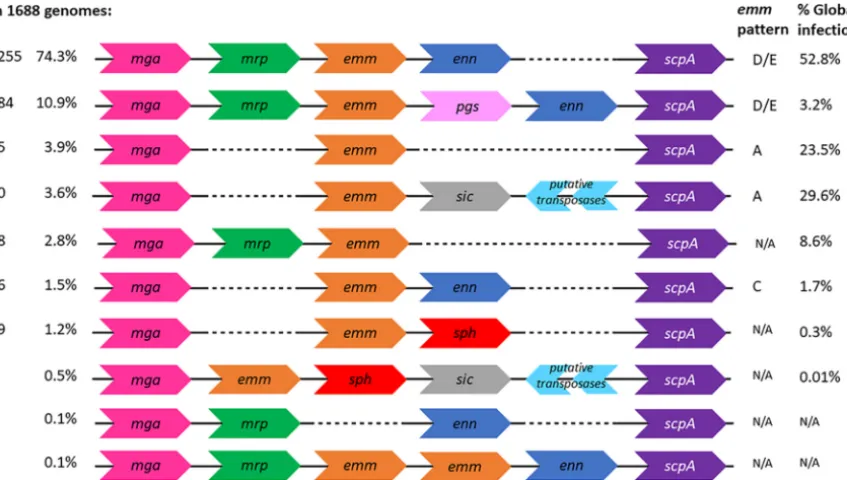
All of the genomes in the database possessed either anemmoremm-like gene, and the vast majority (85.2%) contained a gene for all three. Importantly, 74.3% of the genomes (n⫽1,255) have a core Mga regulon consisting of:mga,mrp,emm,enn, and
scpA, specifically in this stated order (Fig. 2). In the remaining 10.9% of isolates (n⫽184), the Mga regulon also included apgsgene between theemmandenngenes. The 85.2% of genomes which contained genes formrp,emmandennwould be a D or E pattern under theemm-pattern typing system. Pattern C, defined as containing an
emmandenngene, was present in only 1.5% of isolates (n⫽25). Among the genomes without a gene encoding M-like proteins, around half (3.9% of total,n⫽65) had only an emm gene between mga and scpA (emm-pattern A), while 3.6% (n⫽60) also harbored genes for SIC and for two transposases downstream of theemmgene. The genomes containingemmbut neitherennnormrpgenes belonged to only 15 different
emmtypes, mostly belonging to A to Cemmclusters (Table S5). There were no pattern B isolates within the collection, i.e., encoding two emmgenes with no other M-like genes. A total of 47 genomes contained anmrpandemmgene but noenngene. In two genomes there were two copies of the sameemmgene betweenmrpandenngenes, and six genomes did not contain anemmgene but contained anmrpandenngene.
FIG 2 Configurations of Mga regulons. In the large collection of contiguous Mga regulon sequences, we identified 10 possible configurations of the regulon based on presence and positions of genes. All Mga regulons began and ended with themgaandscpAgenes and could contain genes for Mrp, Emm, Enn, Pgs, protein H, SIC, and transposases. The most frequent Mga regulon configuration, with genes for the trio of M and M-like proteins, was present in around 74% of genomes, fromemmtypes that are responsible for around half of global infections.
on September 8, 2020 by guest
These variants have not previously been assigned to anemmpattern. Isolates with the sameemmtype tended to encode the same pattern of proteins in their Mga regulon. A gene encoding protein H (sph) was present in 1.6% of isolates (n⫽28), of which eight also contained a gene for SIC and genes for two transposases downstream. In all isolates containing a sic gene there were also genes present for two transposases (n⫽67). The Mga regulons encoding protein H, transposases, SIC andpgsbelonged to fewemmtypes (Table S5).
Although Mga proteins are highly conserved (93.9% pairwise identity), we observed two distinct variants, which differ by 21% at the amino acid level (0.254 substitutions per site, Fig. S2A). The minor variant was present in 10.6% of genomes, exclusively in strains that do not encode an Mrp protein, i.e., strains from A and C patterns and strains encoding SIC and protein H. The other variant was present in the remaining 89.4% of genomes. There was very little diversity within each protein variant (98% sequence identity, 0.01 substitutions per site). The amino acid diversity of Mga proteins was more evenly distributed along the length of the proteins than the other proteins present in the Mga regulon (Fig. S2B). This is in concordance with previous findings of 24.5% nucleotide diversity between two divergentmgaalleles (13, 28).
emm.The M protein has been genetically analyzed previously and was not a major focus of this study (6). The mature M protein sequences ranged in size from 220 to 513 amino acids in length (Fig. 3) and had an average pairwise identity of 44.7%.
mrp.An mrp gene was present in 88.9% of genomes described (n⫽1,501) and included 295 unique alleles based on individual single nucleotide polymorphisms and 225 unique mature protein sequences (Fig. 1). Mrp protein sequences ranged from 277 to 430 amino acids in length (Fig. 3) and had an average pairwise identity of 83.2% (Fig. S2B). While Mrp proteins shared functional characteristics with M proteins (22), they were more homogenous in sequence. Unlike the wide distribution ofemmgene length, genes for mrphad more restricted variability of length, since the majority of genes fit into four distinct length classes (Fig. 3).
In place of C-repeat sequences in the C-terminal region of M, Mrp proteins have A-repeat sequences (26, 29) (Fig. S3). These A-repeats were 35 amino acids in length, spanned a region of uninterrupted alpha-helix, and had no intervening sequence. In 95% of Mrp protein sequences, three distinct A-repeats could be identified and in 99% of sequences there were at least two A-repeats. The number of repeats was at least partly responsible for the observed difference in gene lengths. Numbered from the N terminus, the A1 repeats contained 95% pairwise identity, and the A2 and A3 repeats contained 99% pairwise identity. When aligned, all A repeat sequences contained 74% average pairwise identity.
FIG 3 Distribution of M and M-like protein lengths. Distribution of the lengths of all M and M-like proteins from the collection. Bars represent the number of genomes in the collection that contained a protein of the size indicated on thexaxis. M proteins show the most diversity in protein lengths and can be both the smallest or the largest of the trio of proteins. Enn proteins are typically smaller and have less variable length distribution, and Mrp proteins are largely restricted to four possible lengths.
on September 8, 2020 by guest
http://msphere.asm.org/
were 352 unique alleles. The genes encoded 276 unique mature protein sequences following removal of signal sequences and cleaved regions (Fig. 1). Mature proteins ranged in length from 199 to 346 amino acids (Fig. 3) and had an average pairwise identity of 68.6% (Fig. S2B). Enn proteins therefore presented genetic diversity that is intermediate between the high diversity of M and the low diversity of Mrp and were generally the smaller of this trio of protein families (Fig. 3).
The repeat region of Enn proteins contained C-repeats (30) which are predicted to form alpha-helices disrupted by small regions of random coil and divided by linker regions of 7, 14, or 28 amino acids (Fig. S3). The repeats were less homogenous than the A repeats of Mrp: the C1 repeat was present in 100% of sequences and had 94% sequence identity, the C2 repeat was present in 94% of sequences and had 94% sequence identity, and the C3 repeat was present in 37% of sequences and had 93% sequence identity. The number of repeats present and the combination of linker regions had a large effect on the protein lengths.
Following the variable region at the N terminus, Enn proteins had either an EQ-rich central core (n⫽154/278; 55% of sequences) with significant similarity to the analo-gous region in M proteins or, in 39% of sequences (n⫽109/278), an 18-amino-acid consensus sequence (EKEKEDLKTTLAKTTKEN). There was greater sequence similarity between the N-terminal 50 first amino acids from Enn proteins with the 18-amino-acid core than EQ-rich cores, with 58 and 34% pairwise identities, respectively.
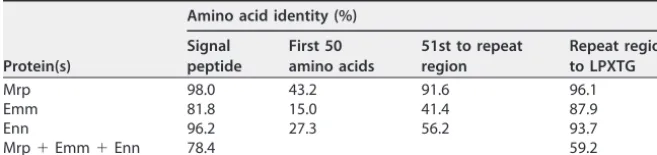
Sequence similarities across different regions of proteins. All M and M-like protein sequences were preceded by a signal peptide, typically 41 amino acids in length. The sequences were highly homogenous within each protein family and only slightly less so between the different families (Table 2). The most C-terminal part of the proteins contained the LPXTG sortase motif, which allows attachment of the protein to the bacterial cell wall. This was also the region of the most sequence homogeneity in the mature M and M-like proteins, and all proteins became increasingly heterogeneous more distally (Fig. S2B).
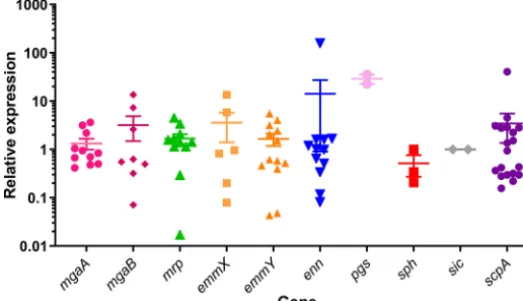
Expression analysis.To better characterize expression of the Mga regulon com-ponents, gene expression was analyzed during exponential growth of 19 representative isolates grown in rich broth, conditions known to maximizeemmgene expression (20) (Table S1). The expression of all genes was observed at levels comparable toemm, with similar variability (Fig. 4).
In silico emm-typing ambiguities.Using the current CDC emm-typing database, there were 2,192emm-typing sequences present in the analyzed Mga regulons. After analyses of positional information and the presence of gene-defining oligonucleotide probes (Table 1), as well as BLAST searches, it was determined that 529 of the
emm-typing sequences were present in genes other thanemm. The presence of two
emm-typing sequences in two genes in the same locus (theemmgene and a non-emm
gene) has high potential for mistyping. emm sequencing regions for emm types
emm134.1 andemm226.0 were present in 20sphgenes encoding three distinct protein H alleles. Sequencing regions for theemmtypesemm141.0 andemm156.0 were also present in 44mrpgenes encoding nine distinct Mrp proteins. The remaining 465emm
on September 8, 2020 by guest
sequence typing regions in non-emmgenes were in enngenes (Table S6). Utilizing whole-genome-sequencing (WGS) data to derive emm types of GAS is becoming increasingly common practice; however, there is the possibility for the detection of an
emm-like gene in place of theemmgene (9). A well-curated database ofemm-typing sequences is essential to reduce potential mistyping using WGS and bioinformatic pipelines. This study utilized a globally informed whole-genome-based platform to thoroughly refine theemmsequence database to differentiate PCR-derivedemmtypes into those relating to mrp, enn, and sph genes. Of note, 18 different emm-typing sequences were not found inemmgenes but only inmrp,enn, orsphgenes. Athey et al. previously identified 12 of these emm types (9), and in this work we identified
emm141 inmrp63,emm134.1, andemm226 in threesphgenes andemm203,emm134, andemm166 in eight, seven, and fourenngenes, respectively. Such sequences have been removed from theemmsequence typing database and correctly renamed in the appropriate M-like database on the website of the GAS reference laboratory at the CDC (https://www2a.cdc.gov/ncidod/biotech/strepblast.asp).
Chimeric proteins.Chimericemmgenes containing the N-terminal portion of the
emm gene and C-terminal portion of the enn gene were present in 17 genomes belonging to six differentemmtypes (emmtypes 4 [n⫽12], 9, 44, 58, 73, and 82). These genes contained the 5= emmprobe and theennprobe at their 3=ends (Fig. S4). This phenomenon was recently described in M4 isolates (31). Of note, all belonged to a specific Mga configuration withmrpandemmgenes and were exceptions in theiremm
type.
DISCUSSION
This study provides for the first time a comprehensive, genome-based, genetic description of the GAS Mga regulon and, in particular, the M-like proteins Mrp and Enn. We also provide a molecular definition using conserved oligonucleotide probes for
emmandemm-like genes that allows for proper identification and will improve strain typing.
With the increasing adoption by public health laboratories of WGS for GAS typing in place of PCR sequence typing of theemmgene, it is critical to differentiate between
emmandemm-like genes. Although the current system utilizing the 5=emmprobe is efficient for detection ofemmgenes (7), this could be further improved by incorpo-rating the 3=emmprobe and the other gene family specific probes described in this study into a pipeline foremm gene typing. Updating the emm-typing collection to FIG 4 Expression analysis of Mga regulon genes. cDNA from 19 isolates grown to mid-log phase in rich medium were analyzed for the expression of Mga regulon genes. The isolates were selected to be representative of all possible Mga regulon configurations and emmcluster diversity where possible. Primers were designed to amplify all members of the gene family where possible (mrp,enn,pgs,sph, and
scpA) and to amplify a subset where sequence diversity necessitates. The dot plot symbols represent the mean value of the four qPCR analyses for each isolate, and the error bars represent the standard errors for all isolates for each gene.
on September 8, 2020 by guest
http://msphere.asm.org/
conceivable that the M-like proteins perform roles otherwise performed by M proteins. The emmtype is predictive of the composition of the Mga in many instances. This suggests the regulon has evolved as a whole in order to fill a functional niche. No D4 cluster M protein has been shown to bind fibrinogen (35); however, all Mrp proteins have one or two fibrinogen-binding motifs (36), and all D4emm-types contain anmrp
gene. In high-income settings where specific emm types, such as M1 and M12, are responsible for the majority of infections, the proportion of M-like protein-producing strains would be lower (8, 37).
In contrast to previous studies which found very low expression of mrpandenn
genes compared to emm genes (20), we observed, under the growth conditions described here, high expression of allemmandemm-like genes in at least one isolate. Importantly, all genes present in core Mga regulons were capable of being transcribed. The emergence of a range of emm types deriving from possible gene fusion betweenemmandenngenes suggests this may be a significant mechanism for the bacteria to alter function or evade immune recognition. This phenomenon, recently identified in M4 isolates (31), appears to have occurred in diverse emmtypes in the United States, a high-income-nation setting where there is low diversity of circulating
emmtypes (38, 39).
The prevalence of emm-like genes, in addition to their genetic similarities and comparable expression with emmgenes, indicates the importance of their encoded proteins to GAS virulence. The results presented here will thus aid further genetic and biological characterization of the Mga regulon in order to better understand its role in virulence and vaccine development.
MATERIALS AND METHODS
Genome collection and global epidemiological data. We analyzed Mga regulon genes in a 2,083-GAS genome database representative of worldwide geographic and clinical diversity (25). A previously published global database of GAS infection (38) was used to assess the frequencies of each Mga configuration among global infections.
Bioinformatics.The Mga regulon was derived from 2,083 GAS genome assemblies (25) based on the coordinates of themgaandscpAgenes. Mga regulons that were not contained within a single contig (395/2,083) were excluded from the analysis. Annotation was performed using Geneious 10.1.2 based on gene orientation and BLAST searches to initially defineemm,enn, andmrpgene families. To facilitate gene identification and solve nomenclature ambiguities, nucleotide probes to identifyemm,enn, and
mrpwere developed based on regions of high sequence identity, with high sensitivity and specificity for each gene family. We also used the previously describedemm-typing sequence as anemmprobe (7). The specificity of probes was determined by Geneious 10.1.12 motif search within whole GAS genomes. Alleles with sequence ambiguities and frameshift mutations resulting in truncations were excluded from unique gene and protein sequence analyses (Fig. 1). Unique genes were differentiated by single nucleotide variations, and genes that produced proteins with the same amino acid sequences were annotated as subtypes (e.g., mga13.0 and mga13.1). Theemm-typing database available from the CDC website (www.cdc.gov/streplab) was used to annotate emm genes and to search for emm-typing sequences withinemm-like genes.
Mature protein sequences of M and M-like proteins were derived by removing the 41 to 42 amino acid signal peptide based on the EMBOSS 6.5.7 tool sigcleave at the amino terminus and the cleaved region following the threonine of the sortase LPXTG signal at the carboxy terminus. Repeat regions were identified by comparison to published sequences for M and M-like proteins (3, 30). Domains were defined
on September 8, 2020 by guest
as the N-terminal 50 amino acids, the 51st amino acid to the beginning of A- or C-repeat sequences and the repeat sequences to the mature protein’s last residue (22).
Multiple alignments were performed with the MAFFT program using the global pairwise iterative refinement (G-INS-i) method which uses the Needleman-Wunsch algorithm and BLOSUM62 scoring matrix (40). The percent identities at each position along amino acid sequences were graphed using Geneious 10.1.2, and genetic distances between groups ofmgaalleles were calculated using MEGA version X (41). RDP v4.97 (42) was used to detect recombination events and map gene breakpoints.
Expression analysis.A representative collection of 19 GAS strains were selected for expression analyses, to include a diverse array of Mga regulon configurations andemmclusters (Table S1). Reverse transcriptase quantitative PCR was performed on the 19 representative GAS strains. Bacteria were grown at 37°C with 5% CO2in Todd-Hewitt broth (Carl Roth, Karlsruhe, Germany) with 0.5% yeast extract (Carl Roth) until exponential phase (optical density at 600 nm, 0.4 to 0.6), and 1 ml of culture was harvested at 5,000⫻gfor RNA extraction. Bacteria were washed once with distilled water, and pellets were lysed with enzymatic lysis buffer consisting of 9.5 mg/ml lysozyme, 20 mM Tris-HCl, 3 mM EDTA, and 1% Triton X-100. Further lysis and separation of aqueous phase was achieved using PureZOL RNA isolation reagent (Bio-Rad; 732-6880), and RNA extraction was performed according to manufacturer’s instructions (Aurum Bio-Rad; 732-6870). After extraction, genomic DNA contamination was removed using Turbo DNase treatment (Invitrogen; AM1907), and the RNA yield and purity was estimated using a QuickDrop spectrophotometer (Molecular Devices). Reverse transcriptase (NEB; E6560) was performed using ap-proximately 300 ng of RNA and a 6M concentration of the random primer mix provided for 1 h at 42°C after an initial incubation for 5 min at 25°C. Target genes from 5l of cDNA were amplified in 20-l reactions with Luna Universal SYBR qPCR master mix (NEB; M3003) in a Bio-Rad CX96 real-time PCR detection system with conditions as follows: 95°C for 60 s, followed by 40 cycles of 95°C for 15 s and 60°C for 30 s. Dissociation curves were calculated for each reaction to confirm product specificity. No-reverse-transcriptase and no-template controls were performed for each extraction and each pair of primers. Results were analyzed with qBase⫹(Biogazelle) software, and the relative expression compared torecA
was calculated for each sample. Specific primers were used (see Table S2), and amplification efficiencies were calculated. cDNA was produced twice from each strain, each sample was analyzed twice by qPCR, and the four relative expression values were averaged.
SUPPLEMENTAL MATERIAL
Supplemental material is available online only. FIG S1, PDF file, 0.3 MB.
FIG S2, PDF file, 1.3 MB. FIG S3, PDF file, 0.3 MB. FIG S4, PDF file, 0.05 MB. TABLE S1, DOCX file, 0.01 MB. TABLE S2, DOCX file, 0.01 MB. TABLE S3, XLSX file, 0.1 MB. TABLE S4, XLSX file, 0.3 MB. TABLE S5, XLSX file, 0.01 MB. TABLE S6, DOCX file, 0.01 MB.
ACKNOWLEDGMENTS
H.R.F. is supported by a Ph.D. fellowship granted by the Royal Academy of Medicine from Belgium and sponsored by GSK Vaccines. The work is supported by the Belgian Fonds National de la Recherche Scientifique research grants (PDR T.0255.16 and CDR J.0019.17). The funders had no role in study design and analysis.
REFERENCES
1. Walker MJ, Barnett TC, McArthur JD, Cole JN, Gillen CM, Henningham A, Sriprakash KS, Sanderson-Smith ML, Nizet V. 2014. Disease manifesta-tions and pathogenic mechanisms of group a streptococcus. Clin Micro-biol Rev 27:264 –301.https://doi.org/10.1128/CMR.00101-13.
2. Watkins DA, Johnson CO, Colquhoun SM, Karthikeyan G, Beaton A, Bukhman G, Forouzanfar MH, Longenecker CT, Mayosi BM, Mensah GA, Nascimento BR, Ribeiro ALP, Sable CA, Steer AC, Naghavi M, Mokdad AH, Murray CJL, Vos T, Carapetis JR, Roth GA. 2017. Global, regional, and national burden of rheumatic heart disease, 1990 –2015. N Engl J Med 377:713–722.https://doi.org/10.1056/NEJMoa1603693.
3. Smeesters PR, McMillan DJ, Sriprakash KS. 2010. The streptococcal M protein: a highly versatile molecule. Trends Microbiol 18:275–282. https://doi.org/10.1016/j.tim.2010.02.007.
4. Beall B, Facklam R, Thompson T. 1996. Sequencingemm-specific PCR
products for routine and accurate typing of group A streptococci. J Clin Microbiol 34:953–958.
5. Li Z, Active Bacterial Core Surveillance/Emerging Infections Program Network, Sakota V, Jackson D, Franklin AR, Beall B. 2003. Array of M protein gene subtypes in 1064 recent invasive group A streptococcus isolates recovered from the active bacterial core surveillance. J Infect Dis 188:1587–1592.https://doi.org/10.1086/379050.
6. McMillan DJ, Dreze PA, Vu T, Bessen DE, Guglielmini J, Steer AC, Cara-petis JR, Van Melderen L, Sriprakash KS, Smeesters PR. 2013. Updated model of group A streptococcus M proteins based on a comprehensive worldwide study. Clin Microbiol Infect 19:E222–E229.https://doi.org/10 .1111/1469-0691.12134.
7. Whatmore AM, Kapur V, Sullivan DJ, Musser JM, Kehoe MA. 1994. Non-congruent relationships between variation in emm gene sequences and the
on September 8, 2020 by guest
http://msphere.asm.org/
https://doi.org/10.1093/infdis/jiu260.
11. Shulman ST, Tanz RR, Dale JB, Steer AC, Smeesters PR. 2014. Added value of theemmcluster typing system to analyze group A streptococcus epidemiology in high-income settings. Clin Infect Dis 59:1651–1652. https://doi.org/10.1093/cid/ciu649.
12. Smeesters PR, Laho D, Beall B, Steer AC, Van Beneden CA. 2017. Sea-sonal, geographic, and temporal trends ofemmclusters associated with invasive group A streptococcal infections in US multistate surveillance. Clin Infect Dis 64:694 – 695.https://doi.org/10.1093/cid/ciw807. 13. Hollingshead SK, Readdy TL, Yung DL, Bessen DE. 1993. Structural
hetero-geneity of the emm gene cluster in group A streptococci. Mol Microbiol 8:707–717.https://doi.org/10.1111/j.1365-2958.1993.tb01614.x.
14. Akesson P, Cooney J, Kishimoto F, Bjorck L. 1990. Protein H: a novel IgG binding bacterial protein. Mol Immunol 27:523–531.https://doi.org/10 .1016/0161-5890(90)90071-7.
15. Akesson P, Sjoholm AG, Bjorck L. 1996. Protein SIC, a novel extracellular protein ofStreptococcus pyogenesinterfering with complement function. J Biol Chem 271:1081–1088.https://doi.org/10.1074/jbc.271.2.1081. 16. Hartas J, Sriprakash KS. 1999.Streptococcus pyogenesstrains containing
emm12 and emm55 possess a novel gene coding for distantly related SIC protein. Microb Pathog 26:25–33.https://doi.org/10.1006/mpat.1998 .0244.
17. Bessen DE, Smeesters PR, Beall BW. 2018. Molecular epidemiology, ecology, and evolution of group A streptococci. Microbiol Spectr 6. https://doi.org/10.1128/microbiolspec.CPP3-0009-2018.
18. Hondorp ER, McIver KS. 2007. The Mga virulence regulon: infection where the grass is greener. Mol Microbiol 66:1056 –1065.https://doi.org/ 10.1111/j.1365-2958.2007.06006.x.
19. McIver KS, Scott JR. 1997. Role of mga in growth phase regulation of virulence genes of the group A streptococcus. J Bacteriol 179: 5178 –5187.https://doi.org/10.1128/jb.179.16.5178-5187.1997. 20. Bessen DE, Fischetti VA. 1992. Nucleotide sequences of two adjacent M
or M-like protein genes of group A streptococci: different RNA transcript levels and identification of a unique immunoglobulin A-binding protein. Infect Immun 60:124 –135.
21. Podbielski A, Flosdorff A, Weber-Heynemann J. 1995. Molecular charac-terization of the M type 49 group A streptococcal (GAS)virRgene. Dev Biol Stand 85:153–157.
22. Frost HR, Sanderson-Smith M, Walker M, Botteaux A, Smeesters PR. 2018. Group A streptococcal M-like proteins: from pathogenesis to vaccine potential. FEMS Microbiol Rev 42:193–204.https://doi.org/10.1093/femsre/ fux057.
23. Dale JB, Niedermeyer SE, Agbaosi T, Hysmith ND, Penfound TA, Hohn CM, Pullen M, Bright MI, Murrell DS, Shenep LE, Courtney HS. 2015. Protective immunogenicity of group A streptococcal M-related pro-teins. Clin Vaccine Immunol 22:344 –350.https://doi.org/10.1128/CVI .00795-14.
24. Courtney HS, Niedermeyer SE, Penfound TA, Hohn CM, Greeley A, Dale JB. 2017. Trivalent M-related protein as a component of next generation group A streptococcal vaccines. Clin Exp Vaccine Res 6:45– 49.https:// doi.org/10.7774/cevr.2017.6.1.45.
25. Davies MR, McIntyre L, Mutreja A, Lacey JA, Lees JA, Towers RJ, Duchene S, Smeesters PR, Frost HR, Price DJ, Holden MTG, David S, Giffard PM, Worthing KA, Seale AC, Berkley JA, Harris SR, Rivera-Hernandez T, Berk-ing O, Cork AJ, Torres R, Lithgow T, Strugnell RA, Bergmann R,
Nitsche--6408.1989.
29. O’Toole PW, O’Toole P, Stenberg L, Rissler M, Lindahl G. 1992. Two major classes in the M protein family in group A streptococci. Proc Natl Acad Sci U S A 89:8661– 8665.https://doi.org/10.1073/pnas.89.18.8661. 30. Podbielski A, Weber-Heynemann J, Cleary PP. 1994.
Immunoglobulin-binding FcrA and Enn proteins and M proteins of group A streptococci evolved independently from a common ancestral protein. Med Micro-biol Immunol 183:33– 42.https://doi.org/10.1007/bf00193629. 31. DebRoy S, Li X, Kalia A, Galloway-Pena J, Shah BJ, Fowler VG, Flores AR,
Shelburne SA. 2018. Identification of a chimericemmgene and novel
emmpattern in currently circulating strains ofemm4group A strepto-coccus. Microb Genom 4.https://doi.org/10.1099/mgen.0.000235. 32. Williamson DA, Smeesters PR, Steer AC, Morgan J, Davies M, Carter P,
Upton A, Tong SY, Fraser J, Moreland NJ. 2016. Comparative M-protein analysis ofStreptococcus pyogenesfrom pharyngitis and skin infections in New Zealand: implications for vaccine development. BMC Infect Dis 16:561.https://doi.org/10.1186/s12879-016-1891-6.
33. Parks T, Smeesters PR, Steer AC. 2012. Streptococcal skin infection and rheumatic heart disease. Curr Opin Infect Dis 25:145–153.https://doi .org/10.1097/QCO.0b013e3283511d27.
34. Frost HR, Laho D, Sanderson-Smith ML, Licciardi P, Donath S, Curtis N, Kado J, Dale JB, Steer AC, Smeesters PR. 2017. Immune cross-opsonization withinemmclusters following group A streptococcus skin infection: broadening the scope of type-specific immunity. Clin Infect Dis 65:1523–1531.https://doi.org/10.1093/cid/cix599.
35. Sanderson-Smith ML, Dinkla K, Cole JN, Cork AJ, Maamary PG, McArthur JD, Chhatwal GS, Walker MJ. 2008. M protein-mediated plasminogen binding is essential for the virulence of an invasive Streptococcus pyogenesisolate. FASEB J 22:2715–2722.https://doi.org/10.1096/fj.07 -105643.
36. Li Y, Courtney HS. 2011. Promotion of phagocytosis ofStreptococcus pyogenesin human blood by a fibrinogen-binding peptide. Microbes Infect 13:413– 418.https://doi.org/10.1016/j.micinf.2010.12.008. 37. Nelson GE, Pondo T, Toews KA, Farley MM, Lindegren ML, Lynfield R,
Aragon D, Zansky SM, Watt JP, Cieslak PR, Angeles K, Harrison LH, Petit S, Beall B, Van Beneden CA. 2016. Epidemiology of invasive group A streptococcal infections in the United States, 2005–2012. Clin Infect Dis 63:478 – 486.https://doi.org/10.1093/cid/ciw248.
38. Steer AC, Law I, Matatolu L, Beall BW, Carapetis JR. 2009. Globalemm
type distribution of group A streptococci: systematic review and impli-cations for vaccine development. Lancet Infect Dis 9:611– 616.https:// doi.org/10.1016/S1473-3099(09)70178-1.
39. Smeesters PR, McMillan DJ, Sriprakash KS, Georgousakis MM. 2009. Differences among group A streptococcus epidemiological landscapes: consequences for M protein-based vaccines? Expert Rev Vaccines 8:1705–1720.https://doi.org/10.1586/erv.09.133.
40. Katoh K, Kuma K, Toh H, Miyata T. 2005. MAFFT version 5: improvement in accuracy of multiple sequence alignment. Nucleic Acids Res 33: 511–518.https://doi.org/10.1093/nar/gki198.
41. Kumar S, Stecher G, Li M, Knyaz C, Tamura K. 2018. MEGA X: molecular evolutionary genetics analysis across computing platforms. Mol Biol Evol 35:1547–1549.https://doi.org/10.1093/molbev/msy096.
42. Martin DP, Murrell B, Golden M, Khoosal A, Muhire B. 2015. RDP4: detection and analysis of recombination patterns in virus genomes. Virus Evol 1:vev003.https://doi.org/10.1093/ve/vev003.