Proc. IAHS, 379, 199–203, 2018
https://doi.org/10.5194/piahs-379-199-2018 © Author(s) 2018. This work is distributed under the Creative Commons Attribution 4.0 License.
Open Access
v
ativ
e
w
ater
resources
management
–
understanding
and
balancing
inter
actions
betw
een
humankind
and
n
ature
Mid and long-term optimize scheduling of cascade
hydro-power stations based on modified GA-POA method
Jiqing Li and Xiong Yang
School of Renewable Energy, North China Electric Power University, Beijing 102206, China
Correspondence:Jiqing Li ([email protected])
Received: 30 December 2017 – Revised: 2 April 2018 – Accepted: 3 April 2018 – Published: 5 June 2018
Abstract. In this paper, to explore the efficiency and rationality of the cascade combined generation, a cascade combined optimal model with the maximum generating capacity is established, and solving the model by the modified GA-POA method. It provides a useful reference for the joint development of cascade hydro-power stations in large river basins. The typical annual runoff data are selected to calculate the difference between the calculated results under different representative years. The results show that the cascade operation of cascaded hydro-power stations can significantly increase the overall power generation of cascade and ease the flood risk caused by concentration of flood season.
1 Introduction
As more and more large and medium hydro-power stations are put into use in our country, the joint dispatching of cas-caded hydro-power plants has been getting more and more widespread attention. In order to encourage all hydro-power stations in cascade hydro-power stations to actively partici-pate in the joint dispatch in order to maximize the benefits, the hydro-power industry advocates the implementation of “Cascade, rolling, integrated” mode of operation (Xu, 2015; He, 2014; Zhou, 2016). In the joint operation of cascade hydro-power stations, the leading hydro-power station in the upper reaches has good regulating performance, which can greatly increase the power generation capacity of each down-stream hydro-power station and has objective power gener-ation compensgener-ation benefits (Li, 2016; Wang, 2014). So, re-flecting the compensating function of power plants with good performance in cascade joint scheduling and solving the joint operation process by highly efficient and feasible algorithms mean very much.
2 Modified GA-POA method
According to the idea of successive optimization, the T-stage optimization problem can be divided into several two-stage optimization sub-problems, while the sub-problem decision-making, using real-coded genetic algorithm to solve.
Tra-ditional genetic algorithms generate initial populations in a random way. However, randomized methods often fail to meet the requirements of “global distribution” of initial pop-ulations, which leads to their low representation and ineffi-ciency. Based on this, the idea of uniform design is intro-duced into the generation of initial population of genetic al-gorithm to improve the initial population quality by increas-ing the uniform distribution of the initial population.
2.1 Coding method and initial population generation
Taking the water level of the library as a gene and
cod-ing with an integer, the population size is set as Size, i=
1∼Size. The initial population is generated as follows:
Pi,t =Zt,min+0.1n (1)
n=10× Zt,max−Zt,min=1,2, . . . ,size, (2)
wherePi,t is the integer coding of theiindividual in the
par-ent population at timet,t=1,2, . . ., T+1;T is the number of scheduling period;Zt,min, Zt,maxis upper and lower water
level.
2.2 Fitness function setting
generation is mainly considered. When the system initial so-lution does not meet the minimum system output require-ments, the penalty function is used to adjust. The objective function value:
φ(Z)=
T
X
t=1
Nt·1t+α·min
N
t−Nmin
Nmin
,0
, (3)
whereT is Each time period;Ntis the output of the cascade
at timet;Nminis system minimum output.
2.3 Cross operation
Using the single point crossover method, it is assumed that i1andi2cross at the time point:
Pk,t0 =
pi1,t t <time
pi2,t t≥time
Pk0+1,t=
pi2,t t <time
pi1,t t≥time,
(4)
where time∈ [1,2, . . . , T+1], after crossing, a populationP0 of the same size as Size is formed.
2.4 Variation operation
Using random mutation, the gene Py is controlled by the
probabilityPy, a new gene is generated at the mutation point:
Pi,t00 =
Zt,min+(Zt,max−Zt,min)·Py0Py0 < Py
Pi,tPy0≥Py,
(5)
wherePy,Py0are all random numbers distributed between [0,
1], mutation to populationP00with the same population size of size.
2.5 Choose operation
The league method (Howson, 1975) was used to score a
to-tal of 3Size individuals in the parento-tal group P, crossover
groupP, and mutation groupP. The scoring rules of
indi-vidual i were as follows: size random indiindi-viduals were ran-domly selected without duplication, and the adaptability ofi exceeded that of the competition individuals counts Score as iscore:
Scorei=Count{φi > φj|i, j∈size}. (6)
3Size individuals ranked according to the score, the highest score of Size individuals as a parent group into the next gen-eration of evolution.
2.6 Evolution termination conditions
The evolution termination condition is to reach the maximum evolutionary algebra set in advance.
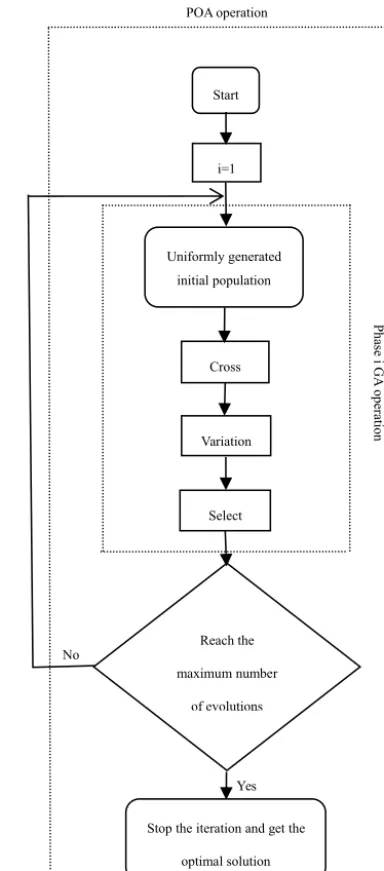
The multi-stage optimization problem in the progressive optimality algorithm is split into multiple two-stage sub-problems, and then the modified genetic algorithm is applied to the decision of the sub-problems. The modified GA-POA method solving flowchart is shown as Fig. 1.
Uniformly generated initial population Cross Variation Select i=1 Reach the maximum number of evolutions
Stop the iteration and get the
optimal solution Ph ase iG A op era tio n POA operation Yes No Start
Figure 1.The modified GA-POA method solving flowchart.
3 Mid and Long-Term Optimize Scheduling of Cascade Hydro-power Stations
3.1 The objective function
Model to maximize the power generation as the optimization goal, the mathematical description of:
maxF =
n
X
i=1
T
X
j=1
Nij1t, (7)
whereF is the goal of optimal scheduling is the total power
generation of all stations in the cascade throughout the
scheduling period;Nijis theireservoir’s output ofj period;
1t is Time interval.
3.2 Restrictions
3.2.1 Water balance constraints
Vt+1−Vt=(Qt−qt)·1t, (8)
whereVt, Vt+1is the beginning and the end of the reservoir’s
storage capacity oftperiod;
Qt,qt is the average inflow and the average outflow.
3.2.2 Water level constraints
Zmin< Zt< Zmax, (9)
whereZmax,Zminis the reservoir’s upper and lower water
level oftperiod.
3.2.3 Output constraint
Nmin< Nt< Nmax, (10)
whereNmax,Nminis the reservoir’s upper and lower output.
3.2.4 Discharge flow constraints
qmin< qt< qmax, (11)
whereqmax,qminis the reservoir’s upper and lower outflow.
3.2.5 Hydraulic equation
Ii,l=qi−1,l+Qqj,l−Qks,l, (12)
whereIi,l is the reservoiri0s inflow of thelperiod;qi−1,l is
the reservoiri−1’s outflow of thelperiod;Qqj,l,Qks,lis the
interval flow and the loss flow of thelperiod.
3.2.6 Non-negative conditional constraints
All of the above variables satisfy the non-negative condition.
3.3 Output and power generation
N =KQ·(H−1H) (13)
1H=θ·Q2 (14)
E=N·t, (15)
whereKis output coefficient;Qis used flow;His net head; 1His head loss;θis coefficient of head loss;tis time;N, E is the output and power generation of hydro-power station.
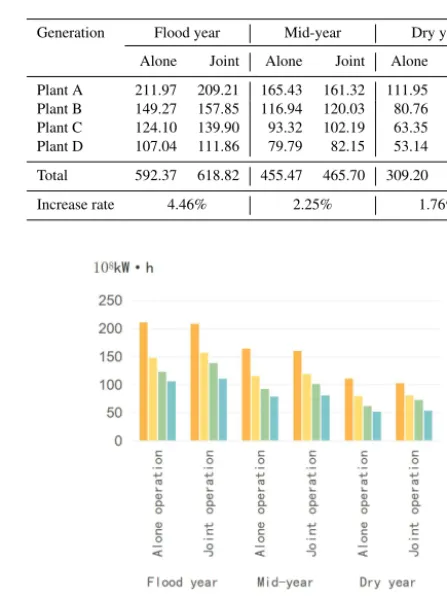
Table 1.Cascade power generation 108kW h.
Generation Flood year Mid-year Dry year
Alone Joint Alone Joint Alone Joint
Plant A 211.97 209.21 165.43 161.32 111.95 103.75 Plant B 149.27 157.85 116.94 120.03 80.76 82.29 Plant C 124.10 139.90 93.32 102.19 63.35 73.62 Plant D 107.04 111.86 79.79 82.15 53.14 54.99
Total 592.37 618.82 455.47 465.70 309.20 314.65
Increase rate 4.46% 2.25% 1.76%
Figure 2.Cascade power generation.
4 Case study
In this study, an example is given to four hydro-power sta-tions in a river basin cascade in China, which are represented by A, B, C and D. Among them, A is the leading power plant with huge storage capacity and significant power generation benefit which has not been completed and put into produc-tion. The adjustment capacity of B, C and D is small, and the runoff data used in this study is the monthly typical runoff which are regarded as run-of-run power plants. In this study,
population size=200, maximum iteration generation=300,
crossover time=3 and mutation probability=0.03. Solving
the model by the established modified GA-POA method with
C++programming language, the cascade power generation
under different representative years are shown as Table 1 and Fig. 2.
Figure 3.The output of plant A.
Figure 4.The output of plant B.
The joint operation can significantly improve the overall power generation of the cascade. When the water inflow is small, the joint operation has a greater significant. The up-stream power station compensates the power plants of the downstream power stations and improves the output of the dry season and the seasonal power generation. It can also ease the flood risk caused by concentration of flood season. This will help mobilize the enthusiasm of the leading hydro-power station and downstream hydro-hydro-power stations to par-ticipate in the joint cascade scheduling and achieve the goal of joint operation, which bring the maximum benefit in the basin.
The monthly output process of each station in flood year when it is operated independently and jointly is shown as Figs. 3 to 6. When each station of cascades operates inde-pendently, the output of the power plant fluctuates greatly. The specific performance is that when in the flood season, the output is large; when in the dry season, the output is small.
When the water supply is reduced rapidly in some months, there are efforts to make a sharp turn; when the cascade power plants are jointly operated, the power plant output pro-cess is relatively gradual. Due to the regulation and storage of the leading power station, the output of the power plant during the flood season is smaller than that of the power station alone. In the dry season, the power plant output is greater than when the power station is operated alone. Out-put, the overall change is smaller than that of each power sta-tion when it is running alone, and the leading power stasta-tion has a significant effect on the adjustment of the steps.
Figure 5.The output of plant C.
Figure 6.The output of plant D.
5 Conclusion
In this paper, the long-term optimal scheduling model is es-tablished, and the modified GA-POA method is proposed to
solve the model by C++ programming. This model is
ap-plied to cascade reservoirs in a river basin in China, which achieved good results. The study provides a beneficial refer-ence for the joint development of large-scale cascaded hydro-power stations.
Data availability. The data used in this paper are provided by the reservoir management departments, which can not be provided ex-ternally because the data are confidential.
Competing interests. The authors declare that they have no con-flict of interest.
Special issue statement. This article is part of the special issue “Innovative water resources management – understanding and bal-ancing interactions between humankind and nature”. It is a result of the 8th International Water Resources Management Conference of ICWRS, Beijing, China, 13–15 June 2018.
China (No.51641901). The author would like to give special thanks to anonymous reviewers.
Edited by: Yangbo Chen
Reviewed by: two anonymous referees
References
He, X., Wu, Y., and Jiang, G.: Profit allocation model of supply network based on revised Shapely value, Soft Science, 28, 70– 73, 2014.
Howson, H. R. and Sancho, N. G. F.: A new algorithm for the solu-tion of multi-state dynamic programming problems, Math. Pro-gram., 8, 104–106, 1975.
Li, Y., Zhou, J., Zhang, S., Huang, C., and Yan, D.: Combined dis-patching chart of cascade hydropower stations on Yalong river, Jinsha river and Yangtze river, Journal of Hydroelectric Engi-neering, 35, 32–40, 2016.
Wang, Y., Guo, S., Zhou, Y., Hong, X., Hu, T., and Liu, D.: Uncer-tain analysis of long-term generation optimal operation for reser-voirs, Water Resources and Power, 32, 61–65, 2014.
Xu, W.: Research on some issues in the joint optimal operation of cascaded reservoirs between Long yang xia and Liu jia xia, Ts-inghua University, 2015.