A REVIEW PAPER ON STUDY AND DEVELOPMENT OF
COMPRESSED AIR ENGINE AND THERE POWER SOURCE
Gaurav Kumar tandan1 , Gopal Sahu2, Prakash Kumar Sen3, Ritesh Sharma4, Shailendra Bohidar5 1
Student, Mechanical Engineering, Kirodimal Institute of Technology, Raigarh (C.G.)
2,3,4,5
Lecturer, Mechanical Engineering, Kirodimal Institute of Technology, Raigarh (C.G.)
ABSTRACT
Compressed air as a source of energy in different uses in general and as a non-pollutingfuel in compressed air vehicles has attracted scientists and engineers for centuries.Compressed air filled by electricity using a compressor.The electricity requirement for compressing air has to be considered while computing overall efficiency.The air engine is currently the most generally used device to convert potential energy of compressed air into mechanical energy.Nevertheless the compressed air vehicle will contribute to reducing air pollution and tend to zero pollution level and promoting great environment.No combustion process is occurring there. Light utility vehicles are becoming very popular means of independent transportation for short distances. Costand pollution with petrol and diesel are leading vehicle manufacturers to develop vehicles fuelled by alternative energies.Engineers are directing their efforts to make use of air as an energy source to run the light utility vehicles.
Keywords- compressed air, vehicles, and engine.
1 INTRODUCTION
Compared to batteries, compressed air is favourable because of a high energy
density, low toxicity, fast filling at low cost and long service life. These issues make it technically challenging todesign air engines for all kind of compressed air driven vehicles. To meet the growing demand of public transportation, sustainable with environmental consciousness, people are in the search for the ultimateclean car with zero-emissions. It is hard to believe that compressed air can be used to drive vehicles. However that is true and “air car” as it popularly knows has caught the attention of research worldwide.MDI (Moteur Development International) is one company thatholds the international patents for compressed air car.This review study reveals aim is to run the fourstrokes bike with help of compressed air, it will try toachieve a 50 km/h speed and range of refillingcompressed air is after running of 70-80 km.
Two technologies have been developed to meetdifferent need (1) Single energy compressed air engines.
(2) Dual energy compressed air plus fuel
The single energy engines will be available in both Minicabs and City cats. These engines have beenconceived for city use, where the maximum speed is50 km/h and where MDI believes polluting will soonbe prohibited with use of compressed air technology which
much for the city as the open road andwill be available in all MDI vehicles. The engineswill work exclusively with compressed air while it isrunning under 50 km/h in urban areas. But when thecar is used outside urban areas at speeds over 50km/h, the engines will switch to fuel mode. Theengine will be able to use gasoline, gas oil, biodiesel,gas, liquidized gas, ecological fuel, alcohol,etc. Both engines will be available with 2, 4 and 6cylinders, When the air tanks are empty the driverwill be able to switch to fuel mode, by car’s on boardcomputer.
2 WORKING
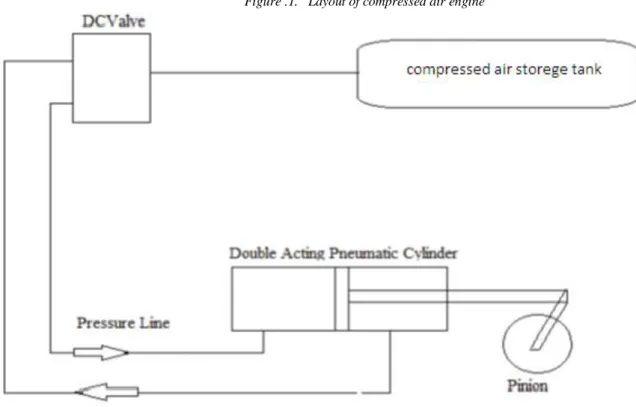
Figure .1. Layout of compressed air engine
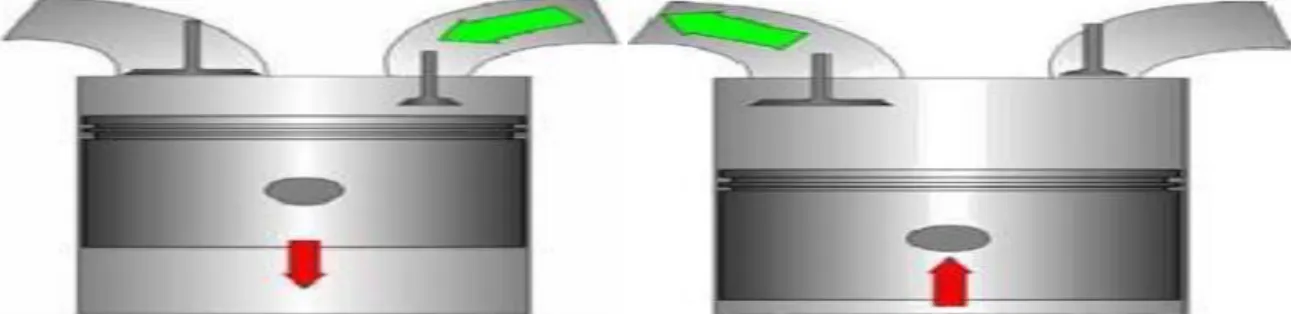
A compressed air engine is a type of engine which does mechanical work by expanding compressed air. Pneumatic engine generally convert compressed air energy to mechanical work either into linear motion or rotatory motion. Once compressed air is transferred into theonboard storage tank, it is slowly released to power thecar’s pistons. The motor then converts the air powerinto mechanical power. That power is then transferredto the wheels and becomes the source of power for thecar. The engine that is installed in a compressed air caruses compressed air which is stored in the car’s tank ata pressure as high as 4500 psi. The technology used byair car engines is totally different from the technologythat is used in conventional fuel cars. Approximately 90m3 of compressed airis stored in fibre tanks in the vehicle.The engine is powered by compressedair, stored in a carbon-fibre tank at 30MPa (4500 psi). The tank is made ofcarbon fibre in order to reduce itsweight. The engine has injection similarto normal engines, but uses specialcrankshafts and pistons, which remainat top dead centre for about 70 degreesof the crankshaft’s cycle; this allowsmore power to be developed in theengine. The expansion of this airpushes the pistons and creates movement.The atmospheric temperature isused to re-heat the engine and increasethe road coverage. The air conditioningsystem makes use of the expelledcold air. Due to the absence of combustionand the fact there is no pollution,the oil change is only necessary
Fig2.1.-inlet of airFig figure 2.2: outlet of air
3 COMPRESSED AIR ENGINE TECHNOLOGY
The
basic object with Compressed air Technology is to implement in vehicle for consumption of minimum amount of energy and remain the output work same. In today’s world, everyone wants to afford a vehicle and itsenergyy to power it. Engine air technology makes it happen from many aspects. It is very less in term of mass as compared with other sources of energy for transportation of man or material. It alsoimproves urban life style through sustainability & Non-polluting vehicle. Its impact on the environment is also considered low. It remains with intelligency, lighter, style and comfort.3.1 ADIABATIC: Aprocess which has no cooling and the heat does remains in the air which
causing pressure rise that increases compression work requirements for the maximum value.
3.2 ISOTHERMAL: A process that provides perfect cooling, in which no changing in
temperature of air and the work required for compression is tends to the minimum.” But the given fig: indicates that isothermal expansion is higher than adiabatic expansion, the volume of the compressed air and flow rate are controlled at a particular compressed pressure.
Figure 3 :Energy Released As A Function Of Compressed Pressure At Constant Volume
CAT vehicles have significant economicaland environmental advantages. With the incorporation of bi-energy(compressed air + fuel) the CATVehicles have increased their
drivingrange to close to 2000 km with zeropollution in cities and considerably reducedpollution outside urban areas.Also, the application of the MDI enginein other areas, outside the automotivesector, opens a multitude of possibilitiesin nautical fields, co-generation,auxiliary engines, electric generatorsgroups, etc.Compressed air is a new viableform of power that allows the accumulationand transport of energy. MDI isvery close to initiating the productionof a series of engines and vehicles. Thecompany is financed by the sale ofmanufacturing licenses and patents allover the world. Table 1 lists the technicalspecifications of the vehicle
4 ADVANTAGES
(1) Compressed –air vehicles are comparable in many way to electric vehicles, but
use compressed air to the store the energy instead of batteries. Their potential advantages over other vehicles include.
(2)Compressed –air technology reduces the cost of vehicle production by 20% because no need to build a cooling system, fuel tank, ignition system or silencers.
(3) The engine can be massively reduced in size.
(4) Low manufacture and maintenance costs as well as easy maintenance.
(5) Compressed –air tanks can be disposed of or recycled with less pollution than batteries. (6)Lighter vehicles cause less damage to roads, resulting in lower maintenance cost.
CONCLUSION
It’s important to remember that while vehiclesrunning on only compressed air might seem like adistant dream, but they still have public interest due totheir environmental friendly nature.After tenyears of research and development, thecompressed air vehicle will be introducedworldwide. If further improvement is carried out with stress analysis, thermodynamic analysis, minimize compressed energy loss and other losses then efficiency of CAE may be further increases.
REFERENCES-
(1) J.Gary Wood et al. “Design of a low pressure air Engine for third world use” 17th Annual Intersociety Energy Conversion Los Angeles, California August, 1982 . (2) HE Wei et al. “Performance study on three-stage Power system of compressed air
(3) 1. B.R.Singh, O. Singh, Study of Compressed Air Storage System as Clean Potential
Energy for 21st Century, Global Journal of researches in engineering Mechanical and
mechanics engineering,12(1), 2012
(4) 2. Y.M.Kim,D. Favrat,Energy and energy analysis of a micro compressed air energy
storage and air cycle heating and cooling system. Energy, 35 (1), (2010), 13-20.
(5) 3. C.Y. Yuan. T. Zhang, A. Rangarajan, D.Dornfeld, B. Ziemba, R. Whitbeck, A decision-based analysis of compressed air usage patterns in automotive manufacturing, Journal of Manufacturing System, 25 (4) (2006), 293-300.
(6) A. Papson, F. Creutzig, L. Schipper, Compressed air vehicles: a drive cycle analysis
of vehicle performance, environmental impacts, and economic costs, 2010 Annual
meeting of the transportation research board and publication in the transportation
(7) SAE 1999-01-0623, Schechter.M.,“New Cycles for Automobile engines.”