Abstract— Texture has been widely used in human life since it provides useful information that appeared on the surface of every object. The most common use of texture is to help everyone to identify different objects in daily life. Texture is also often involved in many important real life applications such as biomedical image processing, remote sensing, wood species recognition, etc. Such situation has encouraged extensive researches to be conducted on texture, such as texture analysis and texture classification under the computer vision field. This paper has conducted a research study on texture classification, by using Discrete Wavelet Transform and Local Binary Pattern with Naïve Bayes as the main feature extraction and classification method respectively. The objective of this work is to discover the main factors that will affect the performance of discrete wavelet transform and LBP during a texture classification process. The experimental results show that the developed texture classification system is able to achieve the highest classification rate at 100 %; such results have proved that the developed texture classification system by using Discrete Wavelet Transform and LBP is potential and worth to be implemented in real life applications. Index Terms— Wavelet Transform, Fourier transform, Fast Fourier transformation, Gray level co-occurrence matrix.
I. INTRODUCTION
Texture can be defined as the properties appeared on the surface or structure of an object, such as a person's fingerprint, repeated patterns on clothes, structure of a textile, etc. In other words, texture describes the characteristics such as shapes, patterns, and coarseness that appear on the surface on an object. These characteristics found on textures are very important and useful in human daily life. In fact, everyone is using textures to recognize and distinguish different objects around the world. Such important feature has caused that textures are inevitable to be extensively involved in many real life applications, such as remote sensing, document processing, biomedical image processing, etc.
Texture classification techniques have been developed in order to minimize the issues mentioned above. The main objective of texture classification is to classify or label various kinds of textures into the correct texture groups or classes according to the features found on each texture. This
Manuscript received June, 2015.
Mayur Sonawane, Department of Electronics & Telecommunication Engg., Shri Sant Gadge baba College of Engg. & Technology, Bhusawal, India.
D.G.Agrawal, Associate Professor, Department of Electronics &
Telecommunication Engg., Shri Sant Gadge baba College of Engg. & Technology, Bhusawal, India.
includes two major processes, i.e. feature extraction and texture classification. Over the last few decades, many texture classification approaches have been developed, ranging from conventional statistical perspective to modern computational perspective.
In texture classification, the problem is identifying the given textured region from a given set of texture classes. For example, a particular region in an aerial image may belong to agricultural land, forest region, or an urban area. Each of these regions has unique texture characteristics. The texture analysis algorithms extract distinguishing features from each region to facilitate classification of such patterns. Implicit in this is the assumption that the boundaries between regions have already been determined. Statistical methods are extensively used in texture classification. Properties such as gray-level co-occurrence, contrast, entropy, and homogeneity are computed from image gray levels to facilitate classification.
Textures might be divided into two categories, namely, tactile and visual textures. Tactile textures refer to the immediate tangible feel of a surface. Visual textures refer to the visual impression that textures produce to human observer, which are related to local spatial variations of simple stimuli like color, orientation and intensity in an image.
The definition of texture is still an open issue. Few commonly accepted definitions are as follows:
Texture refers to properties that represent the surface or structure of an object.
Texture is an intrinsic property of all surfaces and can be used in segmentation of scenes into distinct object and regions, for classification or recognition of surface material and in computation of surface shape.
A structure of interwoven fibers or other elements.
Texture can be defined as something consisting of mutually related elements.
It is repeating patterns of local variations in image intensity.
There are four major issues in Texture analysis:
Feature extraction, to compute the characteristics of a digital image and be able to numerically describe its texture properties.
Texture discrimination, is to partition a textured image into regions, each corresponding to a perceptually homogeneous texture.
Texture classification, is to determine which of the regions belongs to the homogeneous textures.
Texture Classification with Feature Analysis:
A Wavelet Based Approach
Mayur Sonawane, D. G. Agrawal Shape from texture, is to reconstruct 3-D surface geometry from texture information. Texture can be characterized by the intensity values of texels and the structure of its spatial relationship. Texture synthesis is the process of algorithmically constructing a large digital image from a small digital sample image by taking advantage of its content.
II. LITERATURE REVIEW
There are a lot of researches in the way of visual features extraction: for example texture has been considered as one of the most important features that refer to natural relationship between objects and theirs environment in an image [1]. Several authors have worked in finding descriptors and features for texture identification. Existing features and techniques for modeling textures include Bidirectional Texture Function(BTF), a sampled 6D data structure parameterized by position (x,y) as well as light (wi) and view (wo) direction: b(x,y;wi,wo). Essentially, BTFs are textures that vary with view and light direction and are acquired by taking photographs of a material under many view/light configurations. Kautz et al. introduced a set of editing operators that enable the manipulation of view and light-dependent BTF effects. For effective editing, these operators can be restricted to work on subsets of the BTF, e.g., shadow areas, using selections. A current major limitation of BTFs is that the user is limited to the measured data and cannot easily modify the material appearance [2].
Varma and Zisserman investigated the classification from single images obtained under unknown view point and illumination [3]. Some invariant feature descriptors such as Zernike moments among these, Haralick features are the most widely used [4]. In his work, Haralick et. Al suggested the use of Gray-tone Spatial-dependence matrices also called Gray-level co-occurrence matrices (GLCM) to extract texture features from an image. Since then, GLCMs became widely used for image texture features extraction in many types of applications [5]. The benchmark data set called Brodatz database is considered [6].
B. Vijayalakshmi1, V. Subbiah Bharathi, in their quantitative study was performed using classification over 12 texture images based on Euclidean Distance which is used to determine the distance between training and testing set. The minimum distance decision rule is used for the texture classification. The classification accuracy of texture features of the various methods are shown in the paper and its performance is depicted. The experimental result shows that the combined features of Local Binary pattern and Texture spectrum descriptor approach has better classification performance than Local Binary pattern, Legendre Moment and Texture Spectrum. Her paper describes a new approach for texture classification by combining statistical texture features of Local Binary Pattern and Texture spectrum. Since most significant information of a texture often appears in the high frequency channels, the features are extracted by the computation of LBP and Texture Spectrum and Legendre Moments. Euclidean distance is used for similarity measurement. The experimental result shows that 97.77%
classification accuracy is obtained by the proposed method. [7]
Milind M. Mushrif and Yogita K. Dubey in their paper they proposes a technique for image texture classification based on cosine-modulated wavelet transform. Better discriminability and low implementation cost of the cosine-modulated wavelets has been effectively utilized to yield better features and more accurate classification results. Experimental results demonstrate the effectiveness of this approach on different datasets in three experiments. Their proposed approach improves classification rates compared to the traditional Gabor wavelet based approach; rotated wavelet filters based approach, DT-CWT approach and the DLBP approach. The computational cost of the proposed
method is less as compared to the other two methods.
Also they propose a novel approach to texture classification problem that uses cosine-modulated wavelets for feature extraction. The cosine modulated wavelets have the advantages that they occupy adjacent bands in the spectrum that gives better frequency resolution and the analysis/synthesis computations in these wavelet bases can be done very efficiently using combination of two channel unitary filter banks and the discrete cosine transform. Also, the computations of these wavelets have low design and implementation complexity. His experimental results reveal that better quality features with low implementation cost are obtained by using cosine-modulated wavelet transform. The proposed classification algorithm for texture classification yields very high accuracy with low computational complexity and it clearly outperforms the existing methods [8].
Subodh S.Bhoite, Prof.Sanjay S.Pawar, Mandar D. Sontakke, Ajay M. Pol, their Paper proposes a new approach to extract the features of a color texture image for the purpose of texture classification by using global and local feature set. Four feature sets are involved. Dominant Neighborhood Structure (DNS) is the new feature set that has been used for color texture image classification. In this feature a global map is generated which represents measured intensity similarity between a given image pixel and its surrounding neighbors within a certain window. Addition to the above generated feature set, features obtained from DWT, LBP or Gabor are added together with DNS to obtain an efficient texture classification. Also the proposed feature sets are compared with that of Gabor wavelet, LBP and DWT. The texture classification process is carried out with the KNN classifier. The experimental results on the CUReT database shows that the classification rate of DNS gets improved by combining Local & Global features. From their experimental analysis, it is inferred that LBP produces higher classification rate as compared with that other feature sets. The success rate achieved by using LBP feature is 96.33% and by using the Gabor and DWT features is 92.60% & 90.67% respectively. The success rate of DNS is very low; this can be improved by adding local & global features. [9]
III. SYSTEM DESIGN A. Proposed Methods
a. Discrete Wavelet Transform
Wavelets are functions generated from one single function W by The basic idea of the wavelet transform are to represent any arbitrary function as a superposition of wavelets. Any such superposition decomposes the given function into different scale levels where each level is further decomposed with a resolution adapted to that level. The discrete wavelet transform (DWT) is identical to a hierarchical sub band system where the sub-bands are logarithmically spaced in frequency and represent octave band decomposition. Fig. 1 illustrates an example of DWT, where h and g represent the low-pass and high-pass filter respectively, while the symbol with a down arrow inside a circle represents the down sampling operation
.
Fig. 1 Discrete Wavelet Transform
From Fig. 1, an image S at resolution level i was decomposed into four sub-band images after going through one stage of decomposition process. The four sub-band images consist of one approximation image and three detail images. The approximation image is actually the low-frequency components of the original image S, whereas the detail images are the high-frequency components of the original image S in different orientations, i.e. vertical, horizontal, and diagonal. By applying DWT, the image is actually divided i.e., decomposed into four sub-bands and critically sub-sampled as shown in Fig. 2(a) these four sub-bands arise from separate applications of vertical and horizontal filters. The sub-bands labeled LH1, HL1 and HH1 represent the finest scale wavelet coefficients i.e., detail images while the sub-band LL1 corresponds to coarse level coefficients i.e., approximation image. To obtain the next coarse level of wavelet coefficients, the sub-band LL1 alone is further decomposed and critically sampled. This results in two level wavelet decomposition as shown in Fig. 2(b). Similarly, to obtain further decomposition, LL2 will be used. This process continues until some final scale is reached. The values or transformed coefficients in approximation and detail images (sub-band images) are the essential features, which are as useful for texture classification and segmentation. Since textures, either micro or macro, have non-uniform gray level variations, they are statistically characterized by the values in the DWT transformed sub band images or the features derived from these sub-band images or their combinations. In other words, the features derived from these approximation
and detail sub-band images uniquely characterize a texture. The features obtained from these DWT transformed images are shown here as useful for texture analysis.
Fig. 2 Image Decomposition (a) One Layer (b) Two Layer
b. Local Binary Pattern
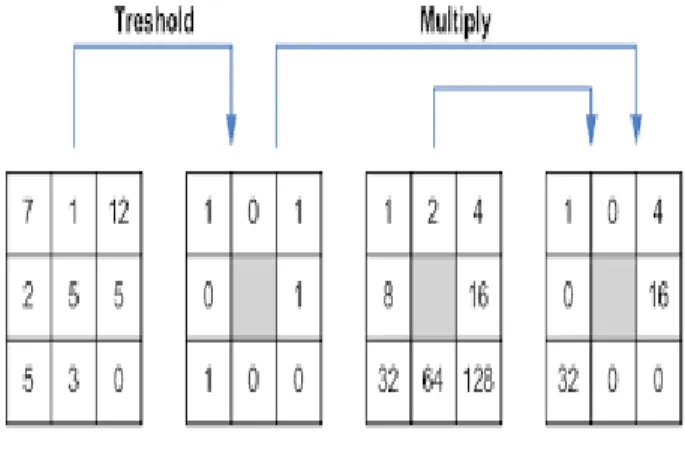
The LBP operator was first introduced as a complementary measure for local image contrast. The first incarnation of the operator worked with the eight-neighbors of a pixel, using the value of the center pixel as a threshold. An LBP code for a neighborhood was produced by multiplying the threshold values with weights given to the corresponding pixels, and summing up the result (Fig.3).
Since the LBP was, by definition, invariant to monotonic changes in gray scale, it was supplemented by an orthogonal measure of local contrast. The average of the gray levels below the center pixel is subtracted from that of the gray levels above (or equal to) the center pixel. Two-dimensional distributions of the LBP and local contrast measures were used as features. The operator was called LBP/C, and very good discrimination rates were reported with textures selected from the photographic album of Brodatz.
Fig. 3 Calculating the Original LBP Code And A Contras Measure.
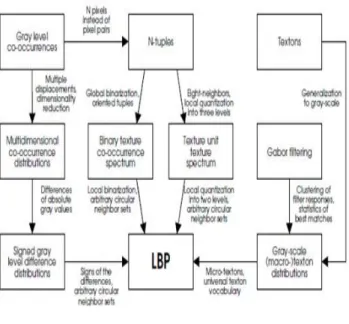
The current form of the LBP operator is quite different from this basic version: the original definition is extended to arbitrary circular neighborhoods, and a number of extensions have been developed. The basic idea is however the same: a binary code that describes the local texture pattern is built by thresholding a neighborhood by the gray value of its center. The operator is related to many well-known texture analysis methods. The relations are summarized in Fig. 4.
Fig. 4. LBP in the Field of Texture Operators. The LBP method can be regarded as a truly unifying approach. Instead of trying to explain texture formation on a pixel level, local patterns are formed. Each pixel is labeled with the code of the texture primitive that best matches the local neighborhood. Thus each LBP code can be regarded as a micro-texton. Local primitives detected by the LBP include spots, flat areas, edges; edge ends, and curves and so on. Some examples are shown in Fig. 5 with the LBP8R operator.
In the figure, ones are represented as white circles, and zeros are black.
Fig. 5 Different texture primitives detected by the LBP. The combination of the structural and stochastic approaches stems from the fact that the distribution of micro-textons can be seen as statistical placement rules. The LBP distribution therefore has both of the properties of a structural analysis method: texture primitives and placement rules. On the other hand, the distribution is just a statistic of a non-linearly filtered image, clearly making the method a statistical one. For these reasons, it is to be assumed that the LBP distribution can be successfully used in recognizing a wide variety of texture types, to which statistical and structural methods have conventionally been applied separately.
c. Naïve Bayes Classifier
The Naive Bayes classifier is designed for use when features are independent of one another within each class, but it appears to work well in practice even when that independence assumption is not valid. It classifies data in two steps:
Training step: Using the training samples, the method estimates the parameters of a probability distribution, assuming features are conditionally independent given the class.
Prediction step: For any unseen test sample, the method computes the posterior probability of that sample belonging to each class. The method then classifies the test sample according the largest posterior probability.
The class-conditional independence assumption greatly simplifies the training step since you can estimate the one-dimensional class-conditional density for each feature individually. While the class-conditional independence between features is not true in general, research shows that this optimistic assumption works well in practice. This assumption of class independence allows the Naive Bayes classifier to better estimate the parameters required for accurate classification while using less training data than many other classifiers. This makes it particularly effective for datasets containing many predictors or features.
IV. FLOW CHART OF THE SYSTEM
Fig. 6 Flow Chart.
V. IMPLEMENTATIONOFTHESYSTEM The implementation of the system & results is as follows: Step 1: Input
Fig.7 Texture Image Database: Bark, Cobble, food, Metal, Mosaic, Plant Leaf, Quilt, Tile, Water, and Wood. Step 2: Feature Extraction
All the features are extracted of the known image database by using DWT & Local Binary Pattern (LBP) which is then stored in the feature library .The process as shown in Fig. 8
Fig. 8 Feature Extraction Process
Step 3: Save the Extracted Features in the Feature Library. Step 4: Load Image
Again load the various original texture images from the image database.
Step 5: Select &Add Noise
There are four types of noise Gaussian noise, Poisson noise, Salt n Paper and Speckle noise.
The noise is selected & added into the texture images. Fig. 9 shows the Salt & Pepper noise is added into the image.
Fig. 9 Original Image with Noisy image.
Fig.10 (a) Images with Gaussian Noise. (b) Images with Poison Noise. (c) Images with Salt & Pepper Noise. (d) Images with Speckle Noise.
Fig. 10 (a) Images with Gaussian Noise
Fig. 10(b) Images with Poison Noise
Fig. 10 (c) Images with Salt & Pepper Noise
Step 6: Identify Noise
The Noisy texture is recognized from which directory it is taken by using DWT & LBP as shown in Fig 11.
Fig. 11 Identification of Noisy Images using DWT & LBP. Step 7: Performance
Fig. 12 Feature Extraction & Classification
Here the images is selected from the image database containing the original images, then noise such as Gaussian noise, Poisson noise, Salt n Paper and Speckle noise is added to the images and their features are extracted with the help of DWT & LBP.
The present features of the noisy images are then classified by the classifier with the extracted features of the non-noisy images which are stored in the feature library as shown in fig.3.12. The Classifier used here is Naïve Bayes Classifier. The aim is whether the classification can be done exactly as same that is without noise.
Step 8: Classification & Result
Use the results in final table to represent the perfect Classification Rate of Features against several noises.
The Gaussian noise, Poisson noise, Salt n Paper and Speckle noise is introduced in the image that is to be classified but the classification is correct at 100 % if the F1 features which is DWT as shown in fig 13. This suggests that DWT gives correct features of noisy images also. Table I shows the performance results against several noises
Fig. 13 Results
Step 9: Repeat the steps from 5 for the remaining three noises.
Table I Classification Rate of Features against several Noises.
VI. CONCLUSION
The Matlab based code is used to generate the above mentioned results, and that can be concluded as under:
When classification is done with DB1 i.e by usig DWT the mean success rate is improved to 100%.
When classification is done with DB2 i.e Local Binary Pattern, the mean success rate is slightly reduced to 97.50%.
Therefore we concluded that the efficiency of Discrete Wavelet Transform is higher in classification even in noise as compared to other Features efficiency.
VII. FUTURE SCOPE
The research work is focused on algorithmic development and future work is to change different wavelet family to generate the result and achieve higher mean success rate. Even if the Gaussian noise, Poisson noise, Salt and Paper and Speckle noise is introduced the DWT gives the correct classification of image which reveals that DWT can classify images with noise also and further this feature can be used in many classification algorithms.
Features Classification Percentage of Features in Noise Poisson Noise Gaussian Noise Salt n Pape r Noise Speckl e Noise F1 (DWT) 100 100 100 100 F2 (LBP) 97.50 97.50 97.50 97.50
REFERENCES
[1] M.Rahimi and M.Moghadam, ―A texture based image retrieval approach using selforganizing map pre-classification," IEEE International Symposium on Signal Processing and Information Technology (ISSPIT), pp. 415-420, December 2011.
[2] J. Kautz, S. Boulos and F. Durand, ―Interactive editing and modeling of bidirectional texture functions," ACM Transactions on Graphics, vol. 26, p. 53, July 2007.
[3] M. Varma and A. Zisserman, ―A statistical approach to texture classification from single images," International Journal of Computer Vision, vol. 62, pp. 61-81, April 2005.
[4] A. Khotanzad and Y. H. Hong, ―Invariant image recognition by zernike moments," IEEE Transactions on Pattern Analysis and Machine Intelligence, vol. 12, pp. 489-497, May 1990.
[5] R. M. Haralick, K. Shanmugam, and I. Dinstein, ―Textural features for image classification," IEEE Transactions on In Systems, Man and Cybernetics, vol. 3, pp. 610- 621, December 1973.
[6] P. Brodatz, ―Textures: A photographic album for artists and designers," Dover Publications, 1966.
[7] B. Vijayalakshmi1, V. Subbiah Bharathi, ‖A Novel Approach to Texture Classification using Statistical Feature‖.
[8] Milind M. Mushrif and Yogita K. Dubey, Member, IACSIT, ―Texture Classification Using Cosine-modulated Wavelets‖, International Journal of Computer and Electrical Engineering, June 2012, Vol. 4, No. 3. [9] Subodh S.Bhoite, Prof.Sanjay S.Pawar, Mandar D. Sontakke, Ajay M.
Pol,‖ Color Texture Classification Using Local & Global Method Feature Extraction‖, International Journal of Advanced Technology in Engineering and Science ,August 2014, Volume No.02, , Issue No. 08.
Mayur Rajendra Sonawane is a P.G. student at S.S.G.B.C.O.E.T, Bhusawal, Affiliated to N.M.U. Jalgaon, Maharashtra, India. B.E. from Aditya College of Engg. Beed, Dr. Baba-Saheb Ambedkar Marathwada University, Aurangabad, Maharashtra, India.