WWW.WIPRO.COM
Amit Puri General Manager and Head of Presales - SIMS Manjari Sharma
SOFTWARE DEFINED NETWORKING
Table of contents
Abstract
Introduction: Traditional Network that We Know
What is the Problem with the Network?
SDN – The Change Agent
How does the SDN Controller Achieve This?
Approaches to SDN
Network Function Virtualization
SDN Use Cases
Is SDN Technology Perfect?
SDN Vendor Ecosystem
System Integrator: Filling the Gaps
Summary
Conclusion
Authors’ Profile
About GIS
About Wipro Ltd.
01
01
02
02
03
04
04
05
05
06
08
10
10
11
11
12
The past two years have witnessed flurry of action and hype around Software Defined Networking. There are
umpteen numbers of vendors claiming to churn out SDN solutions and products every other week. This paper
provides a perspective on the technology, SDN industry, role of system integrators in this space, and how SI can
adapt and evolve to facilitate the SDN adoption journey of customers.
Network by design has been a distributed computing environment. Each node in the network, be it a switch or a router, has both intelligence (control plane) and muscle (forwarding or data plane). Packet forwarding was done on a hop-by-hop basis with each node making forwarding decisions on its own. Configuration of these network devices was being done box by box. Troubleshooting was even more complex - with packet traces, hop-by-hop checks and required deep expertise in product architecture most of the time. Managing networks includes a mundane set of activities like backup, repeated configuration tasks, fulfillment of requests and keeping the lights on.
Most network products were proprietary and built with Application Specific Integrated Circuits (ASICs) that are tightly coupled to the operating system on top of it. It is fair to say that these were ‘black boxes’ with very limited openness either in software or hardware. Proprietary network management software from the respective product vendors was needed to manage this complex infrastructure. Thus, traditional network architectures were a vertically integrated stack of proprietary closed systems. More diversity in network infrastructure would mean more people with specialized skills, more management systems and more processes to orchestrate changes across the stacks.
Abstract
What is the Problem with the Network?
With the advent of virtualization technologies the server computeblock has become agile and provisioning in the Data Center is largely automated. However, the same is not true for network and associated services. Today application or workload provisioning in the DC is time consuming due to the network not being agile. Network provisioning might take several days to weeks in the DC. Most enterprise DC’s have significant product diversity in the network services layer – DNS, Load-balancing, WAN optimization, VPN and firewalling, to name a few. The deployment of these
services demand expert skills, change requests, maintenance windows and sometimes manual rollback of failed provisioning. Network operations have become complex with the need to maintain, manage and upgrade heterogeneous infrastructure. Availability of skilled personnel to oversee successful network operations is becoming a daunting task for DC network managers. And to top it all, the network is always blamed for performance issues or any other infra wide problems in the DC. Network opera-tions are challenged frequently to prove otherwise.
SDN – The Change Agent
Network Virtualization techniques are not something new in the network world. VLANs, tunneling, and VPNs have been around for quite long. Talking about SDN, it intends to centralize all intelligence (control planes) in the network on a software layer allowing centralized control and abstraction of the underlying complex infrastructure. Theoretically, all network nodes would only need the muscle (forwarding or data plane) to push packets out.
Figure1 shows SDN architecture with abstractions and SDN controller providing single layer of management.
SDN ARCHITECTURE
APPLICATION LAYER
API API API API
API Openflow Proprietary NORTHBOUND INTERFACE CONTROL LAYER NORTHBOUND INTERFACE NORTHBOUND INTERFACE CUSTOM APP 3RD PARTY APP CLOUD
PORTAL SDNAPP PORTALWEB
SDS CONTROLLER SOFTWARE NETWORK SERVICES NETWORK DEVICES Figure 1 SDN Architecture NO CONTROLLER AND API INTEGRATIONS IN TRADITIONAL NETWORK
How does the SDN Controller Achieve This?
As shown in Figure1, there are two distinct interfaces in the SDNcontroller the southbound interface that talks to the infrastructure layer and the northbound interface that speaks to cloud, orchestration and management layer. The northbound interface is pretty much standardized as REST API’s (Representational State
Transfer - Application Programming Interface) in all the SDN controllers that are available today. The southbound interface is specific to the vendor’s implementation. Some use open standards based protocols like OpenFlow, BGP, Netconf etc., while others use proprietary interfaces.
Vendor Neutrality
BENEFITS OF SDN
Guaranteed Content Delivery
Use of less expensive hardware “white box” switches with intelligence centered at SDN controller.
SDN, if implemented using open standards, can help in reducing vendor lock-ins.
SDN’s ability to shape and control data traffic results in enforcing quality of service (QOS) in the network fabric delivering guarantees on performance for applications.
Integration with Public Cloud
Service Chaining and Automation
More Granular Security
Low Capital Expenditure Costs Abstraction of Infrastructure Automation of Network Provisioning
Holistic Enterprise Management
Low Operational Costs
Network provisioning can be done today from a cloud portal without getting into manual device centric configuration mode as earlier.
Seamless insertion and configuration of network services on the fly in an elastic fashion on-demand.
SDN, if effectively used, can manage security throughout the enterprise (mix of physical and virtual environment).
Complexity of network infrastructure i.e., vendor specific interfaces, commands, software features are made available to upper layers (like cloud platform or stand-alone orchestrators) as abstracted GUI drop-downs.
Network orchestrators can do this without SDN too. But very few mature and niche products are around.
SDN allows management of physical and virtual network devices from a central controller.
Routine network administration tasks can be centralized & automated resulting into lower operational costs.
Approaches to SDN
There are two primary approaches that vendors are taking to implement SDN architecture overlay and underlay (fabric based) while there is one more called Hybrid approach which is a combination of both overlay and underlay. Hybrid approach helps in end-to-end visibility and control.
BENEFITS OF SDN
Focus On hypervisor and uses tunneling and encapsulation On virtual and physical network (Overall Fabric Management)
Implementation On top of existing network infrastructure, multiple networks and multiple layers Puts Software Defined Network in every point in your network
Vendors • Scalability• Management challenges • Management and troubleshooting challenges
Pros
• Support for an unlimited number of Virtual Networks • Ability to manage overlapping IP addresses between multiple tenants.
• Support for multi-path forwarding within virtual networks
• Support for multitenant logical networks • End to end resiliency-millisecond link failover
• Manages complex and granular performance networking issues
OVERLAY APPROACH
UNDERLAY APPROACH
Network Function Virtualization
SDN, NFV and OpenFlow are often used together in field of today’s networking solutions creating confusions among end users. They are all complementary approaches. They each offer a new way to design, deploy and manage the network and its services.NFV in particular, is concerned with the transition of networks from collections of proprietary boxes to collections of software components running on industry-standard hardware.
Buying and implementation of hardware which used to take months earlier now can be done in hours because of their transition into software forms. Almost any network function can be virtualized.
NFV focus in market includes:
Virtual Switching – physical ports are connected to virtual ports on virtual servers with virtual routers using virtualized IPsec and SSL VPN gateways.
Virtualized Network Services – traffic analysis, network monitoring tools, load balancers and accelerators.
Virtualized Applications – almost any network management related application you can imagine.
SOFTWARE DEFINED NETWORKING
OPEN
While choosing the right NFV or SDN solution, it is important you know various pros and cons of solution offered and see what fits your environment.
SDN Use Cases
While the use of SDN in Data Centers receives the majority of attention but its use in WAN and campus networks is also being getting analyzed and implemented. Most of the use cases are generalized and can be used in each environment. Below are some general use cases:
Is SDN Technology Perfect?
Though SDN offers a lot of features there are few concerns over its adoption. Let us see the challenges ahead: • Manual Intensive Management
• Rapid growth of IP end points • Elasticity and Multi-tenancy
• Conformance with ETSI framework and standards • Verify performance and reliability offered
• Memory and CPU footprint
• Scalability, programmability & compatibility • Security
• Any specialized hardware requirements • Supports orchestrated and management stacks
KEY CRITERIA IN SELECTING NFV
COMPONENTS AND SOLUTIONS
NFV CHALLENGES
• Less Capex and Opex • Quickly deployable • Scalable and Flexible • Security
• Policy management
NFV ADVANTAGES
DATACENTER
Virtual machine migration, White Box switches, L4-L7 services optimization, security services, load balancer services
WAN
WAN Virtualization, Network Analytics, Centralization, Bandwidth Allocation, Google G-Scale WAN
CAMPUS
Dynamic QOS and Traffic Engineering, Unified Wireless and Wired Networks, Role Based Access
SDN SOLUTIONS FROM MULTIPLE VENDORS WERE ANALYZED AND THE TCO SAVINGS ARE 20 TO 80%; WHILE CAPEX SAVINGS ARE 10 - 40%, THE OPEX SAVINGS RANGE FROM 10 TO 80%.
Integration
SDN CHALLENGES
Its New
SDN offers capability to have Southbound integration with any vendor hardware and to integrate Northbound with any monitoring, orchestration and cloud solutions, but Integration is challenging and requires skills and knowledge on various vendors’ solutions and how to integrate with existing environment.
Because of this infancy, many believe SDN implementations are not ready for prime time.
Different Interpretations SDN has been interpreted by each vendor differently, hence there is need to carefully look at vendors’ future SDN roadmap, architectural principals before finalizing any solution
Management
Security SDN removes physical layers from the network design and virtualizes it, then replaces it with exposed layer of highly sensitive network layer, open for attack.
Management challenges in defining the scope of control given to SDN controller
SDN Vendor Ecosystem
Network ISVs are taking a three pronged approaches while offering SDN products:
• Open SDN Products supporting Open standards and protocols such as OpenFlow and OpenDaylight • Proprietary SDN products with tight integration between hardware and software
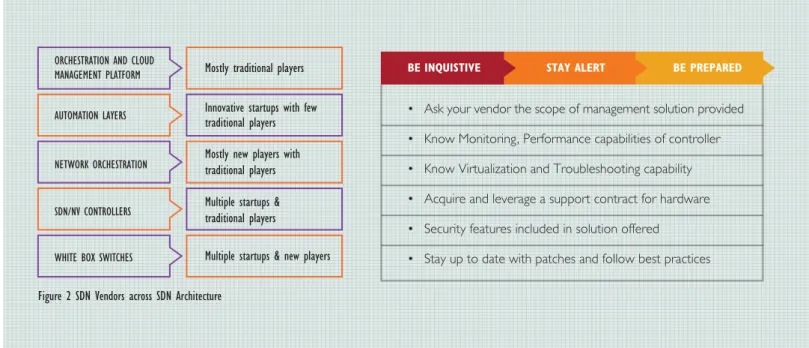
• Hybrid approach, where SDN products, supporting Open standards, are tightly tied with proprietary platforms and products. Figure 2 depicts multiple vendors at each layer:
• Ask your vendor the scope of management solution provided • Know Monitoring, Performance capabilities of controller • Know Virtualization and Troubleshooting capability • Acquire and leverage a support contract for hardware • Security features included in solution offered
• Stay up to date with patches and follow best practices Figure 2 SDN Vendors across SDN Architecture
ORCHESTRATION AND CLOUD
MANAGEMENT PLATFORM Mostly traditional players AUTOMATION LAYERS Innovative startups with fewtraditional players
NETWORK ORCHESTRATION Mostly new players withtraditional players
SDN/NV CONTROLLERS Multiple startups &traditional players
WHITE BOX SWITCHES Multiple startups & new players
1. Porter’s Five Forces Analysis
UNDERSTANDING SDN INDUSTRY
POTENTIAL ENTRANTS MEDIUM BARGAINING POWER OF SUPPLIERS MEDIUM BARGAINING POWER OF CUSTOMERS HIGH INDUSTRY COMPETITION HIGH THREAT OF SUBSTITUTES LOW• Market is new and many new players are rising • 100+ NNF members
• High capital requirements for R&D • Industry growth high
• Vendor from market leaders to new startups • Lot of products and solutions available
• Vendors from niche players to integration services • Brand loyalty less, technology is new
• Lot of price and product differences CISCO followed by Juniper have clear dominance in terms of network infrastructure but SDN inclusion will change the landscape which will help in avoiding vendors lock-ins
Though technology is changing continuosly and capex will reduce, but technology functionality will change at very lower pace
2. SWOT Analysis
STRENGTHS:
• SDN market expected to grow to $8bn (734%) by 2018 (IDC Report,2014)
• Multiple channels available to reach to customers
OPPORTUNITIES:
• Venture capital funding of SDN-related companies is rising • Market embrace open source • Focus on software over hardware
WEAKNESS:
• Numerous Vendors • Difficulty of migration and integration • No standard skill set
THREATS:
• Frequent technology changes
• High customers bargaining power
KEY CONCERNS OF END USERS AND BUYERS OF SDN
>> Limited skills & time to evaluate best solution for their environment.
>> How to evaluate & collaborate different vendors? >> Not sure which use-case to implement. >> Will there be inter-operability issues?
>> How to exact degree of scalability/agility/flexibility of solution? >> How to handle administration involving
heterogeneous environment?
>> Whether to choose end to end or point solution? >> Are industry standards met?
>> Is the solution provided a tested/proven one?
>> What about my recent investments done in technology?
Though the SDN industry has lot of scope to grow, given lot of players and functionalities it offers, it has led to adoption challenges
System Integrator: Filling the Gaps
Given the wide ecosystem of SDN Vendors and SDN’s adoptionchallenges, there is a requirement of service providers who have the right skill set to analyze the customer environment, offer best solution for customers apt to their environment needs, assist in integration and provide end to end services.
To make sure that System Integrators do not create an additional level of complexity in SDN environment, they need to evolve and adapt themselves to facilitate and ease the SDN adoption journey of customers. Let us see how they can do in each stage of service delivery and can do overall value addition:
Consulting & Assessment
Customize App
Development
Testing & Validation
Integration & Migration
Integrator does?
What System
Manage Service Provider
TEST DEPLOY SUPPORT & MANAGE OPTIMIZE PLAN • Discovery tool to identify customer environment’s readiness for SDN deployment • TCO calculator to educate customer how different SDN solutions reduce customer’s Capex and Opex and whether the investment in SDN is worth or not • API Development Identifying the gaps and develop custom APIs to integrate with southbound and northbound interfaces • Simulator Labs to provide tested and proven solution as every customer’s environment is different from the other • Vendor Agnostic While choosing best solution for customers, SIs have to be vendor agnostic and evaluate neutrally to provide best solution for customers • Automatize Provision
Finding the gaps and automatize the migration and deployment process • Integration of network infrastructure with controller and orchestration layer tools • App Development Developing solutions around SDN troubleshooting, Predictive Analytics, Policy governance, Auditing • Streamlining IT Processes SDN’s orchestration and automation functionalities can reduce administrative tasks • Managed Service Provider Breakfix support and Single Proof of Concept for heterogeneous SDN environment
• Vertical Integration
Not just SDN but helping customer with SDS, SDC, SDDC (Software defined storage, compute and Data Center) solutions • Communities Membership To stay abreast with latest developments and to contribute in SDN community, SIs can be part of groups like ONF, IEEE, IETF, OpenStack, OpenDayLight, HP Appstore
VALUE ADDITION
SHARED VALUES STRUCTURE SYSTEM STYLE STRATEGY STAFF SKILL SKILLSWith advent of SDN, Network administrators need to be trained in different network technologies as compared to earlier where there used to be Network Administrators expert in Cisco devices or Juniper devices only. SIs will also need heterogeneous pool of skilled people say a developer (Linux, Python or Java skills) with administration skills or vice versa
STAFF
SIs will have to be always on their toes to identify new partners/technologies in market and at the same time, they have to be vendor agnostic in their approach
SHARED VALUES
Last but not the least, customer centricity, intensity to win and integrity is the success mantra, which not only helps in bringing new customers, but also to retain them.
STRUCTURE
More administrators skilled in building and migration will be required as compared to traditional break fix administrators with Level 1, Level 2 & Level 3 kind of support. With SDN, Level 2 players may not be needed, given its automation and orchestration functionalities. This will help in reducing cost /employee for an SI and OPEX for customers
STYLE
SIs will require leaders who can collaborate with multiple vendors and be aggressive enough to propagate better SDN solutions to customers
SYSTEM
SLAs and incident/request/problem management will need to be redefined, with SDN offering orchestration and automation features, as users will be having power to configure network configurations that will help in reducing OPEX
STRATEGY
• SDN provides an opportunity for SI to market itself and sell its SDN proposition of Integration as a Service.
• Vertical Integration by integrating SDN with SDDC, SDC and SDS (Software Defined Data Center/Compute/Storage)
• Transition from mindset where customer is always right to model where provider takes lead and places bets to build their feature • Automating service provision to reduce customer’s TCO
Summary
SDN is a new and disruptive technology in the networking domain. There are a number of vendors announcing SDN solutions and products every other week. Given it’s new and still evolving, it has led to adoption challenges for end customers. And to leverage SDN’s benefits and integrate it in present environment requires great level of skills, knowledge of different vendors; the kind of solutions and level of abstraction offered. System Integrators who have past experience in integrating traditional solutions, desired skill set for SDN, partnership with multiple vendors can help plug the gaps, and provide customers a complete comprehensive and a vendor agnostic solution and support.
To make sure that System Integrators do not create an additional level of complexity in SDN environment, they need to evolve and adapt themselves to facilitate and ease the SDN adoption journey of customers through automation, tools and robust migration methodology. System Integrators can create value for their customers by identifying the white spaces in service delivery process involving planning, testing, deploying, support & management and optimization stage. System Integrators are rightly placed to act as consultant and hand hold customer through this very exciting SDN adoption journey.
Authors’ Profile
Amit Puri is leading ‘Change the Business’ portfolio that includes software defined Infrastructure and open source initiatives globally. Amit is a business leader with varied experience ranging from strategy, sales, presales, IT operations and delivery, large project management and P&L management. He has been instrumental in launching and running new practices successfully in Wipro including telecom network services, open Source and software defined infrastructure. Amit is passionate about new technologies and making them deliver the promise as clients adopt them.
Manjari Sharma has been a part of the Global 100 Intern program at Wipro and is currently enrolled in the Post Graduate Program in Management at Indian Institute of Management, Calcutta. Before starting out on her management journey, she worked for five and a half years in infrastructure management services at IT majors such as Infosys and Wipro. Her experience is primarily in computing and Network platform. She has a keen interest in Technology and Marketing.
Ramesh Padmanabhan has over 17 years of experience in Telecom and Enterprise IT services encompassing Network Operations, System Integration, Support services, Service Delivery, Network Architecture and Technical Pre-sales. He is currently part of System Integration & Maintenance Services - Global Infrastructure Services in Wipro responsible for network practice development,competency and delivery enablement. Ramesh has wide ranging interests in networking, Openstack and data center technologies. He is currently developing SDN solutions relevant to Wipro's Enterprise customers with specific focus on Open Networking.
ABOUT WIPRO LTD.
Wipro Ltd. (NYSE:WIT) is a leading Information Technology, Consulting and Business Process Services company that delivers solutions to enable its clients do business better. Wipro delivers winning business outcomes through its deep industry experience and a 360 degree view of "Business through Technology" - helping clients create successful and adaptive businesses. A company recognized globally for its comprehensive portfolio of services, a practitioner's approach to delivering innovation, and an organization wide commitment to sustainability, Wipro has a workforce of over 150,000, serving clients in 175+ cities across 6 continents.
For more information, please visit www.wipro.com
About GIS
Global Infrastructure Services (GIS), a unit of Wipro Limited, is an end to end IT infrastructure & outsourcing services provider to global customers across 57 countries. Its suite of Technology Infrastructure services spanning Data Center, End User Computing, Networks, Managed Services, Business Advisory and Global System Integration. Wipro, is a pioneer in Infrastructure Management services and is amongst the fastest-growing providers across the world. GIS enables customers to do business better by enabling innovation via standardization and automation, so that businesses can be more agile & scalable, so that they can find growth and succeed in their global business. Backed by our strong network of Integrated ServiceNXT™ Operation Centers and 11 owned data centres spread across US, Europe and APAC, this unit serves more than 500+ clients across with a global team of 23,800 professionals and contributes to over 30% of Wipro’s IT Services revenues of Wipro Limited.
WIPRO LIMITED, DODDAKANNELLI, SARJAPUR ROAD, BANGALORE - 560 035, INDIA TEL : +91 (80) 2844 0011, FAX : +91 (80) 2844 0256, email : [email protected]
WWW.WIPRO.COM CONSULTING|SYSTEM INTEGRATION|BUSINESS PROCESS SERVICES