Choosing a Solution for Web-Filtering:
Software, Appliance, Managed Service?
Table of Contents
Executive Summary
3
The Rising Tide of Web Threats
3
Web Security Options: In Brief
4
Software-based Solutions
5
Appliance-based Solutions
6
Managed Services
6
The MessageLabs Approach
7
Executive Summary
There are three types of web security solutions: software-based, appliance-based and managed services. Each of these categories – and each individual offering within them – needs to be evaluated against the following key buying criteria:
• Accuracy of threat protection • Ease of installation and use • Total cost of ownership (TCO)
Software and appliance-based solutions have
significant weaknesses which undermine their
suitability as a cost-effective option for business.
For instance, TCO is significantly higher than initial
purchase price and installation/maintenance will require substantial, ongoing commitment of in-house resources. Managed services, on the other
hand, offer valuable benefits: lower TCO, minimal
commitment of in-house resources, and constant, uninterrupted protection against inappropriate web use and the increasing threat posed by web-born viruses and spyware.
MessageLabs is a global leader in managed web security services. Providing a solution that is simple to install and use, MessageLabs offers outstanding performance in enabling businesses to set up and enforce acceptable
usage policies that are flexible, fit-for-purpose and
accommodate evolving needs and priorities. In
parallel, its proprietary technology, Skeptic, equips
MessageLabs to achieve unrivalled Internet-level
detection and blocking of web-born malware and
converged threats. Calculated on a per-user, per-month basis, these capabilities are delivered at highly competitive cost. The result is a service that doesn’t just help businesses maximize
productivity, profitability and protection against legal risks arising from web usage – it also means the web’s many business-building benefits can be
harnessed effectively and comprehensively.
The Rising Tide of Web Threats
It’s indisputable. In the course of a few short years, the World Wide Web has demonstrated its ability to add real value to the operations of
all kinds of organizations.
It’s become a key communications tool allowing commercial transactions to take place quickly
and effectively, regardless of barriers imposed by time and distance. It’s secured a vital niche as
a medium that businesses can exploit to promote themselves, their products and their values. It’s also established itself as an indispensable source of information and intelligence which can inform and
improve business decision-making.
Yet like any other communication medium, the web brings risks as well as benefits. Every bit as serious as email-born threats, these risks have the potential to deliver damaging – and in some cases crippling – blows to organizations that don’t have adequate
protection in place.
Web threats can be divided into two broad categories: inappropriate web use and web-born malware.
Inappropriate web use:
Arguably, this is the number one web-related issue
facing businesses today. Efficiency, productivity, bandwidth and corporate reputation can all take a big hit if employees squander office hours on inappropriate surfing activities.
Unfortunately, the web now offers more potential
distractions than ever before. The key examples
which eat up valuable in-house resources include chat rooms, iPlayer and other streaming
media, online games and file downloads (see
MessageLabs Intelligence Report, August 2008 www.messagelabs.com/resources/mlireports).
Statistically speaking, visits to adult and illegal
websites are less common. Nevertheless they
expose businesses to severe legal risks, e.g.
from failure to protect staff from indecent images, cyber bullying and sexual harassment. As well as
prosecution, fines and other penalties, the results
can include loss of client trust and unwelcome media coverage.
A complicating factor, however, is the need for
businesses to strike the right balance in their approach to web usage. The key is to ensure that
your organization as a whole and your individual employees are properly protected, but also that
motivation, creativity and wider business benefits
aren’t compromised by over-draconian restrictions.
Social networking websites, for instance, can
play a valuable role in fostering important professional relationships and the recruitment of high-caliber staff.
Web-born malware:
Increasingly, websites are becoming the preferred delivery mechanism for damaging malware such as viruses, as well as spyware and adware. In some cases, simply visiting an infected website will be enough to download unwanted programs onto a computer. Even if such programs are discovered
WHITEPAPER: Choosing a Solution for Web-Filtering: Software, Appliance, Managed Service?
The web
brings serious
risks as well
as benefits.
Managed
services route
web traffic
through the
vendor’s
infrastructure.
In the face of this alarming and continually evolving threat landscape, what should businesses do? An increasing number of vendors are responding to the rising tide of web-based threats by promoting web security solutions alongside their better established email security offerings. But how can you determine
which products or services are the most efficient, easy to use and cost-effective? Outlining the key
issues to consider when evaluating the options, this guide aims to help you reach the right decision for your business.
Web Security Options: In Brief
Web security solutions fall into three basic categories: software-based solutions, appliance-based solutions and managed services
(sometimes also known as hosted services or SaaS – “software as a service”):
before they bring your network down or surrepti
-tiously leak sensitive financial or client data to
a criminal third party, cleaning and rebuilding a polluted machine will have unwelcome resource
implications. Blocking access to malicious websites
and infected downloads is therefore absolutely vital to safeguarding your organization’s productivity. The need to counter web-born malware has become all the more urgent in the face of a developing
and significant trend on the messaging and web
security landscape. Increasingly, the “bad guys” are
mixing and merging their attacks across vectors. A
classic example of such “converged threats” is the
use of spam emails to advertise – and carry links to – websites polluted with aggressive viruses or
spyware. The uncomfortable truth is that the web
is now firmly locked into the armoury of tools and
techniques which the increasingly professional, sophisticated criminal gangs behind most cyber-crime now routinely deploy.
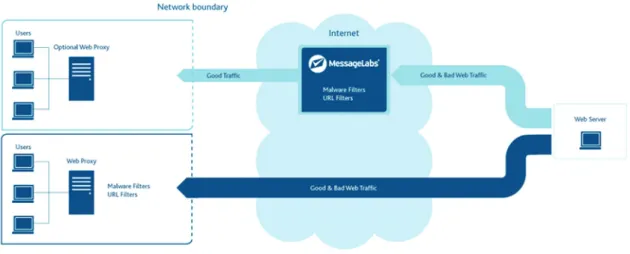
Fig. 1: The MessageLabs managed services approach to web security
• Software-based solutions require on-site installation of licensed web security software between the
customer’s web browsers and their network boundary.
• Appliance-based solutions are also installed on the customer’s premises. But unlike software solutions, this involves setting up hardware in the form of additional hardware between web browser and network
boundary.
• Managed services, by contrast, don’t usually involve installing hardware or software on the customer’s
premises. Instead, the customer’s web traffic is routed through – and processed by – the service vendor’s
infrastructure, consisting of data centers sited at major internet hubs. The managed service model normally involves the customer paying a regular subscription fee in return for a web monitoring and control service and/or protection from web-born malware.
Specific issues relating to each category of web security service are discussed below. The following table (on
next page) also summerizes the principal performance factors of software-based solutions, appliance-based solutions and managed services.
Software-based Solutions
Compared with email security, web security
represents a relatively new market. Many
businesses are not yet aware of the severity of the
web threat and so are yet to make the decision
to invest in a protection solution. With regard to those businesses that have already made such a
decision, authoritative data is still lacking on the
options they are choosing.
But it seems likely that a majority are committing
themselves to software-based solutions, mirroring
their email security purchasing decisions. (In 2007,
software-based email security solutions generated an estimated $1348 million globally, more than appliance-based solutions and managed services combined; see “Worldwide Messaging Security 2007-2011 Forecast and 2006 Vendor Shares”, IDC 2007).
MessageLabs believes this picture will change
significantly. Essentially, this is due to the drawbacks associated with software-based
solutions. These relate directly to the drain on in-house resources that such solutions customarily involve and also to in-built characteristics that militate against continuous, reliable protection:
WHITEPAPER: Choosing a Solution for Web-Filtering: Software, Appliance, Managed Service?
Software-based
solutions can
be a drain
on in-house
resources.
5
• Although the initial price of a software-based solution may seem attractive, total cost of
ownership (TCO) can be substantially higher.
This is because investment in additional hardware and/or software will almost certainly be essential,
and it will be necessary to devote sufficient
house resources to managing and administering the solution. In addition, a software solution will typically have to be replaced within 3-5 years, generating a further commitment to hardware and software renewal.
• It is essential that a software-based solution and
the system it serves have the capacity to keep pace with (i) increases in overall levels of web traffic and (ii) demand “spikes” where the number
of webpage requests far exceeds the average
figure. Under-capacity can lead to web access
being compromised, damaging business continuity and customer relations. Eliminating worries about capacity will inevitably have
financial implications.
• Setting up fit-for-purpose acceptable usage
policies and enforcing them accurately using a software-based solution can be extremely resource-hungry. For instance, there can be a substantial support training requirement which,
Deploying
appliances
can take
several days.
maintained – all of which will impact webavailability, IT budgets, network storage and
corporate bandwidth. Failure to cater to increased demand could result in degradation of performance and in extreme cases interruption of service and severance of web contact.
• Should an appliance go offline (e.g. due to a power
or system failure), web access will be interrupted and business could be lost. As insurance against this, organizations often invest in extra “redundant”
appliances. But these require further financial outlay, use valuable bandwidth, soak up storage
capacity and need further administration.
• Relying on web security appliances will involve a
heavy burden in terms of the time taken to frame
and implement the right acceptable use policy for your organization.
• Eliminating windows of vulnerability that web- born malware can exploit will be paramount. This will necessitate a high state of vigilance and a sophisticated understanding of malware threats among in-house IT staff. Supplementing internal expertise with external consultancy may prove
unavoidable – a practice also characteristic of
organizations that invest in software-based solutions.
• Because of the legal dimension associated with web usage, those responsible for managing and administering your appliances will need to maintain an excellent awareness of relevant legislative
and regulatory frameworks. The penalties for
compliance can be extremely severe. This applies to software-based solutions too.
Overall, appliance-based web security solutions tend to be high outlay and high maintenance, and involve an open-ended commitment in terms of budgets and in-house staff resources.
Managed Services
In the field of email threat protection, managed services are gaining an increasing market share. Generally speaking, vendors of such services have
earned a reputation for upstream innovation which translates directly into rapid deployment of leading-edge protection capabilities on their clients’ behalf.
The functionality, flexibility and ease of customization they offer are also playing a key role in their rising popularity. (See, for example: “Predicts 2007:
Software as a Service Provides a Viable Delivery Model”, Gartner, Inc. 2006).
in many cases, will have to be met by in-house
IT staff, deflecting them from other
critical activities. Installing software patches
will also involve sidetracking IT staff from important tasks.
• To maintain effective protection against web-born malware, software-based solutions must
continually be updated with the latest signatures. Failure to do so can open a window of
vulnerability which malware may exploit mercilessly, with devastating consequences for your business.
• Even where businesses have large IT
departments and extensive IT skills, ensuring that in-house web security know-how keeps fully
to-speed with an ever-changing threat landscape
is at best difficult and, at worst, impractical.
This, however, is a prerequisite to ensuring that a software-based solution can provide the watertight protection businesses need.
To sum up, software-based web security solutions require substantial investment and continual reinvestment, in terms of both in-house staff time and capital/maintenance costs.
Appliance-based Solutions
Similarly, web security solutions that involve on-site installation of hardware appliances have a number of drawbacks:
• As with software-based solutions, the headline price of a web security appliance may seem tempting, but the TCO will be much less attractive. Above all, extensive input from in- house IT staff will be needed to adjust appliance settings, install patches when issued and respond to requests for technical support from end-users. It will also be vital to maintain accurate projections of changing capacity needs and ensure these are
catered for in a timely and efficient way.
• Installing, deploying and testing appliances can
take several days. So can fine-tuning settings to make sure local factors and conditions are
properly accommodated. Inevitably, web availability will be restricted and perhaps even curtailed completely during the installation and set-up process.
• Relying on in-house appliances raises critical questions regarding management and capacity.
Above all, as web traffic expands, more
This growing preference for managed services is now becoming evident in web security too.
The main benefits that managed services
generally aim to provide include:
• Predictable TCO, delivering significant savings
compared to software and appliance-based
solutions. This is because (i) managed service
providers can achieve substantial economies of
scale and (ii) there should be no “hidden extras”.
Because a managed service uses the vendor’s
infrastructure, away from subscribers’ networks, the need to install, maintain and keep reinvesting
in on-site software and hardware is basically eliminated. Valuable corporate bandwidth is also preserved.
• Ease and speed of set-up, with minimal disruption to web access, maximizing business continuity and employee productivity.
• Complete scalability and fallover protection. Temporary and long-term increases in demand for web access can be seamlessly
accommodated. Subscribers should also be immune from the effects of server crashes and planned or unplanned power outages.
• Incorporation of policy engines for development and automatic, accurate enforcement of acceptable use policies. An important spin-off
from this benefit is the minimal amount of training
required, removing a major burden on in-house IT staff.
• Non-stop, constantly updated protection from web-born malware. Managed service providers
employ technicians and engineers who work
day-in, day-out to understand and neutralise web security threats. To replicate this level of specialist expertise within an average IT department is simply not feasible.
• Releasing in-house IT resources from the
relentless, and often impossible, task of
monitoring/controlling web usage and providing effective protection against increasingly virulent web-born malware and converged threats.
The MessageLabs Approach
Managed web security services offer businesses important advantages. But how are prospective subscribers to differentiate between the increasing
number of vendors coming to market with such
services?
WHITEPAPER: Choosing a Solution for Web-Filtering: Software, Appliance, Managed Service?
Managed
services offer
significant
savings.
7
MessageLabs fully managed Web Security Services provide capabilities in:
• Monitoring employees’ web browsing behavior, which includes highlighting bandwidth used and the potential need to put web usage controls in place.
• Control of websites that can be visited and files
that can be downloaded from them.
• Interception of viruses, spyware and adware.
Other vendors offer services which ostensibly perform the same tasks. However, MessageLabs outperforms its competitors in three critical areas:
1. Accurate protection:
Harnessing the world’s most advanced and stable
network, consisting of 14 data centers spanning
four continents, MessageLabs delivers industry-leading zero hour Internet-level protection against web-born threats. Underpinning this capability is the use of multiple signature-based anti-malware scanners and MessageLabs unique, proprietary
threat detection technology, Skeptic.
For almost a decade now, Skeptic has led the way
in predictive threat detection. As it relentlessly scans for malware, it constantly adds to its
enormous reservoir of knowledge, updating itself
to deal with every new threat that appears on
the landscape – however novel or sophisticated
that threat may be. The other scanners used by MessageLabs are all best-of-breed commercial
offerings that stop known malware threats and so act as a perfect complement to Skeptic.
Delivering such comprehensive threat protection has become all the more essential with the
increasing trend towards threat convergence (see
page 5). Moreover, MessageLabs is the only vendor
to retain its email, web and Instant Messaging (IM)
security services in-house. This means that when a threat is detected in one vector, the solution can be applied across other vectors with the
greatest possible speed and efficiency. Because
MessageLabs email, web and IM services form part of a single system and are not devolved to partner organizations, they can be managed as an integrated whole.
2. Ease of installation and use:
Simplicity of set-up, configuration, use and administration are all hallmarks of MessageLabs
Web Security Services, which function with equal effectiveness regardless of a customer’s web
browser configuration. 24/7/365 client support is
MessageLabs
is extremely
cost-competitive
with other,
less effective
services.
additional hardware or software, installation of increased storage capacity, bringing more
bandwidth online to cope with demand, and making
considerable in-house IT support available to provide a training and troubleshooting resource.
But the TCO of a managed service should stay
stable and predictable – a massive benefit when
it comes to budgeting and ensuring expenditure forecasts are as accurate as possible.
But how does the cost of MessageLabs Web Security Services compare with other managed web security services? Calculating on a per-user, per-month basis
– the most accurate framework for estimating actual costs – MessageLabs is extremely competitive with
the less effective, less comprehensive, less
user-friendly, less flexible solutions provided by other
vendors.
The Best Option for Business
As this guide explains, MessageLabs Web Security
Services are specifically designed to help businesses take control of the many potential threats that can
arise from web usage on a daily basis. This, in turn, equips businesses to protect their productivity and valuable in-house resources.
Crucially, MessageLabs offers benchmark protection
not just compared with software and appliance-based solutions but also with the growing number of rival managed web security services now available. Quite simply, MessageLabs helps ensure that, for your business, the web remains a business-boosting
asset – and doesn’t become a destructive, risk-laden
liability.
“[MessageLabs] provides a convenient and
cost-effective solution for managing and reducing risk
and providing certainty in the exchange of business
information” (IDC 2007).
For more information or for a free trial of
MessageLabs Web Security Services please visit www.messagelabs.com/trials/free_web.
The services also offer unrivalled flexibility. Thanks
to the policy engine incorporated, they can be customized to meet the precise and changing priorities of any business, wherever in the world they are located. This is absolutely essential in today’s business environment where every organization needs to devise an acceptable web usage policy that matches their exact requirements and circumstances as closely as possible.
As well as allowing you to govern web access at group or even individual user level, MessageLabs Web Security Services enable you to set
time-based rules, e.g. to permit web surfing during lunch hours – an approach that can benefit staff
motivation. Similarly, the service is designed to accommodate the increasingly blurred lines
between employees’ home and work lives and
private and professional identities. In many ways,
the web has played a key role in blurring these
lines and creating challenges and opportunities
as a result. The industry-leading flexibility inherent
in MessageLabs intuitive policy-building engine
therefore delivers vital benefits.
Administration of the service is undertaken from
a user-friendly, web-based portal. This generates a whole range of management information,
configuration tools, service statistics and reports
in real-time. So you remain fully informed about the service’s performance and about patterns of web usage for individual employees, groups of employees and the organization as a whole. Furthermore, the client doesn’t need to be involved in service updates and upgrades, which are
undertaken automatically by MessageLabs. Added to this, close study of customer feedback and exactly what this feedback signifies helps MessageLabs continually refine and improve
its services. Vendors with smaller client rosters
inevitably receive less feedback on which to base service improvements – yet another competitive
edge for MessageLabs.
3. Total cost of ownership:
As noted earlier, managed services can offer businesses a lower TCO than software and appliance-based solutions. The “hidden extras” associated with the latter two options can be substantial and may include: investment in
Americas AMERICAS HEADQUARTERS 512 Seventh Avenue 6th Floor New York, NY 10018 USA T +1 646 519 8100 F +1 646 452 6570 CENTRAL REGION
7760 France Avenue South Suite 1100 Bloomington, MN 55435 USA T +1 952 830 1000 F +1 952 831 8118 Asia Pacific HONG KONG 1601 Tower II 89 Queensway Admiralty Hong Kong T +852 2111 3650 F +852 2111 9061 AUSTRALIA Level 14 90 Arthur Street North Sydney NSW 2060 Australia T +61 2 9409 4360 F +61 2 9955 5458 SINGAPORE Level 14 Prudential Tower 30 Cecil Street Singapore 049712 T +65 6232 2855 F +65 6232 2300
©2008 MessageLabs Inc. All Rights Reserved. MessageLabs and the MessageLabs logo are registered trademarks and Be certain is a trademark of MessageLabs Ltd. and its affi liates in the United States and/or other countries. Other products, brands, registered trademarks and trademarks are property of their respective owners/companies. WP_WEBSECURITYBUYERS_1108
WHITEPAPER: Choosing a Solution for Web-Filtering: Software, Appliance, Managed Service? Europe
HEADQUARTERS
1270 Lansdowne Court Gloucester Business Park Gloucester, GL3 4AB United Kingdom T +44 (0) 1452 627 627 F +44 (0) 1452 627 628 LONDON 40 Whitfield St London WIT 2RH United Kingdom T +44 (0) 207 291 1960 F +44 (0) 207 291 1937 NETHERLANDS Teleport Towers Kingsfordweg 151 1043 GR Amsterdam Netherlands T +31 (0) 20 491 9600 F +31 (0) 20 491 7354 BELGIUM / LUXEMBOURG Culliganlaan 1B B-1831 Diegem Belgium T +32 (0) 2 403 12 61 F +32 (0) 2 403 12 12 DACH Feringastraße 9 85774 Unterföhring Munich Germany T +49 (0) 89 189 43 990 F +49 (0) 89 189 43 999 www.messagelabs.com [email protected] © MessageLabs 2008 www.messagelabs.com [email protected] TOLL FREE 866-460-0000