Long-term Impact Evaluation of Specialized Sex Offender Probation Programs
In Lake, DuPage and Winnebago Counties
Prepared for the
The Illinois Criminal Justice Information Authority
By:
Loretta J. Stalans, Ph.D.
Associate Professor of Criminal Justice Loyola University
Magnus Seng, Ph.D.
Associate Professor of Criminal Justice Loyola University
and
Paul R. Yarnold, Ph.D. Research Professor of Medicine Section of Emergency Medicine Northwestern University Medical School
This project was supported by Grant # 99-DB-BX-0017, awarded to the Illinois Criminal Justice Information Authority by the Bureau of Justice Assistance, Office of Justice Programs, U.S. Department of Justice. The Assistant Attorney General, Office of Justice Programs, coordinates the activities of the following program offices and bureaus: Bureau of Justice Assistance, Bureau of Justice Statistics, National Institute of Justice, Office of Juvenile Justice and Delinquency Prevention, and the Office of Victims of Crime. Points of view or opinions contained within this document are those of the author and do not necessarily represent the official position or policies of the U.S. Department of Justice or the Illinois Criminal Justice Information Authority.
Table of Contents
Executive Summary I-XXVII
I. Introduction 1
A. Evaluations of Probation Programs and Recidivism 3
B. Predictors of Recidivism 5
C. Effectiveness of Treatment 8
II. Methodology for Identifying Groups that are at High-Risk
For Recidivism and Treatment Failure 13
III. Long -term Impact Analysis of Lake County 19 A. Defining Characteristics of Specialized Sex Offender
Probation Compared to Standard Probation 19 B. Profile of Lake County Grant and Control Samples 25
C. Probation Outcomes for Lake County 45
D. Treatment Outcomes for Lake County 60
E. Identifying High-Risk Groups for Committing New
Sex Crimes 77
F. Comparison of Grant and Control Samples on Recidivism
Outcomes 91
G. Conclusions and Recommendations 106 IV. Long -term Impact Analysis of DuPage County 113
A. Defining Cha racteristics of Specialized and Standard
Sex Offender Probation 113
B. Profile of DuPage County Grant and Control Samples 118
C. Probation Outcomes for DuPage County 137
D. Treatment Outcomes for DuPage County 156
E. Identifying High-Risk Groups for Committing New
Sex Crimes 173
F. Comparison of Grant and Control Samples on Recidivism
Outcomes 286
G. Conclusions and Recommendations 200
V. Long-term Impact Analysis of Winnebago County 208 A. Defining Characteristics of Specialized and Standard
Sex Offender Probation 208
B. Profile of Winnebago County Grant and Control Samples 213 C. Probation Outcomes for Winnebago County 232 D. Treatment Outcomes for Winnebago County 245 E. Identifying High-Risk Groups for Committing New
Sex Crimes 263
F. Comparison of Grant and Control Samples on Recidivism
G. Conclusions and Recommendations 289 VI. Risk Assessment Instruments for Child Molesters 396
A. Risk Assessment of Sexual Recidivism 300
B. Risk Assessment of Violent Recidivism 317
C. Risk Assessment of General Recidivism
Among Child Molesters 322
D. Risk Assessment for Serious Noncompliance
With Treatment 326
References 330
LIST OF TABLES
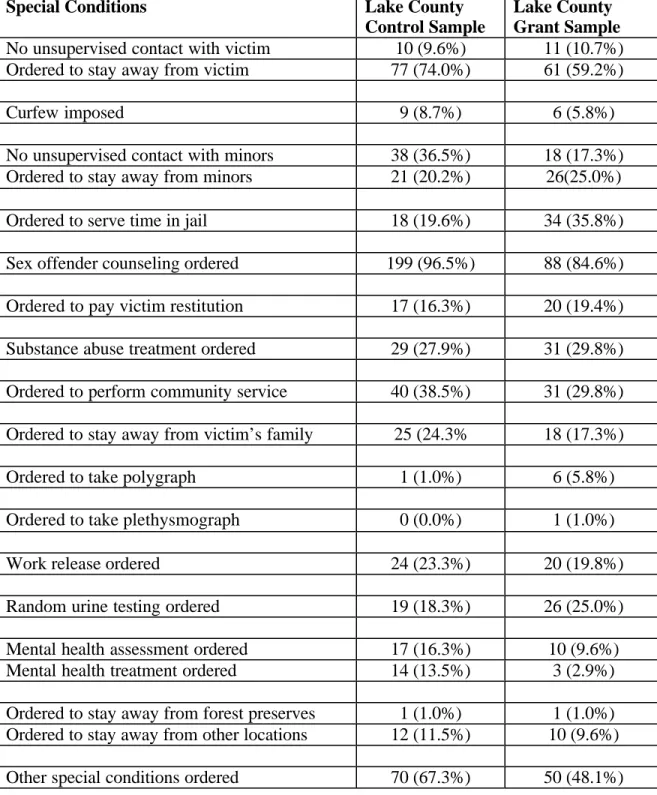
Table III.1: Comparison of Lake County Control and Grant Samples on Court Imposed Special Conditions 24 Table III.2 Comparison of Lake County Gra nt and Control Group on
Risk Factors of Sexual Recidivism 41-42 Table III.3 Control and Grant Samples in Lake County Compared
on Probation Termination Status,
Revocations, and Absconding 45 Table III.4 Generalizable Significant Predictors of Whether a VOP
was filed 50
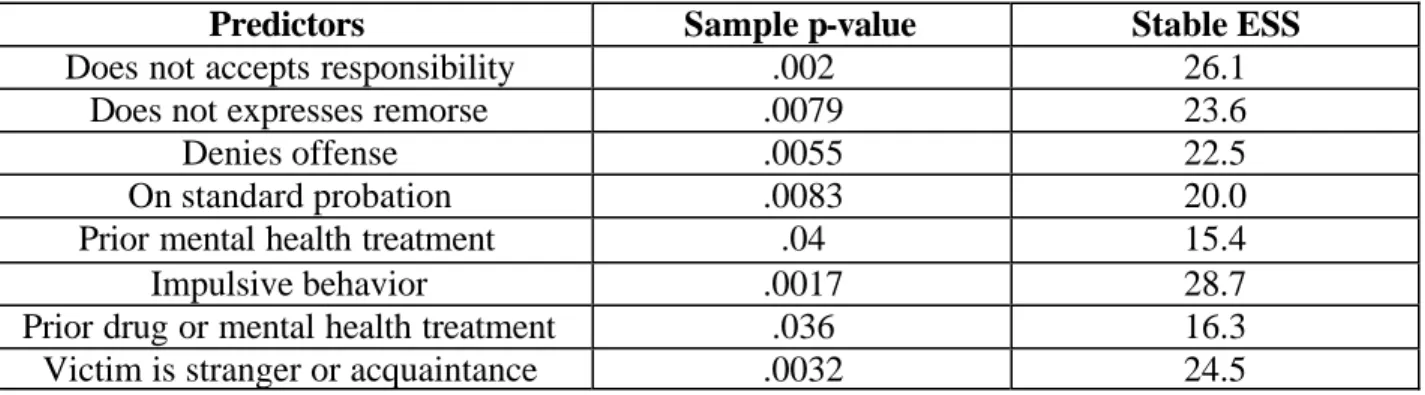
Table III.5 Generalizable Significant Predictors of Whe ther Two or More VOPs were filed in Lake County 54 Table III.6 Generalizable Significant Predictors of Whether Probation Was Terminated Unsatisfactorily in
the Lake County Sample 56 Table III.7 Generalizable Significant Predictors of Whether
Probation Was Revoked 58
Table III.8. Descriptive Statistics of Therapists’ Ratings of Sex Offenders’ Progress in the Last Report in
Lake County (N = 26) 63 Table III.9 Summary of Ipsative Statistical Analysis of Participation,
Commitment and Responsibility Ratings
—Lake County 66
Table III.10 Therapist’s Average Ratings for 24 Sex Offenders in
Treatment in Lake County 67 Table III.11 Descriptive Statistics on Treatment Outcomes for Grant and Control Samples in Lake County 70 Table III.12 Significant Generalizable Predictors of Serious
Noncompliance With Treatment in the Entire
Sample of Lake County 71 Table III.13 Generalizable Significant Predictors of Satisfactory Completion of Treatment in the Entire
Table III.14 Significant and Generalizable Predictors of New Sex
Crimes (Excluding Failure to Register) 78 Table III.15 Generalizable Significant Predictors of Any New Sex Crimes in the Lake County Sample 81 Table III.16 Generalizable and Significant Predictors of New Violent or Sex Crimes in the Entire Sample of Lake County 85 Table III.17 Significant Generalizable Predictors of Committing Any New Crime in the Entire Sample of Lake County
Sex Offenders 87
Table III.18 Generalizable Significant Predictors of Committing Two or More New Crimes of Any Type
in the Entire Sample of Lake County 89
Table III.19 Recidivism of Grant and Control Sample Offenders as Measured by New Arrests and Time to First Arrest 92 Table III.20 Cox Regressions Estimating Time to First Arrest for New Sexual Recidivism, Violent Recidivism, and General
Recidivism in Lake County 100 Table IV.1 Comparison of Probation Conditions in the Standard
and Specialized Sex Offender Programs of
DuPage County 117
Table IV.2 Comparison of DuPage County Grant and Control Group
On Risk Factors of Sexual Recidivism 132-133 Table IV.3 Control and Grant Samples in DuPage Country Compared
on Probation Termination Status, Revocations,
and Absconding 140
Table IV.4 Significant and Generalizable Predictors Related to Filing A VOP Using the Entire Sample of
DuPage County Cases 141
Table IV.5 Significant and Generalizable Predictors of Having Two Or More VOPs Filed Using the Entire Sample
Table IV.6 Significant and Generalizable Predictors of Unsatisfactory Termination of Probation Using the Entire Sample
of DuPage County Cases 148 Table IV.7 Significant and Generalizable Predictors of Revocation
Using the Entire Sample of DuPage County 150
Table IV.8 Descriptive Statistics of Therapists’ Ratings of Sex Offenders’ Progress in the Last Report in
DuPage County 158 Table IV.9 Summary of Ipsative Statistical Analysis of Participation, Commitment and Responsibility Ratings
—DuPage County 161 Table IV.10 Therapist’s Average Ratings for 24 Sex Offenders in
Treatment In DuPage County 163 Table IV.11 Descriptive Statistics on Treatment Outcomes for Grant
and Control Samples in DuPage County 165 Table IV.12 Significant Generalizable Predictors of Serious
Noncompliance With Treatment in the Entire
Sample of DuPage County 166 Table IV.13 Generalizable Significant Predictors of Satisfactory
Completion of Treatment in the Entire Sample of
DuPage County 169
Table IV.14 Significant and Generalizable Predictors of New Sex Crimes Excluding Failure to Register Using the Entire
Sample of DuPage County Cases 174 Table IV.15 Generalizable Significant Predictors of Any New Sex
Crimes in the DuPage County Sample 176 Table IV.16 Generalizable and Significant Predictors of New Violent or Sex Crimes in the Entire Sample of DuPage County 179 Table IV.17 Significant Generalizable Predictors of Committing Any
New Crime in the Entire Sample of DuPage County Sex
Table IV.18 Generalizable Significant Predictors of Committing Two or More New Crimes of Any Type in the Entire
Sample of DuPage County 184 Table IV.19 Recidivism of Grant and Control Sample Offenders as Measured by New Arrests and Time to First Arrest 187
Table IV.20 Cox Regression Models Estimating Time to First Arrest for New Sex Crime, Violent Crimes or Any Type of Crime in
DuPage County 193
Winnebago County
Table V.1 Comparison of Winnebago County Control and Grant
Samples on Court Imposed Special Conditions 212 Table V.2 Comparison of Winnebago County Grant and Control Group
On Risk Factors of Sexual Recidivism 227-228 Table V.3 Control and Grant Samples in Winnebago County
Compared on Probation Termination Status,
Revocations, and Absconding 235 Table V.4 Generalizable Significant Predictors of Whether a
VOP was filed 236
Table V.5 Generalizable Significant Predictors of Whether Probation Was Terminated Unsatisfactorily in the
Winnebago County Sample 240
Table V.6 Generalizable Significant Predictors of Whether Probation Was Revoked in Winnebago County 243 Table V.7 Descriptive Statistics of Therapists’ Ratings of Sex Offenders’ Progress in the Last Report in
Winnebago County (N = 57) 247 Table V.8 Summary of Ipsative Statistical Analysis of Participation,
Commitment and Responsibility Ratings
—Winnebago County 250
Table V.9 Therapist’s Average Ratings for 64 Sex Offenders in Treatment in Winnebago County 253
Table V.10 Descriptive Statistics on Treatment Outcomes for Grant and Control Samples in Winnebago County 256
Table V.11 Significant Generalizable Predictors of Serious Noncompliance With Treatment in the Winnebago County Sample 257 Table V.12 Generalizable Significant Predictors of Satisfactory Completion of Treatment in the Entire Sample of Winnebago County 261
Table V.13 Significant and Generalizable Predictors of Any New Sex Crimes In the Winnebago County Sample 263 Table V.14 Generalizable Significant Predictors of Any New Sex Crimes
in the Winnebago County Sample 265 Table V.15 Generalizable and Significant Predictors of New Violent or
Sex Crimes in the Winnebago County Sample 267 Table V.16 Generalizable Significant Predictors of Any New Crime In the Winnebago County Sample 270 Table V.17 Generalizable Significant Predictors of At Least Two or More New Crimes of Any Type in the
Winnebago County Sample 272
Table V.18 Recidivism of Grant and Control Sample Offenders as
Measured by New Arrests and Time to First Arrest 275 Table V.19 Cox Regressions Estimating Time to First Arrest for Sexual,
Violent, and General Recidivism in Winnebago County 284 Table V.20 Violent Recidivism Estimates for the Standard and Specialized
Programs in Winnebago County 286
Child Molester Sample
Table V1.1 Significant and Generalizable Predictors of Sexual Recidivism Excluding Failure to Register Offenses in
Child Molesters 302
Table VI.2 Risk Assessment Tool of Sexual Recidivism (RAT-SR) 316-317 Table VI.3 Significant and Generalizable Predictors of Violent
Table VI.4 Significant and Generalizable Predictors of General
Recidivism In Child Molesters 322 Table VI.5 Significant and Generalizable Predictors of Serious
Noncompliance with Treatment in Child Molesters 327
List of Figures Lake County
Figure III.1 CTA Model Predicting Whether a VOP was filed 52 Figure III.2 CTA Model Predicting Whether Two or More
VOPs were filed 55
Figure III.3 CTA Model Predicting Termination Status as of
December, 2000 57
Figure III.4 CTA Model Predicting Whether Probation Was
Revoked 60
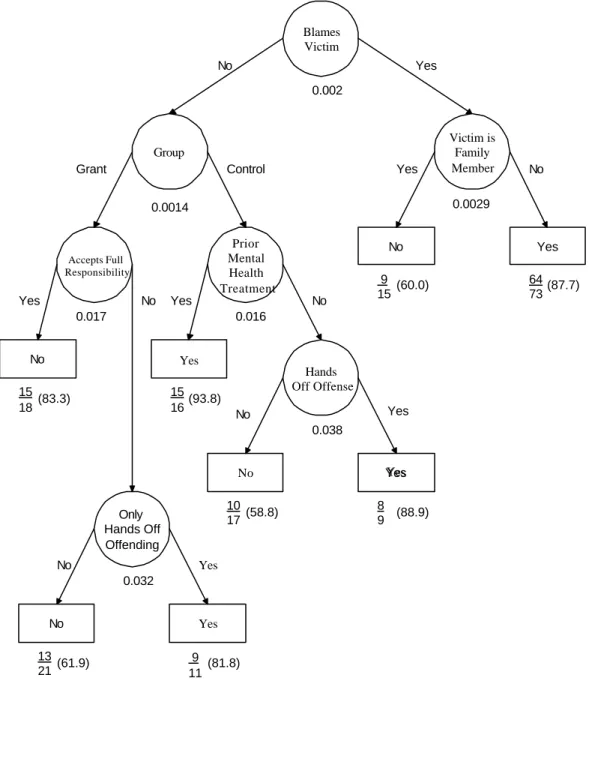
Figure III.5 CTA Model Predicting Failure at Treatment 74 Figure III.6 CTA Model Predicting Satisfactory Treatment
Completion 77
Figure III.7 Admits or Arrested for A New Sex Crime 80 Figure III.8 Prediction of New Arrest for Sex Offense
Including Failure to Register 81
Figure III.9 Prediction of New Arrest for Violent or Sex Crime 86 Figure III.10 CTA Model Predicting General Recidivism 88
Figure III.11 CTA Model Predicting Two or More Arrests For
DuPage County
Figure IV.1 CTA Model Predicting Whether a VOP was filed 143 Figure IV.2 CTA Model Predicting Whether Two or More
VOPs were filed 146
Figure IV.3 CTA Model Predicting Unsatisfactory Termination
Of Probation 149
Figure IV.4 CTA Model Predicting Probation Revocation in
DuPage County 151
Figure IV.5 CTA Model Predicting Serious Noncompliance with
Treatment 168
Figure IV.6 CTA Model Predicting Satisfactory Completion
Of Treatment 172
Figure IV.7 CTA Model Predicting New Sex Crime 175 Figure IV.8 CTA Model Predicting New Sex Crimes
Including Failure to Register 178
Figure IV.9 CTA Model Predicting New Sex or Violent Crime 180 Figure IV.10 CTA Model Predicting New Crime of Any Type 182 Figure IV.11 CTA Model Predicting Two or More New Crimes
Of Any Type 185
Winnebago County
Figure V.1 CTA Model Predicting Whether a VOP was filed 238 In Winnebago County
Figure V.2 CTA Model Predicting Termination Status
As of April, 2001 241
Figure V.3 CTA Model Predicting Whether Probation Was Revoked 244 Figure V.4 CTA Model Predicting Serious Noncompliance with
Figure V.5 CTA Model Predicting Satisfactory Treatment
Completion 262
Figure V.6 CTA Model Predicting New Sex Crimes In
Winnebago County Data 264
Figure V.7 CTA Model Predicting All New Sex Crimes
Including Failure to Register In Winnebago County 266 Figure V.8 CTA Model Predicting New Arrest for Violent
or Sex Crime 268
Figure V.9 CTA Model Predicting New Arrest for Any Crime 271 Figure V.10 CTA Model Predicting Two or More New
Any Crimes 273
Child Molester Sample
Figure VI.1 CTA Model Predicting Sexual Recidivism 311 Figure VI.2 CTA Model Predicting Violent Recidivism 320 Figure VI.3 CTA Model Predicting General Recidivism 325
EXECUTIVE SUMMARY
This Executive Summary reports on a study of the long-term impact of
specialized sex offender probation programs in DuPage, Lake and Winnebago Counties. A previous study reported on the implementation and short-term impact of these three programs (Seng et al. 2000). The current study explores the impact of these programs comparing recidivism and treatment failure of sex offenders who participated in the specialized sex offender probation program (the grant sample) to recidivism and treatment failure of sex offenders on probation who were not part of the specialized program (the control sample). We obtained information about recidivism from Illinois State Police Rap Sheets supplemented with information from FBI criminal histories, violation of probation petitions, polygraph tests, and therapists’ bi- monthly treatment reports. Recidivism was defined as new arrests or self-reports of new offenses after the time that they were arrested for the offense that placed them on probation. Sexual
recidivism was defined as any new sex crime except arrests for failure to register as a sex offender were not included. Violent recidivism was defined as any new violent or sex crime. General recidivism was defined as a new crime of any type, including
misdemeanors such as driving while intoxicated, but other traffic offenses were not included.
The specialized programs, especially Lake County, increased its field surveillance and visits to sex offenders’ homes. This increased surveillance can have two opposing effects. First, increased surveillance may allow probation officers to detect a greater percentage of new crimes that sex offenders commit. For example, probation officers
may discover child pornography on a sex offender’s home computer or may see a sex offender expose himself to a stranger during field surveillance. The higher detection hypothesis predicts that the specialized program will have a higher rate of sexual, violent, and general recidivism than the standard program. By contrast, the second way that increased surveillance may affect sex offenders is to deter them from committing additional crimes due to the fear of being caught and punishment. The deterrence
hypothesis predicts that the specialized program will have a lower rate of sexual, violent, and general recidivism than the standard program. These two opposing effects can result in the specialized and standard probation programs having similar recidivism rates. Even if the two programs have identical recidivism rates, this finding does not mean that the specialized program had no impact because the higher detection effect can mask the deterrence effect. The evaluators, thus, are presented with a conundrum.
To overcome this conundrum, the evaluators used a deterrence conceptual
framework to make predictions about which groups of sex offenders would be deterred or change from the intensive supervision of the specialized programs. Sex offenders can be deterred if they make a rational calculation of the cost (such as a new arrest) and benefits of committing a new crime before they commit the crime. We predicted that mentally ill sex offenders, psychopathic deviants, and sex offenders with sadistic or chronic
aggression problems were not rational and thus should show higher rates of recidivism in the specialized program than in the standard program, which supports the higher
detection hypothesis. We predicted that sex offenders interested in hands-off sexual offending often consider the cost and benefits of committing a sex crime before they commit the crime and should be deterred by the increased surveillance, which supports
the deterrence hypothesis. Sex offenders that have already served a term of probation also may be deterred by the increased supervision because they realize that the
consequences will be more severe if they are caught committing another crime. Sex offenders that have served a prior probation sentence may realize the severe consequence if they commit additional crimes and those on specialized probation may perceive a higher likelihood of getting caught if they commit a new offense; thus, the specialized program should deter sex offenders that have served prior probation and produce lower sexual, violent, and general recidivism rates than the standard program.
Our findings from the implementation study were that each county had successfully implemented a specialized sex offender probation program but in ways unique to each county. Our findings from this long-term impact study mirror this diversity. In general we found that the specialized sex offender program in each county had a positive impact on recidivism for certain groups of sex offenders, and were able to detect higher rates of recidivism for groups of offenders that do not make decisions in a rational manner (e.g., mentally ill offenders). The counties differed in what groups of offenders were affected by the increased surveillance and other conditions of the specialized programs.
This Executive Summary presents a comparison of the standard and specialized sex offender program and major findings for each county. We then discuss the overall implications of the study in general and make final recommendations about risk assessment instruments for child molesters. Our analyses focused on examining recidivism and treatment performances within each county with specific attention to differences between the control and grant samples. An additional and important focus
was identifying groups of offenders in the total sample in each county who were at high risk of recidivism and treatment failure.
The Lake County Program
The essential differences between the standard and specialized programs in Lake County centered upon specialization, caseload and supervision standards. The Lake County probation department had established a sex offender unit in late 1995 with
officers carrying a mixed caseload of regular and sex offender cases. Caseloads averaged approximately 120 cases per officer. The sex offender grant program provided two surveillance officers who were devoted full time to the community supervision and surveillance activities of sex offender cases assigned to probation staff in the sex offender unit. While unit staff continued to carry a mixed caseload, the two surveillance officers handled exclusively sex offender cases. Prior to the specialized sex offender program, the contact standard maintained for sex offenders in Lake County was the Administrative Office of the Illinois Courts (AOIC) standard for maximum supervision of two face-to-face contacts per month and one field visit every other month. The specialized program's contact standards were much more demanding, consisting of a required three field contacts per month in addition to two face-to-face office contacts per month. While the Lake County program experienced some difficulty in meeting its demanding contact standards, the program averaged approximately four face-to-face contacts per month, two above the AOIC standard, and more than doubled the AOIC field visit standard of one every other month to reach an average of 1.7 per month. In addition, the specialized program standardized a set of informal sanctions to apply to offenders for noncompliance
with probation conditions whereas the standard probation program left it up to the discretion of each probation officer. As a result, probation officers in the standard probation program were more likely to resort to the severe sanction of filing a violation of probation petition (VOP), and filed a significantly higher number of VOP petitions than did probation officers in the specialized program.
The standard probation and the specialized sex offender programs accepted any offender sentenced to probation and convicted of any misdemeanor or felony offense that was sexual in nature, even if the convicted offense was not a sex crime. The assignment of special cond itions for sex offenders in both programs was an essentially informal but effective process under which sex offenders were required to meet a set of special conditions. The treatment under both programs was essentially similar. Participation in sex offender cognitive-behavioral group therapy was mandatory in most cases and there was a formal process of probation officer-treatment provider communication in place for both programs.
The research team coded information for 104 offenders in the grant sample and 104 offenders in the control sample. All cases that were sentenced between July 1997 and May 1999 were included in the grant sample. The research team selected control cases from generated lists of sex offenders on standard probation between 1994 and July of 1997. All coded information came from probation department case files, except information on criminal history, which was coded from rap sheets obtained from the Illinois State police. The Lake County grant and control samples were found to be similar on the vast majority of demographic, offense, and risk characteristics examined.
conviction whereas the control sample showed somewhat lower socio-economic status and a previous history of mental health treatment combined with greater illicit drug use. The amount of time that sex offenders were evaluated for recidivism averaged 34.5 months in the grant sample and 57.6 months for the control sample.
Rates of Recidivism
After controlling for opportunity and other predictors, the grant and control sample did not differ on rates for sexual recidivism, violent recidivism, or general recidivism. For the entire sample, the average sexual recidivism rate at the mean of the covariates was 4.1% at one year, 9.9% at two years, 16% at three years, 22.6% at 49 months, and 33.3% at five years. A review of 61 studies on sex offender recidivism found an average of 13.4% sexual recidivism within an average follow- up period of four to five years (Hanson & Bussiere, 1998). Though Lake County’s rates are somewhat higher, it is important to keep in mind that the higher surveillance increases detect of crimes and that prior studies were less likely to contain exclusively hands-off sex offenders. Moreover, Lake County’s rates appear favorable in comparison to a study that tracked sex offenders released from prison; within three years, about half of the offenders had been rearrested for a felony sex crime and 60% had been rearrested for a violent crime (Greenfeld, 1997). Lake County’s violent recidivism rates at the mean of the covariates were 6.7% at one year, 15% at 25 months, 21.8% at three years, 31.9% at 49 months, and 39.3% at 62 months. The average rates of general recidivism at the mean of the covariates were 12.2% at one year, 25.8% at two years, 37.5% at three years, 51.1% at four years, and 69.3% at 62 months.
Specialized Probation And Higher Detection Effect
Mentally ill sex offenders had much higher sexual recidivism rates in the specialized program than in the standard program, suggesting that the specialized
program was able to detect crimes that typically would not be reported or detected in the standard probation program. Similarly, psychopathic deviant sex offenders or offenders with sadistic personalities also had higher sexual recidivism rates in the specialized program than in the standard program. Mentally ill offenders, psychopathic deviants, and sadistic offenders are unlikely to consider the costs and benefits of offending, and thus are likely to continue with their offending behaviors, irrespective of the intensive community-based supervision. The higher surveillance of the specialized program is a better alternative than standard probation because it is able to catch a higher number of these high-risk offenders when they commit new offenses. Moreover, the specialized program should consider increasing the surveillance of these groups and the courts should consider either placing these offenders in a mental health hospital for a period of time or giving these offenders a jail sentence in addition to their probation sentence. If these offenders cannot be deterred or changed through higher surveillance and jail time, prison seems the only remaining alternative.
Specialized Probation and Deterrent Effect
Sex offenders that were interested in hands-off offenses (e.g., exhibitionism, voyeurism), even if they also were interested in hands-on sex offending, were less likely to be arrested for a new sex offense in the specialized program than in the standard probation program. In the standard program, sex offenders with an interest in hands off
sexual offending had a higher rate of sexual recidivism than did exclusively hands-on sex offenders, suggesting that hands-off sex offending is a risk factor associated with sexual recidivism. However, the specialized program was able to deter this high-risk group, and in this program sex offenders with an interest in hands off sexual offending had a lower rate of sexual recidivism than did the exclusively hands-on sex offenders. Sex offenders with an interest in hands off sexual offending also had lower rates of violent and general recidivism in the specialized program than in the standard program. These findings suggest that the specialized sex offender probation program with its higher surveillance and other restrictions contributed to deterring hands-off sex offenders from committing additional sex crimes and exclusively hands-off sex offenders from committing any type of crime.
Predictors of Sexual Recidivism
Consistent with the literature, objective sexual preference was the strongest predictor of sexual recidivism. Offenders with a sexual preference for children had about an 85% chance of sexual recidivism if they had victimized strangers or acquaintances and only a 29% chance if they had victimized family members. When sexual preference for children was unknown or nonexistent, at least one prior arrest for a misdemeanor crime was the strongest predictor. In addition, single or divorced men with access to children or who completely denied the offense had a moderately high chance of committing a new sex crime. Hands-off offending, mental illness, psychopathic deviancy, and sadistic personality also are high- risk predictors of sexual recidivism.
Predictors of Violent Recidivism
Marital status was the strongest predictor of violent recidivism with single or divorced offenders more likely to commit new offenses. This finding is consistent with the literature. The seven variable CTA model revealed three groups in the highest risk category and one group in the moderately high-risk category. Single or divorced sex offenders were at the highest risk of violent recidivism if: (1) they committed prior property crimes and forced the sexual offense; or (2) they committed prior property crimes and began criminal offending before the age of 18. Single or divorced offenders also were at a moderately high risk if they had been committing sexual offenses for four or more months and were at a low risk if they had been committing sexual offenses for three months or less. Married or separated sex offenders were generally at low risk of general recidivism. Married or separated sex offenders are placed in the high-risk category if they have at least one prior arrest and conviction.
Predictors of General Recidivism
Offenders were at high risk of general recidivism if they began criminal
offending: (1) before the age of 28 and used alcohol; or (2) at the age of 28 or later, had a substance abuse problem, and victimized a family member. Our findings suggest that risk assessment instruments for general recidivism of sex offenders should score five characteristics as high risk factors: (1) age younger than 28 at time of first criminal offend ing; (2) substance abuse; (3) alcohol use; (4) single marital status; and (5) charged with a misdemeanor crime. Offenders with three of these five characteristics should be
considered high-risk. In addition, offenders should be considered high risk if they are in one of the two clusters described above.
Probation Outcomes
The control and grant samples did not differ on the percentage of offenders who terminated probation satisfactorily, the percentage that were revoked or the percentage of offenders who absconded from probation. Offenders had a very high chance of
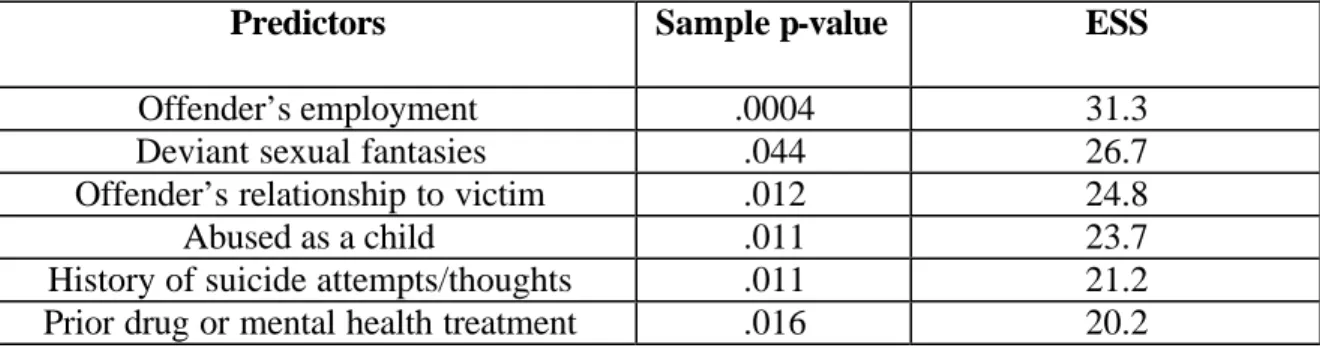
satisfactory termination of probation (92.5% chance) if they had no prior arrests for misdemeanors and expressed great remorse for the offense. Offenders were most likely to be revoked if they were unemployed or part-time employed and used physical force to commit the sex crime. Moreover, data suggest that the Lake County Courts considered new arrests for sex crimes in making revocation decisions, but new arrests alone was not either a necessary nor sufficient reason to revoke an offender’s probation.
Compliance with Treatment
In the specialized sample, N-of-1 analysis of the bi- monthly treatment reports for twenty-six offenders revealed that 7 of the offenders had a significant improvement across time or a significant improvement relative to all sex offenders in the three counties. Overall, 13 of the 26 Lake County sex offenders in the specialized program were classified as responsive to treatment.
A significantly higher percentage of grant sex offenders compared to control sex offenders did not have a VOP filed for noncompliance with treatment. This finding may reflect the greater use of administrative sanctions on the part of specialized probation
officers rather than a greater compliance with treatment among sex offenders on specialized probation. Supporting the differential use of administrative sanctions, the control and grant sex offenders had similar rates of serious noncompliance with
treatment, and control offenders, in part due to the larger number of closed cases, were significantly more likely to complete treatment satisfactorily. Across both samples, 33 of the 79 cases that had a VOP filed for noncompliance with treatment eventually completed treatment satisfactorily, which suggests that the sanction motivated some sex offenders to participate in treatment.
Having a VOP filed for treatment noncompliance was significantly related to sexual recidivism, after opportunity and other significant predictors were controlled. This finding suggests that treatment noncompliance is another risk predictor of sexual recidivism, and that the Lake County probation department may want to increase surveillance when a sex offender becomes noncompliant with treatment.
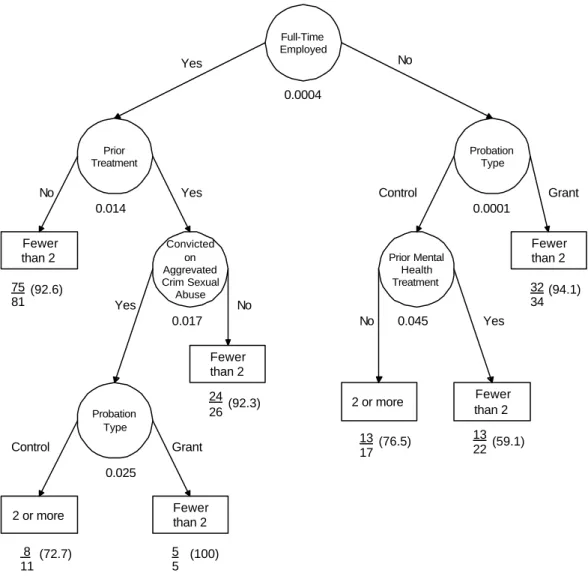
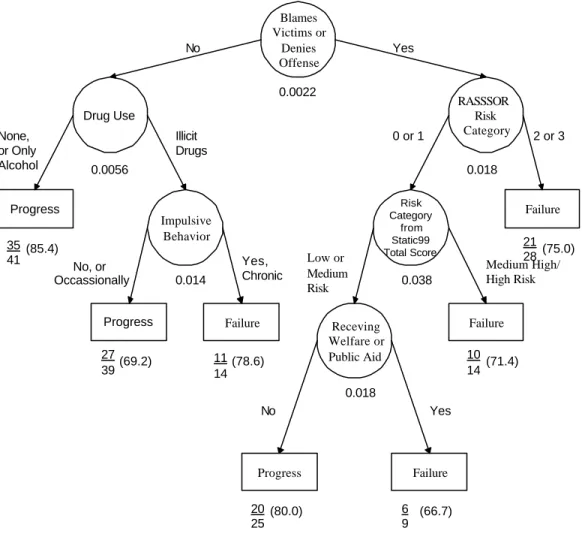
A CTA model showed strong performance in predicting serious noncompliance with treatment. There were two high-risk groups that blamed the victim or denied the offense: (1) those that victimized strangers or acquaintances; and (2) those that had a criminal lifestyle with two or more prior arrests for any crime. Sex offenders that blamed the victim or denied the offense were at a moderately high risk of treatment failure if they had mental illness, victimized boys, and were on public aid; this group of offenders was at a low risk if they were not on public aid. Sex offenders that accepted or minimized responsibility were at a high risk of serious noncompliance with treatment if they used illicit drugs and had a chronic history with impulsive behavior and were at a low risk if they did not use illicit drugs.
The DuPage County Program
The essential difference between the control and grant cases in DuPage County centered on specialization, caseload, and contact standards. Prior to the grant program, DuPage County had a special unit for sex offender cases but probation officers in this unit serviced a mixed caseload of sex offender and regular probation cases. Caseloads averaged approximately 100 per officer. Under the grant program, instituted in 1997, two officers were designated to carry only sex offender cases and caseloads averaged 43 for each of these officers. Also, prior to the grant program, the contact standard maintained for sex offenders in DuPage County was the AOIC standard for maximum supervision. The grant program's contact standards were much more stringent based on a three- level supervision system that required four face-to-face contacts per month in level I, two of which were to be home or field visits. Contact standards in level II were reduced to three face-to-face contacts per month and level III consisted of the AOIC standard for
maximum supervision. While the DuPage County program experienced considerable difficulty in meeting its field visit standards, overall face-to- face contacts averaged close to three per month, one visit above the AOIC standard for maximum supervision.
The control and grant cases did not differ in target population. Both served similar populations of sex offender cases that included any offender convicted of a misdemeanor or felony sex crime or any offender convicted of a non-sex crime that the judge specifically ordered into the specialized program (the latter was a rare event). Also, approved sex offender treatment providers plus requirements for an initial and maintenance polygraph have been a part of the program since 1995. Treatment providers
and program staff have maintained a regular bi- monthly meeting schedule since the inception of the sex offender team, a practice that was continued throughout the period of the grant program. Beginning in 1996, sex offender probationers were required to comply with 15 special conditions. The specialized program did more frequent polygraph testing and routinely required sex offenders to submit to urine analysis. In our examination of the specialized probation sample cases, polygraph examinations were given to 77.6% of the cases with 45.8% receiving two or more polygraph tests. In comparison, we only found two polygraph tests for the control sample. Additionally, a total of 721 drug tests were administered in the specialized probation sample.
The research team selected control cases from lists of sex offenders on standard probation between January 1993 and June 1996. All coded information came from probation department case files, except criminal history was coded from rap sheets obtained from the Illinois State Police. The grant and control samples were found to be similar on the vast majority of demographic, offense, and risk characteristics examined. The grant sample, however, included a significantly greater percentage of sex offenders who are sexually aroused by children, who have committed prior sex crimes, who have more sexual paraphilia, who have a current mental health problem, and who are at higher risk of sexual recidivism based on the SAC-J. The amount of time that sex offenders were tracked averaged 32.8 months in the grant sample and 78.1 months in the control sample.
Rates of Recidivism
After controlling for opportunity and other predictors, the standard probation program and the specialized sex offender program did not differ on sexual, violent, or general recidivism rates. The overall sexual recidivism rates at the mean of the covariates were8% at one year, 1.9% at 25 months, 5.1% at three years, 11.1% at 49 months, and 21.4% at 62 months. The overall violent recidivism rates at the mean of the covariates were 2.1% at one year, 3.7% at 25 months, 8.2% at three years, 16.3% at 49 months, and 28.4% at 62 months. The overall general recidivism rates at the mean of the covariates were 15% at one year, 24.6% at two years, 33.4% at three years, 43.7% at 49 months, and 55.6% at 62 months.
Specialized Probation And Higher Detection Effect
While recidivism rates did not differ, there was a difference between the two programs in terms of mental healt h status as a high- risk predictor of sexual recidivism. Mental health status was a high-risk predictor of sexual recidivism in the specialized sex offender program but was not a relevant predictor in the standard probation program, suggesting that the specialized program was more effective at detecting sexual recidivism by mentally ill offenders than was the standard probation program.
Specialized Probation and Deterrent Effect
We also tested whether sex offenders interested in hands off sexual offending in the specialized program had a lower rate of sexual recidivism than sex offenders
deterrent effect. Hands-off sex offending refers to exhibitionism, voyeurism, public indecency, and other sex acts where the offender does not touch the victim. Findings indicate that hands-off offending was a significant high-risk predictor of sexual recidivism in both the standard probation and specialized probation programs, and the two programs did not differ. This suggests that the specialized sex offender program’s more intensive supervision did not deter hands-off offenders from committing sex crimes.
There, however, was a difference in rates of general recidivism. Hands-off offenders in the specialized program were less likely to be arrested for new crimes of any type than were hands-off offenders in the standard program. An examination of the types of crimes that resulted in new arrests indicates that sex offenders interested in hands off sexual offending in the specialized sample focused primarily on sex crimes.
Furthermore, the specialized program group of hands-off sex offenders were significantly more likely than the standard program hands-off offenders to have two or more sexual paraphilia, a current mental health problem, and to have committed the sex offending over a longer period of time. These differences suggest that hands-off offenders in the specialized program may have been less calculating in their sexual offending and more driven by compulsive or impulsive behavior, and less likely to be deterred from sexual recidivism by knowledge of the specialized program’s procedures. This pattern of findings indicates that the specialized program did not deter sex offenders interested in hands off sexual offending from committing recidivism in general. In addition, two key features of the DuPage County specialized program may have contributed to no deterrent effect: (a) announced field or home visits, and (b) probation officers infrequently going to the treatment site to check on attendance and/or observe group therapy sessions.
Sex offenders that had served prior periods of probation benefited from the specialized program; these offenders had a significantly lower rate of violent recidivism in the specialized program than in the standard program. Moreover, serving a prior period of probation was a high-risk predictor of violent recidivism in the standard program, but did not predict violent recidivism in the specialized program. These findings suggest that sex offenders that had served prior periods of probation were
deterred from committing violent crimes through their knowledge that they would have to submit to polygraph testing, were under increased supervision, and the fact that such arrests were more likely to result in a more severe sentence.
Predictors of Sexual Recidivism
It should be noted that DuPage County’s treatment evaluations did not contain information about psychopathic deviancy and 65% of the control and 33% of the grant samples did not have information about objective sexual preference; thus, these
characteristics could not be tested, but still should be considered important risk indicators of sexual recidivism. We suggest that DuPage County implement a policy requiring all treatment evaluations to contain an objective sexual preference test and an objective personality test that measures psychopathic deviancy.
Findings from classification tree analyses (CTA) indicate that mental health status and a preference for hands-off offending were two key predictors of sexual recidivism. Mentally ill offenders interested in hands-off offending and with some college education had about a 75% chance of sexual recidivism excluding failure to register offenses.
Another important observation is that none of the formalized risk assessment instruments were significant and stable predictors of sexual recidivism. Moreover only one risk assessment instrument, the Static-99, was a significant predictor, but did not rema in stable in the leave-one-out (LOO) analysis. Our CTA model showed substantial improvement in overall classification accuracy and in sensitivity at predicting those who committed sexual recidivism compared to the Static-99 classification.
Another implication of the importance of mental health status is that clinicians and probation officers should consider sex offenders that have been diagnosed with bipolar depression, thought disorders, adjustment disorders, or personality disorders as having a higher risk of recidivism. Future studies should further test the importance of mental health status. Whereas sex offenders can more easily fool treatment evaluators about their sexual preferences or psychopathic deviancy (especially when objective tests are not performed), they have more difficulty hiding other mental health problems. In our samples, many sex offenders with an objective sexual preference for children also had other mental health problems.
Predictors of Violent Recidivism
In predicting violent recidivism (which included violent and sexual offenses), one risk assessment instrument, the SAC-J, was significant and generalizable and improved classification accuracy 22.4% over what could be explained by chance. However, our CTA model showed an improvement of classification accuracy of 36.5% over chance using only two predictors, mental illness and hands-off offending whereas the SAC-J uses 11 predictors. In the CTA model, mentally ill offenders with an interest in hands-off
offending had a moderately high chance of committing new sex or violent crime. Offenders with no known mental illness but also with an interest in hands-off offending had a medium risk of committing new sex or violent crime. Offenders with no interest in hands-off offending had a low chance of committing new sex or violent crime.
Predictors of General Recidivism
Marital status combined with other factors was a key predictor in predicting general recidivism. Married or widowed sex offenders were at very high risk of general recidivism if they denied the offense and were 37.5 years of age or younger and at
moderate risk of general recidivism if they used drugs before committing the offense that placed them on probation. There were two groups of unmarried offenders that were at very high risk of general recidivism: (1) offenders with at least one prior conviction; and (2) offenders in the specialized program without prior convictions but who were placed on probation for a misdemeanor crime.
Probation Outcomes
A significantly higher percentage of specialized program offenders compared to standard program offenders terminated probation unsatisfactorily. The two programs did not differ on rates of revocation or absconding. Offenders who used drugs before
committing the offense that placed them on probation were at very high risk of
unsatisfactory termination if they also had one prior arrest for a violent crime. They were at moderate risk of unsatisfactory termination if they had no prior arrests for a violent crime, but at least one prior arrest for a property crime. There were no very high-risk
groups of offenders who did not use drugs. Offenders who used drugs before committing their offense or needed drug treatment were also at a high risk of being revoked. Thus, drug use is a key variable in probation outcome.
Compliance With Treatment Orders
The research team examined the number of violation of probation (VOP) petitions filed for treatment noncompliance and used significant declines in treatment progress from the monthly treatment reports as well as premature termination of treatment to define serious noncompliance with treatment. Offenders on the specialized program compared to the standard program were more likely to have VOPs filed for
noncompliance with treatment and to have serious noncompliance with treatment. Moreover, offenders in the standard program were significantly more likely to complete treatment satisfactorily than were offenders in the specialized program. It appears that these differences are not due to probation officers in the standard program allowing more chances to comply with the treatment order before filing a VOP. An almost identical proportion of the grant and control sample (approximately 45%) had at least one VOP filed, and were similar on the average number of months on probation until the first VOP was filed. Furthermore, the difference between the specialized and standard probation programs on successful completion remains after controlling for mental health status, marital status, using drugs before the crime, prior convictions and other significant predictors identified by ODA. Upon further analyses, treatment noncompliance is a predictor of sexual recidivism in the specialized program, but is not a predictor in the standard program. This finding suggests that in the specialized programs, sex offenders
that were noncompliant with treatment may have been scrutinized more closely (perhaps through a polygraph exam) and new sex crimes were discovered. Supporting this
explanation, 26.9% (N = 7 out of 26) of the offenders with treatment noncompliance revealed during a polygraph exam that they had committed at least one new sex crime since being placed on probation whereas 9% (N = 5 out of 55) of sex offenders that were compliant with treatment indicated that they had committed a new sex crime. In addition, probation officers supervising cases in the specialized program may have used
administrative sanctions to handle lack of participation in treatment, missed homework assignments, and unexcused absences, and waited until a sex crime was committed to file a VOP for violation of treatment orders. Thus, there are two possible explanations for this difference that sex offenders in the specialized program were more likely to be noncompliant.
Sex offenders with no known mental illness and no prior convictions had a very high chance of successful completion of treatment. Mentally ill sex offenders had a 60% chance of treatment failure if they used drugs before committing a sex crime and a 25% of treatment failure if they did not use drugs before committing a sex crime. Sex offenders that used drugs before the sex crime may have had more difficulty breaking their denial and may have attributed the sex crime to the use of drugs. Offenders with no known mental illness and with at least one prior conviction had a 68% chance of
treatment failure and an even higher chance of treatment failure if they did not disclose a prior sex crime to the treatment provider or were not arrested for a prior sex crime. These findings indicate how the high risk predictors such as mental illness, prior convictions
and use of alcohol or drugs before the commission of the sex crime should be combined to provide the optimal prediction of treatment failure.
The Winnebago County Program
Prior to the implementation of the specialized sex offender program, sex offenders in Winnebago County were supervised along with all other cases as part of regular
probation and were part of the regular 202 cases per officer. Supervision standards for sex offender cases were the AOIC standard for maximum supervision cases of two face-to-face contacts per month and one field visit every other month. The specialized sex offender program, instituted in 1997, designated two senior probation officers to form a sex offender unit that would supervise sex offender cases only. Also, supervision standards were increased using a three- level supervision system that required four face-to-face contacts per month in level I, of which two were to be home or field visits. Contact standards in level II required three face-to- face contacts per month and level III, one to-face contact per month. In actuality, Winnebago averaged a total of 3 face-to-face contacts for Level I offenders, and a total of 2 face-to- face contacts for Level II offenders.
In addition to contact standards, the specialized sex offender probation program and regular probation differed on target population. All sex offenders convicted of either misdemeanor and felony sex offenses were included in the regular probation program. The specialized program was restricted primarily to felony offenses. Sex offenders in both the regular and specialized programs were required to meet a set of special conditions that typically restricted contact with the victim, with minors, and made sex
offender treatment mandatory. The treatment program under both programs was essentially similar except that it was more structured under the specialized sex offender program. Also, probation officer-treatment provider contacts were greatly increased under the sex offender program. The research team coded information for 105 offenders in the grant sample and 103 offenders in the control sample. All cases that were
sentenced between July 1997 and February 2000 or were grand fathered into the grant program were included in the grant sample.
The research team selected control cases from lists of sex offenders on standard probation between June of 1989 and July of 1997. Cases were randomly selected through selecting every fourth case in an alphabetized list of offenders until the sample size was reached. All coded information came from probation department case files, except that criminal history was coded from rap sheets obtained from the Illinois State Police. The grant and control samples were essentially similar on demographic, offense and risk characteristics examined. The amount of time that offenders were tracked averaged 37.6 months for the grant sample and 83.8 months for the control sample.
Rates of Recidivism
The standard and specialized probation programs did not differ on rates of sexual recidivism. The overall sexual recidivism rates at the mean of the covariates were .4% at one year, 4.4% at 28 months, 6.4% at 38 months, 7.2% at 53 months, and 8.6% at 76 months. However, the specialized probation had significantly lower rate of violent recidivism than did the standard program. The average violent recidivism rates at 36 months were 25% in the standard program compared with 4.94% in the specialized
program. The standard and specialized probation programs did not differ on rates of general recidivism. The overall general recidivism rates at the mean of the covariates were 9.7% at one year, 19.3% at two years, 21.9% at three years, 26.6% at four years and 32.7% at 62 months.
Specialized Probation And Higher Detection Effect
The Winnebago specialized probation program only conducted home visits between 9:00 a.m. and 5:00 p.m. during the weekdays, and averaged 1.3 home visits for Level I offenders and one home visit for Level II offenders per month. The program was not able to detect a higher rate of sexual offending in mentally ill sex offenders due in large part to how the home visits were structured.
Specialized Probation and Deterrent Effect
Winnebago's specialized program differed from the standard program in two key ways. First, the increased office contacts and other requirements provided more structure particularly for offenders with prior probation experience than was likely the case for standard probation. Secondly and of perhaps greater import was that probation officers in the specialized program had a particularly effective partnership with treatment providers that prevented sex offenders from playing professionals against each other, and probation officers attended joint meetings with treatment providers and offenders to discuss goals, requirements, and progress. This partnership and the increased office contact provided more structure and perhaps motivated offenders to participate in treatment and comply with the law.
The Winnebago program was particularly more effective than standard probation for certain groups that are traditionally considered at high risk of recidivism such as offenders who have served a prior period of probation and those with prior mental health or drug treatment. Offenders with a history of mental health or drug treatment had a lower rate of sexual recidivism in the specialized program than in the standard probation program. Sex offenders with a prior period of probation had significantly lower general and violent recidivism rates in the specialized program than in the standard program.
Predictors of Recidivism
Because Winnebago treatment evaluations did not contain this information about objective sexual preference or psyc hopathic deviancy, and often did not contain
information on mental illness, it was difficult to find a strong CTA model that predicted sexual recidivism. Our recommendation thus is to use formal risk assessment
instruments and also consider offenders who victimize strangers or acquaintances and have an objective sexual interest in children as high risk for sexual recidivism. In addition, findings from CTA analyses suggest the following characteristics are high-risk predictors of sexual recidivism: prior incarceration, hands-off offending, offenders with chronic impulse control problems and prior convictions, and offenders on standard probation who have prior mental health or drug treatment.
The Static-99 risk instrument also was a significant and generalizable predictor of violent or sexual recidivism, explaining 18.1% of the classification error above chance classification. However, our CTA model for violent/sexual recidivism outperformed the STATIC-99 and explained 45.6% of the classification error above what could be
accounted for by chance. Offenders who are single and started criminal offending at a 18 years of age or younger are at very high risk of violent recidivism whereas single
offenders who started criminal offending after the age of 18 had a low chance of violent or sexual recidivism. Offenders who have prior drug or mental health treatment and victimized strangers or acquaintances had a moderately high chance of sexual or violent recidivism. Offenders who had no prior drug or mental health treatment and were married, separated, or divorced had a low chance of violent or sexual recidivism. Marital status, prior criminal history, length of time of sexual offending and educational level are all important characteristics to consider in assessing risk of general recidivism.
Probation Outcomes
The specialized sex offender probation program and the standard probation program did not differ on the percentages of offenders who completed probation
satisfactorily, but they did differ on the predictors of unsatisfactory termination based on CTA analyses. Mental illness and prior arrests for misdemeanors interacted to predict unsatisfactory termination for the specialized program. Educational level and lack of remorse interacted to predict unsatisfactory termination for the standard program. The two programs also did not differ on the percentage of offenders who were revoked. Not surprisingly, having an arrest for a new sex crime committed while on probation was a significant and reliable predictor of probation revocation but this was only a modest predictor. Criminal history and social adjustment were much stronger predictors of revocation than an arrest for a new sex crime. Few offenders in either program absconded.
Compliance with Treatment Orders
While the majority of offenders in both programs completed treatment satisfactorily, more of the standard probation program offenders had serious
noncompliance with treatment than was the case for the specialized program offenders. This reflects the more intensive probation officer-therapist partnership under the specialized program. Our analyses indicate that the three most important predictors of serious noncompliance with treatment are: needing substance abuse treatment, prior arrests for violent offense, and denial of the offense. On the other hand, expression of great remorse for the offense was the strongest predictor of completing treatment satisfactorily.
Overall Conclusions about Risk Assessment for Child Molesters
In order to make final recommendations about risk assessment, we combined data from all three counties including all offenders that victimized children under the age of 18 (N = 478). Twelve significant and generalizable predictors of sexual recidivism emerged in the combined child molester sample. From the five CTA models, we
recommend that the following characteristics are routinely assessed and incorporated into risk assessments:
• Objective or subjective sexual preference for children,
• Interest in hands-off sexual offending,
• Sexual paraphilia,
• Substance abuse.
In addition, our analyses suggest that current risk assessment tools place too much importance on prior arrests for sex crimes. Our analyses also highlight critical
combinations of variables that are incorporated into a proposed scale, we labeled, Risk Assessment Tool of Sexual Recidivism (RAT-SR). The RAT-SR has much better predictive accuracy than current risk assessment tools available.
Overall Conclusions About the Evaluation Design
Most prior evaluations of specialized or intensive supervision probation programs have failed to appreciate the opposing dual effects of increased monitoring. Prior
research has used less sensitive analyses to determine whether the specialized group differed from the comparison group on recidivism rates. Our subgroup analyses, with the testing of interaction effects, have enhanced evaluation designs. Future evaluations now will be able to provide more sensitive and thorough analyses of the effects of a program. Moreover, the CTA analyses that we have used to determine the predictors of sexual, violent, and general recidivism represent an advancement over the traditional linear logistic regression analyses.
I. Introduction
Sex offenders, especially child molesters, are regarded as malicious, deceitful, self-centered, perverted, and dangerous, tenacious individuals. Still, society must deal with these offenders and try to protect our children and women. It is easy to provide that knee-jerk response: ‘just lock them away’. Prisons, however, are overcrowded and sex offenders are eventually released and reside in communities, often next to many children and women. Recent research indicates that sex offending may be a life- long problem for many sex offenders. Prentky, Lee, Knight, and Cerce (1997) conducted a longitudinal analysis of recidivism rates among 251 sex offenders who were discharged from the Massachusetts Treatment Center for Sexually Dangerous Persons over a twenty- five year period. The failure rate for having a new sexual offense charge among child molesters at the end of the study period was 52%, with an average of 3.64 years before reoffense. The failure rate for having a new sexual offense charge among adult rapists was 39%, with an average of 4.55 years before reoffense.
Despite the potential for a high failure rate, convicted sex offenders often receive a term of community-based probation as their sentence. A study that analyzed almost 1,000 cases of child sexual assault from ten jurisdictions found that 64% of the convicted sex offenders received probation and in 61% of those cases counseling was ordered as a condition of probation (Smith, Elstein, Trost, & Bulkeley, 1993). In 1996, 4,331 child molesters were registered with the police departments in Illinois (Welter, 1997). In contrast to other criminal offenders, child molesters are often productive members of a community and can be found at all levels of social status and occupational prestige (e.g., Greenfeld, 1996). Child molesters are employed in unskilled labor jobs, skilled jobs, a
professional occupation, and some are unemployed. Some child molesters also have family ties that still remain strong even after their offenses are revealed. Judges may choose a sentence of standard probation after considering successes in other areas of a child molester’s life. Moreover, many child molesters, especially those who molest young children, may receive standard probation as part of a plea agreement due to the weakness of the evidence or the desire not to put children through a trial. Many
jurisdictions now acknowledge that standard probation provides insufficient monitoring and surveillance of convicted child molesters serving community-based sentences
(Lurigio, Jones, & Smith, 1995). Standard probation, however, still remains a frequently used option for many child molesters.
Across the nation, several jurisdictions have begun to address the limits of standard probation for supervising sex offenders. Intensive supervision programs that combine treatment and home visits are considered an alternative to standard probation. Loyola University received a grant from the Illinois Criminal Justice Information Authority to evaluate specialized intensive supervision sex offender units in Lake County, DuPage County, and Winnebago County. All three specialized probation programs are based on the containment approach, which is a nationally recognized intensive supervision community-based probation model for sex offenders (English, Pullen, Jones, & Krauth, 1996). The containment approach has three major components: (a) intensive supervision of offenders which includes frequent field searches of offender’s homes and the verification of information obtained ve rbally from offenders; (b) treatment which emphasizes a cognitive-behavioral group therapy approach supplemented with cognitive-behavioral individual counseling; and (c) a partnership between probation
officers and treatment providers that includes frequent communication and the sharing of relevant information on specific offenders. Though all three specialized programs have a similar foundation and philosophy, they differ widely in what components of the
containment approach are emphasized. These differences will be described in Chapters III, IV, and V on the evaluation of each county’s specialized sex offender unit.
A. Evaluations of Probation Programs and Recidivism
Few studies have focused on sex offenders that are sentenced to standard probation and continue to reside in the community after their conviction. Berliner,
Schram, Miller and Milloy (1995) examined recidivism rates of offenders who received a suspended jail sentence and were required to serve a probation term with mandatory treatment. Forty- four percent of probationers violated at least one of their conditions of probation. The most common violation was treatment participation, followed by
noncompliance with financial obligations, and crime-related prohibitions. Seventeen percent of the probationers had their probation revoked. Offenders who were sentenced to the program were less likely to be rearrested for a sex offense during the first two years compared to offenders who served only jail time. Another prior study conducted in Vermont collected data from 122 adult male Caucasian sex offenders placed on probation at some point during a twelve-year period. The sample was comprised of 91 child
molesters, 23 rapists, and eight “hands-off” offenders. The average time at risk was a little over five years, and 18.9% of the sex offenders were arrested for a new criminal offense of any kind (McGrath, Hoke, & Vojtisek, 1998).
Only two studies have examined possible risk markers for sex offenders on probation. Hanson (1998) reports an ongo ing study of probation and parole officers’ retrospective accounts of characteristics that distinguish 208 recidivist and 201 nonrecidivist sexual offenders. “Recidivists were described as having negative social relationships, holding attitudes tolerant of sexual offending, and lacking self- management skills.” (Hanson, 1998, p. 59) These retrospective accounts are informative, but cannot reveal the characteristics that lead to optimal predictions of noncompliance risk.
Maletsky (1990) followed almost 4,000 outpatient sex offenders for between one and 17 years. Men who had worked at three or more jobs during the three years preceding their offense or were unemployed at the time of their offense were almost four times more likely to be treatment failures compared to men who had more stable employment. Treatment failure included not completing treatment, maintaining a deviant arousal pattern throughout treatment, or being arrested for a sexual offense.
In the current evaluation, we have compared a sample taken from the specialized sex offender probation to a sample of sex offenders on standard probation in each county. The major outcomes are sexual recidivism (all new sex crimes excluding failure to
register offenses), violent recidivism (all new sex and violent crimes excluding failure to register offenses), and general recidivism (new crimes of any type). In addition, we have compared the programs on probation termination status, revocations, absconding, serious noncompliance with treatment, and successful completion of the sex offender treatment program.