ISSN: 2252-8938, DOI: 10.11591/ijai.v6.i4.pp159-165 159
Classification of Road Damage from Digital Image Using
Backpropagation Neural Network
Sutikno, Helmie Arif Wibawa, Prima Yusuf BudiartoDepartment of Computer Science/Informatics, Diponegoro University
Article Info ABSTRACT
Article history: Received Aug 23, 2017 Revised Oct 25, 2017 Accepted Nov 8, 2017
One of the biggest causes of death in the world is a traffic accident. Road damage is one of the cause factors from the traffic accident. To reduce this problem is required an early detection against road damage. This paper describes how to classify road damage using image processing and backpropagation neural network. Image processing is used to obtain binary image consists of a normalization, grayscaling, edge detection and thresholding, while the backpropagation neural network algorithm is used for classifying. The conclusion of this test that the algorithm is able to provide the accuracy rate of 83%. The results of this research may contribute to the development of road damage detection system based on the digital image so that the traffic accidents caused by road damage can be reduced.
Keyword:
Backpropagation neural network
Classification Image processing Road damage Traffic accidents
Copyright © 2017 Institute of Advanced Engineering and Science. All rights reserved.
Corresponding Author: Sutikno,
Department of Computer Science/Informatics, Diponegoro University,
Prof. Soedarto Street, Tembalang, Semarang, Indonesia. Email: [email protected]
1. INTRODUCTION
One of the biggest causes of death in the world is the traffic accident. Data obtained from the World Health Organization (WHO) in 2012 shows the biggest numbers of death for people aged 15 to 19 years old is caused by traffic accidents. The number of people died due to the traffic accident in 2013 reached 1.25 billion. It is estimated that the number will increase threefold in 2030 which became 3.6 billion each year [1]. One of the factors that cause traffic accident is bad road condition, e.g. the damaged roads, slippery roads, wet roads and snowy roads [2]. Some causes of the destruction of this road are the increase of traffic load volume, bad drainage system, bad pavement construction material, climate and unstable soil condition [3].
From that problems, to reduce traffic accident that is caused by road damage is required an early detect about the road damage. There are several ways to detect road damage, which is analyzing the road conditions based on the image and analyzing the signal from the results of vibration on the street that is passed [4-9]. Detecting the condition of road damage based on images can be done by the image shooting at long and close distance. Image shooting at long distances can be taken from the satellite. This technique can use several methods: a knowledge-based, demster shafer theory, kullback-leibler and nearest neighbor [5-9].
Other research to classify road damage can be done by analyzing the signal condition of the road. This technique can use several methods: the vibration technique, the Signals of Smartphone-Embedded Accelerometer and wavelet transform technique [10-12]. On the use of vibration method, the road is divided into three classes, namely normal, bump and pothole [10]. On the use of Signals of Smartphone-Embedded Accelerometer method, road conditions are divided into four road conditions, namely flat, positive step damage (PS), negative step damage (NS), and convex step damage (CS) which generates accuracy rate of
70% [11]. While the use of wavelet transform technique, road conditions are divided into three conditions, namely positive step (PS), negative step (NS) and convex step (CS) which generates the best accuracy rate of 88% [12].
In those papers, the road conditions are based on the road signal that is passed and not based on actual road conditions, so it is possible that there is a changed error from road condition to the formation of a signal. To know the real condition of the road, the data used can be in the form of digital image data which then process in further processing process. Image processing has been widely used for the identification and detection of objects, which are rice variety identification, biometric personal identification, water turbidity detection, and cotton diseases detection [13-16]. This technique has been done to classify road damage on digital images by using region split merger and fractal dimension. The accuracy rate that is generated by using region split merger is 61,7% and using fractal dimension is 82,9% [17]. This paper proposes classifying road damage by means of image processing and backpropagation neural network. Image processing is used to obtain a binary image consisting of a process of normalization, grayscaling, edge detection, and thresholding, while the backpropagation neural network algorithm is used for classifying. This algorithm has been widely used to classify which generates the fairly good degree of accuracy rate, among of its are to classify batik motif, brain cancer, harum manis mango, real-time ischemic beat, moving vehicle noise, and gender [18-23]. The results of this research may contribute to the development of road damage detection system based on the digital image captured by the camera that is paired to the vehicle so that the traffic accidents caused by road damage can be reduced.
2. RESEARCH METHOD
2.1 System Process
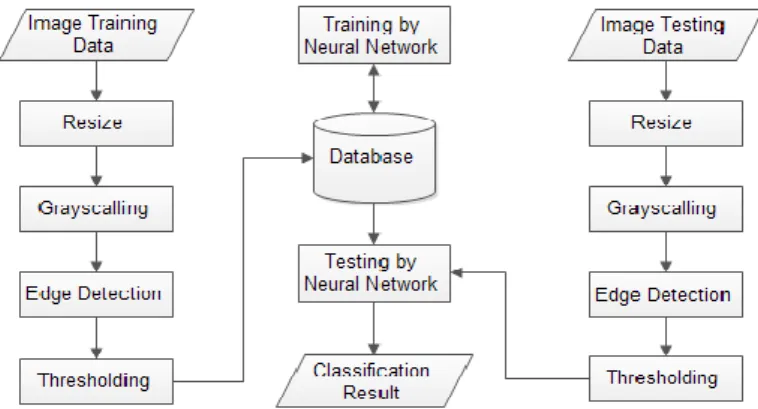
System process that was done in this research, generally divided into two sub-process, namely subprocess training and subprocess testing. Each subprocess that shown in Figure 1. Subprocess training consisting of resizing, grayscaling, edge detection, thresholding and training. Subprocess testing consisting of resizing, grayscaling, edge detection, thresholding, and testing. The process of training and testing is using backpropagation neural network.
Figure 1. Flowchart of system process
Explanation of each process is as follows: 1. Resize
The input of this resizes process is the image condition of damaged road and not damaged with a variety of sizes. This process changes the image of various sizes into 50x50 pixels sized image. This image is used for training and testing.
2. Grayscaling
Image from the result of resize process is an image with a color representation of RGB (Red Green Blue). Grayscaling process is used to simplify RGB color image into the image of eight bits or 256 primary colors.
3. Edge Detection
Edge Detection is the intensity of gray degree that is suddenly changed in a short distance. The purpose of this process is to enhance the appearance of the boundary line between the image part that is damaged and not damaged. The operator that used in this edge detection is the sobel operator.
4. Thresholding
Thresholding is used to set the amount of gray degree at an image. The result from this process is the binary image. The binary image is an image that has two values, namely black and white. The binary image that has been generated is stored in the database to do the training process. Examples the changes of road damage image at a process of grayscaling, edge detection and thresholding can be shown in Figure 2.
Figure 2. The changes of road damage image at process of grayscalling, edge detection and thresholding
5. Training
Classification algorithm that is used in this research is using backpropagation neural network algorithm. This algorithm needs the training before doing the testing. The input from training process is the pattern of the binary image that has been stored in the database and the result of this process is weighted input network layer towards hidden layer and weights network from hidden layer towards output layer. The result from this weights is stored in the database.
6. Testing
The testing process is the last process from system process of this research. The input from this process is weights that resulting from training process and testing image that has been done resize process, grayscaling, edge detection and thresholding. The results from testing process are to test the image, whether entered into damaged road class or not.
2.2 Backpropagation Neural Network Architecture
Classification process of road damage in this research is using backpropagation neural network algorithm. This neural network architecture consists of 2500 inputs, one hidden layer which consists of 10 neurons and 1 output as displayed in Figure 3. The activation function used is a binary sigmoid.
Figure 3. Backpropagation neural network architecture in the research
3. RESULTS AND DISCUSSION
This research is conducted testing backpropagation neural network algorithm to classify the condition of damaged road and good road. In the training process is given the fixed input variable value that is epoch boundary of 10.000 and error boundary of 0.0001. While the value of input variables for learning rate and the amount of training data is given varied. Learning rate variation values that are given are 0.1, 0.5 and 0.9. While the amount of training data that are given are 75, 150, 225 and 300 data. The results of weights from network training on each variation of these variables is stored in the database and used for testing road damage classification.
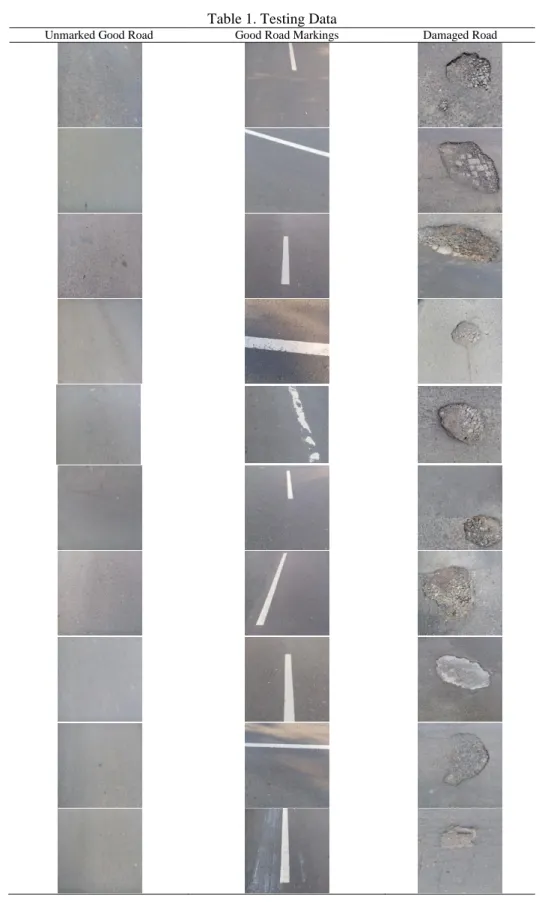
The data used in the testing consists of two road conditions, namely good road and damaged road. The good road is divided into two, these are unmarked good road and good road marking. The amount of data used in this research is 30 data, as shown in Table 1. The results of testing on each learning rate variation is shown in Table 2, Table 3, and Table 4.
Table 1. Testing Data
Table 2. Performance of backpropagation neural network with learning rate 0.9 The Amount of
Training Data
The Accuracy of Unmarked Good Road (%)
The Accuracy of Good Road Markings (%)
The Accuracy of Damaged Road (%)
Average (%)
75 100 30 60 63
150 100 60 60 73
225 100 60 60 73
300 100 60 60 73
Table 3. Performance of backpropagation neural network with learning rate 0.5 The Amount of
Training Data
The Accuracy of Unmarked Good Road (%)
The Accuracy of Good Road Markings (%)
The Accuracy of Damaged Road (%)
Average (%)
75 100 50 50 67
150 100 60 70 77
225 100 60 70 77
300 100 60 70 77
Table 4. Performance of backpropagation neural network with learning rate 0.1 The Amount of
Training Data
The Accuracy of Unmarked Good Road (%)
The Accuracy of Good Road Markings (%)
The Accuracy of Damaged Road (%)
Average (%)
75 100 20 50 57
150 100 40 70 70
225 100 70 70 80
300 100 80 70 83
From Table 2, Table 3, and Table 4 show that the best accuracy is obtained by 83%. This value is obtained at the time given learning rate value of 0.1 and the amount of training data by 300. The algorithm is able to recognize all unmarked good road with an accuracy rate of 100%. This is due to good road data that used in the process of training and testing have almost the same color, so the algorithm is able to identify easily. Besides that, this algorithm is able to recognize good road markings with the best accuracy rate of 80% and this algorithm is able to recognize damaged road with the best accuracy rate of 70%. These results are due to the algorithm that used has not been able to properly distinguish between the marking lines with the damaged road so that the marking lines in the good road is considered damaged road.
From the testing results shown that the more the additions of varying amounts of training data will enhance the accuracy rate that is generated. This is due to the variations data that are added improves weights of training results in distinguishing between damaged road and good road. Other than that, the smaller the added value of learning rate has a tendency can increase the accuracy rate because adding great learning rate value has a tendency will ruin the pattern of training data.
The results of testing in this research compared to other research in classifying road damage can be seen as in Table 5. The algorithm used in this research were compared using the method region split mergers and fractal dimension [17]. From this table shows that backpropagation neural network algorithm used in this research can increase the classification results than using the algorithm of region split-merger and fractal dimension. The performance of this algorithm can be increased by adding a variety of training data because the increased a variety of training data will improve the weights of training that are resulting in distinguishing damaged road and good road.
Table 5. Comparison of algorithms for classification of road damage
Algorithm The Results of Accuracy Rate (%)
Region split - merger 61.7
Fractal dimension 82.9
Image processing and backpropagation neural network 83.0
4. CONCLUSION
Conclusion obtained from this research is road damage classification using image processing and backpropagation neural network algorithm provides accuracy rate of 83%. This algorithm provides enhancement accuracy results compared with the use of the algorithm of region split – merger and fractal dimension. The algorithm is able to recognize all the unmarked good road conditions, but only partially able to recognize the good road markings and damaged road. The accuracy rate can be improved by increasing the amount of data varies.
REFERENCES
[1] World Health Organization, “Global Status Report on Road Safety 2015,” World Health Organization (WHO), 2016.
[2] F. Sagberg, “Road Accidents Caused by Drivers Falling Asleep,” Accident Analysis & Prevention, vol. 31, pp. 639-649, 1999.
[3] Mardianus, “Studi Penanganan Jalan berdasarkan Tingkat Kerusakan Perkerasan Jalan (Studi Kasus: Jalan Kuala Dua Kabupaten Kubu Raya),” Jurnal Teknik Sipil UNTAN, vol. 13, pp. 149-160, 2013.
[4] Q. Qin, et al., “Damage Detection and Assessment System of Roads for Decision Support for Disaster,” Key Engineering Materials, vols 467-469, pp. 1144-1149, 2011.
[5] J. Wang, et al., “A Knowledge-Based Method for Road Damage Detection using High-Resolution Remote Sensing Image,” 2015 IEEE International Geoscience and Remote Sensing Symposium (IGARSS), IEEE, pp. 3564-3567, 2015.
[6] M. O. Sghaier, et al., “Road Damage Detection from VHR Remote Sensing Images based on Multiscale Texture Analysis and Dempster Shafer Theory,” 2015 IEEE International Geoscience and Remote Sensing Symposium (IGARSS), IEEE, pp. 26-31, 2015.
[7] P. Li, et al., “A Novel Method for Urban Road Damage Detection using Very High Resolution Satellite Imagery and Road Map,” Photogrammetric Engineering & Remote Sensing, vol. 77, pp. 1057-1066, 2011.
[8] L. Gong, “Road Damage Detection from High-Resolution RS Image,” 2012 IEEE International Geoscience and Remote Sensing Symposium, IEEE, pp. 990-993, 2012.
[9] X. Zhang, et al., “The Study of Road Damage Detection Based on High-Resolution SAR Image,” 2013 IEEE International Geoscience and Remote Sensing Symposium - IGARSS, IEEE, pp. 2633-2636, 2013.
[10] F. E. Gunawan, et al., “A Vibratory-based Method for Road Damage Classification,” Intelligent Technology and Its Applications (ISITIA), 2015 International Seminar on, IEEE, pp. 1-4, 2015.
[11] Y. Kobana, et al., “Detection of Road Damage using Signals of Smartphone-Embedded Accelerometer while Cycling,” 2014 International Workshop on Web Intelligence and Smart Sensing, ACM, pp. 1-2, 2014.
[12] Y. Kobana, et al., “Accurate Road Damage Classification Based on Real Signal Mother Wavelet of Acceleration Signal,” 2015 IEEE/SICE International Symposium on System Integration (SII), IEEE, pp. 900-905, 2015.
[13] L. Sumaryanti, et al., “Digital Image based Identification of Rice Variety using Image Processing and Neural Network,” Telecommunication Computing Electronics and Control (TELKOMNIKA), Vol. 16, pp. 182-190, 2015. [14] Y. Pandit and C. S. D. Rawat, “Biometric Personal Identification based on Iris Patterns,” Journal of Telematics and
Informatics (JTI), Vol. 2, pp. 7-14, 2014.
[15] C. En, et al., “Automatic Detection and Assessment System of Water Turbidity based on Image Processing,”
TELKOMNIKA, Vol. 11, pp. 1506-1513, 2013.
[16] Q. He, et al., “Cotton Pests and Diseases Detection based on Image Processing,” Telecommunication Computing Electronics and Control (TELKOMNIKA), Vol. 11, pp. 3445-3450, 2013.
[17] Z. Q. Shen, et al., “Road Damage Feature Extraction in Image Based on Fractal Dimension,” Applied Mechanics and Materials, vols 256-259, pp. 2971-2975, 2012.
[18] N. Suciati, et al., “Batik Motif Classification using Color-Texture-Based Feature Extraction and Backpropagation Neural Network, Advanced Applied Informatics (IIAIAAI)-2014 IIAI 3rd International Conference on, IEEE, pp. 517-521, 2014.
[19] V. Gupta and K.S. Sagale, “Implementation of Classification System for Brain Cancer using Backpropagation Network and MRI,” 2012 Nirma University International Conference on Engineering (NUiCONE), IEEE, pp. 1-4, 2012.
[20] Y.M. Yacob, et al., “Harum Manis Mango Weevil Infestation Classification using Backpropagation Neural Network”, Electronic Design 2008- ICED 2008. International Conference on, IEEE, pp.1-6, 2008.
[21] M. Mohebbi and H.A. Moghadam, “Real-Time Ischemic Beat Classification using Backpropagation Neural Network,” 2007 IEEE 15th Signal Processing and Communications Applications, IEEE, pp.1-4, 2007.
[22] N.A. Rahim, et al., “Moving Vehicle Noise Classification using Backpropagation Algorithm,” Signal Processing and Its Applications (CSPA) - 2010 6th International Colloquium on, IEEE, pp. 1-6, 2010.
[23] S.M.R. Azghadi, et al., “Gender Classification Based on Feed Forward Backpropagation Neural Network,” 4th IFIP International Conference on Artificial Intelligence Applications and Innovations, Springer US, pp. 299-305, 2007.
BIOGRAPHIES OF AUTHORS
Sutikno. He had his undergraduate (S.T.) in Electrical Engineering from Diponegoro University, Semarang, Indonesia in 2006, and Master (M.Cs.) in Computer Science from the Gadjah Mada University, Yogyakarta, Indonesia in 2009. His research areas of interest are artificial intelligence, neural network, image processing, and robotics.
Helmie Arif Wibawa. He had his undergraduate in Mathematic Department in Diponegoro University, Semarang, Indonesia in 2001, and Master of Computer Science in Gadjah Mada Univeristy, Yogyakarta, Indonesia in 2008. His research areas of interest are Artificial Intelligence, Image Processing, and Computer Vision.
Email: [email protected]
Prima Yusuf Budiarto. He was born in Jakarta on December 6, 1991. He graduated education at Senior High School level in 2009 at SMAN 3 Sukoharjo, Indonesia. He is now studying in the Department of Computer Science/Informatics, Faculty of Science and mathematics, Diponegoro University, Semarang, Indonesia.