Sharif University of Technology
Scientia IranicaTransactions E: Industrial Engineering www.scientiairanica.com
A two-phase method for a multi-skilled project
scheduling problem with discounted cash ows
B.H. Tabrizi, R. Tavakkoli-Moghaddam
and S.F. Ghaderi
School of Industrial Engineering, College of Engineering, University of Tehran, Tehran, Iran. Received 6 January 2013; received in revised form 26 August 2013; accepted 15 October 2013
KEYWORDS Multi-skilled project scheduling problem; Cash ows;
Genetic algorithm; Path relinking algorithm.
Abstract.This paper considers a multi-skilled project scheduling problem that is a newly developed extension of the Resource-Constrained Project Scheduling Problem (RCPSP). The main dierence in such problems, compared with classic scheduling problems, is associated with the given resources, which are only dependent on human type. Additionally, the net present value of a given project is considered by its cash in and out ow to guarantee project success. To solve the given problem, an enhanced two-phase method is proposed using genetic and path relinking algorithms, whose parameters are tuned by the Taguchi method to provide robust comparisons. Furthermore, the potential changes in the project execution method are considered for some of the mostly used payment methods. Finally, some dierent-sized instances are tested to check the performance and eciency of the proposed method.
c
2014 Sharif University of Technology. All rights reserved.
1. Introduction
The Multi-Skill Project Scheduling Problem (MSPSP) was rst addressed as a new scope in the development of project scheduling problems [1,2]. In other words, the MSPSP is an extended version of the resource-constrained project scheduling problem (RCPSP), in which dierent labor skills are needed to accomplish an activity. In a fairly similar extension, activities can be completed within dierent execution modes, which are referred to as multi-Mode Resource Constraint Project Scheduling Problems (MRCPSP). MSPSP can be mainly dierentiated from MRCPSP in regard to resource types and activity requirements. Without loss of generality, sta members constitute the chief resource of the organization in the MSPSP, while each member owns dierent skills to complete project
*. Corresponding author. Tel: +98 21 82084183; Fax: +98 21 88013102
E-mail address: [email protected] (R. Tavakkoli-Moghaddam)
activities. However, each activity can be performed by dierent execution modes in the MRCPSP in which a balance should be met with respect to mode selection and resource usage.
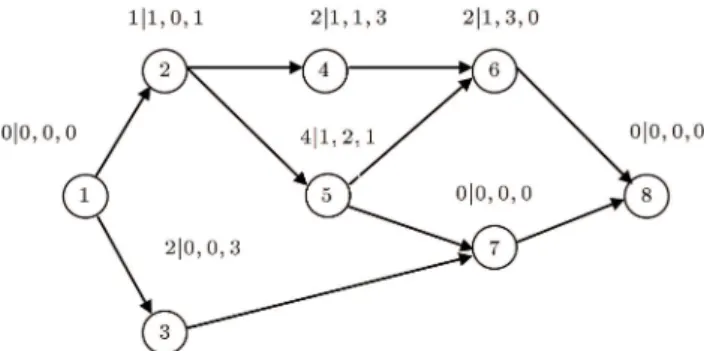
In the MSPSP, it is signicant to nd out how the sta members are designated to activity requirements. Each skill requirement should be satised by just one of the sta members potentially qualied. If it is aimed at establishing an association between the MSPSP and the MRCPSP, execution modes of an activity encompass a subset of qualied resources that can be assigned to it. In a broader sense, the number of modes of performing each activity in the MSPSP pertains to a subset of resources (i.e., sta members) qualied to deal with skilled requirements. Consequently, if it is to enumerate dierent alternatives of project execution, with respect to the corresponding skills, a large number of states can be developed, so that the problem may not be solved, even at medium size [3]. However, if the activities can be carried out just by mere skill, the MSPSP is then transformed into a classic RCPSP. Figure 1 shows a typical network of project activities
Figure 1. Precedence relations and activities requirement in an MSPSP.
in which three dierent skills are utilized to accomplish the project. The numbers written above each activity stand for the execution time and resource needs, re-spectively. The threesome of resource requirements is associated with three determined skills. For example, the numbers above activity 6 indicate that 2 time units are needed for each skill, once sta members 1 and 3 are needed for the rst and second skills, respectively. Moreover, there is no need for the third skill. It can be assumed that the organization wants to assign its sta to the aforementioned project, while they are not identical in regard to the skills possessed (i.e., some of them have all three skills at once, while some may just possess a single skill). It is also evident that the number of assigned sta members and their qualications directly inuences the outcome.
The concept of the MSPSP can be incorporated by a job shop denition in which the jobs should be processed by multi-process machines [4]. On the other hand, the MSPSP can be addressed as the same MRCPSP but with a noticeable raise in potential modes. Hence, the problem complexity increases, so that classic solution techniques cannot be used eciently.
Many situations can be found in which the de-liverables are dependent on human skills. Thus, the MSPSP importance can be highlighted better in such elds. For example, consulting rms, social security organizations, after-sale service centers, research-based organizations, information technology, engineering ac-tivities, and auditing institutes can all be archetypes of an MSPSP. Therefore, there are many dierent in-stances, in which the MSPSP can be applied. However, few research ndings exist about this branch of project management in the literature. For example, Wu and Sun [5] (2006) presented a Mixed-Integer Non-Linear Programming (MINLP) model for project scheduling and stang in addition to the learning eect. They considered no precedence relations amongst the activ-ities and applied a Genetic Algorithm (GA) as the solution approach. Gutjahr et al. [6] (2008) also applied an MINLP model for stang in project scheduling, with respect to the weighted average maximization of
project economic gain. A greedy priority-based heuris-tic was used to develop the scheduling. Valls et al. [7] (2009) dealt with task scheduling and multi-skilled workforce assignment under multi-criteria considera-tion for a service center. They proposed a hybrid GA approach as the solution methodology. Kazemipoor et al. [3] (2012) also addressed the portfolio scheduling of the MSPSP using a goal programming approach, and proposed the dierential algorithm as the solution method.
In addition to above instances, the following are merely associated with the MSPSP. Bellenguez-Morineau and Neron [2] (2005) introduced the MSPSP considering the project makespan minimization. They proposed an integer Linear Programming (LP) model and took dierent skill levels for sta members. More-over, Tabu Search (TS) was applied to solve the model. In a further study, Bellenguez-Morineau and Neron [8] (2007) presented a branch-and-bound algorithm for the problem in small and medium sizes, and studied dierent branching strategies. Bellenguez-Morineau [9] (2008) also applied TS in order to solve the MSPSP, and compared its performance with GAs in which TS could outperform them. Al-Anzi et al. [10] (2010) suggested a lower bound by LP based on the clas-sical RCPSPs. Firat and Hurkens [11] (2012) ap-plied a Mixed-Integer Programming (MIP) formulation to build schedules by repetitive usage of a exible matching model. Yannibelli and Amandi [12] (2013) also addressed the eectiveness of human resources in carrying out a project in the light of an Objective Function (OF) in addition to makespan minimization. Within the project completion process, resources are utilized in terms of activity requirements and their corresponding implementation times. As the project activities are completed, associated cash ow occurs. The issue can be addressed to cash out ow, as the contractor incurs expenses, along with each activity execution. Considering the nancial perspective in project investigations has received much focus, since over 60 percentage of contracts encounter failure be-cause of nancial facets. Likewise, dierent nancial factors (e.g., interest rate, credit limits, and payment condition) have been addressed as crucially inuencing issues on timing the amount of resource usage. In fact, project yield maximization with respect to cash ow considerations can guarantee a reliable execution plan in which the project does not face failure. To do so, Barbosa and Pimentel [13] (2001) proposed a linear programming model for cash ow management in the Brazilian construction industry. Elazouni and Gab-Allah [14] (2004) presented prot maximization with respect to a credit limit. However, most papers have only considered positive cash ow, received after each phase, or when the whole project is delivered. They assumed that negative cash ow can be thoroughly
interpreted by just activities and there is no need to consider resource usage. In fact, the activities can be completed once sucient resources are available and allocated to them. Thus, a resource cost can be taken into account as the crucial component of an activity cost. Likewise, it is advisable to bring cash outow into calculation, so that the actual expenditure and resource assignment method can be reected in the given scheduling problem.
Once the RCPSP is transformed into the RCPSP with discounted cash ow, the given schedule is no longer necessarily optimal. In other words, the activity sequences may be altered to a large extent. This can be interpreted for certain circumstances in which dierent alternatives lead to the same minimum makespan; how-ever, not all of them yield to the maximum Net Present Value (NPV). In a broader sense, maximizing the net NPV can be considered a makespan minimization, by summing all cash ow and putting it at the project completion time, for situations in which all cash ow is positive [15].
There are at least two dierent parties involved in each project for contraction purposes. The former is the client, which can be addressed as the project owner, and the latter is the contractor, who is in charge of project execution. Therefore, they should agree upon the payment method so that the contract can be signed. It is obvious that the client tends to deal with the whole payment at the project delivery due date, and the contractor inclines to receive the whole payment at the outset of project execution. However, it should be noted that in NPV maximization problems, the optimal approach is taken into consideration from the contractor's point of view. According to the extant literature, several types of contract and payment model have been developed. For instance, Dayanand and Padman [16] (1997) presented a comprehensive survey about payment methods. Chen et al. [17] (2005) also dealt with the impact of payment conditions and the accuracy of project cash ow. However, four payment methods have received much attention, in practice, amongst those existing. They can be listed as: Lump Sum Payment (LSP), Payment at Event Occurrences (PEO), payment at Equal Time Intervals (ETI), and Progress Payments (PP). In the LSP method, the whole payment is fullled at the end of the project when it is successfully delivered to the client. The contractor has to incur all nancial burden of the project within the execution interval. However, the client may be strongly in favor of this method, as he/she can abide by his commitment by a single payment. Since LSP may be inappropriate in some situations, the other three methods can be substituted as reasonable choices in which negotiating parties decide on the project duration. Without loss of generality, in PEO, the payments are carried out
when specic events are completed. In ETI, the payments are fullled in H-1 equal time intervals and the Hth payment is done at the completion time. In other words, the project time should be estimated rst and the number of payments should be determined, afterwards. Finally, in the PP method, the payments are practiced in the course of project completion within regular time intervals. However, PP is dierent from ETI, as in the rst one, the two parties concur with the length of the interval instead of the number of payments.
Ulusoy et al. [18] (2001) considered the time value of money in the NPV maximization of cash ow. They considered an MRCPSP with discounted cash ow, in which all renewable, non-renewable, and doubly constrained resource types were extant. A GA was used to nd near-optimal solutions enhanced by a multi-component uniform order-based crossover. It was tested against local constraint-based analysis and proved ecient.
Mika et al. [15] (2005) addressed discounted cash ow maximization in an MRCPSP for an Activity-On-Node (AON) network. They only took positive cash ow into account and assumed that executive costs are not dependent on time, but rather xed and apart from the project duration. However, the issue is not true for all situations, as organizations can be investigated that may borrow additional aid from external experts or even outsource a specic set of activities. Simulated Annealing (SA) and TS were applied as the solution methodology and the results were compared. It was shown that SA could reach ecient results for large-sized problems for a xed discount rate, while TS outperformed for a restricted number of activities.
Liu and Wang [19] (2011) considered prot max-imization for project selection and scheduling prob-lems with time-dependent resource constraints by con-straint programming. They extended the problem into two distinctive scenarios including prot maxi-mization with time-dependent budget limits and prot maximization with time-dependent renewable resource constraints, so that smoother budget consumption and resource usage can be realized.
The aforementioned papers indicate that MSPSP needs to be developed so that it can function better with respect to both its comprehensiveness and result quality. Hence, we consider the problem with the perspective of the NPV to provide a higher security margin for organization survival. Furthermore, we have tried to enhance the obtained schedules for a given payment method, to which both sides have concurred.
The rest of the paper is organized as follows. The problem denition and mathematical model is pre-sented in Section 2. The next section is associated with
a solution representation and a two-phase enhanced GA in which Path Relinking (PR) is addressed as an improvement methodology for the GA output. The computational results are discussed in Section 4, in which the performance of the two-phase algorithm is compared with that of the GA. Finally, conclusions and future research directions are presented in the last section.
2. Problem denition
The problem denition is addressed in this section and the mathematical model is developed afterwards. As stated earlier, we aim to schedule activity execution so that sta members can be assigned appropriately to gain optimal cash ow. In other words, the payment method, number of personnel, and the number and frequency of extant skills can all directly inuence the scheduling problem. In order to formulate the math-ematical model, notations, parameters, and decision variables are introduced as follows.
2.1. Indices and notations
i; j 2 f1; 2; ; Ng Counter of activities, k; k02 f1; 2; ; Kg Counter of skills,
m 2 f1; 2; ; Mg Counter of resources, p 2 f1; 2; ; P g Counter of payment
occurrence. 2.2. Parameters
G = (V; E) Precedence network where G represents the given graph. V and E stand for vertexes and edges, respectively;
S = fs1; s2; ; skg Set of skills;
R = fr1; r2; ; rMg Set of resources (i.e., sta
members);
bik Required amount of the kth
skill to do the ith activity pi Execution time of the ith
activity;
r Rate of interest; CFi Cash outows (resource
utilization cost) for the ith activity;
CF+
p Cash inows (payments) for
the pth payment;
Tp Time of the pth payment
occurrence;
rmk=
(
1 if resource m has the kth skill 0 otherwise
2.3. Decision variables
xikm Start time of the ith activity by resource m
and the kth skill
yikm=
8 > < > :
1 if resource m executes the ith actibity with the kth skill 0 otherwise
fm ijkk0 =
(
1 if xikm xjk0m
0 if xikm< xjk0m
Now, the mathematical model can be formulated, with regard to the previous denitions by Eqs. (1)-(7), in which Eq. (1) stands for the Objective Function (OF) and the rest constitute the model constraints:
max Z = NPV =
N
X
i=1
CFi (1 + r) xikm
+
P
X
p=1
CF+
p (1 + r) Tp; (1)
s.t.:
xikm xjk0m (yikm)(yjk0m)(pj) Mfijkkm 0;
8i; k; m; (2)
xjk0m xikm (yikm)(yjk0m)(pi) M(1 fijkkm 0);
8i; k; m; (3)
M
X
m=1
rmkyikm= bik; 8i; k; (4)
minfxjk0m0g maxfxikmg pijyikm; yjk0m0 = 1;
8k; k0; m; m0; (5)
xikm Myikm; 8i; k; m; (6)
xikm 0; and yikm2 f0; 1g: (7)
Eq. (1) maximizes the NPV of project execution gain, which can be calculated by the dierence between incurred expenditures and fullled payments. The corresponding costs are imposed on the system as the activities start; however, the payments are satised, along with determined milestones, according to the compromised payment method. The precedence rela-tions are taken into account by Eqs. (2) and (3). They guarantee the constraint of non-preemptive assignment of resources to the activities. In other words, a resource is not allowed to be assigned to another activity at the same time if it is to deal with a specic activity skill. Eq. (4) states that the assigned resources to each activity should be equal to the required amount, with respect to the given skill. The next constraint, namely Eq. (5), guarantees that each work can start,
once sucient resources are assigned to it. Eq. (6) expresses that the ith activity can be performed by the mth resource and the kth skill, only if it is assigned to it, and, nally, the variables nature is represented by Eq. (7). Moreover, M denotes the big M method.
It is obvious that the aforementioned model is non-linear; hence, more computational eort is needed to solve it. The intrinsic complexity increase of non-linear problems can be prevented by applying a linearization technique. Eqs. (2) and (3) can be substituted by Eqs. (8) and (9), respectively, in the linear equivalent model, where the binary variables are replaced by introducing an alternative variable, namely zijkk0m. It is also required to practice some
further constraints on the given formulation to take the inuence of the previous variables into account (i.e., Eqs. (10)-(12)). Moreover, Eq. (5) can be easily treated by Eq. (13), with regard to the precedence relations, as follows. In fact, it is obvious that a given activity can start just when all of the required skills of its prerequisites have been completed.
xikm xjk0m zijkk0mpj Mfijkkm 0;
8i; k; m; (8)
xjk0m xikm zijkk0mpi M(1 fijkkm 0);
8i; k; m; (9)
zijkk0m xikm xjk0m+ 1:5 0;
8i; j; k; k0; m; (10)
1:5zijkk0m xikm xjk0m+ 0;
8i; j; k; k0; m; (11)
zijkk0m2 f0; 1g: (12)
3. Solution representation and generation scheme
In this section, a brief discussion is presented about GA and PR and the associated procedure, as well. It is rst required to outline the applied solution representation and schedule generation approach in order to deal with the solution methodology. A preprocessing is carried out before the GA starts. This helps the applied algo-rithm search a smaller solution space. The reduction is obtained through the generation of initial solutions, in which infeasible schedules are not developed regarding the skill availability of the given resource.
Regarding the preprocessing phase, the GA starts by generating the initial population. Afterwards, the given individuals can be evaluated by transforming
them into the schedules. The following steps are repeated until the stop criterion is satised, once the tness value of all initial population individuals is determined. A selection mechanism is applied in order to transform the set of better individuals to the next generation with a higher probability. The given population is sorted by random pairs of indi-viduals and the pairs experience a crossover operation to generate new ospring. Meanwhile, some of the individuals are modied by a mutation operation to a specic probability. However, the operations should be performed so that the individuals may not be excluded from feasibility. As the termination criterion is met, the selected individuals are transformed into the improvement phase implemented by the PR algorithm. The aforementioned steps are described in more detail below.
3.1. Genetic Algorithm (GA)
The GA has received much favor in dierent combi-natorial optimization problems since it was rst intro-duced by Holland [20] (1975). It actually tries to mimic the biological evolution process to enhance solution quality. Referring to Darwinian natural selection and mutations in biological reproduction, a GA has been generalized to dierent modes, with respect to the evolution process. It has proved quite ecient in dealing with discrete optimization problems, as it can move toward high performance even in intricate search spaces [21-23]. Utilizing a crossover operator helps the algorithm explore dierent parts of the solution space, while the exploitation can also be fullled by the use of mutation. Applying mutation hampers the algorithm to experience premature convergence on a local optimum [24]. However, reaching good solutions highly depends on the proper representation of solutions.
As stated above, it is required to develop the genotype, namely the schedule representation, in order to start the GA. Kolisch and Hartmann [25] (1999) indicated ve dierent schedule representations asso-ciated with the RCPSP. Amongst the stated repre-sentations, Activity List (AL) and Random-Key (RK) have been used more frequently. A priority structure is taken into consideration, apart from which of them is selected. However, the relative priority of an activity is determined in the AL representation, with respect to its position, compared with the other activities, while, in the RK representation, the position of an activity depends on the corresponding priority value assigned to it. A structured AL representation has been applied in this study, as the AL has proved ecient in a variety of related papers (e.g., [26-28]). The applied AL-based representation is illustrated by Figure 2 in which, for example, the rst activity requires just a unit resource of the second skill executed by sta member 4 on
Figure 2. Typical AL-based solution representation for the given project.
Figure 3. Pseudo-code of the proposed GA.
start time 2. It is obvious that a required number of columns can be regarded for each activity, with respect to the maximum resource requirement. For instance, the rst activity required three units of skill K and, therefore, three columns have been considered for it. Furthermore, the activities execution times have been considered by day units.
On the other hand, it is required to decode the genotype into phenotype carried out by a Scheduling Generation Scheme (SGS). Here, the serial SGS is chosen in which the individuals are directly trans-formed into their associated schedule. Without loss of generality, the SGS shows how a feasible schedule is obtained by assigning starting times to the dierent activities. More details can be studied in Kolisch [29] (1996), who provided a comprehensive gathering on SGSs. Finally, the pseudo-code of the proposed GA is shown by Figure 3.
3.2. Path Relinking (PR)
PR was rst proposed by Glover and Laguna [30] (1997), as an integrated intensication and diversi-cation strategy, to explore trajectories connecting elite solutions obtained by TS or Scatter Search (SS). More details can be found about the application of the PR algorithm to the combination of solutions in Glover et al. [31] (2000). In this algorithm, the paths leading to higher quality solutions are searched, taking two or more of the elite solutions into consideration. In other words, the search process starts from a high-tted solution (namely, the initial solution) and is ended in another high-tted solution (namely, the guiding solution). An important point in generating paths
is that just the moves representing the attributes in the guiding solution are picked out. This issue can be referred within the circumstances in which a given number of choices are allowed to be checked for the next move. The next move containing the guiding solution attribute is selected if it leads to a better OF value compared with the previous choice. This process is repeated until the whole path connecting the initial and guiding solutions is searched.
Dierent studies can be found about the applica-tion of PR as a complementary tool on the optimizaapplica-tion of project scheduling problems. The widespread usage of PR denotes the noticeable eciency in exploiting the solution space. For instance, Valls et al. [32] (2004) introduced PR as a combinatorial component for SS in the RCPSP in order to obtain high quality schedules. Yamashita et al. [33,34] used a PR mechanism to update the SS reference set in a project scheduling problem with a resource availability cost. In further research, Ranjbar et al. [26] (2008) addressed the PR approach in the resource availability problem by a modied GA. Ranjbar et al. [35] (2009) used a similar framework, namely SS and PR algorithms, in a dis-crete resource/time trade-o problem, where activities could be performed by dierent modes. Baradaran et al. [36] (2010) also utilized PR as an improvement method in the SS algorithm for the RCPSP in PERT networks. Alvarez-Valdes et al. [37] (2008) dealt with a combination of Greedy Randomized Adaptive Search Procedures (GRASP) and PR algorithms in scheduling projects with renewable resources. Tchao and Mar-tins [38] (2008) applied PR as a post optimization method for the TS output, so that the connecting paths of TS elite solutions can be searched.
In order to apply PR in the aforementioned two-phase problem, some issues should be taken into account. The rst underlying issue is the solution enhancement by the GA output. In other words, we do not encounter elite solutions; however, a set of high quality solutions is available. In fact, the GA output contains a gathering of individuals with the most tted values, with respect to the tness function. Therefore, all of the last generation individuals can be involved in the improvement phase. The second phase can be performed with regard to the population frequency, so that a pair of individuals can be selected randomly and their connecting trajectories are investigated. The
second issue corresponds to the feasibility preservation, which is of great importance. In other words, it is rst required to check that the next move does not surpass the network precedence relations and, if it is a legal choice, then, it can be selected for further consideration. Afterwards, the next move is selected if it can yield to a better tness value, and rejected, otherwise. However, the hopefully improving paths should be checked, with respect to the resource assignment method, apart from the activity sequences. The pseudo-code of the proposed PR is shown by Figure 4.
4. Computational study
In this section, the computational study is dealt with, in order to consider the model performance and
e-Figure 4. Pseudo-code of the proposed PR algorithm.
ciency of the solution methodology. The required data set are generated randomly in a logical way regarding the rare accessibility to well-known test problems. A typical instance is taken into consideration in which discussed payment methods are compared with each other. Afterwards, some dierent-sized problems are investigated, so that the performance of the solution method can be highlighted. This leads to realization of how the improvement method can inuence the nal results for dierent problems. All calculations are run by C++ software on a Core i5PC with 2.0 GHz CPU
and 4 GB of RAM.
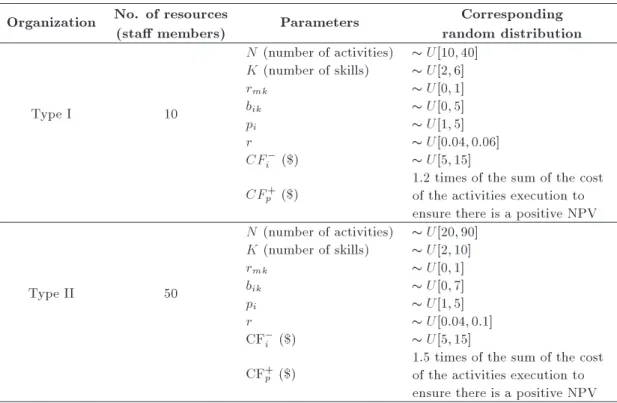
Figure 5 shows a simple network to address the potential inuence of each of the aforementioned payment methods on project execution. However, it is required to tune the parameters of the solution method so that robust results can be obtained. Therefore, the applied tuning approach is described below. Moreover, the data generation method is shown by Table 1. 4.1. Parameter tuning
The performance of the meta-heuristic methods can be highly inuenced by their operators. Likewise, the GA
Figure 5. AON example of a project. Table 1. Data generation method for the parameter values.
Organization No. of resources
(sta members) Parameters
Corresponding random distribution
Type I 10
N (number of activities) U[10; 40] K (number of skills) U[2; 6]
rmk U[0; 1]
bik U[0; 5]
pi U[1; 5]
r U[0:04; 0:06]
CFi ($) U[5; 15]
CF+ p ($)
1.2 times of the sum of the cost of the activities execution to ensure there is a positive NPV
Type II 50
N (number of activities) U[20; 90] K (number of skills) U[2; 10]
rmk U[0; 1]
bik U[0; 7]
pi U[1; 5]
r U[0:04; 0:1]
CFi ($) U[5; 15]
CF+ p ($)
1.5 times of the sum of the cost of the activities execution to ensure there is a positive NPV
behavior can be dependent on its parameters to a large extent. Thus, selection of the most ecient choices by the appropriate methods is fundamental. There are dierent ways to run an experimental consideration. However, their performance can be compared with regard to the criteria inuencing the computational eorts. For example, full factorial design is one of the most frequently applied methods in tuning meta-heuristic parameters [39]. However, it cannot be justied as an ecient approach, because a large amount of eort is needed once the frequency of factors increases, in particular [40-42]. Cochran and Cox [43] (1992) developed a fractional factorial experiment to moderate the number of essential tests. Likewise, Taguchi [44] (1986) addressed the fractional factorial experiment matrices that can decrease the number of required experiments and appropriate preservation of information. In other words, orthogonal arrays utilized in the Taguchi method help to study a broad amount of decision variables by the use of a small number of experiments. This method takes the factors into consideration in two major groups including the con-trollable and noise factors. The method concentrates on the minimization of the noise factors eect. Further-more, it aims to determine the optimum values of the main controllable factors, with regard to the robustness concept, as the noise factors are unavoidable [45].
Likewise, it can identify the relative importance of each factor, with respect to its basic impact, on the total performance of the algorithm. Therefore, the Taguchi experimental design has created a remarkable demand for calibrating factors of the meta-heuristic algorithms [46].
The extant variation of the response variable is measured here by a Signal-to-Noise (S=N) ratio. The terms \signal" and \noise" represent the desirable (i.e., response variable) and undesirable (i.e., standard deviation) values, respectively. The given ratio can be taken into account as a robustness criterion in which the larger values indicate smaller variations of the desired value [47].
It is now required to deal with the most inu-encing factors, as well as their levels in the GA. To do so, ve dierent factors of the GA are investigated of which four levels are taken into account. The factors entail the number of iterations as the stoppage criterion, population size as the conguration issue, and crossover, mutation, and reproduction percentage as the evolution factors. The details of the above-mentioned factors are presented in Table 2. As is obvious, the levels of the given factors are divided by the organization type in order to provide more precise performance.
The total degree of freedom should be determined
Table 2. Factors and factor levels of the GA.
Factor Symbol Level Organization type
I II
Number of iterations A 4
A(1)-60 A(1)-150 A(2)-80 A(2)-175 A(3)-100 A(3)-200 A(4)-120 A(4)-225
Population size B 4
B(1)-40 B(1)-75 B(2)-50 B(2)-100 B(3)-60 B(3)-125 B(4)-70 B(4)-150
Crossover rate C 4
C(1)-75% C(1)-75% C(2)-80% C(2)-80% C(3)-85% C(3)-85% C(4)-90% C(4)-90%
Mutation rate D 4
D(1)-10% D(1)-10% D(2)-15% D(2)-15% D(3)-20% D(3)-20% D(4)-25% D(4)-25%
Reproduction rate E 4
E(1)-10% E(1)-7.5% E(2)-15% E(2)-10% E(3)-20% E(3)-12.5% E(4)-25% E(4)-15%
so that a well tted orthogonal array can be selected. To do that, a degree of freedom for the total mean, and three degrees of freedom for each of the mentioned factors, should be taken to select the array. Hence, the total required degrees of freedom must incorporate at least 16 rows. Here, the orthogonal array, L16, is
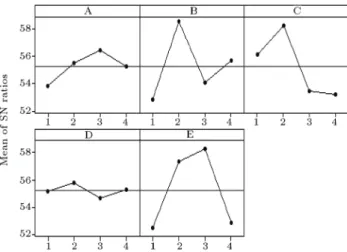
chosen as an appropriate design, as shown in Table 3. In order to nd the most ecient factor levels for both organization types, each array is repeated ve times to obtain the S=N ratio carried out by MINITAB 14. The best tted levels of the GA are shown by Figures 6 and 7. As can be seen, the best GA factors, A, B, C, D and E, are 2, 2, 2, 3 and 2, and 3, 2, 2, 2 and 3 for organizations Types I and II, respectively.
Now, the problem is solved by the tuned proposed
Table 3. The proposed orthogonal array L16 for the GA.
Trial Control factor level
A B C D E
1 1 1 1 1 1
2 1 2 2 2 2
3 1 3 3 3 3
4 1 4 4 4 4
5 2 1 2 3 4
6 2 2 1 4 3
7 2 3 4 1 2
8 2 4 3 2 1
9 3 1 3 4 2
10 3 2 4 3 1
11 3 3 1 2 4
12 3 4 2 1 3
13 4 1 4 2 3
14 4 2 3 1 4
15 4 3 2 4 1
16 4 4 1 3 2
Figure 6. Mean S=N ratio plot for the levels of the GA factors in organizations Type I.
Figure 7. Mean S=N ratio plot for the levels of the GA factors in organizations Type II.
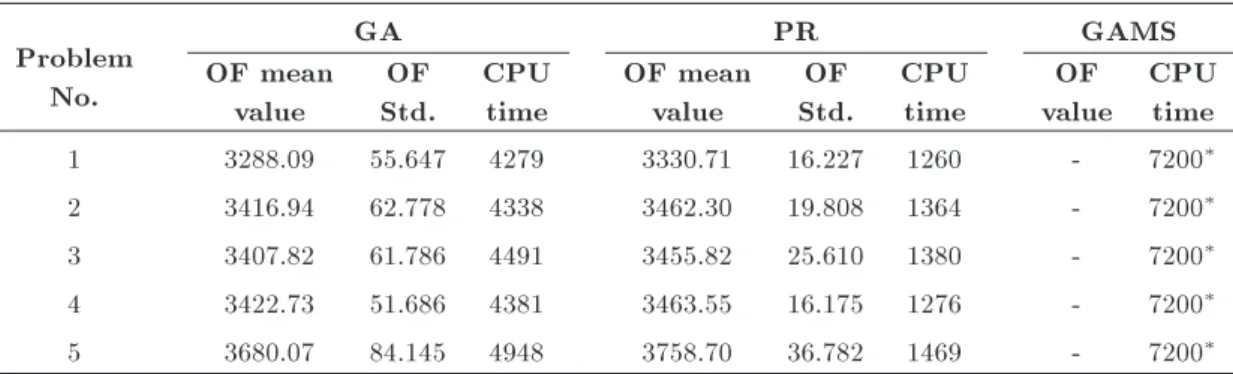
meta-heuristic approach and the results are compared with those obtained from the GAMS 22.1 solver. Moreover, the results are reected once the PR has been applied at the second solution phase so that its improving impact can be realized. The comparison results are illustrated in Table 4.
According to Table 4, it can be observed that the OF value can change, regarding the payment method. However, the value is dependent on dierent issues like the contract details, and the optimum alternative should be selected with respect to the given problem. For example, the LSP obtained the minimum NPV, while ETI led to the maximum one. The GA can converge in a rather short time once the OF mean value shows a trivial dierence, compared with the GAMS. Furthermore, it can yield to the nal solution for the LSP. However, the slight deviation is noticeably retrieved in the second solution phase by the PR approach. The second phase can provide a precise searching possibility, so that the optimal solution can be reached.
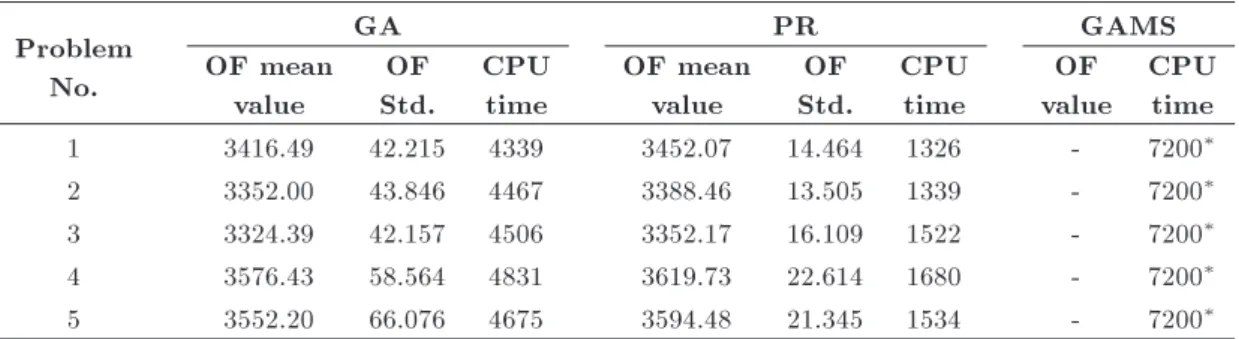
Now, the model is tested by dierent instances for two types of organization. However, the comparisons are carried out just for the PEO and PP methods, since they are more favorable as a reasonable contract type. The comparisons are categorized, with respect to the payment method, and the organization type by Tables 5-8. The results show that GAMS do not reach the optimum solution for the rst type organizations within the predened time, and only an interval can be obtained for the OF value. The GA can obtain appropriate solutions with small variations, preserving the process time. The solutions can again be enhanced through the PR, with respect to both the OF mean and standard deviation values. It should be noted that the rst phase lasts longer than the second, as it has to make more computational eort in searching the solution space.
Table 4. Results obtained for the given network. Payment
method
GA PR GAMS
OF mean value
OF Std.
CPU time
OF mean value
OF Std.
CPU time
OF value
CPU time
LSP 155.57 0.000 11 155.57 0.000 < 5 155.57 54
PEO 155.91 0.029 12 155.93 0.004 7 155.94 56
ETI 156.09 0.018 12 156.11 0.000 < 5 156.11 54
PP 155.77 0.022 12 155.82 0.000 < 5 155.82 57
Table 5. Results obtained for PEO method and organizations Type I. Problem
No.
GA PR GAMS
OF mean value
OF Std.
CPU time
OF mean value
OF Std.
CPU time
OF value
CPU time
1 803.16 12.404 941 824.85 5.905 220 682-845 7200
2 796.04 18.056 892 817.26 6.557 245 711-861 7200
3 754.29 9.172 875 762.41 5.641 197 641-790 7200
4 786.52 9.860 883 792.34 8.637 237 635-818 7200
5 905.11 15.391 1017 917.73 7.610 294 732-944 7200
: The solution process is stopped after two hours.
Table 6. Results obtained for PP method and organization Type I. Problem
No.
GA PR GAMS
OF mean value
OF Std.
CPU time
OF mean value
OF Std.
CPU time
OF value
CPU time
1 965.20 27.135 1074 984.76 8.419 296 733-1040 7200
2 850.82 24.622 1008 857.61 8.750 307 646-932 7200
3 724.49 16.330 914 728.80 11.023 276 682-810 7200
4 1014.73 37.606 1124 1037.33 10.842 314 833-1106 7200
5 765.39 16.228 983 772.84 7.819 286 612-808 7200
: The solution process is stopped after two hours.
Table 7. Results obtained for PEO method and organizations Type II. Problem
No.
GA PR GAMS
OF mean value
OF Std.
CPU time
OF mean value
OF Std.
CPU time
OF value
CPU time
1 3416.49 42.215 4339 3452.07 14.464 1326 - 7200
2 3352.00 43.846 4467 3388.46 13.505 1339 - 7200
3 3324.39 42.157 4506 3352.17 16.109 1522 - 7200
4 3576.43 58.564 4831 3619.73 22.614 1680 - 7200
5 3552.20 66.076 4675 3594.48 21.345 1534 - 7200
: The solution process is stopped after two hours.
in nding even a solution interval for organization Type II. The intrinsic complexity of the problem prevents the conventional branch-and-bound method to perform eciently. In other words, it cannot be applied to solve the problems of medium and large sizes. Therefore, the use of the two-phase algorithm
can be pinpointed in such circumstances. The results show that the PR algorithm could enhance the output of the GA to a remarkable extent, likewise. In both organization types, the second phase is thoroughly ecient and provides solutions with a small varying range.
Table 8. Results obtained for PP method and organizations Type II. Problem
No.
GA PR GAMS
OF mean value
OF Std.
CPU time
OF mean value
OF Std.
CPU time
OF value
CPU time
1 3288.09 55.647 4279 3330.71 16.227 1260 - 7200
2 3416.94 62.778 4338 3462.30 19.808 1364 - 7200
3 3407.82 61.786 4491 3455.82 25.610 1380 - 7200
4 3422.73 51.686 4381 3463.55 16.175 1276 - 7200
5 3680.07 84.145 4948 3758.70 36.782 1469 - 7200
: The solution process is stopped after two hours.
5. Conclusions
The MSPSP was addressed in this paper as a gener-alized version of the classic RCPSP. In this kind of project, the organization resources are only associated with human types, including technicians, engineers, and so on. Since many projects encounter serious nancial problems during their execution, and may fail, the problem was taken into consideration with discounted cash ow. Four of the more well-known payment methods were presented and the probable changes in the optimum schedules were investigated. Regarding the hardness of such problems, a two-phase algorithm was applied in order to provide ecient solutions. First, a GA was used as a capable solution methodology, and a PR algorithm was used, so that the trajectories connecting ecient solutions could be searched, afterwards. The application of the second phase increases the chance of searching the parts of the solution space with higher eligibility in enhancing the solution quality. The GA parameters were tuned by the Taguchi method to enhance the results robustness. For a small-sized instance, the performance of the above-mentioned algorithm was tested for dierent payment methods against the GAMS solver and it proved to be good. Likewise, some further problems were presented for two typical types of organization.
The proposed problem can be of great interest for further research, regarding potential novelties. Thus, it can be taken into consideration with respect to dierent aspects. An interesting issue would be to apply other solution methods and compare the obtained results. For example, GA can be combined by other appropriate approaches. Another future research direction is to consider uncertainty in problem denition, as few events can be interpreted by deterministic states in real world conditions. For instance, the execution time of activities may be treated as a stochastic variable. Payments and client commitment can also be regarded as other uncertain facets. The authors aim to develop more comprehensive extensions of the MSPSP in future studies.
References
1. Neron, E. and Boptista, D. \Heuristics for the multi-skill project scheduling problem", In International Symposium on Combinatorial Optimization, Paris (2002).
2. Bellenguez-Morineau, O. and Neron, E. \Lower bounds for the multi-skill project scheduling problem with hierarchical levels of skills", Lecture Notes in Computer Science (including subseries Lecture Notes in Articial Intelligence and Lecture Notes in Bioin-formatics) 3616 LNCS, 3616, pp. 229-243 (2005). 3. Kazemipoor, H., Tavakkoli-Moghaddam, R.,
Shahnazari-Shahrezaei, P. and Azaron, A. \A dierential evolution algorithm to solve multi-skilled project portfolio scheduling problems", Int. J. Adv. Manuf. Technol., 64(5-8), pp. 1099-1111 (2013). 4. Dauzere-peres, S., Roux, W. and Lassere, J.B.
\Multi-resource shop scheduling with \Multi-resource exibility", Eur. J. Oper. Res., 107, pp. 289-305 (1996).
5. Wu, M.C. and Sun, S.H. \A project scheduling and sta assignment model considering learning eect", Int. J. Adv. Manuf. Technol., 28(11-12), pp. 1190-1195 (2006).
6. Gutjahr, W.J., Katzensteiner, S., Reiter, P., Stummer, C. and Denk, M. \Competence-driven project portfolio selection scheduling and sta assignment", Center of Eur. J. Oper. Res., 16(3), pp. 281-306 (2008). 7. Valls, V., Perez, A. and Quintanilla, S. \Skilled
workforce scheduling in service centres", Eur. J. Oper. Res., 193(3), pp. 791-804 (2009).
8. Bellenguez-Morineau, O. and Neron, E. \A branch-and-bound method for solving multi-skill project scheduling problem", RAIRO - Oper. Res., 41(2), pp. 155-170 (2007).
9. Bellenguez-Morineau, O. \Methods to solve multi-skill project scheduling problem", 4OR, 6(1), pp. 85-88 (2008).
10. Al-Anzi, F.S., Al-Zamel, K. and Allahverdi, A. \Project scheduling problem with weighted multi-skill resources: Enhancing the eeciancy of project schedul-ing", In 2010 International Conference on Compu-tational Intelligence and Software Engineering, CiSE (2010).
11. Firat, M. and Hurkens, C.A. \An improved MIP-based approach for a multi-skill workforce scheduling problem", J. Scheduling, 15(3), pp. 363-380 (2012). 12. Yannibelli, V. and Amandi, A. \Project scheduling: A
multi-objective evolutionary algorithm that optimizes the eectiveness of human resources and the project makespan", J. Eng. Opt., 45(1), pp. 45-65 (2013). 13. Barbosa, P.S. and Pimentel, P.R. \A linear
program-ming model for cash ow management in the Brazilian construction industry", Constr. Manage. Econ. Rout-ledge, 19(5), pp. 469-479 (2001).
14. Elazouni, A. and Gab-Allah, A. \Finance-based scheduling of construction projects using integer pro-gramming", J. Constr. Eng. Manage. ASCE, 130(1), pp. 15-24 (2004).
15. Mika, M., Waligora, G. and Wezglarz, J. \Sim-ulated annealing and tabu search for multi-mode resource-constrained project scheduling with positive discounted cash ows and dierent payment models", Eur. J. Oper. Res., 164, pp. 639-668 (2005).
16. Dayanand, N. and Padman, R. \On modelling pay-ments in projects", J. Oper. Res. Soc., 48(9), pp. 906-918 (1997).
17. Chen, H.L., O'Brien, W.J. and Herbsman, Z.J. \As-sessing the accuracy of cash ow models: the sig-nicance of payment conditions", J. Constr. Eng. Manage. ASCE, 131(6), pp. 669-676 (2005).
18. Ulusoy, G., Sivrikaya-Serifoglu, F. and Sahin, S. \Four payment models for the multi-mode resource con-strained project scheduling problem with discounted cash ows", Ann. Oper. Res., 102(1-4), pp. 237-261 (2001).
19. Liu, S.S. and Wang, C.J. \Optimizing project selection and scheduling problems with time-dependent resource constraints", Autom. Constr., 20(8), pp. 1110-1119 (2011).
20. Holland, J., Adaptation in Natural and Articial Sys-tems, Ann Arbor: University of Michigan Press (1975). 21. Valls, V., Ballestin, F. and Quintanilla, S. \A hybrid genetic algorithm for the resource-constrained project scheduling problem", Eur. J. Oper. Res., 185(2), pp. 495-508 (2008).
22. Sajadieh, M.S., Shadrokh, S. and Hassanzadeh, F. \Concurrent project scheduling and material plan-ning: A genetic algorithm approach", Scientia Iranica, 16(2E), pp. 91-99 (2009).
23. Ranjbar, M. and Kianfar, F. \Resource-constrained project scheduling problem with exible work pro-les: A genetic algorithm approach", Scientia Iranica, 17(1E), pp. 25-35 (2010).
24. Reeves, C.R. and Rowe, J.E., Genetic Algorithms: Principles and Perspectives - A Guide to GA Theory, Kluwer Academic Publishers (2002).
25. Kolisch, R. and Hartmann, S. \Heuristic algorithms for solving the resource-constrained project scheduling problem", In Project Scheduling- Recent Models, Algo-rithms and Applications, Kluwer Academic Publishers. pp. 147-178 (1999).
26. Ranjbar, M., Kianfar, F. and Shadrokh, S. \Solv-ing the resource availability cost problem in project scheduling by path relinking and genetic algorithm", Appl. Math. Comput., 196(2), pp. 879-888 (2008). 27. Ranjbar, M. and Kianfar, F. \A hybrid scatter search
for the RCPSP", Scientia Iranica, 16(1E), pp. 11-18 (2009).
28. Mobini, M., Mobini, Z. and Rabbani, M. \An articial immune algorithm for the project scheduling prob-lem under resource constraints", Appl. Soft Comput., 11(2), pp. 1975-1982 (2011).
29. Kolisch, R. \Serial and parallel resource-constrained project scheduling methods revisited: Theory and computation", Eur. J. Oper. Res., 90(2), pp. 320-333 (1996).
30. Glover, F. and Laguna, M., Tabu Search, Dordrecht: Kluwer Academic Publishers (1997).
31. Glover, F., Laguna, M. and Mart, R. \Fundamentals of scatter search and path relinking", Control and Cybernetics, 29(3), pp. 653-683 (2000).
32. Valls, V., Ballestin, F. and Quintanilla, S. \A population-based approach to the resource-constrained project scheduling problem", Ann. Oper. Res., 131, pp. 305-324 (2004).
33. Yamashita, D.S., Armentano, V.A. and Laguna, M. \Scatter search for project scheduling with resource availability cost", Eur. J. Oper. Res., 169(2), pp. 623-637 (2006).
34. Yamashita, D.S., Armentano, V.A. and Laguna, M. \Robust optimization models for project scheduling with resource availability cost", J. Scheduling, 10(1), pp. 67-76 (2007).
35. Ranjbar, M., Reyck, B.D. and Kianfar, F. \A hybrid scatter search for the discrete time/resource trade-o problem in project scheduling", Eur. J. Oper. Res., 193(1), pp. 35-48 (2009).
36. Baradaran, S., Fatemi Ghomi, S.M., Mobini, M. and Hashemin, S.S. \A hybrid scatter search approach for resource-constrained project scheduling problem in PERT-type networks", Adv. Eng. Software, 41(7-8), pp. 966-975 (2010).
37. Alvarez-Valdes, R., Crespo, E., Tamarit, J.M. and Villa, F. \GRASP and path relinking for project scheduling under partially renewable resources", Eur. J. Oper. Res., 189(3), pp. 1153-1170 (2008).
38. Tchao, C. and Martins, S.L. \Hybrid heuristics for multi-mode resource-constrained project scheduling", Lecture Notes in Computer Science (including sub-series Lecture Notes in Articial Intelligence and Lec-ture Notes in Bioinformatics) 5313 LNCS, pp. 234-242 (2008).
39. Jabbarizadeh, F., Zandieh, M. and Talebi, D. \Hy-brid exible owshops with sequence-dependent setup times and machine availability constraints", Comput. Ind. Eng., 57(3), pp. 949-957 (2009).
40. Montgomery, D.C., Design and Analysis of Experi-ments, 5th Edn., New York, Wiley (2000).
41. Ruiz, R., Maroto, C. and Alcaraz, J. \Solving the owshop scheduling problem with sequence dependent setup times using advanced metaheuristics", Eur. J. Oper. Res., 165(1), pp. 34-54 (2005).
42. Ruiz, R. and Maroto, C. \A genetic algorithm for hybrid ow shops with sequence dependent setup times and machine eligibility", Eur. J. Oper. Res., 169(3), pp. 781-800 (2006).
43. Cochran, W.G. and Cox, G.M., Experimental Designs, New York, Wiley (1992).
44. Taguchi, G. \Introduction to quality engineer-ing", White Plains: Asian Productivity Organiza-tion/UNIPUB (1986).
45. Sadjadi, S.J., Soltani, R., Izadkhah, M., Saberian, F. and Darayi, M. \A new nonlinear stochastic sta scheduling model", Scientia Iranica, 18(3E), pp. 699-710 (2011).
46. Afshar-Nadja, B., Rahimi, A. and Karim, H. \A ge-netic algorithm for mode identity and the resource con-strained project scheduling problem", Scientia Iranica, 20, pp. 824-831 (2013).
47. Mosadegh, H., Zandieh, M. and Fatemi Ghomi, S. \Simultaneous solving of balancing and sequencing problems with station-dependent assembly times for mixed-model assembly lines", Appl. Soft Comput., 12(4), pp. 1359-1370 (2012).
Biographies
Babak H. Tabrizi received his BS degree in Industrial Management from the University of Shahid Beheshti, Iran, and his MS degree in Industrial Engineering from the University of Tehran, Iran, where he is currently pursuing his PhD degree in the same subject. His thesis is entitled \Concurrent Planning of Project Scheduling and Green Procurement under Uncertainty", and his research interests include operations research, project management, and supply chain management.
Reza Tavakkoli-Moghaddam obtained his BS de-gree in Industrial Engineering from Iran University of Science and Technology, Tehran, Iran, in 1989, his MS degree in Industrial Engineering from the University of Melbourne, Australia, in 1994, and his PhD degree in Industrial Engineering from Swinburne University of Technology, Melbourne, Australia, in 1998. He is currently Professor of Industrial Engineering in the University of Tehran, Iran. He serves on the Editorial Board of the International Journal of Engineering, Iranian Journal of Operations Research, and Iranian Journal of Production and Operations Management. He is recipient of the 2009 and 2011 Distinguished Researcher Award and the 2010 Distinguished Applied Research Award at the University of Tehran, Iran, and was selected as National Iranian Distinguished Researcher for 2008 and 2010. Professor Tavakkoli-Moghaddam has published 4 books, 15 book chapters, and more than 500 papers in reputable academic journals and conferences.
Seyed Farid Ghaderi is Associate Professor of In-dustrial Engineering in the College of Engineering at the University of Tehran, Iran, where he is also Deputy Dean of the department. He also served as a member of Iran Power Market Regulatory Boards from 2008 to 2010. Dr. Ghaderi is the founder and was CEO of the Research Institute of Energy Planning and Management from 2003 to 2007. He was also Vice President of the ICS Triplex (1999) and Head of the Standards Department Planning Bureau of the Iran Ministry of Energy from 1989 to 1995. His research interests include energy management, energy planning, energy modeling, electrical energy technologies, elec-trical energy demand and supply, energy economics, energy pricing and energy eciency. He has also published more than 50 papers in many reputable journals.